Licence Creative Commom
CC
RBCDH
1 Universidade do Estado de Santa Catarina. Centro de Ciências da Saúde e do Esporte. Florianópolis, SC. Brasil.
Received: 09 May 2013 Accepted: 29 Septembrer 2013
The “
Timed Up and Go
” in the prediction
and explanation of falls in old people
practicing physical exercises
O “
Timed Up and Go
” na previsão e explicação de
quedas em idosos praticantes de exercícios físicos
Janeisa Franck Virtuoso1
Luis Paulo Perdona Gregório1
Paulo Adão de Medeiros1
Giovana Zarpellon Mazo1
Abstract – he classic and cognitive “Timed Up and Go” tests (TUG) are used to identify old people prone to falls, but we were unable to ind studies that prove their association in old people practicing physical exercise. he objective of this study was to analyze the classic and cognitive versions of TUG in forecasting and explaining the occurrence of falls in old people practicing physical exercise. Participants included 82 physically active old people. Data were collected on the occurrence of falls in the past 12 months among those who performed the classic and the cognitive TUG tests through the pronuncia-tion of animals while performing the test. We used descriptive and inferential statistics with a signiicance level of 5%. A binary logistic regression was performed to associate the outcome (falls) and the performance in the tests. To identify the predictive values, the ROC Curve was used. he occurrence of falls in the sample was 19.5%. here was a signiicant diference between the values obtained in the TUG classic and cognitive tests (9.0 ± 1.9 and 10.0 ± 2.2 seconds, respectively). here was no diference between the old people with and without a history of falls in both tests, despite the averages being higher in old people with a history. In the logistic regression analysis, the performance of both versions did not explain the occurrence of falls. In the ROC curve, the TUG classic test showed an accuracy of 65.3% (p= 0.058) and the TUG cognitive test of 58.1% (p= 0.324). he TUG classic and cognitive tests did not correlate with the occurrence of falls and should be used with caution for predicting falls in old people practicing physical exercise. Key words: Accidents caused by falls; Exercise; Old people.
The “Timed Up and Go” and old people practicing physical exercises Virtuoso et al.
INTRODUCTION
Many studies have shown signiicant social and economic epidemiological relevance in the occurrence of falls because they are the most common type of accident and are among the main causes of morbidity and mortality in
the old people population1-5, since approximately 30% of old people fall at
least once a year3,6. In addition, it has become relevant to establish
trust-worthy standardized assessments for use in clinical practice so that health professionals can provide support for falls in old people and establish more
appropriate interventions. Figueiredo et al.7 identiied through a systematic
review the instruments used in the assessment of static, dynamic body balance and risk of falls among old people in Brazil and internationally. Among the tests, the “Timed Up and Go” (TUG), which was developed by
Podsiadlo in 1991, stands out8.
he guidelines of the American and British Society for the Prevention of Falls recommend the use of TUG for the evaluation and selection of
interventions in old people who seek the services of health organizations9.
In addition, some authors8,10-12 airm that TUG is a valid instrument for
risk screening of falls in the old people of their communities. For Barbosa13,
the realization of a second task, cognitive or manual, during the execu-tion of the TUG, was the most appropriate way to identify the propensity of occurrence of falls because the dual task increased the motor demand needed to maintain balance.
In spite of its wide use, TUG’s clinical importance in its classical or cognitive versions is still imprecise and divergent, especially when consid-ering diferent groups with speciic characteristics among the old people population. Even among old people practicing physical exercises, in which
the incidence of falls reaches 22%14, it becomes necessary to identify quick
instruments of easy application and accessibility to health professionals so that they can assist in the prediction of this occurrence.
In this sense, it should be noted that there is a lack of studies using the classic and cognitive TUG tests in the prediction and explanation of the occurrence of falls among old people practicing physical exercises.
According to Perracini et al.15, there is a diference in the factors related to
the occurrence of falls, as the level of physical activity among old people patients. herefore, this information should be considered in planning interventions for this population. From a research study with old people tied to a systematized program of physical exercises, we intend to contribute to the choice of appropriate instruments for the identiication of potential risks for falls since falls are extremely harmful to the quality of life of this population, and our contribution will meet the recommendations of the “WHO Global Report on Falls Prevention in Older Age” report, which
demonstrates the concern with falls in the entire world16.
his study was approved by the Committee for Ethics in Research with Human Beings of the State University of Santa Catarina, under protocol nº 185/07. It was a descriptive study whose population was composed of old people practicing physical exercises linked to the Program of University Extension Group of Studies of the hird Age, which includes approximately
300 old people of the community17. he classes of this program have a
duration of 50 minutes and are held two to three times per week. hese classes are moderate by intensity value, which is determined by means of self-report of sensation of greater physical efort and increase in respiratory rate during the execution of the exercises.
he sample was selected intentionally, taking as inclusion criteria: being old people (≥60 years of age), of both genders, and regularly enrolled in the program. All of the program’s old people were invited to participate in the study, and we scheduled a date for the tests realization. In this way, par-ticipants took part in a voluntary way. he resulting parpar-ticipants included 82 old people practicing physical exercises, with an average age of 67.3 ± 6.73 years, 56 women (68.30%) and 26 men (31.70%). Ater receiving all the information, the participants signed a free consent form and clariied any concerns they might have had.
For sample characterization, we used a diagnostic test relating to age, gender, and information about last year’s occurrence of falls, which factors
were based on other studies15,18,19 that also used the self-report occurrence
of falls in the past 12 months.
To evaluate the risk of falls, we used the test “Timed Up and Go” (TUG)
in its classical version, developed by Podsiadlo8 in 1991. he test consists
of raising of a standardized chair (seat height 43 cm; arm height 61 cm; seatback height 43 cm; depth 42 cm; width 40 cm), walking 3 meters in a straight line, turning around, returning to the place of departure, and sitting down again. he individual must walk on a comfortable and secure platform using their usual shoes, without any physical assistance or support. To start the test, the test administrator gives the verbal command “go.” he timer is triggered by the irst movement of the old person’s trunk and inished when the same leans on the chair. he cognitive variable of TUG (cognitive TUG) was obtained by adding to the classic test a simple cogni-tive task. In this task, the examiner guided the old people by asking them to “Say all the names of animals that you can remember during the test. It
can be any kind of animal.” his test was adapted from Alvarenga et al.20
The “Timed Up and Go” and old people practicing physical exercises Virtuoso et al.
tests was two minutes. All the old people executed irst the classical version followed by the cognitive version.
he data were organized in Microsot Excel® and analyzed in the
statis-tical program SPSS (Statisstatis-tical Package for Social Sciences version 17.0 for
Windows.) he nominal/dichotomous variables of fall history (with and without) and gender (male and female) were treated by means of simple and relative frequency, while we treated the numerical values of age in the classic and cognitive TUGs by using the mean and standard deviation.
In the inferential analysis, the comparison between groups was per-formed by means of a t test for independent samples or a Mann-Whitney U-test as the distribution of the data. he intra-group comparison was performed by a Wilcoxon test. We used the Chi-Square test or Fisher Exact in the association between nominal variables. To verify the associa-tion between the history of falls (outcome) and the values obtained in the classic TUG and the cognitive TUG (explanatory variables), we performed a binary logistic regression, adjusting age and gender. To identify the pre-dictive values of both tests in the occurrence of falls, the ROC Curve was used. We adopted a statistical signiicance level of 5%.
RESULTS
Participants in this research included 82 old people practicing physical exercises, with women (n= 56) who had an average age of 66.2 ± 6.65 years, while men (n= 26) of 69.7 ± 6.38 years. It was found that this diference
was statistically signiicant (U= 494.5; d.f. = 80; p = 0.02).
In relation to the history of falls in the past 12 months, the occurrence in the sample was 19.5%. here was no association between the history of
falls and gender (X2= 0,413; p= 0.765), since the occurrence in men was
15.4% and in women was 21.4%.
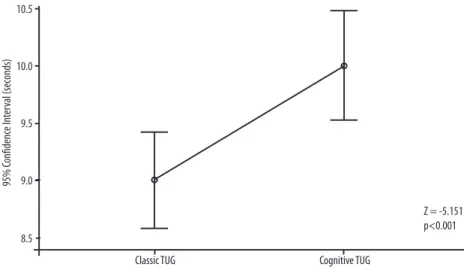
To compare the values obtained in the TUGs, the average time of reali-zation of the classic test was 9.0 ±1.9 seconds, while of the cognitive version, the average was 10.0 ± 2.2 seconds. We found a statistically signiicant
diference between the values (Z= -5.151; p< 0.001), as shown in Figure 1.
he values obtained in the classic TUG and the cognitive TUG were compared according to the occurrence of falls (history of falls) in the past 12 months (Table 1), and we found no signiicant diference in both tests. In spite of this, we observed that old people with falls presented higher average values for both tests.
As seen in Table 2, there was no association (p>0.05) between the
oc-currence of falls (outcome) and the values obtained in classic and cognitive TUG (explanatory variables), demonstrating that both tests did not explain the occurrence of falls in the old people practicing physical activities.
To evaluate the quality of the classic and cognitive TUGs in predic-tion of old people falls, we used the ROC curve (Figure 2). he area under
the curve for the classic TUG pointed to an accuracy of 65.3% (p= 0.058),
Table 1. Comparison between the values of classic and cognitive TUGs and the history of falls among old people practicing physical exercises.
TUG
with history of falls (n= 16)
without history of falls
(n= 66) E p
Average (SD) Average (SD)
Classic 9.57 (1.60) 8.86 (1.95) 366,00¥ 0.058
Cognitive 10.37 (1.60) 9.90 (2.28) 0,771£ 0.443
TUG= Timed up and Go; SD= Standard Deviation; E= Statistical test; p= Statistical signiicance ¥Statistical test U of Mann-Whitney; £ Statistic the t test for independent samples.
Figure 1: Graphical representation of the diference of time of classic and cognitive TUG test performance
Table 2. Logistic regression analysis of the values obtained in TUG (classic and cognitive) in the occurrence of falls in the old people practicing physical exercises.
Variable¥ B OR CI 95% p
TUG classic - 0.176 0.839 0.644 1.093 0.193 TUG cognitive 0.004 1.004 0.665 1.516 0.985
TUG= “Timed Up & Go”; B= Logistic Coeicient; OR (Odds Ratio) = Ratio of Risk for falls; CI 95%=Conidence Interval for the Hazard Ratio; p= level of signiicance; ¥ Adjust by gender and age.
The “Timed Up and Go” and old people practicing physical exercises Virtuoso et al.
DISCUSSION
he occurrence of falls varied according to the old people proile evaluated
and can be associated with several factors. Siqueira et al.3, while
investi-gating 4,003 old people residents in areas of basic health units of various Brazilian municipalities, showed that the prevalence of falls was of 34.8% and was associated with factors such as advanced age, sedentary lifestyle, poor perception of health, and great number of medications. Among old people practicing physical exercises, the research developed by Beck et
al.21 showed an incidence of 7.63%, which value is below what we found
in the present study (19.5%). We believe that there is a relationship in the form of “U” between the occurrence of falls and the practice of physical exercises since practicing little exercise or too much can be considered
risk factors22,23. his premise can explain the occurrence of falls among
old people practicing physical exercises. However, this relationship was not
conirmed by Peeters et al.24 in a longitudinal study of 1,337 older adults,
which implies that several factors may be involved in the occurrence of falls, beyond the level of physical activity.
Silva Duarte and Arantes25 compared the performance of the classic
TUG among old women with diferent levels of physical activity (inactive, moderately active, and active). he results of the TUG were 11.47 (± 2.70), 9.98 (± 1.73), and 8.45 (± 1.55) seconds, respectively. Such results suggest that old women with moderately active and active levels of physical activity have lower execution time and, therefore, a lower risk of falls, compared to sedentary old people. So, the functional mobility TUG test is showed to be sensitive to diferentiate the groups of diferent levels of physical activity and the risk of falls. he old people practicing physical exercises presented a simi-lar performance in the classic TUG to the moderately active old people group.
In this study, a statistically signiicant diference was found (p< 0.001) between the values obtained in the classic test TUG (9.0 ± 1.9 seconds) and the TUG with cognitive variation (10.0 ± 2.2 seconds). Such evidence
comes to meet to the study carried out by Barbosa et al.,13 found that the
interference of one task, cognitive or manual, in the inal time obtained in test TUG. In this study, the authors airmed that the old people had a worse performance in the test when associated with the realization of a second task, whether cognitive or motor. During the present study, we used the repetition of animal names. Despite its being a simple task, it signiicantly changed the values of agility and dynamic balance, even if only for a second.
Goncalves and Coimbra26, when evaluating and comparing the
func-tional balance of 96 elders of the community, equally divided into three groups according to the history of falls (without history of falls, with one fall and with recurrent falls), revealed that old people with a history of falls (including one or more) took longer to complete the TUG test (14.57 ± 4.23 seconds and 14.48 ± 4.46 seconds, respectively) than old people without a
history of falls (11.43 ± 2.95 seconds), and this diference is signiicant (p=
variation (cognitive TUG) did not explain the occurrence of falls. his
observation concurs with the study carried out by hrane et al. 27 with
974 old people of the community (average age of 77.5 years) in which they evaluated using the TUG and a questionnaire covering the falls over the past 12 months. hrane et al. came to the conclusion that the TUG was statistically associated with the history of men falling, but not of women. In the same way, another test widely used to predict falls in old people, the Scale of Balance of BERG, is also not advised for application in old people practicing physical exercises, because a ceiling efect is observed in this
population28. It is believed that the proile of the samples being composed
of old people practicing physical exercises can justify the lack of association and deserves more studies that focus on adjustments.
With respect to the accuracy of the TUG test, the study of Alexander
et al.29 found a value of 68% for the classical version, suggesting that 12.47
seconds is considered a predictive value ideal for Brazilian old people residents in the community. However, as observed in the present study, both versions of the TUG test may not be used for prediction of falls since the ROC curve did not show signiicant values and, therefore, has low ac-curacy values. his result conirms the lack of association of tests with the occurrence of falls in old people practicing physical exercises.
A systematic review30 investigates the efects of physical exercise
pro-grams in reducing the risk of falls in the old people of the community, concluding that there is a need for appropriate methods to identify the most susceptible people to this occurrence, and suggesting that the exposition be controlled to experimental situations similar to the real conditions of a fall.
CONCLUSION
he indings of this study indicate that the classic and cognitive TUG tests do not correlate with the occurrence of falls and, therefore, are not indicated for prediction of this event in old people practicing physical exer-cises. he measurement of the level of physical activity by means of direct measurement, the identiication of some control variables such as the time of practice of physical exercise and a larger sample size could enhance the inferences made. In addition, the randomization in the implementation of the procedures and tests of reliability among researchers could reduce the biases in the study. However, we believe that these results bring important contributions for the clinical practice of health professionals who work with old people practicing physical exercises because it demonstrates that its application should be performed with caution. his inding is in con-cordance with the Model for the Prevention of Falls in Active Aging of the
OMS,16 which proposes, between the strategies for reducing this event, the
The “Timed Up and Go” and old people practicing physical exercises Virtuoso et al.
In addition, it is noted that further studies are needed to ind instru-ments that are sensitive and speciic for the screening of falls in the physi-cally active old people population since the use of equipment, such as force platforms, are expensive and infeasible in daily practice. he fall, being an event of multi-factorial cause, may be associated with several factors, both intrinsic and extrinsic; therefore, its prediction must be analyzed in a wide manner within the protocols of old people evaluation.
Acknowledgment
he National Council for Scientiic and Technological Development (CNPq) for research productivity grant aimed at guiding this study.
REFERENCES
1. Perracini MR, Ramos LR. Fatores Associados a quedas em uma coorte de idosos residentes na comunidade. Rev Saúde Públ 2002;36(6):709-16.
2. Englander F, Hodson TJ, Terregrossa RA. Economic dimensions of slip and fall injuries. J Forensic Sci 1996;41(5):733-46.
3. Siqueira FV, Facchini LA, Piccini RX, Tomasi E, humé E, Silveira DS, et al. Prevalên-cia de quedas em Idosos e fatores assoPrevalên-ciados. Rev Saúde Públ 2007;41(5):749-56. 4. Rebelatto JR, Castro AP, Sako FK, Aurichio TR. Equilíbrio estático e dinâmico em
indivíduos senescentes e o índice de massa corporal. Fisioter Mov 2008;21(3):69-75. 5. Pinho TA, Silva AO, Tura LFR, Moreira MASP, Gurgel SN, Smith AAF, et al. Aval-iação do risco de quedas em idosos atendidos em unidade básica de saúde. Rev Esc Enferm USP 2012;46(2):320-27.
6. Da Cruz DT, Ribeiro LC, Vieira MT, Teixeira MTB, Bastos RR, Leite ICG. Prevalên-cia de quedas e fatores assoPrevalên-ciados em idosos. Rev Saúde Públ 2012;46(1):138-46. 7. Figueiredo KMOB, Lima KC, Guerra RO. Instrumentos de avaliação de equilíbrio
corporal em idosos. Rev Bras Cineantropom Desempenho Hum 2007;9(4):408-13. 8. Podsiadlo D, Richardson S. he Timed “Up and Go”. A test of Basic Functional
Mobility for Frail Elderly Persons. J Am Geriatr Soc 1991;39(2):142-8.
9. Panel on Prevention of Falls in Older Persons, American Geriatrics Society and British Geriatrics Society. Summary of the updated American Geriatrics Society/ British Geriatrics Society clinical practice guideline for prevention of falls in older persons. J Am Geriatr Soc 2011;59(1):148-57.
10. Shumway-Cook A, Brauer S, Woollacott M. Predicting the probability for falls in community-dwelling older adults using the timed up and go test. Phys her 2000;80(9):896-903.
11. Jacobs M, Fox T. Using the “Timed Up and Go/ TUG” test to predict risk of falls. Assisted Living Consult 2008;2:16-18.
12. Wall JC. he timed Get-Up and Go test revisited: measurement of the component tasks. J Rehabil Res Dev 2000;37(1):109-14.
13. Barsosa JMM, Prates BSS, Gonçalves CF, Aquino AR, Parentoni AN. Efeito da realização simultânea de taferas cognitivas e motoras no desempenho funcional de idosos da comunidade. Fisioter Pesq 2008;15(4):374-9.
14. Streit IA, Mazo GZ, Virtuoso JF, Menezes EC, Gonçalves E. Aptidão física e ocor-rência de quedas em idosos praticantes de exercícios Físicos. Rev Bras Ativ Fis Saúde 2011;16(4):346-52.
15. Perracini MR, Teixeira LF, Ramos JLA, Pires RS, Najas MS. Fall-related factors among less and more active older outpatients. Rev Bras Fisioter 2012;16(2):166-72. 16. World Health Organization (WHO). WHO global report on falls prevention in older
Corresponding author
Janeisa Franck Virtuoso
Rua Pascoal Simone, 358. Coqueiros – CEP: 88080-350 – Florianópolis, SC. Brasil
E-mail: [email protected]
ativo. Rev Bras Ativ Fis Saude 2009;14(1):65-70.
18. Berg K, Wood-Dauphinée S, Williams JI. Measuring balance in the elderly: valida-tion of an instrument. Can J Public Health 1992;83:(Suppl.2):7-11
19. Bishop MD, Patterson TS, Romero S, Light KE. Improved fall-related eicacy in old-er adults related to changes in dynamic gait ability. Phys hold-er 2010;90(11):1598-606. 20. Alvarenga PP, Pereira DS, Anjos DMC. Mobilidade funcional e função executiva
em idosos diabéticos e não diabéticos. Rev Bras Fisioter 2010;14(6):491-6. 21. Beck AP, Antes DL, Meurer ST, Benedetti TRB, Lopes MA. Fatores associados
às quedas entre idosos praticantes de atividades físicas. Texto Contexto- Enferm 2011;20(2):280-86.
22. Vogel T, Brechat PH, Leprêtre PM, Kaltenbach G, Berthel M, et al. Health beneits of physical activity in older patients: a review. Int J Clin Pract 2009;63(2):303-20. 23. Laessoe U, Hoeck HC, Simonsen O, Sinkjaer T, Voigt M. Fall risk in an active elderly
population – can it be assessed? J Negat Results Biomed 2007;6(2):1-11.
24. Peeters GM, van Schoor NM, Pluijm SM, Deeg DJ, Lips P. Is there a U-shaped as-sociation between physical activity and falling in older persons? Osteoporos Int 2010;21(7):1189-95.
25. Silva EC, Duarte NB, Arantes PMM. Estudo da relação entre o nível de atividade física e o risco de quedas em idosos. Fisioter Pesq 2011;18(1):23-30.
26. Gonçalves DFF, Ricci NA, Coimbra AMV. Equilíbrio funcional de idosos da comunidade: comparação em relação ao histórico de quedas. Rev Bras Fisioter 2009;13(4):316-23.
27. hrane G, Joakimsen RM, hornquist E. he association between timed up and go test and history of falls: he homso Study. BMC Geriatrics 2007;7(1):1-7. 28. Santos GM, Souza ACS, Virtuoso JF, Tavares GMS, Mazo GZ. Valores preditivos
para o risco de quedas em idosos praticantes e não praticantes de atividade física por meio do uso da Escala de Equilíbrio de Berg. Rev Bras Fisioter 2011;15(2):95-101. 29. Alexandre TS, Meira DM, Rico NC, Mizuta SK. Accuracy of Timed Up and Go
Test for screening risk of falls among community-dwelling elderly. Rev Bras Fisioter 2012;16(5):381-88.