AR
TICLE
1 Programa de Pós-Graduação em Saúde Pública, Escola Nacional de Saúde Pública, Fiocruz. R. Leopoldo Bulhões 1480, Manguinhos. 21041-210 Rio de Janeiro RJ Brasil. [email protected] 2 Departamento de Estudos sobre Violência e Saúde Jorge Careli/Claves, Escola Nacional de Saúde Pública, Fiocruz. Rio de Janeiro RJ Brasil.
Self-harm throughout all life cycles: profile of victims using
urgent and emergency care services in Brazilian state capitals
Abstract The aim of the study was to characterize the profile of victims of self-inflicted injuries, who were attended at urgent and emergency care ser-vices in Brazilian state capitals, by using the “Viva Survey” database of 2014. Descriptive statistics of the self-inflicted injuries by gender, as well as logistic regression analysis, were performed. The evaluated characteristics were age, gender, race/ skin color, education, area of residence, character-istics of the event, alcohol use and the outcome of the case. The results showed that almost 10% of the surveyed cases that were treated by emergency medical services in relation to violence were due to self-inflicted injuries: of particular note were the cases involving females and adults. Gender differences were found, including some that were related to the method chosen to commit suicide. It was not possible to evaluate some factors that are generally associated with suicide attempts because the necessary information was not within the scope of the instrument used for data collection. It was concluded that emergency medical services are very important in terms of studies regarding suicide because they are the gateway to such cases. However, given its sensitive nature, the informa-tion issued by emergency medical services is very restricted. Consequently, patients need appropri-ate follow-up to prevent further suicide attempts.
Key words Suicide attempt, Surveys, Violence, Emergency medical services
Camila Alves Bahia 1
Joviana Quintes Avanci 2
Liana Wernersbach Pinto 2
B
ahia CA
Introduction
Suicide is an act of self-violence that is defined
as an intentional act to end one’s life1,2. Non-fatal
suicidal behaviors are termed suicidal ideation when there are thoughts that foster the desire to end one’s existence, and they are aggravated when
accompanied by a suicidal plan to kill oneself. A
suicide attempt involves conduct aimed at harm-ing oneself, in which there is intent to kill oneself which could result in injury or death. If the cide attempt results in death it is defined as
sui-cide. Suicidal behavior refers to a type of behavior
by a person who seeks to injure or kill themselves.
Self-harm is self-inflicted violence, which can be subdivided into suicidal behavior and self-injury (the latter includes acts of self-mutilation, which range from milder forms such as scratches, cuts, and bites, to severe forms such as the amputation
of limbs)1. The International Statistical
Classifi-cation of Diseases and Related Health Problems (ICD-10) defines self-harm as being intentional self-inflicted injuries and poisonings, as well as
suicide attempts3.
In general, the boundaries between
self-ne-glect, self-harm, suicidal ideation, suicidal
behav-ior, and suicide are tenuous because on the one
hand, a suicide attempt can be interrupted and be established as an idea or an intention, while a thought can erupt due to anguish and over-whelming anxieties and explode as an act against one’s own life. On the other hand, not every
ex-ample of thinking about death or the desire to
die is evidence of suicidal risk2,4,5. According to
some studies worldwide, a self-inflicted death is thought out, prepared and preceded by other at-tempts. There are suicides that are carried out on impulse, but they are rare.
Fatal suicide is among the ten leading caus-es of death worldwide; it mainly affects young people and young adults, resulting in social, economic, family, community and social
conse-quences2. In 2012, 804,000 self-inflicted deaths
were recorded by the WHO’s 172 member states, representing an annual rate of 11.4/100,000, of which 15/100,000 were males and 8.0/100,000
were females6. However, in the richest countries,
suicide accounts for 81% of violent deaths among males and females, and in developing countries it accounts for 44% of male deaths and 70% of female deaths. Although the latter countries have lower suicide rates, 75% of self-inflicted deaths occur in developing countries, which contain the
largest share of the world’s population7.
Suicide rates are distributed unequally
world-wide2,8. Brazil has the eighth largest number of
suicides among WHO member states, with an average of 24 suicides per day. However, its sui-cide rates are considered as low: it ranks 73rd
(between 4.8/100,000 and 5.5/100,000)9,10.
Gender, age, culture and ethnicity have im-portant implications in the epidemiology of sui-cide. Global suicide rates reflect vulnerability for two particular age groups: the age range of 15-35 and that of 75 or over. Suicide rates range from 0.9/100,000 in the 5-14 age group to 66.9/100,000
among people aged over 754. In richer countries
males kill themselves at a rate that is three times that of females. In developing countries this pro-portion is lower: 1.5 males for each female. The exception is the western Pacific region, where the rates are almost equivalent (17.6% and 16.6% respectively). The population aged 15-29 in that region is particularly affected, with suicide being the main cause of death for males and females. In Brazil, this difference is from 3:0 to 4:1,
de-pending on the age group2. As for ethnicity, in
Brazil the phenomenon of suicide among indige-nous people is striking. Another characteristic in Brazil is the higher concentration of self-inflicted
deaths in municipalities with low populations11.
The main risk factors associated with suicidal behavior are as follows: biological, medical, en-vironmental, psychiatric, psychological and exis-tential philosophical problems, as well as social motivations. The most common psychiatric and psychological factors are: depression; problems related to mood and bipolar affective disorder; schizophrenia; anxiety and personality disorders; alcoholism; hopelessness; loneliness; and comor-bidities. Poisoning by the use of stimulants such as cocaine, amphetamines or alcohol are fre-quently predisposing factors for suicide, and they are aggravating when the individual is depressed. Of the aforementioned substances, alcohol is the
most significant. Some studies12 have shown that
there are genetic traits that predispose people from the same family to self-destructive behav-ior. Research on the biological basis of this phe-nomenon has revealed altered levels of serotonin metabolites in the neurospinal fluid of people
who commit suicide12. However, WHO studies2,4
consider that suicidal behavior can be an inherit-ed psychiatric disorder and that suicide may be a response to the suffering associated with serious disabling and painful diseases.
aúd
e C
ole
tiv
a,
22(9):2841-2850,
2017
well as problems related to sexual orientation, are very important. Among young people, dif-ficulties regarding relationships with parents, quarrels with boyfriends and girlfriends, and loneliness are all relevant. Regarding the elderly,
Duberstein et al.13 cite personality traits such as
hypochondria, as well as being closed, timid or excessively independent. From a broader social
point of view, in his classic study, Durkheim14
points out that suicide rates are a symptom of social pathology and social disintegration. How-ever, he stresses that this phenomenon occurs in all societies, although it differs from country to country, from era to era, and from urban to rural environments.
Important environmental factors in this respect include: (1) life stressors, such as inter-personal conflicts, separation, rejection, losses, financial and work problems, and shame for something that is disapproved of by society; (2) ease of access to conditions that enable hang-ing, drownhang-ing, falling from heights, using fire-arms, abuse of drugs and poisons; (3) exposure to shocking events, either by witnessing them first-hand or via the media. Having previously attempted suicide, or having relatives or acquain-tances who attempted or committed suicide are
strong predictors of suicidal behavior1,9,15-21.
In general, suicides, suicide attempts and self-harm are under-reported, even in countries with good information systems. According to the
WHO4, there is evidence that only 25% of those
who attempt to kill themselves come into contact with hospitals. Only the most serious cases are treated by emergency medical services and even these are usually treated simply as an emergency in relation to the injuries that have been caused.
The Brazilian Hospital Information System reported that suicide attempts were responsible for 153,061 hospitalizations of people aged 10 years or over in the period 1998-2014, which indicates that such events were one of the main
causes of hospitalization9,22,23. The situation is
even more critical when one considers that it is estimated that out of every three suicide at-tempts, only one received attention from the
health services23.
Emergency health services are the first place where people who have attempted suicide are cared for; consequently, they have strategic im-portance in terms of secondary prevention, at-tention to the consequences of such events, and reduction of costs for the health services. How-ever, there has been little research conducted regarding this issue. Thus, this article seeks to contribute to broadening existing knowledge
regarding the role of emergency health services in Brazilian state capitals by mapping the occur-rences of suicides and the potential risk factors.
Methods
This cross-sectional study was based on data regarding the care for victims of self-inflicted injuries recorded in the Violence and Accident Surveillance System (VIVA), within its survey component. This survey was conducted in 2014, during a period of 30 consecutive days between September and November. The shifts were ran-domly selected by probabilistic sampling using a single-stage cluster stratified by the type of es-tablishment (general emergency, emergency care units, specialized emergency services) and the shift was the primary sampling unit.
This study involved 86 emergency services of the Unified Health System (SUS), located in 24 state capitals and the Federal District. The sample size was at least 2,000 responses due to external causes: the coefficient of variation was less than 30% and the standard error was less than 3.0.
All the patients interviewed due to external causes in the selected shifts in each establish-ment were eligible for the interview and the cas-es where patients returned to the same unit for the same reason were excluded. In cases where the individual that was attended was a child, the answers were provided by those responsible for them or by the health team that attended the case. The cases of self-inflicted injuries detailed in this study arose from the occurrence of the event that resulted in attendance by the studied emergency units.
Firstly, the cases of self-harm were analyzed according to gender by the following sociodemo-graphic variables: age - child (0-9 years), adoles-cent (10-19), adult (20-59) and elderly (60 and over); self-defined race/skin color; years of edu-cation; day of the week that care was provided; place of occurrence; area of residence; method used in the event; if the self-inflicted injury was a suicide attempt (where the interviewee or the person responsible stated whether the injury was intended to be suicidal); the intentionality of the act (a self-declaration whether the injury was in-tentional or accidental); ingestion of alcoholic beverage in the six hours prior to the event; na-ture of the injury; part of body affected; and the outcome of the case.
B
ahia CA
using the chi-square test with a second-order Rao-Scott correction which incorporated the complex sampling plan with 5% significance.
This was followed by bivariate analysis ac-cording to the cases of self-inflicted injury and other cases of violence attended in the studied emergency medical services by the following variables that were pertinent to the statistical modeling: age; gender; race/skin color; years of education, area of residence; and ingestion of alcoholic beverage in the six hours prior to the event. In order to verify the associations, the Rao-Scott test was used with a 5% significance level. After this bivariate analysis, the variables with a value of p < 0.20 were selected for inclusion in the multiple model. In the multiple analysis, the values of p < 0.05 were considered significant for the factors associated with self-inflicted injuries. All the analyses were performed using the Stata 14 statistical package, utilizing the svy command, which is specific for the analysis of complex sam-ple planes.
The 2014 VIVA Survey project was evaluated and approved by the National Commission for Ethics in Research (CONEP) of the Ministry of Health (opinion No. 735,933/2014). The verbal agreement of the victims was obtained; if they were aged under 18 or if they were unconscious after the event then the agreement of those re-sponsible for them, or their partners, was ob-tained.
Results
In the 2014 Viva-Inquiry, 4,949 cases related to violence were reported, of which 477 (9.5%) re-sulted from self-inflicted injuries, of which 18 (2.9%) involved children, 94 (18.8%) adoles-cents, 348 (74.6%) adults and 16 (3.7%) elderly people.
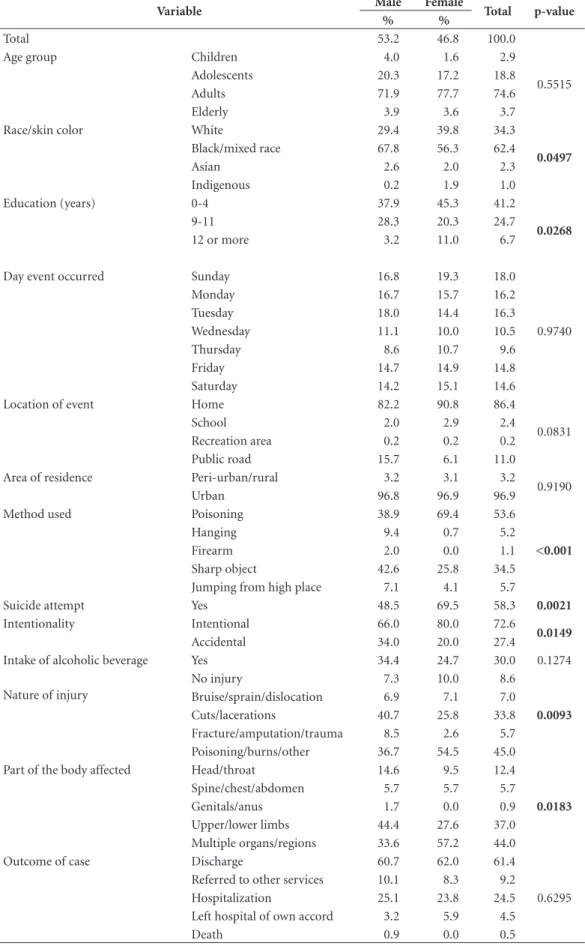
Table 1 shows that 62.4% of the victims of self-inflicted injury were black or mixed race and that 34.3% were white. In the gender compari-son, the percentage of white females was higher (39.8%) than that of males (29.4%), whereas among black/mixed race people the percentage of males was higher (67.8% compared to 56.3% of females). In terms of indigenous people, the percentage of females was higher (1.9% com-pared to 0.2% of males). There was statistically significant difference in the distribution of the variable of skin color according to gender (p = 0.0497). This difference was also observed in re-lation to the variable of education (p = 0.027).
It is interesting to note that there was a higher percentage of females in terms of the lowest lev-el of education (45.3% compared to 37.9%) and also the highest level of education (11.0% com-pared to 3.2%). Independently of gender, a large number of victims had 0-4 years of education (41.2%).
It was found that people within the adult age group were the most frequently attended victims of self-harm. Furthermore, the most frequent days of the week for such incidents were Sunday (18.0%) and Tuesday (16.3%). However, the data analysis did not show a significant difference be-tween these variables according to gender. Most injuries occurred in the home (86.4%) for both males and females, and the individuals mainly re-sided in urban areas (96.9%). However, there was no statistically significant association in terms of gender (Table 1).
Regarding the methods used for self-harm, 53.6% of the self-inflicted injuries resulted from poisoning (males = 38.9% and females = 69.4%) and 34.5% from using sharp objects (males = 42.6 % and females = 25.8%). Table 1 shows that there was a significant difference in the distribution of this variable according to gender (p <0.001). It is noteworthy that 9.4% of males used hanging to self-harm compared to 0.7% of females. Anoth-er question that was diffAnoth-erent in tAnoth-erms of gendAnoth-er was the issue of the intentionality of the act (p = 0.015): it was assumed that it was intentional for 80.0% of females and 66.0% of males. The inter-viewee (or those responsible for the person in the case of children and adolescents) self-declared that the event was a suicide attempt for 69.4% of females and 48.5% of males (p = 0.002). It was found that 30.0% of individuals reported having consumed alcohol in the six hours preceding the attempt, but there was no significant statistical difference.
aúd
e C
ole
tiv
a,
22(9):2841-2850,
2017
Table 1. Profile of the victims of self-inflicted injuries treated at the emergency medical services participating in
the VIVA Survey, 2014, Brazil, N = 477.
Variable Male Female Total p-value
% %
Total 53.2 46.8 100.0
Age group Children 4.0 1.6 2.9
0.5515
Adolescents 20.3 17.2 18.8
Adults 71.9 77.7 74.6
Elderly 3.9 3.6 3.7
Race/skin color White 29.4 39.8 34.3
0.0497
Black/mixed race 67.8 56.3 62.4
Asian 2.6 2.0 2.3
Indigenous 0.2 1.9 1.0
Education (years) 0-4 37.9 45.3 41.2
0.0268
9-11 28.3 20.3 24.7
12 or more 3.2 11.0 6.7
Day event occurred Sunday 16.8 19.3 18.0
0.9740
Monday 16.7 15.7 16.2
Tuesday 18.0 14.4 16.3
Wednesday 11.1 10.0 10.5
Thursday 8.6 10.7 9.6
Friday 14.7 14.9 14.8
Saturday 14.2 15.1 14.6
Location of event Home 82.2 90.8 86.4
0.0831
School 2.0 2.9 2.4
Recreation area 0.2 0.2 0.2
Public road 15.7 6.1 11.0
Area of residence Peri-urban/rural 3.2 3.1 3.2
0.9190
Urban 96.8 96.9 96.9
Method used Poisoning 38.9 69.4 53.6
<0.001
Hanging 9.4 0.7 5.2
Firearm 2.0 0.0 1.1
Sharp object 42.6 25.8 34.5
Jumping from high place 7.1 4.1 5.7
Suicide attempt Yes 48.5 69.5 58.3 0.0021
Intentionality Intentional 66.0 80.0 72.6
0.0149
Accidental 34.0 20.0 27.4
Intake of alcoholic beverage Yes 34.4 24.7 30.0 0.1274
Nature of injury
No injury 7.3 10.0 8.6
0.0093
Bruise/sprain/dislocation 6.9 7.1 7.0
Cuts/lacerations 40.7 25.8 33.8
Fracture/amputation/trauma 8.5 2.6 5.7
Poisoning/burns/other 36.7 54.5 45.0
Part of the body affected Head/throat 14.6 9.5 12.4
0.0183
Spine/chest/abdomen 5.7 5.7 5.7
Genitals/anus 1.7 0.0 0.9
Upper/lower limbs 44.4 27.6 37.0
Multiple organs/regions 33.6 57.2 44.0
Outcome of case Discharge 60.7 62.0 61.4
0.6295
Referred to other services 10.1 8.3 9.2
Hospitalization 25.1 23.8 24.5
Left hospital of own accord 3.2 5.9 4.5
B
ahia CA
in terms of gender regarding the distribution of this variable (p = 0.018). Finally, the outcome of the majority of the cases was discharge after be-ing attended (61.4%). However, in 24.5% of cases hospitalization was necessary and 9.2% of cases were referred to other services, regardless of the gender of the patient.
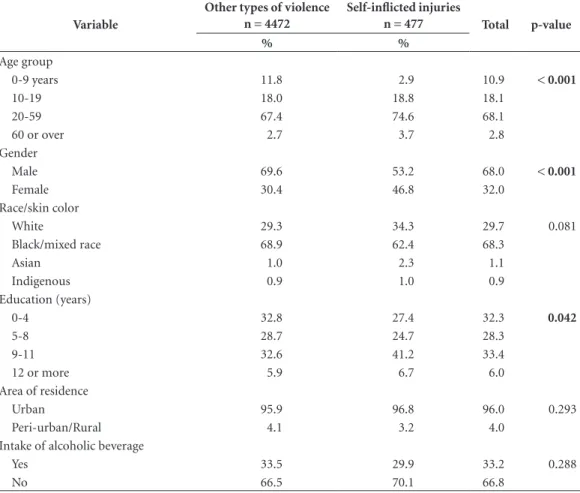
Table 2 shows the distribution of the out-come variable “being a victim of self-inflicted violence” in comparison with the other cases of violence attended by the emergency medical services, and in accordance with the variables that were relevant to the statistical modeling. Statistically significant difference was observed for the variables of age group and gender (p < 0.001). In childhood, attendances due to other forms of violence were more frequent than self-harm (11.8% compared to 2.9%). In the adult age group (20-59) self-harm was more prevalent
(74.6% compared to 67.4% of cases due to oth-er forms of violence), despite the high frequency of both types of injuries in this age group (p < 0.001). In terms of gender, female vulnerabili-ty was more pronounced in cases of self-harm, whereas for males other types of violence were more common (p < 0.001). There was a predom-inance of black/mixed race individuals for both genders, making up more than 60% of the cases that were attended. Education also showed a sig-nificant difference in the bivariate analysis (p = 0.042). There was a higher level of schooling (9-11 years) in relation to the victims of self-harm (41.2%) compared to the group that was attend-ed due to other forms of violence (32.6%). The factors of area of residence and the consumption of alcohol during the previous six hours did not differ among the individuals attended due to self-harm or other types of violence.
Table 2. Bivariate analysis between the group of individuals with self-inflicted injuries and those affected by
other types of violence treated at emergency medical services in Brazil.
Variable
Other types of violence n = 4472
Self-inflicted injuries
n = 477 Total p-value
% %
Age group
0-9 years 11.8 2.9 10.9 < 0.001
10-19 18.0 18.8 18.1
20-59 67.4 74.6 68.1
60 or over 2.7 3.7 2.8
Gender
Male 69.6 53.2 68.0 < 0.001
Female 30.4 46.8 32.0
Race/skin color
White 29.3 34.3 29.7 0.081
Black/mixed race 68.9 62.4 68.3
Asian 1.0 2.3 1.1
Indigenous 0.9 1.0 0.9
Education (years)
0-4 32.8 27.4 32.3 0.042
5-8 28.7 24.7 28.3
9-11 32.6 41.2 33.4
12 or more 5.9 6.7 6.0
Area of residence
Urban 95.9 96.8 96.0 0.293
Peri-urban/Rural 4.1 3.2 4.0
Intake of alcoholic beverage
Yes 33.5 29.9 33.2 0.288
aúd
e C
ole
tiv
a,
22(9):2841-2850,
2017
After bivariate analysis was performed, the logistic regression model was adjusted: the vari-ables of gender, age group, skin color and educa-tion were included because they had a p value of less than 0.2. In the final model, only the variables of gender and education remained. Thus, females were more likely to be treated for self-harm by the emergency medical services compared to those who were attended due to other forms of violence (95%CI = 1.6-2.6) (Table 3). With re-gard to education, there was a greater chance of self-harm occurring in all the studied groups compared to those with the highest number of years of education (12 years or more).
Discussion
The present study is original in that it uses a single study to address the profile of victims of self-inflicted injuries during all life cycles, using a population-based sample, as well as comparing this with the victims of other types of violence based on information provided by emergency medical services. Using the “Viva Survey” provid-ed a powerful source of data regarding non-fatal, self-inflicted injuries because it supplied infor-mation that is usually unregistered and treated. In the case of suicide attempts, this is all the more important because only a minority of people are hospitalized and in those circumstances there is a pre-established form of registration.
It is noteworthy that almost 10% of the sur-veyed cases that were attended by emergency medical services were due to self-harm; these cases particularly involved females and adults.
This corroborates Monteiro’s et al.24 findings
re-garding hospital admissions in the SUS in Brazil due to intentional self-inflicted injuries. In the present study, the low number of cases
involv-ing children (0-9 years) may suggest the rarity of such cases; however, it may also reflect the under-reporting of such events because suicide attempts can be identified as domestic accidents or negligence, both by health professionals and also those responsible for the suicide attempts themselves. Moreover, knowledge about suicide in children is still very limited, firstly due to the commonly held conception of happiness asso-ciated with this phase of life, but also due to to the controversial aspect of intentionality associ-ated with suicide, which includes the notion of responsibility. Although global data point to high rates for self-harm among the elderly, in the pres-ent study there were few such cases that reached emergency medical services, either because they
were more successful in ending their own lives18
or because such cases were dealt with at home or within institutions.
The findings of the present study regard-ing the gender of the victim were in agreement with international data that have been provided
worldwide1,5,6,9,18 related to this phenomenon. It
is noteworthy that female vulnerability is a key issue in the profile of victims of self-harm, as well as in comparison with victims of other forms of violence. It is known that females are more likely to attempt suicide, while males are more
success-ful in ending their own lives5,6,8,18,25. The trend
to-ward increased frequency of mental health prob-lems among females puts them at a higher risk of suicidal behavior. Moreover, the links between females and suicide are more likely to dialogue with the choice of suicide method rather than the
intention to kill oneself26. As noted in this study,
males tend to opt for more lethal methods to kill themselves, such as sharp objects, while females are more likely to use one of the various forms
of poisoning26,27. The verification of the difficulty
for males in identifying a suicidal episode as in-tentional raises the hypothesis of the inability to recognize emotional fragility, which is typical of machismo. It is worth noting the significant per-centage of indigenous females attended due to attempted suicide in comparison to indigenous males. Indigenous people are one of the groups
that are most vulnerable to suicide in Brazil28 and
there is still much to be discovered about the risk factors associated with the worldview, culture and psychopathology that induces suicide in this section of the population.
It is important to highlight the relevant, stra-tegic and precise role of emergency medical care for victims of self-harm because these services: (1) constitute a gateway to health care and are
Table 3. Explanatory model regarding the treatment
of self-inflicted injuries by emergency medical services.
Variable OR CI
Gender
Male Reference
Female 2.00 (1.6 - 2.6)
Education (years)
12 or more Reference
0-4 4.50 (2.3 - 8.9)
5-8 4.80 (2.6- 9.1)
B
ahia CA
the only option for a large part of the population in search of care; (2) they are appropriate in the epidemiological approach to the phenomenon; (3) they respond to suicide attempts, which are the strongest predictor of suicide in children, ad-olescents, adults and the elderly; and (4) they are often responsible for the immediate treatment of cases or referral to other services within the
health system29.
The emergency medical services have a po-tentially important role to play in detecting and caring for cases in the early stages of potential suicide, and they can help to prevent more se-rious harm to possible victims. However, when professionals can only provide limited attention to cases, treating the injuries symptomatically without understanding the circumstances behind the event, the treatment provides little informa-tion regarding the identificainforma-tion of the victims, as well as prejudicing the correct recording of such events and failing to possibly prevent further
sui-cide attempts1,2. Studies have revealed that 19%
of suicide attempts treated by emergency medical services are treated by the same type of service
within six months19 and 39% of such cases kill
themselves within twelve months of their first
treatment30,31. Some studies32,33 have also pointed
out that 3%-12% of adults who have no specific mental health problems, and who are attended to by emergency medical services, present suicidal
ideation32. Furthermore, 8%-12% of people who
are attended by the same services due to other
problems have silenced suicidal ideation33. In
ad-dition, according to Ballard et al29
, a significant
number of people who receive emergency medi-cal care due to gastrointestinal problems and se-vere headaches present self-induced injuries and traumas. Despite the complexity of the situations dealt with by emergency medical services, and the risk of further suicide attempts, most of the people they attend to are discharged after receiv-ing prescriptions, either with or without psycho-social assessment.
Ballard et al.29 recommend that all patients
who are attended by emergency medical services, and who appear to have an association with self-harm, should be screened for the risk of com-mitting suicide. In cases such as these, speedy intervention, together with the design of a safety plan that puts the patient in contact with mental
health services, is one of the most beneficial and
effective actions1,34,35. It is therefore imperative to
redouble efforts to find more effective ways and methods to prevent suicide in all the age groups of people attended by emergency medical ser-vices.
In relation to suicide and health services in general, one of the limitations of the present study is the strength of the myth and stigma that surrounds the issue of suicide. Family and social conventions, as well as political reasons, lead to the under-reporting and misclassification of sui-cides. As a consequence, these cultural and insti-tutional problems make elucidation and preven-tion difficult.
There are further limitations that relate to the nature of this study itself. One of these was the selection bias that was used, because probably only some of the cases of self-harm that occurred in the period in question were attended by emer-gency medical services. In less serious cases peo-ple do not tend to seek care. It is therefore possi-ble that the data were not sufficiently representa-tive of the situation in Brazil. Another limitation was that relevant factors associated with suicide attempts described in the literature could not be evaluated. These included the presence of mental disorders, terminal and degenerative diseases, so-cial and environmental problems, as well as soso-cial motivations and the influence of the media. Such information was not within the scope of the data sources that were used. A further limitation was the fact that it was not possible to make compar-isons with other studies on this issue, performed by emergency medical services in Brazil, because no specific literature on the subject was found. Finally, the ‘Viva Survey’ is still a fairly recent method of recording information regarding vio-lence in Brazil, which limited the investigation of this phenomenon to a restricted period of time.
Finally, we consider that, despite all the lim-itations and shortcomings of the present study, this article can open the way to further studies that can expand upon our work. We also believe that this article helps in reflecting on the impor-tance of the best ways for emergency medical services to act so that they can contribute to pre-venting suicides in accordance with the message of the World Health Organization: “Preventing
aúd
e C
ole
tiv
a,
22(9):2841-2850,
2017
Collaborations
CA Bahia, JQ Avanci, LW Pinto and MCS Minayo participated in the writing of the article, as well as contributing to its design and delineation, the critical review of the content, and the analysis and interpretation of the results. The authors de-clare that they are responsible for all aspects of the article and ensure its accuracy and integrity.
References
1. World Health Organization (WHO). World report on
violence and health. Geneva: WHO; 2002.
2. World Health Organization (WHO). Preventing
sui-cide: a global imperative. Geneva: WHO; 2014.
3. Organização Mundial Da Saúde (OMS). Classificação Estatística Internacional de Doenças e Problemas
Rela-cionados à Saúde. 10° Revisão. São Paulo: Faculdade de
Saúde Pública da Universidade de São Paulo; 2009. Vol. I.
4. World Health Organization (WHO). The world health
report 2003. Shaping the future. Geneva: WHO; 2003.
5. Minayo MC, Souza ER. Suicídio: violência autoinfligi-da. In: Brasil. Ministério da Saúde (MS). Impactos da violência na saúde dos brasileiros. Brasília: MS; 2005. p. 311-331.
6. DeLeo D, Bille-Brahe U, Kerkhof A, Schmidtke A.
Sui-cidal Behavior: Theories and Research Findings.
Gottin-gen: WHO Regional Office for Europe; 2004.
7. Levi F, La Vecchia C, Lucchini F, Negri E, Saxena S, Maulik PK, Saraceno B. Trends in mortality from sui-cide, 1965-99. Acta Psychiatr Scand 2003; 108(5):341-349.
8. Brasil. Ministério da Saúde (MS). Saúde Brasil 2014:
uma análise da situação de saúde e das causas externas.
Brasília: MS; 2015.
9. Minayo MCS. Comportamento suicida e suicídio con-sumado na velhice. In: Minayo MCS, Figueiredo AEB, Silva RM, organizadores. Comportamento suicida de pessoas idosas. Fortaleza: Editorial UFC; 2016. p. 35-58 10. Bittencourt SA, Camacho LAB, Leal MC. O Sistema de
Informação Hospitalar e sua aplicação na saúde
coleti-va. Cad Saude Publica 2006; 22(1):19-30.
11. Minayo MC, Cavalcante FG. Suicide in elderly people: a literature review. Rev Saude Publica 2010; 44(4):750-757.
12. Mann JJ, Apter A, Bertolote J, Beautrais A, Currier D, Haas A, Hegerl U, Lonnqvist J, Malone K, Marusic A, Mehlum L, Patton G, Phillips M, Rutz W, Rihmer Z, Schmidtke A, Shaffer D, Silverman M, Takahashi Y, Varnik A, Wasserman D, Yip P, Hendin H. Suicide pre-vention strategies: a systematic review. JAMA 2005; 294(16):2064-2074.
13. Duberstein PR, Conwell Y, Conner KR, Eberly S. Sui-cide et 50 years of age and older: perceived physical illness, Family discord and financial strain. Psychol Med
2004; 34(1)137-146.
14. Durkheim E. O suicídio: estudo sociológico. Rio de Ja-neiro: Zahar; 1982.
15. Turhan E, Inandi T, Aslan M, Zeren C. Epidemiology of attempted suicide in Hatay, Turkey. Neurosciences 2011; 16(4):347-352.
16. Bertolote JM, Fleischmann A. Suicide and psychiatric diagnosis: a worldwide perspective. World Psych 2002; 1(3):181-185.
17. Ima J, Choib SH, Hongc D, Seoc HJ, Parkb S, Hongb JP. Proximal risk factors and suicide methods among suicide completers from national suicide mortali-ty data 2004-2006 in Korea. Compr Psychiatry 2011; 52(3):231-237
18. Minayo MCS, Cavalvante FG. Tentativas de suicídio entre pessoas idosas: revisão da literatura (2002/2013).
B
ahia CA
19. Larkin GL, Beautrais AL. Emergency departments are underutilized sites for suicide prevention. Crisis 2010; 31(1):1-6.
20. Hoven CW, Mandell DJ, Bertolote JM. Prevention of mental ill-health and suicide: Public health perspec-tives. Eur Psychiatry 2010; 25(5):252-256.
21. DeLeo D, Evans R. International Suicide Rates and Pre-vention. Guttingen: Hogrefe & Huber; 2004.
22. Martins Junior DF, Felzemburgh RM, Dias AB, Caribé AC, Bezerra-Filho S, Miranda-Scippa A. Suicide at-tempts in Brazil, 1998-2014: an ecological study. BMC Public Health 2016; 1:8.
23. Botega NJ. Comportamento suicida: epidemiologia.
Psicologia USP 2014; 25(3):231-236.
24. Monteiro RA, Bahia CA, Paiva EA, Bandeira de Sá NN, Minayo MCS. Hospitalizações relacionadas a lesões autoprovocadas intencionalmente-Brasil, 2002 a 2013.
Cien Saude Colet 2015; 20(3):689-699.
25. Botega NJ, Marín-León L, Oliveira HB, Barros MBA, Silva VF, Dalgalarrondo P. Prevalências de ideação, plano e tentativa de suicídio: um inquérito de base po-pulacional em Campinas, São Paulo, Brasil. Cad Saude
Publica 2009; 25(12):2632-2638.
26. Lovisi GM, Santos SA, Legay L, Abelha L, Valencia E. Epidemiological analysis of suicide in Brazil from 1980 to 2006. Rev Bras Psiquiatr 2009; 31(Supl. 2):S86-S84. 27. Vásquez-Rojas R, Quijano-Serrano M. Cuando el
in-tento de suicidio es cosa de ninos. Rev Colombiana Psi-quiat 2013; 43(S1):36-46.
28. Machado, DB, Santos DN. Suicídio no Brasil, de 2000 a 2012. J. bras. psiquiatr. 2015; 64(1):45-54.
29. Ballard ED, Cwik M, Storr CL, Goldstein M, Eaton WW, Wilcox HC. Recent medical service utilization and health conditions associated with a history of suicide attempts. General Hospital Psychiatry 2014; 36(4):437-441
30. Gairin I, House A, Owens D. Attendance at the accident and emergency department in the year before suicide: retrospective study. Br J Psychiatry 2003; 183:28-33 31. Boudreaux ED, Miller I, Goldstein AB, Sullivan AF,
Allen MH, Manton AP, Arias SA, Camargo Junior CA. The Emergency Department Safety Assessment and Follow-up Evaluation (ED-SAFE): Method and design considerations. Contemp Clin Trials 2013; 36(1):14-24. 32. Boudreaux ED, Clark S, Camargo Junior CA. Mood
disorder screening among adult emergency depart-ment patients: a multicenter study of prevalence, asso-ciations and interest in treatment. Gen Hosp Psychiatry
2008; 30(1):4-13.
33. Claassen CA, Larkin GL. Occult suicidality in an emer-gency department population. Br J Psychiatry 2005; 186:352-353.
34. Fleischmann A, Bertolote JM,Wasserman D, De Leo D, Bolhari J, Botega NJ, De Silva D, Phillips M, Vijay-akumar L, Värnik A, Schlebusch L, Thanh HT. Effec-tiveness of brief intervention and contact for suicide attempters: a randomized controlled trial in five coun-tries. Bull World Health Organ 2008; 86(9):703-709. 35. Qin P, Webb R, Kapur N, Sørensen HT. Hospitalization
for physical illness and risk of subsequent suicide: a population study. J Intern Med 2013; 273(1):48-58.
Article submitted 10/3/2017 Approved 18/4/2017