Abstract
Acid mine drainage is a main environmental problem linked to coal and sulfide ore mining. Its treatment usually involves alkalinization and subsequent precipitation and immobilization of the dissolved species. Rainfalls over stockpiles can cause a very similar phenomenon. This work aimed to study the effluents from such a leaching process in steam-coal stockpiles Brazilian coal with a high pyrite content was used. The effluents have been chemically characterized. Effluent clarification by aggregation and settling in an attempt to simultaneously deplete heavy metal content was studied. Settling experiments were carried out with coal suspensions, in order to evaluate the efficiency of inorganic and polymeric reagents in the process.
Keywords: Acid mine drainage, settling, effluent treatment.
Mineração
Pluvial percolation in pyrite-bearing coal
stockpiles
(Percolação pluvial em pilhas de carvão mineral)
Danielle Andrade Pimentel
Engenheira ambiental - Programa de Pós-Graduação em Engenharia Mineral - PPGEM/UFOP E-mail: [email protected]José Aurélio Medeiros da Luz
Universidade Federal de Ouro Preto - UFOP - Escola de Minas Departamento de Engenharia de Minas - DEMIN/CPGEM E-mail: [email protected]Resumo
A drenagem ácida de mina é grande problema ambiental associado à mineração, em especial de carvão e sulfetos. Seu tratamento usualmente envolve sua alcalinização e posterior precipitação e imobilização das espécies dissolvidas. Similarmente, o presente trabalho estudou efluentes oriundos da lixiviação pluvial de pilhas para armazenamento de carvão mineral brasileiro. Após o efluente ser caracterizado quimicamente, experimentos de sedimentação de suspensões contendo finos de carvão foram feitos, para categorizar reagentes no processo de clarificação e remoção de metais pesados.
1. Introduction
Acid mine drainage is a severe environmental problem linked to coal and sulfide ore mining and it is a result of sulphur-bearing species oxidation by the combined action of water and oxygen, usually including bioxidation and Fe+3
autocatalysis. These effluents display strong acidity and high concentration of Al, Cu, Fe, Mg, Mn e Zn, sulphate and organic compounds (in the case of coal acid mine drainage). As far as wastewater treatment is concerned, the main objective is to remove the effluent pollutants and to adjust it in order to meet acceptable standards for its discard into a receiving stream (Rao, 1991; Ciminelli, 2007).
The runoff from rainfalls over coal stockpiles has characteristics that are similar to conventional acid mine drainage. Such a pluvial effluent is studied in this work. Settling experiments were carried out with suspensions containing fine coal particles, in order to evaluate the efficiency of inorganic and polymeric reagents in imparting aggregation and settling, simultaneously attempting to deplete the heavy metal concentrations.
2. Literature review
The treatment of acid mine drainage is primarily based on solid-liquid separation processes, like screening, settling (in the overwhelming majorities of cases), flotation and filtering. The acid mine drainage treatments involve alkalinization for further precipitation and immobilization of the dissolved pollutant species. The final step usually is neutralization for environmental purposes (Dayube, 2000).
The parameters chosen for the effluent characterization take into account the main objectives of wastewater treatment system. These parameters must characterize the polluting agents; define the effluent treatment process, to make possible the sizing of the wastewater treatment circuit; and consider the monitoring program established for the environmental-standards law. As Rubio and co-workers (2002) pointed out, the particle aggregation process is the most important step in effluent treatment processing.
The properties of the flakes formed in the first step of the solid-liquid separation processes are basic in the evaluation of reagent effectiveness. After Brondani (2004) the flocculation of fine particles in suspension occurs after the polymer diffusion and adsorption, by agitation, followed by flake formation and growth in a slow agitation step.
The most appropriate method for heavy metal removal from the effluent is defined by the way that these metals are in the suspension. There are many processes for heavy metal removal in industrial effluents, such as chemical precipitation, reverse osmosis, ionic exchange, electrodialysis and others.
Barbosa and co-workers (2002) have characterized Brazilian coal effluents and waste similar to the one under consideration in this study.
Luz (2005) has studied a pluvial effluent (stormwater) from a steam-coal stockpile using a low sulphur content Colombian coal. The rainfall over a coal pile was then simulated by dropping rain water (previously collected in rain barrel) through perforated pipe, pumped by laboratory peristaltic pumps. The coal stockpile had a basal area of 0.75 m2 and a height of 0.50 m. The solid runoff took place mainly in the initial phases of the precipitation and in function of the rainfall intensity.
Literature usually reports solid runoff particle size within the range from 20 µm to 100 µm, in urban sites, with sediment loads from 50 to 1000 mg/l (Anta and co-workers, 2006).
3. Material and methods
By request, Brazilian coal with high pyrite content from Copelmi Company was used (Figure 1).
The percolating and leaching experiments of the coal stockpiles for this research were carried out on a layer of coal about 20 cm thick (“stockpile” height), disposed on a 2,28m² rectangular area. The rainfall simulation was done by spraying water (either stormwater or tap water) from a hose during 30 minutes. The aspersion flowrate was 36 ml/s, and done by hand on a layer of coal, trying to achieve homogeneous distribution. The flowrate choice aimed to simulate a typical 28 mm strong precipitation in a rainforest tropical region (pluviosity of about 2,500 mm per year).
The effluent clarification provided by aggregation and settling tests was studied, aiming simultaneously to remove the heavy metals present. Settling experiments were carried out with suspensions containing fine coal particles, in order to evaluate the efficiency of inorganic and polymeric reagents in the process. Retention time, flowrate, type and concentration of flocculants and coagulants were studied as well.
The suspension remained at rest during 24 hours and the clarification interface was monitored. After this period, an aliquot of the supernatant was removed to determine heavy metal concentration.
Superfloc class (polyacrylamides from Cytec Industries B.V.), polyquaternary amine, cornstarch from Cargill and calcium hydroxide solution (Ca(OH)2) were used in the settling tests. The Superfloc solution concentration and calcium hydroxide solution concentration were both 1.0 %, and the mass concentration of the gelatinized starch solution was 0.1%. These tests used a 30 parts per million (ppm) dosage. The cornstarch was previously gelatinized, typically using a 5:1 starch:NaOH ratio.
For the tests with effluent from true rainfall precipitation, Superfloc A-100 and C-581 solutions were used, however, the effluent was alkalinized with a calcium hydroxide solution up to pH 9.5 and a subsequent reagent addition at a 5 ppm dosage. The starting point of the cake compression was determined by Roberts’ plot.
The solid content in the final effluent was quantified using a laser diffraction particle size analyzer (Cilas 1064). Chemical analyses were performed by inductively coupled plasma atomic emission spectrometry (ICP).
4. Results
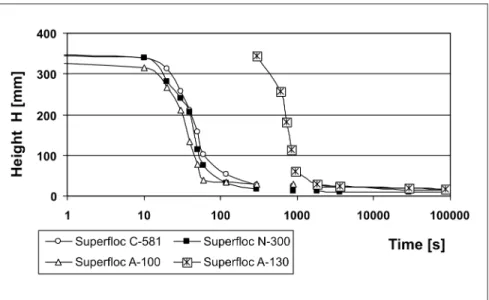
Figures 2 and 3 show the results when using 30 ppm of the Superfloc type reagents. With Superfloc C-581, N-300
and A-100, the curves were similar, indicating that these reagents impart similar behavior in the settling of this kind of effluent. In the test with Superfloc A-130, sedimentation began at about 5 minutes after the experiment began.
Using starch, the settling started after the first 4 minutes and cake compression after 10 minutes (Figures 4 and 5). In contrast, with the use of 30 ppm of calcium hydroxide, settling is observable only after 5 minutes and cake compression startup occurred after 20 minutes of elapsed time.
Figures 8 and 9 show the test results of the suspension alkalinized with Ca(OH)2 to pH 9.5. The suspension initially had pH 2.4. Settling was observed after 1 minute and the time cake compression startup occurred about after 10 minutes in rest.
Figures 10 and 11 show the results from using the Superfloc reagents after the effluent had been submitted to previous alkalinization with Ca(OH)2. Both curves display similar behaviour. The settling process began 10 seconds after the reagent addition. In the test with
Figure 2 - Settling with Superfloc A-130, A-100, C-581 e N-300 solution, and 30 ppm dosage.
Figure 4 - Effect of gelatinized starch in settling.
Figure 5 - Roberts’ plot for gelatinized starch.
Figure 6 - Effect of 30 ppm of Ca(OH)2 in settling.
Figure 7 - Roberts’ plot for 30 ppm of Ca(OH)2.
Figure 8 - Settling curve of effluent for Ca(OH)2 (pH 9.5).
Figure 9 - Roberts’ plot for Ca(OH)2 (pH 9.5).
Figure 11 - Roberts’ plot for effluent alkalinized with Ca(OH)2 and flocculant addition.
Superfloc A-100, the cake compression began at about 4 minutes after the reagent addition, while in the test with Superfloc C-581 solution, the cake compression began more than 10 minutes after the reagent addition.
The Figure 12 shows the neutralization curve of the effluent using Ca(OH)2 up to pH 9.5.
Table 1 presents suspension pH and turbidity values. The pH values do not meet the CONAMA (Brazilian EPA agency) rule (bill Nº 357 - March 17th
2005).
Table 2 shows element concentration resulting from the ash coal digestion process. This analysis was performed by inductively coupled plasma atomic emission spectrometry (ICP). Samples S1, S2 and S3 demonstrate digestion by aqua regia, digestion by hydrochloric acid and digestion by the Savillex method, respectively.
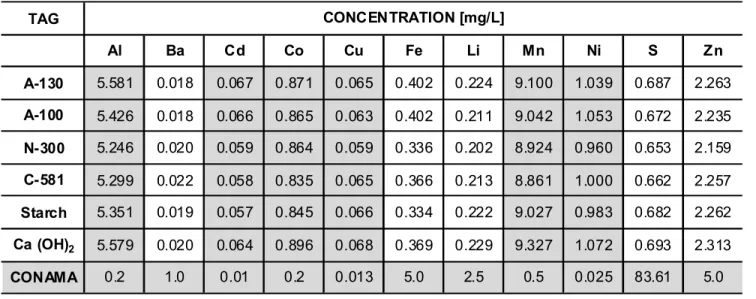
Tables 3 and 4 demonstrate the heavy metal concentration of the clarified suspension after the sedimentation process. Values for the aluminum, cadmium cobalt, copper, manganese and nickel concentrations do not meet the referred to CONAMA rule.
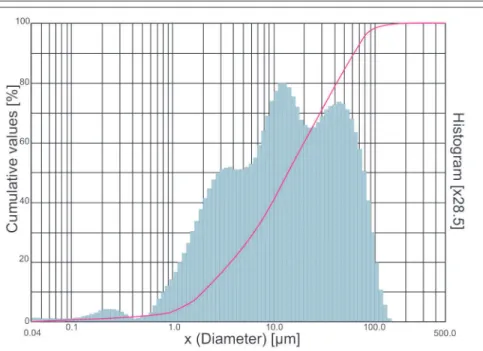
The amount and size of particulate material carried by percolating water depends on precipitation intensity. An intense rain in a tropical region was simulated (28 mm, during 0.5 hour). Using a solids trap to collect material above 0.15 mm, the final effluent solid content would be 0.08 %. Size distribution can be depicted in Figure 13, displaying polymodal distribution.
5. Conclusion
The flake growth detected by settThe flake growth, detected by the settling rate increase, starts up after about two minutes. This is due to the high molecular mass of polyacrylamides, which provide a greater sedimentation rate compared to other types of flocculants, like starch, that are used in
Figure 12 - Neutralization curve: Calcium hydroxide quantity used versus pH values.
Table 1 - pH and turbidity values of the clarified suspension.
! " #$"%" &' ( )'
higher doses and can increase the effluent’s biological oxygen demand. Calcium hydroxide results in a long period before the beginning of cake compression.
Concerning heavy metal removal, the reagents used (without pH adjustment) were not efficient enough to reduce the heavy metals from the effluent, mainly copper and manganese. Previous alkalinization is the key step for heavy metal depletion in such an effluent and only in adsorption and/or chemical abstraction without precipitation is it not an effective mechanism.
6. Acknowledgments
The authors are grateful to CAPES for financial support to this work, to UFOP’s environmental geochemical lab for the chemical analysis and COPELMI Mineração Ltda. for the coal samples.
7. References
Table 3 - Heavy metals concentration from the clarified suspension.
Table 4 - Heavy metals concentration values from the clarified suspension - alkalinized effluent.
Table 2 - Elementary Ash coal composition after digestion.
! "
# $
%
&
(* +* $(*
",-.,
" /+
/ 0 ( % 1+ 2$ !* $ 3*
!
4 ",-2
/ 0 ( % 1+ 2$ !* $ 3*
$* * %
5
5
! ' ' ' ' ' ' ' ' ' '& '
4 ",-/
BARBOSA, L.A.D., SOBRAL, L.G.S., ALCOVER-NETO, A., SILVA, P.F.R. da. Caracterização tecnológica de rejeitos da indústria carbonífera visando a seu aproveitamento sustentado. In: ENCONTRO NACIONAL DE TRATAMENTO DE MINÉRIOS E METALURGIA EXTRATIVA, 19. Recife, 2002. v. 1, p. 43-48.
BRONDANI, L. B., GOBBI, S. J., CARISSIMI, E., RUBIO, J. Desenvolvimento básico de um reator gerador de flocos para estudos de floculação e separação sólido-líquido. Available at: http://www.ufrgs.br/ propesq/livro3/artigo_lauren.htm. Pp. 1-16, 2004.
2015 - Geociências e Tecnologia Mineral. 1º ed. Rio de Janeiro: CETEM/MCT, 2007, p. 157-174.
DAYUBE, P. R.C., TRINDADE, R. de B. E. Remoção de metais presentes em baixa concentração em drenagem ácida de minas. 2000.
LUZ, J. A. M. da. Sistema de tratamento de efluentes do pátio de carvão. Ouro Preto: Universidade Federal de Ouro Preto, 2005. (Relatório Técnico de Pesquisa).
RAO, C.S. Wastewater treatment.
Environmental Pollution Control Engineering. John Wiley & Sons, 1991. Cap. 9.
RUBIO, J., SOUZA, M. L., SMITH, R. W. Overview of flotation as a wastewater treatment technique. Mineral Engineering, 15, p. 139-155, 2002.
Artigo recebido em 06/05/2008 e aprovado em 03/06/2008.
Figure 13 - Size distribution of solid fines in effluent (after scalping the plus 0.15 mm fraction).