DOI: http://dx.doi.org/10.1590/1980-5373-MR-2015-0560
Materials Research. 2016; 19(4): 791-794 © 2016
Inluence of Alumina Phases on the Molybdenum Adsorption Capacity and Chemical
Stability for
99Mo/
99mTc Generators Columns
Cecilia C. Guedes-Silvaa*, Thiago dos Santos Ferreiraa, Flávio M.S. Carvalhob, Carolina M. de Paulaa,
Larissa Otuboa
aInstituto de Pesquisas Energéticas e Nucleares – IPEN, Comissão Nacional de Energia Nuclear -
CNEN, Av. Prof. Lineu Prestes, 2242, 05508-000 São Paulo, SP, Brazil
bInstituto de Geociências – IGC, Universidade de São Paulo – USP, Rua do Lago, 562, 05508-080, São
Paulo - SP, Brazil
Received: September 17, 2015; Revised: April 20, 2016; Accepted: May 11, 2016
Technetium-99m is the clinically most used radionuclide worldwide. Although many techniques can be applied to separate 99Mo and 99mTc, the most commonly used method is the column chromatography
with alumina as stationary phase. However, the alumina nowadays used has limited adsorption capacity of molybdate ions which implies the need to develop or improve materials to produce high speciic activity generators. In this paper, alumina was obtained by a solid state method and heat treatments at diferent conditions. The powders had a microstructure with porous particles of γ, δ, θ and α-Al2O3
phases as well as speciic surface area between 36 and 312 m2 g-1. Most interesting results were reached
by powders calcined at 900oC for 5 hours which had high chemical stability and a molybdenum
adsorption capacity of 92.45 mg Mo per g alumina.
Keywords: alumina, 99Mo/99mTc generator, chromatography
1. Introduction
99mTc has been successfully used in several nuclear
medicine applications, such as cardiology and oncology. The important position of 99mTc is owing to its nuclear
properties that make possible the ready availability of 99mTc
radiopharmaceuticals from generators based on the low decay of 99Mo to 99mTc with short half-life (6 hours)1. As well as
this, gamma rays with adequate power (140 keV) for single-photon emission computed tomography (SPECT) can be readily collimated, allowing better location and minimizing the whole body dose2,3.
The parent radioisotope (99Mo) can be produced by
irradiation of 235U with thermal or fast neutrons or by
irradiation of metallic molybdenum or molybdenum oxide (MoO3) with neutrons. In the irst case, the 99Mo is produced
together with other ission products, requiring separation by diferent techniques. In the second case, little processing is required but only a small portion of 98Mo is converted to 99Mo4-6. Hence, the use of 99Mo produced by irradiadion
of molybdenum, in generator columns, limits the activity of 99mTc eluates since 99Mo/99mTc generators are formed by
chromatography in which 99MoO 4
2- is adsorbed on an alumina
column7. In other words, to obtain generators with adequate
speciic activity, it is necessary to use molybdenum of high activity obtained by the 235U ission.
Therefore, in order to use molybdenum produced by neutron activation in 99Mo/99mTc generators, the adsorbent
material used in the column should be modiied because alumina has an adsorption capacity limited to 20 mg Mo per
g alumina. Many studies have been attempted to develop a material with better performance than alumina but many problems related to the synthesis and to some characteristics of the material have been found8-12. This study evaluates the
inluence of the diferent alumina phases on the molybdenum adsorption capacity and chemical stability in physiological saline in order to use in 99Mo/99mTc generators.
2. Experimental Procedure
2.1. Materials
The starting materials were aluminum nitrate nonahydrate P.A. (Dinâmica) and ammonium carbonate P.A. (Neon)13. The
reactants, in the stoichiometric composition, were ground using a mortar, dried at 100°C for 24 hours and calcined in air at 700oC for 2 hours (AMS700-2h), 900oC for 5 hours
(AMS900-5h) and 1000oC for 5 hours (AMS1000-5h).
The calcined powder was treated in a 0.5 M hydrochloric acid solution for 24 hours under constant agitation at 480 rpm, washed with distilled water, iltered and dried at 100°C for 24 hours.
2.2. Physical measurements
In order to determine the thermal events during the increase of temperature, thermal analysis (thermogravimetry, TG and diferential scanning calorimetry, DSC) measurements were performed under air low at a heating rate of 10oC/
Guedes-Silva et al. Materials Research 792
Each synthesized powder was analyzed by X-ray powder difraction (Siemens D5000 difractometer X-ray, radiation CuKα) to identify the crystalline alumina phases. Also, the speciic surface area of the materials was determined using Micromeritics equipment and the equation of Brunauer-Emmett-Teller (BET). The morphology and porosity of the powders were observed by scanning electron microscopy (Philips XL30 and Jeol JSM6701F microscopes).
2.3. Evaluation of Molybdenum Absorption
Capacity
The molybdenum adsorption capacity was measured by stirring a suspension containing 0.1 g of the calcined powder and 30 ml of ammonium molybdate solution (1 mg/ml) with a pH of 1.5. After 30 minutes under stirring, the suspension was iltered and analyzed by ICP-OES to determine the Mo concentration.
2.4. Chemical Stability Tests
For chemical stability tests, chromatographic columns containing 4g of material were conditioned with 250 ml of HCl with pH of 1.5. 6 ml of physiological saline solution was passed through the column and collected to determine the aluminum content by colorimetric assay using Chromoazurol S like indicator.
3. Results and Discussion
Thermal analyses of the dried uncalcined precursor are shown in Figure 1. The results show ive endothermic peaks between 70 and 200oC related to 11.6 wt.% of water loss
and the peak found at 297oC is due to the decomposition of
ammonium nitrate with a 61 % of mass loss. An exothermic event found at 310oC is related to the rapid release of gases
due to the oxidation of ammonium nitrate14.
Figure 1: Thermal analysis of the material dried at 100 ° C for 24 hours: (a) TG and (b) DSC.
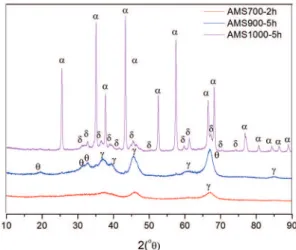
The evolution of the alumina phases for diferent heat treatments can be veriied from powder difraction patterns (Figure 2). Based on Figure 2, it is clear the dependence on polymorphic transformations in alumina with the temperature.
Figure 2: Powder difraction patterns of the samples heat treated
at 700 °C/2h, 900°C/5h and 1000 °C/5h.
The heat treatment performed at 700 °C for 2 hours was enough to transform the precursor to γ-Al2O3. Increasing
the temperature and time to 900oC for 5 hours, we observed
the presence of θ and γ-Al2O3 phases, while the treatments
performed at 1000oC for 5 hours presented δ-Al 2O3 and
α-Al2O3 as transition and stable phases, respectively. The
transition phases of alumina are considered advantageous to application as adsorbents in chromatography columns of
99Mo/99mTc generators due to the higher surface reactivity.
From data shown in Table 1, it is noted that the heat treatments carried out at lower temperatures resulted in powders with a larger speciic surface area, suggesting that the transition alumina phases have higher reactivity. The material calcined at 1000oC for 5 hours, for example, had
a value of speciic surface area four times smaller than that calcined at 900oC for 5 hours due to the presence of α-Al
2O3
phase (Figure 2).
Table 1: Speciic surface area (S) of the synthesized powders.
Sample S (m2/g)
AMS700-2h 312.0 ± 2.0
AMS900-5h 153.7 ± 0.3
AMS1000-5h 36.0 ± 0.1
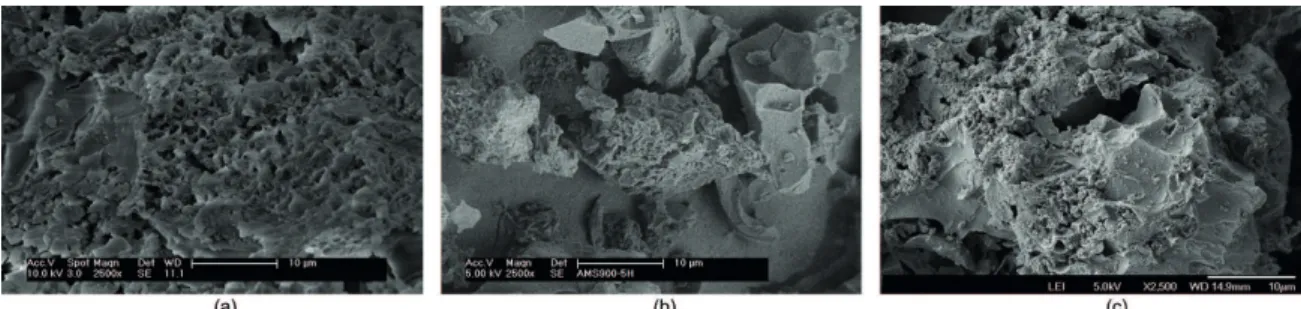
SEM images of the powders in Figure 3 show that the synthesis method results in highly porous powders, which corroborates with the high surface area determined by BET. Further analysis correlating the microstructure and the crystalline phase determined by XRD makes clear the efect of alumina phases on the surface’s morphology and consequently on the surface area. From Figure 4, it is observed that the powder calcined at 900°C/5h (Figure 4a) shows a texturized morphology, typical of transition alumina phases. Powders calcined at 1000oC/5h (Figure 4b),
although exhibit areas with similar texturized morphology, also contain some coalesced regions that can be attributed to α-Al2O3 particles. The heat treatment performed at 1000
oC
Inluence of Alumina Phases on the Molybdenum Adsorption Capacity and Chemical Stability for 99Mo/99mTc
Generators Columns 793
Figure 3: Scanning electron micrographs of powders synthesized at: (a) 700 °C/2h, (b) 900 °C/5h and (c) 1000 °C/5h.
Figure 4: Micrographs obtained by ield emission gun scanning
electron microscope. Powders synthesized at: (a) 900°C/5h and (b) 1000°C/5h.
In addition, the molybdenum absorption capacity of the powders (Table 2) was directly afected by their surface characteristics. The highest values achieved by materials calcined at 700oC for 2 hours are associated with the
presence of gamma phase, high porosity and high speciic surface area. While the lowest adsorption capacity was found for the calcined material at 1000oC for 5 hours due to
the lower speciic surface area and lower porosity resultant from the predominance of the α-Al2O3 phase. Considering
the studied powders, those treated at 900oC for 5 hours
shown an intermediate adsorption capacity but the value was noteworthy (92.45 mg/g) compared with the limit of 20 mg/g reported for alumina currently used in 99Mo/99mTc
generators.
Table 2: Molybdenum adsorption in the synthesized alumina.
Identiication Mo(mg)/Al2O3(g)
AMS700-2h 113.42
AMS900-5h 92.45
AMS1000-5h 37.11
Table 3 presents the results of chemical stability tests that are of great importance for the proposed application because the elutions carried out to separate 99mTc from 99Mo
use saline physiological solution as eluant. Data in Table 3 show that powders calcined at 700oC for 2 hours produced
a solution with high aluminum content what evidences to be unsuitable for use in 99Mo/99mTc generator. Besides, this
result indicates that the γ-Al2O3 phase has a higher solubility
in physiological saline than the other phases of alumina. Chakravarty et al.13 obtained conlicting results since they
found lower than 1 ppm of aluminum when chemical stability tests were performed with acids and bases in powders calcined at 700oC for 2 hours.
Table 3: Content of aluminum present in the saline solution after chemical stability test.
Identiication Al (ppm)
AMS700-2h 17.5 – 25.0
AMS900-5h 2.0 – 3.5
AMS1000-5h 2.0 – 3.5
The presence of θ-Al2O3 in the calcined material at
900°C for 5 hours was enough to reduce the solubility for levels lower than 2 ppm of aluminum, identical to those found for the calcined material at 1000oC for 5 hours mainly
constituted by α-Al2O3. However, the low molybdenum
absorption capacity of the powder treated at 1000oC for 5
hours turns impracticable its application for high activity
99Mo/99mTc generator columns.
4. Conclusions
The synthesis of alumina from the grind of aluminum nitrate and ammonium carbonate followed by drying and calcination can produce highly porous powders. The results showed that the temperature of calcination afected the alumina formed phases, microstructure, chemical stability and molybdenum adsorption capacity.
The heat treatment performed at 700°C for 2 hours promoted the formation of powder with γ-Al2O3 phase
and textured morphology. These characteristics led to high speciic surface, high molybdenum adsorption capacity but low chemical stability, making the material inappropriate for use in 99Mo/99mTc generators columns.
On the other hand, materials calcined at 1000oC for 5
hours had a great chemical stability but low values of surface speciic area and molybdenum adsorption capacity because of the presence of the α-Al2O3 phase and the lower porosity.
The best results were found for the powder calcined at 900oC for 5 hours. The presence of θ-Al
2O3 and γ-Al2O3 led to
a relatively high surface area, high chemical stability and high molybdenum adsorption capacity making it promising to be applied as adsorbents in high activity 99Mo/99mTc generators columns.
5. Acknowledgements
Guedes-Silva et al. Materials Research 794
6. Referências
1. International Atomic Energy Agency. IAEA-TECDOC-852 Alternative technologies for 99mTc generators. Vienna: International Atomic Energy Agency; 1995.
2. Allen JF. An improved technetium-99m generator for medical applications. The International Journal of Applied Radiation and Isotopes. 1965;16:332-334.
3. Molinski VJ. A review of 99mTc generator technology. The International Journal of Applied Radiation and Isotopes. 1982;33(10):811-819. 4. Boyd RE. Technetium-99m generators–The available options.
The International Journal of Applied Radiation and Isotopes. 1982;33(10):801-809.
5. Monroy-Guzman F, Rivero Gutiérrez T, López Malpica IZ, Hernández Cortes S, Rojas Nava P, Vazquez Maldonado JC, et al. Production optimization of 99Mo/99mTc zirconium molybdate
gel generators at semi-automatic device: DISIGEG. Applied Radiation and Isotopes. 2012;70(1):103-111.
6. Seifert S, Wagner G, Eckardt A. Highly concentrated [99mTc] pertechnetate solutions from (n,γ) 99Mo/99mTc generators for nuclear
medical use. Applied Radiation and Isotopes. 1994;45(5):577-579. 7. Lavi N. The study of conditions for the preparation and application of 99Mo-99mTc generators starting from irradiated molybdenum
metal. Journal of Radioanalytical Chemistry. 1978;42(1):25-34.
8. Pinajian JJ. A technetium-99m generator using hydrous zirconium oxide. The International Journal of Applied Radiation and Isotopes. 1966;17(11-12):664.
9. Meloni S, Brandone A. A new technetium-99m generator using manganese dioxide. The International Journal of Applied Radiation and Isotopes. 1968;19(2):164-166.
10. Bigliocca C, Girardi F, Pauly J, Sabbioni E, Meloni S, Provasoli A. Radiochemical separations by adsorption on manganese dioxide. Analytical Chemistry. 1967;39(13):1634-1639. 11. El-Kolaly MT, Misak NZ. A 99mTc Generator Based on the
Adsorption of [99Mo] Molybdophosphate on hydrous manganese
dioxide. International Journal of Radiation Applications and Instrumentation. Part B. Nuclear Medicine and Biology. 1988;15(4):459-461.
12. Mushtaq A, Mansoor MS, Karim HMA, Khan MA. Hydrated titanium dioxide as an adsorbent for 99Mo-99mTc generator. Journal of Radioanalytical and Nuclear Chemistry. 1991;147(2):257-261. 13. Chakravarty R, Ram R, Dash A, Pillai MRA. Preparation of
clinical-scale 99Mo/99mTc column generator using neutron activated low speciic activity 99Mo and nanocrystalline γ-Al2O
3 as column
matrix. Nuclear Medicine and Biology. 2012;39(7):916-922.