1
2
Falando de Física dos
Plasmas...
O que é o plasma?
•
Gás ionizado, com o mesmo número de
elétrons e íons (neutro), que apresenta
um comportamento coletivo;
•
Susceptível aos campos elétrico e
magnético externo;
Plasmas na Medicina
Plasmas empoeirados
32
Capture by porous aerogel targets in space & lab
Silica (SiO
2) aerogels composed of clusters of 2 -5 nm solid silica
spheres with up to 95 % empty space, an average pore size is 2-50
nm and mass density 20-100 kg/m
3.
17
[**]S.Ratynskaia et al,Plasma Phys. Control. Fusion
50
(2008) 124046
Stardust,
1999-2004 ”
[*]S. Ratynskaia,e
t al
2009 Nucl.lFus.
49
122001
(mm scale on the figure below)
[“]F. Hortz
et al.
2006 Science 314
TEXTOR tokamak* **
33
100nm
35
IMAGING:Fast Camera Detection of Dust*
(DIII-D
12)
Time history of dust
(
a)–(d)
. two particles enter
SOL and disintegrate
(e)–(h).particles released
after an ELM impact on the
outer wall
(dust is incandescent)
Dust released by upward-going
38
Aplicações de plasmas no
Centrífugas
8
×
10
5radians per second;
Separação de isótopos;
GROSSMAN AND SHEPP: PLASMA ISOTOPE SEPARATION METHODS 1117
FI anode
cathode
Fig. 3 . Plasma centrifuge from reference [16].
Discharge pulse forming
n e t w o r k Magnet Coils
m-
Cathode target
Grounded Vacuum Vessel
\
\
u p
Laser
Fig. 4. Vacuum arc centrifuge from reference [13].
TABLE I1
PREDICTED VALUES OF c ) *
ions n
H-D 150 D-T 28 NeZ0-NeZ2 2.5
u 2 3 5 - u 2 3 8 1.134
‘From reference [21].
Then
~4 3; I B / p , (16)
In the context of a weakly ionized plasma, the viscosity is due to neurtal-neutral collisions. Argon and xenon plasmas were studied (see Fig. 3) and rotational velocities as high as 1.4 x 10³m/s were obtained. It was found that the value of 8 is limited by the viscous damping, so that higher rota- tional velocities result in higher temperatures maintaining the condition:
8 5 1 and thus limiting the value of cy.
A number of interesting papers have been published deal- ing with the laser-initiated vacuum arc plasma centrifuge, [17]-[20]. A fully ionized plasma is produced and transported through an axial magnetic field. For most of the papers published in this area, a so-called rigid rotor model is used [22]. This represents one of the cases treated in [21], where there is no net ion diffusion out of the plasma column. Further, the magnetic field is assumed to be axial and uniform, and a
constant radial “self-consistant” electric field, E, is assumed to exist. This is due to the ambipolar diffusion of the ions in the radial direction [20], and in turn produces an E, x B,
drift or rotation with frequency or the order of E,/B,. A
three-component system is considered, composed of electrons, and ions 1 and 2. Each component has a corresponding radial Euler-type equation (or momentum conservation) in which a steady state is assumed. (Unlike in [21], viscosity is neglected.) In this case, for each plasma component one has the following:
m u ; / , = e Z ( E ,
+
u@B,) - l / n d p / d r . (17)In [22], a parameter E is defined as the ratio of the centrifugal-
to-electodynamic force:
E = ( m u ~ / r ) / ( Z e w @ , ) = ( v 4 / r ) / ( z e B Z / m ) = w / A ,
(18) where Ai is the cyclotron frequency, and w is the plasma
rotational frequency. In [22], separation of zirconium (mass numbers 96, 94, 92, 91, and 90) was studied. Here, B, =
0.4 T, z = 3, and w = lo5 rad/s. Thus E = 0.08, leading to
the conclusion that both the pressure gradient and centrifugal force terms are small corrections to the ion motion. The ion velocity is, to first order in E ,
Z I ~ S - E r / B z ( l - 2 ~ ) . (19)
Princípios
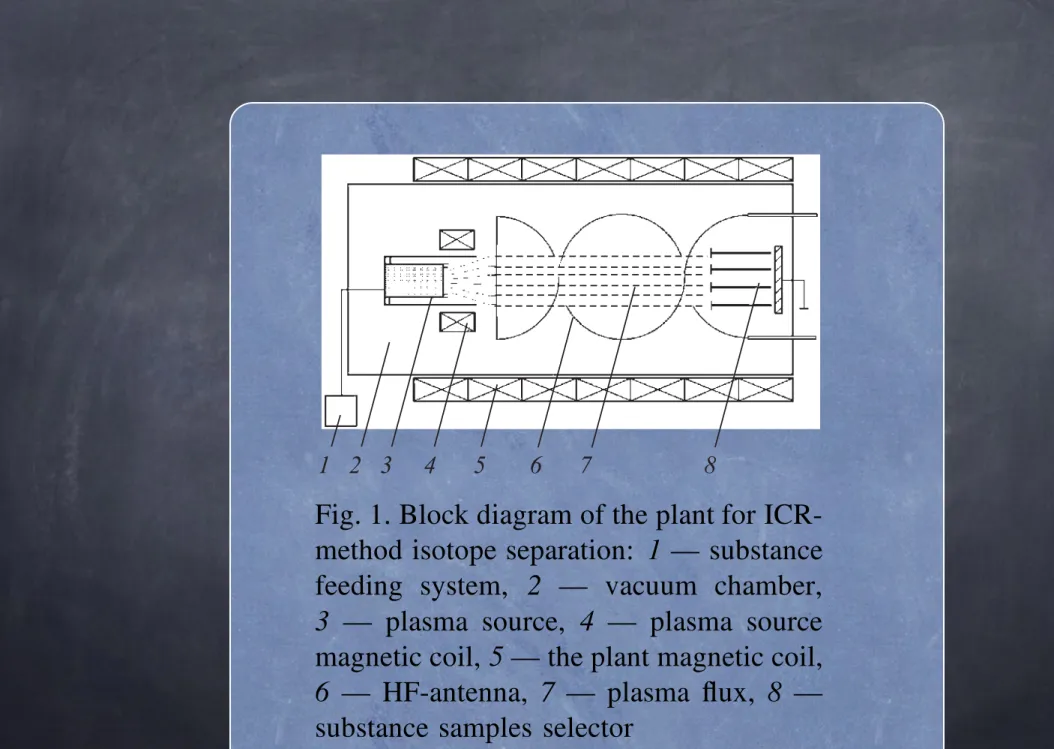
The principal idea of ICR-method is the following. A
!
ux of collision free
plasma comes into heating area in which the aimed isotope ions advantageous
acceleration is executed on resonance frequency:
ω
=
ω
ci=
eB
M
i.
To provide heat selectivity it is necessary to realize several conditions. It is
obvious the requirement of stable magnetic ˇeld uniformity in the heating area:
∆
B
B
<
∆
M
iM
i.
(1)
R lines and dealin
(
∆
B/B
∼
10
−
3
) i
to the mass of isotopes
The other condition of heating selectivity is the requirement of smallness of
cyclotron absorption line widening due to the heated ions collisions:
ν
iiω
<
∆
M
iM
iFig. 1. Block diagram of the plant for
ICR-method isotope separation:
1
Å substance
feeding system,
2
Å vacuum chamber,
3
Å plasma source,
4
Å plasma source
magnetic coil,
5
Å the plant magnetic coil,
6
Å HF-antenna,
7
Å plasma
!
ux,
8
Å
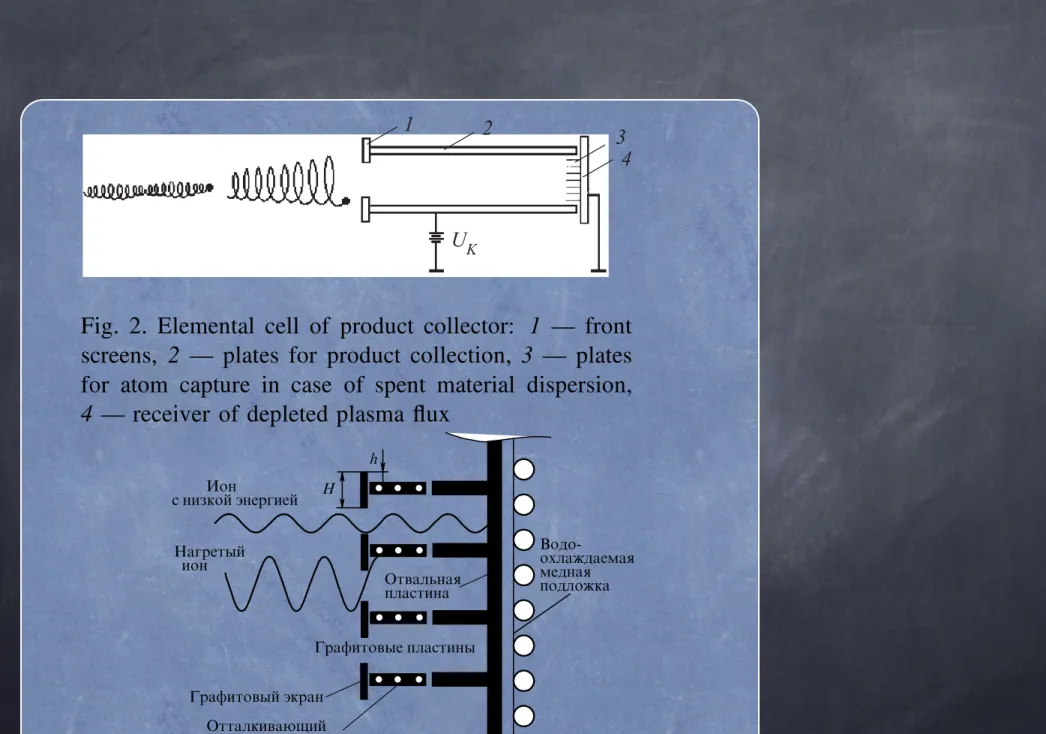
Fig. 2. Elemental cell of product collector:
1
Å front
screens,
2
Å plates for product collection,
3
Å plates
for atom capture in case of spent material dispersion,
4
Å receiver of depleted plasma
!
ux
X,.,D ,L/3=.3%(3F (%.)3F $,./,="3 h&3U'*,-+J !"&3) h&3U'*,-+% $/3#*')+ @38&%*+J ',) G,)
# )'5",J !)%&8'%J
K*-3/0)3F $/3#*')3
K**3/"'-3?9'J $,*%)E'3/(%')X
#
Processamento de materiais
para a indústria
49
Material
Vapor
Pressure
Material
Unit Value
low
high
low
high
glass
Mag.
storage
S/C
Vapor pressure limit for vacuum operation
50
Material/Substrate
Plasma Component
Desired Product
Semiconductor substrates
Active neutral and ionic
species generated by
electron impact
Etching, thin film
deposition, stripping,
cleaning
Magnetic Storage Media
Sputtered atoms generated
by ion bombardment of the
target
Magnetic thin films,
anti-corrosive coatings
Glass
Thin film chemical
precursors, neutrals
Energy efficient coatings
Textiles
Ion bombardment, active
neutrals
Increased wettability, wear
properties,
Industrial Cleaning
Oxygen atoms, ions
Oxidation and removal of
organic films
Food Processing/
Decontamination of CBW
Agents/Medical Equipment
Sterilization
O, O2
+, H, OH: chemical
reactions initiated by
plasma chemistry
Destruction or denature of
pathogens, prions; chemical
destruction of toxins
Water/Wastewater
Treatment
O, O2
+, O3, OH: chemical
reactions initiated by
plasma chemistry
Removal or destruction of
water contaminants,
51
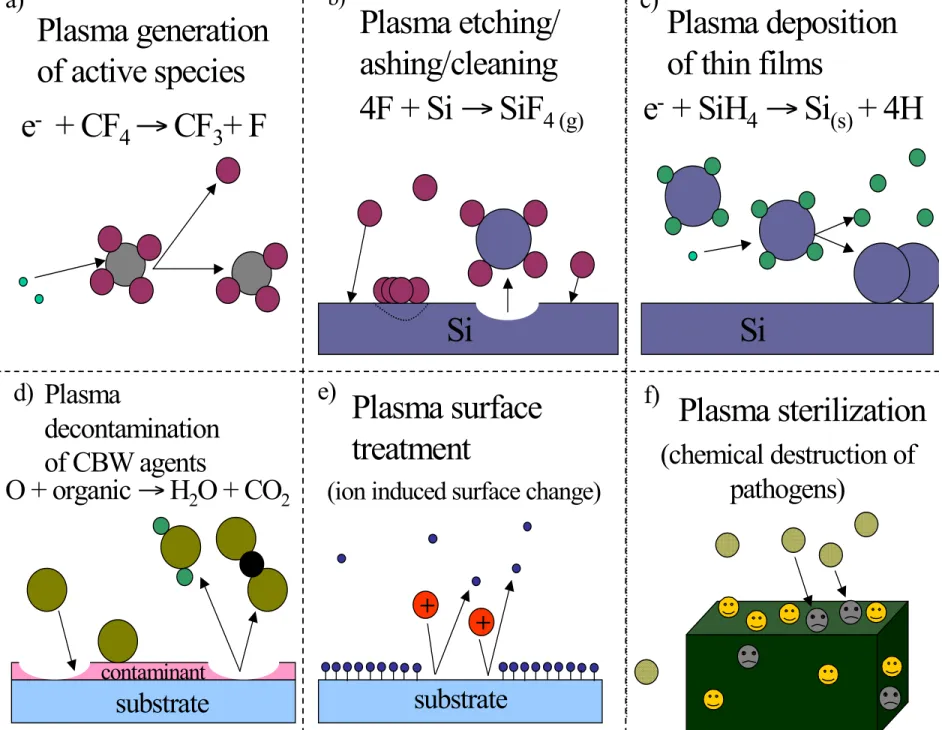
Plasma generation
of active species
e
-
+ CF
4
→
CF
3
+ F
Plasma etching/
ashing/cleaning
4F + Si
→
SiF
4 (g)
Si
Plasma deposition
of thin films
e
-
+ SiH
4
→
Si
(s)
+ 4H
Si
Plasma
decontamination
of CBW agents
substrate
contaminant
O + organic
→
H
2O + CO
2Plasma surface
treatment
substrate
(ion induced surface change)
+
+
Plasma sterilization
(chemical destruction of
pathogens)
a)
b)
c)
d)
e)
f)
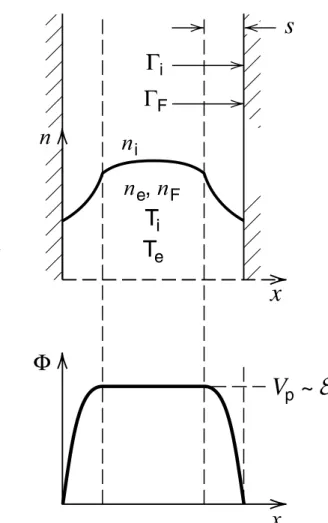
52
V
P
p
s
x
V
53
a. Dielectric
Barrier discharge
b. Corona Discharge
c. DC Plasma torch
Gas In:
RF Electrode
He
O
2feed gas fast flow
Contaminated
Surface
evolved products
d. Atmospheric pressure
plasma jet
54
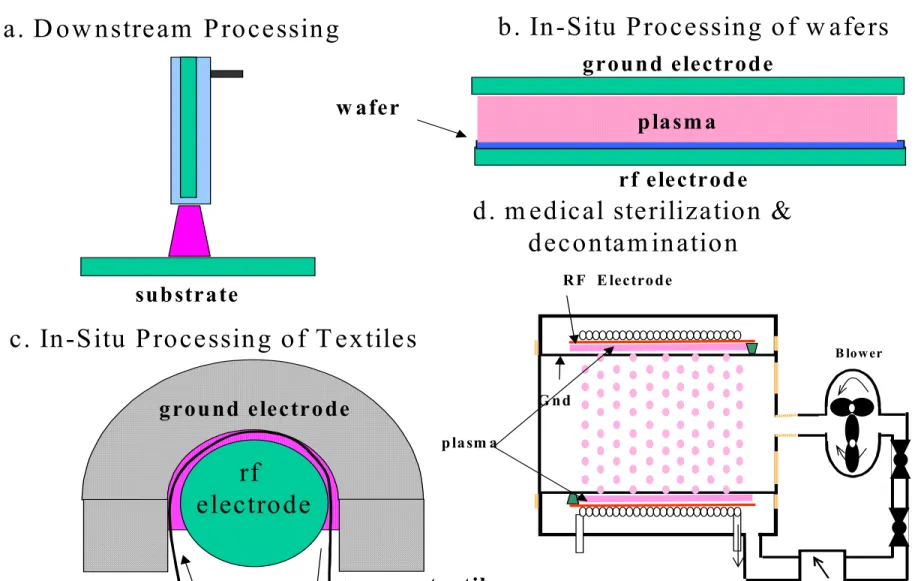
a. D o w n stre am P ro ce ssin g
b . In -S itu P ro c essin g o f w afe rs
su b str a te
g r o u n d e le c tr o d e
r f e le ctr o d e
w a fe r
p la s m a
c. In -S itu P ro ce ssin g o f T ex tile s
rf
electro de
g r o u n d e le c tr o d e
te x tile
d . m ed ic al sterilizatio n &
d ec o n ta m in atio n
B lo w er R F E lec tro d e
G n d
p la sm a
Materiais Micro e Nano
estruturados
55
56
Example:
2
XeF
2
+
Si
Ar
+
57
![Fig. 3 . Plasma centrifuge from reference [16].](https://thumb-eu.123doks.com/thumbv2/123dok_br/16303772.717684/42.1080.20.1080.30.778/fig-plasma-centrifuge-reference.webp)