*e- mail: [email protected]
1. Introduction
In the past few decades, polymers have replaced many conventional materials in different applications due to the cost and manufacturability advantages. Polyethylene (PE), for example, is one of the most important, most popular, and cheapest polymers, hence PE is produced in large quantities and is used in many different applications, in particular food packaging wrapping ilms, pipes, bottles, etc.1. PE is widely used because of the many attractive properties such as low density, low cost, low toxicity, and high processability2. According to ASTM standards, PE can be low density polyethylene (LDPE), medium density polyethylene (MDPE), or high density polyethylene (HDPE)3. PE density range allows a wide range of mechanical and processing behavior; molecular weight, branching, and degree of crystallinity also inluence how the PE behaves4.
Polymer nanocomposites can be produced by adding illers. Fillers can be natural ibers such as hemp, rice‑husk, textile, chitosan, curauá etc. or inorganic ibers made from materials such as clay, alumina, glass, boron, silicon carbide, carbon etc. It was found that mechanical properties of polymer composites can be enhanced with increasing nanoiller content-as documented in literature5-16. It was also found that barrier to gas properties of the polymer composites can be enhanced (i.e. the values of the permeability to gas coeficient reduce as percentage of iber contents increases) as documented in the literature17-27. One important key factor that enhances mechanical properties of the polymer is the aspect ratio of the illers (i.e. the ratio between the length of the iber to its diameter). It was found that as the aspect ratio increases, less percentage of the iller is needed.
Thus, better mechanical properties with few amounts of illers. For example, improvements in mechanical properties have been observed by adding the weight percentages of carbon nanotubes (CNT)28. In addition, permeability to gas coeficient is improved by dispersing nanoillers. For instance, reductions in permeability coeficient have been detected by increasing the weight percentages of clay29.
This study considers the experimental data from Grigoriadou et al.30 on mechanical properties of HDPE/Cu nanoiber nanocomposite ilms and the experimental data from Bikiaris & Triantafyllidis31 on oxygen barrier properties of HDPE/Cu nanoiber nanocomposite ilms. The tensile modulus of elasticity (elastic modulus) and the barrier to oxygen permeability were measured as a function of iller content. The studies are based on the percolation theory32 that the materials properties show either a small increase or decrease below the percolation concentration of the iller33. When percolation concentration is above threshold, the material properties show a power law increase with iller content34,35.
The main objective of this study was to correlate the permeability to oxygen coefficient decrease for HDPE/Cu‑nanoiber composite to the mechanical increase of the modulus of elasticity based on a model developed using Halpin-Tsai equation below the percolation point. In addition to the correlation between the permeability and modulus of elasticity of HDPE/Cu nanocomposite, it is worthy to study the effect of copper nanoibers when added to PE matrix. For example, Cu nanoibers are attractive as copper is 100 times cheaper than silver and 1000 times more abundant relative to the other metallic nanoibers36.
Oxygen Permeability Coeficient of High Density Polyethylene/Cu
Nanoibers Nanocomposites below Percolation
Atheer Mohammad Almasria*
aDepartment of Chemical Engineering, College of Engineering, Al Imam Mohammad Ibn Saud Islamic University – IMSIU, Kingdom of Saudi Arabia
Received: August 10, 2015; Revised: August 29, 2015
The main objective of this study was to relate the elastic modulus of a polymer nanocomposite to its permeability coeficient. The materials studied included high density polyethylene (HDPE) illed with copper nanoibers (Cu‑nanoibers). Both of the experimental values of the elastic modulus and the gas permeability coeficient of the HDPE/Cu‑nanoibers ilms were obtained from Grigoriadou et al. and Bikiaris & Triantafyllidis studies. In this study, the Halpin‑Tsai model was modiied and then used to it the elastic modulus experimental data. It was found that the modiied shape factor (ω′) of the Cu ibers as a function of the composite volume fraction is125exp
(
−41∅)
. Then, the model was used topredict the oxygen permeability coeficient of the HDPE/Cu‑nanoibers ilms below the percolation point. It was found that the tensile modulus of the nanocomposites increased by 24% whereas the permeability to oxygen coeficients decreased by 65% compared to pristine HDPE. Also, the results from the models match the experimental data.
2. Experimental
This study is based on the elastic modulus experiment indings of the HDPE/Cu‑nanoibers ilms and used as obtained by Grigoriadou et al.30 , also this study is based on the oxygen permeability coeficients data of the HDPE/Cu‑nanoibers ilms obtained by Bikiaris & Triantafyllidis31. Some modiications were made and will be explained in the Results and Discussion section. . Thus, all materials and samples preparations were taken from the above two references30,31.
2.1. Materials
High density polyethylene (HDPE) was supplied by Total Petrochemicals (Feluy, Belgium) under the trade name Lumicene mPE M5510 EP. It has a melt low rate (MFR) of 0.28 g/10 min at 2.19 kg/190 °C and density 0.955 g/cm3 and Tm 133 °C. Copper nanoibers were synthesized via the reduction of a copper–amine complex in an aqueous-non polar bilayer system consisted of CTAB/TMEDA/H2O/Cyclohexane (for more details look at Cho & Huh37).
2.2. Nanocomposites preparation
In Grigoriadou et al.30 study; HDPE nanocomposites containing 0.5, 1 and 2.5 wt% of Cu‑nanoibers were prepared by melt mixing in a Haake-Buchler Reomixer (model 600) at 220 °C and 30 rpm for 15 min with roller blades and a mixing head with a volumetric capacity of 69 cm3.
2.3. Mechanical properties
Measurements of tensile mechanical properties of the prepared nanocomposites in Grigoriadou et al.30 study were performed on an Instron 3344 dynamometer, in accordance with ASTM D638[38], using a crosshead speed of 50 mm/min. Thin ilms (100±25 μm) prepared by a PW 30 hydraulic press at a temperature of 220±3 °C. The thin ilms were prepared in order to measure the mechanical properties of these sheets, dumb-bell-shaped tensile test specimens (central portions 5 × 0.5 mm thick, 22 mm gauge length) were cut in a Wallace cutting press. Then, the values of Young’s modulus were determined.
2.4. Oxygen permeability
Oxygen permeability was studied based on Bikiaris and Triantafyllidis31 study on relatively thin ilms (50±5 μm) of HDPE/Cu‑nanoiber samples also prepared by a PW 30 hydraulic press at a temperature of 220±3 °C. Permeability rates of O2 through these ilms were measured using a Davenport Apparatus (London).
3. Results and Discussion
This study is based on the experimental indings of Grigoriadou et al.30 and Bikiaris & Triantafyllidis31 for the elastic modulus and oxygen permeability coeficients of the HDPE/Cu‑nanoibers ilms. Grigoriadou et al.30 in their HDPE/copper nanoiber nanocomposites study measured the tensile modulus of elasticity (elastic modulus) in accordance with ASTM D638[38] using a crosshead speed of 50 mm/min. The values of the elastic modulus for plain HDPE is 652 MPa, increased to 735, 770 and 805, when 0.5 wt% Cu
nanoibers, 1.0 wt% Cu nanoiber, and 2.5 wt% Cu nanoiber were added, respectively.
In this study, among all of the models used to predict the elastic modulus of composite materials, the Halpin-Tsai model39,40 was used to it the experimental data.
( / ) ( / ) ( / ) ( / )
−
+ ∅
+
= −
− ∅
+
f m
f m
c m
f m
f m
E E 1
1
E E
E E
E E 1
1
E E
ω
ω
ω
(1)
Where EC, EF, and EM are the moduli of composite, iber, and matrix, respectively, (ω) is the shape factor, and ∅is the volume fraction of the iller. The shape factor (ω) is related to the aspect ratio of reinforcement length (l) and diameter (d) and deined as (2l/d). Cu‑nanoibers used in this study have an average diameter between 200 and 400 nm and length in the range of 15 to 25 μm. Thus, the calculated shape factor (ω) based on the aforementioned data lies between 125 and 150. The iller volume fraction
( )
∅ is a function of the Cu‑nanoibers weight fraction and the densities of both the iller and the matrix as follows)
(
∅ = −
+
f f
f f
f m
w
w 1 w
ρ
ρ ρ
(2)
Where wF, wM, ρF and ρM are Cu‑nanoibers weight fraction, matrix weight fraction, Cu‑nanoibers density, and matrix density, respectively.
Halpin-Tsai equation was originally used for composites with unidirectional reinforcement, but Cox41 modiied and improved it to account for the randomness of discontinuous ibers by introducing an orientation factor (β)42. If the iber length is greater than the thickness of specimen, the ibers are assumed to be randomly oriented in two dimensions; and the orientation factor (β) is 1/3, while if the iber length is smaller than the thickness of the specimen, the ibers are assumed to be randomly oriented in three dimensions; and the orientation factor (β) is 1/6. In this study, the length range of Cu‑nanoibers is shorter than the specimen thickness, 100 μm, thus β is considered to be 1/6 and the Halpin‑Tsai equation can be modiied to become:
( / ) ( / ) ( / ) ( / )
−
+ ∅
+
= −
− ∅
+
f m
f m
c m
f m
f m
E E 1
1
E E
E E
E E 1
1
E E
β ω
β ω
β
β ω
(3)
Moreover, the effective elastic modulus of Cu‑nanoibers can be deduced from Equation 2 as follows:
(
)
(
)
(
+ ∅)
−(
− ∅)
=∅ + − − ∅
c m
f m
m c
E 1 E
E E
1 E 1 E
ω ω
β ω (4)
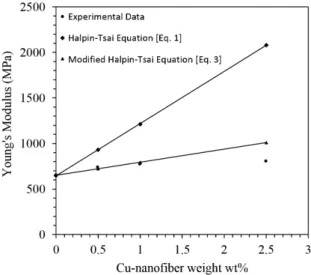
modiied Halpin‑Tsai model (Equation 3). The shape factor (ω) was 125 for both equations, as a function of Cu‑nanoibers.
It is very important to investigate the inluence of the shape factor (ω) on the elastic modulus of the composite (EC) to account for the randomness of discontinuous Cu nanoibers. The effect of the shape factor (ω) on the model curve for elastic modulus of HDPE/Cu composites is shown in Figure 2. Accordingly, the shape factor (ω) values were taken to be between the minimum of 125 and 150.
It is evident from Figure 2 that the experimental data need further modiication to it the nonlinear region for the Cu‑nanoibers content over 1wt%. Yeh et al.43 have modiied the exponential shape factor (ω) to have the following form
− ∅−
′ = e a b
ω ω (5)
Where (ω′). is the modiied shape factor, (ω) is the shape factor, a and b are constants related to the degree of illers clusters and agglomerations, which are responsible for the
nonlinear behavior of the Halpin-Tsai equation. Therefore, the larger and b values indicate more aggregation of the Cu-nanofiber in the polymeric matrix. Hce, this aggregation of the Cu‑nanoibers leads to reduction of the elastic modulus of the composites. Therefore, the modiied Halpin-Tsai (Equation 3) can be further modiied to become
( / )
( / )
( / )
( / )
−
+ ∅
+
= −
− ∅
′
+ ′
′
f m
f m
c m
f m
f m
E E 1
1
E E
E E
E E 1
1
E E
ω
ω
β ω
β β
β (6)
Equation 6 is the nonlinear form of the Halpin-Tsai equation, so it its the Cu‑nanoibers over 1wt% better. As indicated in Figure 3, large a value tends to reduce the stiffness (Elastic Modulus) of the composite at high Cu‑nanoiber loadings. After systematic variation of a in the modiied shape factor (ω′), the results in Figure 3 show that the best value of a to it the model is 41 with a minimum percentage error between the it and the experimental Elastic modulus. Also, Figure 3 shows that there is no need to ind a it value of b in the modiied shape factor ω′, thus b value equals zero.
Both, the small value of a and the zero value of b indicate a little to no aggregations of the Cu‑nanoiber in the HDPE matrix. The experiment showed30 that no aggregates formed in any Cu‑nanoiber content using different characterization techniques, even at high iber content. This discovery was an advantage because most illers aggregate and dificult to disperse such as carbon nanotubes.
However, the inal form of the Halpin‑Tsai model that its the relative elastic modulus of our experimental data is given by Equation 7.
( ) ( )
( )
/ ( / ) / ( / ) / ( / ) / ( / )
−
+ − ∅ ∅
+ − ∅
= −
− ∅
+ − ∅
f m
f m
c
m f m
f m
1 6 E E 1
1 125exp 41
1 6 E E 125exp 41
E
E 1 6 E E 1
1
1 6 E E 125exp 41
(7)
The experimental results in Grigoriadou study30 show no signiicant increase in elastic modulus in line with the percolation theory. The increase was up to 24% between Figure 1. Experimental elastic modulus along with elastic modulus
itted by Halpin‑Tsai equation (Equation 1) and the modiied Halpin‑
Tsai equation (Equation 3).
Figure 2. Experimental elastic modulus along with the effect of the shape factor (ω) on elastic modulus.
the pristine HDPE and the maximum Cu‑nanoiber contents (2.5wt%Cu‑nanoiber). Moreover, there were no results beyond this content, and were no dramatic increase in the modulus, this conirmed the fact that the mechanical percolation threshold was not reached.
Elastic modulus increases as the Cu‑nanoiber loadings increases. In addition, this increase in elastic modulus is also accompanied by a reduction of gas permeability coeficient as the loadings of Cu‑nanoiber increased31. At the deduction of Equation 7, some assumptions were applied such as the percolation concentration of the nanoiller was not reached, and lower nanoiller permeability to oxygen coeficient in comparison with matrix permeability coeficient, which are true in gas transport process case as well. Thus, Equation 7 can be used to describe relative permeability to oxygen coeficient in the following form27
( ) ( )
( )
/ ( / ) / ( / ) / ( / ) / ( / )
−
+ − ∅ ∅
+ − ∅
= −
− ∅
+ − ∅
f m
f m
m
c f m
f m
1 6 E E 1
1 125exp 41
1 6 E E 125exp 41
P
P 1 6 E E 1
1
1 6 E E 125exp 41
(8)
Where PM and PC are the permeability coefficient of the polymeric matrix and of the composite material, respectively.
The experimental results show a slightly decrease in oxygen permeability up to 1wt%Cu‑nanoiber, then a signiicant decrease in oxygen permeability at 2.5wt% Cu‑nanoiber up to 65% relative to the HDPE matrix. This makes one believe that 2.5wt% iller content is beyond the permeability percolation because of expected dramatic decrease. Also, if Equations 7 and 8 are compared, they show enhancement in the composite modulus relative to the pure HDPE matrix, and this enhancement is accompanied by reduction in permeability to oxygen of the nanoilms as the Cu‑nanoiber content increases. Therefore, elastic modulus and permeability to gas coeficient are inversely proportional.
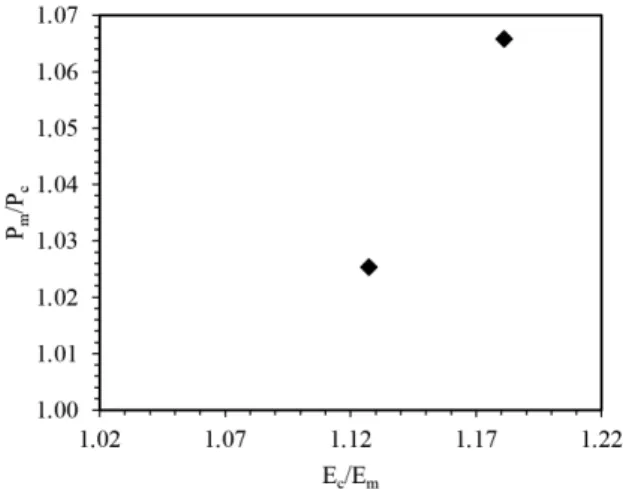
In Figure 4, the relationship between the relative permeability to oxygen coeficient (Pm/Pc) and the relative modulus of the nanocomposite (Ec/Em) is presented. Because there are only two experimental points available from both studies by Grigoriadou et al.30 Bikiaris & Triantafyllidis31 below percolation, we expect that the relationship between the relative permeability coeficients and the relative elastic moduli is linear with a slope of 0.75. It is worthy to mention that even we have a third point in the relative permeability at 2.5wt%, this point was not included in Figure 4 because it is believed that this concentration is beyond the percolation. The reduction between the 1wt% and 2.5wt% is large (almost 65% reduction). However, the relationship in Figure 4 does not pass through the origin and as seen in Figure 4 at Ec/Em=1.09 the value of Pm/Pc=1, which means that at small contents of Cu-nanoiber the value of Pc is close to the permeability to oxygen coeficient for HDPE matrix. The above mentioned circumstances make necessary to modify Equation 8 to become as follows:
( ) ( )
( )
/ ( / )
exp
/ ( / )
. .
/ ( / )
/ ( / )
−
+ − ∅ ∅
+ − ∅
= − +
− ∅
+ − ∅
f m f m
m c
f m f m
1 6 E E 1
1 125 41
1 6 E E 125exp 41
P 0 75 0 18 P
1 6 E E 1
1
1 6 E E 125exp 41
(9)
In addition to that, the experimental Oxygen Transmission Rate (OTR) from Bikiaris & Triantafyllidis31 study through each ilm was converted to permeability coeficient using the following equation
=
P OTR xl (10)
Where l is the thickness of the ilm.
Figure 5 shows the comparison of the experimental permeability to oxygen coeficient from Bikiaris & Triantafyllidis31 study and the calculated values of the permeability to oxygen coeficient from Equation 9 as a function of weight fraction of Cu‑nanoibers. As shown in Figure 5, the modiied model (Equation 9) correlates well for the composite samples and gives very precise permeability to oxygen coeficient up to 1wt% of Cu‑nanoiber. The maximum discrepancy between the experimental and the theoretical values was up to 2%.
Figure 4. The comparison of relative coeficient of gas permeability and
relative elastic modulus for nanocomposites of HDPE/Cu‑nanoibers.
4. Conclusion
Cu‑nanoibers are effective illers for enhancing mechanical and oxygen barrier properties of HDPE. The enhancements of these properties depend on the Cu‑nanoiber content. The reduction in oxygen permeability with Cu‑nanoiber below percolation increase was due to the decrease of HDPE fraction accessible for the gas transport process. However, the reduction was not signiicant because HDPE has relatively low fraction of amorphousity (crystallinity is high) thus the diffusive motion of oxygen between the molecular chains of PE is very low. Often, oxygen transfers easily without any obstacles. Also, it was noticed that mechanical percolation is independent of permeability percolation and they happen at different iller contents. Also, this permeability model can be used to predict the permeability coeficient for composite
materials below percolation based on measuring the elastic modulus of the composite.
One important ield for the produced composite materials is in pharmaceutical blisters packaging industry. With good barrier properties the shelf life of medications can be lengthen, also the cost of the blisters using this composite material can be reduced since both PE and Cu‑nanoibers are much cheaper than any other polymers, metal nanoibers, respectively. Also, the importance of this new material can be used in food packaging since all food packaging materials should have also good barrier properties protecting against oxygen and bacterial reaction or contamination. Food goes through biological and physical changes during storage and distribution. Also, it is very important to mention that the lexibility of the pure PE is retained while the barrier properties improved of this new material.
References
1. Peacock AJ. The chemistry of polyethylene. Journal of Macromolecular Science-Polymer Reviews. 2001; C41(4):285-323. http://dx.doi.org/10.1081/MC-100107860.
2. Galli P and Vecellio G. Polyolefins: the most promising large-volume materials for the 21st century. Journal of Polymer Science Part A: Polymer Chemistry. 2004; 42(3):396-415. http://dx.doi.org/10.1002/pola.10804.
3. Vasile C and Pascu M. Practical guide to polyethylene. Shrewsbury: RAPRA Technology; 2005.
4. Halary JL, Lauprêtre F and Monnerie L. Polymer materials: macroscopic properties and molecular interpretations. Hoboken: Wiley; 2011.
5. Lu N and Oza S. Thermal stability and thermo‑mechanical
properties of hemp-high density polyethylene composites: effect of two different chemical modifications. Composites. Part B, Engineering. 2013; 44(1):484-490. http://dx.doi.org/10.1016/j. compositesb.2012.03.024.
6. Ayswarya EP, Francis KFV, Renju VS and Thachil ET. Rice husk
ash: a valuable reinforcement for high density polyethylene. Materials & Design. 2012; 41:1-7. http://dx.doi.org/10.1016/j. matdes.2012.04.035.
7. Souza PS, Rodrigues EF, Prêta JMC, Goulart SAS and Mulinari
DR. Mechanical properties of HDPE/textile fibers composites. Procedia Engineering. 2011; 10:2040-2045. http://dx.doi. org/10.1016/j.proeng.2011.04.338.
8. Bakkal M, Bodur MS, Berkalp OB and Yilmaz S. The effect
of reprocessing on the mechanical properties of the waste fabric reinforced composites. Journal of Materials Processing
Technology. 2012; 212(11):2541-2548. http://dx.doi.org/10.1016/j. jmatprotec.2012.03.008.
9. Sunilkumar M, Francis T, Thachil ET and Sujith A. Low
density polyethylene–chitosan composites: a study based on biodegradation. Chemical Engineering Journal. 2012; 204–206:114-124. http://dx.doi.org/10.1016/j.cej.2012.07.058.
10. Araujo JR, Mano B, Teixeira GM, Spinacé MAS and De Paoli M-A. Biomicrofibrilar composites of high density polyethylene reinforced with curauá fibers: mechanical, interfacial and morphological properties. Composites Science
and Technology. 2010; 70(11):1637-1644. http://dx.doi. org/10.1016/j.compscitech.2010.06.006.
11. Liu S-P and Tu L-C. Studies on mechanical properties of dispersing intercalated silane montmorillonite in low density
polyethylene matrix. International Communications in Heat and
Mass Transfer. 2011; 38(7):879-886. http://dx.doi.org/10.1016/j. icheatmasstransfer.2011.04.009.
12. Zhang SA, Ke YC, Cao XY, Ma YM and Wang FS. Effect
of Al2O3 fibers on the thermal conductivity and mechanical properties of high density polyethylene with the absence and
presence of compatibilizer. Journal of Applied Polymer Science. 2012; 124(6):4874-4881.
13. AlMaadeed MA, Ouederni M and Noorunnisa Khanam P. Effect
of chain structure on the properties of glass fibre/polyethylene composites. Materials & Design. 2013; 47:725-730. http:// dx.doi.org/10.1016/j.matdes.2012.11.063.
14. Ayrilmis N. Combined effects of boron and compatibilizer on
dimensional stability and mechanical properties of wood/HDPE composites. Composites. Part B, Engineering. 2013; 44(1):745-749. http://dx.doi.org/10.1016/j.compositesb.2012.04.002.
15. Liao CZ, Bao SP and Tjong SC. Effect of silicon carbide nanoparticle additions on microstructure and mechanical behavior
of maleic anhydride compatibilized high density polyethylene
composites. Composite Interfaces. 2011; 18(2):107-120. http://
dx.doi.org/10.1163/092764411X567404.
16. Liu Y, Hu Y, Liu T, Ding JL and Zhong WH. Mechanical behavior of high density polyethylene and its carbon nanocomposites under quasi-static and dynamic compressive and tensile loadings.
Polymer Testing. 2015; 41:106-116. http://dx.doi.org/10.1016/j. polymertesting.2014.11.003.
17. Kuila T, Bose S, Mishra AK, Khanra P, Kim NH and Lee JH. Effect of functionalized graphene on the physical properties
of linear low density polyethylene nanocomposites. Polymer
Testing. 2012; 31(1):31-38. http://dx.doi.org/10.1016/j. polymertesting.2011.09.007.
18. Urresti O, Gonzalez A, Fernandez‑Berridi MJ, Iruin JJ and
Irusta L. Oxygen permeability through poly(ethylene-co-vinyl acetate)/clay nanocomposites prepared by microwave irradiation. Journal of Membrane Science. 2011; 373(1-2):173-177. http:// dx.doi.org/10.1016/j.memsci.2011.03.003.
19. Yousefi N, Gudarzi MM, Zheng Q, Lin X, Shen X, Jia J, et al. Highly aligned, ultralarge‑size reduced graphene oxide/
polyurethane nanocomposites: Mechanical properties and moisture permeability. Composites. Part A, Applied Science and Manufacturing. 2013; 49:42-50. http://dx.doi.org/10.1016/j. compositesa.2013.02.005.
2013; 38(10-11):1629-1652. http://dx.doi.org/10.1016/j. progpolymsci.2013.05.008.
21. Livi S, Sar G, Bugatti V, Espuche E and Duchet-Rumeau J. Synthesis and physical properties of new layered silicates based on ionic liquids: improvement of thermal stability, mechanical behaviour and water permeability of PBAT nanocomposites. RSC Advances. 2014; 4(50):26452-26461. http://dx.doi.org/10.1039/ c4ra02143f.
22. Song P, Yu Y, Zhang T, Fu S, Fang Z and Wu Q. Permeability,
viscoelasticity, and flammability performances and their relationship to polymer nanocomposites. Industrial & Engineering Chemistry Research. 2012; 51(21):7255-7263. http://dx.doi. org/10.1021/ie300311a.
23. Famá L, Rojo PG, Bernal C and Goyanes S. Biodegradable
starch based nanocomposites with low water vapor permeability and high storage modulus. Carbohydrate Polymers. 2012; 87(3):1989-1993. http://dx.doi.org/10.1016/j.carbpol.2011.10.007.
24. Nawani P, Burger C, Rong L, Hsiao BS and Tsou AH. Structure and permeability relationships in polymer nanocomposites containing carbon black and organoclay. Polymer. 2015; 64:19-28. http://dx.doi.org/10.1016/j.polymer.2015.02.041.
25. Yang F, Manitiu M, Kriegel R and Kannan RM. Structure,
permeability, and rheology of supercritical CO2 dispersed polystyrene-clay nanocomposites. Polymer. 2014; 55(16):3915-3924. http://dx.doi.org/10.1016/j.polymer.2014.05.020.
26. Decker JJ, Meyers KP, Paul DR, Schiraldi DA, Hiltner A and Nazarenko S. Polyethylene‑based nanocomposites containing
organoclay: a new approach to enhance gas barrier via multilayer coextrusion and interdiffusion. Polymer. 2015; 61:42-54. http:// dx.doi.org/10.1016/j.polymer.2015.01.061.
27. Choudalakis G and Gotsis A. Recent developments in the permeability of polymer clay nanocomposites. In: Pandey
JK, Reddy KR, Mohanty AK and Misra M, editors. Handbook
of polymernanocomposites: processing, performance and application. Heidelberg: Springer-Verlag Berlin Heidelberg; 2014. p. 415-451.
28. Arash B, Wang Q and Varadan VK. Mechanical properties of
carbon nanotube/polymer composites. Scientiic Reports. 2014; 4:1-24.
29. Kalendova A, Merinska D, Gerard JF and Slouf M. Polymer/
clay nanocomposites and their gas barrier properties. Polymer Composites. 2013; 34(9):1418-1424. http://dx.doi.org/10.1002/ pc.22541.
30. Grigoriadou I, Paraskevopoulos KM, Karavasili M, Karagiannis G,
Vasileiou A and Bikiaris D. HDPE/Cu-nanofiber nanocomposites with enhanced mechanical and UV stability properties.
Composites. Part B, Engineering. 2013; 55:407-420. http:// dx.doi.org/10.1016/j.compositesb.2013.07.002.
31. Bikiaris DN and Triantafyllidis KS. HDPE/Cu‑nanofiber
nanocomposites with enhanced antibacterial and oxygen barrier properties appropriate for food packaging applications. Materials Letters. 2013; 93:1-4. http://dx.doi.org/10.1016/j. matlet.2012.10.128.
32. Stauffer D and Aharony A. Introduction to percolation theory: revised. 2nd ed. New York: Taylor & Francis; 1994.
33. Nawaz K, Khan U, Ul‑Haq N, May P, O’Neill A and Coleman JN. Observation of mechanical percolation in functionalized
graphene oxide/elastomer composites. Carbon. 2012; 50(12):4489-4494. http://dx.doi.org/10.1016/j.carbon.2012.05.029. 34. Stankovich S, Piner RD, Nguyen ST and Ruoff RS. Synthesis and
exfoliation of isocyanate-treated graphene oxide nanoplatelets. Carbon. 2006; 44(15):3342-3347. http://dx.doi.org/10.1016/j. carbon.2006.06.004.
35. Liff SM, Kumar N and McKinley GH. High‑performance
elastomeric nanocomposites via solvent-exchange processing. Nature Materials. 2007; 6(1):76-83. http://dx.doi.org/10.1038/ nmat1798.
36. Hu L, Wu H and Cui Y. Metal nanogrids, nanowires, and nanofibers for transparent electrodes. MRS Bulletin. 2011; 36(10):760-765. http://dx.doi.org/10.1557/mrs.2011.234.
37. Cho YS and Huh YD. Synthesis of ultralong copper nanowires by reduction of copper-amine complexes. Materials Letters. 2009; 63(2):227-229. http://dx.doi.org/10.1016/j.matlet.2008.09.049. 38. Gooch J. ASTM D638. In: Gooch J, editor. Encyclopedic
dictionary of polymers. New York: Springer; 2011. p. 51-51.
39. Affdl J and Kardos J. The Halpin‑Tsai equations: a review.
Polymer Engineering and Science. 1976; 16(5):344-352. http:// dx.doi.org/10.1002/pen.760160512.
40. Halpin JC. Effects of environmental factors on composite materials. Ohio: Air Force Materials Laboratory; 1969. Technical
Report AFML‑TR‑67‑423. DTIC Document.
41. Cox HL. The elasticity and strength of paper and other fibrous materials. British Journal of Applied Physics. 1952; 3(3):72-79. http://dx.doi.org/10.1088/0508-3443/3/3/302.
42. Montazeri A, Javadpour J, Khavandi A, Tcharkhtchi A and
Mohajeri A. Mechanical properties of multi-walled carbon nanotube/epoxy composites. Materials & Design. 2010; 31(9):4202-4208. http://dx.doi.org/10.1016/j.matdes.2010.04.018.
43. Yeh MK, Tai NH and Liu JH. Mechanical behavior of