*e-mail: [email protected]
Use of Ni-Zn Ferrites Doped with Cu as Catalyst in the
Transesterification of Soybean Oil to Methyl Esters
Joelda Dantasa*, Jakeline Raiane D. Santosa, Rodrigo Bruno L. Cunhaa,
Ruth Herta G. A. Kiminamib, Ana Cristina F. M. Costaa
aSynthesis Laboratory of Ceramic Materials – LabSMaC, Department of Materials Engineering,
Federal University of Campina Grande – UFCG, CEP 58109-970, Campina Grande, PB, Brazil
bDepartment of Materials Engineering, Federal University of São Carlos – UFSCar,
CEP 13565-905, São Carlos, SP, Brazil
Received: November 3, 2012; Revised: December 19, 2012
The purpose of this work is to evaluate the performance of Ni0.5Zn0.5Fe2O4 ferrite doped with 0.1 and 0.4 mol of Cu as a catalyst for the transesterification of soybean oil to biodiesel, using methanol. The samples were characterized by X-ray diffraction, nitrogen adsorption and scanning electron microscopy. The reaction was performed for 2 hours at a temperature of 160 °C, using 10 g of soybean oil, a molar ratio of oil: alcohol of 1:20, and 4% (w/w) of catalyst. The product of the reaction was characterized by gas chromatography, which confirmed conversion to methyl esters. The diffraction patterns showed the presence only of Ni0.5Zn0.5Fe2O4 ferrite phase with a crystallite size of 29 nm. The samples doped with 0.1 and 0.4 mol of Cu showed a surface area and particle size of 22.17 m2g–1 and
50.47 nm; and 23.49 m2g–1 and 47.64 nm, respectively. The morphology of both samples consisted of
brittle block-shaped agglomerates with a wide particle size distribution. A comparative analysis of the two catalysts indicated that the catalyst doped with 0.4 mol of Cu showed the better performance, with a conversion rate of 50.25%, while the catalyst doped with 0.1 mol of Cu showed 42.71% conversion.
Keywords: biodiesel, transesterification, NiZn ferrite, copper, catalysts
1. Introduction
Metal oxide spinel type ferrites have proved to be very important for catalysis, and the literature describes the favorable performance of ferrites obtained via combustion synthesis with potential application in biodiesel production1,2. On a laboratory scale, various chemical
synthesis methods are known to obtain ferrites, aiming the development of new materials or the optimization of the existing materials characteristics. Among these are the hydrothermal synthesis3, the conventional ceramic method4
and thermal cracking5. However, the combustion reaction
synthesis has received special attention because its easy procedure, do not require multiple processing steps, do not use sophisticated equipment, it’s quick, it’s possible a reproducibility of the product and its achievement in batches (semi-pilot scale lab)6.
Biodiesel, a renewable source of energy increasingly used for the total or partial substitution of fossil diesel7,
offers numerous advantages for the environment, society and the global economy. Many chemical processes are used in biodiesel production, including transesterification, esterification, cracking or pyrolysis. The transesterification reaction is a widely used process to transform raw materials with high levels of fatty acids into biodiesel. However, the homogeneous and heterogeneous catalysts that trigger this reaction have several limitations. Therefore, research has increasingly focused on new catalytic systems that can
promote high activity, easy separation and recovery, and inhibit the corrosion of processing equipment8.
Among these new systems with potential applications are nanoscale solids, whose large surface area increases the contact between catalyst and substrate, enabling them to be recovered and reused in other reaction processes9.
Thus, heterogeneous catalysts play a fundamental role in the chemical reaction of transesterification, since they accelerate the reaction that converts fatty acids from triacylglycerides (vegetable oil) into the corresponding methyl esters of fatty acids (biodiesel). In view of these advantages, this study aimed to evaluate the performance of Ni0.5Zn0.5Fe2O4 nanoferrites doped with 0.1 and 0.4 mol of Cu2+ as catalysts
in the transesterification of soybean oil with methanol to produce biodiesel.
2. Material and Methods
The synthesis of nanoferrites obtained via combustion reaction involved mixing salts of metal ions as oxidizing reagents (nickel nitrate, zinc, copper and iron) and urea as reducing agent to form a redox solution. The initial composition of the solution was calculated based on the total valence of oxidizing and reducing reagents, using the concept of propellant chemistry10. The reactions were
performed in a stainless steel container, which was heated directly on a ceramic base with a coil resistance until self-ignition and subsequent combustion occurred.
OI:
D 10.1590/S1516-14392013005000031
Dantas et al.
Samples of nanoferrites were characterized by X-ray diffraction (SHIMADZU XRD-6000 diffractometer), using CuKα radiation, λ = 1.542 Å, a voltage of 40 kV, 30 mA current and scanning from 15 to 85. The crystallite size was calculated from the X-ray line broadening (d311) by deconvolution of the secondary diffraction line of polycrystalline cerium (used as standard), using the Debye-Scherrer equation11. The specific surface area of
the nanoferrites was determined by the BET (Brunauer, Emmett and Teller) nitrogen adsorption method, using a Micromeritics ASAP 2020 surface area porosity analyzer. The morphological aspects of the nanoferrites resulting from the combustion reaction were analyzed using a scanning electron microscope (SEM, SHIMADZU SSX-550 Superscan) operating at 15 kV.
The transesterification reactions were performed in a pressurized stainless steel reactor with a usable volume of 80 mL, equipped with borosilicate glass sleeves and a thermocouple input tube connected to a manometer. Stirring and heating were performed on a heating plate with magnetic stirring. The molar ratio of methyl alcohol to fatty acid was 20: 1, using 4 wt. (%) of catalyst relative to fatty acid. The reactions were performed at 160°C for 2 hours. The products of the transesterification reaction were analyzed in a Varian 450-GC gas chromatograph equipped with a flame ionization detector (FID) operating at 380 °C, using a Varian capillary column stationary phase Select Biodiesel for Glycerides + RG (Ultimetal) (15 m × 0.32 mm × 0.45 µm). The initial injection temperature was 100 °C and that of the GC was 180 °C.
3. Results
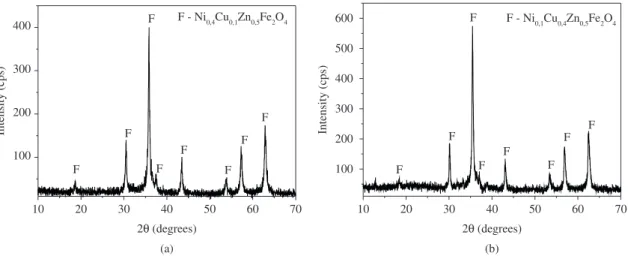
Figure 1 shows the diffractograms of the Ni0.5Zn0.5Fe2O4 nanoferrites doped with 0.1 mol and 0.4 mol of Cu2+. Note
the presence of major peaks characteristic of the inverse spinel structure, as evidenced by the appearance of the main peak 2θ = 35.5°, according to the crystallographic form indicated in JCPDS card no. 52-0278. Note the peaks of high intensity and high basal width of all the reflections, indicating the crystallinity of the samples and their characteristic nanostructure. Both samples showed a crystallite size of about 29 nm, confirming the efficiency of the combustion reaction of the materials. These results are consistent with the work of Batoo and Ansari12, who
studied ferrite nanoparticles with a basic composition of Ni0.7-xCu0.3ZnxFe2O4 synthesized by self-combustion and obtained a single phase and a crystallite size of 28 to 32 nm.
Table 1 lists the values of specific surface area (SBET), particle size (DBET) and the ratio of particle to crystallite size (Tc) of the Ni0.5Zn0.5F2O4 nanoferrites doped with 0.1 mol and 0.4 mol Cu2+. These data indicate that the
two nanoferrites showed very similar surface area values, although the surface area of the nanoferrite doped with 0.4 mol of Cu2+ was 5.52% larger than that of the nanoferrite
doped with 0.1 mol of Cu2+. The specific surface areas
listed in Table 1 indicate that, in general, that of the Ni0,1Cu0,4Zn0,5Fe2O4 nanoferrite was higher, thus favoring a reduction in particle size. In addition, the ratio of particle size to crystallite size (DBET/tc) showed a slight increase at the higher Cu2+ doping, thus indicating that the respective
particles tend to be monocrystalline.
Figure 2 shows the morphology of the nanoferrites. The micrographs indicate that the two nanoferrites were generally composed of irregular block-shaped agglomerates with a brittle appearance, i.e., fine particles loosely bound with little porosity due to the flue gas. This confirms the results of the aforementioned analysis of particle size determined from the surface area measurements. Costa et al.13, who
synthesized and characterized Ni-Cu-Zn ferrites, also
Table 1. Surface area, particle size and ratio of particle size to crystallite size.
Nanoferrites Surface area (BET) (m2g–1) Particle size (DBET) (nm) DBET/Tc*
Ni0,4Cu0,1Zn0,5Fe2O4 22,17 51 1.8
Ni0,1Cu0,4Zn0,5Fe2O4 23,49 48 1,7
*Tc = Crystallite size.
Figure 1. X-ray diffractograms of nanoferrites with: (a) 0.1 mol and (b) 0.4 mol of Cu2+.
Use of Ni-Zn Ferrites Doped with Cu as Catalyst in the Transesterification of Soybean Oil to Methyl Esters
reported a morphology consisting of soft agglomerates of nanoparticles smaller than 100 nm. Our results were also consistent with those reported by these authors regarding the particle size of the materials determined by BET.
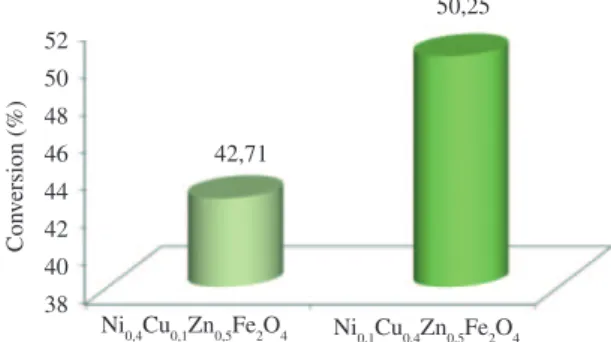
Figure 3 illustrates the results achieved by using nanoferrites as catalysts to obtain biodiesel. The nanoferrite doped with 0.4 moles of Cu2+, whose specific surface area
was slightly higher than that doped with 0.1 moles of Cu2+,
achieved a higher conversion rate. This was probably due to its larger specific surface area, which is an important characteristic of a good catalyst. This finding is supported by reports in the literature that, when it comes to catalysts, the larger the area available to the reactants, the greater the conversion of products provided diffusive phenomena are not involved14. In general, it was observed that both evaluated
nanoferritas has shown satisfactory conversions on tested conditions and it’s possible therefore to be considered as a new promising catalysts aiming in the biodiesel production.
4. Conclusions
The combustion reaction synthesis was efficient for processing Ni0.5Zn0.5Fe2O4 nanoferrites doped with Cu2+,
yielding the desired phase with a crystallite size of 29 nm. The best conversion result was obtained with nanoferrite
doped with 0.4 moles of Cu2+, and a correlation was
identified between specific surface area and the percentage of conversion achieved. The catalysts tested under the conditions of this study show a promising potential for use in transesterification reactions of soybean oil to methyl.
Acknowledgements
The authors are grateful for the financial support granted by the Brazilian research funding agencies RENAMI, Inct-INAMI, CNPq and CAPES.
Figure 3. Conversion to methyl ester of nanoferrites.
Figure 2. SEM micrograph with magnified 1000× for: (a) 0.1 mol
and (b) 0.4 mol Cu2+.
References
1. Dantas J, Silva AS, Santos PTA, Santos JRD, Barbosa DC, Meneghetti SMP et al. Evaluation of catalyst Ni0.4Cu0.1Zn0.5Fe2o4 on methyl esterification of free fatty acid present in cottonseed oil. Materials Science Forum. 2012; 727-728:1302-1307. http://
dx.doi.org/10.4028/www.scientific.net/MSF.727-728.1302 2. Barbosa DC, Santos PTA, Souza FTC, Costa ACFM, Meneghetti
SMP and Meneghetti MR. Emprego de Ni0,4Cu0,1Zn0,5Fe2O4 como Catalisador Heterogêneo na Esterificação de Ácidos Graxos. In: Anais da 34ª Reunião Anual da Sociedade
Brasileira de Química-SBQ; 2011; Praia do Santinho.
SBQ; 2011. T1140-2.
3. Wilson A, Mishra SR, Gupta R and Ghosh K. Preparation and photocatalytic properties of hybrid core–shell reusable CoFe2O4–ZnO nanopheres. Journal of Magnetism and Magnetic Materials. 2012; 324; p. 2597-2601. http://dx.doi. org/10.1016/j.jmmm.2012.02.009
4. Zhao DL, Lv Q and Shen ZM. Fabrication and microwave absorbing properties of Ni–Zn spinel ferrites. Journal of Alloys and Compounds. 2009; 480; p. 634-638. http://dx.doi. org/10.1016/j.jallcom.2009.01.130
5. Buzetzki E, Sidorová K, Cvengrosová Z and Cvengros J. Effects of oil type on products obtained by cracking of oils and fats.
Fuel Processing Technology. 2011; 2041-2047. http://dx.doi.
org/10.1016/j.fuproc.2011.06.005
6. Costa ACFM, Kiminami RHGA and Morelli MR. Combustion synthesis processing of nanoceramics. In: Handbook of nanoceramics and their based nanodevices (Synthesis and Processing). Ed. American Scientific Publishers; 2009. v. 1, chapt. 14, p. 375-392.
7. Brito JF. Tratamento da água de purificação do biodiesel utilizando eletrofloculação. Química Nova. 2012; 35(4):1-5. http://dx.doi.org/10.1590/S0100-40422012000400014 8. Suarez PAZ, Mello VM, Pousa GPAG, Pereira MSC and Dias
IM. Metal oxides as heterogeneous catalysts for esterification of fatty acids obtained from soybean oil. Fuel Processing Technology. 2011; 92:53-57. http://dx.doi.org/10.1016/j.
fuproc.2010.08.019
9. Jacinto MJ, Kiyohara PK, Masunaga SH, Jardim RF and Rossi LM. Recoverable rhodium nanoparticles: synthesis, characterization and catalytic performance in hydrogenation reactions. Applied catalysis A: general. 2008; 338:52-57. http://
dx.doi.org/10.1016/j.apcata.2007.12.018
10. Jain SR, Adiga KC and Verneker VP. A new approach to thermo chemical calculations of condensed fuel. Combustion and Flame. 1981; 40:71-79. http://dx.doi.org/10.1016/0010-2180(81)90111-5
11. Klung H and Alexander L. In X-ray diffraction procedures.
New York: Wiley; 1962. 495 p.
12. Batoo KM and Ansari MS. Low temperature-fired Ni-Cu-Zn ferrite nanoparticles through auto-combustion method for multilayer chip inductor application. Nanoscale Research Letters. 2012; 7(1):112.
http://dx.doi.org/10.1186/1556-276X-7-112
13. Costa ACFM, Gama L, Portela FA, Silva VJ, Torquarto RA, Kiminami RHGA et al. Ferritas Ni-Cu-Zn Preparadas por Reação de Combustão: Síntese e Caracterização. Revista Eletrônica de Materiais e Processos. 2007; 2:10-17. 14. Silva JB, Rodrigues JAJ and Nono MCA. Caracterização
de materiais catalíticos. Instituto Nacional de Pesquisas
Espaciais - INPE; 2008. 15252 – PUD/198.