Article
Printed in Brazil - ©2013 Sociedade Brasileira de Química0103 - 5053 $6.00+0.00
A
*e-mail: [email protected]
Partial Oxidation of Methane to Syngas on Rh/Al
2O
3and Rh/Ce-ZrO
2Catalysts
Raquel L. Oliveira, Isabela G. Bitencourt and Fabio B. Passos*
Departamento de Engenharia Química e Petróleo, Universidade Federal Fluminense, Rua Passo da Pátria, 156, 24210-240 Niterói-RJ, Brazil
A oxidação parcial do metano sobre catalisadores de ródio suportados em γ-Al2O3, CeO2, ZrO2 e Ce-ZrO2 foi investigada. Medidas de DRIFTS (espectroscopia no infravermelho com reflectância
difusa) de CO adsorvido mostraram que houve a formação de diferentes espécies de ródio nos diferentes suportes, o que por sua vez influenciou na dispersão do metal. Os efeitos da dispersão metálica e da capacidade de armazenamento de oxigênio sobre a atividade dos catalisadores na oxidação parcial foram discutidos.
The partial oxidation of methane with γ-Al2O3-, CeO2-, ZrO2- and Ce-ZrO2-supported rhodium
catalysts was investigated. DRIFTS (diffuse reflectance infrared spectroscopy) measurements of adsorbed CO showed the formation of different rhodium species on different supports, which influenced the dispersion of the metal. The effects of the metal dispersion, oxygen storage capacity on the activity of these catalysts for the partial oxidation of methane are discussed.
Keywords: methane partial oxidation, methane, ceria-zirconia, rhodium, DRIFTS
Introduction
The catalytic partial oxidation of methane is an alternative to steam reforming, the industrial process for the production of synthesis gas from methane. Partial oxidation is a more energy efficient and less expensive process than steam reforming. The partial oxidation of methane (POM) is a mildly exothermic reaction, in which methane reacts with a limited amount of oxygen to produce hydrogen and carbon monoxide:
CH4 + ½ O2→ CO + 2H2 (1)
The POM process is capable of producing syngas with a H2/CO ratio of approximately 2, which makes it a favorable method for methanol and hydrocarbon synthesis.1,2 Noble metal catalysts (Ir, Ru, Rh, Pt, Pd) exhibit high activity, along with long-term stability, while minimizing the levels of coking, particularly when compared to the non-noble metals (such as Fe, Co, Ni).1,2 The lack of a hydrogen infrastructure, as well as disadvantages in hydrogen storage, has stimulated the development of compact fuel processors, which are able to produce a rich hydrogen gas mixture from hydrocarbons. Several studies have reported that Rh
catalysts are especially appropriate for use in compact fuel processors because of their high activity, selectivity for syngas and resistance to carbon deposition.2
One of the main disadvantages of methane conversion is the deactivation due to coke formation. Thus, there is a great interest in designing catalysts that minimize the deleterious effect of coking. The presence of oxygen vacancies in supports that contain CeO2 proved to be instrumental in keeping the metal particles free from coke deposition during the steam reforming,3-5 partial oxidation,6-9 CO
2 reforming and autothermal reforming of methane,10-12 when using nickel or noble metals as catalysts.13-15 Furthermore, ceria may also improve the catalytic performance by increasing the noble metal dispersion and stabilizing the support. Both the metal dispersion and support reducibility of Pt/CeO2 and Pt/CexZr1–xO2 were found to influence the catalytic activity and stability of the catalysts in the partial oxidation of methane.6,10 An increase in the activity of Rh/CeZrO2, for the partial oxidation of methane as a result of a higher Rh dispersion has also been reported.11,12
(XRD), CO and H2 chemisorption and diffuse reflectance infrared spectroscopy (DRIFTS) of adsorbed CO. The metal surface was also examined through the dehydrogenation of the cyclohexane model reaction. The partial oxidation of methane by these catalysts was investigated by temperature programmed surface reaction (TPSR) and the stability of the catalysts was probed in a continuous reactor.
Experimental
Catalyst preparation
The catalysts were prepared by incipient wetness using Rh(NO3)3 (final Rh content equal to 1.5%) as the precursor. γ-Al2O3, ZrO2 and CeO2 supports were obtained by calcining bohemite (Catapal), (NH4)2Ce(NO3)6 (Aldrich) and Zr(OH)2 (Aldrich), respectively, at 800 ºC for 1 h. The CexZr1-xO2 (x = 0.25, 0.5, 0.75) supports were obtained through a co-precipitation method.13 An aqueous solution of (NH4)2Ce(NO3)6 (Aldrich) and ZrO(NO3)2 (Aldrich) was prepared to obtain the desired amounts of CeO2 and ZrO2. Then, the ceria and zirconium hydroxides were co-precipitated by the addition of excess NH4OH (Merck). Finally, the precipitate was washed with distilled water and calcined at 800 ºC for 1 h.
Catalyst characterization
BET specific surface areas were measured at –196 °C in a Micromeritics ASAP 2010. The samples (1 g) were previously dried at 250 ºC under vacuum. TPR measurements were carried out in a micro-reactor coupled to a quadrupole mass spectrometer (Balzers, Omnistar). The samples (150 mg) were dehydrated at 150 ºC for 30 min under He flow prior to reduction. After cooling to room temperature, the samples were then subjected to 5% H2/Ar gas flow (30 mL min-1), and the temperature was raised to 1000 ºC at a rate of 10 ºC min-1.
XRD data of the calcined catalysts, and their respective supports, were performed in a Rigaku Miniflex spectrometer using monochromatic Cu Kα(1.540 Å) radiation with a scan rate of 0.05 °C min-1 and a 2θ range of 2-90º.
In the literature, structure insensitive reactions have been reported for the characterization of catalysts.14 The rhodium active phase was probed through cyclohexane dehydrogenation as a structure insensitive reaction.14 This reaction was performed under atmospheric pressure in a continuous flow micro-reactor. The pretreatment of the samples (10 mg) consisted of drying them at 150 ºC under a stream of He (30 mL min-1) for 30 min, followed by reduction at 500 ºC under a H2 flow (10 ºC min-1) and
a final purge using He (30 mL min-1) at 800 ºC for 30 min. The reactant mixture was obtained by bubbling hydrogen through a saturator containing cyclohexane at 12 ºC (H2/C6H12 13.6). The total flow rate was equal to 100 mL min-1 and the temperature was 270 ºC. The effluent gas phase was analyzed with an on-line gas chromatograph (HP-5890) equipped with a flame ionization detector and an HP Innowax capillary column. Under these conditions, no significant deactivation of the catalysts was observed, and there were no diffusional or thermodynamic limitations.
H2 and CO chemisorption measurements were
conducted using a Micromeritics ASAP 2010 gas sorption analyzer. The mass of the samples used was 500 mg. The calcined samples were subjected to a standard procedure consisting of heating the sample under He (30 mL min-1) at 150 ºC for 30 min, followed by reduction in a flow of H2 (30 mL min-1) at a rate of 10 ºC min-1 up to 500 ºC. Then, the samples were heated in He (30 mL min-1) to 800 ºC. Then, the samples were evacuated for 30 min at the final temperature to remove any residual H2, before cooling under vacuum to 35 ºC for analysis. The irreversible H2 and CO uptakes were obtained using the difference between total and reversible H2 and CO uptakes. A chemisorption stoichiometry of H:Rh 1:1 and CO:Rh 1:1 was assumed.
DR-UV-Vis spectroscopy was carried out in a Varian model Cary 5.0 spectrometer equipped with a diffuse reflectance accessory (Harrick). To separate the contribution of the support, the reflectance R(λ) of the sample was made proportional to the reflectance of the respective support, and the Kubelka-Munk function F(R) was calculated.
In situ infrared spectra of the samples were conducted
using a Bruker VERTEX 70 FTIR equipped with an LN-MCT detector, using a diffuse reflectance cell (Harrick, HVC-DRP-4) with ZnSe windows. The spectra were recorded at 4 cm-1 resolution with 256 scans for each spectrum in the range from 2200 to 1700 cm-1. The samples were pretreated ex situ as described in the chemisorption experiments, and
Partial oxidation of methane
The partial oxidation of methane was performed in a quartz reactor at atmospheric pressure. Prior to each reaction, the catalyst was reduced under a flow of H2 (30 mL min-1) at 500 ºC for 1 h and then heated to 800 ºC under a He flow (30 mL min-1). The reaction was carried out at 800 ºC and weight hourly space velocity (WHSV) of 520 h-1 for all catalysts. A reactant mixture with a CH
4:O2 ratio of 2:1 and a total flow rate of 100 mL min-1 was used. To avoid temperature gradients, catalyst samples (10 mg) were diluted with inert SiC (18 mg). The transfer lines were kept at 140 °C to avoid condensation. The exit gases were analyzed using a gas chromatograph (Varian CP3800) equipped with a thermal conductivity detector and a Carboxen 1010 capillary column (SUPELCO). The H2 and CO selectivities were determined via the equations:
(2)
(3)
The TPSR experiments were performed in the same apparatus used for the TPR measurements. After drying under He at 150 ºC, the samples (150 mg) were reduced under a flow of H2 at 500 ºC for 1 h, purged with a flow of He at 800 ºC for 30 min, and cooled to room temperature. The samples were subjected to a flow of CH4/O2/He (2:1:27) at 30 mL min-1 while the temperature was raised to 800 ºC at rate of 20 ºC min-1.
Results and Discussion
Catalyst characterization
BET specific surface areas of the several catalysts are shown in Table 1. As expected, the 1.5%Rh/γ-Al2O3 presented the highest surface area, followed by the mixed oxide supported Rh catalysts, which presented higher surface areas than the single CeO2- and ZrO2-supported catalysts.
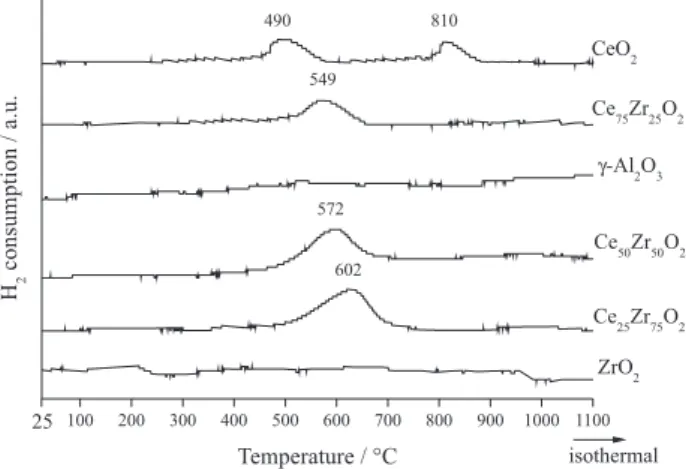
TPR profiles of the supports are presented in Figure 1.
The CeO2 support showed H2 consumption peaks at
approximately 490 and 810 ºC; usually these are ascribed to the reduction of the capping and bulk CeO2, respectively.15 No reduction was observed for γ-Al2O3 and ZrO2.16,17 Ce-ZrO2 supports presented maximum temperatures of reduction that shifted from 602 to 549 ºC with increasing CeO2 content. These peaks are related to the CeO2 reduction in a solid Ce-ZrO2 solution, which happened at a lower temperature than the reduction temperature observed for pure CeO2.18
The TPR profile (Figure 2) for the 1.5%Rh/γ-Al2O3 catalyst showed a peak at 154 °C, which may be attributed to the reduction of Rh2O3.19,20 The profile for the 1.5%Rh/CeO2 catalyst showed peaks at 96, 224 and 967 °C. The first two peaks may be attributed to the reduction of well-dispersed Rh2O3 and of larger Rh2O3 particles,21 which occurs simultaneously with the reduction of the surface ceria, and the last peak results from the reduction of bulk ceria.22 For the 1.5%Rh/ZrO
2, there were peaks at 98 and 211 °C corresponding to the reduction of two different types of Rh2O3, one with high dispersion and the other with low dispersion.23 The 1.5%Rh/Ce
75Zr25O2 TPR profile presented peaks at 98, 135, 238 and 1003 °C, which may be attributed to the reduction of well dispersed Rh2O3, larger Rh2O3 particles, surface ceria and the reduction of bulk ceria, respectively. Additionally, the TPR profiles of the 1.5%Rh/Ce25Zr75O2 and 1.5%Rh/Ce50Zr50O2 catalysts presented only two peaks, the first due to the reduction of well dispersed Rh2O3 and the second resulting from simultaneous reduction of Rh2O3 and the respective supports.23 The hydrogen uptakes of the supported catalysts during the TPR experiments are displayed in Table 1 and are consistent with the previous peak assignments.
Table 1. BET specific surface area and H2 uptake during TPR for Rh catalysts
Catalyst SBET / (m2 g-1) H
2 uptake / (µmol gcat-1)
1.5%Rh/γ-Al2O3 188 1.9
1.5%Rh/CeO2 16 4.1
1.5%Rh/ZrO2 37 1.8
1.5%Rh/Ce75Zr25O2 58 3.5
1.5%Rh/Ce50Zr50O2 52 3.1
1.5%Rh/Ce25Zr75O2 49 2.6
Figure 3 shows the XRD patterns of the Rh catalysts. Due to the low Rh content and high dispersion,2 no Rh2O3 peaks were detected. Thus, all catalysts presented diffraction patterns essentially identical to their respective supports.
The 1.5%Rh/γ-Al2O3 catalyst showed the presence of peaks at approximately 2θ 45 and 70º, which are characteristic of γ-Al2O3 obtained through the calcination of bohemite.24,25 For 1.5%Rh/CeO
2, it was possible to observe the diffraction patterns relative to that of CeO2 with a fluorite structure (JCPDS 4-0593), while a monoclinic ZrO2 phase (JCPDS 13-307) could be detected for the 1.5%Rh/ZrO2 catalyst.15,26 The diffraction pattern for 1.5%Rh/Ce
75Zr25O2 did not show separate phases for CeO2 or ZrO2. There was a shift in the corresponding CeO2 peaks from 2θ 28.6, 33.1, 47.51 and 56.41° to 2θ 28.9, 33.3, 48.1 and 57.0°. This shift increased to higher Bragg angles as the ZrO2 content was increased (1.5%Rh/Ce25Zr75O2 and 1.5%Rh/Ce50Zr50O2).
This shift is related to the formation of a solid solution of CeO2 and ZrO2 with a cubic structure.27
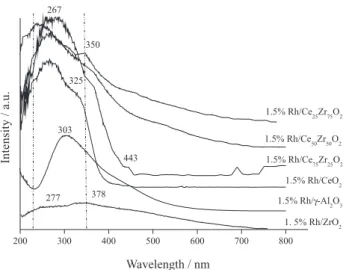
Figure 4 shows the DR-UV-Vis spectra of the catalysts. For 1.5%Rh/γ-Al2O3, a broad band centered at 320 nm was present. This band corresponds to the 1A
1g→1T1g transition.28,29 The spectra for the 1.5%Rh/ZrO2, 1.5%Rh/CeO2 and 1.5%Rh/Ce-ZrO2 catalysts displayed two broad bands, one centered at approximately 260 nm due to Rh-O charge transfer and the other at approximately 320 nm due to the 1A
1g→1T1g transition.35 These results are consistent with the TPR results as the broad bands are due to the inhomogeneity of the surface.
Table 2 displays the results of H2 and CO chemisorption on the catalysts. The 1.5%Rh/γ-Al2O3 catalyst showed larger H/Rh and CO/Rh values due to the higher γ-Al2O3 surface area. Rh/ZrO2 presented the lowest H/Rh and CO/Rh ratios, although these values increase with CeO2 content for the Rh/Ce-ZrO2 catalysts. Since H2 and CO can adsorb on CeO2, these gases are not considered adequate to evaluate the dispersion of the CeO2 supported catalysts.30
Additionally, cyclohexane dehydrogenation was used to probe the surface active sites of the investigated catalysts (Table 3). The initial dehydrogenation rate increased in the following order: 1.5%Rh/ZrO2 < 1.5%Rh/Ce50Zr50O2 < 1.5%Rh/CeO2 < 1.5%Rh/Ce75Zr25O2 < 1.5%Rh/Ce25Zr75O2 < 1.5%Rh/γ-Al2O3.
DRIFTS absorption spectra of CO adsorbed on the catalysts at room temperature are displayed in Figure 5. The 1.5%Rh/γ-Al2O3 catalyst presented a major band with a maximum at 2090 cm-1 and a smaller band at 2019 cm-1. These bands are associated with the symmetric and asymmetric CO stretching modes of the gem-dicarbonyl
Figure 2. Temperature programmed reduction profiles of the
1.5%Rh/γ-Al2O3, 1.5%Rh/CeO2, 1.5%Rh/ZrO2 and 1.5%Rh/Ce-ZrO2 catalysts.
Figure 3. X-Ray diffraction patterns of the 1.5%Rh/γ-Al2O3, 1.5%Rh/CeO2, 1.5%Rh/ZrO2 and 1.5%Rh/Ce-ZrO2 catalysts.
species RhI-(CO)
2, which are generated by reaction of atomically dispersed rhodium particles with surface hydroxyl groups and CO.37,38 An additional band at 2062 cm-1 was observed for 1.5%Rh/CeO2. This band results from the linear adsorption of CO on metallic rhodium crystallite particles.31,32 This is consistent with the presence of both well dispersed and larger Rh particles indicated by the TPR experiments. Additionally, two broad bands at 1850 and 1940 cm-1 were observed and are attributed to two types of bridge-bonded CO on the Rh0 sites.33 With 1.5%Rh/ZrO
2, the absorbance intensities were lower than observed for the other catalysts, and the bands relative to gem-dicarbonyl
species (2090 and 2020 cm-1) were much smaller as
expected because of the low CO adsorption capacity observed for this catalyst. A broad band between 2000 and 2050 cm-1, attributed to the linear adsorption of CO on Rh metal, and a small band at 1850 cm-1, attributed to bridge-bonded CO, were observed.34 The spectra of the Rh/CeZrO
2 catalysts contained very broad bands, indicating a non-uniform distribution of Rh particle sizes. For the 1.5%Rh/ Ce75Zr25O2 catalyst, a main broad band was observed at 2055 cm-1 due to linear CO-Rh adsorption, with a tail at 1950 cm-1. A small band at 1850 cm-1 due to the two types of bridge-adsorbed CO was also observed. A small shoulder was observed at 2020 cm-1 indicating a superposition of the bands resulting from the gem-dicarbonyl species (2090 and 2020 cm-1) and the broad band centered at 2055 cm-1. Similar results were observed for the 1.5%Rh/Ce50Zr50O2 and 1.5%Rh/Ce25Zr75O2 catalysts.
Figure 6 shows the thermal desorption spectra for the 1.5%Rh/γ-Al2O3 catalysts. The intensity of the band relative to the gem-dicarbonyl species decreases as the temperature was raised. The frequencies of these bands were essentially invariant as is expected for CO adsorption on isolated sites.37
Conversely, 1.5%Rh/Ce25Zr75O2 shows a decrease (Figure 7) in the frequency of the linearly bound CO from 2055 to 2028 cm-1 due to the decrease in the dipole-dipole Table 2. H2 and CO chemisorption uptake at 35 ºC on Rh catalysts
Catalyst CO uptake / (µmol gcat-1) CO/Rh* / % H2 uptake / (µmol gcat-1) H/Rh* / %
Total Irreversible uptake Total Irreversible uptake
1.5%Rh/γ-Al2O3 120 98.5 67.6 58.1 36.5 50.1
1.5%Rh/CeO2 25.7 24.3 16.7 22.8 12.8 17.6
1.5%Rh/ZrO2 30.6 11.2 7.7 22.0 5.9 8.1
1.5%Rh/Ce75Zr25O2 34.9 28.9 19.8 27.0 14.0 19.2
1.5%Rh/Ce50Zr50O2 41.2 21.3 14.6 29.5 10.6 14.5
1.5%Rh/Ce25Zr75O2 34.3 18.7 12.8 29.6 7.0 9.6
Table 3. Cyclohexane dehydrogenation on Rh catalysts at 270 ºC
Catalyst Initial rate / (10-3 mol h-1 g
cat-1)
1.5%Rh/γ-Al2O3 121.1
1.5%Rh/CeO2 52.2
1.5%Rh/ZrO2 40.5
1.5%Rh/Ce75Zr25O2 62.9
1.5%Rh/Ce50Zr50O2 51.2
1.5%Rh/Ce25Zr75O2 64.8
Figure 5. Infrared spectra of adsorbed CO at room temperature on 1.5%Rh/γ-Al2O3, 1.5%Rh/CeO2, 1.5%Rh/ZrO2 and 1.5%Rh/Ce-ZrO2 catalysts.
Figure 6. Thermal desorption infrared spectra of CO adsorbed on
interactions as CO coverage decreases. The bridge-bond CO was less stable to the temperature increase than the linearly adsorbed CO. Similar results were obtained for the other Rh/CeZrO2 catalysts. These results confirm that the presence of Ce influences the state of Rh particles as reported by Erickson et al.11
Partial oxidation of methane
Figure 8 shows the conversion of methane during the partial oxidation of methane using these catalysts. All of the catalysts showed an initial induction time, required to stabilize the actives sites, except for 1.5%Rh/γ-Al2O3. This may be because only 1.5%Rh/γ-Al2O3 presented isolated Rh atoms as indicated by the DRIFTS experiments. All of the catalysts were stable during the 24 h time-on-stream, and no coke could be detected by temperature programmed oxidation of the used catalysts. The order of activity (Table 4) approximated the same order observed for the H/Rh and CO/Rh chemisorption ratios, with 1.5%Rh/γ-Al2O3 presenting the highest conversion. Thus, the H2 and CO chemisorption results were more reliable in predicting the order of methane conversion activity than the initial rate of cyclohexane dehydrogenation. This result is different than that observed for Pt/Ce-ZrO2 catalysts, in which cyclohexane dehydrogenation provided good estimates for methane partial oxidation activity.10
The addition of cerium to ZrO2 improved the activity of the Rh/Ce-ZrO2 catalysts but only for molar ratios greater than 50%. The H2 and CO selectivities for the catalysts followed the same trend as the activities (Figures 9 and 10).
The ratio of H2/CO (Table 4) was close to a value of 2 for the catalysts, indicating that there was no influence from the reverse water gas shift reaction. X-ray Photoelectron (XPS) and IR spectroscopic studies have previously shown the complex nature of Rh/γ-Al2O3 for CPO, with Rh0,
Figure 8. Methane partial oxidation on Rh catalysts (pressure: 1 atm, temperature: 800 °C and CH4:O2: 2:1, WHSV: 523 h-1).
Figure 7. Thermal desorption infrared spectra of CO adsorbed on
1.5%Rh/Ce25Zr75O2, (a) under 10% CO/He flow at 30 °C, and under He flow at (b) 30, (c) 100, (d) 200 and (e) 300 °C.
Table 4. Methane conversion and H2/CO ratio obtained in the partial oxidation of methane on Rh catalysts (pressure: 1 atm, temperature: 800 °C and CH4:O2: 2:1,WHSV: 523 h-1)
Catalyst CH4 conversion / % H2/CO
1.5%Rh/γ-Al2O3 84.5 1.8
1.5%Rh/CeO2 83.4 2.0
1.5%Rh/ZrO2 60.0 1.9
1.5%Rh/Ce75Zr25O2 80.4 2.0
1.5%Rh/Ce50Zr50O2 72.0 2.1
1.5%Rh/Ce25Zr75O2 59.0 2.1
Figure 9. Selectivity to H2 in the partial oxidation of methane on Rh catalysts (pressure: 1 atm, temperature: 800 °C and CH4:O2: 2:1, WHSV: 523 h-1).
Rh+ and Rh3+ coexisting on the surface under the reaction conditions.11
with Pt/ZrO2,35 Pt/Ce-ZrO2 and Rh/Ce-ZrO2 catalysts.16,17 In fact, recent theoretical and experimental results showed that the indirect mechanism is most probable for the catalytic partial oxidation of CH4 as CO and H2 are predominantly formed upon complete O2 depletion from the sequential reforming steps.42
The advantage of using CeZrO2 as a support has been explained by the continuous removal of carbonaceous deposits from the active sites at the metal-support interfacial perimeter.6,11 However, under the reaction conditions used in this study, the catalysts have not been deactivated and the coke could not be detected by temperature programmed oxidation experiments. From this, an improvement in the dispersion for the Rh/CeZrO2 catalysts when compared to Rh/ZrO2 was the main observed effect.
Conclusions
Rhodium catalysts supported on γ-Al2O3, CeO2, ZrO2 and Ce-ZrO2 were characterized and tested for the
partial oxidation of methane to produce hydrogen. The formation of different rhodium species on the surface of different supports was evidenced by the DRIFTS measurements of adsorbed CO. The performance of Rh catalysts in the partial oxidation of methane was primarily dependent on the fraction of exposed metal. Rh/Ce-ZrO2 showed better dispersion and consequently better catalytic activity compared to Rh/ZrO2.
Acknowledgements
The authors acknowledge financial support from CNPq, MCT, FINEP and Petrobras.
Reference
1. Tian, Z.; Dewaele, O.; Marin, G. B.; Catal. Lett.1999, 57, 9. 2. Eriksson, S.; Nilsson, M.; Boutonnet, M.; Jaras, S.; Catal. Today
2005, 100, 447.
3. Laosiripojana, N.; Assabumrungrat, S.; Appl. Catal., A2005, 290, 200.
4. Dong, W. S.; Roh, H. S.; Jun, K. W.; Park, S. E.; Oh, Y. S.; Appl. Catal., A2002, 226, 63.
5. Purnomo, A.; Gallardo, S.; Abella, L.; Salim, C.; Hinode, H.;
React. Kinet. Catal. Lett.2008, 95, 213.
6. Mattos, L. V.; Oliveira, E. R.; Resende, P. D.; Noronha, F. B.; Passos, F. B.; Catal. Today2002, 77, 245.
7. Xu, S.; Wang, X.; Fuel2005, 84, 563.
8. Larrondo, S. A.; Kodjaian, A.; Fábregas, I.; Zimicz, M. G.; Lamas, D. G.; Int. J. Hydrogen Energy 2008, 33, 3607.
9. Salazar-Villalpando, M. D.; Reyes, B.; Int. J. Hydrogen Energy 2009, 34, 9723.
10. Passos, F. B.; de Oliveira, E. R.; Mattos, L. V.; Noronha F. B.;
Catal. Lett.2006, 110, 161.
11. Eriksson, S.; Rojas, S.; Boutonnet, M.; Fierro, J. L. G.; Appl. Catal., A2007, 326, 8.
12. Boullosa-Eiras, S.; Zhao, T.; Chen, D.; Holmen, A.; Catal. Today2011, 171, 104.
13. Hori, C. E.; Permana, H.; Simon, K. Y.; Brenner, A.; More, K.; Rahmoeller, M.; Belton, D.; Appl. Catal., B1998, 16, 105.
14. Passos, F. B.; Frety, R.; Schmal, M.; Catal. Lett.1992, 14, 57. 15. Roh, H. S.; Jun, K. W.; Dong, W. S.; Chang, J. S.; Park, S. E.;
Joe, Y.; J. Mol. Catal. A: Chem.2002, 181, 137.
16. Bozo, C.; Guilhaume, N.; Garbowski, E.; Primer, M.; Catal. Today2000, 59, 33.
17. Dong, W. S.; Roh, H. S.; Jun, K. W.; Park, S. E.; Oh, Y. S.; Appl. Catal., A2002, 226, 63.
18. Vidal, H.; Kašpar, J.; Pijolat, M.; Colon, G.; Bernal, S.; Cordo’n;
Appl. Catal., B2001, 30, 75.
19. Yao, H. C.; Japar, S.; Shelef, M.; J. Catal.1977, 50, 407.
20. Hwang, C. P.; Yeh, C. T.; Zhu, Q.; Catal. Today1999, 51, 93.
Figure 10. Selectivity towards CO in the partial oxidation of methane
on Rh catalysts (pressure: 1 atm, temperature: 800 °C and CH4:O2: 2:1, WHSV: 523 h-1).
Figure 11. Temperature programmed surface reaction of methane partial
21. Van’t, J. C.; Blik, H. F. J.; Huizinga, T.; Van Grondelle, J. V.; Prins, R.; J. Catal.1985, 95, 333.
22. Diagne, C.; Idriss, H.; Kiennemann, A.; Catal. Commun.2002,
3, 565.
23. Wang, J. A.; Lopez, T.; Bokhimi, X.; Novaro, O.; J. Mol. Catal. A: Chem.2005, 239, 249.
23. Ruckenstein, E.; Wang, H. Y.; J. Catal.1999, 187, 151. 25. Wang, S.; Lu, G. Q. M.; Appl. Catal., B1998, 16, 269.
26. Pengpanich, S.; Meeyoo, V.; Rirksomboon, T.; Bunyakiat, K.;
Appl. Catal., A 2002, 234, 221.
27. Hori, C. E.; Permana, H.; Simon, N. K. Y.; Brenner, A.; More, K.; Rahmoeller, K.M.; Appl. Catal., B1998, 16, 105.
28. Lin, Q.; Shimizu, K.; Satsuma, A.; Appl. Catal., A 2012, 419, 142.
29. Stoyanovskii, V. O.; Vedyagin, A. A.; Aleshina, G. A.; Volodin, A. M.; Noskov, A. S.; Appl. Catal., B2009, 90, 141.
30. Rogemond, E.; Essayem, N.; Frety, R.; Perrichon, V.; Primet, M.; Mathis, F.; J. Catal.1997, 166, 229.
31. Yang, A. C.; Garland, C. W.; J. Phys. Chem.1957, 61,1504. 32. Rice, C. A.; Worley, S. D.; Curtis, C. W.; Guin, J. A.; Tarrer,
A. R.; J. Chem. Phys.1981, 74, 6487.
33. Kondarides, D. I.; Zhang, Z., Verykios, X. E.; J. Catal.1998, 176, 536.
34. Gutierrez, A.; Karinen, R.; Airaksinen, S.; Kaila, R.; Krause, A. O. I.; Int. J. Hydrogen Energy2011, 36, 8967.
35. Hegarty, M. E. S.; Catal. Today1998, 42, 232.
Submitted: June 30, 2012