0103 - 5053 $6.00+0.00
A
r
ti
c
le
* e-mail: [email protected]
Phase-Boundary Catalysts for Acid-Catalyzed Reactions: The Role of Bimodal Amphiphilic
Structure and Location of Active Sites
Hadi Nur*,a, Shigeru Ikedab and Bunsho Ohtanib
a
Ibnu Sina Institute for Fundamental Science Studies, Universiti Teknologi Malaysia, 81310 UTM Skudai, Johor, Malaysia
b
Catalysis Research Center, Hokkaido University, Sapporo 060-0811, Japan
O potencial catalítico para reações de interface de fases em reações catalisadas por ácidos foi demonstrado pelo zeólito NaY enriquecido com ácido nióbico recoberto por alquilsilano na reação de hidratação do 1,2-epoxioctano com água em fase líquida. O catalisador foi preparado através da impregnação do ácido nióbico na superfície externa de NaY, seguida da modificação parcial da superfície externa de NaY com grupos alquilsilanos. As partículas adicionadas a uma mistura contendo água e 1,2-epoxioctano foram facilmente localizadas na interface das fases líquido-líquido, e catalisaram eficientemente a hidratação do epóxido, mesmo sem agitação. Com o objetivo de investigar o efeito da localização dos sítios ativos, foram preparados HZSM-5 alquilsililado e NaY funcionalizado com ácido sulfônico, em que os sítios ativos estão localizados predominantemente na superfície interna dos zeólitos. Neste caso, foi necessária agitação mecânica para aumentar a velocidade de reação. Sugere-se que a alquisilação da superfície externa do zeólito, quando o sítio ativo se encontra principalmente dentro do poro, não pode modificar o modo de ação do catalisador; ainda é necessário agitar a mistura reacional para promover a transferência de massas de substratos e reagentes.
The catalytic potential of phase-boundary catalyst for acid-catalyzed reactions has been demonstrated by NaY zeolite loaded with alkylsilane-covered niobic acid in the liquid phase hydration of 1,2-epoxyoctane with water. The catalyst was prepared by impregnation of niobic acid on the external surface of NaY and followed by a partial modification of the external surface of NaY with alkylsilyl groups. When the particles were added to a mixture of water and 1,2-epoxyoctane, they were feasibly located just at the liquid-liquid phase boundary and efficiently catalyzed hydration of the epoxide even without stirring. In order to investigate the effect of the location of the active sites, alkylsilylated HZSM-5 and sulfonic acid functionalized NaY in which the active sites are located dominantly on the internal surface of zeolites were prepared. In that case, mechanical stirring was needed to increase the reaction rate. It was suggested that alkylsilylation on the external surface of zeolite, when the active site is mainly inside the pore, could not change the mode of the catalytic action; it is still necessary to stir the reaction mixture to drive the mass transfer of substrates and reagents.
Keywords:phase-boundary catalysis, acid-catalyzed reactions
Introduction
The fast-growing insight into green chemistry has led the research to focus in the area of environmentally benign
catalysts.1,2 Along this line, we recently reported a novel
concept of the “phase-boundary catalysis (PBC)”3-6 in order
to utilize an immiscible liquid-liquid system using a solid catalyst. Several authors have reported such triphase system in which the homogeneous modification of a particulate
catalyst loaded with metal ions or their complexes as active sites induced or accelerated the catalytic reaction of organic substrate with aqueous solution.7,8 In such triphase
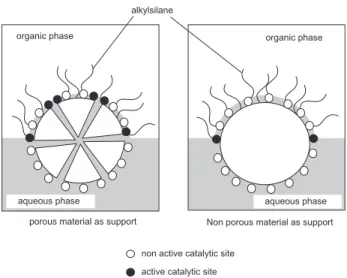
system, the agitation is also needed to mechanically shuttle the catalyst from one liquid phase to the other. Our strategy is different from those previously reported because we aim at placing the bifunctional particles, containing both hydrophilic and hydrophobic regions, as well as the active sites at the phase boundary in order to catalyze the reaction without any transports the substrate across the interphase and without the formation of an emulsion containing a catalyst by vigorous stirring. Proposed model of phase-boundary catalyst is shown in Figure 1. This system offers advantages in terms of ease of separation, the possibility of continuous supply of immiscible substrates and working effectively without co-solvent. This phenomenon was observed when the external surface of zeolites is covered partially with hydrophobic alkylsilyl groups.
Previously, we reported the PBC for the oxidation
reactions using aqueous H2O2. In this paper, the study of
PBC is now extended for acid catalysis in which the hydration of 1,2-epoxyoctane using zeolite loaded niobium oxide covered by alkylsilane is chosen as model catalytic system.
Experimental
Catalysts preparation
Alkylsilylated HZSM-5. HZSM-5 (JRC-Z5-90H(1))
powder was supplied by the Catalysis Society of Japan and used as received. The SiO2/Al2O3 ratio and surface area of
HZSM-5 were 90 and 300 m2 g-1 respectively. Unmodified
HZSM-5 is called w-HZSM-5. Partly modified ZSM-5 on which the external surface was partly covered with alkylsilane was prepared by attachment of
n-octadecyltrichlorosilane (ODS). This preparation method
is same as given in our recent papers.3-6 In a typical experiment,
in order to modify HZSM-5 with alkylsilane, the w-HZSM-5 powder containing water (0.5 – 0.9 g per 1.0 g of w-HZSM-5)
was immersed in 5 mL toluene containing 500 µmol of
n-octadecyltrichlorosilane (ODS, ShinEtsu) and the
suspen-sion was shaken for ca. 5 minutes at room temperature. Then, the solid was collected by centrifugation and dried at 383 K for 5 h. The partly modified sample was labeled w/o-HZSM-5. Fully modified HZSM-5 (o-HZSM-5) was prepared without the addition of water.
Passivation of the external surface of HZSM-5. In the
first step, n-octadecyltrichlorosilane (ODS) is attached by
fully coverage, with a similar procedure for making o-HZSM-5. In the second step, the powders obtained were
calcined at 500 oC for 5 h in order to make the external
surface of HZSM-5 coated by silica layer. The solids obtained were further modified with ODS at a similar proce-dure in the preparation of w/o-HZSM-5 and o-HZSM-5. They were labeled as w-Si-HZSM-5, w/o-Si-HZSM-5 and o-Si-HZSM-5.
Sulfonic acid functionalized NaY. NaY zeolite (JRC-Z-Y5.5) was supplied by the Catalysis Society of Japan
and used as received. The SiO2/Al2O3 ratio and surface
area of NaY zeolite were 5.5 and 700 m2 g-1 respectively.
Sulfonic acid covered NaY zeolite was prepared according
to the literature.10 In typical experiment, before
modifi-cation, NaY zeolite is calcined at 400 oC for 2 h in order to
remove adsorbed water. Calcined NaY zeolite (3 g) is added to a solution of 3-mercatopropyl trimethoxysilane (MPTS, Wako) (0.294 g) dissolved in toluene (20 mL) as the organosulfonic acid precursor. Toluene was dried over zeolite 4A before use. The molar amount of sulfonic acid (SO3H) was 500 µmol g-1 zeolite. After 4 h refluxing, the
powder is collected and washed with CH2Cl2/Et2OH (1:1)
(50 mL) and air-dried.
Materials with immobilized mercaptopropyl groups
were oxidized with H2O2 in methanol-water mixture.
Typically, 6 mL 30% H2O2 dissolved in 18 mL methanol.
After 24 h, the suspension was filtered, and washed with
H2O and EtOH. The wet material was resuspended (3 wt%)
in 0.1 mol L-1 H
2SO4 for 2 h. Finally, the materials were
extensively rinsed with H2O and dried at 333 K under
vacuum. These acid materials are denoted with SO3H-NaY.
Partly modified SO3H-NaY in which the external surface
was partly covered with alkylsilane from ODS was prepared with the same procedure for making w/o-HZSM-5 and
labeled as w/o-SO3H-NaY. Unmodified and fully modified
SO3H-NaY were labeled as w-SO3H-NaY and o-SO3H-NaY
respectively.
Niobic acid functionalized NaY. NaY zeolite covered niobic acid (Nb-NaY) was prepared by impregnation of
niobium pentaethoxide ([Nb(OEt)5]) from its ethanol solution at room temperature. The molar amount of Nb
was 500 µmol g-1 zeolite. Unmodified Nb-NaY is called
w-Nb-NaY. Modified Nb-NaY on which the external surface was partly covered with alkylsilane was prepared by
attachment of n-octadecyltrichlorosilane (ODS). This
preparation method is same as given in preparation of alkylsilylated HZSM-5. The partly modified sample was labeled w/o-Nb-NaY and o-Nb-NaY for fully modified.
Reaction conditions
Hydration of cyclohexene was carried out using the above catalysts. Cyclohexene (2 mL), water (2 mL) and catalyst powder (50 mg) were placed in a glass tube, and the reaction was performed with or without stirring at 70
oC for 20 h after removal of oxygen by argon bubbling.
Hydration of 1,2-epoxyoctane with water was carried out
at 70 oC for 20 h. In detail, 1,2-epoxyoctane (1 mL), water
(1 mL) and catalyst powder (25 mg) were placed in a glass tube, and the reaction was performed with or without stirring. The reaction products of the above reactions were analyzed by gas chromatography (Shimadzu GC-14B with FID and DB-1 column) and GC/MS.
Results and Discussion
Effect of stirring on the location of active sites
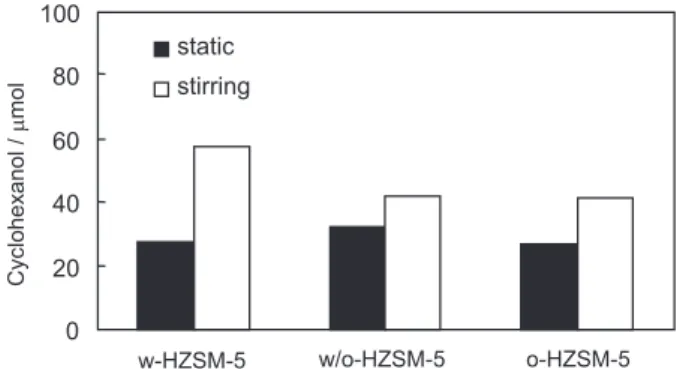
Figure 2 shows the yield of cyclohexanol in the hydration of cyclohexene with water over w-HZSM-5, w/o-HZSM-5 and o-HZSM-5. The first effect observed from this figure is that the stirring is required to increase the reaction rate. Our early results in the epoxidation reactions3-5
indicate no mass transfer limitation observed when the active sites were located on the external surface of zeolite
and the catalyst particles were placed at the liquid-liquid boundary, therefore we conclude that the activity of catalyst does not depend on the stirring rate. On the other hand, this phenomenon could not be applied for hydration of cyclohexene by w/o-HZSM-5 even though the catalyst was successfully placed at the liquid-liquid boundary. Furthermore, diffusion resistance becomes dominant factor in this triphasic mode reaction. This can be explained on the basis of the location of active sites of HZSM-5, which are located predominantly inside the pore, and not on the external surface. Based on this consideration, the role of the external active sites in the reaction could be examined by passivating the external surface of zeolite with silica layer coating, where this layer has been considered not to be active for hydration of cyclohexene. Figure 3 shows the trend of the catalytic activity of w-Si-HZSM-5, w/o-Si-HZSM-5 and o-Si-HZSM-5 (passivated HZSM-5s). Although the results show no significant effect of this approach for the trend of catalysts’ activities, under static conditions, the yield of passivated HZSM-5 exhibit a yield
ca. 5% lower when compared to unpassivated HZSM-5.
This suggests that the active sites located on the external surface give a contribution for increasing the catalysts’ activity under static conditions, although their contribution to the overall reaction is small.
Nature of active sites
Catalytic activities as depicted in Figures 2 and 3 indicate w-HZSM-5 is the most active catalyst for hydration of cyclohexene. In our previous reports,3-5 it was
explained that the highest catalytic activity has a correlation to the location of catalysts’ particles, in which the solid catalyst was placed at the liquid-liquid phase boundary. Obviously, this argument does not hold for the w-HZSM-5 since the enhancement of the rate cannot be solely attributed to the distribution of catalysts in
liquid-Figure 3. The yield of cyclohexanol in organic phase on the hydra-tion of cyclohexene using various modified HZSM-5 under static and stirring conditions. Reaction conditions are the same as given for Figure 2.
liquid system and location of their active sites. The effect of HZSM-5 intrinsic properties such as the existence of active sites in the framework and its MFI structure play an important role in the catalytic activity. These properties certainly give a synergy effect for the catalytic activities
with hydrocarbons.11 To exclude the possibility of these
characteristics, sulfonic acid (SO3H) anchored on the
surface of NaY zeolite was used as a catalyst model. Since
the molecular size of MPTS (ca. 0.55 nm) is smaller than
pore size of NaY zeolite (ca. 0.70 nm), it is expected that
the deposition of SO3H occur on the internal surface of
zeolite. This catalyst was used for acid catalysis in the system containing cyclohexene and water.
As shown in Figure 4, all the systems containing modified
sulfonic acid functionalized zeolites (w-SO3H-NaY,
w/o-SO3H-NaY and o-SO3H-NaY) produce
2-methyl-2-cyclopenten-1-one as a major product as analyzed by GC/MS. A similar compound was also observed when 0.1 mol L-1 H
2SO4 was used instead of those catalysts in
the same experimental conditions (Figure 4). With a w/o-SO3H-NaY, under stirring conditions, the activity (i.e., the peak area of the 2-methyl-2-cyclopenten-1-one per
amount of SO3H) more than triples compared to the mixture
containing H2SO4. This indicates that the w/o-SO3H-NaY
is particularly capable of catalyzing the reaction at the liquid-liquid phase-boundary. However, the mechanism of this reaction was not fully understood. It could be that the carbenium ion and ring contraction occur within the
mechanisms.12,13 In order to investigate heterogeneity, the
catalysts were suspended in water and stirred for 2 h at 70 oC. After filtration, the water, without the catalyst, was
vigorously stirred for 20 h with addition of cyclohexene. This system exhibits no activity suggesting the reaction occurs on the catalyst particles, but not due to the leached
SO3H species. It should be noted that the mass transfer
limitations may be place a constraint on SO3H-NaY
catalysis because of the location of SO3H is mainly inside
the pore of NaY. It is clearly shown in Figure 4 that these mass transfers are further enhanced by the mechanical
agitation. For comparison, modified SO3H-NaY catalysts
were also used to catalyze the hydration of 1,2-epoxyoctane to 1,2-octanediol, and the results are shown in Figure 5. It
showed that the activity of modified SO3H-NaY was also
always higher when mechanical agitation was applied for the system. Similar to the hydration of cyclohexene (Figure
3), the results in Figure 5 showed that w/o-SO3H-NaY also
gave a higher activity compared to w-SO3H-NaY and
o-SO3H-NaY. One possible explanation is that the bimodal
amphiphilicity character of w/o-SO3H-NaY gives a large
contribution to the catalytic activity. This argument was supported by the distribution of catalysts during the
reaction under static conditions; w/o-SO3H-NaY was
located at the liquid-liquid phase boundary, whereas
w-SO3H-NaY and o-SO3H-NaY were dispersed in aqueous
and organic phases respectively.
Niobic acid functionalized NaY
According to the catalytic activity of the alkylsilylated HZSM-5 and sulfonic acid functionalized NaY as catalyst models of acid-catalyzed reactions, the specific role of location and nature of the active sites was examined. The two effects may indeed account for the observed catalytic activity of the catalysts in the liquid-liquid system under static and stirring conditions. Thus, our task here is to confirm the effect of active site which is located at the external surface of zeolite. Based on this purpose, niobic acid functionalized NaY has been chosen as another catalyst model. Although there is no experimental evidence at present, Nb active sites should be attached to the external surface of NaY since the estimated molecular size of Nb(OC2H5)5 (ca. 0.90 nm), the source of Nb sites, larger
than the size of pore-entrance of NaY (ca. 0.70 nm).
Figure 5. The yield of 1,2-octanediol in organic and aqueous phases on the hydration of 1,2-epoxyoctane using various modified SO3 H-NaY under static and stirring conditions. All reactions were carried out at 70 oC for 20 h: 25 mg catalyst; 1 mL 1,2-epoxyoctane and 1 mL water. The yield was subtracted from the control experiment, without catalyst.
Figure 4. The yield of 2-methyl-2-cyclopenten-1-one in organic phase on the reaction of cyclohexene with water using various modi-fied SO3-NaY, under static and stirring conditions. Due to lack of the authentic sample, the yield was calculated from the peak area of 2-methyl-2-cyclopentene-1-one in chromatogram. Reaction was also carried out with acidified aqueous phase (0.1 mol L-1 H
The dispersion behavior of w/o-Nb-NaY, prepared with different amount of added water to form Nb-NaY aggregates before attachment of alkyl groups, and o-Nb-NaY are shown in Figure 6. From their dispersibility, more water is added to Nb-NaY, resulting more hydrophilic
w/o-Nb-NaY particles. It was found that the addition of ca.
60 – 70 wt% water per g Nb-NaY gave the highest yield of 1,2-octanediol. Addition of more than 90 wt% water per g Nb-NaY can make the powder totally wetted by water in the form of ‘wet cake’. After attachment of alkylsilyl groups, the resulting alkylsilylated particles seemed heterogeneous; some particles were located at the phase-boundary while others were dispersed in water.
It should be noted that alkylsilyl groups should be attached to the external surface of NaY zeolite since the
estimated molecular size of alkylsilane (ca. 0.50 nm x 2.60
nm), the source of alkylsilyl, larger than the size of
pore-entrance of NaY zeolite (ca. 0.70 nm). The distribution of
alkylsilyl groups on the external surface of w/o-NaY has been clarified by using fluorescence microscopy; each w/o-NaY particle has both hydrophobic and hydrophilic surfaces; i.e., one side is covered with alkylsilyl groups and the other is kept covered with hydroxyl groups (silanols). Details for this fluorescence microscopic study
was reported recently.5 Because of this surface
characteristic, the modified particles are spontaneously located at the interphase in a W/O mixture with the hydrophobic side facing the organic phase and the hydrophilic side facing the aqueous phase.
As demonstrated in the previous paper,4 in the water
adsorption experiment, it was observed that the adsorption capacity of OTS-modified NaY particles at ambient
temperature (8 mmol g-1 for both w/o–NaY and o-NaY)
was not so different from that of the parent NaY zeolite (11 mmol g-1), indicating that the structure and hydrophilic
features of internal pores of these NaY particles were retained and that the hydrophobic alkyl chains did not block the entrance of zeolite pores.
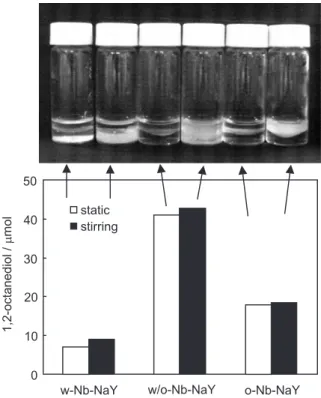
When the above catalysts were used in reaction system containing 1,2-epoxyoctane and water, it was observed that, after four hours reaction, under stirring condition, the emulsion was formed in the system containing w/o-Nb-NaY, whereas o-Nb-NaY was still located at organic phase due to its hydrophobicity in nature (Figure 7). Instead distinctly, the w-Nb-NaY was well dispersed in aqueous phase. This suggests that w/o-Nb-NaY possess amphiphilic character to stabilize the immiscible mixture of organic and aqueous phases.
As shown in Figure 7, all the system containing modified niobic acid functionalized zeolite (w-Nb-NaY, w/o-Nb-NaY and o-Nb-NaY) produced 1,2-octanediol as a major product. The w/o-Nb-NaY gave highest yield of diol in comparison to the w-Nb-NaY and o-Nb-NaY. It is notable that the activity of w/o-Nb-NaY was independent of the stirring rate; i.e., this catalyst does not require the formation
of the emulsion by stirring at ca. 1000 rpm. One needs to
consider that the hydrophilic and hydrophobic parts of the w/o-Nb-NaY play an important role for continuous supply of the organic and aqueous substrates to the active sites, and increase the activity.
Figure 7. The yield of 1,2-octanediol in organic and aqueous phases on the hydration of 1,2-epoxyoctane using various modified Nb-NaY, under static and stirring conditions. Reaction conditions are the same as given for Figure 5. The photograph shows the distribu-tion of solid catalyst after 4 h reacdistribu-tion.
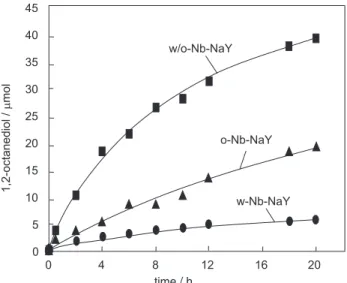
The hydration rate of 1,2-epoxyoctane under static condition is shown in Figure 8. It was observed that the reaction rate was considerably slow. Due to no significant quantitative yield was observed in the first 30 minutes, the reaction was extended to 20 h. It confirms that significant difference in the rate of the reaction between w-Nb-NaY, w/o-Nb-NaY and o-Nb-NaY is observed.
It has been reported in the previous paper that NaY, having a microporous structure with a relatively large surface area, was preferable as a support in this system
compared with nonporous silica with a smaller surface area.4
One considers that Nb active sites on the NaY surface can be in contact with both organic substrate and water. During the reaction at the Nb sites, due to the decrease in the concentration of substrate and water at the interphase, the concentration gradient of these reagents may appear in both organic and aqueous phases; this gradient may generate a driving force to supply these reagents from respective bulk solutions, thereby enabling the reaction to proceed efficiently without any enforced manipulation, such as stirring, in order to drive liquid–liquid mass transfer. In order to achieve this, the catalyst must satisfy the following requirements: (i) existence of active Nb sites at the liquid–liquid phase boundary, and (ii) continuous supply of both substrates through the hydrophobic and hydrophilic parts of the catalyst particles. Therefore, if the catalyst particles consist of nonporous materials, the number of Nb active sites are limited and efficient PBC cannot be expected (see Figure 1). The use of a microporous material as a support must increase the effective interphase area of the catalyst (i.e., increase the number of active sites), resulting in higher activity.
Figure 8. The hydration rate of 1,2-epoxyoctane using various modified Nb-NaY under static conditions. Reaction conditions are the same as given for Figure 5.
Attachment of aklylsilane on the niobic acid sites is another possibility cause lowering activity of o-Nb-NaY compared to w/o-Nb-NaY. In order to exclude this argument, the Temperature Programme Desorption (TPD) of ammonia experiments were performed on w-Nb-NaY, w/o-Nb-NaY and o-Nb-NaY. It was observed that no significant difference in the amount of acid sites from calculation of desorbed ammonia amount within the samples.14 This suggests that the acid sites on the modified
samples are not attached by ODS.
Conclusions
In this study, the phase-boundary catalysis concept was applied for acid-catalyzed hydration of 1,2-epoxyoctane with water by NaY zeolite loaded with alkylsilane-covered niobic acid. This system did not require stirring to make an emulsion to drive the hydration. The nature of acid sites and their location, whether in the pore or on the external surface of zeolite, are important factors for the catalytic activity of phase-boundary catalysts for acid catalysis.
References
1. Matlack, A. S.; Introduction to Green Chemistry, Marcel Dekker: New York, 2001.
2. Clark, J. H.; Macquarrie, D. J.; Chem. Commun. 1998, 853. 3. Nur, H.; Ikeda, S.; Ohtani, B.; Chem. Commun. 2000, 2235. 4. Nur, H.; Ikeda, S.; Ohtani, B.; J. Catal. 2001, 204, 402. 5. Ikeda, S.; Nur, H.; Sawadaishi, T.; Ijiro, K.; Shimomura, M.;
Ohtani, B.; Langmuir2001, 17, 7976.
6. Ikeda, S.; Nur, H.; Wu, P.; Tatsumi, T.; Ohtani, B.: Stud. Surf.
Sci. Catal. 2003, 145, 251.
7. Tatsumi, T.; Koyano, K. A.; Igarashi, N.; Chem. Commun.
1998, 325.
8. D’Amore, M. B.; Schwarz, S.; Chem. Commun. 1999, 121. 9. Starks, C. M.; J. Am. Chem. Soc. 1971, 93, 195.
10. Bossaert, W. D.; De Vos, D. E.; Van Rhijn, W. M.; Bullen, J.; Grobet, P. J.; Jacobs, P. A.; J. Catal. 1999, 182, 156. 11. van Bekkum, H.; Flanigen, E. M.; Jansen, J. C., eds.;
Introduction to Zeolite Science and Practice, Elsevier Science:
Amsterdam, 1991.
12. March, J.; Advanced Organic Chemistry, 3rd edition, John Wiley and Sons: New York, 1985.
13. Kazansky, V. B.; Catal. Rev. 2001, 43, 199.
14. Nur, H.; Hau, N. Y.; Muhid, M. N. M.; Hamdan. H.; unpublished work.