Abstract
Introduction: Orofacial clefts are among the most prevalent birth defects worldwide. Specialized treatment and surveillance of basic health needs are critical. Few studies have investigated primary care practitioners’ experience in caring for individuals with clefts. Objec-tive: It was to describe experience and current interest of family care practitioners on the management of individuals with clefts. Methods: Observational cohort of 104 practitioners from Maceió (AL) e Campinas (SP). Demographic, academic and professional characteristics, didactic experience and desire in continuing education on clefts were assessed using a questionnaire. Results: Seventy-four practitio-ners were located in Maceió and 30 in Campinas. Female gender and low academic qualification were predominant. Physicians and nurses prevailed over dentists, 78 (75%) participants had clinical experience with clefts. Use of protocols was mentioned by 3/104 (2.9%), provision of information on clefts by 58/104 (56%) and referrals to the Brazilian Reference Network by 7/104 (6.7%). Almost 50% reported didactic experience and 94%, desire on continuing education in this field. Conclusion: Results corroborate the literature and reinforce the need of improving family care practitioners’ skills to manage individuals with clefts. Education and strengthen ties between primary level of the health system and specialized teams must be focused. Some strategies are presented in this regard.
Keywords: orofacial clefts; primary care; continuing education.
Resumo
Introdução: As fendas orofaciais estão entre os mais prevalentes defeitos congênitos em todo o mundo. Atenção especializada e vigilância de necessidades básicas de saúde são críticas no cuidado aos indivíduos. Objetivo: Foi descrever a experiência e o interesse de profissionais da Estratégia Saúde da Família no acompanhamento de indivíduos com fendas orofaciais. Métodos: Coorte observacional com 104 profissionais de Maceió (AL) e Campinas (SP). Características demográficas, acadêmicas e profissionais, bem como a experiência didática e o desejo por educação continuada, foram colhidas por meio de questionário. Resultados: Setenta e quatro profissionais atuavam em Maceió e 30 em Campinas. O gênero feminino e a baixa qualificação acadêmica foram predomi-nantes. Médicos e enfermeiros prevaleceram sobre dentistas, e 78 (75%) participantes tinham experiência clínica com fendas. O uso de protocolos foi mencionado por 3/104 (2,9%), a oferta de informações sobre fendas por 58/104 (56%) e o encaminhamento para unidades especializadas da Rede de Referência por 7/104 (6,7%). Cerca de 50% dos participantes referiram experiência didática e 94%, desejo por educação continuada. Conclusão: Os resultados corroboram a literatura e reforçam a necessidade de melhorar a capacitação de profissionais nesta área. Para tanto, são apresentadas estratégias para promover educação e reforçar laços entre a atenção básica e equipes especializadas.
Palavras-chave: fendas orofaciais; atenção básica; educação continuada.
Family care practitioners experience with
individuals with orofacial clefts in Brazil
Experiência de profissionais de saúde da família
com pessoas com fendas orofaciais no Brasil
Filipe Silveira dos Anjos
1, Bruna Henrique Bueno
2,
Eneida Lipinski-Figueiredo
3, Carlos Guilherme Gaelzer Porciuncula
4,
Vera Lúcia Gil-da-Silva-Lopes
5, Isabella Lopes Monlleó
4Study carried out at Polo Saúde da Família da Universidade Estadual de Ciências da Saúde de Alagoas – Macéio (AL); Universidade Estadual de Campinas (UNICAMP) – Campinas (SP), Brazil.
1Physician of Family Care of Secretaria Municipal de Saúde de São Cristóvão – São Cristóvão (SE), Brazil. 2Resident Nurse at Hospital Sírio-Libanês – São Paulo (SP), Brazil.
3Adjunct professor (retired), Instituto de Ciências Biológicas, Universidade Federal de Alagoas (UFAL) – Maceió (AL), Brazil. 4Adjunct professor, School of Medicine, UFAL – Maceió (AL), Brazil.
5Associate Professor, School of Medical Sciences, Universidade Estadual de Campinas – Campinas (SP) Brazil.
Correspondence to: Isabella Monlleó – Serviço de Genética Clínica, Hospital Universitário Professor Alberto Antunes – Avenida Lourival Melo Mota, s/n – CEP: 57072-970 – Macéio (AL), Brasil – E-mail: [email protected]
Financial support: Fundação de Amparo à Pesquisa do Estado de Alagoas (FAPEAL #809 60030-700/2009) and Conselho Nacional de Desenvolvimento Científico e Tecnológico (CNPq# 01300.000433/2008-00). VLGSL is supported by CNPq 304455/2012-1.
INTRODUCTION
For more than ten years, birth defects are the second most common cause of infant mortality in Brazil1. Orofacial clets
(OC) are among the most prevalent defects in the world, with prevalence around 1:600–1,000 newborns. In 70% of the cases, they are isolated malformations (non-syndromic), but can also be classiied as a syndromic picture if other de-fects are present. Etiology of non-syndromic OC is complex and involves several genetic and environmental risk factors following multifactorial threshold model of inheritance. Teratogenic efects, chromosomal and mendelian abnormali-ties respond to many syndromic cases2-4.
Among more than 20 investigated genes, IRF6, VAX1
and 8q24 locus have conirmed role in non-syndromic OC. Maternal exposure to tobacco and alcohol use, metabolic status (diabetes, obesity and underweight), viral infection, medicinal drugs (anticonvulsivants) and teratogens (sol-vents and agricultural chemicals), as well as the preven-tive role of vitamin supplements, have been investigated. Maternal smoke during pregnancy is consistently linked with increased risk of OC. Findings on the other risk factors and gene-environment interactions have been inconclusive due to methodological issues2-6.
Besides these factors, a meta-analysis approach of paren-tal age showed that 40-year-old fathers or older have a 58% higher probability of having a child with clet palate (CP), and for mothers aged over 40 years the probability is 28% higher for CP and 56% higher for clet lip with or without clet palate (CLP)7.
Individuals with OC need timely and multi-professional care to cope with primary surgical repair, and aesthetic and functional rehabilitation. Efective cure is deined as a situ-ation in which individuals can normally function in society and residual problems, if present, grade into the normal range. It is estimated that this is achieved for 80–85% of patients who receive the so called best available modern treatment3,8-10.
Good outcomes, however, depend on various factors, such as experience of the clet team, engagement of the family and appropriate management of basic health needs. Family edu-cation and support, monitoring of growth and development, immunization, dental hygiene, prevention and early treat-ment of infections play a crucial role11-15.
hese issues should be addressed as close as possible to the community where patient lives. his is much important when there is great distance between the patients’ domicile and their reference clet centre and even more when there are not enough specialized centers in the country. herefore, a partnership between primary care providers and clet teams is critical to ensure optimum outcomes11,13,14.
Public health in Brazil is provided through the Uniied Health System (Sistema Único de Saúde – SUS). It was estab-lished in 1988 as a constitutional right. he SUS was concep-tualized to provide integral care through a network of units arranged according to areas of coverage and crescent levels of complexity. Funding and management of primary and second-ary levels are under municipal responsibility, whereas the most specialized procedures are under federal administration16.
here was not universal access to services for caring of persons with OC in Brazil before the implementation of the SUS. First action was taken in 1993 when the government created a spe-ciic fund for clet surgery. An important improvement occurred in 1998 through the establishment of the Brazilian Reference Network for Craniofacial Treatment (Rede de Referência no Tratamento de Deformidades Craniofaciais – RRTDCF)16-18.
Currently, 20 multi-professional units are listed in the RRTDCF and distributed all over the country (Figure 1). All of them are accredited by the Ministry of Health and funded by federal resources19,20. Despite of this, annual volume of
patients and composition of the teams are greatly variable. Regional disparities and lack of coordination between spe-cialized units and low complexity services within the SUS are unsolved problems16-18.
Family Care Program (Programa Saúde da Família – PSF) was initiated in 1994 and rapidly evolved into a national strat-egy (Estratégia Saúde da Família – ESF]), which structures primary care in the country. According to the Ministry of Health, ESF should focus on integral care instead of manage-ment of diseases. his means professionals should entrust with continuous promotion and protection of health, preven-tion of diseases, early and low complexity care, management of chronic diseases and community-based rehabilitation21.
ESF teams are responsible for a deined territory of 2,400– 4,500 citizens. Basic teams are composed by one physician, one nurse and one assistant nurse, and ive to six community health agents. Oral caring extended teams include one den-tist, one dental assistant and one dental hygiene technician. Aiming to quality improvement, the Ministry of Health cre-ated oices for continuing education of ESF teams. Oices have autonomy to plan and delivery training programs in accordance with demands of the local teams21.
Few reports have investigated primary care physicians roles, responsibilities and skills in caring for individuals with OC11-14,22. In Brazil, these issues have not been investigated yet.
he aims of this study were: (1) to describe experience and current interest of primary care practitioners — physicians, nurses and dentists — linked to ESF teams from two difer-ent regions of Brazil on the managemdifer-ent of individuals with OC; and (2) to provide strategies on how to improve liaison between primary and specialized levels of clet care.
METHODS
Primary care practitioners were asked to participate in this study during three training courses promoted by their respective ESF educating boards in 2009. Two of these courses took place in Maceió (Alagoas) and one in Campinas (São Paulo), respec-tively located in the Northeast and Southeast of Brazil (Figure 1). Participants were not identiied by their unit of origin.
Information was gathered using a multiple choice, ill-in-the-blank and anonymous questionnaire adapted from a similar study performed in the United States of America (USA)12. It comprised 18 questions covering the following:
age, gender, occupation, highest academic qualiication, years since graduation and in practice, number of patients with OC treated throughout career and in the last year, time past since treating a patient with OC, use of protocols, pattern of infor-mation given and referral of patients, didactic experience on
OC (literature readings, conference or lecture attendance), desire for continuing education and current interest in OC.
A total of 185 questionnaires (111 in Maceió plus 74 in Campinas) were distributed to the participants at the begin-ning of the traibegin-ning course. Response rates were 81% (90/111) in Maceió and 51% (38/74) in Campinas (p<0.02) for a com-bined rate of 69% (128/185). Primary care practitioners not linked to an ESF team were not eligible. herefore, the inal sample amounted to 104 individuals. Information was com-piled in a database. Some variables show diferent amounts because of incompleteness of the questionnaire.
he sotware package Epi Info™ Version 3.5.1 (http://www. cdc.gov/epiinfo/) was used for data processing and analysis. Kruskal-Wallis Test, Fisher Test and Chi Square were used for statistics in order to check preferential association between independent variables (age, gender, years since graduation and in practice, academic qualiication, number of patients with OC treated throughout career and in the last year, time past since treating a patient with OC, use of protocols, pattern of information given and referral of patients, literature read-ings, conference or lecture attendance, desire for continuing education and current interest in OC) and the professional location and category. Diferences were considered statically signiicant if the p-value was <0.05.
he study was approved by the local Institutional Review Boards and the National Research Ethics Committee (CONEP protocol number 709/2008).
RESULTS
Seventy-four practitioners (71%) were located within the area of Maceió and 30 (29%) within Campinas. Physicians amounted to 40 (38.5%), nurses to 38 (36.5%) and dentists to 26 (25%) individuals of the sample. Demographic and oc-cupational characteristics are shown in Table 1.
Ages ranged from 24 to 66 years (mean of 38 years and SD±9.2). here were 89 (86%) females and 15 (14%) males. Years since university graduation ranged from 2 to 38 (mean of 14 years and SD±9.2). Years of practice in ESF ranged from 0 to 15 (mean of 6 years and SD±3.5). Eighty-four (81%) par-ticipants were specialists, 17 (16%) had bachelors’ and three (3%) Master’s degree. here was no statistically signiicant diference between professionals from Maceió and Campinas with regard these characteristics. Comparisons between professional categories, however, showed that physicians had signiicantly higher mean of ages (p<0.006) and years since graduation (p<0.001), and that all Masters were physicians.
Seventy-eight (75%) participants had already cared for pa-tients with OC. his characteristic was not statistically difer-ent among responddifer-ents with regard to their geographic loca-tion and professional category. Time elapsed since last treated patient ranged from less than a year to more than ive years. Among practitioners who had ever seen a patient with OC, 31 (57%) had treated at least a patient within the past year, while 17 (12%) had seen one for over ive years. None statistically signiicant diference was found between professionals from Maceió and Campinas or among professional categories with regard to time interval since last treated patient (p<0.52 and p<0.97, respectively).
Volume of treated patients ranged from 1–10 (global mean of 2.6 and SD±1.9) per professional. Within the past year, it ranged from 1–7 (global mean of 1.8 and SD±1.3). Twenty-two (32%) practitioners had hitherto treated just one patient, 17 of which had done so within the previous 12 months (Table 2).
Table1. Demographic and occupational characteristics
Maceió n (%)
Campinas n (%)
Physicians n (%)
Nurses n (%)
Dentists n (%)
Total n (%)
74 (71) 30 (29) 40 (38) 38 (37) 26 (25) 104 (100)
Age in years
<30 10 (14) 6 (21) 4 (10) 8 (21) 4 (16) 16 (16) 30–39 31 (44) 13 (45) 15 (40) 18 (49) 11 (44) 44 (44) 40–49 22 (31) 7 (24) 10 (27) 10 (27) 9 (36) 29 (29)
50–59 6 (8) 3 (10) 7 (18) 1 (3) 1 (4) 9 (9)
≥60 2 (3) – 2 (5) – – 2 (2)
Mean 39 38 (p<0.59#) 43 36 36 (p<0.006#) 38
Gender
Female 65 (88) 24 (80) 31 (78) 38 (100) 20 (77) 89 (86) Male 9 (12) 6 (20) (p<0.23§) 9 (22) – 6 (23) 15 (14)
Years since university graduation
≤5 15 (21) 10 (33) 6 (16) 15 (39) 4 (16) 25 (24) 6–10 12 (16) 4 (13) 3 (8) 6 (15) 7 (27) 16 (15) 11–15 17 (23) 5 (17) 9 (23) 10 (26) 3 (11) 22 (21) 16–20 10 (13) 3 (10) 4 (10) 4 (10) 5 (19) 13 (13) 21–25 9 (12) 8 (27) 9 (23) 4 (10) 4 (16) 17 (16)
≥26 11 (15) – 8 (20) – 3 (11) 11 (11)
Mean 15 12 (p<0.42#) 18 10 14 (p<0.001#) 14
Years of practice in ESF
<1 4 (5) 1 (4) 3 (7) 2 (5) – 5 (5)
1–5 26 (36) 15 (50) 11 (28) 19 (50) 11 (42) 41 (39) 6–10 36 (49) 11 (37) 20 (50) 12 (32) 15 (58) 47 (45)
11–15 8 (10) 3 (9) 6 (15) 5 (13) – 11 (11)
Mean 6 6 (p<0.19#) 7 6 6 (p<0.29#) 6
Academic qualiication
Bachelor 13 (18) 4 (13) 6 (15) 7 (18) 4 (15) 17 (16) Specialist 60 (81) 24 (7) 31 (78) 31 (82) 22 (85) 84 (81) Master (physicians) 1 (1) 2 (80) (p<0.31*) 3 (7) – – 3 (3)
here was no statistically signiicant diference between professionals from Maceió and Campinas with regard to the mean of treated patients considering the entire career. However, the mean of treated patients during the past year was statistically higher among those from Campinas.
Although physicians had shown signiicantly higher glob-al mean of treated patients, none statisticglob-al diference among professional categories was observed regarding volume of patients within the past year.
hree out of 75 respondents (a physician from Campinas and two dentists from Maceió) airmed they follow a protocol while treating an individual with OC. Among 74 who answered ques-tions about provision of health information, 16 (22%) stated they do not provide any speciic guidance for patients and parents, 44 (59%) give only verbal and 14 (19%) give verbal and written
information on OC. hese characteristics were not statistically diferent among participants with regard to their geographic location (p<0.11) and professional category (p<0.05).
Forty-seven out of 72 (65%) respondents asserted they refer patients to specialized centers. None statistically sig-niicant diference was veriied between professionals from Maceió and Campinas or among professional categories with regard to the practice of referring patients (Table 2). On the other hand, only seven (9.7%) practitioners, all of them from Campinas, mentioned a unit of the RRTDCF. he remaining hospitals and clinics listed are not clet teams.
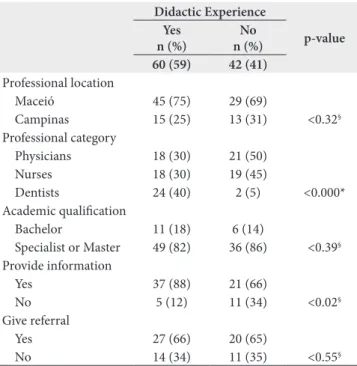
A total of 102 participants answered questions regard-ing continuregard-ing education (Table 3). Among them, 60 (59%) mentioned didactic experience such as participation in con-ferences and lectures or literature readings. Dentists appeared
Table 2. Clinical experience and characteristics of care
Maceió n (%)
Campinas n (%)
Physicians n (%)
Nurses n (%)
Dentists n (%)
Total n (%)
74 (71) 30 (29) 40 (38) 38 (37) 26 (25) 104 (100)
Ever provided care since university graduation
Yes 54 (73) 24 (80) 34 (85) 24 (63) 20 (77) 78 (75) No 20 (27) 6 (20) (p<0.31§) 6 (15) 14 (27) 6 (23) (p<0.08*) 26 (25)
Time interval since last treated patient
≤12 months 22 (42) 9 (45) (p<0.52§) 13 (42) 10 (43) 8 (44) (p<0.97*) 31 (57)
13–36 months 15 (29) 6 (30) 9 (29) 5 (22) 7 (39) 21 (15) 37 months–5 years 7 (14) 1 (5) 2 (6) 3 (13) 3 (17) 8 (11) >5 years 8 (15) 4 (20) 7 (23) 5 (22) – 12 (17)
Total 52 20 31 23 18 72 (100)
Amount of patients carried for throughout carrier
1 18 (37) 4 (21) 5 (22) 10 (37) 7 (38) 22 (32) 2 16 (33) 6 (32) 7 (30) 9 (34) 6 (33) 22 (32)
3 5 (10) 3 (16) 7 (30) – 1 (6) 8 (12)
4 3 (6) 2 (10) 2 (9) 2 (7) 1 (6) 5 (7)
5–10 7 (14) 4 (21) 2 (9) 6 (22) 3 (17) 11 (17)
Total 49 19
Mean 2.4 3.2 (p<0.13#) 3.3 2.1 2.2 (p<0.04#) 2.6
Amount of patients carried for within past year
1 15 (68) 2 (22) 7 (54) 6 (60) 4 (50) 17 (55) 2 7 (32) 4 (44) 3 (23) 4 (40) 4 (50) 11 (35)
3 – – – – – –
4 – 1 (11) 1 (8) – – 1 (3)
5–7 – 2 (22) 2 (15) – – 2 (6)
Mean 1.3 2.9 (p<0.006#) 2.2 1.4 1.5 (p<0.76#) 1.8
Provision of health information
No 9 (17) 7 (33) 11 (33) 4 (18) 1 (5) 16 (22) Yes, verbal 34 (64) 10 (48) 17 (52) 13 (59) 14 (74) 44 (59) Yes, verbal and written 10 (19) 4 (19) (p<0.11§) 5 (15) 5 (23) 4 (21) (p<0.05*) 14 (19)
Referral to specialized treatment
No 16 (30) 9 (47) 7 (22) 11 (52) 7 (37) 25 (35) Yes, to the RRTDCF – 7 (37) 5 (16) 2 (10) – 7 (10) Yes, to non-clet teams 37 (70) 3 (16) (p<0.14§) 20 (62) 8 (38) 12 (63)(p<0.07*) 40 (55)
most likely to have had didactic experience than the other categories (p<0.000). None statistical diference was veriied with regard to the geographic location (p<0.32) and academic qualiication (p<0.39) of the practitioner.
Provision of information was statistically associated with di-dactic experience (p<0.02), but not with academic qualiication (p<0.44). Referral of patients was not statistically associated with either (p<0.55 and p<0.57, respectively). Desire for continuing education in this area was expressed by 96 (94.1%) participants without statistical diference among the analyzed groups (p<0.20).
DISCUSSION
Alagoas and São Paulo have opposite economical position, with São Paulo being the richest state of the country. Maceió, the capital of the state of Alagoas, is located in the Northeast coast of Brazil. With 936,313 inhabitants, it counts with 72 ESF teams which serve 26.8% of the population. Campinas is a country-side town of 1,064,669 inhabitants in the state of São Paulo, southeast of the country. With 102 teams, 33.2% of the population is covered by the ESF23. Despite signiicant
economical and social diferences, both town are under the same health policy and have similar coverage of ESF teams.
Our sample consisted mostly of professionals from Maceió, where the training course and survey was conducted twice. Global and town-speciic response rates followed cur-rent trend in surveys involving physicians which ranges from 52 to 81% with a mean of 68%24.
Inter-town comparison showed that response rate was higher in Maceió. We presume there was a lack of motivation among professionals from Campinas concerning this survey due to limited knowledge or experience in the ield related, perhaps, to the existence of a multi-professional clet centre in Campinas which probably absorbs a large number of patients. Despite of this, and with the exception of volume of treated pa-tients within the past year, there were not statistically signiicant diferences between professionals from Maceió and Campinas.
Non-response bias tests were not performed because we did not record information on non-respondents. We recog-nize this is a weakness of our study, however we agree with Damiano et al.14 that shortfall of reports on this issue justiies
the analysis of the collected data.
Physicians and nurses prevailed over dentists. All participants of the last category were from Maceió because local ESF oice decided to extend the training course to this professional category.
Young female practitioners with low academic qualiication were predominant in the sample. Mean of years since gradua-tion and years in ESF teams were low despite the wide variagradua-tion veriied. Physicians were signiicantly older and had more years of practice since graduation, however there was no diference among professional categories regarding academic qualiica-tion. hese results corroborate the current proile of Brazilian community-based practitioners linked to the ESF25,26.
One quarter of the surveyed professionals had never cared for patients with OC. Among professionals with some experi-ence, there was a shortfall in total and last year’s number of patients. Despite diferences concerning structure of health systems, similar result was found in two studies carried out in the USA12,14. Nevertheless, considering Brazil’s OC prevalence
rate of 19.34/10,00027 and even taking years of practice into
account, these igures still are unexpected.
Very few professionals use protocols while caring for patients with OC. Although many provide information, they consist predominantly of verbal guidance with just few using written resources. Majority (65%) of the participants refer patients to specialized centers. However, a large number of them actually refer to hospitals where there are not clet teams and just 7 (9.7%) mentioned units of the RRTDCF. hese rates are lower than those found by Grow and Lehman12 among
American family practitioners.
here are not multi-professional centers for OC care in Maceió. he closest unit is part of the RRTDCF and is located in Recife, the capital of the state of Pernambuco, which is 25 miles away. In Campinas, OC care is provided through a unit of the RRTDCF20. his unit is seeded into a specialized
hospital with multidisciplinary craniofacial rehabilitation with a volume of more than 1,000 surgeries per year, clets
Table 3. Didactic experience, occupational and cleft care characteristics
Didactic Experience
p-value Yes
n (%)
No n (%)
60 (59) 42 (41)
Professional location
Maceió 45 (75) 29 (69)
Campinas 15 (25) 13 (31) <0.32§
Professional category
Physicians 18 (30) 21 (50) Nurses 18 (30) 19 (45)
Dentists 24 (40) 2 (5) <0.000* Academic qualiication
Bachelor 11 (18) 6 (14)
Specialist or Master 49 (82) 36 (86) <0.39§
Provide information
Yes 37 (88) 21 (66)
No 5 (12) 11 (34) <0.02§
Give referral
Yes 27 (66) 20 (65)
No 14 (34) 11 (35) <0.55§
included. It also performs research and provides professional education through medical residence and short-term courses on speech-language therapy28.
Geographic proximity must have been the reason why all professionals who referred patients to units of the RRTDCF were from Campinas. However, it was unforeseen that there were not signiicant diferences regarding other characteristics of caring between professionals from Maceió and Campinas.
Our results show that the existence of the RRTDCF is un-known among the majority of primary care practitioners and suggest they are unaware on how the Brazilian system for OC care is structured. his is not totally surprising considering that care provided through the SUS is still fragmented. With regard to OC care, a national survey showed serious problems of coordination between units of the RRTDCF and other lev-els of the health system16,17.
Our data also suggest primary care professionals do not have a course of action to take with their patients. here seems to be not clear which role and responsibilities should they take, and perhaps they feel unprepared and uncomfort-able to care for these patients.
A study conducted with primary care physicians from three states of the USA showed they were much comfortable in providing services that were similar to those they provide to other children in their practice and less comfortable in OC-speciic approach and counseling14.
A study performed with last year students from college of Medicine, Dentistry, Nursing and Speech Language herapy of the University of Campinas (UNICAMP) concluded they are not able to meet primary health needs of patients with OC29. his situation probably applies to other regions of
Brazil, such as Maceió.
In our sample, almost 60% of the participants mentioned some didactic experience on OC, more than a half of the par-ticipants read specialized literature, but just a minor percent-age (7.8%) attended to conferences or lectures. he last result is probably similar to 9% reported in a study with American family practitioners12. Provision of information to patients/
parents was the only characteristic of caring signiicantly as-sociated with previous didactic experience in our sample.
A survey conducted in 2010 found that 75% of surveyed primary care physicians had experienced providing care for a child with OC during medical school or residency14.A
limita-tion of our study is that professionals were not asked about when, where and how oten they had educational experiences. Despite of this, we found high percentage of professionals in-terested in updating knowledge on OC. Didactic experience and current desire for updating were not inluenced by the professionals’ geographic location.
Bearing country diferences in mind, our results cor-roborate studies carried out in the USA12,14 with regard to the
limited experience of primary care professionals in caring for children with OC and to the need of improving their knowl-edge in this ield through didactic experience during college, residence and continuing education programs.
In Brazil, within the structure of SUS, ESF teams have an es-sential role for patients and families with OC. hey are invaluable when dealing with parent’s stress, confusion, fears and misunder-standings. Besides preparing parents and patients for a lifelong specialized treatment, they should care for ideal health conditions in order to ensure their patients will thrive throughout life.
Neonatal period is such a challenging phase. Specialized treatment depends on how successful parents are in dealing with nutritional problems of their child. A study performed at a secondary hospital of Brazil showed parents did not re-ceive systematic guidance on how to feed their babies. Many of them reported surgical delays associated with poor gain weight in this period of life30.
In a multicenter study carried out in diferent regions of Brazil, it was veriied that delays on lip surgery were associ-ated with low gain weight in 25% patients. Anemia was the reason for delays in 50% of patients who were waiting for palate repair. hese results reinforced concerns on nutritional patterns in children with OC in the country15.
In addition to nutritional issues, ESF professionals should take action to prevent other physical problems, such as re-current infections. hey also should support family to deal successfully with psychological and social efects of OC, and to understand genetic susceptibility and recurrence risk of non-syndromic cases11-14,22.
All of these actions involve low density technology and cost, and are fully compatible with primary care level of the health system. However, patients will not beneit from them if unknown and fragmentation which still surrounds OC care in Brazil persist. Education of primary care professionals and strengthening ties between primary level of the SUS and spe-cialized teams must be focused.
Strategies to address identiied problems comprise local meetings between ESF boards and clet teams in order to form a pact on how to coordinate eforts, to promote the exchange of experience between primary care professionals and special-ists, and to agree on core content on OC to be regularly in-cluded on ESF courses. he following topics on OC are given as a matrix for additional discussion:
• Epidemiology and impact
• Clinical classiication
• Etiology and risk factors
• Health needs and comorbidity according cycles of life (infancy, childhood, adolescence and adulthood)
• Psychosocial implications
• he concept of multi-professional team
Authors believe that the implementation of these strategies is an achievable and cost-efective way to reduce current frag-mentation and improve the standards of care for patients with orofacial clets in Brazil and other middle income countries.
1. Brasil. Ministério da Saúde: Saúde Brasil 2008: 20 anos de Sistema Único de Saúde (SUS) no Brasil. [cited 2010 Dec 8]. Available from: http://www. rededepesquisaaps.org.br/UserFiles/File/biblioteca/saude_brasil_2008_ web_20_11.pdf/
2. Mossey PA, Little J, Munger RG, Dixon MJ, Shaw WC. Clet lip and palate. Lancet. 2009;374(9703):1773-85.
3. Mossey PA, Shaw WC, Munger RG, Murray JC, Murthy J, Little J. Global oral health inequalities: challenges in the prevention and management of orofacial clets and potential solutions. Adv Dent Res. 2011;23(2):247-8.
4. Dixon MJ, Marazita ML, Beaty TH, Murray JC. Clet lip and palate: synthesizing genetic and environmental inluences. Nat Rev Genet. 2011;12(3):167-78.
5. Rahimov F, Marazita ML, Visel A, Cooper ME, Hitchler MJ, Rubini M, Domann FE, Govil M, Christensen K, Bille C, Melbye M, Jugessur A, Lie RT, Wilcox AJ, Fitzpatrick DR, Green ED, Mossey PA, Little J, Steegers-heunissen RP, Pennacchio LA, Schutte BC, Murray JC. Disruption of AP-2 alpha binding site in an IRF6 enhancer is strongly associated with clet lip. Nat Genet. 2008;40(11):1341-7.
6. Luijsterburg AJM, Vermeij-Keers C. Ten years recording common oral clets with a new descriptive system. Clet Palate-Craniofac J. 2011;48(2):173-82.
7. Herkraf APCQ, Herkraf FJ, Rebelo MAB, Vettore MV. Parental age as a risk factor for non-syndromic oral clets: a meta-analysis. J Dent. 2012;40(1):3-14.
8. Strauss RP. he organization and delivery of craniofacial health services: the state of the art. Clet Palate Craniofac J. 1999;36(3):189-95.
9. Shaw WC, Semb G, Nelson P, Brattström V, Mølsted K, Prahl-Andersen B, Gundlach KK. he Euroclet Project 1996-2000: overview. J Craniomaxillofac Surg. 2001;29(3):131-40.
10. World Health Organization (WHO). Global strategies to reduce the health-care burden of craniofacial anomalies [cited 2010 Dec 8]. Available from: http://www.who.int/genomics/publications/en/
11. Mitchell JC, Wood RJ. Management of clet lip and palate in primary care. J Ped Health Care. 2000;14(1):13-9.
12. Grow JL, Lehman JA. A local perspective on the initial management of children with clet lip and palate by primary care physicians. Clet Palate-Craniofac J. 2002;39(5):535-40.
13. Nackashi JA, Dedlow RE, Dixon-Wood V. Health care for children with clet lip and palate: comprehensive services, and infant feeding. In: Wyszynski DF (editor). Clet lip and palate from origin to treatment. New York: Oxford University Press; 2002. p. 127-58.
14. Damiano PC, Tyler MC, Romitti PA, Druschel C, Austin AA, Burnett W, Robbins JM. Primary care physicians experience with children with oral clets in three states. Birth Defects Res A Clin Mol Teratol. 2010;88(12):1050-6.
15. Amstalden-Mendes LG. Aspectos da atenção à saúde a indivíduos com fenda de lábio e (ou) palato no Brasil e propostas para seu incremento no SUS [thesis]. Campinas (SP): Universidade Estadual de Campinas; 2011.
16. Monlleó IL, Mossey PA, Gil-da-Silva-Lopes VL. Evaluation of craniofacial care outside the Brazilian Reference Network for Craniofacial Treatment. Clet Palate-Craniofac J. 2009;46(2):204-11.
REFERENCES
17. Monlleó IL, Gil-da-Silva-Lopes VL. Anomalias craniofaciais: descrição e avaliação das características gerais da atenção no Sistema Único de Saúde. Cad Saúde Pública. 2006;22(5):913-22.
18. Monlleó IL, Gil-da-Silva-Lopes VL. Brazil’s Craniofacial Project: genetic evaluation and counseling in the Reference Network for Craniofacial Treatment. Clet Palate-Craniofac J. 2006;43(5):577-9.
19. Brasil. Portaria SAS/MS nº 62, 19 de abril de 1994: normaliza cadastramento de hospitais que realizem procedimentos integrados para reabilitação estético-funcional dos portadores de má-formação lábio-palatal para o Sistema Único de Saúde [cited 2010 Dec 8]. Available from: http://www. saude.mg.gov.br/atos_normativos/legislacao-sanitaria/estabelecimentos-de-saude/lesoes-labio-palatais/Portaria%20SAS-MS%20no%2062,%20 de%2019-04-1994.pdf/
20. Brasil. Ministério da Saúde: reduzindo as desigualdades e ampliando o acesso à assistência à saúde no Brasil 1998-2002 [monograph]. Brasília: Ministério da Saúde; 2002.
21. Brasil. Ministério da Saúde. Secretaria de Atenção à Saúde. Departamento de Atenção Básica: Avaliação para melhoria da qualidade da estratégia saúde da família [cited 2010 Dec 8]. Available from: http://dab.saude.gov.br/dab/docs/ publicacoes/geral/doc_tec_amq_portugues.pdf/
22. Yetter JF 3rd. Clet lip and clet palate. American Family Physician. 1992;46(4):1211-8.
23. Brasil. Ministério da Saúde: sala de situação em saúde. Saúde da família [cited 2011 Jan 11]. Available from: http://189.28.128.178/sage/
24. Cull WL, O’Connor KG, Sharp S, Tang SS. Response rates and response bias for 50 surveys of pediatricians. Health Serv Res. 2005;40(1):213-26.
25. Tomasi E, Facchini LA, Piccini RX, Thumé E, Silveira DS, Siqueira FV, Rodrigues MA, Paniz VV, Teixeira VA. Perfil sócio-demográfico e epidemiológico dos trabalhadores da atenção básica à saúde nas regiões Sul e Nordeste do Brasil. Cad Saúde Pública. 2008;24(Suppl 1):193-201.
26. Gil CRR. Formação de recursos humanos em saúde da família: paradoxos e perspectivas. Cad Saúde Pública. 2005;21:490-8.
27. World Health Organization (WHO). Programmes and projects. [cited 2011 Aug 25]. Available from: http://www.who.int/genomics/anomalies/americas_ registry/en/index.html
28. Hospital Sobrapar – Crânio e Face. [cited 2011 Jan 11]. Available from: http:// www.sobrapar.org.br/default.asp/
29. Silveira-Basso MC. Conhecimento de futuros proissionais da saúde sobre aspectos de importância multiproissional de indivíduos com fendas de lábio e (ou) palato [dissertation]. Campinas (SP): Universidade Estadual de Campinas; 2011.
30. Amstalden-Mendes LG, Magna LA, Gil-da-Silva-Lopes VL. Neonatal care of infants with clet lip and/or palate: feeding orientation and evolution of weight gain in a nonspecialized brazilian hospital. Clet Palate-Craniofac J. 2007;44(3):329-34.