In
fl
uence of Body Image in Women Undergoing
Treatment for Breast Cancer
In
fl
uência da imagem corporal em mulheres em
tratamento contra câncer de mama
Ana Carolina Lagos Prates
1Ruffo Freitas-Junior
1Mariana Ferreira Oliveira Prates
2Márcia de Faria Veloso
1Norami de Moura Barros
31Program of Mastology, Hospital das Clínicas, Universidade Federal
de Goiás (UFG), Goiânia, Goiás, Brazil
2Department of Food Technology, Universidade Federal do Mato
Grosso do Sul (UFMS), Campo Grande, Mato Grosso do Sul, Brazil
3Department of Medicine, Universidade Federal de Goiás (UFG),
Goiânia, Goiás, Brazil
Rev Bras Ginecol Obstet 2017;39:175–183.
Address for correspondence Ana Carolina Lagos Prates, MSc, Programa de Mastologia, Hospital das Clínicas, Universidade Federal de Goiás (UFG), 1ª Avenida, s/n, Setor Leste Universitário, 74605-020–Goiânia, Goiás, Brasil (e-mail: [email protected]).
Keywords
►
breast cancer
►
body image
►
self-esteem
Abstract
Objective
The objective of this study was to investigate the self-esteem of women
with and without breast cancer regarding their body image.
Methods
A quantitative, case-control study in which 90 women with breast cancer
were evaluated in the case group, and 77 women without breast cancer in the control
group. For data collection, the body satisfaction scale (BSS), a scale adapted and
validated in Brazil, and the Rosenberg self-esteem questionnaire were used. For the
statistical analysis of the data, the Statistical Package for the Social Sciences software
(IBM-SPSS, Chicago, Il, US), version 16.0 was used.
Results
Compared with the women without breast cancer, those with breast cancer were
more dissatis
fi
ed with body image related to appearance. Women undergoing neoadjuvant
chemotherapy were more dissatis
fi
ed with their appearance compared with those with
cancer who were not undergoing this treatment. Mastectomy also accounted for more
dissatisfaction concerning appearance among women who underwent the procedure
compared with the women who were submitted to breast-conserving therapy.
Conclusion
Women with breast cancer were more dissatis
fi
ed with their body image
compared with those without breast cancer, particularly following mastectomy or
during chemotherapy. The self-esteem was found to be negatively affected in patients
who were dissatis
fi
ed with their body image.
Resumo
Objetivo
O presente estudo investigou a in
fl
uência da imagem corporal na
auto-estima de mulheres em tratamento de câncer de mama.
Método
Estudo caso-controle. Para o grupo caso, foram avaliadas 90 pacientes em
tratamento quimioterápico e cirúrgico; e para o grupo controle, 77 mulheres sem
câncer de mama. Para a coleta de dados, foi utilizada a escala de satisfação com a
received July 11, 2016
accepted after revision January 27, 2017 published online March 30, 2017
DOIhttp://dx.doi.org/ 10.1055/s-0037-1601453. ISSN 0100-7203.
Copyright © 2017 by Thieme-Revinter Publicações Ltda, Rio de Janeiro, Brazil
Introduction
Cancer is a group of diseases that have cluttered cell growth, with property of invasion of other organs and tissues, featuring the metastasis.1
Among all cancers, breast cancer is the one with the highest rate of cancer death worldwide, and is increasing in developing countries, where most cases are diagnosed in advanced stages.2
Currently, breast cancer is considered a public health issue in many countries.3Its incidence increased by more than 20%
between 2008 and 2012, while mortality from breast cancer increased by 14% in 140 countries.4In Brazil, the prevalence of
breast cancer also increased, reflecting the increase in the number of survivors of this disease.5Nevertheless, the same
treatment that offers better cure rates may often result in serious emotional harm, diminishing the women’s quality of
life and provoking changes in their bodies.6
The breast is the epitome of femininity, and anything that affects it leads women to question their roles as attractive, feminine individuals and breastfeeding mothers. Body image affects self-esteem and sexuality; therefore, understanding these issues is a way of understanding the female universe.7
Body image encompasses self-perception and attitudes related to the body that involve thoughts, beliefs, feelings and behaviors.8
With respect to the physical changes that may occur, body image has been studied in many different ways. Some authors have reported that body image is related to self-image and self-esteem. In this respect, women understand the female body as a vehicle for communicating their fema-leness to the world.9
Self-esteem is defined as a set of impressions that the individual has of him or herself that involve self-assessment, lifestyle and ideas about oneself that can be positive or negative.10 Thus, individuals with low self-esteem have
difficulties employing suitable social strategies; they con-tinually face the conflict to take the challenge to succeed and,
therefore, earn the approval of others and of themselves. At the same time, they run the risk of failing and earning the disapproval of others and of themselves.11
Evaluating the effect of the type of breast cancer treatment on body image and on self-esteem is extremely relevant, since women with breast cancer participate in the decision-making process regarding their treatment.12 Self-esteem has been
found to be higher in mastectomized women who were submitted to breast reconstruction compared with those who were not.13Hence, the loss of an eroticized organ that
is capable of provoking desire in others may damage a woman’s
physical structure, leading her to feel that she has lost her physical attractiveness, her femininity, possibly leading to diminished self-esteem.14
Surgical treatment for breast cancer can be subdivided into breast-conserving therapy (quadrantectomy) or mutilating surgery (mastectomy). The defect resulting from the surgery can be repaired during the same surgical procedure (immediate reconstruction) or afterwards (late reconstruction).15
Following the surgical treatment, women submitted to mastectomy who do not undergo breast reconstruction experience a feeling of inferiority, since the breast is an organ that is replete in symbolism and indeed symbolizes the concept the woman has of herself. Mastectomy involves the loss of the formerfigure and harms the image the women make of their bodies; it is considered an attack on body image, which makes patients feel they are not beautiful.16
Therefore, understanding that women undergoing breast cancer treatment have poor self-esteem and altered body image, the objective of the present study was to investigate the self-esteem related to body image in women with and without breast cancer, and to seek correlations between body image and the self-esteem of these patients.
imagem corporal (ESIC) e o questionário da autoestima de Rosenberg. Para a análise
estatística dos dados, foi utilizado o programa Statistical Package of the Social Sciences
(IBM-SPSS, Chicago, Il, EUA), versão 16.0.
Resultados
As mulheres com câncer de mama apresentaram maior insatisfação com
a imagem corporal relacionada à aparência do que aquelas sem câncer de mama.
Aquelas em processo de quimioterapia e as submetidas a mastectomia apresentaram
mais insatisfação com a sua imagem corporal relacionada à aparência do que as
mulheres submetidas à cirurgia conservadora, que apresentaram maior nível de
satisfação. As mulheres submetidas a reconstrução mamária não apresentaram
prejuízo na percepção da sua imagem corporal relacionada à aparência. Assim, a
percepção da imagem corporal relacionada à aparência pode ser in
fl
uenciada pela
insatisfação em casos de pacientes submetidas a mastectomia ou a quimioterapia.
Conclusão
As mulheres com câncer de mama apresentaram maior insatisfação com a
sua imagem corporal do que aquelas sem câncer de mama, sobretudo após
mastecto-mia ou durante a quimioterapia. A autoestima foi negativamente afetada em pacientes
insatisfeitas com a sua imagem corporal.
Palavras-chave
►
câncer de mama
►
imagem corporal
Methods
This case-control study involved women with and without breast cancer.
Participants
The participants were invited to take part in the study between March 2011 and February 2013 at the Mastology Program of a teaching hospital in the city of Goiânia, in the Brazilian Midwest region.
Total 257 women diagnosed with breast cancer were treated at the Mastology Program between 2011 and 2013. In 2011, 58 patients were treated; in 2012, 59 patients; and, in 2013, 140 patients were treated.
The possible participants were approached during the medical consultation, and those who accepted to participate were forwarded to the Psychology Room, a space created by the Mastology Program. The participants were then divided into two groups: the case group consisted of patients with breast cancer, and the control group was composed by the patients’
companions. It is important to remember that the participants from both groups shared the same sociodemographic data: age, marital status, level of schooling, income and origin.
Inclusion and Exclusion Criteria Inclusion Criteria for the Cancer Group
a) Patients older than eighteen years.
b) Patients who underwent conservative surgery or mas-tectomy with or without immediately breast reconstruc-tion, performed between one month tofive years. c) Patient receiving neoadjuvant chemotherapy (which have
not undergone the surgery).
Inclusion Criteria for the no Cancer Group
Women over 18 who were in the waiting room of Mastology HC Program / (companions of patients awaiting medical consultation).
Exclusion Criteria for the Cancer Group
a) Patients with metastatic disease without curative inten-tion of cancer treatment.
b) Patients with neuropsychiatric disorders. c) Patients who had cognitive impairment.
d) Patient receiving adjuvant chemotherapy (which were submitted to surgery).
Exclusion Criteria for the no Cancer Group
a) Women who have had their breasts plastic surgically, resulting in asymmetric breasts.
b) Women with neuropsychiatric disorders. c) Women who had cognitive impairment.
Sample
There original sample comprised 92 women with breast cancer. However, two failed to answer all the questions of the instrument applied, resulting in a final sample of 90 women who fulfilled all of the selection criteria. The control group consisted of 77 women recruited among the relatives/
friends who were accompanying the patients registered at the Mastology Program of the teaching hospital. Therefore, thefinal sample included 167 participants who were chosen
randomly. The study had a significance level of 5% and 80% test power, with a margin of error of 2.63. The sample size was set at 90 subjects in total, and in order to make the necessary calculations for the study, we used as reference the article written by Manos et al.17
Ethical Aspects
This study also aimed to show respect for the patients and the institution in which it took place. To that end, we followed Resolution no. 466/12 of the Brazilian National Health Council, which regulates research involving human beings in the country. Before any procedure, the participants were informed about the study’s goals and purpose. The
study considered refusal as a possibility, and that did not imply any damage to the volunteers. It was approved by the Ethics Research Committee (CEP) of the institution under protocol number 195/2010.
Instruments
The participants were interviewed for the purpose of obtain-ing their sociodemographic data. In addition, the followobtain-ing two instruments were applied:
a) Body Satisfaction Scale (BSS)
In order to evaluate satisfaction with body image, a scale adapted and validated in Brazil by Ferreira and Leite18was
used. The questionnaire contains 25 questions with re-sponses given on a Likert-like scale ranging from 1 (totally disagree) to 5 (fully agree). This instrument was based on two questionnaires: The Body-Esteem Scale (BES) devel-oped by Mendelson et al in 1997, and The Multidimen-sional Body-Self Relations Questionnaire (MBSRQ) developed by Cash in 1994. The BSS18 evaluates two
factors or subscales: the degree of satisfaction with one’s own appearance; and the concern regarding one’s
weight. The value of Cronbach’sα measured for these
factors was 0.90 and 0.79 respectively. In this scale, the items that refer to appearance are items 1, 2, 6, 7, 8, 11, 12, 14, 15, 17, 20, 22, 23, 26, 27, 30, 31 and 32. The items related to weight are items 4, 8, 16, 18, 24, 28 and 29. The two subscales are corrected to obtain the individual satisfaction level. The higher the score, the less concern the individual has with respect to weight, and the greater the satisfaction with his/her own body image. In other words, the higher the score awarded for each factor in the scale, the higher the level of satisfaction with the body image. Correction is performed by adding factors to the mean score. In the case of the negative items (items 4, 7, 9, 11, 17, 18, 24, 27, 28 and 29), the score is inverted. b) Rosenberg Self-Esteem Scale (RSES)
The Rosenberg Self-Esteem Scale, developed by Morris Rosenberg in 1956 and revised by the same author in 1989, and translated and adapted for use in Portuguese by Avanci et al19, was used. The scale evaluates an
him/herself, and encompasses questions on personal satisfaction, self-deprecation, and perception of qualities, competence, self-pride, self-worth, respect and feelings of failure. Self-esteem is then classified based on afinal score of 10–40 points. A score of 26–40 points is classified as high self-esteem, while a score of 10–25 points is indicative of
low self-esteem. Thus, the self-esteem questionnaire bears a two-dimensional structure (positive or negative). The overall self-esteem contributes substantially to the descrip-tion of the latent construct. Global self-esteem is calculated by subtracting the high esteem score from the low self-esteem score. The questionnaire consists of 10 closed questions that are evaluated on a Likert-type scale in which 1 represents full agreement, and 4, complete disagreement. The value of Cronbach’sαmeasured was 0.68.
Statistical Analysis
Data were inserted into a Microsoft Excel (Microsoft, Red-mond, WA, US) spreadsheet, and the statistical analysis was performed using the Statistical Package for the Social Sciences (IBM-SPSS, Chicago, Il, US) software, version 16.0. A univariate analysis was used to compare the groups with respect to their sociodemographic profiles. Student’st-test was used to
eval-uate the results of body image and self-esteem as a function of the therapeutic procedures to which the women in the case group were submitted. Pearson’s correlation coefficient was used toverify correlations between the domains of body image and self-esteem in the case group. The significance level was established at 5% (p<0.05).
Results
The case group consisted of 90 women with breast cancer. The age of these women ranged from 31 to 88 years (mean 50 years; standard deviation [SD] 10.3 years). The control group consisted of 77 women without breast cancer. The age of these women ranged from 31 to 77 years, with a mean of 48 years (SD: 11.1 years).
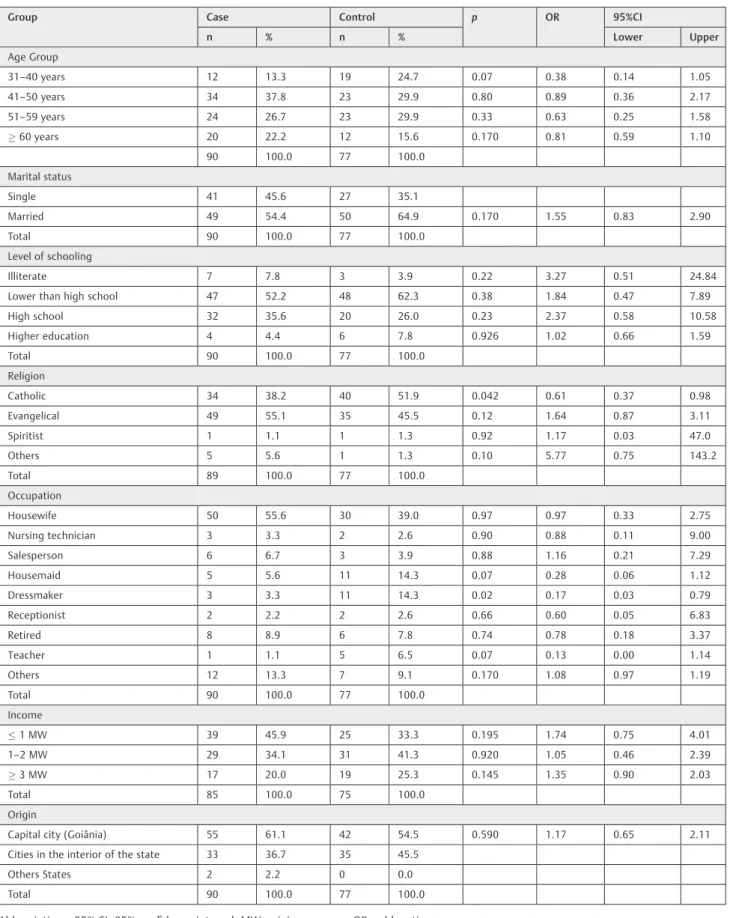
The results of the comparison between the groups were adjusted by the following variables: age group, marital status, level of education, religion, job, income and origin. They are described in►Table 1. The comparison showed that the groups
were similar, except when it came to religion (p¼0.042), in
which there were more Evangelicals in the cancer group, and profession, especially, in the case of the Seamstress (p¼0.02).
The results for body image related to weight, body image related to appearance, and self-esteem in both groups are described in►Table 2. A significant difference was found
between the groups with respect to appearance (with scores of 56.71 for the case group and 66.75 for the control) (p¼0.001), that is, the women with breast cancer felt their
appearances were compromised.
►Table 3describes the results of the body image and
self-esteem domains for the case group as a function of whether or not they had been submitted to neoadjuvant chemother-apy. Statistically significant differences were found only for body image related to appearance (p¼0.019) and high
self-esteem (p¼0.031).
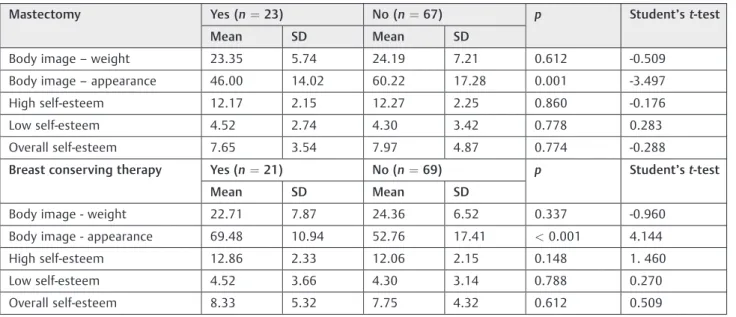
The results of the comparative analysis of the body image and self-esteem domains of the case group as a function of whether or not they had been submitted to mastectomy are described in►Table 4. A statistically significant difference
was found only for appearance (p¼0.001).►Table 4 also
shows the results of the comparative analysis of the body image and self-esteem domains for the women in the case group as a function of whether or not they had been sub-mitted to breast conserving therapy. A statistically significant difference was found only for the appearance domain (p<0.001), with the women who had undergone
breast conserving therapy reporting being more satisfied
with their physical appearance.
A comparative analysis of the domains of body image and self-esteem of the case group in relation to whether or not they had undergone breast reconstruction showed no sta-tistically significant differences.
The results of the correlation analysis between the do-mains of body image and self-esteem of the case group are described in ►Table 5. A statistically significant negative
correlation was found between body image related to weight and low self-esteem (p¼0.039) and overall self-esteem
(p¼0.034). A statistically significant negative correlation
was found between body image related to appearance and high self-esteem (p<0.001), and low self-esteem
(p<0.001) and overall self-esteem (p<0.001). A
statisti-cally significant negative correlation was found between
high self-esteem and low self-esteem (p<0.001) and overall
self-esteem (p<0.001). Finally, a statistically significant
negative correlation was found between low self-esteem and overall self-esteem (p<0.001).
Discussion
The results of the present study show differences between the case and control groups with respect to body image and self-esteem. There was a significantly higher mean score for body image related to appearance in the control group compared with the case group. Thisfinding shows that the surgical intervention negatively affected the perception of the women in the study group regarding their body image related to appearance. These results confirm that Brazilian women are usually anxious about their appearance prior to undergoing mastectomy.20Other studies have reported that
women who were submitted to breast conserving therapy and those submitted to mastectomy with breast reconstruc-tion value their appearance.21
We also found that having to undergo chemotherapy resulted in a significant reduction in the scores achieved for body image related to appearance and high self-esteem. Nevertheless, this treatment did not affect body image in relation to weight, low self-esteem or overall self-esteem in the case group. Patients undergoing chemotherapy report great concern regarding hair loss, resulting in anxiety, dis-tress and dismay.22This may be one of the reasons behind
Table 1 Comparison of the sociodemographic characteristics of the case and control groups
Group Case Control p OR 95%CI
n % n % Lower Upper
Age Group
31–40 years 12 13.3 19 24.7 0.07 0.38 0.14 1.05
41–50 years 34 37.8 23 29.9 0.80 0.89 0.36 2.17
51–59 years 24 26.7 23 29.9 0.33 0.63 0.25 1.58
60 years 20 22.2 12 15.6 0.170 0.81 0.59 1.10
90 100.0 77 100.0
Marital status
Single 41 45.6 27 35.1
Married 49 54.4 50 64.9 0.170 1.55 0.83 2.90
Total 90 100.0 77 100.0
Level of schooling
Illiterate 7 7.8 3 3.9 0.22 3.27 0.51 24.84
Lower than high school 47 52.2 48 62.3 0.38 1.84 0.47 7.89
High school 32 35.6 20 26.0 0.23 2.37 0.58 10.58
Higher education 4 4.4 6 7.8 0.926 1.02 0.66 1.59
Total 90 100.0 77 100.0
Religion
Catholic 34 38.2 40 51.9 0.042 0.61 0.37 0.98
Evangelical 49 55.1 35 45.5 0.12 1.64 0.87 3.11
Spiritist 1 1.1 1 1.3 0.92 1.17 0.03 47.0
Others 5 5.6 1 1.3 0.10 5.77 0.75 143.2
Total 89 100.0 77 100.0
Occupation
Housewife 50 55.6 30 39.0 0.97 0.97 0.33 2.75
Nursing technician 3 3.3 2 2.6 0.90 0.88 0.11 9.00
Salesperson 6 6.7 3 3.9 0.88 1.16 0.21 7.29
Housemaid 5 5.6 11 14.3 0.07 0.28 0.06 1.12
Dressmaker 3 3.3 11 14.3 0.02 0.17 0.03 0.79
Receptionist 2 2.2 2 2.6 0.66 0.60 0.05 6.83
Retired 8 8.9 6 7.8 0.74 0.78 0.18 3.37
Teacher 1 1.1 5 6.5 0.07 0.13 0.00 1.14
Others 12 13.3 7 9.1 0.170 1.08 0.97 1.19
Total 90 100.0 77 100.0
Income
1 MW 39 45.9 25 33.3 0.195 1.74 0.75 4.01
1–2 MW 29 34.1 31 41.3 0.920 1.05 0.46 2.39
3 MW 17 20.0 19 25.3 0.145 1.35 0.90 2.03
Total 85 100.0 75 100.0
Origin
Capital city (Goiânia) 55 61.1 42 54.5 0.590 1.17 0.65 2.11
Cities in the interior of the state 33 36.7 35 45.5
Others States 2 2.2 0 0.0
Total 90 100.0 77 100.0
Table 3 Comparison of the variable chemotherapy in relation to the domains of body image and self-esteem in the case group
Chemotherapy Yes (n¼22) No (n¼68)
(Patients who un-derwent surgery)
p Student’st-test
Mean SD Mean SD
Body image–weight 24.23 6.27 23.90 7.06 0.845 0.196 Body image–appearance 49.14 18.45 59.19 16.68 0.019 -2.390 High self-esteem 11.36 2.46 12.53 2.06 0.031 -2.197
Low self-esteem 4.55 3.61 4.29 3.14 0.754 0.314
Overall self-esteem 6.82 5.37 8.24 4.24 0.206 -1.275
Abbreviation: SD, standard deviation of the mean.
Note: Values ofp0.05 were considered statistically significant.
Table 4 Comparison of the variables mastectomy and breast-conserving therapy in relation to the domains of body image and self-esteem in the case group
Mastectomy Yes (n¼23) No (n¼67) p Student’st-test
Mean SD Mean SD
Body image–weight 23.35 5.74 24.19 7.21 0.612 -0.509 Body image–appearance 46.00 14.02 60.22 17.28 0.001 -3.497 High self-esteem 12.17 2.15 12.27 2.25 0.860 -0.176
Low self-esteem 4.52 2.74 4.30 3.42 0.778 0.283
Overall self-esteem 7.65 3.54 7.97 4.87 0.774 -0.288
Breast conserving therapy Yes (n¼21) No (n¼69) p Student’st-test
Mean SD Mean SD
Body image - weight 22.71 7.87 24.36 6.52 0.337 -0.960
Body image - appearance 69.48 10.94 52.76 17.41 <0.001 4.144
High self-esteem 12.86 2.33 12.06 2.15 0.148 1. 460
Low self-esteem 4.52 3.66 4.30 3.14 0.788 0.270
Overall self-esteem 8.33 5.32 7.75 4.32 0.612 0.509
Abbreviation: SD, standard deviation of the mean.
Note: Values ofp0.05 were considered statistically significant.
Table 2 Comparison between both groups in relation to the domains of body image and self-esteem
Group Case (n¼90) Control (n¼77) p Student’st-test
Mean Median SD Mean Median SD
Body image–weight 23.98 23.50 6.84 23.10 23.00 7.57 0.435 0.783 Body image–appearance 56.71 56.00 17.58 66.75 71.00 19.02 0.001 -3.522 High self-esteem 12.24 13.00 2.21 12.73 14.00 2.73 0.209 -1.262
Low self-esteem 4.36 4.00 3.24 3.51 3.00 2.82 0.075 1. 789
Overall self-esteem 7.89 8.50 4.55 9.22 10.00 4.98 0.073 -1.805
Abbreviation: SD, standard deviation of the mean.
changes the self-esteem of women, compromising their social relations.23 A study conducted in Korea showed a
moderate correlation between distress related to hair loss and body image, but not with self-esteem.24Indeed, patients
undergoing chemotherapy and those submitted to breast-conserving therapy do not appear to have problems seeing themselves naked.25
Of the body image domains evaluated in the present study, having been submitted to mastectomy resulted in a negative effect only on body image related to appearance. This type of treatment is understood to represent a major challenge for women, exerting a negative effect on emotional and social aspects. The data presented are in agreement with the findings of another study that showed that patients submitted to mastectomy are very concerned with their body image.26According to a study conducted in northern
Taiwan, concern regarding body image increased signifi -cantly in 41.5% of young patients with breast cancer.27
With respect to the cosmetic aspects of mastectomy, patients have described it as a“terrible mutilation”that is
emotion-ally devastating and leads them to avoid social interactions and physical intimacy.28,29Another study showed that 67% of
mastectomized patients felt inadequate in regard to their femininity, and found it difficult to accept their new body.30
A comparative study between mastectomy and breast-con-serving therapy showed that 38% of the patients submitted to mastectomy declared that they were dissatisfied with their body image, while patients who had been submitted to breast-conserving therapy did not report dissatisfaction with their body.31
Patients submitted to breast-conserving therapy were found to be more satisfied with their appearance, with higher levels of satisfaction with their body image compared with those submitted to mastectomy with breast reconstruction. Thesefindings are in agreement with those reported in a study conducted in Germany, in which a sample of 112
patients was evaluated, with results showing that the women submitted to breast-conserving therapy had a better image of their body compared with those submitted to mastectomy and reconstruction.32Another study, conducted
in Greece, also showed satisfaction with body image follow-ing breast-conservfollow-ing therapy.33A study conducted in the
United States found that body image remained unaffected in 57.6% of patients submitted to breast-conserving therapy, while 6.1% declared that their perception of body image was poorer, and 36% stated that it was better. The patients who were dissatisfied with the results of the surgery were more
likely to evaluate their physical image negatively compared with patients who were satisfied.34
No statistically significant differences were found in the appearance domains or self-esteem of the case group when women who had undergone breast reconstruction were com-pared with those who had not, that is, having undergone breast reconstruction made no difference to the body image or self-esteem domains in these women. Therefore, patients under-going this type of treatment have neither a negative perception of their body nor poor self-esteem. A study conducted in Spain reported conflicting results, with patients submitted to breast reconstruction reporting greater satisfaction with their body image and higher self-esteem.13In the United States, a study
published in 2013 found that 63.9% of women had positive expectations regarding their body image following surgery for breast reconstruction.35It has also been reported that women
submitted to breast reconstruction report greater satisfaction with their abdominal region, whereas women submitted to breast-conserving therapy are more satisfied with the appear-ance of their breasts.36
As a possible limitation of this study, it is important to mention that the differences found in the treatment vari-ables in the case group may reflect the different religious beliefs of the women; however, the variable religion was not a control factor in the selection of this sample.
Table 5 Correlation between the domains of body image and self-esteem in the case group
Domains (n¼90)
Body image High self-esteem Low self-esteem Overall self-esteem
Body image–weight
r 0.130 0.140 0.218 0.223
p 0.223 0.188 0.039 0.034
Body image–appearance
r 0.367 0.389 0.456
p <0.001 <0.001 <0.001
High self-esteem
r 0.368 0.748
p <0.001 <0.001
Low self-esteem
r 0.892
p <0.001
Another limitation of this study refers to the question-naires, as there was a large number of women who refused to participate. Therefore, the time of data collection for the group of women without breast cancer was also a limitation of the study, because it was not possible to apply 90 ques-tionnaires to women without breast cancer.
Conclusion
The results of this study show that self-esteem is negatively affected in patients who are dissatisfied with their body image. In conclusion, the study found women with breast cancer to be more dissatisfied with their body image related appearance compared with women without breast cancer, particularly after mastectomy or during chemotherapy. There was also a weak correlation between the body image and self-esteem domains, showing the influence of the former over the latter
Acknowledgments
This research study was supported by Coordenação de Aperfeiçoamento de Pessoal de Nível Superior (CAPES). The authors have no conflicts of interest to declare.
The study was conducted at the Mastology Program of Hospital das Clínicas, Universidade Federal de Goiás (UFG), Goiânia-Goiás, Brazil.
References
1 World Health Organization [Internet]. Cancer: breast cancer:
prevention and control. 2015[cited 2015 Oct 19]. Available from: http://www.who.int/cancer/detection/breastcancer/en/ index1.html
2 World Health Organization [Internet]. Media Centre. Cancer. 2015
[cited 2015 Oct 19]. Available from: http://www.who.int/media-centre/factsheets/fs297/en/
3 Brasil. Ministério da Saúde. Instituto Nacional de Câncer José
Alencar Gomes da Silva. Coordenação de Prevenção e Vigilância [Internet]. Estimativa 2014: incidência de câncer no Brasil. Rio de Janeiro: INCA; 2014[citado 2015 Out 19]. Disponível em: http://www.inca.gov.br/bvscontrolecancer/publicacoes/Estima-tiva_2014.pdf
4 International Agency for Research on Cancer. World Health
Organization [Internet]. GLOBOCAN 2012: estimated cancer in-cidence and mortality worldwide. Lyon: IARC; 2013[cited 2014 May 20]. Available from: http://globocan.iarc.fr
5 Martins E, Freitas R Jr, Curado MP, Freitas NMA, Silva CMB, Oliveira
JC. Prevalence of breast cancer in the city of Goiânia, Goiás, Brazil, between 1988 and 2002. Sao Paulo Med J 2011;129(05):309–314 6 Remondes-Costa S, Jimenéz F, Pais-Ribeiro JL. Body image,
sexu-ality and qusexu-ality of life in breast cancer. Psicol Saúde Doenças 2012;13(02):327–339
7 Cantinelli FS, Camacho RS, Smaletz O, Gonsales BK, Braguittoni E,
Rennó J Junior. A oncopsiquiatria no câncer de mama: consider-ações a respeito de questões do feminino. Rev Psiquiatr Clin (Santiago) 2006;33(03):124–133
8 Cash TF. Body image: past, present, and future. Body Image 2004;
1(01):1–5
9 da Costa Vargens OM, Berterö CM. Living with breast cancer: its
effect on the life situation and the close relationship of women in Brazil. Cancer Nurs 2007;30(06):471–478
10 Kernis MH. Measuring self-esteem in context: the importance of
stability of self-esteem in psychological functioning. J Pers 2005; 73(06):1569–1605
11 Johnson M, Forsman L. Competence strivings and self-esteem: an
experimental study. Pers Individ Dif 1995;19(04):417–430
12 Helms RL, O’Hea EL, Corso M. Body image issues in women with
breast cancer. Psychol Health Med 2008;13(03):313–325 13 Rincón Fernández ME, Pérez San Gregorio MA, Borda Más M,
Martín Rodríguez A. Impacto de la reconstrucción mamaria sobre la autoestima y la imagen corporal en pacientes con cáncer de mama. Univ Psychol 2012;11(01):25–41
14 García Arroyo JM, Domínguez López ML. Cuerpo, corporalidad y
esquema corporal en la mujer mastectomizada (parte 1). An Psiquiatr 2007;23(05):235–240
15 American Cancer Society [Internet]. Surgery for breast cancer.
Atlanta: ACS; 2015[cited 2015 Oct 19]. Available from: http:// www.cancer.org/cancer/breastcancer/detailedguide/breast-cancer-treating-surgery
16 Arroyo JM, López ML. Psychological problems derived from
mastectomy: a qualitative study. Int J Surg Oncol 2011; 2011:132461
17 Manos D, Sebastián J, Bueno MJ, Mateos N, de la Torre A. Body
image in relation to self-esteem in a sample of Spanish women with early-stage breast cancer. Psicooncologia (Pozuelo Alarcon) 2005;2(01):103–116
18 Ferreira MC, Leite NGM. Adaptation and validation of an
instru-ment for evaluation of body image satisfaction. Aval Psicol 2002; 1(02):141–149
19 Avanci JQ, Assis SG, Santos NC, Oliveira RV. Cross-cultural
adapta-tion of self-esteem scale for adolescents. Psicol Reflex Crit 2007; 20(03):397–405
20 da Silva SÉ, Vasconcelos EV, de Santana ME, et al. Social
repre-sentations of women submitted to mastectomy and the implica-tions for self-care. Rev Bras Enferm 2010;63(05):727–734 21 Paredes CG, Pessoa SGP, Peixoto DTT, Amorim DN, Araújo JS,
Barreto PRA. Impacto da reconstrução mamária na qualidade de vida de pacientes mastectomizadas atendidas no Serviço de Cirurgia Plástica do Hospital Universitário Walter Cantídio. Rev Bras Cir Plást 2013;28(01):100–104
22 Nizamli F, Anoosheh M, Mohammadi E. Experiences of Syrian
women with breast cancer regarding chemotherapy: a qualitative study. Nurs Health Sci 2011;13(04):481–487
23 Santos LR, Tavares GB, Reis PED. Análise das respostas
comporta-mentais ao câncer de mama utilizando o modelo adaptativo de Roy. Esc Anna Nery 2012;16(03):459–465
24 Cho J, Choi EK, Kim IR, et al. Development and validation of
Chemotherapy-induced Alopecia Distress Scale (CADS) for breast cancer patients. Ann Oncol 2014;25(02):346–351
25 Lyngholm CD, Christiansen PM, Damsgaard TE, Overgaard J.
Long-term follow-up of late morbidity, cosmetic outcome and body image after breast conserving therapy. A study from the Danish Breast Cancer Cooperative Group (DBCG). Acta Oncol 2013;52(02):259–269
26 Rosenberg SM, Tamimi RM, Gelber S, et al. Body image in recently
diagnosed young women with early breast cancer. Psychooncol-ogy 2013;22(08):1849–1855
27 Chen CL, Liao MN, Chen SC, Chan PL, Chen SC. Body image and its
predictors in breast cancer patients receiving surgery. Cancer Nurs 2012;35(05):E10–E16
28 Fallbjörk U, Salander P, Rasmussen BH. From“no big deal”to “losing oneself”: different meanings of mastectomy. Cancer Nurs
2012;35(05):E41–E48
29 Metcalfe KA, Semple J, Quan ML, et al. Changes in psychosocial
30 Odigie VI, Tanaka R, Yusufu LM, et al. Psychosocial effects of
mastectomy on married African women in Northwestern Nigeria. Psychooncology 2010;19(08):893–897
31 Gorisek B, Krajnc P, Krajnc I. Quality of life and the effect on social
status among Slovenian women after breast cancer treatment. J Int Med Res 2009;37(02):557–566
32 Han J, Grothuesmann D, Neises M, Hille U, Hillemanns P. Quality of
life and satisfaction after breast cancer operation. Arch Gynecol Obstet 2010;282(01):75–82
33 Markopoulos C, Tsaroucha AK, Kouskos E, Mantas D,
Antonopou-lou Z, Karvelis S. Impact of breast cancer surgery on the
self-esteem and sexual life of female patients. J Int Med Res 2009; 37(01):182–188
34 Wang HT, Barone CM, Steigelman MB, et al. Aesthetic outcomes in
breast conservation therapy. Aesthet Surg J 2008;28(02):165–170 35 Duggal CS, Metcalfe D, Sackeyfio R, Carlson GW, Losken A. Patient motivations for choosing postmastectomy breast reconstruction. Ann Plast Surg 2013;70(05):574–580
36 Parker PA, Youssef A, Walker S, et al. Short-term and long-term