Licence Creative Commom
CC
RBCDH
1 Universidade de Brasília. Grupo de Pesquisa Avaliação e Intervenção em Fisioterapia. Brasília, DF. Brasil.
2 Universidade de Brasília. Programa de Pós-Graduação em Educação Física. Brasília, DF. Brasil.
Received: 14 February 2014 Accepted: 08 May 2014
Chronic efects of resistance exercise using
reciprocal muscle actions on functional
and proprioceptive performance of young
individuals: randomized controlled trial
Efeitos crônicos do exercício resistido com contrações
recíprocas no desempenho funcional e proprioceptivo de
indivíduos jovens: ensaio controlado aleatório
Euler Alves Cardoso1,2
Martim Bottaro2
Pâmella Rodrigues1
Clarice Bacelar Rezende1
huany Fischer1
Jessica Mota1
Adailson Fernandes1
Rodrigo Luiz Carregaro1,2
Abstract– Studies have suggested that beneits from resistance exercise (RE) using antagonist muscle pre-activation could be transferred to functional activities. However, chronic studies using pre-activation through reciprocal actions in neuromuscular performance and functional activities are scarce. he aim of this study is to compare the efects of 12 RE sessions using reciprocal muscle actions and a traditional mode on functional and proprioceptive performance of young individuals. Forty eight young subjects were randomized into two groups: 1) reciprocal training (RT, 3 sets; 10 repetitions; knee lexion immediately followed by knee extension), 2) traditional training (TRA, 3 sets. 10 repetitions; knee extension). Pre and post evaluations were characterized by balance tests, hop tests (HT) and ”8” shape circuit (RC8). ANOVA 2X2 of mixed model was applied to analyze diferences between pre and post-training conditions and between groups. For overall and anterior-posterior balance, no signiicant diferences were found between RT and TRA (p>0.05). Similarly, no post-training diferences were found. he medial lateral balance in the dominant limb showed no signiicant diferences in post-training for both groups (p = 0.94), but the non-dominant limb showed signiicant diferences between groups (p<0.01). In HT, signiicant post-training increases were found within groups (p<0.01), but no diferences were found between them (p=0.90). RC8 was diferent between groups (p=0.03), indicating better post-training running time for TRA. Resistance exercise caused transfers to balance and functional performance, and training with reciprocal muscle actions showed better rates for HT and medial lateral knee balance.
Key words: Functional performance; Knee; Muscle strength; Physical herapy; Resistance exercise.
INTRODUCTION
Resistance exercise (RE) is considered one of the most eicient ways to enhance functional capacity of the neuromuscular system. Muscle strength gain, improvement in balance and motor coordination are among its speciic efects1,2. herefore, the importance of including RE in the context
of health, human performance and rehabilitation of the musculoskeletal function is clear3.
According to Wikstrom et al.4, muscle strength gain resulting from
RE represents a relevant clinical application as it can promote dynamic stability and improve performance. However, in order to obtain such beneits, RE must be carried out with the purpose of balancing the agonist/ antagonist muscles of a speciic joint. A strategy widely studied over the last few years involves the pre-activation of the antagonist musculature5-7.
Pre-activation can be carried out through previous contraction of the antagonist muscular group, immediately followed by contraction of the agonist group8,9. In this study, the pre-activation model was adopted as
training of a reciprocal contraction (TRE) routine. Previous studies have shown that individuals who adopt pre-activation obtained acute positive efects in generating muscle strength of the agonist group10, and improve
their performance by generating higher work levels7 and better eicency11.
However, these results are found either in transversal studies or in short-term training studies.
According to Zatsiorsky et al.12, the efects of RE on musculoskeletal
function can be explained as a transference of gains, as demonstrated by Wilson et al.13. In their study, Wilson et al. demonstrated that ater 8
weeks of RE in the 1RM test, gains were 21% for crouching exercise, 21% for vertical hop performance and 2% for running performance. hese results show that gains obtained from RE for lower limbs may cause efects on other exercise or sport modalities and functional movements. In this context, training with antagonist pre-activation could produce positive efects related to gain in neuromuscular ability, which is needed by many functional activities that require motor control of primary and stabilizing muscles14.
METHODS
Study design
Randomized controlled trial for a period of 6 weeks. Participants were randomly assigned into two training groups as shown in Figure 1.
Figure 1. Study lowchart.
Participants
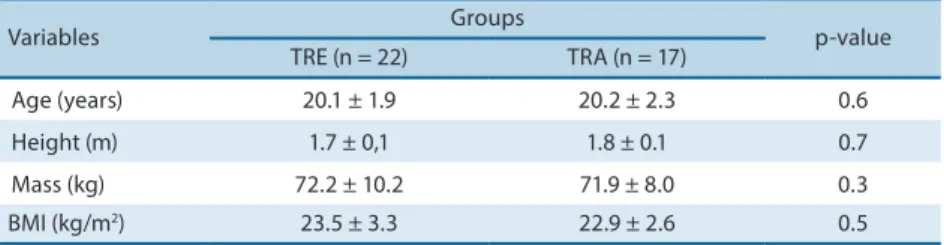
Sample size calculation was carried out using the GPower sotware, version 3.1.9, considering statistic power of 80%, α-value of 5% and moderate size of efect, indicating minimum sample of 26 individuals. For this study, 48 healthy young males were included (age 20.9 ± 2.2 years; height 1.8 ± 0.1 m; mass 75.0 ± 8.2 kg). Sample characterization is shown in Table 1. Volunteers were recruited at the University Campus by explaining the study objectives and showing posters. Subsequently, volunteers´ physical evaluation was carried out, followed by conducting the inclusion and exclusion criteria.
Table 1. Characteristics of the study participants, divided into two training groups.
Variables Groups p-value
TRE (n = 22) TRA (n = 17)
Age (years) 20.1 ± 1.9 20.2 ± 2.3 0.6
Height (m) 1.7 ± 0,1 1.8 ± 0.1 0.7
Mass (kg) 72.2 ± 10.2 71.9 ± 8.0 0.3
BMI (kg/m2) 23.5 ± 3.3 22.9 ± 2.6 0.5
Inclusion criteria were: being male, aged 18-25 years, not having participated in any RE over the last 6 months preceding the beginning of the study and to be available for training for a period of 6 weeks. Exclusion criteria were: any kind of cardio-respiratory condition, or metabolic disease, or osteo-myo-articular back injury, ankle and/or knee joint injury, any neurological and/or proprioceptive condition or deicit and those who missed two or more training sessions. All volunteers were given instructions about the objectives and procedures of the study and were invited to participate ater signing the free and informed consent form, which was approved by the Institutional Ethics Research Committee (Process n. 112/12).
Participants were randomly divided into two training groups: 1) reciprocal training (TRE, n = 24) or 2) traditional training (TRA, n = 24). For the randomization process, sealed opaque envelopes containing the name of the intervention group were used. Subsequently, participants started the study and were given an envelope containing the intervention group they were assigned to. A researcher, unaware of the purposes of the research, was responsible for the process.
Training Protocol Description
Participants attended the laboratory twice a week over 6 weeks (at intervals of at least 48 hours between each), making up a total of 12 training sessions in isokinetic dynamometer. here is consensus in literature indicating that the efect of neural and morphological adaptations on strength production levels occurs ater six weeks, during which a transition between neural and morphological training efects occurs. Since literature describes results concerning pre-activation in short-term trainings (from 2 to 3 training sessions) or transversal studies, our study adopted the minimum time required for the stabilization of gains from neural factors (6 weeks).
Training sessions for both groups (TRE and TRA) were characterized by 3 series of 10 maximum concentric isokinetic repetitions at 60º.s-1, with
intervals of one minute between each series15,16, described as follows: 1)
reciprocal training group (TRE, concentric reciprocal exercise of agonist and antagonist knee muscles, characterized by lexion movement of the knee immediately followed by its extension at each repetition), 2) traditional training group (TRA, only concentric exercise of the knee extensor muscles was carried out; knee was lexed in passive mode).
Training was carried out using a Biodex System 4 dynamometer (Biodex
Medical Systems, Shirley, New York, USA). Calibration was performed
day (chair height, chair depth, chair position on the track, dynamometer arm and position).
All participants were trained by the same researcher. During the study period, participants were advised not to do any additional resistance ex-ercise sessions.
Evaluation procedures
Participants were submitted to motor performance and postural balance functional evaluations, which were carried out over three visits to the laboratory. In the irst visit, familiarization with all tests was carried out, and then, ater a period of 48 hours, the irst evaluation, known as pre-training evaluation, was conducted. Ater 48 hours from the last pre-training session, post-training session was conducted (Figure 1).
Initially, the Athlete Single Leg Stability Testing (ASL) was applied using the balance platform. he ASL test was carried out in an instability condition (level 4), characterized by 2 series of 20 seconds for both lower limbs (dominant and non-dominant). he position adopted was with supporting leg in a semi-lexed position and the counter-lateral with knee lexed at 90º, arms crossed and hands resting on shoulders17. For this study,
Balance System platform (Biodex Medical Systems, Shirley, New York, USA) was used. Calibration was carried out according to manufacturer´s recom-mendations. Based on the test, global, anteroposterior and medial-lateral balance indexes were obtained.
Ater a ive-minute period, the Hop Test (HT) was applied, in which par-ticipants were asked to stand on one limb, with counter-lateral knee lexed at 90° and hands resting on their hips. Ater verbal command, participants were asked to jump the longest possible distance. he test was repeated three times, bilaterally with one-minute intervals between each hop. he average values were taken for analysis according to guidelines by Magee et al.18. Ater a ive-minute interval, an agility test was conducted, which
consisted of running into an ”8” shape circuit of 10m long by 4m wide19.
Participants were asked to run at their highest possible speed. he test was conducted once and the time spent, in seconds, was considered for analysis.
A previous study carried out by Ross et al.20 showed interclass
correlation coeicient (CCI) of 0.92 for the HT test, whereas for the”8” shape circuit running test, another study21 obtained 0.87 for CCI. For balance
indexes, Malaysia et al.22 demonstrated CCI indexes of 0.85, 0.78 and 0.84
for global, anterior-posterior and medial lateral, respectively, indicating high reliability of the balance platform.
Data analysis
Data were analyzed using the Statistical Package for the Social Sciences
applied in order to verify data normality assumptions. As assumptions were met, parametric tests were applied.
Initially, the t student test for independent samples was applied, aim-ing to compare the sample characteristics between TRE and TRA groups (Table 1). Using the t student test for paired samples, values of dominant limb (D) and non-dominant limb (ND) for the balance and jumping tests were compared. his analysis showed that only the medial lateral balance index presented diferences between D and ND limbs, for both groups. herefore, for balance variables, except for the medial lateral, data for the dominant limb were used. Finally, Analysis of Variance (ANOVA) 2X2 for mixed models was applied in order to verify diferences between pre- and post-training conditions and between training groups. Signiicance was set at 5% (p<0.05).
RESULTS
Forty-eight individuals were assessed for eligibility and were included in this study. However, during the training period, two participants from the TRE group and seven from the TRA group gave up the study. he remaining 39 participants received the original interventions and were included for subsequent analyses (Table 1).
he values for global and anterior-posterior balance indexes measured at pre- and post-training moments are illustrated in Figure 2. For both indexes (global and anterior-posterior), intergroup analysis showed no signiicant diference between TRE and TRA (p=0.23 and p=0.70, respectively). Similarly, no signiicant diferences were found between pre- and post-training moments for TRE and TRA groups (p=0.54 and p=0.32, respectively).
he index values for the medial lateral balance of D and ND limbs are shown in Table 3. For D limb, no signiicant diference was found (p=0.94) between pre and post-training moments. Similarly, TRE and TRA groups did not show signiicant diferences (p=0.33). However, there was a signiicant diference for the ND limb between pre and post-training moments for both TRE and TRA (p<0.01) groups. Figure 3 shows that the TRE group presented an increase in the medial lateral balance index, closer to the average when compared to the traditional group (which presented higher variability). In the intergroup analysis, no signiicant diference between groups was found (p=0.82).
Data concerning HT and agility test (“8” shape running) are shown in Table 2. Regarding HT, the comparison between groups showed no signiicant diference (p=0.90). However, signiicant diference was found between pre- and post-training moments, indicating that both TRE and TRA had gains on the hop test ater training. It was clear that the TRE group had higher percentage gains when compared to the TRA group (Table 2)
indicating a better running time for the TRA group. However, no signiicant diferences were found between pre- and post-training moments for any of the groups (p=0.74).
Figure 2. Values of Global Balance (A) and Anterior-posterior Balance (B) at pre and post-training moments for reciprocal contraction group (TRE) and traditional group (TRA). Normality ranges are presented as mean ± standard-deviation, based on the Balance System platform´s reference data.
Figure 3. Index values of Medio-lateral Balance of dominant limb (A) and non-dominant limb (B) at pre- and post-training moments,for the reciprocal contraction (TRE) and traditional (TRA) groups. Normality ranges are presented as mean ± standard-deviation, based on the Balance System platform´s reference data (Signiicant Diference between pre- and post-training moments: *p<0.01).
Table 2. Values for the Hop Test and “8” format circuit in pre- and post-training moments of ST, for reciprocal (TRE) and traditional (TRA) groups. Values are shown as mean ± standard-deviation.
Hop Test (m) “8” shape circuit (sec)
Pre Post Δ% Pre Post Δ%
TRE 1.50 ± 0.17 1.61 ± 0.15* 7.3 8.3 ± 0.6 8.5 ± 1.1 2.4
TRA 1.56 ± 0.22 1.58 ± 0.19* 1.2 8.1 ± 0.4 7.8 ± 0.4 -3.7
DISCUSSION
he aim of this study was to compare the efect of twelve resistance exercise sessions of TRE modality with traditional model, regarding the functional and proprioceptive performance of young individuals. he results partially conirm the initial hypothesis, considering that for the hop test, participants achieved longer distances, but both groups were eicient in post-training. Moreover, global and anterior-posterior balances were not afected by any of the two training modalities. However, signiicant improvements were found on the medial-lateral balance of the ND limb for both groups. For the “8” shape running circuit, it was observed that in post-training, TRA group obtained better results compared to TRE group.
In this study, 12 RE sessions did not show signiicant gains in the global and anterior-posterior balance, corroborating results found in the study conducted by Heitkamp et al.23. However, for global balance, TRE and TRA
groups showed indexes close to those recommended by the Balance System
platform. Concerning the anterior-posterior balance, both groups began with recommended indexes. However, ater intervention, only TRE group remained in the normality range. Apparently, the traditional format is not interesting when the main focus is to balance the knee´s anterior-posterior musculature as only the anterior musculature was trained. hese results corroborate those presented by a previous study4, which recommends that
in order to obtain better balance, anterior and posterior muscles should be trained at the same intensity.
Paterno et al.17 showed the effect of 6 weeks of RE sessions and
neuromuscular training, and as in our study, balance evaluations were carried out using the ASL test, level 4. he results reported by Paterno and colleagues showed signiicant efects from intervention for global and anterior-posterior balance, which can be justiied by the training modalities used (strength, plyometric and balance exercises), unlike our study. A factor that could justify the lack of results could be the fact that in this study, the training volume was not adjusted, as the study by Paterno et al.17 had
a periodicity, in which the training overload was adjusted by evaluators according to observations they made in the participants´ evolution. Furthermore, in the study by Paterno et al.17, the training consisted of
exercises aimed at hip, pelvic and thorax muscular groups. On the other hand, this study focused on the agonist and antagonist knee musculature. his fact by itself imposes a limitation when comparing the results.
Heitkamp et al.23 adopted 2 series of 5 repetitions at 80% of maximum
repetition with the same intervention time used in this study (12 sessions). However, they used isoinertial devices (legpress and a lexing table). he authors showed that there was no signiicant efect on the dynamic balance, corroborating our study. Still regarding the study by Heitkamp et al.23, no
for better balance in the anterior-posterior direction, in accordance with a previous study17.
Previous results regarding the medial lateral balance did not show signiicant gains ater resistance exercise for the dominant limb, corroborating previous study17. However, signiicant results were found
for the non-dominant limb for both groups in post-training, which result was not expected. Surprisingly, the results for the non-dominant limb were better for the TRE group, considering that the values obtained were close to recommendations. In the study conducted by Paterno et al.17, no signiicant
results were obtained for the medial lateral balance, and no signiicant diference was found between limbs (D and ND), unlike our results. It could be inferred that these diferences are due to methodological variations, as Paterno et al.17 trained several muscular groups. According to Tessitore
et al.24, there are diferences in the coordination of counter lateral limbs,
which can be inluenced by training. In this case, it can be assumed that diferences of coordination between dominant and non-dominant limbs of our sample could have been afected diferently by training.
Concerning HT, both TRE and TRA groups showed signiicant gains, 7.3% and 1.2%, respectively. Fitzgerald et al.25 showed that HT is commonly
used as a representation of physical performance and widely used for clinical assessment in order to measure dynamic balance. In turn, Sekiya et al.26 reported that HT can provide qualitative data regarding quadriceps and
hamstring muscular strength. However, there is no consensus in literature as to which muscular group becomes more involved in functional activities. Li et al.27 showed a correlation between hamstrings during functional
activities involving the knee joint, whereas other studies28,29 found
correlation only with the quadriceps musculature. Our results corroborate those by Sekiya et al.26, in which jumping gains were observed in TRE and
TRA groups. hese efects demonstrate transference of gains acquired by resistance exercise for functional activities, with some indications of higher eiciency for TRE group, even though there is no diference in relation to TRA group. Apparently, the strengthening of agonist and antagonist muscles provides better results for functional exercises such as jumping4,27.
he results for the “8” shape running did not show signiicant efects for TRE and TRA groups ater training. However, signiicant diferences between groups at the post-training moment could be observed. Pasanen et al.28 investigated a muscle warm-up program over 6 months, including
running techniques, balance jumping and muscle strengthening exercises of soccer players. he authors showed signiicant efects on the “8” shape running in accordance with results for TRA group (2.4% reduction in the running time), while TRE group showed a 3.7% increase. hus, traditional training produced a better response than reciprocal one, corroborating the results by Maynard and Ebben5, who demonstrated that the pre-activation
primary muscular groups (agonist). However, this assumption should be conirmed in further studies.
Our study presented some limitations. Initially, it is possible to suppose that longer training, over more than 6 weeks, could favor the proprioceptive response as there would be higher levels of muscle strength from training sessions over 8 weeks or longer. Another limitation was the lack of blind evaluators during the evaluation process, which is an issue to be considered in future studies using resistance exercise, regardless of exercise modality being adopted. he training characteristic, focused on only one joint (knee) could also have limited interpretations and results, as both proprioception and musculoskeletal function depend on the interaction among diferent kinematic chains. Finally, for future studies, we suggest considering the reciprocal action model for longer training protocols and to include exercises that involve more muscular groups, mainly ankle, knee and hip joints.
CONCLUSION
his study showed that resistance exercise provided transference for balance and functional tests in a sample of healthy young individuals. Despite the absence of signiicance, training carried out on the reciprocal contractions modality showed better indexes for the hop test performance and medial lateral balance of the knee. However, exercise modality with no pre-activation showed better results for running performance. he indings show that the use of reciprocal contractions can be included in exercise programs that use resistance exercise when the focus is the dynamic joint balance.
REFERENCES
1. Kraemer WJ, Ramamess NA. Fundamentals of resistance training: progression and exercise prescription. Med Sci Sports Exerc 2004;36(4):674-88.
2. Fleck SJ,Kraemer WJ. Fundamentos do treinamento de força muscular. 3. ed. Porto Alegre: Artmed, 2006.
3. American College of Sports Medicine (ACMS).Diretrizes para os teste de esfoço e sua prescrição. 5ª ed. Guanabara Koogan, 2007.
4. Wikstrom EA, Tillman MD, Chmielewski TL, Borsa PA. Measurement and evalu-ation of dynamic joint stability of the knee and ankle ater injury. Sports Med 2006;36(5):393-410.
5. Maynard J, Ebben WP. he efects of antagonist prefatigue on agonist torque and electromyography. J Strength Cond Res 2003;17(3):469-74.
6. Balsamo S, Tibana RA, Nascimento DC, Farias GL, Petruccelli Z, Santana FS, et al. Exercise order afects the total training volume and the ratings of perceived exertion in response to a super-set resistance training session. Int J Gen Med 2012;5:123-7.
7. Carregaro RL, Cunha RR, Cardoso JR, Pinto RS, Bottaro M. Efects of diferent methods of antagonist muscles pre-activation on knee extensors neuromuscular responses. Braz J Phys her 2011;15(6):452-9.
8. Miller JP, Croce RV, Hutchins R. Reciprocal coactivation patterns of the medial and lateral quadriceps and hamstrings during slow, medium and high speed isokinetic movements. J Electromyogr Kinesiol 2000;10(4):233-9.
Corresponding author
Rodrigo Luiz Carregaro
Curso de Fisioterapia, Campus UnB Ceilândia.
Faculdade de Ceilândia (FCE/UnB) Centro Metropolitano, conjunto A, lote 01,
72220-900 – Brasília, DF. Brasil E-mail: [email protected]
10. Burke DG PT, Holt LE. he inluence of varied resistance and speed of concentric antagonistic contractions on subsequent concentric agonistic eforts. J Strength Cond Res 1999; 13(3):193-7.
11. Robbins DW, Young WB, Behm DG, Payne WR. he efect of a complex agonist and antagonist resistance training protocol on volume load, power output, electromyographic responses, and eiciency. J Strength Cond Res 2010;24(7):1782-9.
12. Zatsiorsky VM, Kraemer WJ. Ciência e prática do Treinamento de Força. 2a ed. Phorte, 2008.
13. Wilson GJ, Murphy AJ, Walshe A. he speciicity of strength training: the efect of posture. Eur J Physiol 1996;73(3-4):346-52.
14. Kisner C, Colby LA. herapeutic exercise. Foundations and techniques. 5thed. Philadelphia: Davis Company, 2007.
15. Ratamess NA, Alvar BA, Evetoch TK, Housh TJ, Kibler WB. American College of Sports Medicine position stand. Progression models in resistance training for healthy adults. Med Sci Sports Exerc 2009;41(3):687-708.
16. Parcell AC, Sawyer RD, Tricoli VA, Chinevere TD. Minimum rest period for strength recovery during a common isokinetic testing protocol. Med Sci Sports Exerc 2002;34(6):1018-22.
17. Paterno MV, Myer GD, Ford KR, Hewett TE. Neuromuscular Training Improves Single-Limb Stability in Young Female Athletes. J Orthop Sports Phys her 2004;34(6):305-16.
18. Magee DJ. Avaliação musculo esquelética. 4a. ed. São Paulo: Manole, 2005.
19. Fonseca ST, Magee D, Wessel J, Reid D. Validatio94n of a performance test for outcome evaluation of knee function. Clin J Sports Med 1992: 2(4):251-6.
20. Ross MD; Brian L, Patrick J. Whelan PJ. Test-Retest Reliability of 4 Single-Leg Horizontal Hop Tests. J Strength Cond Res 2002;16(4):617-22.
21. Gross TM, Everts JR, Sarah E, Roberson BS, David S, Roskin BA, et al. Efect Of Donjoy Ankle Ligament Protector And Aircast Sport-Stirrup Orthoses On Functional Performance. J Orthop Sports Phys her 1994;19(3):150-6.
22. Ariin N, Abu Osman NA, Wan Abas WA. Intrarater test-retest reliability of static and dynamic stability indexes measurement using the biodex® balance system during unilateral stance. J Appl Biomech 2014;30(2):300-4
23. Heitkamp HC, Horstmann T, Mayer F, Weller J, Dickhuth HH. Gain in strength and muscular balance ater balance training. Int J Sports Med 2001;22(4):285-90.
24. Tessitore A, Perroni F, Cortis C, Meeusen R, Lupo C, Capranica L. Coordination of soccer players during preseason training. J Strength Cond Res. 2011; 25(11):3059-3069.
25. Fitzgerald GK, Lephart SM, Hwang JH, Wainner RS. Hop tests as predictors of dynamic knee stability. J Orthop Sports Physher 2001;31(10):588-97.
26. Sekiya I, Muneta T, Ogiuchi T, Yagishita K, Yamamoto H. Signiicance of the single-legged hop test to the anterior cruciate ligament-reconstructed knee in relation to muscle strength and anterior laxity. Am J Sports Med 1998;26(3):384-8.
27. Li RC, Mafuli N, Hsu CY, Chan KM. Isokinetic strength of the quadríceps and hamstrings and functional ability of anterior cruciate ligament deicient knees in recreational athletes. Br J Sports Med 1996;40:161-4.
28. Pasanen K, Parkkari J, Pasanen M, Kannus P. Efect of a neuromuscular warm-up programme on muscle power, balance, speed and agility: a randomised controlled study. Br J Sports Med 2009;43(13):1073-8.