Effects of Acid Treatment on Dental Zirconia:
An
In Vitro
Study
Haifeng Xie1, Shuping Shen1, Mengke Qian1, Feimin Zhang1, Chen Chen2*, Franklin R. Tay3*
1Jiangsu Key Laboratory of Oral Diseases, Nanjing Medical University, Department of Prosthodontics, Affiliated Hospital of Stomatology, Nanjing Medical University, Nanjing, China,2Jiangsu Key Laboratory of Oral Diseases, Nanjing Medical University, Department of Endodontics, Affiliated Hospital of Stomatology, Nanjing Medical University, Nanjing, China,3Department of Endodontics, College of Dental Medicine, Georgia Regents University, Augusta, Georgia, United States of America
*[email protected](CC); [email protected](FRT)
Abstract
The aim of this study was to evaluate the effects of hydrofluoric (HF) acid, acetic acid, and citric acid treatments on the physical properties and structure of yttria-stabilized tetragonal zirconia polycrystal (Y-TZP) at ambient temperature. In total, 110 bar-shaped zirconia spec-imens were randomly assigned to 11 groups. The specspec-imens in the control group (C) received no surface treatment, while those in the Cage group were hydrothermally aged at 134°C and 0.2 MPa for 20 h. Ten specimens each were immersed at ambient temperature in 5% and 40% HF acid for 2 h (40HF0), 1 day (5HF1, 40HF1), and 5 days (5HF5, 40HF5), while 10 each were immersed at ambient temperature in 10% acetic acid and 20% citric acid for 7 (AC7, CI7) and 14 days (AC14, CI14). X-ray diffraction (XRD) was used to quanti-tatively estimate the monoclinic phase. Furthermore, flexural strength, surface roughness, and surface Vickers hardness were measured after treatment. Scanning electron micros-copy (SEM) was used to characterize the surface morphology. The Cage group specimens exhibited an increased monoclinic phase and flexural strength. Furthermore, 40% HF acid immersion decreased the flexural strength and surface hardness and deteriorated the sur-face finish, while 5% HF acid immersion only decreased the sursur-face hardness. All the HF acid-immersed specimens showed an etched surface texture on SEM observations, while the other groups did not. These findings suggest that the treatment of Y-TZP with 40% HF acid at ambient temperature causes potential damage, while treatment with 5% HF acid, acetic acid, and citric acid is safe.
Introduction
Yttria-stabilized tetragonal zirconia polycrystal (Y-TZP) is a popular nonmetallic material used for dental restorations and implants because of its superior mechanical properties and biocom-patibility. Prostheses fabricated from Y-TZP are supposed to be more clinically durable than those prepared from other all-ceramic systems. However, clinical studies reported Y-TZP
OPEN ACCESS
Citation:Xie H, Shen S, Qian M, Zhang F, Chen C, Tay FR (2015) Effects of Acid Treatment on Dental Zirconia: AnIn VitroStudy. PLoS ONE 10(8): e0136263. doi:10.1371/journal.pone.0136263
Editor:Tatsuo Shimosawa, The University of Tokyo, JAPAN
Received:March 26, 2015
Accepted:August 3, 2015
Published:August 24, 2015
Copyright:© 2015 Xie et al. This is an open access article distributed under the terms of theCreative Commons Attribution License, which permits unrestricted use, distribution, and reproduction in any medium, provided the original author and source are credited.
Data Availability Statement:All relevant data are within the paper.
framework fractures in extended fixed dental prostheses and crowns [1,2]. Susceptibility to low-temperature degradation [LTD, based on tetragonal phase (t) to monoclinic (m) phase transformation] has allegedly been an important factor affecting the mechanical properties and survival of Y-TZP frameworks [3–6]. However, chemical degradation was also recently reported to alter the mechanical properties of Y-TZP in an adverse manner. According to Egil-mez et al, the flexural strength of zirconia decreased significantly after immersion in 4% acetic acid at 80°C for 7 days [7]. In other studies, Y-TZP readily corroded after immersion in 100°C HCl/Fe2Cl3, hydrofluoric acid (HF), nitric acid, and sulfuric acid for 30 min [8,9]. These
find-ings collectively suggest the potential adverse effects of acid solutions on the crystalline struc-ture and mechanical properties of Y-TZP. However, the experiments in these previous studies involved acid etching at high temperatures, not ambient temperature. The oral cavity is a potentially hostile environment because of the high humidity and varied pH values. In particu-lar, an acidic environment caused by the ingestion of beverages and foods with low pH values is predominant, and restorations fabricated from Y-TZP inevitably come into contact with this environment. Furthermore, some authors advocate etching or cleaning of Y-TZP restorations with HF acid before bonding. In a study by Sriamporn et al [10], 9.5% and 48% HF was used to etch dental zirconia ceramic at 25°C, resulting in micromorphological changes. However, that study did not investigate the effects of HF acid etching on the mechanical properties and crys-talline structure of Y-TZP. Investigation of the effects of an acidic environment created by the ingestion of low-pH beverages and foods or by HF etching on the physical properties and crys-talline structure of Y-TZP at ambient temperature is essential to determine whether such actions should be avoided. Unfortunately, few studies have evaluated these effects. Therefore, the present study was designed to evaluate the effects of HF and two typical acids, citric acid and acetic acid, which come from juice and vinegar, respectively, on the physical properties and phase composition of Y-TZP at ambient temperature and to determine whether these changes occur because of LTD and chemical degradation or chemical degradation only. The null hypothesis tested was that there are no differences in Y-TZP immersed in HF acid, acetic acid, and citric acid for different time periods with respect tot!mtransformation, destabiliza-tion of the crystalline phase, and deterioradestabiliza-tion of physical properties.
Materials and Methods
Specimen preparation
In total, 110 bar-shaped specimens (2 × 5 × 25 mm3) were sectioned from a machinable Y-TZP block (zirconia94%, alumina0.5%; Everest ZS-B42/16, KAVO, Altenbach & Voigt GmbH, Bismarcking, Germany) using an electric low-speed saw (Isomet 100, Buehler Ltd., Lake Bluff, IL, USA). The specimens were wet polished with 600- and 800-grit silicon carbide abrasive papers and completely sintered in a crystallization furnace (EverestTherm, KAVO) at a temperature of 1450°C for 2 h according to the manufacturer’s instructions. The dimensions of the zirconia specimens after sintering were approximately 1.2 × 4 × 20 mm3.
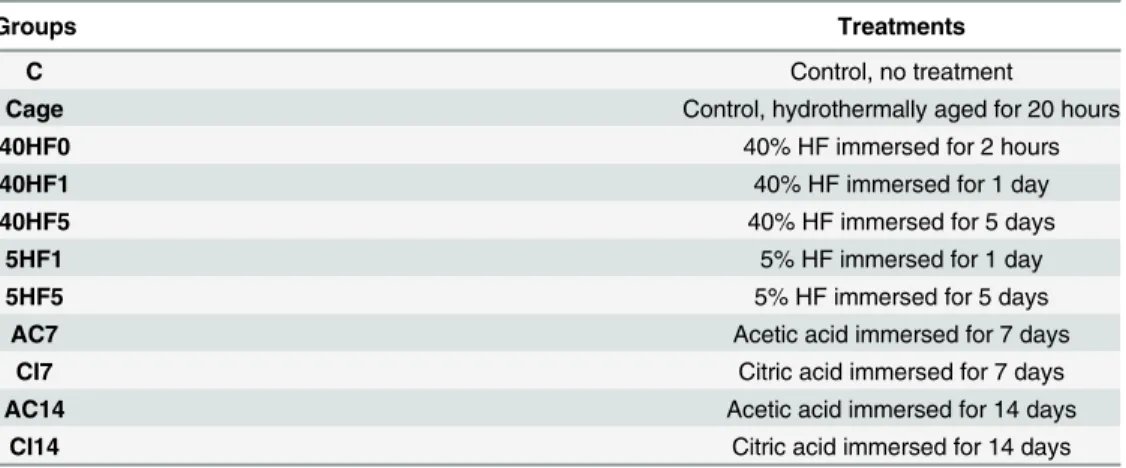
The Y-TZP bars were randomly assigned to 11 groups (N = 10). Specimens in the control group (C) received no further surface treatment, while those in the Cage group were hydrother-mally aged at 134°C and 0.2 MPa in an autoclave (Vacuklav 24B, MELAG, Germany) for 20 h. Ten specimens each were immersed at ambient temperature in 5% and 40% HF for 2 h (40HF0), 1 day (5HF1, 40HF1), and 5 days (5HF5, 40HF5). The other specimens (N = 10) were immersed in 10% acetic acid and 20% citric acid for 7 (AC7, CI7) and 14 days (AC14, CI14). The treatments of all the experimental groups were summarized inTable 1. After treat-ment, all specimens were ultrasonically cleaned in distilled water for 10 min before testing.
Higher Education Institutions [grant number 2014-37], the Jiangsu Student’s Platform for Innovation and Entrepreneurship Training Program [grant number 201410312012Z], the National Natural Science Foundation of China [grant number 81400539] and the Natural Science Foundation of Jiangsu Province, China [grant number BK20140913].
Flexural strength, surface roughness, and surface Vickers hardness
evaluation
The 110 Y-TZP bars were subjected to three-point bending tests performed using a universal testing machine (Instron Model 3365, Norwood, MA, USA) equipped with a three-point bend-ing jig that had a span length of 14 mm. Prior to testbend-ing, the dimensions of each specimen were determined using a digital micrometer. Moreover, all edges were rounded off along the long axis of the specimen and provided a 0.1-mm-wide chamfer, as proposed by ISO 6872 [11]. Each specimen was loaded mid-length with a crosshead speed of 1 mm/min until failure, and the load at fracture was recorded. The flexural strength (in MPa) was calculated using the equa-tion M = 3FL/2WT2, where F is the load at fracture, L is the span length (center-to-center
dis-tance between the supporting rollers), W is the specimen width, and T is the specimen thickness.
The reliability of flexural strength testing was assessed using the Weibull distribution [12–
14]. For each of the 11 test groups, the stress values were ranked in ascending order as follows: i = 1, 2, 3,. . ., N), where N is the total number of test specimens and i is the ith datum.
Accord-ingly, the lowest stress value for each configuration is represented by the first datum (i = 1), the second lowest value is represented by the second datum (i = 2), and so on, with the highest stress value represented by the Nth datum. This enables the determination of a ranked proba-bility of failure, Pf(σf), which is assigned to each datum according to the following formula:
Pf ¼ ði 0:5Þ=N
Then, least-squares estimation (LSE), maximum likelihood estimation (MLE), and mean and variance evaluation were used to evaluate each material and treatment group using the scale parameterσθand the Weibull modulus m (two-parameter Weibull distribution)
accord-ing to the followaccord-ing formula:
Pf ¼ 1 expf ðsf=syÞ
m
g;
where Pfis the probability of failure at or below the stressσf.
The following calculations were derived from the above equation:
lnln½1=ð1 P
fÞ ¼ mlnsf mlnsy l Table 1. Summarization of the treatments for all the experimental groups.
Groups Treatments
C Control, no treatment
Cage Control, hydrothermally aged for 20 hours
40HF0 40% HF immersed for 2 hours
40HF1 40% HF immersed for 1 day
40HF5 40% HF immersed for 5 days
5HF1 5% HF immersed for 1 day
5HF5 5% HF immersed for 5 days
AC7 Acetic acid immersed for 7 days
CI7 Citric acid immersed for 7 days
AC14 Acetic acid immersed for 14 days
CI14 Citric acid immersed for 14 days
The plotting oflnln[1/(1−Pf)] againstσfprovided a slope with the value m (Weibull
modu-lus) and an intercept mlnσθ.
Five fractured Y-TZP bars (flexural strength closer to the mean) were selected from each group for the evaluation of surface roughness (Ra) using a surface profilometer (Mahr Perth-ometer PGK, Mahr GM, Germany). Each surface roughness value was derived from the mean of three different observation points.
The five selected bars were then subjected to surface Vickers hardness testing. Indentations were created using a Vickers microhardness tester (FM-700, Future-Tech Corp., Kanagawa, Japan) with a constant load of 9.807 N for 10 s. The diamond indentations were assessed using scanning electron microscopy (SEM, LEO 1530VP, Oberkochen, Germany) at 15 kV with 5000× magnification.
All the above data are expressed as means, standard deviations, and 95% credibility inter-vals. Following validation of the normality and homoscedasticity assumptions of the data sets, one-way analysis of variance (ANOVA) and least significant different (LSD) tests (for multiple comparisons) were performed to determine statistically significant differences among groups using the SPSS 19.0 statistical software package (SPSS Inc., Chicago, IL, USA). A p-value of 0.05 was considered statistically significant.
Morphological analysis
The surface of a selected fractured Y-TZP bar (flexural strength closest to the mean) from each group was sputter-coated with gold for examination using SEM at 20 kV in the secondary elec-tron imaging mode, with magnifications of 30×, 3000×, and 10000×.
Characterization of phase transformation
The amount ofm-ZrO2crystals in a random Y-TZP bar selected from each group was
deter-mined using X-ray diffraction (XRD; Shimadzu XRD-6000 X-ray diffractometer, Bruker, Ger-many) with Ni-filtered Cu K radiation (λ= 1.5418 Å) at ambient temperature. The test
parameters were as follows: step size, 0.01° 2θ; start angle, 25°; end angle, 80°; and scan speed,
2° 2θ/min. The monoclinic phase weight fraction (Xm) was calculated using the method of
Gar-vie and Nicholson [15].
Characterization of the sediments obtained after acid immersion
The sediments formed after acid immersion were separated, washed with absolute ethanol, and dried. XRD with the same test parameters mentioned above was used to characterize the dried powders and determine the composition of the mixture. The sediments were assessed by SEM with energy-dispersive X-ray microanalysis (SEM/EDS; 15 kV, 200×; INCAx-sight, Oxford Instruments, United Kingdom). On the basis of the EDS analysis, the oxide weight percent was calculated using stoichiometry.
Results
Flexural strength, surface roughness, and surface Vickers hardness
values
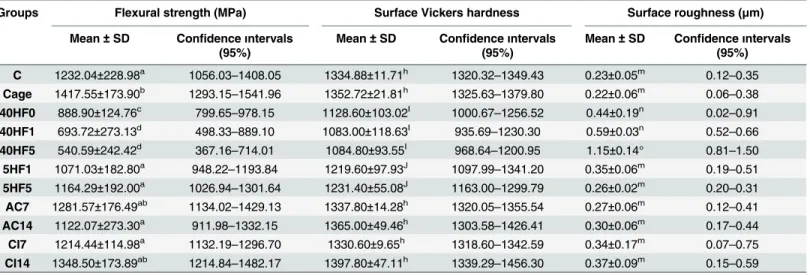
One-way ANOVA revealed significant differences among the 11 groups in flexural strength, surface roughness, and surface Vickers hardness (all p<0.05) values. LSD tests revealed the following results. The flexural strength decreased in all the HF acid-treated groups except the groups 5HF1 and 5HF5, with the maximum decrease observed in the 40HF5 and 40HF1 groups. The surface roughness increased only in the HF acid-treated groups, with the increase being directly proportional to the concentrations and immersion times. The Vickers hardness decreased only in the HF acid-treated groups, with the decrease being directly proportional to the concentrations.
The Weibull statistical parameters are presented inTable 3. A high Weibull modulus indi-cated a smaller error range, a higher level of structural integrity, and potentially greater struc-tural reliability of the material. Statistical analysis revealed significant differences among the flexural strength values obtained for all tested groups. The 40HF0, 40HF1, and 40HF5 groups
Table 2. Flexural strength, Vickers hardness, and surface roughness values for each group.
Groups Flexural strength (MPa) Surface Vickers hardness Surface roughness (μm)
Mean±SD Confidenceıntervals (95%)
Mean±SD Confidenceıntervals (95%)
Mean±SD Confidenceıntervals (95%)
C 1232.04±228.98a 1056.03–1408.05 1334.88±11.71h 1320.32–1349.43 0.23±0.05m 0.12–0.35
Cage 1417.55±173.90b 1293.15
–1541.96 1352.72±21.81h 1325.63–1379.80 0.22±0.06m 0.06–0.38 40HF0 888.90±124.76c 799.65
–978.15 1128.60±103.02I 1000.67–1256.52 0.44±0.19n 0.02–0.91 40HF1 693.72±273.13d 498.33
–889.10 1083.00±118.63I 935.69–1230.30 0.59±0.03n 0.52–0.66 40HF5 540.59±242.42d 367.16–714.01 1084.80±93.55I 968.64–1200.95 1.15±0.14° 0.81–1.50
5HF1 1071.03±182.80a 948.22
–1193.84 1219.60±97.93J 1097.99–1341.20 0.35±0.06m 0.19–0.51 5HF5 1164.29±192.00a 1026.94
–1301.64 1231.40±55.08J 1163.00–1299.79 0.26±0.02m 0.20–0.31 AC7 1281.57±176.49ab 1134.02
–1429.13 1337.80±14.28h 1320.05–1355.54 0.27±0.06m 0.12–0.41 AC14 1122.07±273.30a 911.98–1332.15 1365.00±49.46h 1303.58–1426.41 0.30±0.06m 0.17–0.44
CI7 1214.44±114.98a 1132.19
–1296.70 1330.60±9.65h 1318.60–1342.59 0.34±0.17m 0.07–0.75 CI14 1348.50±173.89ab 1214.84
–1482.17 1397.80±47.11h 1339.29–1456.30 0.37±0.09m 0.15–0.59
Values with the same superscript letters are not significantly different (p<0.05).
doi:10.1371/journal.pone.0136263.t002
Table 3. Weibull statistics determining a 10% probability of fracture (P10) derived from the flexural strength values.
Groups +P
10(MPa) Scale parameter,σθ(MPa) *m
C 921 1327 6.2
Cage 1176 1493 9.4
40HF0 720 941 8.4
40HF1 532 801 5.5
40HF5 305 636 3.1
5HF1 825 1146 6.9
5HF5 905 1242 7.1
AC7 1038 1356 8.4
CI7 1056 1264 12.5
AC14 759 1230 4.7
CI14 1101 1424 8.7
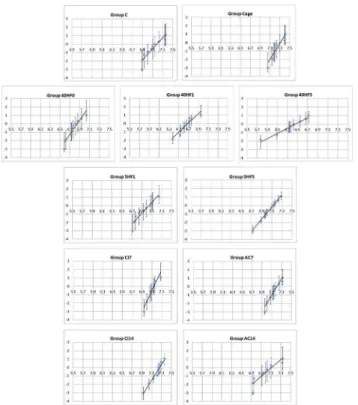
showed the lowest mean flexural strength values and Weibull moduli. The Weibull distribution presented the highest shape values for the CI7, CI14, and Cage groups. A Weibull plots for all the experimental groups with 95% confidence interval was shown inFig 1.
Morphological analysis
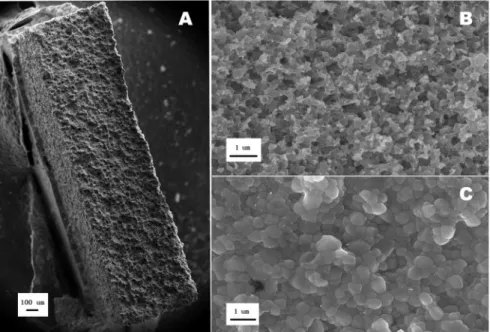
SEM observations revealed completely different Y-TZP surface morphologies in the 11 groups. All the HF acid-immersed specimens were evidently etched and exhibited a cellular texture, including the dislodgment of superficial grains, an irregular grain shape, and a decrease in grain size (Fig 2A and 2B, irrespective of the duration of immersion and concentration of HF. Several round, shallow concavities were observed in the 40HF5, 40HF1, and 5HF5 group speci-mens. However, there were no differences in surface morphology among the control, Cage, AC7, AC14, CI7, and CI14 group specimens (Fig 2C, which exhibited a homogenous fine-grained structure and closed intergrain spaces.
Characterization of phase transformation
As shown inFig 3, XRD only detectedm-ZrO2in the Cage group specimens, while nom-ZrO2
was found in the other groups. Them-ZrO2contents could be sequenced according to
quanti-fied data from XRD as follows: Cage (19.8 wt%)>40HF5, 40HF1, 40HF0, 5HF5, 5HF1, AC14, CI14, AC7, CI7, and C (0 wt%).
Characterization of the sediments after immersion
A large quantity of sediment was observed in the immersion solutions from the 40HF5 group, while a small amount of visible sediment was observed in the solutions from the 40HF1 group
Fig 1. Weibull plots for all the experimental groups with 95% confidence interval.
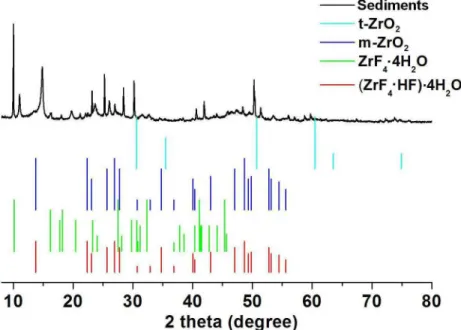
(Fig 4A). No obvious sediment was observed in the solutions from the 40HF0 and other groups. The composition of the sediments was examined by XRD (Fig 5); the diffraction peaks could be well indexed tot-ZrO2(JCPDS 00-001-0750),m-ZrO2(JCPDS 00-007-0337), ZrF4·
4H2O (JCPDS 00-019-1486), and (ZrF4·HF)·4H2O (JCPDS 00-009-0118). According to
quanti-tative analysis of three different scanned regions using SEM/EDS (Fig 4B), the sediments were a mixture of ZrO2(54.08 ± 3.52%) and ZrF4(46.54 ± 3.08%).
Discussion
Flexural strength, surface hardness, and surface finish are important physical properties that affect the clinical performance of Y-TZP restorations. Flexural strength contributes to fracture
Fig 2. Scanning electron microscopic images of representative specimens from the hydrofluoric (HF) acid-immersed groups (A, B) and the other groups (C).As shown in A and B, a cellular texture with round, shallow concavities can be observed. In contrast, no etched morphology can be observed in C.
doi:10.1371/journal.pone.0136263.g002
Fig 3. X-ray diffraction (XRD) patterns of specimens from the 11 groups.The m-phase of pure zirconium dioxide is detected at 27.5–28.5° 2θ(arrow) in
resistance, surface hardness to wear resistance, and an excellent surface finish to the prevention of bacterial adhesion and wear of antagonist teeth. Therefore, these parameters were investi-gated after the treatment of Y-TZP restorations with HF, acetic, and citric acids at ambient temperature in the present study. The Y-TZP specimens immersed in 10% acetic acid and 20% citric acid at ambient temperature did not exhibit any significant changes in flexural strength, surface Vickers hardness, and surface roughness. To determine whether immersion in acetic acid and citric acid would accelerate LTD of Y-TZP, a negative control group that received no treatment and a hydrothermally aged group, which simulated LTD of Y-TZP, were included. Hydrothermal aging at 134°C is frequently employed for accelerated testing of LTD [16]. According to a previous study, 1 hour of in vitro hydrothermal aging at 134°C corresponds to 1 to 2 years of in vivo aging [17]; therefore, the hydrothermal aging conditions adopted in the present study should be equivalent to more than 20 years of in vivo aging. XRD revealed a sig-nificant increase of up to 19.8 wt% inm-ZrO2contents in the Cage group compared with those
in the negative control group. Nevertheless, the present hydrothermal aging condition did not affect the surface Vickers hardness and surface morphology in an adverse manner after 20 h, although it resulted in a slight increase in the flexural strength, which could have been caused by phase transformation toughening. These results are consistent with those reported in previ-ous studies [18–20]. Similarly, in addition to the negligible change in physical properties, the crystalline structure of the Y-TZP specimens immersed in acetic acid and citric acid at ambient temperature showed no change, with XRD detecting nom-ZrO2content. These results suggest
that immersion in acetic acid and citric acid at ambient temperature does not acceleratet!m
Fig 4. A. Immersion solutions from the 40HF1 (left) and 40HF5 (right) groups. Arrows point to the sediment. The white lines mark the level of the sediment. A large quantity of sediment is observed in the 40HF5 group, while a small visible quantity is observed in the 40HF1 group. 40HF5: immersion in 40% hydrofluoric (HF) acid for 5 days. 40HF1: immersion in 40% HF acid for 1 day. B. Scanning electron microscopy/energy-dispersive X-ray microanalysis (SEM/EDS) findings for sediments formed in the solutions from the HF acid-treated groups.
doi:10.1371/journal.pone.0136263.g004
Fig 5. X-ray diffraction (XRD) patterns of the sediments formed in the solutions from the 40% hydrofluoric (HF) acid-immersed groups.The diffraction peaks can be well indexed tot-ZrO2(JCPDS 00-001-0750),m-ZrO2(JCPDS 00-007-0337), ZrF44H2O (JCPDS 00-019-1486), and (ZrF4HF)4H2O (JCPDS 00-009-0118).
transformation. However, different conclusions have been reported in previous studies. Egil-mez et al. [7] reported that the effects of Y-TZP immersion in 4% acetic acid at 80°C for 168 h resulted in more accelerated aging compared with hydrothermal aging at 134°C and 0.2 MPa for 5 h, which detected 20.89%m-ZrO2. Ardlin [21] reported that 99% ZrO2was resistant to
168 h of 4% acetic acid reflux without compromising its subsequent flexural strength; neverthe-less, increasedm-ZrO2contents were found [21]. These conflicting results may be a
conse-quence of the different zirconia materials used in the studies. According to some authors, diffusion-controlled transformation of Y-TZP strongly depends on the grain size, i.e., a larger grain size may be a disadvantage during prolonged aging below 100°C in an acidic environ-ment [7,22]. In addition, we also consider different reaction temperatures to be an important reason for the conflicting results. According to Guo et al. [23,24], LTD of Y-TZP is accelerated by the chemical reaction of H2O with O2−on the ZrO2surface to form-OH groups, which
pen-etrate the inner part of Y-TZP crystals via grain boundary diffusion to fill the oxygen spaces and form protonic defects. These reactions are easier to execute at higher temperature or higher pressure. Therefore, the lower reaction temperature adopted in the present study did not pro-vide a favorable environment for accelerating LTD of Y-TZP. Our results indicate that acetic acid and citric acid present in drinks and foods do not result in appreciable deterioration of the clinical performance of Y-TZP restorations, although exposure to these acids may not be safe when the temperature is higher than 80°C.
On the other hand, significant changes in one or more of the three parameters, flexural strength, Vickers surface hardness, and surface roughness, were detected in all the HF acid-immersed specimens. Hot acid etching has been attempted to achieve microinterlocking and improve the bond between resin and Y-TZP. This includes etching with HCl/Fe2Cl3solution at
100°C, HF acid at 100°C, and nitric acid or sulfuric acid [8]. More recently, Sriamporn et al. found that 9.5% and 48% HF can etch dental zirconia ceramic at 25°C, creating obvious nano-porosities within 2 h and 30 min [10]. Although etching at ambient temperature is encouraged and would be potentially beneficial in the clinical setting, potential damage caused by HF etch-ing of Y-TZP restorations have not been investigated before this study. In the present study, nanoporosities were detected on the surface of all specimens from the five HF acid-treated groups. Accordingly, these five groups showed decreased surface hardness compared with the other groups. The present results also suggest that surface roughness is HF concentration-dependent, because 40% HF immersion resulted in greater surface roughness. This result can be attributed to the higher chemical degradation of Y-TZP in higher concentrations of HF acid, similar to the findings of Sriamporn et al. [10]. These results imply that higher concentra-tions of HF should be used to etch Y-TZP for lesser chairside time and increased surface rough-ness. However, the safety of this procedure with regard to restoration quality remains
whether HF acid etching can lead to LTD of Y-TZP, we analyzed the sediments that originated from early disintegration of the specimens during immersion in 40% HF for 1 and 5 days and the HF acid-immersed specimens from all five groups. Initially, the authors speculated that immersion in 40% HF acid for 1 or 5 days may accelerate LTD of Y-TZP, causing the dislodg-ment of superficial grains because of the volume expansion that accompaniedt!mphase transformation. However, according to XRD analysis, nom-ZrO2was detected in all the tested
HF-immersed Y-TZP specimens, unlike the findings in the Cage group. However,m-ZrO2was
detected in the sediments from the 40HF1 and 40HF5 groups. The XRD patterns and SEM/ EDS data obtained in the present study also confirmed that the sediments contained ZrO2and
ZrF4; the latter was probably a reaction product of Y-TZP and HF acid. All these results suggest
that chemical degradation caused by immersion in HF acid, and not LTD, plays an important role in the deterioration in flexural strength, surface Vickers hardness, and/or surface rough-ness. HF acid immersion may not necessarily lead to LTD of Y-TZP. With regard to the pres-ence ofm-ZrO2in the sediments from the 40HF1 and 40HF5 groups, the reason could be the
separation of yttria from Y-TZP within the sediments, witht!mtransformation occurring because of loss of stabilizer. Nevertheless, the adverse effects caused by 40% HF immersion do not prevent us from drawing the conclusion that 5% HF is safe for etching Y-TZP.
Conclusions
Within the limitations of the present study, the overall results warrant rejection of the null hypothesis that there are no differences in Y-TZP immersed in HF, acetic, and citric acids for different time periods with respect tot!mtransformation, destabilization of the crystalline phase, and deterioration of the surface finish and mechanical properties. The following conclu-sions may be drawn.
1. The flexural strength, surface finish, and surface Vickers hardness of Y-TZP are significantly deteriorated by chemical degradation with 40% HF at ambient temperature.
2. 5% HF can create a roughened surface at ambient temperature without deteriorating the flexural strength of Y-TZP restorations.
3. Acetic acid and citric acid do not deteriorate the flexural strength, surface finish, and surface Vickers hardness of Y-TZP restorations at ambient temperature.
Author Contributions
Conceived and designed the experiments: HX CC. Performed the experiments: SS MQ. Ana-lyzed the data: FZ. Wrote the paper: HX FRT.
References
1. Triwatana P, Nagaviroj N, Tulapornchai C. Clinical performance and failures of zirconia-based fixed partial dentures: a review literature. J Adv Prosthodont. 2012; 4: 76–83. doi:10.4047/jap.2012.4.2.76
PMID:22737311
2. Sailer I, Feher A, Filser F, Gauckler LJ, Lüthy H, Hämmerle CH. Five-year clinical results of zirconia frameworks for posterior fixed partial dentures. Int J Prosthodont. 2007; 20: 383–388. PMID:17695869 3. Iijima T, Homma S, Sekine H, Sasaki H, Yajima Y, Yoshinari M. Influence of surface treatment of
yttria-stabilized tetragonal zirconia polycrystal with hot isostatic pressing on cyclic fatigue strength. Dent Mater J. 2013; 32: 274–280. PMID:23538763
4. Lughi V, Sergo V. Low temperature degradation-aging- of zirconia: A critical review of the relevant aspects in dentistry. Dent Mater. 2010; 26: 807–820. doi:10.1016/j.dental.2010.04.006PMID:
5. Keuper M, Berthold C, Nickel KG. Long-time aging in 3 mol.% yttria-stabilized tetragonal zirconia poly-crystals at human body temperature. Acta Biomaterialia. 2014; 10: 951–959. doi:10.1016/j.actbio.
2013.09.033PMID:24090986
6. Giordano R, Sabrosa CE. Zirconia: material background and clinical application. Compend Contin Educ Dent. 2010; 31: 710–715. PMID:21197939
7. Egilmez F, Ergun G, Cekic-Nagas I, Vallittu PK, Lassila LV. Factors affecting the mechanical behavior of Y-TZP. J Mech Behav Biomed Mater. 2014; 37: 78–87. doi:10.1016/j.jmbbm.2014.05.013PMID:
24887645
8. Casucci A, Osorio E, Osorio R, Monticelli F, Toledano M, Mazzitelli C, et al. Influence of different sur-face treatments on sursur-face zirconia frameworks. J Dent. 2009; 3: 891–897.
9. Xie H, Chen C, Dai W, Chen G, Zhang F. In vitro short-term bond strength performance of zirconia treated with hot acid etching and primer conditioning. Dent Mater J. 2013; 32: 928–938. PMID:
24240899
10. Sriamporn T, Thamrongananskul N, Busabok C, Poolthong S, Uo M, Tagami J. Dental zirconia can be etched by hydrofluoric acid. Dent Mater J. 2014; 33: 79–85. PMID:24492116
11. ISO 6872:2015. Dentistry—Ceramic Materials.
12. Weibull W. Wide applicability. J Appl Mech. 1951; 18: 293–297.
13. Tinschert J, Zwez D, Marx R, Anusavice KJ. Structural reliability of alumina-, feldspar-, leucite-, mica-and zirconia-based ceramics. J Dent. 2000; 28: 529–535. PMID:10960757
14. Siarampi E, Kontonasaki E, Andrikopoulos KS, Kantiranis N, Voyiatzis GA, Zorba T, et al. Effect of in vitro aging on the flexural strength and probability to fracture of Y-TZP zirconia ceramics for all-ceramic restorations. Dent Mater. 2014; 30: e306–316. doi:10.1016/j.dental.2014.05.033PMID:24993809 15. Garvie RC, Nicholson PS. Phase analysis in zirconia systems. J Am Ceram Soc. 1972; 55: 303–305. 16. ISO 13356:2008. Implants for surgery ceramic materials based on yttria stabilized tetragonal zirconia
(Y-TZP).
17. Zhang F, Inokoshi M, Vanmeensel K, Van Meerbeek B, Naert I, Vleugels J. Lifetime estimation of zirco-nia ceramics by linear ageing kinetics. Acta Materialia. 2015; 92: 290–298.
18. Cotes C, Arata A, Melo RM, Bottino MA, Machado JP, Souza RO. Effects of aging procedures on the topographic surface, structural stability, and mechanical strength of a ZrO2-based dental ceramic. Dent Mater. 2014; 30: e396–404. doi:10.1016/j.dental.2014.08.380PMID:25244926
19. Alghazzawi TF, Lemons J, Liu PR, Essig ME, Bartolucci AA, Janowski GM. Influence of low-tempera-ture environmental exposure on the mechanical properties and structural stability of dental zirconia. J Prosthodont. 2012; 21: 363–369. doi:10.1111/j.1532-849X.2011.00838.xPMID:22372432
20. Flinn BD, deGroot DA, Mancl LA, Raigrodski AJ. Accelerated aging characteristics of three yttria-stabi-lized tetragonal zirconia polycrystalline dental materials. J Prosthet Dent. 2012; 108: 223–230. doi:10.
1016/S0022-3913(12)60166-8PMID:23031728
21. Ardlin BI. Transformation-toughened zirconia for dental inlays, crowns and bridges: chemical stability and effect of low-temperature aging on flexural strength and surface structure. Dent Mater. 2002; 18: 590–595. PMID:12385900
22. Kosmac T, Oblak C, Jevnikar P, Funduk N, Marion L. Strength and reliability of surface treated Y-TZP dental ceramics. J Biomed Mater Res. 2000; 53: 304–313. PMID:10898871
23. Guo X. On the degradation of zirconia ceramics during low-temperature annealing in water or water vapor. J Phys Chem Solids. 1999; 60: 539–546.