Printed in Brazil - ©2003 Sociedade Brasileira de Química 0103 - 5053 $6.00+0.00
A
r
ti
c
le
* e-mail: [email protected]
Sulfite Induced Autoxidation of Cu(II)/Tetra/ Penta and Hexaglycine Complexes.
Spectrophotometric and Rotating-ring-disk Glassy Carbon Electrode Studies and
Analytical Potentialities
Maria V. Alipázaga, Rodrigo L. Bonifácio, Luis Kosminsky, Mauro Bertotti and Nina Coichev*
Instituto de Química, Universidade de São Paulo, CP 26077, 05513-970 São Paulo - SP, Brazil
A oxidação de complexos de Cu(II) com tetra, penta e hexaglicina, em solução aquosa de tampão borato, pelo oxigênio dissolvido é fortemente acelerada por sulfito. A formação de complexos de Cu(III) com máximos de absorbância em 250 nm (ε = 9000 mol-1 L cm-1) e 365 nm (ε = 7120 mol-1 L
cm-1) foi também caracterizada usando-se voltametria com eletrodo rotativo disco-anel, na qual
componentes anódicos e catódicos foram observados em voltamogramas registrados em solução contendo Cu(II). Voltamogramas, obtidos com várias velocidades de rotação, mostraram que a espécie de Cu(III) gerada eletroquimicamente não é estável em toda a janela de tempo do experimento, e em solução contendo tetraglicina a corrente limite é controlada pela cinética de um equilíbrio envolvendo espécies de Cu(II). O valor calculado da constante de decomposição de primeira ordem foi 4,37x10⁻³ s-1. Experimentos eletroquímicos realizados em solução de Cu(II) após a adição de
quantidades relativamente pequenas de sulfito demonstraram que a espécie de Cu(III), formada na reação química, é a mesma que foi coletada no eletrodo anel quando Cu(II) é oxidado no eletrodo disco. A concentração dos complexos de Cu(III) é proporcional à quantidade de sulfito adicionada e os resultados indicaram a possibilidade de desenvolvimento de um método analítico indireto para sulfito, com detecção espectrofotométrica ou amperométrica do produto quimicamente gerado.
The oxidation of Cu(II) complexes with tetra, penta and hexaglycine in borate buffer aqueous solution, by dissolved oxygen is strongly accelerated by sulfite. The formation of Cu(III) complexes with maximum absorbances at 250 nm (ε = 9000 mol-1 L cm-1) and 365 nm (ε = 7120 mol-1 L cm-1)
was also characterized by using rotating ring-disk voltammetry, whose anodic and cathodic components were observed in voltammograms recorded in solutions containing Cu(II). Voltammograms, obtained at various rotation speeds, showed that the Cu(III) species electrochemically generated is not stable over the entire time window of the experiment and in solutions containing tetraglycine the overall limiting current is controlled by the kinetics of an equilibrium involving Cu(II) species.The calculated first order rate constant of the decomposition was 4.37x10⁻³ s-1. Electrochemical experiments carried out in Cu(II) solutions after the addition of
relatively small amounts of sulfite demonstrated that the Cu(III) species formed in the chemical reaction is the same as the one collected at the ring electrode when Cu(II) is oxidized at the disk electrode in ring-disk voltammetry. The concentration of Cu(III) complexes is proportional to the amount of added sulfite and the results indicated that indirect analytical methods for sulfite may be developed by means of spectrophotometric or amperometric detection of the chemically generated product.
Keywords: copper (III), glycines, sulfite, catalysis, autoxidation, rotating ring disc electrode
Introduction
The present article is a comparative study of the sulfite induced oxidation of Cu(II) complexes with tetra, penta
and hexaglycine by dissolved oxygen. The symbols Gn
(G4, G5 and G6) are used here as general terms for
tetraglycine, pentaglycine and hexaglycine respectively.
(H-xGn)-(x+1) refers to a peptide ligand with x deprotonated
nitrogens coordinated to the copper ion. The degree of protonation of the copper peptides complexes depends on the medium acidity. The representations CuIIG
n and Cu
IIIG
n
refer to all complexes species present in solution. The autoxidation of CuIIG
4 and the decomposition of
CuIII/G
studied by Margerum’s research group.1, 2 The reaction of
O2 with [CuII(H
-3G4)]
2-, represented by the general reaction
(equation 1), is very slow at room temperature and pH 7-10. This reaction is thermodynamically favorable (Eo
Cu(III/II)G
4 = 0.63 V and E o
O2/H2O= 0.815 V vs NHE).
4[CuII (H
-3G4)]
2- + O
2 + 4H
+ → 4[CuIII(H
-3G4)]
- + 2H 2O (1)
This reaction is catalyzed by initial traces of [CuIII(H
-3G4)]
- (10-7 mol L-1), with an induction period which
becomes smaller by addition of strong oxidants as [CuIII(H
-3G4)]
- (electrochemically generated). The CuIIIG 4
is moderately stable in neutral solution, with a half-life of 5.5 h at 25 °C. 1
The rate of subsequent decomposition of [CuIII(H
-3G4)]
-is dependent on the pH and the oxygen concentration. The main species in solution (pH 7-10) prior to decom-position is [CuIII(H
-3G4)]
-. The pK
a value of [Cu
III(H
-3G4)]H
and [CuIII(H
-3G4)]
- are 4.2 and 12.1 (Table 1), respectively.2
After the completion of the oxygenation and the decom-position of [CuIII(H
-3G4)]
-, new species were detected in
the solution as suggested in the following mechanism (pH 7-9).1
[CuIII(H
-3G4)]
-→ R + H+ (2)
R + O2 → RO
2 (3)
R + [CuIII(H
-3G4)]
-→ CuII((H
-1G4)DHP) + [Cu
II(H
-3G4)]
2- (4)
R is a reactive intermediate (either a carbon-centered free radical or a Cu(I) complex), RO2 is either a peroxy
radical or a copper(III) peroxide and G4DHP is a
dehydropeptide which hydrolyzes to give glycyl-glycinamide and glyoxylglycine.1
Further studies2 of the redox decomposition of CuIIIG 4
at pH 6-8 showed that the species [CuII(H
-2G4)]
- is
responsible for the catalysis of the decomposition of [CuIII(H
-3G4)]
- (equations 5 and 6):
[CuIII(H -3G4)]
- + [CuII(H -2G4)]
-
º
[CuII(H -3G4)]2- + [CuIII(H -2G4)] (5)
[CuIII(H
-2G4)] → redox products (6)
The [CuIII(H
-2G4)] is expected to have a higher reduction
potential than [CuIII(H
-3G4)]
- because one of the peptidic
nitrogen is not coordinated and a faster redox decom-position reaction occurs. Kirschenbaum and Meyerstein3
also concluded the relative instability of neutral [CuIII(H
-2G4)] compared to [Cu
III(H
-3G4)]
- species.
Studies related to CuIIIG
5 complex in basic medium
(pH 11.6), in experimental condition where [CuIII(H
-4G5)]
2-is the predominant species, showed that the initial
products, are dehydropeptides which hydrolyze to form amides and corresponding carbonyl species.4,5
Margerum et al.1,2,4-6 studied the oxidation of CuIIG 4
complexes by oxygen in the presence and absence of sulfite, these data could not clearly explain the induction period and the autocatalytic behaviour. The present work brings more information about the reaction of CuIIG
4 with
oxygen accelerated by sulfite. The studies were carried out in excess of Cu(II), G4 and oxygen compared two sulfite concentration, such as a first order formation of CuIIIG
4
could be evaluated. Besides we also investigated the CuIIG 5
and CuIIG
6 complexes.
We also did complementary study about the decom-position of CuIIIG
4, electrochemically generated, by using
the rotating ring-disk electrode (RRDE). The great advantage of the RRDE is that it can be used to analyse short-live species (unstable intermediate or product). The used RRDE technique is more sensitive and precise for kinetic studies than the one used by Margerum group,2, 4
which consisted of a flow system, not adequate for very short-live product as further discussed.
In the present study, Cu(III) formation was followed when sulfite was added to air saturated solutions of CuIIG
4,
G5 and G6 complexes in borate buffer in aqueous medium. These new comparative studies, using spectrophotometric and electrochemical measurements bring a new contri-bution to better understanding of the mechanism and development of a new alternative analytical method.
Experimental
Reagents
All reagents used were of analytical grade (Merck or Sigma). The water used to prepare the solutions was purified with a Milli-Q Plus Water system (Millipore).
Stock solutions of sulfite (2.00x10⁻² mol L-1) were daily
prepared by dissolving Na2S2O5 salt in water previously purged with nitrogen. To prepare diluted solutions of sulfite, small volumes of the stock solutions were properly added to air saturated water.
Cu(II) perchlorate stock solution (0.2 mol L-1)was
prepared from the direct reaction of Cu(II) carbonate with perchloric acid followed by standardization with EDTA by a conventional procedure.7 This solution also contained
2.0x10⁻³ mol L-1 Ni(II), 6.6x10⁻⁶ mol L-1 Mn(II) and 4.2x10⁻⁵
mol L-1 Fe(III) ions, as impurities (determinated by ICP
OES technique).
Cu(II)/peptide complex solutions, CuIIG
n, were freshly
the addition of 0.2 mL of Cu(II) perchlorate. The final pH (7, 8, 9 and 10) was adjusted with 1.0 mol L-1 NaOH or 1.0
mol L-1 HCl solutions. Most of the working solutions
(solution A) were: 2.0x10⁻³ mol L-1 CuIIG
n (with 25 %
(5.0x10⁻⁴ mol L-1) of peptide in excess over CuIIG
n) in 0.02
mol L-1 borate buffer solution. This working solution
contains 2x10⁻⁵ mol L-1 Ni(II). Ni(II) at this level
concentration increases the reaction rate and the maximum absorbance at 365 nm.
The borate medium was chosen since the Cu(II) and Cu(III) complexes are stable in this medium. In phosphate buffers the Cu(III) formation is less effective as the anion may displace the peptide ligand.
The final concentration in air saturated solutions after mixing the reactants, with or without sulfite, are indicated in all figures.
Spectrophotometric measurements
Freshly prepared solutions were mixed prior to the experiments. An equal volume (1.0 mL) of sulfite solution was mixed with CuIIG
n solution in borate buffer (1mL,
solution A) in a Tandem spectrophotometric cell (optical path length = 0.875 cm).
The UV/VIS spectra were recorded on a HP8453 spectrophotometer, which was also used for kinetic measurements. Stopped flow data were acquired with a Pro-K.2000 Stopped-Flow Mixing Accessory (Applied Photophysics).
In all experiments, air saturated solutions were employed for which the oxygen concentration can be considered 2.8x10⁻⁴ mol L-1.8 All UV/VIS spectra were
recorded using water as a blank solution, since only the product, CuIIIG
n, absorbs in 365 nm.
A pHmeter Metrohm model 713 with a glass electrode (filled with saturated NaCl) was used in the pH measurements. The temperature was kept at 25.0± 0.1 °C .
Electrochemical measurements
Rotating ring-disk electrochemical experiments were carried out using an analytical rotator (AFMSRX) connected to an AFCBP1 bipotentiostat (Pine Instrument Company), recording current potential curves typically at a 50 mV s-1 potential scan rate with a data acquisition
software made available by the manufacturer (ASWCV2, PineChem). The glassy carbon / glassy carbon ring-disk electrodes (AFMT29) had the following dimensions: disk radius = 0.5613 cm, inner radius of the ring = 0.6248 cm and outer radius of the ring = 0.7925 cm. The electrodes
were polished using 0.3 µm alumina before using. A
platinum wire and a Ag/AgCl (saturated NaCl) were used as counter and reference electrodes respectively. During rotating ring-disk electrode (RRDE) experiments, the disk electrode potential was scanned between the limits 0 and 0.6 V, the ring being maintained at 0.1 V to collect the material generated at the disk. 0.1 mol L-1 KNO
3 in borate
buffer was used as supporting electrolyte.
Results and Discussion
The CuIIG
4 complex is rapidly oxidized to Cu(III) in
the presence of dissolved oxygen,NiIIG
4 (traces) and
sulfite, with the simultaneous formation of sulfate. The Cu(III) complex can be followed at 365 nm (ε = 7120 mol-1
L cm-1). Anast and Margerum6 proposed an autocatalytic
mechanism, where the rate constant depends on the initial Cu(III) concentration. This species reacts with SO32- to form
the SO3• –radical (equation 7) and the further reaction with
O2 gives SO5• – (equation 8). The initiation in the absence
of Cu(III) may be due to the disproportionation of Cu(II) to Cu(I) and Cu(III), or Ni(III) and formation of peroxo-monosulfate by the reaction (equation 9).6 The
pero-xomonosulfate can then oxidize Cu(II) to Cu(III) (equations 10 and 11).
[CuIII(H
-3G4)]
– + SO 3
2–→ [CuII(H
-3G4)]
2– + SO 3
• – (7)
SO3• – + O
2→ SO5
• – or (8)
SO32– + O
2→ SO5
2– (9)
[CuII(H
-3G4)]
2– + SO 5
• –→ [CuIII(H
-3G4)]
– + SO 5
2– (10)
2[CuII(H
-3G4)]
2– + SO 5
2– + H
2O → 2[Cu
III(H
-3G4)]
–
+ SO42- + 2OH– (11)
Surprisingly SO32-, a reducing agent, induces the
autoxidation of the metal ion. It follows that a critical balance between the oxygen and sulfite concentration will controll the overall reaction, S(IV) will be oxidized to S(VI) and oxygen is consumed.9-13
Spectrophotometric studies of the sulfite induced
autoxidation of CuIIG
n
The absorbance changes at 365 nm of an air saturated solution of (1.0x10⁻³ mol L-1) CuIIG
4 in the absence of sulfite
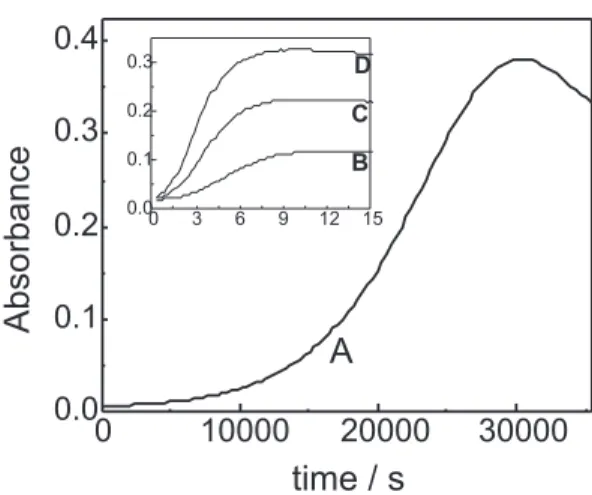
(Figure 1A) indicate that the Cu(III) formation due to the spontaneous oxidation by dissolved oxygen (equation 1) is slow with an induction period of about 10000 s. The length of the induction period depends on the acidity and peptide, for instance at pH 7 (data not reported in the present work), the induction period is longer for G5 andG6 complexes, about 5.5 h, while for the G4 it is about 3.5 h.
kinetic measurements were performed on a stopped-flow instrument equipped with an online data acquisition system (Figure 1B, C and D).
Figure 1B, C and D shows the absorbance changes at 365 nm after addition of sulfite to a CuIIG
4 solution in
borate buffer (pH 9). At the indicated experimental conditions, two maximum peaks appear, one at 365 nm (CuIIIG
4 complex)and other around 250 nm (Cu
IIIG
4 and
CuIIG
4 complexes). The same spectrum profile was
observed for G5 and G6 complexes. At 365 nm only CuIIIG
n species absorb
1, 2, 6 and the
absorbance before and after sulfite addition is higher, when compared to the one at 250 nm, and better for analytical purposes.
Figure 1B, C and D shows that in the presence of sulfite and oxygen the CuIIIG
4 formation is accelerated by sulfite,
the induction period still exists (around 3 s) and depends on the initial CuIIIG
4 concentration (around 10
-7 mol L-1,
due to the spontaneous oxidation with O2 (equation 1)) and sulfite. This induction period is an evidence of autocatalytic behavior.
Figure 1B, C and D (data at the first 15 seconds) and Figure 2 (data at longer time) shows that one fast reaction ocurrs at the beginning, with Cu(III) formation, oxygen comsumption and simultaneous oxidation of S(IV) to S(VI) (equations 7-11). In some cases, after the fast first step, this process is followed by a slow absorbance increase (the oxidation of CuIIG
n with oxygen still remaining in
solution, equation 1, i.e., Figure 2B) and further decrease due to its decompositon (equations 2-4). The formation and decomposition depends on the oxygen concentration and acidity.
Cu(III) formation, calculated neglecting the induction
period, can be obtained by the slope of ln(Absorbance)tvs. time, for several initial sulfite concentrations, [SO32-]
i. The
slope increases with [SO32-]
i (Figure 3). According to
Coichev and van Eldik9 and Atkins14 the later part the
kinetics trace exhibits the maximum rate of Cu(III) formation. The curves show an induction period and autocatalytic behaviour.
The dependence of [SO32-]
i was studied over a limited
Figure 2. Absorbance changes at 365 nm after addition of [SO32-] = 8.0x10⁻⁵ mol L-1 to a Cu(II) complex solution. [CuIIG
n] = 1.0x10 -3
mol L-1; [G
n]= 0.25x10
-3 mol L-1; 0.01 mol L-1 borate medium; (A)
[CuIIG
4] ; (B) [Cu IIG
5] and (C) [Cu IIG
6].
Figure 1. Absorbance changes at 365 nm after addition of sulfite to a CuIIG
4 solution. Conditions: [Cu IIG
4] = 1.0x10
-3 mol L-1; [G 4]= 0.25x10⁻³ mol L-1; 0.01 mol L-1 borate buffer (pH 9.0). [SO
3 2-]
concentration range ([SO32-]
i = 1.0-8.0x10
-5 mol L-1) in air
saturated solutions ([O2]i = 2.8x10⁻⁴ mol L-1), where [O 2]i
was in excess compared to [SO32-]
i. The slope (Figure 3) is
lineraly correlated with [SO32-]
i in the cited range.
Some conclusions can be done regarding to the pH
dependence shown in the absorbance vs. time profile
(Figure 2), which is a result of Cu(III) formation induced by SO32- in the presence of oxygen (equations 7-11) and
its further decomposition (equations 2, 4, 5 and 6). The pH dependence might be due to the [CuII(H
-xGn)]
(1-x) species
present in the solution, as a result of variable degree of protonation of the Cu(II) peptides complexes.15 Besides,
shift in the HSO3-/SO 3
2- equilibrium (pK a = 6.3
16) will lead
to an increase in the redox rate constant at pH > 6. According to Anast and Margerum,6 the maximum net generation of
[CuIII(H
-3G4)]
- was found at pH 8, which also corresponds
to the maximum rate of formation of [CuIII(H
-3G4)]
-, the
rate constant value decreasing at both higher and lower pH values.
As can be seen by the pKa values listed in Table 1, at pH range 7 to 10 the Cu(III) complex formed is present only as the triply deprotonated peptide complex [CuIII(H
-3Gn)]
- (pK
a[CuIII(H
-3Gn)]- = 11.4 – 12.1). The [CuII(H
-3Gn)]
2- must be more reactive than [CuII(H -2Gn)]
-.
The pKa values of [CuII(H
-2Gn)]
- follow the order: pK a
[CuII(H
-2G6)]
- < pK
a [Cu
II(H
-2G5)]
- < pK
a [Cu
II(H
-2G4)]
-, such
as, at pH 9-10 the [CuI I(H
-3G5)]
2- and [CuII(H
-3G4)]
2- are the
predominant species in solution and the ratio [CuII(H -2G4)]
- :
[CuII(H
-3G4)]
2- is about 1:1 at pH 9. This is in agreement
with the higher maximum absorbance values obtained at pH 9 (Figure 2). As reported in previous studies, the
decomposition of [CuIII(H
-3G4)]
-, the predominant Cu(III)
species at pH 7-9, is catalyzed by [CuII(H
-2G4)]
- (pKa =
9.1417) (equations 5 and 6),2 mainly at lower pH.
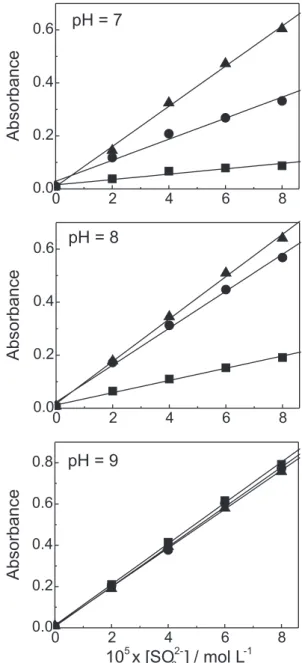
Figure 4 shows the effectiveness of Cu(III) complexes formation as the sulfite concentration increases. The maximum generation of Cu(III) peptide is attained at pH 9.
The relative concentrations of SO32- and O
2 determine
the Cu(III) formation (equations 7 and 9). At low O2
concentration, sulfite reduces Cu(III) with the formation of SO3• – (equation 7) with no further Cu(II) oxidation
(equations 10 and 11).
Figure 4. Absorbance at 365 nm (after 190 s of reaction) as a function of added sulfite to a Cu(II) complex solution. [CuIIG
n] = 1.0x10⁻³ mol L-1, [G
n]= 0.25x10
-3 mol L-1; 0.01 mol L-1 borate
me-dium; ■ [CuIIG 4]; ● [Cu
IIG 5]; ▲ [Cu
IIG 6].
Figure 3. Formation of CuIIIG
4 as function of [SO3 2-]
i. Conditions: [CuIIG
4] = 1.0x10
-3 mol L-1; [G
4]= 0.25x10
-3 mol L-1; 0.01 mol L-1
borate buffer (pH 9.0). Ionic strength = 0.1 mol L-1 (NaClO 4). T = 25.0 °C. Calculated slope (s-1) for each [SO
3 2-]
i (mol L
-1): (A) 0.30 ±
For analytical purposes, it is interesting to note that absorbance values at 365 nm are proportional to the initial SO32- concentration (Figure 4). A flow injection procedure
has already been developed for kinetic studies by measuring absorbance values at 365 nm originated from the formation of [CuIII(H
-3G4)]
-.18 These kinetic studies
showed the catalytic effect of some transition metal ions on the oxidation of S(IV), which are likely to exist in environmental samples.18 The influence of formaldehyde
on the kinetics of the S(IV) oxidation process was also addressed. The well-known property of this aldehyde in the stabilization of S(IV) in non complexant medium containing metallic ions being confirmed.8 The
pseudo-first-order rate constants of sulfite consumption were determined in the presence of formaldehyde, and lower values were found at higher formaldehyde concentrations (1.0x10⁻³ mol L-1).18
Electrochemical studies of the oxidation of CuIIG
4 in the
absence of sulfite
Some rotating ring-disk (RRD) voltammetry studies were carried out to characterize the formation of CuIIIG
4.
Figure 5 shows a typical steady state voltammogram, recorded at the disk, for a 5.0x10⁻⁴ mol L-1 CuIIG
4 solution
in borate medium (pH 10) also containing 0.1 mol L-1
KNO3, at ω = 900 rpm; the corresponding signal at the ring
(maintained at 0.1 V) is also presented. At this pH CuIIG 4
complex in the solution is present partially as [CuII(H
-2G4)]
-and predominantly as [CuII(H
-3G4)]
2-, some Cu(OH)
2
precipitates, which does not interfere in the electrodes reactions. The CuIIIG
4 generated complex is present as
[CuIII(H
-3G4)]
-. The following equations are responsible for
the anodic and cathodic processes respectively:
CuIIG
4
º
CuIIIG
4 + e
- at the disk (12)
CuIIIG
4 + e
-º
CuIIG4 at the ring (13)
Since the half-wave potentials for both processes (oxidation and reduction) are very similar, it may be
concluded that the electrochemical process related to the
couple Cu(II)/Cu(III) in a medium containing G4 is
reversible. The half-wave potential found 0.66 V vs. NHE (Figure 5), for all these peptides it is in agreement with the literature (see Table 1).
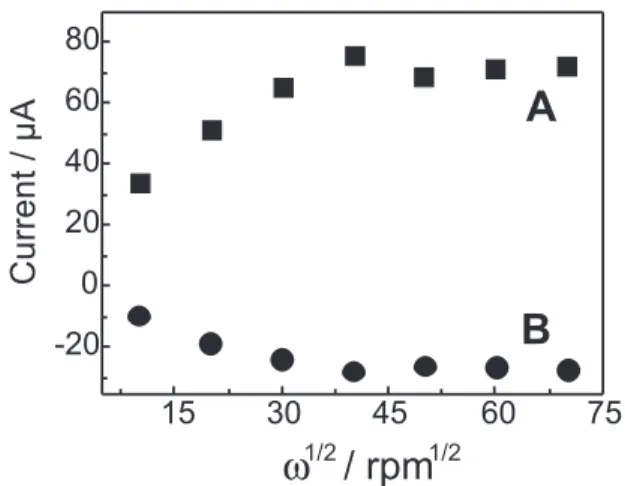
Figure 6 shows the results of RRDE experiments performed at various rotation speed values in the 100 – 4900 rpm range. The current signals obtained at relatively high rotation speeds (> 900 rpm) led to Iring / I disk values (Nk collection efficiency) around 0.37, similar results being obtained by using an electroactive species characterized by fast electron transfer with no further chemical steps (Fe(CN)64-)21 as a probe. Therefore, in the CuII/III G
4 system
no chemical transformation involving the electrogenerated CuIIIG
4 is noticeable at this time window (rotation speed
> 900 rpm), suggesting that the CuIIIG
4 decomposition
could not be monitored at such short time. However, proportionally lower collection efficiency values were obtained at slower rotation rates, i.e., 0.26 at 100 rpm, demonstrating the possibility of a following chemical step involving the Cu(III) complex formed at the disk, which decomposition, according to the literature,1, 2 is favoured
Table 1. Some Cu(II)/(III) complexes characteristics
Copper-peptide CuIIIG
n pKa pKa pKa E (V)vs. NHE
ε (mol-1 L cm-1) [CuII(H-1Gn] a [CuII(H-2Gn)]- b [CuIII(H-3Gn)]- c CuIII/II(H-3Gn) d
365 nm (ref. 20) (ref. 17) (ref. 5) (ref. 20)
G4 7120 ± 200 6.8 9.14 (ref. 17) 12.1 ± 0.2 0.63
G5 7670 ± 300 6.9 8.04 (ref. 19) 11.6 ± 0.1 0.66
G6 7580 ± 300 —- —- 11.4 ± 0.2 0.67
a, b ionization constant for the loss of coordinated peptide hydrogen from [CuII(H
-1Gn)] and [Cu II(H
-2Gn)]
- complexes, respectively, 25 °C, (µ = 0.1 mol L-1, NaClO
4 );
c for amine hydrogen from [CuIII(H -3Gn)]
- complexes, (25 °C, µ = 1.0 mol L-1, NaClO 4);
d Potencial Redox: cyclic
voltammetric-carbon paste working electrode 100 mV s-1 (scan rate).
Figure 5. Current responses in RRDE experiments. Solution: [CuIIG 4] = 5.0 x 10⁻⁴ mol L-1, in 0.05 mol L-1 borate buffer (pH 10) and 0.1 mol L-1 KNO
at higher pH values (also in agreement with the data in Figure 2) and relatively high Cu(III) concentration.
The RRDE experiments performed at various rotation speeds have a particular application in mechanisms study of electrochemical processes happening on two electrodes, it is possible the detection of unstable products (such as CuIIIG
4 complexes) formed on the disk electrode. The
advantage of these electrodes is the transport enhancement of the electroactive species to the ring electrode, leading to higher currents and therefore, to a higher sensibility and reproducibility.22, 23
According to the literature,24 for cases where the
intermediate undergoes a first-order homogeneous chemical reaction a plot of Nk as a function of ω-1 leads to
a straight line whose slope contains the information on the first order kinetic constant (k). From the data shown in Figure 6, kwas found to be 4.37x10⁻³ s-1 at 25°C, ionic
strenght 0.12 mol L-1 and pH 10 (borate buffer), from which
t1/2 was calculated as 159 seconds. The observed first-order rate constant reported in the literature2 at pH 10.07 (0.05
mol L-1 carbonate buffer, 25°C), 1.12x10⁻³ s-1, is smaller. It
can be explained by the different buffer composition and also depends on the concentration of oxygen and Cu(II) complexes (equations 3 and 5), which has being found to be responsible for the catalysis of the decomposition of Cu(III).2, 3 Besides the studies of Margerum et al.2, 4 were
carried out in a flow system, which consisted of an electro-chemical flow cell, used to generate CuIIIG
4, followed by
spectrophotometric measurements of Cu(III) decom-position. With such experimental design is difficult to
evaluate the life time of short-live product (CuIIG 4).
In fact the RRDE experiments allowed the determi-nation of first-order constant of CuIIIG
4 decomposition,
which would not be possible by spectrophotometric measurements. For instance Figure 2A (pH 9) shows the absorbance decrease due to CuIIIG
4 decomposition. In this
case CuIIIG
4 was chemically generated by the reaction of
CuIIG
4 with oxygen accelerated by sulfite, with
simul-taneous consumption of oxygen and sulfite (equation 1). The kinetics of the CuIIIG
4 decomposition (equations 2-4)
proved to be quite complex, and depends on CuIIG
4 and
oxygen concentration. At the conditions in Figure 2A (pH 9) the oxygen concentration decreases during the global process of Cu(III) formation (equations 7-9) and decom-positon (equations 2-4), and it will influence on the rate decomposition. Figure 2 also shows that the kinetic profile depends on the ligand (Gn).
Also from Figure 6, it can be concluded that the I vsω1/2
dependence does not correspond to a diffusion-controlled process since a clear deviation from a straight line is noticed at more intense hydrodynamic conditions.25, 26 This
observation may be associated with the existence of an equilibrium between different CuIIG
4 species in solution
which controls the overall electrode process. As is further discussed, from the data in Figure 7, [CuII(H
-3G4)]
2- is the
electroactive species in solution, such as the acid-base equilibrium (equation 14) is displaced by the fast oxidation of the electroactive species. Hence, for relatively long time windows the depletion of the electroactive species by the electrochemical oxidation process may be compensated by the conversion of the non-electroactive species near to the electrode surface. At high rotation speeds this replenishment is not fast enough and the current at the disc is pure kinetically controlled and independent of the rate of mass transport. This conclusion is in agreement with the electrochemical studies reported in literature on the electroxidation of copper (II) G4 and G5 complexes.27
[CuII(H
-2G4)]
-
º
[CuII(H-3G4)]
2- + H+ (14)
non-electroactive electroactive
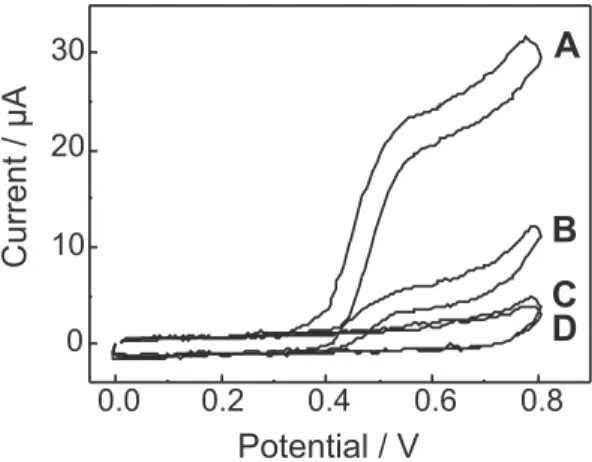
The voltammograms obtained at the 7-10 pH range (Figure 7) clearly show the importance of the acid-base equilibrium of the [CuII(H
-xGn)]
(1-x) species in solution. The
current increases with the pH, that is, at higher pH the [CuII(H
-3G4)]
2- species concentration also increases, such
as it can be concluded that [CuII(H
-3G4)]
2- is the
electro-active species in solution. This evidence was also obtained from Figure 6. The conclusion that [CuII(H
-3Gn)]
2- must be
more reactive than [CuII(H -2Gn)]
- was already discussed from
the spectrophotometric results presented in Figure 2.
Figure 6. Dependence of the limiting currents on the square root of the rotation rate in RRDE experiments. Solution: [CuIIG
4] = 5.0x10 -4
concentration and the amount of sulfite added to the solution when experiments are performed in conditions of excess of both CuIIG
4 and oxygen in respect to sulfite. 18
From an analytical point of view this relationship could be useful for the development of an indirect method for sulfite. At the experimental condition reported in the Figure 4 (pH 9) the estimated detection limit was 2.0x10⁻⁶
mol L-1. By flow injection analysis this limit was 7.0x10⁻⁶
mol L-1.18
Owing to the advantages of the amperometric detection as its excellent signal to noise ratio26 (since the capacitive
current is virtually zero at constant potential), some experiments were performed at E = 0.1 V, where the CuIIIG
4
species is electroactive (Figure 8). Accordingly, Figure 9 shows the results for successive injections of sulfite solution to an aerated solution containing CuIIG
4 .The fast
increase in the cathodic current after addition of relatively low amounts of sulfite to the working solution indicates the feasibility of an indirect method for determination of sulfite with electrochemical detection of the CuIIIG
4
compound chemically generated. The proposed indirect approach is particularly relevant because the direct electroxidation of sulfite at bare electrode surfaces has been reported to be irreversible.28 Hence, drastic
pre-treatment procedures combined with very positive potentials29, 30 or the modification of the electrode surface
by incorporating catalytic layers31, 32 have been suggested
to enhance the sensitivity. In this way, owing to the good results noticed in Figure 9 the proposed method is being fitted for a flow injection configuration and the preliminary results are very promising.
Figure 7. Voltammograms of air saturated solutions containing 2.0x10⁻⁴ mol L-1 CuIIG
4, in 0.05 mol L
-1 borate medium (pH 10) and
0.1 mol L-1 KNO
3. (A) pH 10; (B) pH 9; (C) pH 8 and (D) pH 7.
Working electrode = disk, rotation speed = 1000 rpm, scan rate = 50 mV s-1. Potential vs. Ag/AgCl (saturated NaCl) electrode.
Electrochemical studies of the sulfite induced autoxidation
of CuIIG
4
The formation of a CuIIIG
4 complex when sulfite is
added to a CuIIG
4 solution under aerobic conditions was
investigated electrochemically as shows Figure 8, where voltammograms were recorded at the rotating disc electrode (ω = 900 rpm). After the addition of sulfite a voltammogram
with an anodic and a cathodic component is obtained, confirming that both CuIIG
4 and Cu
IIIG
4 complexes exist
in solution. A comparison of the voltammograms presented in Figures 5 and 8 suggests that the Cu(III) complex formed as a consequence of the induced sulfite oxidation is the same species electrochemically generated from CuIIG
4.
Preliminary spectrophotometric studies have shown that there is a linear dependence between the CuIIIG
4
Figure 9. Current signals measured at the disk polarized at 0.1 V for a 1.0x10⁻³ mol L-1 CuIIG
4 solution, in 0.05 mol L
-1 borate buffer
(pH 10) and 0.1 mol L-1 KNO
3, during consecutive additions of sulfite to give the following final concentrations:(A) 6.0x10⁻⁵, (B) 1.1x10⁻⁴, (C) 1.8x10⁻⁴, (D) 2.7x10⁻⁴ and (E) 3.7x10⁻⁴ mol L-1. RRDE at 900 rpm.
Figure 8. Voltammograms of an air saturated solution containing 2.0x10⁻⁴ mol L-1 CuIIG
4, in 0.05 mol L
-1 borate buffer (pH 10) and
0.1 mol L-1 KNO
3, before (A) and after (B) addition of 2.0x10 -4 mol L-1
Interesting mechanistic studies9 and development of
alternative analytical methods10-13, 33 based on metal ion
catalyzed reactions, for determination of S(IV) in food, environmental samples and degraded hexafluoride have been already reportedby our group.
Acknowledgments
We gratefully acknowledge the financial support from Fundação de Amparo à Pesquisa do Estado de São Paulo (FAPESP) and Conselho Nacional de Pesquisa e Desen-volvimento Tecnológico (CNPq) (Brazilian Agencies).
References
1. Kurtz, J. L.; Burce, G. L.; Margerum, D. W.; Inorg. Chem.
1978, 17, 2454.
2. Rybka, J. S.; Kurtz, J. L.; Neubecker, T. A.; Margerum, D. W.;
Inorg. Chem.1980, 19, 2791.
3. Kirschenbaum, L. J.; Meyerstein, D.; Inorg. Chem.1980, 19, 1373.
4. Neubecker, T. A.; Kirksey Jr., S. T.; Chellapa, K. L.; Margerum, D. W.; Inorg. Chem.1979, 18, 444.
5. Kirksey Jr., S. T.; Margerum, D. W.; Inorg. Chem.1979, 18, 966.
6. Anast, J. M.; Margerum, D. W.; Inorg. Chem.1981, 20, 2319.
7. Flaschka, H. A.; EDTA Titrations, Pergamon Press: London,
1959.
8. Olson, T. M.; Hoffmann, M. R.; Atmos. Environ.1989, 23, 985.
9. Coichev, N.; van Eldik, R.; Inorg. Chem.1991, 30, 2375. 10. Neves, E. A.; Coichev, N.; Gebert, J.; Klockow, D.; Fresenius
Z. Anal. Chem.1989, 335, 386.
11. Leite, H. M. S.; Coichev, N.; Neves, E. A.; Anal. Lett.1996,
29, 2587.
12. Segundo, M.; Neves, E. A.; Klockow, D.; Analyst1994, 119, 1075.
13. Neves, E. A.; Valdes, J.; Klockow, D.; Fresenius J. Anal. Chem. 1995, 351, 544.
14. Atkins, P. W.; Physical Chemistry, 3rd ed., Oxford Press: Ox-ford, 1986.
15. Margerum, D. W.; Chellapa, K. L.; Bossu, F. P.; Burce, G. L.;
J. Am. Chem. Soc.1975, 12, 6894.
16. Kraft, J.; van Eldik R.; Inorg. Chem.1989, 28, 2297. 17. Smith, R. M.; Martell, A. E.; NIST Critical Selected Stability
Constants of Metal Complexes Database (version 3.0); NIST.
U. S. Department of Commerce: Gaithersburg, MD, USA, 1997.
18. Yoshida, D.; Moya, H. D.; Bonifácio, R. L.; Coichev, N.;
Spectrosc. Lett.1998, 31, 1495.
19. Hartzell, C. R.; Gurd, F. R. N.; J. Biol. Chem.1969, 244, 147. 20. Bossu, F. P.; Chellapa, K. L.; Margerum, D. W.; J. Am. Chem.
Soc.1977, 99, 2195.
21. Adams, R. N.; Electrochemistry at Solid Electrodes, Marcel Dekker: New York, 1969.
22. Crow, D. R.; Principles and Applications of Electrochemistry, 4th ed., Chapman & Hall: London, 1994.
23. Oliveira, A. M.; Brett, C. M. A.; Eletroquímica, Princípios, Métodos e Aplicações, Almedina: Coimbra, 1996.
24. Prater, K. B.; Bard, A. J.; J. Electrochem. Soc.1970, 117, 335. 25. Bard A. J.; Faulkner, L.R.; Electrochemical Methods,
Funda-mentals and Applications, Wiley: New York, 1980.
26. Pletcher, D.; A First Course in Electrode Processes, The Elec-trochemical Consultancy, Romsey: Chichester, UK, 1991.
27. Woltman, S. J.; Alward, M. R.; Weber, S.G.; Anal. Chem.1995,
67, 541.
28. Katagiri. A.; Matsubara, T.; J. Electrochem. Soc.1988, 135, 1709.
29. Fogg, A.G.; Fernandez-Arciniega, M. A.; Alonso, R. M.; Ana-lyst1985, 110, 851.
30. Granados, M.; Masposh, S.; Blanco, M.; Anal. Chim. Acta
1986, 179, 445.
31. Shankaran, D.R.; Narayanan, S.S.; Sensors and Actuators
B-Chem. 1999, 55, 191.
32. Azevedo, C.M.N.; Araki, K.; Toma, H.E.; Angnes, L.; Anal.
Chim. Acta1999, 387, 175.
33. Silva, R. L. G. N. P.; Silva, C. S.; Nóbrega, J. A.; Neves, E. A.;
Anal. Lett.1998, 31, 2195.
Received: January 11, 2002
Published on the web: May 23, 2003