Printed in Brazil - ©2006 Sociedade Brasileira de Química 0103 - 5053 $6.00+0.00
A
r
ti
c
le
* e-mail: [email protected]
Corrosion Inhibition of Iron in 0.5 mol L
-1H
2
SO
4by Halide Ions
C. Jeyaprabha, S. Sathiyanarayanan, S. Muralidharan and G. Venkatachari*
Central Electrochemical Research Institute, Karaikudi – 630 006, India
O efeito de inibição de íons haletos, tais como iodeto, brometo e cloreto, na corrosão de ferro em solução 0,5 mol L-1 de H
2SO4, e o comportamento da adsorção desses íons na superfície do eletrodo,
foram estudados pelos métodos de polarização e de impedância. Foi observada uma inibição de aproximadamente 90% para íons iodeto a 2,5 × 10⁻³ mol L-1 e para íons brometo a 10 × 10-3 mol L-1, e de
80% para íons cloreto a 2,5 × 10⁻³ mol L-1. O efeito da inibição aumenta com o aumento da concentração
dos íons haletos I– e Br–, mas decresce no caso do Cl–, para concentrações maiores que 5 ×10⁻³ mol L-1. Os valores de capacitância de dupla camada diminuíram consideravelmente na presença
dos íons haletos, o que indicou que esses ânions são adsorvidos no ferro no potencial de corrosão.
The inhibition effect of halide ions such as iodide, bromide and chloride ions on the corrosion of iron in 0.5 mol L-1 H
2SO4 and the adsorption behaviour of these ions on the electrode surface have
been studied by polarization and impedance methods. It has been found that the inhibition of nearly 90% has been observed for iodide ions at 2.5 × 10⁻³ mol L-1, for bromide ions at 10 × 10-3 mol L-1 and
80% for chloride ions at 2.5 × 10⁻³ mol L-1. The inhibition effect is increased with increase of halide
ions concentration in the case of I– and Br– ions, whereas it has decreased in the case of Cl– ion at
concentrations higher than 5 × 10⁻³ mol L-1. The double layer capacitance values have decreased
considerably in the presence of halide ions which indicate that these anions are adsorbed on iron at the corrosion potential.
Keywords: corrosion inhibition, iron, sulphuric acid, halide ions
Introduction
Adsorption of anions over metal surfaces leading to the inhibitive or stimulation effects on metallic corrosion have been reported by earlier researchers.1-6 It is well known that the dissolution of iron in H2SO4 solutions occurs in four different states viz. active, passive, transpassive and brightening states as determined by the nature and kinetics of reaction involved, which depend on the potential and electrolyte composition. Combined adsorption of anions and cations together on the surface have also been studied. Electrostatic interaction is the main reason for the specific adsorption of anions on metal surface.7,8 Possibility of chemisorption of the anions on metal by the formation of a covalent type bond is also suggested by Grahame.9 Quantum chemical calculations have been used to describe the chemisorption of the halide ions on the metal electrode surface by the formation of partial charge transfer bonds.10 Pearson suggested that the stability of the anion adsorption bond over metal
surface should resemble to hard and soft acids and bases principle if the adsorption occurs by forming a donor – acceptor type bond.11,12 The specific adsorption behaviour of some of the anions on metal electrode surface and their effects on corrosion have been qualititatively related to this HSAB principle.13,14
The breakdown of the iron passivity and initiation of pitting corrosion induced by the adsorption of halide ions are of technological interest.15-20 Due to the complex physico – chemical reaction involved, the mechanism and kinetics of passivity and pitting intiation are not fully understood. Current – potential oscillations as well as other anodic reactions associated with the physico–chemical process leading to pitting corrosion have attracted significant attention.21-30 It is reported that, the aggressive anions like Cl–, Br– and I– are found to catalyze the iron dissolution reaction in higher concentrations.31 But some
studies32-36 have shown that halide ions in lower
of halide ions on the iron surface in 0.5 mol L-1 H
2SO4 and the effect of adsorbed halide ions on corrosion.
Experimental
Experiments were made using a conventional three electrode cell assembly at 28 ± 1 oC. The working electrode was a pure iron sample (99.99% purity, Johnsons Mattey Ltd., UK) of one cm2 area with the rest being covered with araldite epoxy and a large rectangular platinum foil was used as counter electrode and saturated calomel electrode as reference electrode. The reference electrode was connected to the main cell through a luggin capillary in order to avoid the contamination of 0.5 mol L-1 H
2SO4 with chloride ions. The working electrode was polished with 1/0 to 4/0 grades of emery papers, washed with water and degreased with trichloroethylene. All solutions were prepared using AR grade chemicals using triple distilled water and deaerated by purging purified nitrogen for half an hour before the start of the experiment under stationary condition. Solartron Electrochemical analyzer (Model 1280 B) interface with an IBM computer and Corrware and Z plot corrosion software were used for data acquisition and analysis. The polarization and impedance studies were made after 30 minutes of immersion since the specimen attained a steady state potential (± 0.005 V). The polarization was carried out using a Corrware software from a cathodic potential of –0.2V to an anodic potential of +0.2 V with respect to the corrosion potential at a sweep rate of 0.5 mV s-1. E vs log I curves were plotted. The linear tafel segments of the anodic and cathodic curves were extrapolated to corrosion potential to obtain the corrosion current densities. For linear polarization resistance measurements, polarization was done from -0.020 V to + 0.020 V with respect to corrosion potential at a sweep rate of 0.5 mV s-1 and the slope of the linear segment at corrosion potential was obtained as polarization resistance Rp. AC signals of 10 mV amplitude and a frequency spectrum from 10 KHz to 0.01 Hz was impressed and the Nyquist representations of the impedance data were analysed with Zview software using the following equivalent circuit due to the presence of single semi circle in the impedance diagram.
where Rs is the solution resistance, Rct is the charge transfer resistance and Cdl is the double layer capacitance.
The diameter of the semicircle was measured as the charge transfer resistance Rct. For Tafel polarization method, the corrosion inhibition efficiency was evaluated from the measured icorr values using the relationship
where icorr and icorr’ are the corrosion current densities without and with the addition of halide ions. The inhibition efficiencies were evaluated from the measured Rp values in linear polarization resistance method as
Where Rp and Rp’ are the polarization resistance values without and with the addition of halide ions. In the impedance method, the inhibition efficiency was evaluated from the measured charge transfer resistance Rct values as
where Rct and Rct’ are the charge transfer resistance values in the absence and presence of halide ions.
From the measured double layer capacitance Cdl, the surface coverage θ of inhibitor is given by
since Cdls << Cdl ) where Cdl , Cdl’ and Cdls are the double layer capacitance values in the absence, presence and saturation value in the presence of halide ions respectively.37-39
Results and Discussion
Iodide ions
The potentiodynamic polarisation behaviour of iron in 0.5 mol L-1 H
2SO4 without and with the addition of iodide ions is shown in Figure 1. The corrosion kinetic parameters derived from these curves are presented in Table 1. From the table it is clear that the addition of iodide ions in the concentration range 0.5 × 10⁻³ to 5 × 10⁻³ mol L-1 markably reduces the dissolution rate of iron in 0.5 mol L-1 H
2 4
potential Ecorr shifts to the more anodic value. This shows that iodide ions act as anodic inhibitor.
The Nyquist representation of the impedance values of the iron in 0.5 mol L-1 H
2SO4 with and without the addition of iodide ions is shown in Figure 2. The existence of a single semi circle depicts the presence of single charge transfer process during dissolution which is unaffected by the presence of halide ions. The slightly depressed nature of the semi circle which has the center below the real axis indicates the generation of micro roughness surface heterogeneities at the surface during the corrosion process.40,41 The charge transfer resistance Rct and the interfacial double layer capacitance Cdl derived from these curves are given in Table 2.
It is observed that the Rct values increase from 33 Ω cm2 to 288 Ω cm2 at 2.5 ×10⁻³ mol L-1 KI where the highest inhibition efficiency of 89% is observed. The Cdl values are also decreased from 2244 μF cm-2 in the presence of iodide ions. The higher surface capacitance values for iron is due to the micro roughness of the surface during corrosion process. Similar higher values of 1775 μF cm-2,42 750 μF cm-243 and 1504 μF cm-2 44 have been reported for iron in 0.5 mol L-1 H
2SO4 solutions. Typical linear polarization curves for iron in 0.5 mol L-1 H
2SO4 with and without the addition of various concentrations of iodide ions is shown in Figure 3. The slope
of these curves, the polarization resistance Rp showed an increase values from 34 Ω cm2 to 327 Ω cm2 and then decreases with the further addition of iodide ions (Table 2). As observed in the case of potentiodynamic method, linear polarization method and impedance method have showed that further increase of iodide ion concentrations leads to gradual decrease in inhibition efficieny. Surface coverage “θ” values suggest that uniform adsorption of iodide ions on iron surface at lower concentrations and a small amount of desorption of the same at higher concentrations.
Bromide ions
Figure 4 shows the potentiodynamic polarization behaviour of iron in 0.5 mol L-1 H
2SO4 with the addition of bromide ions. The corrosion kinetic parameters derived from these plots are presented in the Table 3. It is seen from the Table 3 that the bromide ions are not as effective as iodide ions even though the inhibition efficiency is increased with the increase in the concentration of the bromide ions. The corrosion current values decrease from 410 μA cm-2 to 52 μA cm-2 with the maximum concentration of bromide ions (i.e.
Table 1. Corrosion kinetic parameters of pure iron in 0.5 mol L-1
H2SO4 with I– ions
Concentration Ecorr ba bc icorr Inhibition
of I– ions (mV vs SCE) (mV dec-1) (mV dec-1)(μA cm-2) Efficiency
(10-3 mol L-1) (%)
Blank -508 76 109 410 —
0.5 -503 53 95 89 78
1.0 -480 63 90 78 81
2.5 -452 86 107 46 89
5.0 -429 76 118 53 87
7.5 -445 61 111 54 87
10.0 -405 68 122 62 85
Figure 2. Nyquist plots of iron in 0.5 mol L-1 H
2SO4 with and
without the addition of iodide ions.
Figure 3. Linear polarization curves for iron in 0.5 mol L-1 H 2SO4
with and without the addition of iodide ions.
Figure 1. Potentiodynamic polarisation behaviour of iron in 0.5 mol L-1 H
10.0 ×10⁻³ mol L-1) where the inhibition efficiency is 87%. The corrosion potential Ecorr remains unaffected by the added bromide ions which indicates the mixed mode of action.
The charge transfer resistance (Rct) values derived from the Nyquist plots (Figure 5) are given in Table 4 along with the polarization resistance values obtained from the linear polarization resistance method. The Rct values are increased from 33 Ω cm2 to 201 Ω cm2 with a corresponding increase of inhibition efficiency to 84%. The interfacial double layer capacitance Cdl values are decreased from 2244 μF cm-2 to 131 μF cm-2 while the surface coverage θ values are increased from 0.47 to 0.94 indicating the uniform adsorption of Br– ions on the iron electrode.
Chloride ions
Table 4 shows the corrosion kinetic parameters derived from the polarization curves (Figure 6) after the addition of various concentrations of chloride ions. It is observed that the icorr values are decreased to 90 μA cm-2 for 5.0 ×10⁻³ mol L-1 of KCl corresponding to an inhibition efficiency of 78% and after that a sharp rise
Table 3. Corrosion kinetic parameters of pure iron in 0.5 mol L-1
H2SO4 with Br– ions
Concentration Ecorr ba bc icorr Inhibition of Br– ions (mV vs SCE) (mV dec-1) (mV dec-1) (μA cm-2) Efficiency
(10-3 mol L-1) (%)
Blank -508 76 109 410 —
1.0 -488 49 100 296 28
2.5 -506 61 103 195 52
5 -496 45 97 140 65
7.5 -510 72 91 54 86
10 -480 50 96 52 87
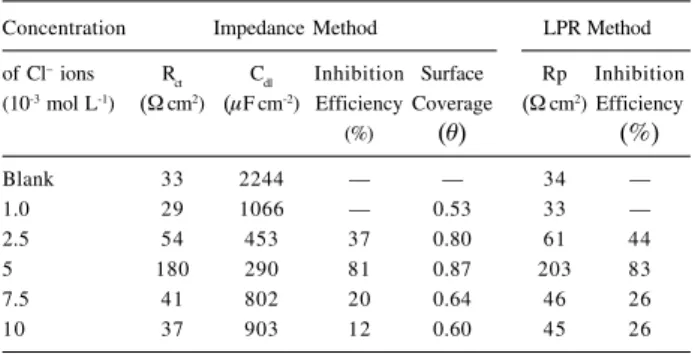
in corrosion current density is observed with further increase in concentration of chloride ions. As in the case of bromide ions, here also, the Ecorr values are not changed significantly with the addition of chloride ions. The charge transfer resistance Rct values derived from the electrochemical impedance spectroscopy (Figure 7) and the polarization resistance Rp values obtained from LPR studies are given in Table 6. It is found that increase in inhibition efficiency up to a specific concentration of chloride ions which is very much agreeing with that of polarization measurements. Chloride ions inhibit the iron dissolution at lower concentrations more effectively than at higher concentrations.
Figure 4. Potentiodynamic polarisation behaviour of iron in 0.5 mol L-1 H
2SO4 without and with the addition of bromide ions.
Figure 5. Nyquist plots of iron in 0.5 mol L-1 H
2SO4 with and
without the addition of bromide ions.
Table 2. Electrochemical impedance and linear polarization param-eters for pure iron in 0.5 mol L-1 H
2SO4 with I – ions
Concentration Impedance Method LPR Method
of I– ions R
ct Cdl Inhibition Surface Rp Inhibition
(10-3 mol L-1) (Ω cm2)(μF cm-2) Efficiency Coverage (Ω cm2) Efficiency
(%) (θ) (%)
Blank 33 2244 — — 34 —
0.5 67 731 50 0.61 100 66
1.0 199 802 83 0.64 225 85
2.5 288 685 89 0.69 327 90
5.0 290 682 89 0.70 286 88
7.5 193 812 83 0.64 255 87
10.0 194 839 83 0.63 194 83
Table 4. Electrochemical impedance and linear polarization param-eters for pure iron in 0.5 mol L-1 H
2SO4 with Br– ions
Concentration Impedance Method LPR Method
of I– ions R
ct Cdl Inhibition Surface Rp Inhibition
(10-3 mol L-1) (Ωcm2)(μF cm-2) Efficiency Coverage (Ω cm2) Efficiency
(%) (θ) (%)
Blank 33 2244 — — 34 —
1.0 23 1178 — 0.48 27 —
2.5 51 487 35 0.78 62 45
5 60 381 45 0.83 59 42
7.5 118 375 72 0.83 148 77
2 4
The role of halide ions in the iron dissolution is still a matter of dispute. According to the present study, all halide ions influence the kinetics of metal dissolution to some extent depending on their nature and concentration. At lower concentrations and near the corrosion potential, the halide ions are chemisorbed more strongly on the iron electrode surface thereby reducing the free surface area of the metal for metal dissolution reaction to a larger extent than for hydrogen evolution.45 The specific adsorption of halide ions on the iron surface gives rise to the inhibition of iron dissolution32-36 and the inhibitory action of these halide ions on the active dissolution of iron in H2SO4 has been reported by Walpert.46 The inhibition of iron corrosion by halide ions has been reported to be caused by the adsorption on the electrode surface and by the formation of surface compounds which are insoluble in the corrosive media.47-48
The inhibition behaviour of I– ions at lower concen-trations is mainly due to the strong adsorption of these ions on the electrode surface at Ecorr.49 The adsorption ability of halide ions on the iron surface has been estimated in the order2, 50-52
I– > Br– > Cl–
Generally the adsorbability of anions is related to the degree of hydration; the less hydrated ion is preferentially
adsorbed on the electrode surface.53,54 The ease of
adsorption in the case of iodide ions may be due to its less degree of hydration. The inhibitive effect of halide ions is found to be in the same order as that of adsorption ability. The anodic tafel slope values in the presence of halide ions are 70 ± 10 mV and cathodic tafel slope values are 100 ± 10 mV. The anodic tafel slopes have been reported as 30 mV55 and 40 mV56 for iron in acid solutions The higher anodic tafel slopes are attributed to the measure-ments made in shorter immersion time.3
The corrosion potential Ecorr values are found to be shifted in noble direction in the case of iodide ions where as, the values remain unaffected in the case of bromide and chloride ions. This shows that iodide ions affect the anodic reaction significantly whereas bromide and chloride ions affect both the reactions.
There is a marked decrease in Cdl values in the presence of halide ions. This decrease in the Cdl, which can result from a decrease in local dielectric constant and / or an increase in the thickness of the electrical double layer, signifying
Figure 6. Potentiodynamic polarisation behaviour of iron in 0.5 mol L-1 H
2SO4 without and with the addition of chloride ions.
Figure 7. Nyquist plots of iron in 0.5 mol L-1 H
2SO4 with and
without the addition of chloride ions.
Table 5. Corrosion kinetic parameters of pure iron in 0.5 mol L-1
H2SO4 with Cl– ions
Concentration Ecorr ba bc icorr Inhibition of Cl– ions (mV vs SCE) (mV dec-1) (mV dec-1) (μA cm-2) Efficiency
(10-3 mol L-1) %
Blank -508 76 109 410 —
1.0 -504 68 109 347 15
2.5 -521 115 137 251 38
5 -508 84 140 90 78
7.5 -519 50 100 238 42
10 -501 77 106 245 40
Table 6. Electrochemical impedance and linear polarization param-eters for pure iron in 0.5 mol L-1 H
2SO4 with Cl – ions
Concentration Impedance Method LPR Method
of Cl– ions R
ct Cdl Inhibition Surface Rp Inhibition
(10-3 mol L-1) (Ω cm2) (μF cm-2) Efficiency Coverage (Ω cm2) Efficiency
(%) (θ) (%)
Blank 33 2244 — — 34 —
1.0 29 1066 — 0.53 33 —
2.5 54 453 37 0.80 61 44
5 180 290 81 0.87 203 83
7.5 41 802 20 0.64 46 26
that the halide ions act by adsorption at the solution/ interface.57 Further, it is reported that these adsorbed halide ions do not participate in iron dissolution reaction since negative reaction orders have been observed in sulphate solutions.32,58,59 Cathodic polarization studies on the effect of addition of chloride and iodide ions on iron dissolution in H2SO4 solutions have revealed that the adsorbed halide ions inhibits the hydrogen evolution reaction predo-minantly.49,60 Hence the mechanism of inhibition of iron dissolution in sulphuric acid solution by halide ions is mainly due to blocking of surface by adsorption.
Conclusions
The halide ions are found to inhibit the corrosion of iron in 0.5 mol L-1 H
2SO4 to the extent of 80 to 90% at concentrations less than 5 x 10⁻³ mol L-1. The order of inhibition is I– > Br– > Cl–. The inhibition of halide ions is mainly due to adsorption on iron surface at the corrosion potential.
Acknowledgments
The authors wish to thank the Director, Central Electrochemical Research Institute, Karaikudi – 630 006 for his keen interest and kind permission to carry out this work. One of the authors, Mrs. C. Jeyaprabha thanks the Council of Scientific and Industrial Research , New Delhi, India for the award of Senior Research Fellowship.
References
1. Jeyaprabha, C.; Ph.D. Thesis, Bharathidasan University, Tiruchirapalli, India, 2001.
2. Aramaki, K.; Hagiwara, M.; Nishihara, H.; J. Electrochem. Soc. 1987,134, 1896.
3. Plonski, I. H. In Modern aspects of Electrochemistry; Bockris, J. O. M.; Conway, B. E.; White, R. E., eds.; Plenum Press: New York, 1996, vol. 29, p. 203.
4. Saraby-Reintjes, A.; Electrochim. Acta 1985, 30, 387 and 403. 5. Drazic, D.M. In Modern Aspects of Electrochemistry; Conway, B. E.; Bockris, J. O. M.; White, R. E., eds.; Plenum Press: New York, 1989, Vol. 19, p. 69.
6. Lorenz, W. J.; Heusler, K. E. In Corrosion Mechanisms; Mansfeld F., ed.; Marcel Dekker: New York, 1987, p. 1. 7. Habib, M. A.; Bockris, J. O. M. In Comprehensive Treatise of
Electrochemistry, Bockris, J. O. M.; Conway, B.E.; Yeager, E., eds.; Plenum Press: New York, 1980, vol. 1, p. 135. 8. Bockris, J. O, M.; Khan, S.V.M. In Quantum Electrochemistry;
Plenum Press: New York, 1979, p. 1. 9. Grahame, D. C.; Chem. Rev. 1947, 41, 441. 10. Lorenz, W.; J. Electroanal. Chem. 1985, 191, 31.
11. Pearson, R. G.; J. Am. Chem. Soc. 1963, 85, 3533.
12. Pearson, R.G. In Hard and Soft Acids and Bases; Pearson, R.G., ed.; Dowden, Hatchinson & Ross, Inc.: Stoudsburg, PA, 1973, p. 1.
13. Barclay, D. J.; J. Electroanal. Chem. 1968, 19, 318. 14. Barclay, D.J; Caja, J.; Croat. Chem. Acta 1971, 43, 221. 15. Szklaraska – Smialowska, Z.; Corrosion 1971, 27, 223. 16. Kolotyrkin, Ya. M.; Popov, Y. A.; Alekseev, Y. V. In Advances in
Physical Chemistry: Current Developments in Electrochemistry and
Corrosion; Kolotyrkin, Ya, S., ed.; MIR: Moscow, 1982, p. 12. 17. Sharland, S.M.; Corros. Sci. 1987, 27, 289.
18. Sato, N.; Corrosion 1989,45, 354.
19. Bohni, H. In Corrosion Mechanisms; Mansfeld, F., ed.; Dekker: New York, 1987, p. 285.
20. Strehblow, H. H. In Corrosion Mechanisms in Theory and Practice; Marcus, P.; Oudar, J., eds.; Marcel Dekker: New York, 1995, p. 201.
21. Hudson, J. L.; Tsotsis, T. T.; Chem. Eng. Sci. 1994,49, 1493. 22. Sazou, D.; Pagitsas, M. In Passivity and Breakdown, Isaacs, H. S. et al., eds.; The Electrochem. Society: Pennington, NJ,
1998, 132.àautor
23. Pagitsas, M.; Sazou, D.; J. Electroanal. Chem. 1999,471, 132. 24. Podesta, J.J; Piatti, R.C.V.; Arvia, A.J.; Corros. Sci. 1982,22,
193.
25. Li, W.; Wang, X.; Nobe, K.; J. Electrochem. Soc. 1990, 137, 1184.
26. Li, W.; Wang, X.; Nobe, K.; Pearlstein, A.J.; Corros. Sci. 1990, 31, 615.
27. Sazou, D.; Pagitsas, M.; Georgolois, C.; Electrochim. Acta.
1992, 37, 2067.
28. Li, W.; Wang, X.; Nobe, K.; Pearlstein, A. J.; J. Electrochem. Soc. 1993, 140, 721.
29. Sazou, D.; Pagitsas, M.; Georgolois, C.; Electrochim. Acta
1993, 38, 2321.
30. Sazou, D.; Georgolios, C.; Electrochim. Acta 1996,41, 147. 31. Kolotyrkin,Ya. M.; Corrosion 1963, 19, 261.
32. Lorenz, W.J.; Corros. Sci. 1965,5, 121.
33. Darwish, N.A.; Hilbert, F.; Lorenz, W.J.; Rosswag, H.; Electrochim. Acta 1973, 18, 421.
34. Mc Cafferty, E.; Hackerman, N.; J. Electrochem. Soc. 1972, 119, 999.
35. Golovina, G.V.; Florianowich, G.M.; Kolotyrkin, Ya. M.; Zashch. Metal. 1966,2, 4.
36. Mikheeva, F.M.; Florianowich, G.M.; Zashch. Metal. 1987, 23, 41.
37. Elkadi, L.; Menari, B.; Traisnel, M.; Bentiss, F.; Lagrenee, M.; Corros. Sci. 2000, 4, 2703.
38. Rengamani, S.; Iyer, S.V.K.; J. Appl. Electrochem. 1994, 24, 355.
39. Mernari, B.; Attari, H.E.L.; Traisnel, M.; Bentiss, F.; Lagrenee, M.; Corros. Sci. 1998, 48, 391.
2 4
41. Paskossy ,T.; J. Electroanal. Chem. 1994,364, 111. 42. Bentiss, F.; Traisnel, M.; Lagrenee, M.; J. Appl. Electrochem.
2001,31, 41.
43. Feng, Y.; Siow, K.S.; Teo, W.K.; Hstch, A.K.; Corros. Sci.
1999,41, 829.
44. Bentiss, F.; Lagrenee, M.; Traisnel, M.; Horenz, J.C.; Corros. Sci. 1999,41, 789.
45. Heusler, K.E; Cartledge, G.H.; J. Electrochem. Soc. 1961, 108, 732.
46. Walpert, G.; Z. Phys. Chem. 1930,A.151, 219. 47. Kirkov, P.; Corr. Sci. 1973,13, 697.
48. Jesionek, M.; Szklarska - Smialowska. Z.; Corr. Sci. 1983,23, 183.
49. Abd Elhamid, M.H.; Ateya, B.G.; Pickering, H.W.; J. Electrochem. Soc. 2000,147, 2258.
50. Hackerman, N.; Snavely Jr., E.S.; Payne Jr., J.S.; J. Electrochem. Soc. 1966, 113, 677.
51. Kelin, I.I.; Balezin, S.A.; Russ. J. Phys. Chem. 1976,50, 1078.
52. Bonnemay, M.; Lamy, C.; J. Electroanal. Chem. 1971, 32, 183.
53. Devanathan, M.A.V.; Tilak, B.V.K.S.R.A.; Chem. Rev. 1965, 65, 635.
54. Bockris, J.O’M.; Devanathan, M.A.V.; Muller, K.; Proc.R. Soc. London, Sec A, 1963,274, 55.
55. Heusler, K.E.; Z. Electrochem. 1958, 62, 582.
56. Bockris, J.O’M.; Drazic, D.; Despic, A.R.; Electrochim. Acta
1961, 4, 325.
57. McCafferty, E., Hackerman, N.; J. Electrochem. Soc. 1991, 119, 146.
58. Schwabe, K.; Voigt, C.; Electrochim. Acta 1969, 14, 853. 59. Cavellero, I.; Felloni, I.; Trabenelli, G.; Puludori, P.;
Electrochim. Acta 1964, 9, 485.
60. Vracar, L.J.; Drazic, D.M.; J. Electroanal. Chem. 1992, 339, 269.
Received: May 14, 2005