
On the Infrared Behavior of Green’s Functions in Yang-Mills Theory
Axel Maas, Attilio Cucchieri, and Tereza Mendes Instituto de F´ısica de S˜ao Carlos, Universidade de S˜ao Paulo,
Caixa Postal 369, 13560-970 S˜ao Carlos, SP, Brazil (Received on 27 September, 2006)
Non-perturbative properties of QCD, such as color confinement, are encoded in the infrared behavior of correlation functions, e.g. propagators and vertices. Various analytic predictions have been suggested for these quantities in various gauges. Here we numerically test these predictions using lattice gauge theory. In particular, we present results for the 2- and 3-point functions forSU(2)Landau-gauge Yang-Mills theory in three and in four dimensions. Special attention is paid to systematic finite-volume effects. The gluon and ghost propagators are also evaluated in the so-called interpolating gauge (between the Landau and the Coulomb gauge), in order to study their gauge-dependence. Finally, we consider these propagators in Landau gauge at finite temperature, with the aim of understanding the effect of the deconfinement phase transition on their infrared behavior. All our results are compatible with the so-called Gribov-Zwanziger confinement scenario.
Keywords: Yang-Mills theory; Confinement; Propagators; Vertices; Landau gauge; Interpolating gauge; Finite temperature
I. INTRODUCTION
The confinement phenomenon in QCD is a long-range ef-fect and one can expect its explanation to be encoded in the infrared (IR) behavior of the QCD correlation functions. In-deed, various confinement scenarios make predictions for this behavior [1]. Unfortunately, a quantitative determination of these correlation functions is a very difficult task.
Continuum methods, based e.g. on Dyson-Schwinger equa-tions (DSEs) [1–4], on the renormalization group [5] or on ef-fective potentials [6], lead to results that seem to agree with the Gribov-Zwanziger confinement scenario [4, 7] and with the Kugo-Ojima scenario [8]. These methods have the disad-vantage of introducing approximations, which in general can-not be controlled and verified. On the other hand, numeri-cal studies using lattice gauge theory allow a determination of QCD correlation functions in the IR limit using approxima-tions that can in principle be controlled and quantified [9, 10]. In this case, since one has to work with finite volumesNd, the system considered has a natural IR cutoff p∼1/(aN), mak-ing difficult the study of the true IR limit. (This topic will be discussed in more detail in Section II.) Clearly, a close cooperation between continuum and lattice methods can be a promising approach. In particular, lattice gauge theory al-lows to check the approximations usually considered in con-tinuum methods, or at least to provide constraints for possible Ans¨atze. The most important test is probably the verification of the approximations employed for the 3-point vertices when solving DSEs. Results for the three-gluon and the ghost-gluon vertices will be reported in Section III.
Most of the studies of QCD correlations functions, both in the continuum and on the lattice, have been done in Landau gauge. On the other hand, since these quantities are gauge dependent, it is interesting to evaluate them in other gauges too (e.g. Coulomb gauge [11] and maximally Abelian gauge [12]). In principle, the explanation of the confinement mecha-nism based on the IR properties of the QCD correlation func-tion can also be gauge-dependent. Particularly important are the so-called interpolating gauges [13, 14], since they allow to relate different gauges and possible different confinement
mechanisms. In Section IV we report 3dresults for the gauge interpolating between the Landau and the Coulomb gauge.
Finally, a clear understanding of the confinement mecha-nism could be useful in the study of the QCD phase diagram and of the deconfining phase transition [15]. In particular, one might expect to observe a modification of the IR properties of the correlation functions at finite temperatureT. As a first step in this direction, the gluon and ghost propagators at finite T are considered (in the 4dLandau gauge) in Section V.
II. FINITE-VOLUME EFFECTS
Confinement is induced by long-range correlations. More precisely, the correlation length should be infinite [1]. Thus, when considering QCD correlation functions in momentum space, confinement should be related to their IR properties. This is the case for the Gribov-Zwanziger and the Kugo-Ojima confinement scenarios. Indeed, they predict a specific IR behavior for the gluon and the ghost propagators in Landau gauge: the gluon propagator should be IR suppressed — and it is expected to vanish at zero momentum — while the ghost propagator should be IR enhanced compared to the one of a massless particle.
As said above, the IR-cutoff 1/(aN)makes it difficult to study the IR properties of the correlation function and one should pay attention to possible finite-size effects. Of course, this analysis can be computationally very demanding. In this case, the consideration of three-dimensional lattices can be useful in order to access large lattice volumes. Let us note that the Gribov-Zwanziger scenario applies also to the three-dimensional case [4] and that results for the IR behavior of the propagators using DSEs are available ford=3 [4, 16].
increas-p [GeV] 0.2 0.4 0.6 0.8 1 1.2 1.4 1.6 1.8 2 2.2
]
-2
D(p) [GeV
0.5 1 1.5 2 2.5 3 3.5 4 4.5 5
Gluon propagator
p [GeV]
0.5 1 1.5 2 2.5 3 3.5
]
-2
(p) [GeV
G
D
-1
10 1 10
2
10
3
10
Ghost propagator
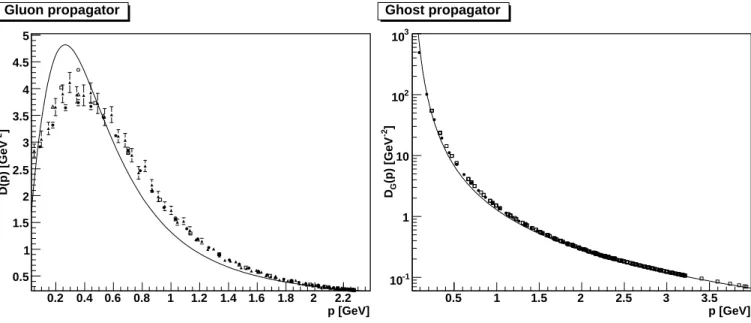
FIG. 1: Comparison of lattice data and DSE results for gluonD(p)(left) and ghostDG(p)(right) propagators in the 3dcase in Landau gauge as a function of the momentump. The solid line is from DSE results [16]. Lattice simulations have been done atβ=4.2 considering various lattice volumes. Open circles correspond to lattice volume 203[V≈(3.5 fm)3][18], open squares represent 303[V≈(5.2 fm)3][18], open triangles are used for 403[V≈(6.9 fm)3][19], full circles correspond to 803[V≈(14 fm)3][20] and full triangles represent lattice volume 1403[V≈(24 fm)3][21].
ing volume. Thus, momenta of the order of 2 sin(π/N)/a≈
2π/(aN)are affected by finite-volume effects. From Figure 1 one also sees that DSE and lattice results are in qualitatively agreement. Let us remark that DSE studies predict [17] that the true IR regime is reached only below a certain momen-tum scaleΛI.200 MeV, i.e. on a finite volume one should have a sufficient number of non-zero momenta in the range 2π/(aN)≪ p.ΛI. With a lattice spacinga of order of 1 GeV−1one needsN≫50. Unfortunately, this regime is just reached by the lattices in the 3dcase but not yet in 4d.
The ghost propagator is much less affected by finite-volume effects, even though small effects can be found for the dress-ing function at small momenta [19]. Moreover, the compar-ison of the lattice data to DSE results is quite good (see Fig. 1). One should however recall that the IR enhancement of the ghost propagator seems to be related to an appropriate sampling of the so-calledexceptional configurations[10, 18]. Thus, results obtained considering a relatively small statistics are likely underestimating this IR enhancement.
We conclude that the smallest non-zero lattice momenta – of the order of 2π/(aN)— are probably not reliable in lattice studies and should be treated with great care. A more thor-ough discussion of finite-size effects will be presented in [19].
III. THREE-POINT VERTICES
Besides the propagators, also the vertices are of great im-portance in understanding the IR properties of QCD. In par-ticular, assumptions on their IR behavior are crucial inputs for the analytic methods [1–3]. At the same time, predictions for
their IR behavior have been obtained using continuum meth-ods [22–24]. As stressed in the Introduction, lattice gauge theory provides us with the possibility of verifying these re-sults as well as the assumptions considered in analytic stud-ies. The simplest of these vertices are the 3-point ones. In Landau-gauge pure Yang-Mills theory one can consider the ghost-gluon vertex and the three-gluon vertex. Kinematically these vertices are much more complicated than the propaga-tors, since they depend on three independent kinematic vari-ables. In addition, they have a complex tensor structure (espe-cially the three-gluon vertex).
In order to simplify the presentation, we consider here only one specific kinematic configuration, namely the one in which two of the incoming momenta are orthogonal with respect to each other (see [18, 25] for details and for other possible kine-matic configurations). Furthermore, instead of the various ten-sor elements we evaluate the quantity [18]
G= Γ
tl,abcGabc
q [GeV]
0 0.5 1 1.5 2 2.5 3 3.5
/2)
π
(q,0,
A
c
c
G
0 1 2
Ghost-gluon vertex, one momentum vanishing
q [GeV] (Ghost)
0.5 1
1.5 2
k [GeV] (Gluon)
0 0.5 1 1.5 2
/2)
π
(q,k,
A
c
c
G
-1 0 1 2
Ghost-gluon vertex, orthogonal momenta
p [GeV]
0 0.5 1 1.5 2 2.5 3 3.5
/2)
π
(p,0,
3
A
G
0 1 2
Three-gluon vertex, one momentum vanishing
p [GeV] 0
1
2 3
q [GeV]
0 1 2 3
/2)
π
(p,q,
3
A
G
0 1 2
Three-gluon vertex, orthogonal momenta
FIG. 2: Top-left panel: ghost-gluon vertex at zero gluon momentum; open triangles are used forV=303[25] and open circles forV=303(in both casesβ=4.2), full triangles are used forV=203[18] and full circles forV=303(in both casesβ=6.0). Top-right panel: ghost-gluon vertex with the gluon and the ghost momenta orthogonal to each other; the graph interpolates data obtained from a 403 lattice atβ=4.2 [25]. The spike at zero momentum is an artifact, as the vertex function cannot be evaluated there. Bottom-left panel: 3-gluon vertex with one external momentum vanishing [18]; full symbols correspond toβ=4.2 and open symbols toβ=6.0; circles are used forV =203and triangles forV=303. Bottom-right panel: 3-gluon vertex with two external momenta orthogonal to each other [18]; the graph interpolates data obtained from a 303lattice atβ=4.2 and atβ=6.0. Note that the spike at zero momentum is an artifact of the interpolating algorithm, since the vertex cannot be evaluated there.
Results for the quantity (1) in three and in four dimensions for both vertices are shown in Figures 2 and 3, respectively. The ghost-gluon vertex is essentially constant for all momenta studied here as well as for other kinematic configurations [18, 25, 26], both in 3dand in 4d. In particular, there is no sign of
q [GeV] 0 0.2 0.4 0.6 0.8 1 1.2 1.4 1.6 1.8 2
/2)
π
(q,0,
A
c
c
G
0 0.5 1 1.5 2
Ghost-gluon vertex, one momentum vanishing
q [GeV] (Ghost) 0.5
1
1.5
k [GeV] (Gluon)
0 0.5 1 1.5
/2)
π
(q,k,
A
c
c
G
0 1 2
Ghost-gluon vertex, orthogonal momenta
p [GeV] 0 0.2 0.4 0.6 0.8 1 1.2 1.4 1.6 1.8 2
/2)
π
(p,0,
3
A
G
-0.5 0 0.5 1 1.5 2
Three-gluon vertex, one momentum vanishing
p [GeV]
0 0.5
1 1.5
q [GeV]
0 0.5 1 1.5
/2)
π
(p,q,
3
A
G
0 1 2
Three-gluon vertex, orthogonal momenta
FIG. 3: Same as Figure 2 but in the four-dimensional case. Here the lattice volume is 164and simulations have been done atβ=2.2 [25].
The evaluation of three-gluon vertex is numerically much more demanding than that of the ghost-gluon vertex. In par-ticular, very large statistics are required for its investigation [18, 25], especially in the three-dimensional case. Our results show that this vertex is suppressed at intermediate momenta, especially ford=3. On the other hand, with our data, it is dif-ficult to understand completely its precise IR behavior. Let us note that, if this suppression were to be confirmed by studies using larger lattices, this result would contradict predictions obtained from DSE studies [22, 24]. Nevertheless, it would not invalidate the assumptions usually made in the continuum
calculations of the propagators [1, 2, 16, 24].
IV. INTERPOLATING GAUGES
[GeV] 0 p
0 0.5
1 1.5
2
| [GeV] p |
0 0.5 1 1.5 2
]
-2
[GeV
00
D
0 2 4 6 8
00 Temporal gluon propagator D
[GeV] 0 p
0 0.5
1 1.5
2
| [GeV] p |
0 0.5 1 1.5 2
]
-2
[GeV
tr
D
0 2 4 6 8
tr Spatial gluon propagator D
FIG. 4: The spatial (top) and temporal (bottom) gluon propagator in the interpolating gauge (2) atλ=1/2 as a function of the temporalp0 and spatial|~p|momenta, from a 603lattice atβ=4.2 [29]. Results have been interpolated; the spike at zero is an artifact of the missing point there.
so-called interpolating gauges allow to interpolate smoothly between specific gauge conditions. One example is given by the gauge condition [13, 27]
λ ∂0Ab0+~∂~Ab=0. (2) This gauge interpolates between the Landau gauge (λ=1) and the Coulomb gauge (λ=0), even though the Coulomb gauge limit itself is likely not to be a smooth one [28]. Nonethe-less, this gauge allows one to study the Gribov-Zwanziger scenario when moving away from the Landau gauge. Since forλ6=1 theO(4)-invariance is explicitly broken, it is natural to consider two scalar gluon propagators [28], i.e. the time-time component Daa00/(Nc2−1)and the 3-dimensional trans-verse oneDtr=Daaii /((d−1)(Nc2−1)). In addition, the prop-agators depend independently on the temporal momentump0 and on the spatial momentum|~p|.
[GeV] 0 p
0 0.5 1 1.5 2
| [GeV] p |
0 0.5
1 1.5
2
)
2
p
+
2 0
(p)(p
G
D
0 2 4
Ghost dressing function
FIG. 5: The ghost dressing functionDG(p)(p20+~p2) in the inter-polating gauge (2) atλ=1/2 as a function of the temporal p0and spatial|~p|momenta, from a 203 lattice atβ=4.2 [29]. Numerical data have been interpolated.
Results at λ=1/2 are shown in Figure 4 for these two gluon propagators and in Figure 5 for the scalar ghost dress-ing functionDG(p)(p20+~p2). Note thatD00(p0,0)vanishes exactly for any p0 due to the gauge condition, even though (due to technical reasons) this is not clear from Figure 4. Both gluon propagators are found to be IR suppressed when con-sidered as a function of p20+~p2. Also, both propagators ex-hibit a clear maximum. Furthermore, both propagators are not suppressed as long as either p0or|~p|are not sufficiently small. At the same time, the ghost propagator is IR enhanced. The difference in behavior at large pure-temporal and at large pure-spatial momenta is a direct consequence of howλ ap-pears in the tree-level propagators. Thus, the IR behavior of these propagators is (qualitatively) the same as that found in Landau gauge. This is in agreement with results from DSE studies [28]. On the other hand, since the limit λ→1 is smooth, one wouldn’t expect a strong deviation from the Lan-dau behavior for a valueλ=1/2. Results for the non-smooth limitλ→0 will be presented elsewhere [29].
V. FINITE TEMPERATURE
Yang-Mills theory undergoes a deconfining phase transition at finite temperature [15] and one expects this transition to change the confining properties of the theory. At the same time, if confinement is manifest in the IR properties of the QCD propagators, these might also change across the phase transition. At finite temperature, the gluon propagator can no longer be described by a single tensor structure and one needs two independent structures [30]:
p [GeV]
0 0.5 1 1.5 2 2.5 3 3.5 4
]
-2
(p) [GeV
L
D
-1
10 1 10
3d-longitudinal gluon propagator
p [GeV]
0 0.5 1 1.5 2 2.5 3 3.5 4
]
-2
(p) [GeV
T
D
-1
10 1 10
3d-transverse gluon propagator
FIG. 6: The spatially transverse (top) and spatially longitudinal (bot-tom) gluon propagators at various temperatures [19]. Full circles are atT =0 on a 204 lattice, full triangles are atT ≈149 MeV on a 10×263lattice, open circles are atT ≈298 MeV on a 4×343 lat-tice, and open triangles are atT≈597 MeV on a 2×423lattice. All results have been obtained usingβ=2.3.
Here,PT
µν is purely spatial and transverse whilePµLν=Pµν− PµTν, i.e.PµLνcomplementsPµTνto a four-dimensional-transverse
O(4)-invariant tensor-structurePµν=δµν−pµpν/p2. In
ad-dition,PµLνis longitudinal in the spatial sub-space. Further-more, all functions depend on the spatial momentum|~p|and on the energyp0separately. The latter is discrete with values p0=2πT n, wherenis an integer. Infrared or soft modes are those with zero energy, i.e.n=0.
Results for the soft modes of the two gluon propagators and of the (scalar) ghost propagator are shown in Figures 6 and 7 for temperatures above and below the phase transition. Clearly, as expected, all propagators coincide with the zero-temperature perturbative tail for momenta plarge compared to the temperature T. At the same time, each of the three
p [GeV]
0 1 2 3 4 5
]
-2
D(p) [GeV
-1
10 1 10
2
10
Ghost propagator
FIG. 7: Same as figure 6, but for the ghost propagator. Also the symbols are the same except for full circles, which refer to a 324 lattice atβ=2.3 (T=0).
propagators shows a different temperature dependence at low momenta. In particular, the 3d-transverse propagatorDT(p) decreases smoothly (in the IR) with increasing temperature. At the same time, for the highest temperature considered here (T≈597 MeV), one sees a clear IR suppression with a maxi-mum forp≈600 MeV. Let us stress that, while atT=0 one does not see a decreasing propagatorDT(p) even for a lat-tice volume of 524[31], for this temperature above the phase transition the IR suppression is already manifest for a spatial volume of 423. This suggests that, at high temperature, ei-ther the infrared suppression is stronger or that finite-volume effects are smaller, compared to the zero-temperature case. In the case of the 3d-longitudinal propagatorDL(p)we ob-serve an increase as the temperature is turned on starting from T =0. However, the propagator decreases (in the IR region) when going from the second-highest to the highest tempera-ture. A possibility would be a propagator increasing (respec-tively decreasing) when the temperature rises for temperatures below (respectively above) the phase transition. Let us note thatDL(p)does not seem to be IR suppressed, even though in the IR limit it does not grow as strongly as the propaga-tor of a massless particle [19]. Finally, the ghost propagapropaga-tor does not show any visible temperature dependence. Let us also stress that these results should be taken with care, es-pecially when considering the 3d-longitudinal gluon propa-gatorDL(p), since we find strong volume and discretization effects[19].
VI. SUMMARY
Summarizing, we have presented results for gluon and ghost propagators considering the 3- and the 4-dimensional cases for various gauges at zero temperature. In all cases our results are in qualitatively agreement with the Kugo-Ojima and with the Gribov-Zwanziger scenarios. Moreover, an in-vestigation of the propagators in the interpolating gauge (2) suggests that the Gribov-Zwanziger scenario is stable when moving away from the Landau gauge condition.
At zero temperature, in Landau gauge, we have also eval-uated the ghost-gluon and the 3-gluon vertices. This study provides additional hints and constraints for the assumptions usually considered in continuum studies.
Finally, we have presented results for the two propagators at finite temperature around the deconfining phase transition.
These results fit into an extension of the Gribov-Zwanziger scenario at finite temperature [19, 32, 33].
In all cases considered, the analysis of finite-volume effects should be done very carefully, especially for the gluon prop-agator. Thus, a complete understanding of the IR behavior of the QCD correlation functions and a confirmation (or dis-proof) of the available confinement scenarios will be obtained only when extending these studies to larger lattices.
Acknowledgments
A. M. was supported by the DFG under grant number MA 3935/1-1. A. C. and T. M. were supported by FAPESP (under grant # 00/ 05047-5) and by CNPq.
[1] R. Alkofer and L. von Smekal, Phys. Rept.353, 281 (2001), and references therein.
[2] P. Watson and R. Alkofer, Phys. Rev. Lett.86, 5239 (2001); C. Lerche and L. von Smekal, Phys. Rev. D65, 125006 (2002); C. S. Fischer, J. Phys. G 32, R253 (2006), and references therein;
[3] L. von Smekal, R. Alkofer, and A. Hauck, Phys. Rev. Lett.79, 3591 (1997); Annals Phys.267, 1 (1998) [Erratum-ibid.269, 182 (1998)]; C. S. Fischer and R. Alkofer, Phys. Lett. B536, 177 (2002); C. S. Fischer, R. Alkofer, and H. Reinhardt, Phys. Rev. D65, 094008 (2002).
[4] D. Zwanziger, Phys. Rev. D65, 094039 (2002); Phys. Rev. D 69, 016002 (2004), and references therein.
[5] H. Gies, Phys. Rev. D66, 025006 (2002); C. S. Fischer and H. Gies, JHEP0410, 048 (2004); J. M. Pawlowski, D. F. Litim, S. Nedelko, and L. von Smekal, Phys. Rev. Lett.93, 152002 (2004).
[6] D. Dudal, R. F. Sobreiro, S. P. Sorella, and H. Verschelde, Phys. Rev. D72, 014016 (2005).
[7] V. N. Gribov, Nucl. Phys. B139, 1 (1978); D. Zwanziger, Nucl. Phys. B412, 657 (1994); Phys. Rev. D67, 105001 (2003). [8] T. Kugo and I. Ojima, Prog. Theor. Phys. Suppl.66, 1 (1979)
[Erratum Prog. Theor. Phys.71, 1121 (1984)]; T. Kugo, hep-th/9511033.
[9] J. C. R. Bloch, A. Cucchieri, K. Langfeld, and T. Mendes, Nucl. Phys. B687, 76 (2004); P. O. Bowman, U. M. Heller, D. B. Leinweber, M. B. Parappilly, and A. G. Williams, Phys. Rev. D70, 034509 (2004).
[10] A. Sternbeck, E. M. Ilgenfritz, M. M ¨uller-Preussker, and A. Schiller, Phys. Rev. D72, 014507 (2005).
[11] H. Reinhardt and C. Feuchter, Phys. Rev. D71, 105002 (2005); C. Feuchter and H. Reinhardt, Phys. Rev. D70, 105021 (2004); A. Cucchieri and D. Zwanziger, Phys. Rev. D 65, 014001 (2002).
[12] V. G. Bornyakov, M. N. Chernodub, F. V. Gubarev, S. M. Mo-rozov, and M. I. Polikarpov, Phys. Lett. B 559, 214 (2003); M. A. L. Capriet al., hep-th/0603167; A. Cucchieri, A. Mihara, and T. Mendes, in preparation.
[13] L. Baulieu and D. Zwanziger, Nucl. Phys. B548, 527 (1999).
[14] M. A. L. Capri, R. F. Sobreiro, and S. P. Sorella, Phys. Rev. D 73, 041701 (2006).
[15] F. Karsch, Lect. Notes Phys.583, 209 (2002), and references therein.
[16] A. Maas, J. Wambach, B. Gr¨uter, and R. Alkofer, Eur. Phys. J. C37, 335 (2004).
[17] C. S. Fischer, A. Maas, J. M. Pawlowski, L. von Smekal, .
[18] A. Cucchieri, A. Maas, and T. Mendes, Phys. Rev. D74, 014503 (2006).
[19] A. Cucchieri, A. Maas, and T. Mendes, is just available as [arXiv:hep-ph/0701050], and not yet published.
[20] A. Cucchieri and T. Mendes, Phys. Rev. D73, 071502 (2006). [21] A. Cucchieri, T. Mendes, and A. R. Taurines, Phys. Rev. D67,
091502 (2003).
[22] W. Schleifenbaum, M. Leder, and H. Reinhardt, Phys. Rev. D 73, 125019 (2006)
[23] W. Schleifenbaum, A. Maas, J. Wambach, and R. Alkofer, Phys. Rev. D72, 014017 (2005).
[24] R. Alkofer, C. S. Fischer, and F. J. Llanes-Estrada, Phys. Lett. B611, 279 (2005).
[25] A. Cucchieri, A. Maas, and T. Mendes, arXiv:hep-lat/0701011. [26] A. Cucchieri, T. Mendes, and A. Mihara, JHEP 0412, 012
(2004).
[27] A. Cucchieri and T. Mendes, hep-lat/9902024.
[28] C. S. Fischer and D. Zwanziger, Phys. Rev. D 72, 054005 (2005).
[29] A. Cucchieri, A. Maas, T. Mendes, in preparation.
[30] “Finite-Temperature Field Theory”, J. I. Kapusta (Cambridge University Press, 1989).
[31] A. Cucchieri and T. Mendes, hep-ph/0605224, and references therein.
[32] A. Cucchieri, F. Karsch, and P. Petreczky, Phys. Rev. D64, 036001 (2001); Phys. Lett. B497, 80 (2001).
![FIG. 2: Top-left panel: ghost-gluon vertex at zero gluon momentum; open triangles are used for V = 30 3 [25] and open circles for V = 30 3 (in both cases β = 4.2), full triangles are used for V = 20 3 [18] and full circles for V = 30 3 (in both cases β = 6](https://thumb-eu.123doks.com/thumbv2/123dok_br/18982651.457618/3.892.83.844.76.806/panel-ghost-vertex-momentum-triangles-circles-triangles-circles.webp)
![FIG. 3: Same as Figure 2 but in the four-dimensional case. Here the lattice volume is 16 4 and simulations have been done at β = 2.2 [25].](https://thumb-eu.123doks.com/thumbv2/123dok_br/18982651.457618/4.892.79.846.74.805/fig-figure-dimensional-case-lattice-volume-simulations-β.webp)
![FIG. 5: The ghost dressing function D G (p)( p 2 0 + ~ p 2 ) in the inter- inter-polating gauge (2) at λ = 1/2 as a function of the temporal p 0 and spatial |~ p| momenta, from a 20 3 lattice at β = 4.2 [29]](https://thumb-eu.123doks.com/thumbv2/123dok_br/18982651.457618/5.892.81.444.77.650/dressing-function-polating-function-temporal-spatial-momenta-lattice.webp)
![FIG. 6: The spatially transverse (top) and spatially longitudinal (bot- (bot-tom) gluon propagators at various temperatures [19]](https://thumb-eu.123doks.com/thumbv2/123dok_br/18982651.457618/6.892.469.840.83.386/spatially-transverse-spatially-longitudinal-gluon-propagators-various-temperatures.webp)
