Remarks on Lorentz and CPT Violation in Field Theory
T. Mariz, J. R. Nascimento, and E. PassosDepartamento de F´ısica, Universidade Federal da Para´ıba, Caixa Postal 5008, 58051-970 Jo˜ao Pessoa, Para´ıba, Brazil
Received on 10 August, 2006
In this brief review we explicitly calculate the radiative corrections to the Chern-Simons-like term in the cases of zero and finite temperature, and in the gravity theory. Our results are obtained under the general guidance of dimensional regularization.
Keywords: Lorentz and CPT violation; Chern-Simons-like; Finite temperature
I. INTRODUCTION
The possibility of breaking Lorentz and CPT symmetries has been considered in several different contexts [1–6]. Most of them were dedicated to the extended quantum electrody-namics (QED) sector of the extended standard model (see e.g. Ref. [2, 3]). The initial motivation for consideration of Lorentz violation came from string theory [7, 8]. Its basic idea is that interactions in the underlying theory induce nonzero ex-pectation values for one or more Lorentz tensors which can be regarded as background quantities in the vacuum throughout spacetime.
Some time ago, in Ref. [1] the authors formulated the first model in which the electrodynamics is modified by adding the Chern-Simons-like term to Maxwell term and verified that the Lorentz and CPT symmetries are broken. This model predicts the rotation of the plane of polarization of light from distance galaxies, an effect which was not observed yet [1]. In recent papers [9, 10], the modification of general relativity obtained by adding the Chern-Simons-like gravitational term has been studied. The authors have observed that in such modified the-ory the Schwarzschild metric turns out to be a solution, gravi-tational waves possess two polarizations which travel with the velocity of light and polarized waves are suppressed or en-hanced.
In four dimensions Colladay and Kosteleck´y posed the question whether such a term is induced when Lorentz and CPT violating term ¯ψb/γ5ψ is added to conventional La-grangian of the QED [3]. In this case the fermions can be integrated out, and the radiative correction up to the first loop may lead to
SCS= 1 2
d4xεµνλρkµFνλAρ (1) wherekµ=Cbµ. The issue has been carefully investigated in several different contexts and regularization schemes, by many authors [3, 11–24], leading to results whereCvanishes [3, 5, 17, 18, 24] and results whereCdoes not [11–16, 19–23] but different each other. This dependence upon the regulariza-tion scheme [11, 12] corresponds to an “ambiguity”, i.e. finite but undetermined values, which has been well discussed in the literature [25, 26].
In this brief review we will summarize the induction of the Chern-Simons-like term by radiative corrections in the
con-texts of the zero and finite temperature, and in the gravity the-ory.
II. RADIATIVELY INDUCED CHERN-SIMONS-LIKE
TERM
In order to study this issue, one may consider the action of the Lorentz and CPT violating fermion sector
Sf =
d4xψ¯(i∂/−m−γ5b/−A/)ψ, (2) wherebµis a constant four vector which selects a fixed direc-tion in spacetime. To account for the fermionic integradirec-tion we write
eiSe f f[b,A]=
Dψ¯DψeiSf (3) where the effective action is given by
Se f f[b,A] =−iTr ln(i∂/−m−γ5b/−A/)ψ. (4) Note that the Eq. above can be written as Se f f[b,A] = Se f f(0)[b]+S(e f f1)[b,A], whereSe f f(0)[b] =−iTr ln(p/−m−γ5b/)and
S(e f f1)[b,A] =iTr ∞
∑
n=11 n
1 p/−m−γ5b/A/
n
. (5)
Since the termS(e f f0)[b]is independent of the gauge field and cannot induce Chern-Simons-term, we shall focus only on the second termS(e f f1)[b,A] looking for the first order derivative terms which are linear inb and quadratic in A. This is the perturbative route, in which we do not include the contribution involving the vectorbµ into the Dirac propagator (see Ref. [11] for details).
Using the derivative expansion [27, 28]
1 /
p−i/∂−m= 1 / p−m+
1 / p−mi/∂
1 /
p−m+···, (6) we can rewrite Eq.(5) in the form
S(e f f1b)[b,A] = i 2
d4x
Πµν1 +Πµν2 +Πµν3
where
Πµν1 =tr d4p
(2π)4 S(p)/bγ5S(p)γ
µS(p)i/∂S(p)γν, (8)
Πµν2 =tr d4p
(2π)4 S(p)γ
µS(p)/bγ5S(p)i/∂S(p)γν, (9)
and
Πµν3 =tr d4p
(2π)4S(p)γ
µS(p)i/∂S(p)/bγ5S(p)γν.
(10)
withS(p) = (p−m)−1.
We evaluate the integrals under the general guidance of dimensional regularization [29–31]. Thus, we change di-mensions from 4 to 2w, and we change d4p/(2π)4 to
(µ2)2−w[d2wp/(2π)2w], whereµis an arbitrary parameter that identifies the mass scale. We use two distinct routes to do the calculations involving the Dirac matrices. In the first route we use the cyclic property of the trace, to moveγ5to the very end of every expression involving the trace of Dirac matrices and γαγα=2w, so that we get
S(e f f1b)[b,A] = 3
2iΠ(w)tr(γ
µγνγλγργ5)
×bµ
d4x∂νAλAρ. (11) Here the factor 3 accounts for identical contributions that comes fromΠµν1 ,Πµν2 andΠµν3 , andΠ(w)is given by
Π(w) = −2w−1 96π2 +
w+1 96π2
4πµ2
m2 2−w
×Γ(2−w)(2−w). (12) In the above calculations we have setΠµνi =Πµνi,div+Πµνi,fin to split theΠµνi contribution into two parts, one divergent and the other finite. The contribution Πµνi,div is divergent in the limit w→2, and it contribute with the term proportional to Γ(2−w). However, the factor involving the Dirac matrices contributes with the term(2−w), in a way such that the full contribution is finite in the limit w→2. Furthermore, this finite term exactly compensates the finite contribution that ap-pears fromΠµνi,fin in the limitw→2. In the limitw→2 we
can use tr(γµγνγλγργ5) =4iεµνλρ, butΠ(w→2)→0 and this leaves no room for Lorentz and CPT violation. The perfect balance between the two contributions that we have just found has been identified before in Ref. [34] as being peculiar to di-mensional regularization.
We stress that if one uses the relation{γµ,γ5}=0 to move
γ5to the end of every expression involving the trace of Dirac matrices, the perfect balance between the two contributions is broken, giving rise to a non zero value for the constantC. In the same way, if one uses the cyclic property of the trace and γαγ
α=4 [13], we have
kµ= 3
16π2bµ. (13)
This is the unambiguous Chern-Simons coefficient [11] ob-tained when we use the nonperturbative route, in which we include the contribution involvingbinto the Dirac propagator. We make this point stronger by considering another route to implement the calculation involving properties of the Dirac matrices when the spacetime has dimension 2w. We follow [31, 32], and now the Dirac matrices contracted withb and
Aare physical matrices; they are written in the form ¯γµ, etc. The other Dirac matrices are changed according to the rule γα→γ¯α+γˆα, where{¯γα,¯γβ}=2 ¯gαβ, {γˆα,ˆγβ}=2 ˆgαβ, and {γ¯α,ˆγβ}=0, and also ¯γα¯γ
α=4, ¯γαˆγα=0 and ˆγαγˆα=2(w−2). In this case we can use either the cyclic property of the trace, or the relations{γ5,¯γµ}= [γ5,ˆγµ] =0 with tr(γ¯µ¯γνγ¯λγ¯ργ5) = 4iεµνλρand tr(γµγνγλγˆργ5) =0, that we arrive at the same re-sult where the Eq. (12) does vanish.
Therefore, we can emphasize that concerning dimensional regularization scheme a variety of results can be obtained when a variety of prescriptions is made.
III. RADIATIVELY INDUCED CHERN-SIMONS-LIKE
TERM AT FINITE TEMPERATURE
In this section we will analyze the behavior of the para-meter C when we take temperature into account. By com-paring with results in the literature [33–35], we also will find that at finite temperature, the Chern-Simons-like term remains undetermined. It is more convenient rewrite the Eq. (4) as Se f f[b,A] =S(e f f0)[b] +S
(1)
e f f[b,A], where now
S(e f f1)[b,A] =i 1
0
dzTr
1
i∂/−m−γ5b/−zA/(x)A/(x) . (14)
To perform the momentum space integration in Eq. (14), we consider the prescription [37]:
i∂/→p/, A/(x)→A/
x−i ∂
∂p
Then, the Eq. (14) now reads
S(e f f1)[b,A] = i 1
0
dz
d4x d4p
(2π)4tr
1
p/−m−γ5b/−zeA/(x−i∂p∂ )A/(x)
. (16)
We can manipulate the Eq.(16) to keep only first order derivative terms which are linear inb/and quadratic inA/. Carrying out the integral inzgives
S(e f f1b)[b,A] = −i 2
d4x d4p
(2π)4tr
1 p/−mi∂µA/
∂ ∂pµ
1 p /−mγ5b/
1 p/−mA/+
1 p/−mγ5b/
1 p/−mi∂µA/
∂ ∂pµ
1 p
/−mA/ . (17)
Now, using the relation ∂ ∂pµ
1 p/−m=−
1 p /−mγ
µ 1 p /−m.
and taking the traces of the products ofγmatrices on relevant terms, i.e., the terms that contain tr(γµγνγαγβγ5), the Eq.(17) takes the form
S(e f f1b)[b,A] =−1 2
d4x d4p
(2π)4
N
(p2−m2)4, (18) whereNis given by
N = −4i(p2−m2)εαβµσ
3m2+p2−4εαβµνpνpσ
× bσ∂µAαAβ. (19)
Note that by power counting the momentum integral in Eq. (18) contains terms with logarithmic divergence. Let us use the relation
dDq
(2π)Dqµqνf(q
2) =gµν
D
dDq (2π)Dq
2f(q2),
(20)
that naturally removes the logarithmic divergence. Now, con-sideringD=4, the terms containingp2andpνpσin (19) can-cel out and we find
N=−12m2i(p2−m2)εαβµσbσ∂µAαAβ. (21) In this way, the logarithmic divergence in (18) disappears, so that the effective action now reads
S(e f f1b)[b,A] =
6im2
d4p (2π)4
1
(p2−m2)3 (22)
× εαβµσbσ
d4x∂µAαAβ,
which is finite by power counting. Evaluating the momentum integral in the (22) we also obtain unambiguously the Chern-Simons coefficient [11]
kµ= 3
16π2bµ. (23)
However, if we use another regularization schemekµmay van-ish, for instance, in Pauli-Villars regularization scheme [3].
Next we study such undetermined coefficient when we take into account the temperature.
Let us now assume that the system is at thermal equilib-rium with a temperature T =1/β. In this case we can use Matsubara formalism for fermions, which consists in tak-ingp0= (n+1/2)2π/βand changing(1/2π)
d p0=1/β ∑n [38]. We also change the Minkowski space to Euclidean space, by makingx0=−ix4,p0=ip4andb0=ib4, such that
p2=−p2
E, p2E =p2+p24, d4p=id4pE andd4x=−id4xE. Now the Eq. (22) can be written as
S(e f f1b)[b,A] =6f(m2,β)εαβµσb σ
(−i)d4x
E∂µAαAβ, (24)
wheref(m2,β), is the Chern-Simons coefficient dependent on the temperature which is given by
f(m2,β) = m
2 β
d3p (2π)3
∞
∑
n=−∞1 (p2+p2
4+m2)3
(25)
= m
2 2β
d2
d(m2)2
d3p (2π)3
∞
∑
n=−∞1 (p2+p2
4+m2)2 .
We calculate the momentum integral by adopting dimensional regularization scheme to obtain
f(m2,β) =m2 2β
Γ(3−D/2) (4π)D/2
∞
∑
n=−∞1 (p2
4+m2)3−D/2
. (26)
To perform summation we shall use an explicit representation for the sum over the Matsubara frequencies [39]:
∑
n[(n+b)2+a2]−λ= √
πΓ(λ−1/2)
Γ(λ)(a2)λ−1/2 (27)
+ 4 sin(πλ) ∞
|a| dz (z2−a2)λRe
1 exp 2π(z+ib)−1
,
∞
|a| dz (z2−a2)λRe
1 exp 2π(z+ib)−1
= 1 2a2
3−2λ 1−λ
∞
|a|
dz (z2−a2)λ−1Re
1 exp 2π(z+ib)−1
(28)
− 1 4a2
1 (2−λ)(1−λ)
∞
|a|
dz (z2−a2)λ−2
d2 dz2Re
1 exp 2π(z+ib)−1
.
Now forD=3 the Eq.(26) takes the form [36] f(m2,β) = 1
32π2+ 1
16F(ξ), (29)
whereξ=βm2π and the function
F(ξ) = ∞
|ξ|dz(z 2
−ξ2)1/2 tanh(πz)
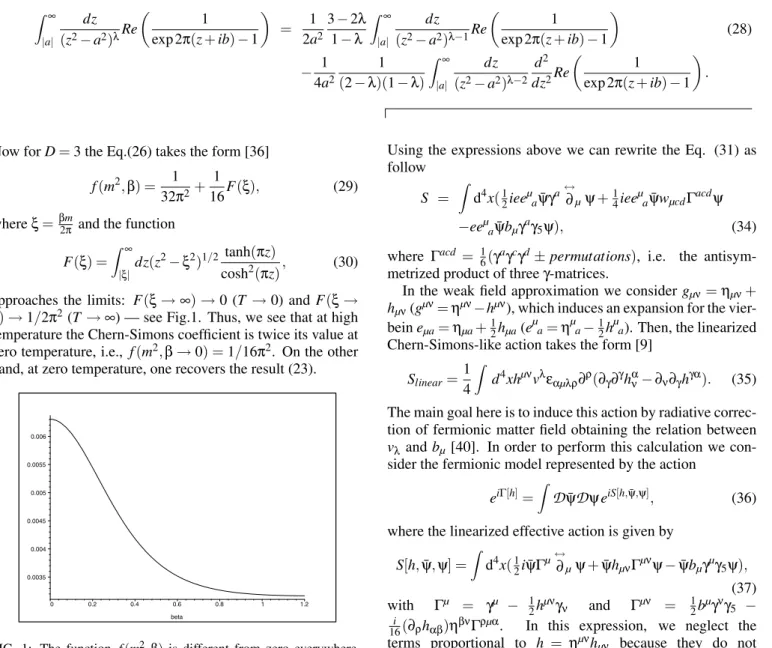
cosh2(πz), (30) approaches the limits: F(ξ→∞)→0 (T →0) and F(ξ→ 0)→1/2π2(T→∞) — see Fig.1. Thus, we see that at high temperature the Chern-Simons coefficient is twice its value at zero temperature, i.e., f(m2,β→0) =1/16π2. On the other hand, at zero temperature, one recovers the result (23).
0.0035 0.004 0.0045 0.005 0.0055 0.006
0 0.2 0.4 0.6 0.8 1 1.2
beta
FIG. 1: The function f(m2,β) is different from zero everywhere. At zero temperature (β→∞), the function tends to a nonzero value 1/32π2.
IV. RADIATIVELY INDUCED CHERN-SIMONS-LIKE
TERM IN GENERAL RELATIVITY
The action that we are interested is given by
S=
d4x(12ieeµaψγ¯ a↔
Dµψ−eeµaψb¯ µγaγ5ψ), (31)
where we have included the parity-violating term. Here,eµais the tetrad (vierbein),e≡deteµaandbµis a constant 4-vector. The covariant derivative is given by
Dµψ=∂µψ+12wµcdσcdψ, (32)
wherewµcdis the spin connection andσcd=1 4[γ
c,γd], whereas the covariant derivative on a Dirac-conjugate field ¯ψis
Dµψ¯ =∂µψ¯−12wµcdψσ¯ cd. (33)
Using the expressions above we can rewrite the Eq. (31) as follow
S =
d4x(1
2iee
µ aψγ¯ a
↔
∂µψ+14ieeµaψw¯ µcdΓacdψ −eeµaψb¯ µγaγ5ψ), (34)
where Γacd = 1
6(γaγcγd±permutations), i.e. the antisym-metrized product of threeγ-matrices.
In the weak field approximation we considergµν=ηµν+ hµν(gµν=ηµν−hµν), which induces an expansion for the vier-beineµa=ηµa+12hµa(eµa=ηµa−12hµa). Then, the linearized Chern-Simons-like action takes the form [9]
Slinear= 1 4
d4xhµνvλεαµλρ∂ρ(∂γ∂γhαν−∂ν∂γhγα). (35)
The main goal here is to induce this action by radiative correc-tion of fermionic matter field obtaining the relacorrec-tion between vλandbµ[40]. In order to perform this calculation we con-sider the fermionic model represented by the action
eiΓ[h]=
D
ψ¯D
ψeiS[h,ψ¯,ψ], (36)where the linearized effective action is given by
S[h,ψ¯,ψ] =
d4x(1
2iψΓ¯
µ↔
∂µψ+ψh¯ µνΓµνψ−ψb¯ µγµγ5ψ), (37) with Γµ = γµ − 1
2h
µνγ
ν and Γµν = 12bµγνγ5 −
i
16(∂ρhαβ)ηβνΓρµα. In this expression, we neglect the terms proportional to h = ηµνh
µν because they do not contribute to generating of the Chern-Simons-like action.
The Feynman rules that we obtain from Eq.(37) are:
= S(p) = i
p/−m
= −ib/γ5
= −i
4γµ(2p+q)ν
= iγµbνγ5
= −16i η
βνΓµρα(q
1−q2)ρ. (38)
(a) (b)
FIG. 2: One-loop relevant contributions
Πµναβa (q) =− i 16tr
d4p (2π)4
γµ(2p+q)νS(p)γα(2p+q)βS(p+q)bγ5S(p+q) (39) and
Πµναβb (q) =− i 16tr
d4p (2π)4
γµ(2p+q)νS(p)bγ5S(p)γα(2p+q)βS(p+q). (40) It is straightforward to see that
Πµναβ(q) =Πµναβa (q) =Πανµβb (−q), (41) which appears of substituting the loop momenta, p→p−qx, and we use the cyclic properties of the trace of a product of γ-matrices. So, from now on we work only with Eq. (39) which takes the form
Πµναβ(q) = −1 8
1 0 d
x x d4p
(2π)4
(2p+q(1−2x))ν(2p+q(1−2x))β [p2−m2+x(1−x)q2]3
×tr[γµ(p−qx+m)γα(p+q(1−x) +m)bγ5(p+q(1−x) +m)], (42) where we have used Feynman parameter to combine the denominator in Eq. (42). Taking into account the trace of Dirac matrices and dropping all odd terms inp, we get
Πµναβ(q) = −1 8
1 0
dx x d4p
(2π)4
Nµναβ(p0,p2,p4)
[p2−m2+x(1−x)q2]3, (43) where the numeratorNµναβ(p0,p2,p4)has the form,
Nµναβ(p0,p2,p4) =4pνpβ(Tαµ
0 +Tppαµ) +2(1−2x)(pνqβ+pβqν)(Tpαµ+Tpppαµ) + (1−2x)2qνqβ(T αµ
0 +Tppαµ) (44) with
T0αµ = −4ibλεαµλθqθ[x(1−x)2q2+ (2−x)m2], (45)
Tpαµ = −4ibλεαµλρ[m2+ (1−x2)q2]p
ρ−8i(1−x)bλ[εµλρθqα−εαλρθqµ−(1−x)εαµλθqρ]qθpρ, (46) Tppαµ = −4ibλ[2(εµλρθpρpα−εαλρθpρpµ+xεαµλρpρpθ)−(2−x)εαµλθp2]qθ, (47)
Tpppαµ = 4ibλεαµλρp2pρ. (48)
The integral (43) is badly divergent. Finally, using the di-mensional regularization, the Eq. (42) takes the form
Πµναβ(q) =bλεαµλρqρ
A q2ηβν+B qβqν, (49)
where the expressionsAandBare given by
A = 1
32π2 1
0 d
x
3x3(1−x) + (5x−3)x2(1−x)
2 ε+ln
4πµ2 −M2
−γ
−3x2
2 ε+ln
4πµ2 −M2
−γ+1
m2
and
B = 1
64π2 1
0 d
x
(1−2x)2(3−2x)x
2(1−x)q2
M2
+ [(2−3x)(1−2x)−4x(1−x)]x(1−2x)
2 ε+ln
4πµ2 −M2
−γ
, (51)
after they have been expanded aroundε→0, withε=4−D andM2=m2−x(1−x)q2.
As one can see1
0dx[(5x−3)x2(1−x)](2ε−γ) =0 inAand 1
0dx[(2−3x)(1−2x)−4x(1−x)]x(1−2x)(2ε−γ) =0 inB, thenAandBtake the form
A = 1
32π2 1
0 dx
3x3(1−x) +(1−2x)x
3(1−x)2q2
m2−x(1−x)q2
− 3x2
2 ε+ln
4πµ2 −M2
−γ+1
m2
q2 (52)
and
B = 1
32π2 1
0 d
x(1−2x)
2x2(1−x)q2
m2−x(1−x)q2 . (53) Here we have performed an integration by parts onxfor log term inAandB. Note that inAthe divergent part is present which will disappear when we consider the limit m2→0. Now performing thex-integration, we have
A|m2→0=−B|m2→0= 1
192π2. (54)
We substitute these results into Eq. (49), to obtain the Chern-Simons-like term
Πµναβ(q) = 1 192π2bλε
αµλρq ρ
q2ηβν−qβqν. (55) Finally, the Chern-Simons-like gravitational action induced by radiatively corrections is given by
Γcs[h] = 1 192π2
d4xbλhµνεαµλρ∂ρ∂γ∂γhαν−∂ν∂γhγα. (56) Comparing to Eq.(35) we obtain the relation between the pa-rametersvλandbµwhich is written as
vλ= 1
48π2bλ. (57)
V. CONCLUSION
We have studied the induction of Chern-Simons-like term at zero and finite temperature, and in gravity theory. Here the dimensional regularization was applied to evaluate momen-tum integrals. We found that depending on the prescription, one can obtain either zero Chern-Simons coefficient or the un-ambiguous result [11], at zero temperature.
At finite temperature, our result is finite [36] but does not agree with other results presented in the literature [33–35]. We argue that this is also caused by different regularization schemes. In the limitT →0 our result leads to a nonzero Chern-Simons-like term, a behavior also predicted in [33], obtained with the use of dimensional regularization, and the result in [35], obtained with the use of cutoff regularization scheme. However, it is in conflict with the result found in [34] which suggests the vanishing of the Chern-Simons-like term at zero temperature. On the other hand, at high temperature our result behaves as the result of [34]. But now, however, it conflicts with the results in [33, 35] which predict that the Chern-Simons-like term vanishes at high temperature. These results are all finite, and they show that the Chern-Simons co-efficient is indeed undetermined just as it happens at zero tem-perature [25, 26].
Finally, we recall that we also have calculated the radiative corrections induced by Dirac fermions coupled to a gravita-tional background field, including the nonstandard contribu-tion that violates parity. In this calculacontribu-tion we have used the weak field approximation. As we are using the perturbative route, i.e., to lowest order inbµ, probably these radiative cor-rections are also undetermined.
Acknowledgments
This work was done in collaboration with D. Bazeia, R. F. Ribeiro and F. A. Brito. We would like to thank to A. Yu. Petrov for comments and discussions, and CAPES, CNPq, PADCT/CNPq, and PRONEX/CNPq/FAPESQ for financial support.
[1] S. Carroll, G. Field, and R. Jackiw, Phys. Rev. D 41, 1231 (1990).
[2] D. Colladay and V. A. Kosteleck´y, Phys. Rev. D 55, 6760 (1997).
[3] D. Colladay and V. A. Kosteleck´y, Phys. Rev. D58, 116002, (1998)
[4] S. Coleman and S. L. Glashow, Phys. Lett.405B, 249 (1997). [5] S. Coleman and S. L. Glashow, Phys. Rev. D 59, 116008,
(1999).
[6] V. A. Kostelecky, ed.,CPT and Lorentz Symmetry, World Sci-entific, Singapore, 1999
[8] V. A. Kosteleck´y and S. Samuel Phys. Rev. Lett.63224 (1989). [9] R. Jackiw and S.-Y. Pi, Phys. Rev. D68104012 (2003). [10] A. Lue, L. Wang, and M. Kamionkowski, Phys. Rev. Lett.83,
1506 (1999).
[11] R. Jackiw and V.A. Kosteleck´y, Phys. Rev. Lett. 82, 3572 (1999).
[12] M. P´erez-Vitoria, Phys. Rev. Lett.83, 2518 (1999). [13] J. M. Chung and P. Oh, Phys. Rev. D60, 067702 (1999). [14] J. M. Chung, Phys. Rev. D60, 127901 (1999).
[15] W. F. Chen, Phys. Rev. D60, 085007 (1999). [16] J. M. Chung, Phys. Lett. B461, 318 (1999).
[17] C. Adam and F. R. Klinkhamer, Nuc. Phys. B607, 247 (2001); Phys. Lett. B513, 245 (2001).
[18] G. Bonneau, Nucl. Phys. B593, 398 (2001). [19] Yu. A. Sitenko, Phys. Lett. B515, 414 (2001).
[20] M. P´erez-Victoria, J. High Energy Phys.04, 032 (2001). [21] M. Chaichian, W.F. Chen, and R. Gonz´alez Felipe, Phys. Lett.
B503, 215 (2001).
[22] J. M. Chung and B.K. Chung, Phys. Rev. D63, 105015 (2001). [23] A. A. Andrianov, P. Giacconi, and R. Soldati, J. High Energy
Phys.02, 030 (2002).
[24] D. Bazeia, T. Mariz, J. R. Nascimento, E. Passos, and R. F. Ribeiro, J. Phys. A364937 (2003)
[25] R. Jackiw, Int. J. Mod. Phys. B14, 2011 (2000). [26] M. Perez-Victoria, JHEP0104, 032 (2001).
[27] I. J. R. Aitchison and C. M. Fraser, Phys. Lett. B146, 63 (1984); Phys. Rev. D31, 2605 (1985); C. M. Fraser, Z. Phys. C28, 101 (1985).
[28] A. Das and A. Karev, Phys. Rev. D36, 623 (1987); K. S. Babu, A. Das, and P. Panagrahi, Phys. Rev. D36, 3725 (1987). [29] J. Ashmore, Lett. Nuovo Cim.4, 289 (1972).
[30] C. G. Bolini and J. J. Giambiagi, Phys. Lett. B40, 566 (1972). [31] G. t’Hooft and M. J. G. Veltman, Nucl. Phys. B44, 189 (1972). [32] P. Breitenlohner and D. Maison, Comm. Math. Phys.52, 11
(1977).
[33] J. R. Nascimento, R. F. Ribeiro, and N. F. Svaiter, Radiatively induced Lorentz and CPT violation in QED at finite tempera-ture, hep-th/0012039.
[34] L. Cervi, L. Griguolo, and D. Seminara, Phys. Rev. D 64, 105003 (2001).
[35] D. Ebert, V. C. Zhukovsky, and A. S. Razumovsky, Phys. Rev. D70, 025003 (2004).
[36] T. Mariz, J. R. Nascimento, E. Passos, R. F. Ribeiro, and F. A. Brito, J. High Energy Phys.10, 019 (2005).
[37] L. H. Chan, Phys. Rev. Lett,54, 1222 (1985). [38] L. Dolan and R. Jackiw, Phys. Rev. D9, 3320 (1974). [39] L. H. Ford, Phys. Rev. D21, 933 (1980).