1
Volume 84, Nº 3, Março 2005 Volume 84, Nº 3, Março 2005
Original Article
Comparative Analysis of the Flows of Left Internal
Thoracic Artery Grafts Dissected in the Pedicled
Versus
Skeletonized Manner for Myocardial
Revascularization Surgery
Gustavo Peressoni Castro
Porto Alegre, RS - Brazil
Hospital de Clínicas de Porto Alegre da Universidade Federal do RS Mailing address: Gustavo Peressoni Castro - Rua São Manoel, 808/504 Cep 90620-110 - Porto Alegre - RS - Brazil
E-mail: [email protected] Received for publication: 03/31/2004 Accepted for publication: 05/19/2004 English version by Stela Maris Costalonga
Objective
To compare the free blood flow, caliber, and length of the left internal thoracic artery (LITA), dissected in the pedicled (P) and skeletonized (S) manners, during surgery before and after topical vasodilator (TV) application.
Methods
A randomized, blind, clinical trial was carried out with 50 patients undergoing elective myocardial revascularization to assess the use of the LITA in situ in its pedicled or skeletonized form. The 25 patients in the pedicled group (GP) had NYHA class II or III angina, ejection fraction (EF) of 50.8±9.2%, and 16 were of the male sex. The patients in the skeletonized group (SG) had NYHA class II angina, EF of 46.8±9.3%, and 19 were of the male sex. The measurements were performed before extracor-poreal circulation and divided into 2 phases: phase 1 (before topical papaverine application) and phase 2 (15 min after topical application of papaverine, 2.5 mg/mL, at 37ºC). During the measurements, mean blood pressure, central venous pressure, and heart rate were monitored.
Results
The phase 1 and 2 results are as follows: 1) PG: blood flow, 46±16 and 77±28 mL/min; caliber, 1.4±0.1 and 1.7±0.1 mm, respectively; 2) SG: blood flow, 57±27 and 97±35 mL/ min; and caliber, 1.4±0.1 and 1.8±0.2 mm, respectively. No significant differences were observed in length.
Conclusion
The LITA in SG had a significant increase in blood flow and caliber after the use of TV compared with blood flow and caliber in PG (P=0.03 and P=0.01, respectively).
Key words
left internal thoracic artery; coronary artery bypass grafting; skeletonized
The internal thoracic artery is the preferred graft for coronary artery bypass grafting1-4, and, in the in situ position, it is considered the gold standard for revascularizing the anterior interventricular artery5,6 due to its patency. On a 10-year follow-up, that graft remains patent in 90% of the patients6-9, while the venous graft remains patent in 50% of patients in the same period10-13.
Dissection of the internal thoracic artery in the pedicled form has already been well established; the skeletonized dissection technique, however, bears some uncertainties.
Reports have been published about the technique of skeleto-nization for internal thoracic artery dissection, comparing it with the pedicled dissection in regard to the following characteristics: free blood flow14-17; caliber15,17; length14,15,18; number of distal and sequential anastomoses18; respiratory function14,19,20; preservation of the integrity of the pleura14,19,20; blood supply to the sternum after internal thoracic arterydissection21,22; sternal complica-tions23,24; uni- and bilateral use of the artery23,25-27; use in the elderly26; and use in diabetic patients23,26-28. Outcomes, such as survival and event-free survival (angina, angioplasty, myocardial infarction, stroke)18,27,29, have been compared.
A change has been observed in the profile of the patients undergoing coronary artery bypass grafting. They currently have ventricular impairment of a moderate to severe degree, advanced age, and other associated diseases, such as diabetes mellitus (type I or II), chronic obstructive bronchopulmonary disease (COBPD), systemic arterial hypertension, chronic renal failure (CRF), dyslipidemias, obesity, and a history of tobacco use.
Studies assessing outcomes, such as blood flow and the caliber and length of the graft, have been published14,16,17,30,31, most of which are observational studies, only a few being blind or double-blind randomized clinical trials. In the latter, intraluminal injection of vasodilators or hydrostatic dilation of the internal thoracic artery has usually been used, and the measurements have been taken during extracorporeal circulation.
The present study aimed at comparing length, caliber, and free blood flow of the left internal thoracic artery graft in its pedicled (conventional) versus skeletonized form before and after the topical application of a vasodilator.
Methods
2
coronary artery bypass grafting. After randomization (fig. 1), the patients were divided into 2 groups as follows: pedicled group (PG), comprising 25 patients with the left internal thoracic artery dissected in the pedicled manner; and skeletonized group (SG), comprising 25 patients with the left internal thoracic artery dis-sected in the skeletonized manner. Patients with the following characteristics were excluded from the study: cardiogenic shock; need for circulatory support with intra-aortic balloon; coronary artery bypass grafting associated with valvular replacements or any other procedure; atrial fibrillation; situations in which internal thoracic artery dissection was contraindicated; age < 35 and > 80 years; ejection fraction < 30%; mean blood pressure (MBP) < 70 and > 100 mm Hg and heart rate (HR) greater than 100 bpm during the measurements; and those who did not agree to participate in the study. The patients taking part in the study were informed about the research and, after agreeing with the proposed procedure, they signed the written informed consent approved by the scientific committee and the committee on ethics and research on health of the Hospital de Clínicas de Porto Ale-gre, where the surgeries were performed.
All patients received the same anesthetic regimen without analgesia through a peridural catheter. The preanesthetic medi-cation (oral flunitrazepam, 2 mg) was administered on the prece-ding day at 11 PM. After arriving at the operating room, the patients
were monitored by electrocardiography, invasive arterial blood pres-sure (through the radial artery), central venous prespres-sure (through the internal jugular vein or subclavian vein), urinary output (vesical catheter), pulse oximetry, and rectal and nasopharyngeal tempe-ratures. Anesthetic induction was performed after preoxygenation through peripheral venous punctures (2 in the upper limb with a 14 or 16 catheter) using midazolam (0.1 µg/kg), fentanyl (10 µg/ kg), and pancuronium (0.1 µg/kg). Then, orotracheal intubation was performed and mechanical ventilation was installed with iso-flurane at a concentration of 1 to 2%. For anesthesia maintenance, the same drugs used during induction were used at reduced doses (midazolam, 0.05 µg/kg; fentanyl, 5 µg/kg; and pancuronium, 0.03 µg/kg).
Then, a median sternotomy was performed, followed by the required hemostasia, pericardiotomy, and, in the sequence, pla-cement of a retractor for dissecting the left internal thoracic artery (Quinelato-Dinkhhyiusen).
Pedicled or skeletonized dissection was decided on by the
anesthetist who tossed a coin (heads or tails) before beginning the surgical incision. The patients ignored the technique of left internal thoracic artery dissection they would undergo.
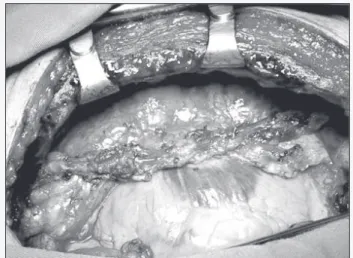
Once the left internal thoracic artery was exposed, dissection was initiated by pushing aside the left lung pleura, aiming always at maintaining it intact. A monopolar electrocautery (Valleylab Force 2) at the potency of 25 watts was used for the entire dissection (coagulation); a clip (Ethicon, LT 200 size) applicator (Ethicon) was used only for the important caliber branches. The distal limit was the bifurcation of the internal thoracic artery into the musculophrenic artery (MFA) and the superior epigastric artery (SEA), and the proximal limit was the superior margin of the first rib (fig. 2). In this technique, the pedicle comprised veins, muscle, endothoracic fascia, and adipose tissue, in addition to the left internal thoracic artery, and had an approximate width of 2 cm. In the skeletonized dissection, the same distal and proximal limits of the previous technique were applied, and the left lung pleura was pushed aside and kept intact. By use of the monopolar electrocautery (Valleylab Force 2) at the potency of 18 watts, the endothoracic fascia was opened from the bifurcation of the internal thoracic artery until the superior margin of the first rib. Then, using a delicate tweezers and the blade of the cautery (using neither cut nor coagulation at this phase, but only blunt divulsion), skeletonized dissection of the left internal thoracic artery was performed, without tweezing the artery or using the cautery. After identification, the branches of the LITA were isolated and ligated by using the metallic clip (Vitalitec, small size) applicator (Vitalitec), always fixating one proximal and another distal clip, and sectioning with the Potts scissors (fig. 3).
After systemic heparinization (4 mg/kg), the LITA was sectioned at the level of its bifurcation, and the measurements of length, caliber, and free blood flow were taken.
Those measurements were taken in 2 phases: phase 1 (with no vasodilator), and phase 2 (with a topical vasodilator). In phase 1, the measurements of the length of the LITA were taken by using a graded metallic ruler (cm), and the limits were as follows: the proximal limit was the superior margin of the first rib, and the distal limit was the bifurcation into MFA and SEA. Then the caliber was measured by using metallic coronary measurers, whose dia-meters ranged from 1 to 2.5 mm. Then, the LITA was left in the horizontal position to drain freely for 30 seconds into a graded plastic receptacle. That volume was multiplied by 2, and the
POPUL POPUL POPUL POPUL
POPULAAAAATION STUDIEDTION STUDIEDTION STUDIEDTION STUDIEDTION STUDIED 50 Patients
GROUP P GROUP P GROUP P GROUP P GROUP P 25 Patients
GROUP E GROUP EGROUP E GROUP EGROUP E 25 Patients
LITA LITA LITA LITA LITA Pedicled
LITA LITALITA LITA LITA Skeletonized
3
Volume 84, Nº 3, Março 2005 Volume 84, Nº 3, Março 2005 Comparative Analysis of the Flows of Left Internal Thoracic Artery Grafts Dissected in the Pedicled Versus Skeletonized Manner for Myocardial Revascularization Surgery
T T T T
Table II - Medications with cardiovascular effects being used by theable II - Medications with cardiovascular effects being used by theable II - Medications with cardiovascular effects being used by theable II - Medications with cardiovascular effects being used by theable II - Medications with cardiovascular effects being used by the patients in the preoperative period
patients in the preoperative periodpatients in the preoperative period
patients in the preoperative period patients in the preoperative period
Pedicled Skeletonized P
(n=25) (n=25)
Aspirin (%) 7 (28.0) 8 (32.0) 0.99
Nitrate (%) 12 (48.0) 15 (60.0) 0.57
Beta-blocker (%) 22 (88.0) 17 (68.0) 0.17
Statin (%) 13 (52.0) 15 (60.0) 0.78
Calcium antagonist (%) 4 (16.0) 4 (16.0) 0.99
ACE inhibitor (%) 18 (72.0) 17 (68.0) 0.99
Diuretics (%) 8 (32.0) 10 (40.0) 0.77
Digitalis (%) 4 (16.0) 3 (12.0) 0.99
Data are described as frequency (percentage); ACE - angiotensin-converting enzyme.
T T T T
Table I – Pable I – Pable I – Pable I – Pable I – Preoperative patient datareoperative patient datareoperative patient datareoperative patient datareoperative patient data
Pedicled Skeletonized P
(n=25) (n=25)
Male sex (%) 16 (64.0) 19 (76.0) 0.54
Age (years) 63 ± 10.2 60 ± 11.5 0.44
Body surface (m²) 1.7 ± 0.1 1.8 ± 0.1 0.60
Functional class (NYHA) 2.6 ± 0.9 2.4 ± 1.1 0.68
Diabetes mellitus I and II (%) 10 (40.0) 15 (60.0) 0.26
Arterial hypertension (%) 22 (88.0) 21 (84.0) 0.99
History of smoking (%) 11 (44.0) 15 (60.0) 0.40
Dyslipidemia (%) 12 (48.0) 11 (44.0) 0.99
Ejection fraction (%) 50.8 ± 9.2 46.8 ± 9.3 0.13
Data are described as mean ± standard deviation or frequency (percentage); NYHA - New York Heart Association.
result was expressed in mL/min. In phase 2, the LITA was ligated with a metallic clip at its bifurcation. It was humidified and wrapped in gauze soaked with the vasodilator (papaverine at the concen-tration of 2.5 mg/mL at the temperature of 37ºC). After 15 minu-tes, the same measurements of phase 1 were taken again, now being affected by the topical vasodilator.
The measurements were performed before extracorporeal cir-culation, and in the cases in which the heart rate was < 90 bpm, artificial temporary atrial stimulation was adopted at a fre-quency of 90 bpm, and mean blood pressure, central venous pres-sure, and heart rate were monitored and recorded, as was the use of vasoconstrictive or vasodilating drugs. All left internal thoracic arteries were anastomosed in the anterior interventricular artery (fig. 4) and the venous graft (saphenous vein) was chosen to complete the rest of the myocardial revascularization. Extracor-poreal circulation with a mean body temperature of 32ºC was used, as was anterograde, hypothermic, and crystalloid myocardial protection, which was repeated every 25 minutes.
The data are shown as mean and standard deviation. The quantitative variables were analyzed by using the Student t test for independent samples, and the qualitative variables were analyzed by using the chi-square test. In addition, analysis of variance was used for the repeated data, and multiple linear regression was used for assessing the changes in the values of the outcome variables and the factors that influenced them. The Statistical Package for the Social Sciences (SPSS), version 11.0, was used for statistical analysis. Differences with P < 0.05 were considered statistically significant.
Results
The preoperative data of the patients, such as sex, age, body surface, New York Heart Association functional class, associated diseases, history of tobacco use, and the ejection fraction measured on ventriculography are shown in table I. No significant differences were observed in the groups. Table II shows the medications with cardiovascular effects used by the patients in the preoperative period. No significant differences were observed between the groups. The results of the hemodynamic and surgical data (tab. III) showed statistical differences in the variables time of extracorporeal circu-lation and maintenance of pleural integrity (4 pleuras in the PG and 18 pleuras in the SG) for the SG (P=0.04 and P=0.0002, respec-tively). When the measurements in phases 1 and 2 (before and after the topical use of the vasodilator) in groups P and S were compared, no significant differences were identified in the following variables: number of distal anastomoses (2.96± 0.8 versus 3.16± 0.6 anastomoses, in PG and SG, respectively); time of aortic clam-ping (42.21±14.3 versus 51.68±21.8 min, in PG and SG, res-pectively); MBP; CVP; and HR. One PG patient had perioperative acute myocardial infarction, and an SG patient had a superficial sternal infection. In the in-hospital phase, the following findings were not observed: death, sternal dehiscence, mediastinitis, and difference in the hospital length of stay (9.1±1.69 versus 8.96±1.49 days for PG and SG, respectively, P=0.65). The results of the secondary outcomes (caliber and length of the vessel) are shown in table IV, in which one can see that a significant increase occurred neither in length in phases 1 and 2, nor in the variable caliber in phase 1, when comparing the groups. However, the caliber signifi-cantly increased after the use of TV (P=0.01) in SG. Figure 5
Fig. 3 - Skeletonized dissection of the left internal thoracic artery.
4
shows the result of the major outcome of the study, free blood flow, with an increase in blood flow in SG, both in phase 1 (57±27 mL/min) and phase 2 (97.1±35 mL/min), significant in the latter, when compared with that in PG before (46.2±16.7 mL/min) and after TV (77.2±28.8 mL/min) (P=0.09 and P=0.03, respectively).
Discussion
One of the reasons for choosing the skeletonized dissection of the internal thoracic artery is that it provides greater length14,25,29,32-34 and
caliber17 compared with those provided by the conventional technique (pedicled), and, therefore, may revascularize coronaries with distal lesions. In addition, it maintains the internal thoracic artery in its in situ form, which is advantageous, because a 10 to 15% loss in the patency of that vessel is known to occur when it remains as a free graft, being anastomosed in the ascending aorta5.
The length of the left internal thoracic artery in this study was not statistically different between the groups, probably due to the topical administration of the vasodilator or the assessment method used; nevertheless, in practice, a greater mobility of the skeletonized graft was observed.
Calafiore et al 18, in an observational study comprising 1146 patients undergoing coronary artery bypass surgery, compared the pedicled (n=304) with the skeletonized (n=842) dissection of the left internal thoracic artery. They studied a subgroup of 28 patients (14 patients in the PG and 14 patients in the SG) and observed that the length of the left internal thoracic artery in-creased in both groups from 16.1±1.4 to 16.4±1.7 cm and from 17.6±1.4 to 20.1±1.6 cm, respectively. However, the mea-surements were performed before and 10 minutes after the intra-luminal injection of 10 mL of papaverine (1 mg/mL).
Deja et al 14, in a study comparing the length of the vessel dissected in the pedicled and skeletonized manner, reported an increase, although not significant (P=0.11 for SG). This study was performed after the use of topical papaverine (0.2%), and measurement was taken only before performing the anastomosis of the left internal thoracic artery in the anterior interventricular artery, ie, the vasodilator had a longer time to act, and the influence of the mean blood pressure could be exerted longer (measured during extracorporeal circulation with a flow of 2.2 L/min/m2); no measurement of length was made without the vasodilator effect. In our study, the caliber of the vessel increased significantly in the SG when compared with that in the PG in phase 2 (1.7±0.1 versus 1.85±0.2 mm; P=0.01), and, in phase 1, the calibers were almost the same (1.43±0.13 versus 1.44±0.19 mm). Choi and Lee 17 reported that, after topical use of papaverine (1.25 mg/mL), of 23 patients undergoing skele-tonized dissection of the left internal thoracic artery, 21 had calibers between 1.5 and 2 mm, and 2 patients had diameters > 2 mm. Of 14 patients undergoing the pedicled dissection, in 6 the caliber was < 1.5 mm, in 7 between 1.5 and 2 mm, and in 1 it was > 2 mm. In their study, no measurement was perfor-med before the use of the vasodilator, and the measurements were taken during extracorporeal circulation, before the anasto-mosis with the anterior interventricular artery, and no statistical comparison was performed with the pedicled group.
The technique of skeletonized dissection resulted in a significant increase in the caliber, therefore providing better conditions for performing the anastomoses, and contributing to a greater free blood flow.
The skeletonized dissection of the internal thoracic artery pro-vides advantages, such as the preservation of the collateral circula-tion of the sternum, which reduces sternal complicacircula-tions23-25,29,31-36 and respiratory complications, due to pleural preservation19,20. In addition, the greater initial flow decreases the occurrence of hypo-perfusion syndrome16,17, considering the longer time of dissection (10 to 15 min)16.
Flow (mL/min)
phase 1: measurements taken before the use of the topical vasodilator (p=0.09) phase 2: measurements taken after the use of the topical vasodilator (p=0,03)
100 90 80 70 60 50 40 30 20 10 0
46+16 46+16 46+16 46+16 46+16
77+28 77+28 77+28 77+28 77+28
57+27 57+2757+27 57+27 57+27
97+35 97+35 97+35 97+35 97+35
Pedicled n=25
Skeletonized n=25
phase1 phase2
Fig. 5 - Results of the major outcome. T
T T T
Table IV - Rable IV - Rable IV - Rable IV - Results of length and caliberable IV - Results of length and caliberesults of length and caliberesults of length and caliberesults of length and caliber
Pedicled Skeletonized P
n=25 n=25
Length (cm)
phase 1 16.2 ± 1.3 16.1 ±1.3 0.78
phase 2 16.7 ±1.4 16.8 ±1.4 0.82
Caliber (mm)
phase 1 1.4 ± 0.1 1.4 ± 0.1 0.83
phase 2 1.7 ± 0.1 1.8 ± 0.2 0.01
Data are described as mean ± standard deviation; phase 1 - measurements taken before the use of the topical vasodilator; phase 2 - measurements taken after the use of the topical vasodilator.
T T T T
Table III - Hemodynamic and operative data of patientsable III - Hemodynamic and operative data of patientsable III - Hemodynamic and operative data of patientsable III - Hemodynamic and operative data of patientsable III - Hemodynamic and operative data of patients
Pedicled Skeletonized P
(n=25) (n=25)
N of distal anastomoses 2.9 ± 0.8 3.1 ± 0.6 0.3600
TECC (min) 63.7 ± 20.0 78.0 ± 26.6 0.0400
T. Ao Clamp (min) 42.2 ± 14.3 51.6 ± 21.8 0.0700
MBP (mmHg) – ph1 78.2 ± 8.6 76.2 ± 7.6 0.3900
MBP (mmHg) – ph2 77.4 ± 6.5 78.1 ± 6.5 0.7100
CVP (mmHg) – ph1 7.44 ±3.8 7.36 ± 3.9 0.9400
CVP (mmHg) – ph2 8.12 ± 3.7 7.9 ± 3.7 0.8800
HR (bpm) – ph1 90.3 ± 2.0 90.9 ±3.7 0.4600
HR (bpm) – ph2 90.0 ± 0.1 91.0 ± 5.2 0.3500
Maintenance of pleural integrity 4 (16.0) 18 (72.0) 0.0002
5
Volume 84, Nº 3, Março 2005 Volume 84, Nº 3, Março 2005 Comparative Analysis of the Flows of Left Internal Thoracic Artery Grafts Dissected in the Pedicled Versus Skeletonized Manner for Myocardial Revascularization Surgery
Different authors have shown the positive effect of papaverine on internal thoracic artery flow 34,37-41. Mills et al 37 and Degrelid et al 38 have studied the intraluminal injection of diluted papaverine and reported a greater flow compared with that resulting from the topical use of papaverine. However, a morphological study showed damage to the endothelium associated with the intralu-minal injection of the vasodilator and its acid pH. Noera et al 34 studied the left internal thoracic artery in the pedicled versus skeletonized forms, and also compared the subgroups: intraluminal injection of papaverine with hydrostatic dilation versus topical application of the vasodilator. They reported that, at the end of the histological assessment, all subgroups with intraluminal in-jection and hydrostatic dilation had lesions in the intimal layer of the endothelium, and, therefore, recommended the topical appli-cation of papaverine. Some studies have shown that the topical administration of papaverine, such as intraluminal injection, is effective34,38-41. Bilgen et al40 have reported that the topical use of papaverine at 37ºC has better results than that at 20 to 22ºC.
In our study, maintenance of pleural integrity had results simi-lar to those reported in the literature14,19,20.
Free blood flow was greater in SG when comparing the groups in the 2 phases of measurements (46.2±16.7 versus 57±27 mL/min and 77.2±28.8 versus 97.1±35 mL/min in PG and SG, respectively), being significant in phase 2 (P=0.03), due to the increase in caliber. However, considering flow gain, ie, flow in phase 2 minus flow in phase 1, and comparing it in both groups, an increase in flow gain was observed in SG, although not signi-ficant. In our study, the pedicled versus skeletonized dissection with topic papaverine at a concentration of 2.5 mg/mL at 37ºC was used, and the measurements were taken before extracorporeal circulation. Other studies in the literature, however, have used different temperatures and concentrations of the vasodilator, in addition to its intraluminal use16 and also the measurement being taken during extracorporeal circulation14. Therefore, a safe com-parison is difficult. Considering the methodological differences,
the measurements of free blood flow in phase 2 are similar to those reported in the literature14,16. Wendler et al16 used the model of intraluminal injection of papaverine, and reported a greater blood flow after using the vasodilator (147±70.5 mL/min in the PG, and 197±66.6 mL/min in the SG). However, the initial flow in the pedicled form was greater than that in the skeletonized form (68±54 versus 51±39 mL/min, respectively), but the diffe-rence was not statistically significant.
This study has the limitation of only measuring the free blood flow of the grafts, which is not a complete evaluation of the subject, because the resistance of the distal runoff may play an important role in blood flow distribution after implantation of the left internal thoracic artery in the anterior intraventricular artery, and that is its definitive condition. It is clear that free flow represents the maximum flow of the grafts in natural conditions, and it is not difficult to agree that the measurements of the flows obtained in the arteries of the patients should be adequate to revascularize the corresponding myocardial region.
Calafiore et al29 have reported that patency of the skeletonized and pedicled grafts is similar. However, the patients had a follow-up of approximately 9 years, while those with the pedicled form had patency assessment throughout 15.17 and 20 years3,42. In that study, angiography was limited to 1/3 of the patients with a mean follow-up of 17.5 months and wide standard deviation (± 18.4 months)43.
Studies aiming at assessing long-term patency of the skeleto-nized internal thoracic artery are required to clarify the definitive role of the skeletonized dissection in coronary artery bypass surgery. To conclude this clinical trial comparing measurements of length, caliber, and flow: in regard to the variable length, the skeletonized left internal thoracic artery showed no statistical difference; however, in regard to caliber and free blood flow, it showed a significant increase in phase 2 (P=0.01 and P=0.03, respectively) when compared with those of the pedicled left internal thoracic artery.
1. Cameron A, Kathryn BD, Grenn GE, Schaff HV. Coronary bypass surgery with
in-ternal-thoracic-artery grafts – effects on survival over a 15 year period. N Eng J Med 1996; 334: 216-9.
2. Fiore AC, Naunheim KS, Dean P et al. Results of internal thoracic artery grafting
over 15 years: single versus double grafts. Ann Thoracic Surg 1990;49:202-9.
3. Galbut DT, Traad EA, Dorman MJ et al. Seventeen-year experience with bilateral
in-ternal mammary artery grafts. Ann Thoracic Surg 1990; 49: 195-201.
4. Calafiore AM, Di Giammarco G, Luciani Net et al. Composite arterial conduits for
a wider arterial myocardial revascularization. Ann Thorac Surg 1994; 58: 185-90.
5. Loop FD, Lytle BW, Cosgrove DM et al. Influence of the internal-mammary-artery
graft on 10-year survival and other cardiac events. N Engl J Med 1986;314:1-6.
6. Lytle BW, Loop FD, Cosgrove DM et al. Long term (5 to 12 year) serial studies of
internal mammary artery and saphenous vein coronary bypass. J Thorac Cardio-vasc Surg 1985; 89: 248-58.
7. Acinapura AJ, Rose DM, Jacobowitz IJ et al. Internal mammary artery bypass
grafting: influence of recurrent angina and survival in 2100 patients. Ann Thorac Surg 1989; 48: 186-90.
8. Barner HB, Swartz MT, Mudd JD, Tyras DH. Late patency of the internal
mamma-ry artemamma-ry as a coronamamma-ry bypass conduit. Ann Thorac Surg 1982; 34: 408-11.
9. Tector AJ, Schmahl TM, Janson B, Kallies JR, Johnson G. The internal mammary
artery graft: Its longevity after coronary bypass. JAMA 1981; 256: 2181-6. 10. Bourassa MG, Fischer LD, Campeau L et al. Long-term fate of bypass graft: the
Coronary Artery Surgery Study (CASS) and Montreal Heart Institute experiences. Circulation 1985; 72: 71-8.
11. Kouchoukos NT, Karp RB, Oberman A et al. Long term patency of saphenous veins for coronary bypass grafting. Circulation 1978; 58(I): 96-9.
References
12. Campeau L, Enjalbert M, Lespérance J et al. Atherosclerosis and late closure of aortocoronary saphenous vein grafts: sequential angiographic studies at 2 weeks, 1 year, 5 to 7 years, and 10 to 12 years after surgery. Circulation 1983; 68(II): 1-7. 13. Fitzgibbon GM, Kafka HP, Leach AJ et al. Coronary bypass graft fate and patient outcome: Angiographic follow-up of 5,065 grafts related to survival and reopera-tion in 1,388 patients during 25 years. J Am Coll Cardiol 1996; 28: 616-26. 14. Deja MA, Wós S, Golba KS et al. Intraoperative and laboratory evaluation of
skeleto-nized versus pedicled internal thoracic artery. Ann Thorac Surg 1999; 68: 2164-8. 15. Keeley SB. The skeletonized internalmammary artery. Ann Thorac Surg 1987; 44:
324-5.
16. Wendler O, Tscholl D, Huang Qi, Schäfers H-J. Free flow of skeletonized versus pe-dicled internal thoracic artery grafts in coronary artery bypass grafts. Eur J Cardio-thorac Surg 1999; 15: 247-50.
17. Choi JB, Lee SY. Skeletonized and pedicled internal thoracic artery grafts: effects on free flow during bypass. Ann Thorac Surg 1996; 61: 909-13.
18. Calafiore AM, Vitolla G, Iaco AL et al. Bilateral internal mammary artery grafting: midterm results of pedicled versus skeletonized conduits. Ann Thorac Surg 1999; 67: 1637-42.
19. Matsumoto M, Konish Y, Miwa S, Minakata K. Effect of different methods of internal thoracic artery harvest on pulmonary function. Ann Thorac Surg 1997; 63: 653-5. 20. Bonacchi M, Prifti E, Giunti G et al. Respiratory dysfunction after coronary artery
bypass grafting employing bilateral internal mammary arteries: the influence of intact pleura. Eur J Cardio-Thorac Surg 2001; 19: 827-33.
6
22. Lorberboym M, Medalian B, Bder O et al. 99mTc-MDP bone SPECT for the evalu-ation of sternal ischaemic following internal mammary artery dissection. Nucl Med Commun 2002; 23: 47-52.
23. Sofer D, Gurevitch J, Shapira I et al. Sternal wound infection in patients after co-ronary artery bypass grafting using bilateral skeletonized internal mammary arteries. Ann Surg 1999; 229: 585-90.
24. Pevni D, Mohr R, Lev-Run O et al. Influence of bilateral skeletonized harvesting an occurrence of deep sternal wound infection in 1000 consecutive patients un-dergoing bilateral internal thoracic artery grafting. Ann Surg 2003; 237: 277-80. 25. Pevni D, Kramer A, Paz Y et al. Composite arterial grafting with double skeletonized
internal thoracic arteries. Eur J Cardio-Thorac Surg 2001; 20: 299-304. 26. Gurevitch J, Matsa M, Paz Y et al. Effect of age on outcome of bilateral
skeletoni-zed internal thoracic artery grafting. Ann Thorac Surg 2001; 71: 549-54. 27. Endo M, Tomizawa Y, Nishida H. Bilateral versus unilateral internal mammary
re-vascularization in patients with diabetes. Circulation 2003; 108: 1343-9. 28. Matsa M, Paz Y, Gurevitch J et al. Bilateral skeletonized internal thoracic artery grafts
in patients with diabetes mellitus. J Thorac Cardiovasc Surg 2001; 121: 668-74. 29. Colafiore AM, Contini M, Vitolla G et al. Bilateral internal thoracic artery grafting:
long-term clinical and angiographic results of in situ versus Y grafts. J Thorac Car-diovasc Surg 2000; 120: 990-8.
30. Takami Y, Ina H. Effects of skeletonization on intraoperative flow and anastomosis diameter of internal thoracic arteries in coronary artery bypass grafting. Ann Thorac Surg 2002; 73: 1441-5.
31. Higami T, Yamashita T, Nohara H et al. Early results of coronary grafting using ultra-sonically skeletonized internal thoracic arteries. Ann Thorac Surg 2001; 71: 1224-8. 32. Parish MA, Asai T, Grossi EA et al. The effects of different techniques of internal mammary harvesting on sternal blood flow. J Thorac Cardiovasc Surg 1992; 1104: 1303-7.
33. De Jesus RA, Acland RD. Anatomic study of the collateral supply of the sternum. Ann Thorac Surg 1995; 59: 163-8.
34. Noera G, Pensa P, Lodi R et al. Influence of different harvesting techniques on the arterial wall the internal mammary artery graft: microscopic analysis. Thorac Car-diovasc Surgeons 1993; 41: 16-20.
35. Wender O, Hennen B, Demertzis S et al. Complete arterial revascularization in multivessel coronary artery disease with 2 conduits (skeletonized grafts and T grafts). Circulation 2000;102(suppl III): 79-83.
36. Bical O, Braunberg E, Fischer M et al. Bilateral skeletonized mammary artery graf-ting: experience with 560 consecutive patients. Eur J Cardio-Thorac Surg 1996; 10: 971-6.
37. Mills NL, Bringaze WL. Preparation of the internal mammary artery graft. Wich is the best method? J Thorac Cardiovasc Surg 1989; 98: 73-9.
38. Dregelid E, Heldal K, Resch F et al. Dilation of the internal mammary artery by ex-ternal and intraluminal papaverine application. J Thorac Cardiovasc Surg 1995; 110: 697-703.
39. Villareal RP, Mathur VS. The string phenomenon: an important cause of internal mammary artery graft failure. Tex Heart Inst J 2000; 27: 346-9.
40. Bilgen F, Yapici MF, Serbetgioglu A et al. Effect of normothermic papaverine to relieve intraoperative spasm of the internal thoracic artery. Ann Thorac Surg 1996; 62: 769-71.
41. Van Son JA, Tavilla G, Noyez L. Detrimental sequelae on the wall of the internal mammary artery caused by hidrostatic dilation with diluted papaverine solution. J Thorac Cardiovasc Surg 1992; 104: 972-6.
42. Voutilainen MS, Järvinen AA, Verkkala KA et al. Angiographic 20-year follow-up of 61 consecutive patients with internal thoracic artery grafts. Ann Surg 1999; 229: 154-8.