Arch Bone Jt Surg. 2014;2(3):215-219. http://abjs.mums.ac.ir
the online version of this article abjs.mums.ac.ir
Amirreza Sadeghifar, MD; Shahab Ilka, MD; Hasan Dashtbani, MSc; Mansour Sahebozamani, PhD Research performed at Faculty of Sport Science and Physical Education, Shahid Bahonar University, Kerman, Iran
Introduction
A
lmost 50% of major joint dislocations occur in the glenohumeral joint because this joint maintains a wide range of motion and has weak inherent bone stability. The most common complication following acute initial shoulder dislocation is recurrent dislocation or chronic instability (1). Since the majority of glenohumeral joint instabilities occur as anterior or anterior-inferior dislocations, addressing their mechanism is essential (2). Anterior glenohumeral dislocation is commonly caused by external rotation-abduction mechanism (3).The glenohumeral joint maintains the widest range of motion among all the body joints and this requires
desirable efficiency of shoulder stabilizer and rotator cuff muscles, which are naturally responsible for retaining the head of the humerus in place in the glenoid fossa while carrying out functional activities (4). Any disorders in the balance and harmony of shoulder and humerus motions negatively influence the rotator cuff biomechanics and increase the possibility of shoulder injury (5).
A disorder in internal and external rotation strength of the shoulder plays an important role in shoulder injuries. The imbalance of the internal/external rotation strength ratio may cause the arm’s rotation angle to change while the arm is lifted that may be followed by a disordered shoulder movement pattern (6). Changes in
Corresponding Author: Amirreza Sadeghifar, Kerman Medical University, Kerman, Iran.
Email: [email protected]
Received: 30 June 2014 Accepted: 29 August 2014
A Comparison of Glenohumeral Internal and External
Range of Motion and Rotation Strength in healthy and
Individuals with Recurrent Anterior Instability
Abstract
Background: The glenohumeral joint becomes dislocated more than any other major joint because it maintains a wide range of motion and its stability is inherently weak. The most common complication following acute initial shoulder dislocation is recurrent dislocation or chronic instability. Imbalance of strength and range of motion in individuals with anterior dislocation can be a contributing factor in recurrent dislocation as well.
Methods: This case-control study consisted of 24 individuals with a mean age of 24.29±4.33 years, and a mean dislocation rate of 5.37±3.62 times. Isometric cuff strength was measured using a handheld dynamometer and for
range of motion, the Leighton lexometer was used in internal and external rotational motions of both upper extremities.
Independent t-test was used for data analysis.
Results: The internal and external range of motion of the injured glenohumeral joint was lower than the uninjured
joint (P<0.001). Similarly, the internal and external rotation strength of the injured joint was lower than the uninjured joint (P<0.001).
Conclusions: According to previous data, imbalance of strength and range of motion in individuals with anterior shoulder dislocation can be a contributing factor in long-term disability and increased recurrent dislocation and our
inding conirm decreased range of motion and strength in our patients. Hence, proper exercise and rehabilitation plans
need to be developed for those suffering from this complication.
the range of motion will cause uneven and asymmetric muscular growth due to excessive exercising; targeting specific muscle groups, and as a result, increases the risk of injury in athletes.
Considering the prevalence of shoulder dislocation, there is a need for effective strategies in decreasing recurrent dislocations. Due to pain, limitation of motion, and disability of the shoulder, this problem disrupts daily activities, especially in younger athletes. The present study aimed at comparing the internal and external range of motion and rotation strength of the glenohumeral joint in individuals with recurrent anterior dislocation.
Materials and Methods
This was a case-control study that included a statistical population of 24 individuals who were selected by simple sampling method. All of the individuals presented with recurrent anterior glenohumeral joint dislocation and so were referred to our research team. All the patients signed a written informed consent form to participate in the study. They were physically examined by an orthopedic surgeon regarding any history of glenohumeral joint surgery, and those with a history of shoulder surgery at the time of the study were excluded. This study was approved by the Ethical Committee for Research of the Kerman University of Medical Sciences.
Method of Measurement
A trial course was initially conducted to familiarize the participants with the test and the correct testing
performance. After measuring the heights and body weights of the subjects, testing initiated. This study used a Leighton flexometer to measure range of motion and a dynamometer to measure strength.
Measuring the internal and external rotation range of motion of the glenohumeral joint
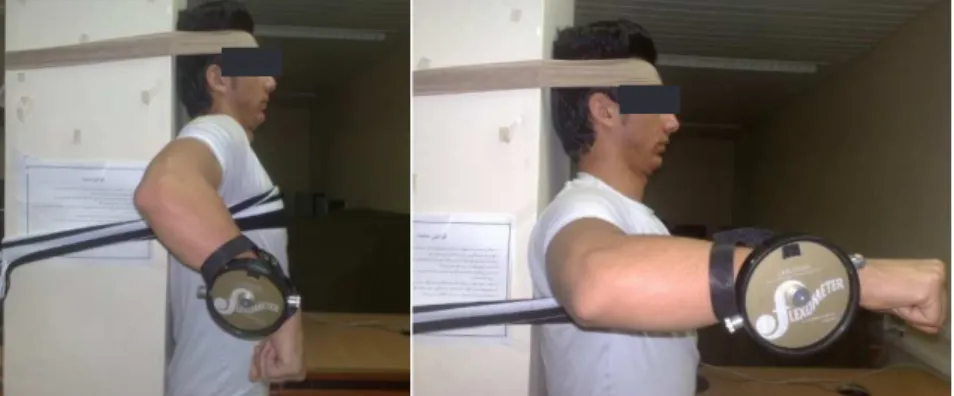
Each participant stood with their back against the pillar and cloth straps were tied across their chest, head, and hips to prevent movement. The studied arm was abducted to 90º and the elbow was flexed to 90º. The opposite arm was positioned along the body, and the Leighton flexometer (Jtech Medical, UK) was fixated on the middle of the outer forearm (Figure 1). To measure internal rotation range of motion, the participant was asked to move the forearm throughout the range of motion; the dial of the flexometer locked at full extent of down and backward motion. Then the subject was asked to take a resting position while the observed value was recorded. When commencing measurement, the distal end of the arm was retained to 90º abduction and 90º flexion (Figure 2).
To measure external rotation range of motion, the participant was asked to move the forearm throughout up and backward range of motion and then the dial locked at full extent. Then, the subject was asked to take a resting position and the observed value was recorded. When commencing measurement, the distal end of the arm was retained at 90º abduction and 90º flexion (Figure 3).
Measuring the internal rotation strength of the Figure 1 and 2. Measuring the internal rotation range of motion of the glenohumeral joint.
Figure 3. Measuring the external rotation range of motion of the glenohumeral joint.
Figure 4. Measuring the internal rotation strength of the glenohumeral joint.
glenohumeral joint
The subject lied prone on a table with a pillow placed under the examined arm. The arm was abducted to 90º and the elbow flexed to 90º. The subject’s head was turned towards the examined arm. To measure internal rotation strength, the examiner placed one hand directly above the subject’s shoulder, and with the other hand located the dynamometer behind the anteroinferior forearm. The participant was asked to apply maximal force for about 6-7 seconds. This test was conducted for a second time with a 30 sec interval (Figure 4). To measure external rotation strength the examiner located the dynamometer behind the posteroinferior forearm. The participant was asked to apply maximal force for about 6-7 seconds. This test was conducted for a second time with a 30 sec interval (Figure 5).
Results
Internal rotation range of motion values for the injured and uninjured glenohumeral joints were 69.00±6.62º and 81.53±7.03º, respectively. External rotation range of motion values for the injured and uninjured glenohumeral joints were 84.45±5.86º and 104.54±11.09º, respectively (Figure 6). Also, values for internal rotation strength of injured and uninjured glenohumeral joints were 8.88±1.53 and 11.42±2.58 Newton, respectively. Values for external rotation strength of injured and uninjured glenohumeral joints were 8.7±1.96 and 10.56±2.21 Newton, respectively (Figure 7).
As shown in Table 1, the results indicate that there
is a significant difference between the internal and external rotational range of motion of the injured and uninjured glenohumeral joint (P<0.001). Similarly, there is a significant difference between the internal and external rotation strength of the injured and uninjured glenohumeral joint (P<0.001).
Discussion
This study measured differences of internal and external rotation range of motion and strength between injured and non-injured shoulders in patients with recurrent shoulder instability. Results of this study revealed affected shoulders had decreased range of motion and strength, which are consistent with those reported by Gabriel., who proposed that internal rotation range of motion in handball players with shoulder pain in the dominant hand was significantly lower compared to those without shoulder pain (7). Our results also match the results of Ruotolo, indicating that the changes of internal rotation range of motion in the painful and painless groups were significant (8).
According to the results, internal rotation strength values of the injured and uninjured shoulder are significantly different, which is consistent with the findings reported by Jan et al., who studied subjects with shoulder impingement (9). They maintained that cuff strength was lower in the injured rather than the uninjured shoulder. Similarly, findings of the current study match those of Michelle et al., who reported internal and external rotation strength was lower in Table 1. Comparison of internal and external ROM and strength in healthy and injured shoulders.
Variable Injured Uninjured P value No. Mean No. Mean
Internal rotation range of motion 24 69.00 ± 6.62 24 81.53 ± 7.03 <0.001 External rotation range of motion 24 84.45 ± 5.86 24 104.54 ± 11.09 <0.001 Internal rotation strength 24 8.88 ± 1.53 24 11.42 ± 2.58 <0.001 External rotation strength 24 8.70 ± 1.96 24 10.56 ± 2.21 <0.001
Figure 6. Internal and external range of motion in injured and uninjured shoulder.
subjects with anterior dislocation (10).
In uninjured individuals, bilateral comparisons are mostly employed to identify muscle strength deficiencies. Every joint, in general, is required to maintain a desirable range of motion for efficient force transfer to accelerate, decelerate, and stabilize the interconnected joints of the body and produce the desired movements (11). A proper balance between agonist and antagonist muscle groups leads to dynamic stabilization of the inherently unstable shoulder joint (12). The imbalance of these muscles causes changes in arthrokinematics and movement impairments, which may eventually lead to structural changes (13). Muscular imbalance occurs when agonist/antagonist length or strength prevents normal functions. Muscular imbalance may occur as a response to adaptation for movement patterns, which includes strength or flexibility imbalance of antagonist muscle groups (7). Muscular imbalance may be indistinct because many people suffer from painless imbalance, which ultimately causes joint disability, changes in pattern of movement, and eventually grow painful. Some injuries lead to muscular imbalance, while some other injuries may result from it. Shoulder concussion
is associated with rotator cuff muscular imbalance and shoulder stabilizers. Unstable shoulder is also associated with muscular imbalance. As reported by prospective studies, muscular imbalance is associated with injury status, although, specific injuries may change either of or both length and strength of imbalanced muscles (14).
The results of the present study showed that the imbalance of strength and range of motion, introduced as a traumatic agent in many studies, can be also presented in individuals with anterior dislocation as a factor in increasing long term injury and dislocation recurrence.
Amirreza Sadeghifar MD Shahab Ilka MD
Kerman Medical University, Kerman, Iran
Hasan Dashtbani MSc Mansour Sahebozamani PhD
Shahid Bahonar University of Kerman,Kerman, Iran
References
7. Gabriel PL, Paula FS, Nathalia PL, Gisele B, Benno E, Moises C. Glenohumeral range of motion in handball players with and without throwing-related shoulder pain. J Shoulder Elbow Surg. 2012; 6:1-6.
8. Ruotolo C, Price E, Panchal A. Loss of total arc of motion in collegiate baseball players. J Shoulder Elbow Surg. 2006; 15: 67-71.
9. Jan J, Benkalfate T, Rochcongar P. The impact of recurrent dislocation on shoulder rotator muscle balance (a prospective study of 102 male patients). Annals of Physical and Rehabilitation Medicine. 2012; 55 (2): 404–14.
10. Saccol MF, Zanca GG, Ejnisman B, de Mello MT, Mattiello SM. Shoulder rotator strength and torque steadiness in athletes with anterior shoulder instability or SLAP lesion. J Sci Med Sport. 2014; 17(5): 463-8.
11. Borsa PA, Wilk KE, Jacobson JA, Scibek JS, Dover GC, Reinold MM, et al. Correlation of range of motion and glenohumeral translation in professional baseball pitchers. Am J Sports Med. 2005; 33(9): 1392-9. 12. Wendy J, Kevin M, Neal S, Frank W, Bernard F, Kenton
R. A Profile of Glenohumeral Internal and External Rotation Motion in the Uninjured High School Baseball Pitcher, Part II: Strength. J Athl Train. 2011; 1. Mehdi nasab A, Marashi A, Sarrafan N. Recurrent
Anterior Shoulder Dislocation (Results with “Bristow” Procedure). Iranian J Orthopedic Surgery. 2007; 5(1):11-6. [Persian]
2. Rouhani AR, Elmi A. Treatment of Anterior Shoulder Instability with Inside-to-Out Technique. Scientific Journal of Hamadan University of Medical Sciences and Health Services. 2010; 16(4):42-8. [Persian] 3. Charehsaze S, Shahla A. A Case Report Bilateral Post
Traumatic Anterior Shoulder Dislocation. Urmia Medical Journal. 2009; 19(4):346-8. [Persian]
4. Mohammadi R, Nodehi Moghaddam A, Arab AM, Kazemnezhad A. Shoulder key exercise effect of on isometric torque of glenohumeral joint movements in healthy young females. J of rehabilitation. 2009; 10(2): 38-44. [Persian]
5. Kibler WB, Sciascia A, Dome D. Evaluation of apparent and absolute supraspinatus strength in patients with shoulder injury using the scapular retraction test. Am J Sport Med. 2006; 34(10):1643-7.
46(3): 289–95.
13. Labriola JE, Lee TQ, Debski RE, McMahon PJ. Stability and instability of the glenohumeral joint: the role of shoulder muscles. J Shoulder Elbow Surg. 2005; 14: 32-8.