Original Article
4 0 Arq Bras Oftalmol. 2015;78(1):40-3 http://dx.doi.org/10.5935/0004-2749.20150011
INTRODUCTION
Major epidemiological studies on the causes of low visual acuity, with a focus on several types of ocular diseases considered in isola-tion or in combinaisola-tion, or the evaluaisola-tion of overall aspects of these diseases, are common in the literature. These studies serve as the foundation for various eye care policies(1-4).
However, few epidemiological studies have elucidated more specific aspects which assume greater importance when addressing more restricted population groups(5-7).
This is mainly the case in groups of individuals with ocular mor-bidities that live in geriatric day-care clinics. In addition to ocular morbidities, associated systemic diseases may limit or even prevent the access to outpatient care for evaluation or treatment of these morbidities. Even a simple refraction examination, with prescription of corrective lenses, becomes an almost inaccessible treatment option. ABSTRACT
Objective: To identify the causes of low visual acuity and systemic morbidities that limit ambulation and access to eye care in geriatric clinics in Rio de Janeiro. Methods: This cross-sectional study evaluated 187 patients from three geriatric clinics in Rio de Janeiro between January 2010 and January 2011. The inclusion criteria were individuals with a visual acuity of less than of equal to 20/200 in either eye (118 individuals), without optical correction. The exclusion criteria were individuals who refused to participate and those unable to undergo screening because of mental disabilities (6 individuals). Of the 187 individuals evaluated, 63 had visual acuity above 20/200.
Results: A total of 118 individuals with a visual acuity of ≤20/200 effectively par-ticipated in the study after meeting the inclusion and exclusion criteria. In addition, 57 participants (48.3%) presented systemic disabling morbidities. Of the 118 indivi-duals with low visual acuity, 27.96% had cataract and 26.27% had refractive errors. Conclusion: Most of the patients from geriatric clinics experienced ocular mor-bidities, but their proper treatment resulted in improved visual acuity. A more socially oriented problem associated with eye care involved the difficulty of access to ophthalmologic consultations.
Keywords: Ophthalmopathies; Visual acuity/epidemiology; Older people; Health services for older people; Health status of older people; Access to health care services; Health of individuals with disabilities; Morbidity
RESUMO
Objetivo: Identificar causas de baixa acuidade visual e morbidades sistêmicas que dificultem a deambulação e o acesso à tratamento oftalmológico em clínicas geriá-tricas do Rio de Janeiro.
Métodos: Estudo transversal com 187 indivíduos de 3 clínicas geriátricas do Rio de Janeiro, no período de janeiro de 2010 à janeiro de 2011. O critério de inclusão foi todos os indivíduos com acuidade visual menor ou igual a 20/200 em qualquer olho (118 indivíduos) e sem atualização da correção óptica. O critério de exclusão foi indivíduos que se recusaram à participar do estudo e indivíduos incapazes de realizarem os exames por déficit mental (6 indivíduos). Dos 187 indivíduos avaliados, 63 indivíduos tinham acuidade visual melhor que 20/200.
Resultados: Participaram do estudo efetivamente, após os critérios de inclusão e ex -clusão, 118 indivíduos com variadas causas de acuidade visual menor ou igual 20/200. Foram encontrados no estudo 57 (48,3%) indivíduos com a presença de morbidades sistêmicas incapacitantes. Dos 118 indivíduos com baixa acuidade visual, que parti-ciparam do estudo, 27,96% apresentaram catarata e 26,27% ametropias.
Conclusão: A maioria dos indivíduos destas clínicas geriátricas apresentou morbi-dades oculares que com tratamento adequado permitem a melhora da acuidade visual. Foi encontrado um problema mais de cunho social pela dificuldade de acesso à consulta oftalmológica.
Descritores: Oftalmopatias; Acuidade visual/epidemiologia; Idoso; Serviços de saúde para idosos; Saúde do idoso; Acesso aos serviços de saúde; Saúde da pessoa com de -fi ciência; Morbidade
These incapacitating conditions are limitations that outweigh the eye complications, particularly when social and family aspects are involved(1,8,9).
This study aimed to identify the main causes of low visual acuity and systemic morbidities that may limit or preclude the access to ophthalmologic examination in inpatients of geriatric clinics in Rio de Janeiro.
METHODS
This cross-sectional study evaluated patients from three private day-care geriatric clinics in Rio de Janeiro between January 2010 and January 2011. All participants (or their legal guardian, where appro-priate) signed an informed consent form. The refusal of individuals or family membersin participating in the study was respected. This
Ocular diseases at geriatric clinics in Rio de Janeiro: social and epidemiological
considerations among patients with motor locomotion deficit
Morbidades oculares em clínicas geriátricas do Rio de Janeiro: considerações sociais e epidemiológicas
associados a indivíduos com déicit de locomoção
Nadyr a. damasceNo1,2, marcelo Palis VeNtura3, eduardo F. damasceNo3
Submitted for publication: September 29, 2014 Accepted for publication: November 6, 2014 1 Hospital Naval Marcilio Dias, Rio de Janeiro, RJ, Brazil.
2 Programa do Curso de Pós-graduação em Ciências Médicas, Fluminense Federal University (UFF), Niterói, RJ, Brazil.
3 Department of Ophthalmology, Fluminense Federal University (UFF), Niterói, RJ, Brazil.
Funding: No specific financial support was available for this study.
Disclosure of potential conflicts of interest: None of the authors have any potential conflicts of interest to disclose.
Corresponding author: Eduardo F. Damasceno. Hospital Universitário Antônio Pedro. Av. Marques do Paraná 303 - Niterói, RJ - 24033-900 - Brazil - Email: [email protected]
Damasceno NA, et al.
41
Arq Bras Oftalmol. 2015;78(1):40-3 study was approved by the Research Ethics Committee of the
Univer-sidade Federal Fluminense.
All patients with a visual acuity of ≤20/200 and without optical correction in either eye were initially included in the study.
The study excluded individuals who refused to participate and those having mental disabilities that could limit the performance of ophthalmologic examinations.
Initially, 187 individuals enrolled in the study, and after the appli-cation of the inclusion and exclusion criteria, 118 individuals effecti-vely enrolled. Six individuals whose degree of mental retarda tion precluded the assessment of visual acuity, considering the impossibi-lity of social interaction, were excluded. Of the 187 individuals initially enrolled, 63 had a visual acuity of >20/200 and were not included in the study.
Systemic morbidities were also listed. Disabling morbidities were considered to be those that precluded the realization of evaluations during outpatient medical and ophthalmologic consultations; peo-ple with physical or mental disabilities were included in this group. All medical information related to morbidities was collected through interviews and assessment of patient documents as well as medical records maintained in the geriatric clinic.
Systemic morbidities were recorded and classified into the following subgroups:
a) Mental retardation or neuromotor deficits (Alzheimer’s disea-se, senile dementia, sequelae of demyelinating neuropathies, sequelae of stroke, and psychiatric depressive disorders). b) Orthopedic and/or rheumatic morbidities that limited
ambu-lation (arthritis of the lower limbs, rheumatoid arthritis, use of orthopedic prostheses, or lower limb amputations).
c) Cardiovascular morbidities (ischemic heart disease, post in-farction restrictive syndrome, cardiomyopathy with valvular heart disease, vascular disease of the lower limbs).
d) Neoplasms that progressed to syndromes that could restrict physical activity or cachexia (prostate carcinoma, lung carci-noma, lymphoma with metastatic dissemination).
e) Others (pulmonary emphysema and morbid obesity, among others).
Some common systemic morbidities were assigned to older peo-ple and the remaining morbidities were allocated in the subgroup designated “others.”
Ophthalmologic examination was performed in the hospitaliza-tion rooms of the geriatric clinic. Visual acuity was measured using Snellen’s chart (Optik Inc., São Paulo, Brazil), a test box of spherical and cylindrical lenses with universal test frames, retinoscope and in direct ophthalmoscope (Welch Allyn Inc., Skaneateles Falls, USA), illuminated magnifier (Estek Inc., São Paulo, Brazil), contact tonometry (Tonopen, Reichert Inc., Depew, USA), anesthetic eye drops (Anestal-con, Alcon Inc., São Paulo, Brazil), and pupil dilation using tropicamide eye drops 1% (Latinofarma, Inc. - São Paulo, Brazil). Some criteria were used (equipment portability, lack of slit-lamp for ocular microscopy, and failure of immediate referral to more sophisticated complemen-tary exams) for the definition of the etiological groups of specific ocular diseases to simplify the ophthalmologic examinations. The causes of low visual acuity reported herein are those that originated directly from visual impairment, and other concurrent eye diseases were not considered.
The more common causes of low visual acuity among older peo-ple were categorized and less common causes were allocated to the category designated as “others.”
Epidemiological data including gender, age, systemic morbidity, and the causes of low visual acuity were recorded and evaluated as a unilateral or bilateral characteristic.
With regard to the statistical tests involved, a nonparametric chi-square test and Fisher’s Exact test were used with a significance level of 5% (gender and causes of low visual acuity were analyzed using frequencies and percentages and displayed through
contin-gency tables). Epidemiological data regarding age were analyzed using unpaired Student’s t test and means and standard deviations.
A total of three tables covering all study groups evaluated (total population, individuals with low visual acuity, and individuals with low visual acuity combined with mobility disabilities) were analyzed with these statistical tests to correlate the data with each other.
The causes of low visual acuity and their characteristics are listed below:
• Refractive errors: refractive error as the sole cause of low visual acuity.
• Cataract: crystalline opacity as the sole cause of low visual acuity, defined after optical correction. According to their in-tensity and progression after examination under ectoscopy with magnifying glasses, this disease was characterized as the cause of low visual acuity after other concomitant injuries of the posterior segment were discarded.
• Age-related macular degeneration (AMD): The forms deined as AMD were evaluated on fundoscopy with mydriasis and grouped into a single category as dry (non-exudative) or wet (exudative). They were identified as responsible for the low vi-sual acuity after optical correction and after other concomitant injuries of the posterior segment were discarded.
• Diabetic retinopathy: these conditions were grouped regardless of their non-proliferative or proliferative forms, associated or not with diabetic macular edema, and were identified as the etiology when responsible for the low visual acuity even after optical correction.
• Glaucoma: although reported and observed as a common co-morbidity, it was considered responsible for the low visual acuity when associated with optical atrophies, regardless of its stages or forms as primary or secondary glaucoma.
• Retinal vascular occlusion (RVO): the causes of central or branch retinal vein and retinal artery occlusions were arranged and grouped in this subgroup.
• Sequelae of uveitis: post facectomy chronic inlammatory pro -cesses, scar processes of chorioretinitis, or non-infectious ocular inlammatory processes. These cases were described as seque -lae because no cases involving acute inlammatory processes were observed during the study period.
• Others: some eye diseases were allocated in this category be -cause, considering their ability to promote eye atrophy (Phitisis bulbi), it was not possible to specifically define the initial etio-logy that resulted in impaired vision.
RESULTS
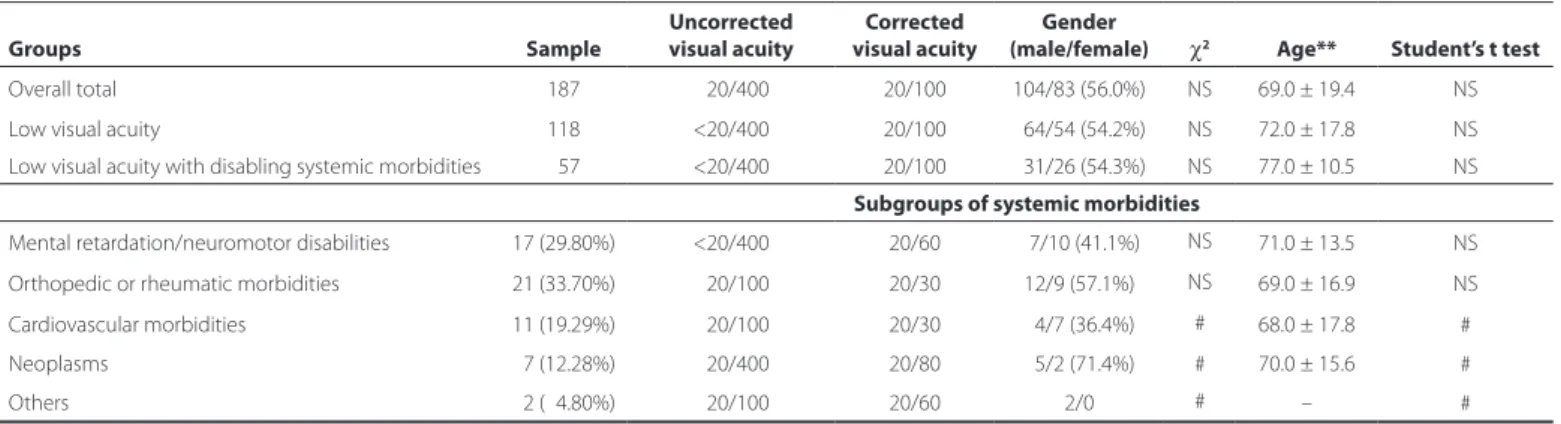
A total of 118 individuals presented a visual acuity of <20/200 due to various causes, and among them, a subgroup of 57 patients presen-ted systemic disabling morbidities (Table 1).
Table 1 shows that the epidemiological data were not significant after statistical analysis. Table 1 describes the three study groups according to gender and age. One group involved all the individuals evaluated, another group involved individuals with low visual acuity, and a third group involved those with low visual acuity and disabling systemic morbidities. The chi-square and Student’s t tests were used to compare gender and age between these three groups, respecti-vely. Although the frequencies, means, and standard deviations were different, statistical tests were not significant, indicating statistical similarity.
Table 2 shows the details of the group with low visual acuity. Of the 118 individuals with low visual acuity, 27.96% had cataract, and 26.27% had refractive errors. These data were significant in compari-son with the set of other comorbidities.
Ocular diseases at geriatric clinics in Rio de Janeiro: social and epidemiological considerations among patients with motor locomotion deficit
42 Arq Bras Oftalmol. 2015;78(1):40-3
All cases with refractive errors were corrected with significant improvement of visual acuity and evident satisfaction.
DISCUSSION
Vulnerable populations that have restricted mobility and limited access to specialized eye care need special attention with actions aimed at circumventing these difficulties. Epidemiological charac-teristics including age, gender, and ethnicity, were analyzed in this study. However, no significant differences in these characteristics were observed between the study groups. Moreover, no statistically significant difference in the epidemiological data was observed for individuals with disabling systemic morbidities(10-12).
Whitson et al. observed that individuals experiencing visual im-pairment along with cognitive disabilities are at high risk of disability, and each of these conditions contributes additively to the risk of disability among older people(8).
Araújo et al. evaluated older people in geriatric care facilities and observed that 60% were women and 40% were men. In this study, 56% of the study group were men and 44% were women. The mean age in the present study was 69 years, in contrast to the 82 years reported by Araújo et al. The present study was performed in private geriatric clinics, in contrast to the study by Araújo et al.(12).
In the present study, the etiologies of the subcategories of sys-temic morbidities relect a variety of causes, which often partially restrict the mobility capacity of individuals. In addition, 38 patients were bedridden and unable to remain upright (19.3% of the study group). In this subgroup, the individuals with refractive errors and who achieved optical correction had the highest satisfaction in terms of medical care.
Most of the reported etiologies involving visual acuity deficits among older people include refractive errors, cataracts, age-related macular degeneration, and glaucoma(3,4,13). Limburg et al. found that
43%-88% of the causes of blindness among individuals aged ≥50 years in Latin America were curable and were mainly caused by cataract and refractive errors(13).
In this study, low visual acuity was observed in 64 patients (54.2%). This would be a significant rate to justify the visual complaints. However, 14 of these patients (11.8%) were already using correction glasses previously prescribed. Two of these causes are easier to correct, one of a surgical nature (cataracts) and the other involving prescription glasses (refractive errors).
This study addressed a population with great difficulty in accessing ophthalmic outpatient services. This fact underscores the importan-ce of conducting this type of ophthalmologic examination in geria-tric institutions because, even in private clinics, the access to ophthal-mologic examination is limited for these individuals considering the complexity of the equipment necessary for home-based eye care(10).
Of note, even among the individuals with no disabling ambula-tion problems (63 individuals), some patients benefited from the eye consultation, by receiving a prescription of glasses and correction of refractive errors (13 subjects), because of a simple social problem: the family members could not provide follow-up support for home-ba-sed medical care(14,15).
The present study showed that many individuals presented with systemic diseases that could lead to low visual acuity, including dia-betes and systemic diseases, which interfere with ambulation and limitthe patient’s visit to an eye care service facility(11,16,17).
Therefore, periodic ophthalmologic assessments, particularly tho-se of chronic ocular ditho-seatho-ses, in geriatric clinics are estho-sential to impro-Table 1. Epidemiological data: comparison of groups and subgroups according to gender and age (mean and standard deviation)
Groups Sample
Uncorrected visual acuity
Corrected visual acuity
Gender
(male/female) χ2 Age** Student’s t test
Overall total 187 <20/400 20/100 104/83 (56.0%) NS 69.0 ± 19.4 NS
Low visual acuity 118 <20/400 20/100 064/54 (54.2%) NS 72.0 ± 17.8 NS
Low visual acuity with disabling systemic morbidities 057 <20/400 20/100 031/26 (54.3%) NS 77.0 ± 10.5 NS Subgroups of systemic morbidities
Mental retardation/neuromotor disabilities 17 (29.80%) <20/400 20/60 07/10 (41.1%) NS 71.0 ± 13.5 NS
Orthopedic or rheumatic morbidities 21 (33.70%) <20/100 20/30 12/9 (57.1%) NS 69.0 ± 16.9 NS
Cardiovascular morbidities 11 (19.29%) <20/100 20/30 04/7 (36.4%) # 68.0 ± 17.8 #
Neoplasms 07 (12.28%) <20/400 20/80 05/2 (71.4%) # 70.0 ± 15.6 #
Others 02 (04.80%) <20/100 20/60 2/0 # – #
*= mean ± standard deviation; χ2= chi square test; NS= not significant at P>0.05; #= statistical test was unfeasible considering the sample size.
Table 2. Causes of low visual acuity in the patients evaluated (N=118)
Causes Unilateral Bilateral Total % Chi square test
Cataract 21 11 33 27.96 P<0.05
Refractive errors 06 26 32 26.27 P<0.05
AMD 06 11 17 14.40 NS
Diabetic retinopathy - 10 10 08.47 NS
Glaucoma 05 04 09 07.62 #
RVO 07 01 08 06.77 #
Uveitis 04 01 05 04.23 #
Others 04 - 04 03.38 #
NS= not significant; #= statistical test was unfeasible considering the sample size.
Table 3. Causes of low visual acuity in patients with disabling systemic morbidities (N=57)
Causes Unilateral Bilateral Total % Chi square test
Cataract 5 7 12 2105 P<0.05
Refractive error 4 16 21 36.84 P<0.05
AMD 5 5 10 17.54 NS
Diabetic retinopathy - 5 5 8.77 #
Glaucoma - 4 4 7.01 #
RVO 1 1 2 3.55 #
Uveitis 1 1 2 3.55 #
Others 1 1 2 3.55 #
Damasceno NA, et al.
43
Arq Bras Oftalmol. 2015;78(1):40-3 ve the quality of life of individuals, even of those who are bedridden
and experience unfavorable cognitive conditions(13,18,19).
Despite the value of this epidemiological analysis, the present study has some limitations, including the small sample size evaluated and the evaluation of patients in a single municipality, despite having a large population(12,20). However, this limitation has also been
obser-ved in other studies that evaluated this social group. In this respect, Araújo et al. evaluated older people in two clinics, with a total of 25 individuals in each clinic(12).
REFERENCES
1. Pararajasegaram R. VISION 2020 - the right to sight: from strategies to action. Am J Ophthalmol. 1999; 128(3):359-60. Comment in: Am J Ophthalmol. 1999;128 (3):357-8. 2. West S, Sommer A. Prevention of blindness and priorities for the future. Bull World Health
Organ. 2001;79(3):244-8. Comment in: Bull World Health Organ. 2002;80(5):419. 3. Araújo FA, Salomão SR, BerezovskyA, Cinoto RW, Morales PH, Gonçalves Santos FR,
Belfort Jr R. Prevalence of visual impairment, blindness, ocular disorders, and cataract surgery outcomes in low-income elderly from a metropolitan region of São Paulo - Brazil. Arq Bras Oftalmol. 2008;71(2):246-53.
4. Arieta EL, Delgado AM, Jose NK, Temporini ER, Alves MR, Moreira Filho DC. Refractive errors and cataract as causes of visual impairment in Brazil. Ophthalmic Epidemiol. 2003;10(1):15-22.
5. Verçosa IC, Maia EF. Peril oftalmológico dos alunos do programa alfabetização so-lidária em quatro municípios do Ceará. [Ophthalmological profile of students of an inclusive literacy program in four municipalities in the state of Ceará, Brazil.]Arq Bras Oftalmol. 2003;66(2):193-7.
6. Silva JC, Bateman JB, Contreras F. Eye disease and care in Latin America and the Ca-ribbean. Surv Ophthalmol. 2002;47(3):267-74.
7. Nizetic B. Perspectives in ophthalmology A Public health point of view.Can J Oph -thamol. 1973;8(3):311-6.
8. Whitson HE, Cousins SW, Burchett BM, et al. The combined effect of visual impairment and cognitive impairment on disability in older people. J Am Geriatr Soc.2007;55(6): 885-91.
9. Macedo BG, Pereira LS, Gomes PF, Silva JP, Castro AN. Impacto das alterações visuais nas quedas, desempenho funcional, controle postural e no equilíbrio dos idosos: uma
revi-são de literatura. [Impact of visual changes in falls, functional performance, postural control, and balance among the elderly: a literature review.]Rev Bras Geriatr Gerontol. 2008;11(3):419-32.
10. Converso ME, Iartelli I. Caracterização e analise do estado mental e funcional dos idosos institucionalizados em instituições públicas de longa permanência. [Characterization and analysis of the mental and functional status of older people institutionalized in public long-term care facilities.] J Bras Psiquiatr. 2007;56(4):267-72.
11. Pereira FM, Besse M. Fatores associados a independência funcional de idosos resi-dentes em instituição de longa permanência. [Factors associated with functional independence of older people living in long-term care facilities.] Acta Fisiatr. 2011; 18(2):66-70.
12. Araujo LF, Lima Coutinho MP, Santos MF. O idoso nas instituições gerontológicas: um estudo na perspectiva das representações sociais. [Older people living in geriatric ins-titutions: a study in the perspective of social representations.] Psicologia e Sociedade. 2006;18(2);89-98.
13. Limburg H, Barria Von-Bischhofshausen F, Gomez P, Silva JC, Foster A. Review of recent surveys on blindness and visual impairment in Latin America. Br J Ophthalmol. 2006;92(3):315-9.
14. Manino JH. Visual deicits and mobility. Evaluation and management. Clin Geriatr Med. 1996;12(4):803-23.
15. Temporini ER, Kara-José N. A perda da visão: estratégias de prevenção. [Vision loss: prevention strategies.] Arq Bras Oftalmol. 2004;67(4):597-601.
16. Rosa TE, Benício MH, Latorre MR, Ramos LR. Fatores determinantes da capacidade funcional entre idosos. [Determinants of functional capacity among older people.] Rev Saúde Pública. 2003;37(1):40-8.
17. Marchon RM, Cordeiro RC, Nakano MM. Capacidade funcional: estudo prospectivo em idosos residentes em uma instituição de longa permanência. [Functional capa-city: a prospective study among older people living in long-term care facilities. Rev Bras Geriatr Gerontol. 2010;13(2):203-14.
18. Luiz LC, Rebelatto JR, Coimbra AM, Ricci NA. Associação entre déicit visual e aspectos clínico-funcionais em idosos da comunidade. [Association between visual deficit and clinical-functional aspects in community-dwelling older people.] Rev Bras Fisioter. 2009;13(5):444-50.
19. Owen CG, Rudnicka AR, Smeeth L, Evans JR, Wormald RP, Fletcher AE. Is the NEI-VFQ-25 a useful tool in identifying visual impairment in an elderly population? BMC Ophthal-mol. 2006;6:24.