Instituto do Coração do Hospital das Clínicas-FMUSP and Hospital Sírio Libanês – São Paulo
Mailing address: Miguel BarberoMarcial – Incor Divisão de Cirurgia – 2º -S/10 - Av. Dr. Enéas C. Aguiar, 44 - 05403-000 - São Paulo, SP, Brazil
Objective – To assess intermediate-term outcome in
chil-dren who have undergone orthotopic heart transplantation.
Methods – We carried out a longitudinal and
pros-pective study between October ’92 and June ’99 compri-sing 20 patients with ages ranging from 12 days to 7 years (mean of 2.8 years). We employed a double immunosup-pression protocol with cyclosporine and azathioprine and induction therapy with polyclonal antithymocyte serum. Survival and complications resulting from the immuno-suppression protocol were analyzed.
Results – The double immunosuppression protocol
and the induction therapy with polyclonal antithymocyte serum resulted in an actuarial survival curve of 90% and 78.2% at 1 and 6 years, respectively, with a mean follow-up period of 3.6 years. One patient died due to acute rejection 40 days after transplantation; another patient died 2 years after transplantation due to lymphoproliferative disorder; a third patient died because of primary failure of the graft; and a fourth patient died due to bronchopneumonia. The major complications were as follows: acute rejection, infection, nephrotoxicity, and systemic hypertension. The means of rejection and infection episodes per patient were 2.9 and 3.4, respectively. After one year of transplantation, a slight reduction in the creatinine clearance and systemic hypertension were observed in 7 (38.9%) patients.
Conclusion – Heart transplantation made life
possi-ble for those patients with complex congenital heart di-seases and cardiomyopathies in refractory congestive heart failure constituting a therapeutical option for this group of patients in the terminal phase.
Key words: heart transplantation, neonates, children
Arq Bras Cardiol, volume 74 (nº 3), 203-208, 2000
Estela Azeka, Miguel Barbero-Marcial, Marcelo Jatene, Paulo Roberto Camargo, José O távio C. Auler, Edmar Atik, José Antonio F. Ramires, Munir Ebaid
São Paulo, SP - Brazil
Heart Transplantation in Neonates and Children.
Intermediate-Term Results
Heart transplantation has made life possible and im– proved its quality for children with complex congenital heart diseases and cardiomyopathies refractory to the conven-tional treatment 1-3.
The first successful orthotopic heart transplantation in a neonate was reported by Bailey et al4. The patient was a
newborn with left heart hypoplasia and a good outcome 11 years after the event 5. Our first transplantation in a patient
with left heart hypoplasia was performed in 1992 by Barbe-ro-Marcial et al 6.
According to the first official report on pediatric heart transplantation by the International Society of Heart and Lung Transplantation 7, 3,446 heart transplantations were
performed in 201 medical centers from 1982 to 1996. A higher mortality during the first year, especially in the first 3 months, was observed. The survival curve after the first year showed an annual mortality of 2.5%.
This study aimed to report the intermediate-term resul-ts of orthotopic heart transplantation in neonates and chil-dren and complications that occurred due to the immuno-suppression protocol used.
Methods
We carried out a prospective and longitudinal study on 20 patients who had undergone orthotopic heart trans-plantation at INCOR and Hospital Sírio Libanês during the period from October ’92 to June ’99.
The ages of the patients ranged from 12 days to 7 years (mean of 2.8 years). Distribution according to age (<1 year of age and >1 year of age) is shown in figure 1. Out of the 20 trans-planted patients, 11 (55.0%) were males and 9 (45.0%) were females (Table I). Their weights varied from 3.3kg to 20.0kg, with a mean of 10.41kg and a standard deviation of 4.8kg.
congenital heart diseases were the most common and the cardiomyopathies occurred in 25.0%. Among those patients older than 1 year, the cardiomyopathies were the most common (93.7%), and the congenital heart diseases occurred in 6.3%.
In regard to the donors, their ages ranged from 10 days to 10 years, with a mean of 4.9 years and standard deviation of 3.7 years (table I), and their weights ranged from 3.8kg to 30.0kg, with a mean of 16.9kg and standard deviation of 8.2kg. Fourteen (70.0%) were males. The diagnosis of
cere-bral death resulted more frequently from craniocerecere-bral trau-ma (12 cases - 60.0%).
Duration of ischemia varied from 38min to 145min, with a mean of 74.8min and standard deviation of 28.4min.
The criteria of inclusion used for transplantation were the following: patients with complex congenital heart disea-se or cardiomyopathy in refractory congestive heart failure, or both 8.
The criteria of exclusion were the following: patients with infection at the time of transplantation; patients with neurological malformations or severe neurological seque-lae; patients with alterations in renal function; patients with malformation of the urinary tract and chronic renal failure; patients with severe metabolic disorders; patients with ge-netic syndromes; premature infants; small-for-gestational-age infants; and patients with pulmonary vascular resis-tance index higher than 6 units Wood/m28,9.
Assessment of the potential donors included the follo-wing: determination of the blood group to assess compatibi-lity, the donor’s weight should be as much as 3 times that of the recipient, cardiovascular and infectious assessment. The cardiovascular criteria for inclusion were the following: the cardiovascular physical examination of the donors, as well as their chest X-rays should be normal; their echocardiogram should have a shortening fraction higher than 25% and show no heart defects. In regard to infection, the donors should have no infectious process and negative serologies for HIV, hepatitis B and C, and Chagas’ heart disease 10,11.
The cross-match (a test with cells of the donor and plasma of the recipient) was performed in all cases, and a positive result excluded the possibility of using the organ. Prophylaxis of rejection consisted of immediate use of cyclosporine in the postoperative period. The drug was ad-ministered intravenously in a continuous infusion, at the dose of 0.1 to 0.2mg/kg/hour; after withdrawal of the endo-tracheal tube, cyclosporine was administered orally at the initial dose of 20mg/kg/day. The drug’s dose was controlled according to its serum level through the radioimmunoassay method; cyclosporine level was maintained between 300 and 400ng/ml in the first year, and after that, between 150 and 200ng/ml, according to rejection episodes and assess-ment of the side effects of the drug.
Azathioprine was administered at the dose of 3mg/kg/ day, immediately after transplantation. The drug was admi-nistered at a dose up to 3mg/kg/day in the first year after transplantation; later, it was reduced to 1mg/kg/day. Control of the dose was performed according to the number of leu-kocytes in the peripheral blood and azathioprine was sus-pended when the count was lower than 3500 cells per mm3.
Methylprednisolone was administered immediately after transplantation at the dose of 125 to 500 mg every 12 hours, according to the child’s weight for a period of only 48 hours.
Antithymocyte rabbit or horse serum 12 was used
im-mediately after transplantation or at the first episode of acu-te rejection.
After hospital discharge, children with inadequate so-cioeconomic conditions who had come from other cities and
Table I - Characteristics of the recipients and donors
Recipients Donors N Age Sex LVEF FC “Status”/ Age Sex
(days) (%) priority (days)
1 12 M IV Yes 21 M
2 916 M 19 III 1095 M
3 135 F III 365 M
4 1946 M 13 IV 3650 M
5 477 M 19 IV 2190 F
6 2167 F 10 III 3650 M
7 754 F 12 III 365 M
8 716 F 16 IV 300 F
9 590 M IV 365 M
10 1908 M 18 IV 2920 M
11 186 M 12 IV 300 M
12 907 M 8 IV Yes 2555 M
13 1495 F 16 IV 3285 F
14 29 F IV Yes 10 F
15 1066 F 25 IV 3650 M
16 416 M 19 IV 2555 F
17 1361 F 15 IV 2920 M
18 794 F 20 IV 300 M
19 1388 M IV 2555 F
20 2792 M IV Yes 2555 F
LVEF (%)- left ventricle ejection fraction by the gated blood pool; F-female; M- male; FC – functional class.
Table II – Indications for heart transplantation in the 20 patients
Indications N %
Left heart hypoplasia 2 10.0
Pulmonary atresia with coronary artery-cavitary fistulas 1 5.0 Interventricular septal defect surgically corrected 1 5.0
Dilated cardiomyopathy 15 75.0
Restrictive cardiomyopathy 1 5.0
N- n° of patients with indication for heart transplantation; %- percentage of patients.
Fig. 1 - Distribution of the 20 patients according to age group. patients
states remained for a minimum period of 4 months in the As-sociação de Assistência à Criança Transplantada do Cora-ção, a philanthropic entity especially created to make trans-plantation in these patients possible.
Ambulatory follow-up after hospital discharge was performed through sequential assessments twice a week in the first 3 months and, after that, once a month.
The major complications directly related to the trans-plantation and the immunosuppression protocol were as follows: primary failure of the transplanted heart; right ven-tricular dysfunction immediately after transplantation; acute rejection; infection; coronary heart disease; tumor; nephrotoxicity; systemic hypertension; hyperlipidemias; and biliary lithiasis 13.
Primary failure of the transplanted heart was characte-rized by clinical findings of systemic low output and severe ventricular dysfunction shown on the echocardiogram and whose evolution resulted in death of the patient.
Right ventricular dysfunction was assessed by signs of heart failure and qualitative increase in the right ventricu-lar chambers on the echocardiogram.
The diagnosis of acute rejection was made through clinical, electrocardiographic, and Doppler echocardiogra-phic findings 14,15.
Endomyocardial biopsy was performed when the sig-nals of acute rejection persisted after the initial treatment with corticosteroids 16.
Prophylaxis of the infectious processes consisted of respiratory and contact isolation of the patients in the first 3 months after transplantation. Right after transplantation, antibiotics were employed until withdrawal of the drains as was hyperimmune gamma globulin at the dose of 400mg/kg/ day every other day for a total of 5 doses.
In our study, those infectious episodes considered risky for the life of the child and requiring antimicrobial therapy through oral or intravenous or both viae were analyzed 17.
Coronary heart disease of the graft was assessed throu-gh angiography of the coronary arteries or throuthrou-gh the anatomicopathological examination. Coronary angiography was indicated in patients with more than 3 years of evolution. Lymphoproliferative disorder was defined by the ana-tomicopathological study of the patients 13.
Nephrotoxicity of the immunosuppressive drugs was evaluated through measurement of the creatinine clearance in patients more than one year after transplantation 13,18.
The frequency of systemic hypertension in patients more than one year after transplantation was analyzed 19.
Hyperlipidemia was regarded as hypercholesterolemia in patients more than one year after transplantation 13.
The presence of biliary lithiasis was assessed through clinical signs and symptoms of gallstones and through the abdominal ultrasound in patients more than one year after transplantation.
A descriptive analysis of data of the 20 patients was performed comprising demographic data, clinical outcome, and complications. The actuarial survival curve was perfor-med by the Kaplan-Meyer method.
Results
Out of the 20 patients undergoing heart transplanta-tion, 16 (80.0%) survived. One patient died due to primary failure of the graft 2 days after transplantation. Three pati-ents died after hospital discharge as follows: one due to acu-te rejection 40 days afacu-ter transplantation; one due to lym-phoproliferative disorder 2 years after transplantation; and another patient due to infection by Pneumocistis carinii, one year after transplantation.
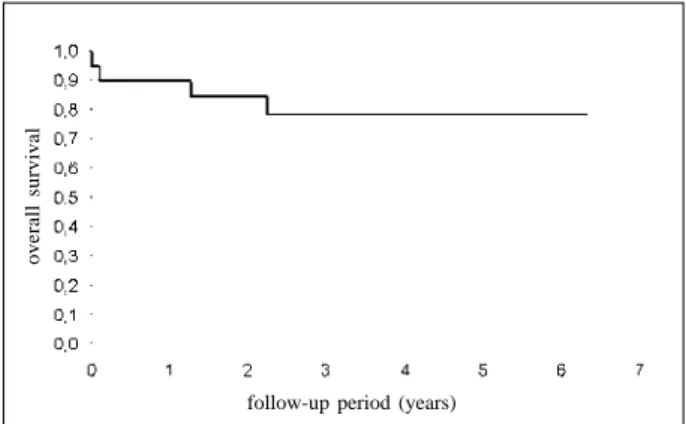
The actuarial survival curve was 90% and 78.2% after 1 year and 6 years of transplantation, respectively (fig. 2) wi-th a mean follow-up period of 3.6 years.
Among the 20 patients, the complications directly rela-ted to transplantation and immunosuppression were as fol-lows: one patient had primary failure of the graft, dying 48 hours after transplantation, despite the use of assisted circulation; 4 (20.0%) patients had mild ventricular dysfunc-tion; and 2 (10.0%) had moderate to severe ventricular dys-function secondary to pulmonary hypertension. All pati-ents had a good evolution with administration of vasodila-ting drugs. Fifty-seven episodes of acute rejection occur-red. The number of rejection episodes per patient varied up to 8 with a mean of 2.9.
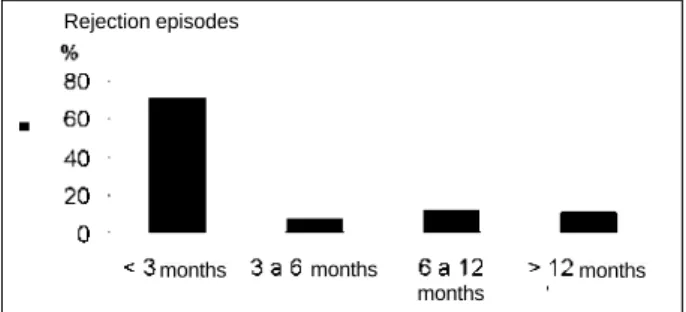
Noninvasive diagnostic methods made the diagnosis of acute rejection possible in 91.2% of the cases. The endo-myocardial biopsy was performed only in 5 (8.8%) episodes. Distribution of the episodes of rejection in regard to time is shown in figure 3.
Sixty-nine infectious events occurred in the 20 pati-ents. Patients had a mean of 3.4 episodes of infection. Distri-bution of the infectious episodes in regard to the causative agents is shown in figure 4.
follow-up period (years)
overall survival
Fig. 2 – Survival curve – Kaplan-Meier method – of the 20 patients.
No of No of Time P Standard No of patients
patients deaths (years) (Survival) error at risk
1 0.900 0.067 18
2 0.847 0.081 14
20 4 3 0.782 0.098 12
4 0.782 0.098 7
5 0.782 0.098 5
Angiographic studies performed in 3 patients more than 3 years after transplantation did not show any lesions in the coronary arteries.
Only one (5.0%) patient had a tumor 2 years after transplantation with pulmonary nodules revealed on chest tomography. Even though 3 pulmonary biopsies were per-formed, the definitive diagnosis could only be established after death.
From the 18 patients with more than 1 year of evolution, 7 (38.9%) had a mild decrease in renal function and 7 (38.9%) had systemic hypertension.
Out of these 18 patients, 1 (5.6%) had hypercholeste-rolemia 1 year after transplantation; the angiography, howe-ver, was normal.
In regard to gallstones, 2 (11.1%) patients had this complication, and only 1 required surgery, undergoing en-doscopic papillotomy and laparoscopic cholecystectomy.
Discussion
Heart transplantation is the therapy of choice for pati-ents with complex congenital heart diseases and cardio-myopathies with refractory heart failure.
In our study, the types of heart disease with indication for transplantation in children under 1 year of age were simi-lar to those described by Boucek et al 7. We observed that
75% of our patients had congenital heart diseases, of which the most common was left heart hypoplasia, and 25% had cardiomyopathies.
In regard to children older than 1 year of age, 93.7% had cardiomyopathies and 6.3% had congenital heart disea-ses, in accordance with predominance of cardiomyopathies (51%) in the first official pediatric report of the International Society of Heart and Lung Transplantation 7, even though
our percentage was higher.
Cardiomyopathy is considered a factor of favorable prognosis 7. Predominance of this heart disease in children
older than 1 year of age in our study may explain the favora-ble outcome of these children despite their mean age of 2.8 years, considered within the risky age group 7.
In the clinical trials with double protocols using cyclos-porine, azathioprine and induction with antithymocyte rabbit serum, Au et al 20 and Fullerton et al 21 have reported no death
due to rejection. The cause of death was primary dysfunction of the transplanted organ 20 or right ventricular failure
secondary to pulmonary hypertension 21. However, both
studies were conducted in patients older than 5 weeks. Chi-nnock 5 carried out the major evolutional study in 299 patients,
92 of whom were under 30 days of age, with actuarial survival curves of 83%, 72%, and 66% at 1, 5, and 10 years, respectively. In his study, rejection was the major cause of death, occurring in 8% of the patients. In our study, 16 (80.0%) out of the 20 patients survived. Four patients died; the first, a newborn with left heart hypoplasia died 40 days after transplantation due to acute rejection; the second patient died 2 years after transplan-tation due to a tumor; the third patient died due to primary failure of the graft; and the fourth patient died because of pneu-monia due to Pneumocistis carinii.
The actuarial survival curve of 90% and 78.2% at 1 and 6 years, respectively, was probably the major indicator of fa-vorable clinical outcome in the period of time observed.
In regard to complications, we observed that lower do-ses and lower levels of the drugs of the immunosuppressi-on protocol immunosuppressi-one year after transplantatiimmunosuppressi-on may have cimmunosuppressi-ontri- contri-buted to the lower percentage of severe complications ob-served in this study.
The number of rejection episodes per patient in the studies with double protocols and induction with antithymo-cyte rabbit serum varied from 0.8 to 2.0 5,20,21. In our study, we
observed that the patients had a mean of 2.9 rejection episodes. Chinnock et al 14 reported that the diagnosis of acute
rejection through endomyocardial biopsy in patients less than 1 year after transplantation was 0.26. Fullerton et al 21
performed endomyocardial biopsy only in the cases where the diagnosis of acute rejection was not certain. In that study, because of the risks of the endomyocardial biopsy, it was performed only in 5 (8.8%) out of the 57 episodes of rejec-tion; diagnosis through noninvasive methods was preferred. Infection is a cause of death according to the official pediatric report of the International Society of Heart and Lung Transplantation 7. Studies with double protocols show
that as many as 4.4% of patients die due to infection 5,20,21.
We had results similar to those of the study group of the In-ternational Society of Heart and Lung Transplantation 17 in
regard to infectious episodes. In our study, infection occur-red only in one patient, probably because of the prophylac-Rejection episodes
Fig. 3 - Distribution of the frequency of rejection episodes in the 20 patients undergoing heart transplantation in the period of the study.
months months
months
months
bacterium virus protozoan fungus
%
Fig. 4 - Distribution of the frequency of the infectious processes in the 20 patients undergoing heart transplantation according to causative agents.
tic measures adopted right after transplantation and becau-se of early diagnosis and adequate therapy established as soon as the patients had the first signs of fever in an attempt to avoid progression of the infection.
Coronary heart disease is one of the major factors limi-ting long-term survival in children undergoing heart trans-plantation. It may occur in all age groups 7,22. Chinnock 5
observed that the only risk factor in patients with this disea-se is the highest number of rejections. In our study, the only patient with this disease evolved with the highest number of rejection episodes of hard therapeutical control.
Tumors represent a severe complication of heart trans-plantation 13. Studies of patients receiving the double protocol
and therapeutical induction have shown a low incidence of tumors 5,20,21. In our study, only 1 patient had this complication
that evolved with pulmonary nodules, which are a common form of the disease 23. Nevertheless, despite pulmonary
biopsies, the diagnosis was only established after death. Chronic use of cyclosporine may lead to renal failure because of its nephrotoxicity 24. The major study on double
protocol in children undergoing transplantation with a fol-low-up period longer than 5 years was carried out by Chinno-ck 5. This study has shown that most of the patients had a
mild reduction in the glomerular filtration rate. In our study, assessment of children with a follow-up period longer than 1 year has shown that 7 (38.9%) patients evolved with a mild reduction in the creatinine clearance while the others had a normal creatinine clearance. This result may have been more favorable because of the shorter follow-up analyzed.
Hypertension is the major cause of death described in the official pediatric report of the International Society of Heart and Lung Transplantation 7, and it occurs in
approxi-mately 40% of the patients after a 1-year or 2-year follow-up. In our study on children with a follow-up longer than 1 year, we observed that 7 (38.9%) children evolved with hyper-tension, which is a percentage similar to that found by Bou-cek et al 7.
Hyperlipidemia, which is another complication associa-ted with immunosuppression described by a number of au-thors 7,26, was found in this study only in 1 patient more than 1
year after transplantation. In this case, the coronary an-giography was normal; therefore, hypertension was not a po-tential factor in the development of coronary heart disease.
Gallstones, which is a complication associated with the immunosuppression protocol, has a low incidence of surgery 27,28. In our study, its frequency was also low. Only 1
patient underwent laparoscopic cholecystectomy. In conclusion, orthotopic heart transplantation in our service has made intermediate-term survival of children with complex congenital heart disease and cardiomyopa-thies with refractory functional class III-IV heart failure pos-sible. Therefore, orthotopic heart transplantation is a promi-sing therapeutical option for this group of patients.
Aknowledgments
We thank Prof. Dr. Geraldo Verginelli for his langua-ge assistance.
1. Bailey LL, Wood M, Razzouk A, Arsdell GV, Gundry S. Heart transplantation during the first 12 years of life. Arch Surg 1989; 124: 1221-6.
2. Addonizio LJ. Cardiac transplantation in the pediatric patient. Prog Cardiovasc Dis 1990; 33: 19-34.
3. Starnes VA, Oyer PE, Bernstein D, et al. Heart, heart-lung, and lung transplanta-tion in the first year of life. Ann Thorac Surg 1992; 53: 306-10.
4. Bailey LL, Nehlsen-Cannarella SL, Doroshow RW, et al. Cardiac allotransplan-tation in newborns as therapy for hypoplastic left heart syndrome. N Engl J Med 1986; 315: 949-51.
5. Chinnock RE. Pediatric heart transplantation at Loma Linda: 1985 to 1996. In: Cecka Terasaki, eds. Clin. Transpl.: Los Angeles, California. UCLA Tissue Ty-ping Laboratory 1996; 1: 145- 51.
6. Barbero-Marcial M, Azeka E, Camargo PR, et al. Transplante cardíaco neonatal e infantil. Arq Bras Cardiol 1996; 67: 165-70.
7. Boucek MM, Novick RJ, Bennett LE, Fiol B, Keck BM, Hosenpud JD. The Regis-try of the International Society of Heart and Lung Transplantation: First official pediatric report - 1997. J Heart Lung Transplant 1997; 16: 1189-206. 8. Gundry SR, Freedom RM. Cardiac replacement in infants and children:
indica-tions and limitaindica-tions. J Heart Transplant 1991; 10(suppl. 2): 791-801. 9. Azeka E, Auler JOC, Camargo PR, et al. The hemodynamic effects of inhalation of
nitric oxide on pulmonary hypertension and its complications in children candi-dates for heart and heart-lung transplantation. Intensive Care Med 1997; 23(suppl. I): S19.
10. Boucek MM, Kanakriyeh MS, Mathis CM, Trimm III RF, Bailey LL. Cardiac trans-plantation in infancy: Donors and recipients. J Pediatr 1990; 116: 171-6. 11. Pediatric Heart Transplantation Protocol - Loma Linda International Heart
Ins-titute . Loma Linda, 1993.
12. Halloran PF, Miller LW. In vivo immunosuppressive mechanisms. J Heart Trans-plant 1996; 15: 959-71.
References
13. Miller LW, Schlant RC, Kobashigawa J, Kubo S, Renlund DG. Task Force 5: Complications. J Am Coll Cardiol 1993; 22: 41-54.
14. Chinnock RE, Baum MF, Larsen RL, Bailey LL. Rejection management and long-term surveillance of the pediatric heart transplant recipient: the Loma Linda Experience. J Heart Lung Transplant 1993; 12(Part 2): S255-S264. 15. Azeka E, Barbero-Marcial M, Soares J, et al. The importance of noninvasive
me-thods on the evaluation of acute rejection in pediatric heart transplantation: Gal-lium-67 scintigraphy as an option. In: Imai Y, Moma K, eds. Proceedings of the Second World Congress of Pediatric Cardiology and Cardiac Surgery. Nova York: Futura, 1997: 133-6.
16. Billingham ME, Cary NRB, Hammond ME, et al. A working formulation for the standardization of nomenclature in the diagnosis of heart and lung rejection: Heart rejection study group. J Heart Transplant 1990; 9: 587-93.
17. Schowengerdt KO, Naftel DC, Seib PM, et al. Infection after pediatric heart trans-plantation: Results of a multiinstitutional study. J Heart Lung Transplant 1997; 16: 1207-16.
18. Bennett WM, DeMattos A, Meyer MM, Andoh T, Barry JM. Chronic cyclospori-ne cyclospori-nephropathy: The Achilles’ heel of immunosuppressive therapy. Kidn Int 1996; 50: 1089-1100.
19. National Heart, Lung, and Blood Institute. Report of the second Task Force on blood pressure control in children. Pediatrics 1987;.79: 1-25.
20. Au J, Gregory JW, Colquhoun IW, et al. Paediatric cardiac transplantation with steroid-sparing maintenance immunosuppression. Arch Dis Child 1992; 67: 1262-6. 21. Fullerton DA, Campbell DN, Jones SD, et al. Heart transplantation in children
and young adults: early and intermediate-term results. Ann Thorac Surg 1995; 59: 804–12.
22. Pahl E, Fricker FJ, Armitage J, et al. Coronary arteriosclerosis in pediatric heart trans-plant survivors: Limitation of long-term survival. J Pediatr 1990; 116: 177-83. 23. Boyle G; Michaels MG, Webber AS, et al. Posttransplantation lymphoproliferative
24. Borel JF, Baumann G, Chapman I, et al. In vivo pharmacological effects of ciclos-porin and some analogues. Adv Pharmacol 1996; 35: 115-246.
25. Fricker FJ, Armitage JM. Heart and heart-lung transplantation in children and ado-lescents. In: Adams FH, Emmanouilides GC, Riemenschneider TA, Gutgesell HP, eds. Moss’Heart Disease in Infants, Children, and Adolescents Including the Fetus and Young adult. Baltimore: Williams & Wilkins, 1995: 495-510.
26. Uzark K, Crowley D, Callow L, Bove E. Hypercholesterolemia after cardiac transplantation in children. Am J Cardiol 1990; 66: 1385-7.
27. Razzouk AJ. Surgical intervention in children after heart transplantation. J Heart Lung Transplant 1993; 12(Part 2): S195-S8.