Late-term Effects of Surgery on Nasal Functions
in Patients who Underwent Total Laryngectomy
Surgery
Deniz Karaoglu
1Murat Kocyigit
2Sa
fi
ye Giran Ortekin
2Mustafa Kemal Adali
31Department of Otolaryngology, Inegol State Hospital, Bursa, Turkey 2Department of Otolaryngolgy, Istanbul Kanuni Sultan Suleyman
Egitim ve Arastirma Hastanesi Ringgold Standard Institution, Istanbul, Turkey
3Department of Otolaryngology, Bir Nefes Private Hospital, Edirne, Luleburgaz, Turkey
Int Arch Otorhinolaryngol 2017;21:270–275.
Address for correspondence Murat Kocyigit, MD, Department of Otolaryngolgy, Istanbul Kanuni Sultan Suleyman Egitim ve Arastirma Hastanesi, Istanbul Kanuni Sultan Suleyman Egitim ve Arastirma Hastanesi, Istanbul 34303, Turkey (e-mail: [email protected]).
Introduction
Total laryngectomy is a common treatment in advanced larynx cancers. Nowadays, total laryngectomy inductions are restricted and are applied less frequently. This is largely a result of the development of partial laryngectomy and radiotherapy. In a total laryngectomy, removing the larynx
causes dissociation of the digestive tract from the respiration tract and breaks down the vocal system. The patient cannot emit sound and the upper respiratory tract is inactive. After a laryngectomy, some defects appear in some functions such as swallowing, taste, and smell. Because of tracheostomy, breathed air ceases to connect with nasal mucous membrane and constitutional, short and long-term changes occur in the
Keywords
►
laryngectomy
►
rhinometry
►
mucociliary clearance
►
olfactory
Abstract
Introduction
There is a common opinion that losing airway functions in total
laryngectomy patients cause changes in nasal physiological rates. Studies conducted
to review the subject present gaps, especially in terms of objective measurements.
Objective
We evaluated late-term effects of surgery on nasal functions in patients
who underwent total laryngectomy surgery more than two years ago.
Methods
We included in the study 22 patients who had undergone total
laryngecto-my, as well as 24 healthy subjects with similar demographic characteristics as the control
group. We performed acoustic rhinometry for intranasal volume and cross-sectional
area measurements, saccharin test for measurement of nasal mucociliary clearance, and
smell identi
fi
cation test for evaluation of olfactory function in the patient and control
groups. We compared and statistically analyzed the data obtained from the groups.
Results
In our study, although late-term (
>
2 years) measurements were not
statisti-cally signi
fi
cant, we detected more nasal passage patency in the patient group than in
the control group. In smell identi
fi
cation test, lower scores were obtained in the patient
group. The difference between measurements in both groups was statistically
signi
fi
cant.
Conclusion
We believe that since the upper respiratory tract is disabled due to
tracheostomy in patients with total laryngectomy, atrophy occurs in the late term
and, consequently, nasal mucociliary clearance is impaired. We also see diminished
olfactory function in total laryngectomy patients.
received
September 11, 2016
accepted
November 6, 2016
published online
January 4, 2017
DOI https://doi.org/ 10.1055/s-0036-1597972.
ISSN 1809-9777.
Copyright © 2017 by Thieme Revinter Publicações Ltda, Rio de Janeiro, Brazil
nasal mucous surface.1–3The consensus is that losing airway
functions in total laryngectomy patients causes changes in nasal physiological rates.3Studies conducted to review the
subject present gaps, especially in terms of objective measurements.
Objective
In our study, we have tried to obtain objective results by comparing with healthy volunteers, showing similar demo-graphic characteristic with the laryngectomees in nasal cili-ary activity, the measurements of intranasal volume and the olfactory functions to evaluate the functions of the nose, physiological airway, at post laryngectomy.
Methods
This study conducted with a control group included 24 healthy volunteer individuals and 22 patients operated for total laryngectomy. This study included patients whose sur-gical operation had been at least 2 years prior. Individuals in both groups were men. The control group’s average age was 60.329.87 and the total laryngectomy performed group’s
average age was 60.328.82. In the endoscopic exam,
neither of the groups presented nasopharyngeal pathology. In the control group, 5 individuals had diabetic and 8 indi-viduals were addicted to smoking. In contrast, patients that performed total laryngectomy were not diabetic and only one of them was addicted to smoking. We identified 11 patients with nasal septum deviation. Although all the individuals that were addicted to smoking continued smoking in the control group, 21 out of the 22 patients that underwent total laryn-gectomy gave up smoking. This study received approvalfrom the Ethics Board and written approval from patient and control groups (Approval Protocol Number: TÜTFEK-2006/ 059). We performed a smell recognition test for mucociliary clearance measurement, saccharin test4for inner nasal
vol-ume, and cross-sectional area measurement. We conducted a smell recognition test for acoustic rhinometry5,6and smell
functions evaluation.7
Acoustic Rhinometry
In this study we used a Rhinometrics SRE 2000 device, Rhinoscan version 2.5, Microsoft Windows 98 operating system, and Intel Pentium III 1.2 Ghz (133 9.0; RhinoMetrics, Denmark) computer system for acoustic rhinometry measurements.
The medium was soundless to take the most appropriate measurement. For participant adaptation to the media, the participant was provided the same media over30 minutes
prior to the operation. The same researcher performed whole measurements.
We carried out postoperative measurements after at least two years. In both groups, we did not apply nasal deconges-tant before measurement. Before postoperative measure-ment at nasal cavity edema, we noted incrustation and secretion. Participants in the control group did not have stuffiness or any surgical operation history. In the nasal cavity
exams such as rhinoscopy and, nasal endoscopy mucous had normal appearance.
We used four parameters in this study: minimal cross-section area 1 (MCA1) with 0.0 cm and 2.2 cm in the narrowest cross-section area to nasal cavity. The unit of measurement was cm2. Minimal cross-section area 2
(MCA2) was the narrowest cross-section between 2.2 cm and 5.5 cm with the unit of measurement in cm2. T vol is total
volume to the nasal cavity between 0.0 cm and 5.4 cm and unit of measurement is cm3. MCA value is formed by the
smallest of MCA1 and MCA2 values and expresses the nar-rowest area in the nasal cavity.
We evaluated nasal cavity participants separately. We performed statistical analysis on 44 nasal cavities of 22 patients and 48 nasal cavities of 24 individuals.
Mucociliary Clearance Measurement
We carried out the mucociliary clearance measurement with the participant in the upright sitting position. First, we cleaned all the individuals’ nasal secretions. In the chosen cavity, we preferred sides that were not deviated. We placed a saccharin tablet with the dimensions of 111 mm (¼
saccharin tablet) with a 1 cm retreat from the medial surface front border. We asked participants to not sneeze or snuffle and to keep their head bent head low. They received instruc-tions to swallow once every 30 seconds and to inform as soon as they tasted saccharin. The moment at which participants tasted saccharin was ntoed as the clearance duration.
Smell Recognition Test
Before starting this test, we asked participants whether they could perceive smell at all. All participants replied positively. We chose mostly odors that were known, taking into consid-eration the social and cultural context. We presented six pictures of sources of odors to participants using a printed A4 photographic paper. Participants then smelled six odors in bottles (coffee, garlic, vanilla, carnation, cinnamon, and rose water). The participants had to match the pictures with the odor in every bottle. We noted participants’correct defi ni-tion, scoring, and numbers.
We performed statistical analysis using Minitab package program (S0064 Minitab Release 13) (License No: Wcp 1331.00197). We determined normal distribution congruities to measurable data through a sample Kolmogorov-Smirnov test. For intergroup comparison, we used the 'T' test in independent groups with individuals suitable for normal distribution. For individuals not suitable for normal distribu-tion, we used the Mann-Whitney U test. For qualitative data, we used the Pearsonx2analysis and Fisher'sx2analysis. We
provide the arithmetic meansSS for quantitative data and
numbers and percentages for qualitative data. Significance level was set at p0.05 for all statistical analyses.
Results
no difference between average ages in groups and the differ-ence between ages was not significant (p¼0.186). We found
no nasopharyngeal pathology through endoscopic assess-ment in either the patient or control group.
While all patients in the study group (22) presented larynx cancer symptoms, as they had been addicted to smoking, only 8 out of 24 men (33.3%) were addicted to smoking in the control group. Only one individual in the patient group (4.54%) and 8 (33.3%) in the control group were smoking. Because of the smoke effect while evaluating nasal function results, individuals who were smoking did not undergo evaluation. Eleven men (50%) out of the 22 in the patient group and 24 individuals of the 14 (63.3%) in the control group had nasal septum deviation. Statistical difference was not significant between both groups’ deviation rates (p¼0.571).
The MCA average measured 0.47 cm2 for the 48 nasal
cavities in the control group and 0.52 cm2for the 44 nasal
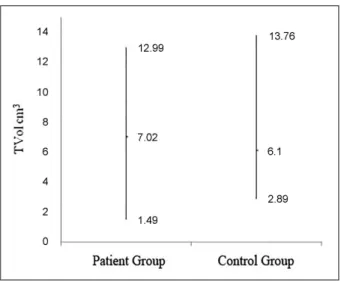
cavities in the patient group (►Fig. 1). T Vol average was 6.10
cm3 for the control group and 7.02 cm3the patient group
(►Fig. 2). In terms of MCA and T Vol rates, the difference was
not significant between the two groups (p>0.05) (►Table 1).
For the purpose of ruling out some changes appearing at the nose that caused smoke and diabetes, septum deviation, nasal septum deviation's MCA and TVol rates were compared with 6 individual (25%) in the control group, 10 individual (45.4%) in the patient group which did not have smoke and diabetes.
We determined MCA average for 12 nasal cavities as 0.53 cm2 and for 20 nasal cavities as 0.59 cm2 in control and
patient groups, respectively, where as T Vol average was 6.39 cm3and 7.92 cm3, respectively (
►Figs. 3and4). The
differ-ence between T Vol and MCA measurements was not signifi -cant (p>0.05) (►Table 2).
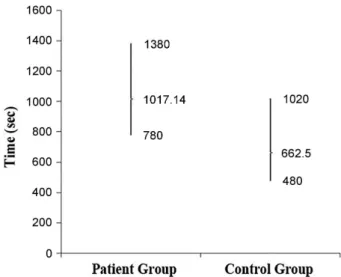
We compared 13 individuals (54.16%) in the control group (24) and 21 individuals (95.4%) in the patient group (22) with each other for mucociliary clearance time in the saccharin test. Mucociliary clearance time average was 662.5 seconds for the 13 men in the control group and 1017.14 seconds for the 21 men in patient group (►Fig. 5). The difference between
mucociliary clearance times was significant (p 0.05).
We compared all men in both groups for smell recognition. While the control group volunteers could distinguish an average of 4.92 (82%) out of the 6 scents, the average for the patient group was 2.82 (47%) in the patient group (►Fig. 6). The difference between smell recognition rates
was significant (p 0.05). Fig. 2 Assessment of groups with mean total volume values. T Vol:
Total Volume.
Fig. 1 Assessment of groups with minimum cross-sectional area values. MCA: Minimal Cross-sectional Area.
Fig. 3 Assessment of subjects without nasal septum deviation, diabetes, and non-smoker in terms of minimal cross-sectional area.
The difference between control and patient groups in terms of smell recognition rates, except for carnation and rose water, was statistically significant (►Table 3).
Discussion
There is a common belief that there is an alteration of physiological values in the noses of patients with total laryngectomy.2However, there is a deficit in objective
meas-urements among the studies focused on this subject. Our study aims to evaluate the functions of the nose as a physio-logic airway after total laryngectomy operation.
Several studies measure physiology and nasal airway openness after total laryngectomy; however, such studies relied mostly on anterior rhinoscopy or rhinomanometry procedures.8–10In our opinion, anterior rhinoscopy only is
not efficient for such an assessment. Rhinomanometry is an assistive evaluation method for the nose assessment and it gives indirect information about hypertrophic or atrophic structures of the nose.9Acoustic rhinomanometry is a quick,
non-invasive, and reliable method to assess nasal cavities.11,12
There are a few acoustic rhinomanometry studies con-ducted in total laryngectomised patients. Ozgursoy and Dur-sun13 used rhinomanometry to assess the nasal cavities in
pre- and post-term total laryngectomy performed on 48 patients. They found that there was a contraction in the narrowest segment of the nasal cavity and total volume during the first and second year follow-up measurements compared with preoperative conditions. Results from our data anakysis showed that the narrowest segment of the nose and total volumes of the patient group were higher than
Table 2 Acoustic rhinometry measurements of the nasal cavities in subjects without nasal septum deviation, diabetes, and non-smoker in terms of minimal cross-sectional area (mean values)
Patient group Control group p
MCAcm2 0.59
0.23 0.530.19 0.433
TVol cm3 7.922.93 6.392.81 0.157
Abbreviations: MCA, Minimal Cross-sectional Area; TVol, Total Volum.
Independent samples test (p
>0.05).
Table 1 Acoustic rhinometry measurements of the nasal cavity (mean values)
Patient group Control group p
MCA cm2 0.52
0.23 0.470.19 0.350
TVol cm3 7.022.60 6.102.05 0.061
Abbreviations: MCA, Minimal Cross–sectional Area; TVol, Total Volume. Independent samples test (p
>0.05).
Table 3 Smell identification percentages by the type of odor in the control and patient groups
Coffee Vanilla Garlic Carnation Cinnamon Rose water
Control group 24 (100%) 17 (71%) 24 (100%) 16 (67%) 17 (71%) 20 (83%)
Patient group 10 (45%) 9 (41%) 18 (82%) 9 (41%) 2 (9%) 14 (64%)
p 0.001 0.042 0.029 0.083 0.001 0.134
Independent samples test (p
0.05).
Fig. 5 Assessment of mean mucociliary clearance times between the groups.
that of the control group. But the difference was not statisti-cally significant (p>0.05).
To exclude several alterations in the nose related to smoking and diabetes, we compared the MCA and T Vol values of 10 participants in the patient group and 6 partic-ipants in the control group without nasal septum deviation, who did not have diabetes and did not smoke. In our data analysis, the difference in the measurements between the patients and the control groups was also not statistically significant (p>0.05). In both groups, when we compared the
measurements, the passage openness in the patient group was more than that of the control group. Although this reflected the delayed effects of total laryngectomy in the nose, we evaluated it as a reflection of atrophic changes as a result of not using the nose.
Mucociliary clearance is the most important protection mechanism of the nasal respiratory epithelium. Mucociliary functions indicate differences in environmental temperature, humidity, partial oxygen pressure (PO2), pH, trauma, and
inhaler agents such as sulfuric acid, formaldehyde, ozone, chlorine, smoke,14,15chronic bronchitis, as well as anatomical
obstacles such as septum deviation and diabetes melli-tus.16–18In the present study, we excluded the diabetic and
smoking participants in the control group for evaluation. To exclude the potential effects of age on mucociliary clearance, we chose volunteers with ages similar to those in the patient group to create our control group.
The interruption of airflow in the nasal cavity leads to changes in endonasal temperature,19an increase in humidity,20
and changes in mucus consistency. Such changes give rise to the formation of a hyper-secretory phase and mucociliary clear-ance increases21in the early term, depending on the loss of
nasal cycle, and a slowing down of the endonasal bloodflow.22
We also determined in our study prolonged mucociliary clear-ance time in patients who underwent total laryngectomy at least two years ago. None of the studied cases presented mucociliary clearance time within pathological limits. The average mucociliary clearance time was 16.952.47 minutes
in the patient group; whereas in the control group, that average was 11.042.71 minutes. Mucociliary clearance time of the
patient group was significantly higher than the control group in our statistics (p<0.01). We found that nasal mucociliary
clearance slowed down in the later term, which is different from the results of previous studies conducted early (<2 years)
in patients with total laryngectomy. It is possible that there was damage to patients’ nasal mucociliary clearance due to the disabling of the upper airway after total laryngectomy because of tracheostomy and due to atrophy of the nasal mucosa in the late stages. Mucociliary clearance time is prolonged because of the changes in the nasal mucosa in the chronic term. Moreover, such changes create conditions that favor secondary infections from saprophytic bacteria and cause atrophy in nasal mucosa, reduction in humidity, and a decrease in endonasal temperature.
Previous studies on patients with hyposmia-anosmia in the post-laryngectomy period considered there was a dam-age in the neuronal interaction between the nose and the larynx.8,23 Several studies evaluate olfactory activities in
patients with total laryngectomy. Fujii et al24 used an
olfactometer to assess preoperative and postoperative val-ues at 3, 6, and 12 months in 29 patients with total laryngectomy. They found no statistically significant differ-ence between preoperative and postoperative values. Leon et al’s25 study was performed with 36 patients with total
laryngectomy, scoring patients’ smell recognition ratio. Comparing patients with total laryngectomy and a control group, their results were 2.9 and 6.6 points, respectively, out of a maximum of 10 points. The authors also explained odor disfunction with the lack of ventilation in the nasal mucosa. Risberg et al26 conducted a study with 24 patients and
determined that 10 of those patients could smell and 14 could not smell after thefifth month post-laryngectomy. They associated the smell disfunction with not using the nose, which is the physiological airway. Hilgers et al27
supported the same association.
In our study, we assessed 24 participants in the patient group and 22 participants in the control group with the smell recognition test. While control group patients recognized a mean of 4.92 odors out of 6 (82%), that mean was 2.82 (47%) in the patient group. There was a statistically significant differ-ence between the patient and control groups in terms of aromatic odors, such as coffee and cinnamon (p0.05).
While odor recognition ratio was determined in the control group for coffee, vanilla, garlic, and cinnamon as 100%, 71%, 100%, and 71%, respectively, it was 45%, 41%, 82%, and 9% in the patient group. We analyzed coffee, vanilla, garlic, and cinnamon data obtained from study groups and found sta-tistically significant differences between them (p0.05), but
the difference between carnation and rose water smells was not significant (p>0.005). Regarding carnation and rose
water results, the control group was superior to the patient group. Odor recognition ratio for carnation and rose water smells in the control group were 67% and 83%, whereas for the patient group were 41% and 64%. The difference between the patient and control groups in terms of the general smell measurements was statistically significant (p¼0.001). In our
opinion, loss of smell function in patients with total laryngec-tomy in our study is associated with not using the nose, which is the normal physiological airway, due to airway changes in post-laryngectomy.
Conclusion
Our results show some implication for late term effects of total laryngectomy on nose functions followed by an increase in the minimal sectional area, increase in total volume, a slowdown in ciliaryflow, and reduction in recognizing odor and changes, which point out potential mucosal atrophy.
Based on thefindings of our study, we believe it may be helpful to suggest nasal irrigation and moisturizing sprays to such patients to maintain the function and mucous mem-brane of the nose.
patients with total laryngectomy and instruct the patients about available or future methods.
References
1 Maurizi M, Paludetti G, Almadori G, Ottaviani F, Todisco T. Muco-ciliary clearance and mucosal surface characteristics before and after total laryngectomy. Acta Otolaryngol 1986;102(1-2): 136–145
2 Moore-Gillon V. The nose after laryngectomy. J R Soc Med 1985; 78(6):435–439
3 Castellanos PF, Spector JG, Kaiser TN. Larenks ve larengofarenksin tümörleri (çeviri: M. Toprak). Şenocak D (Editor). Ballenger, Otorinolaringoloji baş ve boyun cerrahisi’nde. İstanbul: Nobel Tıp Kitabevleri; 2000:585–652
4 Lale AM, Mason JD, Jones NS. Mucociliary transport and its assessment: a review. Clin Otolaryngol Allied Sci 1998;23(5): 388–396
5 Miman MC. Akustik rinometri: Kullanımı, endikasyonları, sınırları. KBBİhtisas Dergisi 2001;8:416–423
6 Hilberg O. Objective measurement of nasal airway dimensions using acoustic rhinometry: methodological and clinical aspects. Allergy 2002;57(Suppl 70):5–39
7 Richard LD, Steven MB, Windolyn DP. Olfactory function and dysfunction. In: Bailey BJ, Johnson JT, Newlands SD(Eds.). Head & Neck Surgery–Otolaryngology. 4 th ed. Vol. 1, Philadelphia: Lippincott Williams & Wilkins; 2006:289–306
8 Henkin RI, Larson AL. On the mechanism of hyposmia following laryngectomy in man. Laryngoscope 1972;82(5):836–843 9 Fisher EW, Liu M, Lund VJ. The nasal cycle after deprivation of
airflow: a study of laryngectomy patients using acoustic rhinom-etry. Acta Otolaryngol 1994;114(4):443–446
10 Havas TE, Cole P, Gullane PJ, Kassel R, Kamino D. The nasal cycle after laryngectomy. Acta Otolaryngol 1987;103(1-2):111–116 11 Cakmak O, Celik H, Ergin T, Sennaroglu L. Accuracy of acoustic
rhinometry measurements. Laryngoscope 2001;111(4 Pt 1): 587–594
12 Mamikoglu B, Houser SM, Corey JP. An interpretation method for objective assessment of nasal congestion with acoustic rhinom-etry. Laryngoscope 2002;112(5):926–929
13 Ozgursoy OB, Dursun G. Influence of long-term airflow depriva-tion on the dimensions of the nasal cavity: a study of
laryngecto-my patients using acoustic rhinometry. Ear Nose Throat J 2007; 86(8):490–492
14 Dalhamn T. The effect of cigarette smoke on ciliary activity in the upper respiratory tract. AMA Arch Otolaryngol 1959;70(2): 166–168
15 Wanner A, Hirsch JA, Greeneltch DE, Swenson EW, Fore T. Tracheal mucous velocity in beagles after chronic exposure to cigarette smoke. Arch Environ Health 1973;27(6):370–371
16 Yue WL. Nasal mucociliary clearance in patients with diabetes mellitus. J Laryngol Otol 1989;103(9):853–855
17 Ho JC, Chan KN, Hu WH, et al. The effect of aging on nasal mucociliary clearance, beat frequency, and ultrastructure of re-spiratory cilia. Am J Respir Crit Care Med 2001;163(4):983–988 18 Mortensen J, Lange P, Nyboe J, Groth S. Lung mucociliary clearance.
Eur J Nucl Med 1994;21(9):953–961
19 Sakakura Y, Ukai K, Majima Y, Murai S, Harada T, Miyoshi Y. Nasal mucociliary clearance under various conditions. Acta Otolaryngol 1983;96(1-2):167–173
20 Dixon FW, Hoerr NL, McCALL JW. The nasal mucosa in the laryngectomized patients. Ann Otol Rhinol Laryngol 1949;58(2): 535–547
21 Bende M. Bloodflow in human nasal mucosa after total laryngec-tomy. Acta Otolaryngol 1983;96(5-6):529–531
22 Maurizi M, Ottaviani F, Paludetti G, Almadori G, Zappone C. Adenoid hypertrophy and nasal mucociliary clearance in children. A morphological and functional study. Int J Pediatr Otorhinolar-yngol 1984;8(1):31–41
23 Hoye RC, Ketcham AS, Henkin RI. Hyposmia after paranasal sinus exenteration of laryngectomy. Am J Surg 1970;120(4):485–491 24 Fujii M, Fukazawa K, Hatta C, Yasuno H, Sakagami M. Olfactory
acuity after total laryngectomy. Chem Senses 2002;27(2):117–121 25 Leon EA, Catalanotto FA, Werning JW. Retronasal and orthonasal olfactory ability after laryngectomy. Arch Otolaryngol Head Neck Surg 2007;133(1):32–36
26 Risberg-Berlin B, Ylitalo R, Finizia C. Screening and rehabilitation of olfaction after total laryngectomy in Swedish patients: results from an intervention study using the Nasal Airflow-Inducing Maneuver. Arch Otolaryngol Head Neck Surg 2006;132(3): 301–306