Key words:
Asymptomatic Diseases; Prostate; Prostatic Hyperplasia; Urinary Bladder
Int Braz J Urol. 2013; 39: 841-6
__________________
Submitted for publication: June 11, 2013
__________________
Accepted after revision: August 12, 2013 Purpose: The aim of this study was to assess the uroflowmetry data in a large population
of asymptomatic Brazilian men submitted to a health check up program and their corre-lation to IPSS and prostate size.
Materials and Methods: Asymptomatic men underwent a health check-up program be-tween January and December 2012. The inclusion criteria were men bebe-tween 40 and 70 years, IPSS ≤ 7, without bladder, prostate, urethral surgery, neurological diseases, urinary tract infection, PSA < 4.0 ng/dL and urinary volume higher than 150 mL. Urological assessment consisted of clinical history, IPSS, digital rectal examination (DRE), prostate specific antigen (PSA), urinalysis, ultrasonography and uroflowmetry.
Results: A total of 1041 asymptomatic men were included in this study. The average age was 49 years and average maximum flow rate was 17.4 mL/s. In spite of IPSS and prostate size increase with aging, they had a weak correlation with Qmax cutoffs (10 mL/s and 15 mL/s). A total of 85 men (8.3%) had more than 60 years, and even in this group, Qmax was higher than 15 mL/s. Out of 1041 men, 117 had IPSS less than 8 and Qmax less than 10 mL/s.
Conclusions: In asymptomatic men there is a weak correlation between IPSS, prostate size and uroflowmetric data. The establishment of different normal cutoffs seems to be complicated and uroflowmetry data should be interpreted with caution in order to avoid misdiagnosis.
Uroflowmetry in a Large Population of Brazilian Men
Submitted to a health check up program and its
correlation with ipss and prostate size
_______________________________________________
João Paulo Zambon, Nelson Sivonei da Silva Batezini, Amir Jamil Karam Junior, Raquel Dilguerian
Oliveira Conceição, José Antônio Maluf de Carvalho, Fernando G. Almeida
Hospital Israelita Albert Einstein (JPZ, NSSB, AJKJ, RDOC, JAMC), Universidade Federal de São Paulo (JPZ, NSSB, FGA), São Paulo, SP, Brazil and Wake Forest University (JPZ), NC, USA
ABSTRACT
ARTICLE
INFO
_________________________________________________________ ___________________
INTRODUCTION
Most men have a progressive prostate enlargement after fourth decade. The main con-sequence of benign prostate hyperplasia (BPH) is bladder outlet obstruction (BOO), which is cha-racterized by high bladder pressure and low flow rates. The natural history of BPH is not well
es-tablished and the long-term consequence of BOO remains unclear (1,2).
Uroflowmetry is a non-invasive method that may help the urologist to diagnose bladder outlet obstruction. However, it is not able to dis-tinguish BOO and detrusor underactivity (DUA). Both bladder dysfunctions can be characterized by low maximum flow rate (Qmax) (1,2).
Likewise men with BOO, asymptomatic men also may have low urinary maximum flow rate. For this reason, Qmax in men with or without symptoms should be interpreted with caution. There is a lack of studies in the literature in this specific population (3).
The aim of this study was to assess the uroflowmetry data in a large population of asymptomatic Brazilian men submitted to a heal-th check up program and heal-their correlation it wiheal-th IPSS and prostate size.
MATERIALS E METHODS
Local Ethical Committee approved the stu-dy and all subjects filled out a written informed consent. This study was performed in asympto-matic men submitted to a health check-up pro-gram between January and December 2012. A multidisciplinary team composed by general cli-nicians, urologists, ophthalmologists, dermatolo-gists, nutritionists and physiotherapists, evalua-ted patients. Urological assessment consisevalua-ted of clinical history, IPSS, digital rectal examination (DRE), prostate specific antigen (PSA), urinalysis, ultrasonography and uroflowmetry.
The inclusion criteria were men between 40 and 70 years, IPSS ≤ 7, without bladder, pros-tate, urethral surgery, neurological diseases, uri-nary tract infection, PSA < 4.0 ng/dL and uriuri-nary volume higher than 150 mL.
Uroflowmetry and ultrasonography for post-void residual urine measurement (PVR) were performed during the urological evaluation. PSA and urinalysis were collected on the same day and before starting the check up.
Data was analyzed using Statistical Pa-ckage for Social Sciences (SPSS) version 8.0 for Windows. Pearson’s linear correlation coefficient was calculated to estimate the correlation be-tween numeric variables and multiple linear re-gressions to investigate the association between
uroflowmetry parameters, clinical and ultrasound data. The Pearson’s Chi-Square was performed to compare numeric variables. It was considered sta-tistically significant p values ≤ 0.05.
RESULTS
Out of 2880 men, 1041 asymptomatic
men with mean age of
49 ± 6.9years old
(range 40 to 70) were included in this study.
Demographics, IPSS, prostate size and
uro-flowmetry data can be seen on Table-1.
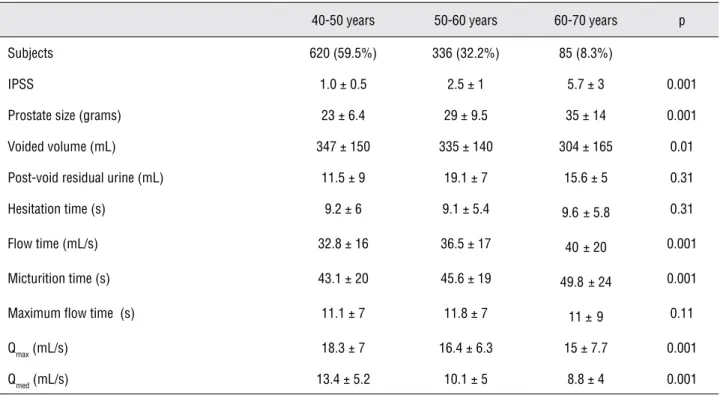
Men were categorized into three diffe-rent aging groups (40 to 50, 51 to 60 and 61 to 70). The older men had higher IPSS, prostate size, flow time and micturition time than youn-ger men (p = 0.001, p = 0.001, p = 0.001 and p = 0.001 respectively). On the other hand Qmax and Qmed were higher in younger men. Hesita-tion time, PVR and maximum flow time were not statistic significant (p = 0.31, p = 0.31 and p = 0.11 respectively). Prostate size, IPSS, post--void residual urine and uroflowmetry data in the three groups can be observed on Table-2.
A second analysis was performed com-paring the men with Qmax > 15 mL/s and Qmax < 15 mL/s. A total of 424 men (40.7%) with ave-rage age 50.9 years had Qmax < 15 mL/s, whereas 617 men (60.3%) with average age 48.8 years had Qmax > 15 mL/s. The Qmax cutoff 15 mL/s had a weak correlation with aging, IPSS and prosta-te size on asymptomatic men. These data can be observed on Table-3.
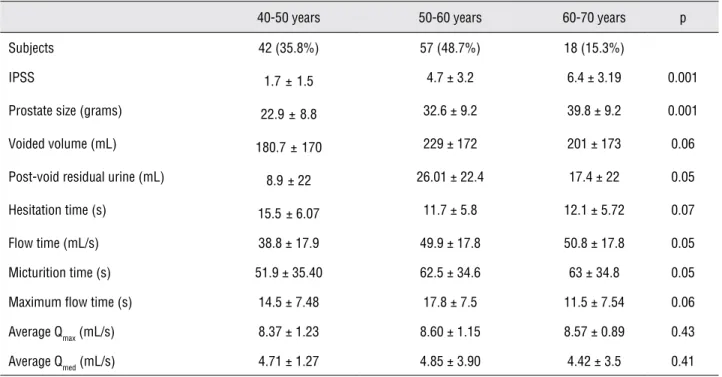
A further analysis was performed in or-der to correlate the clinical data with lower Qmax cutoff (< 10 mL/s). A total of 117 men (11.2%) had Qmax less than 10 mL/s and IPSS less than 8. The average age of this specific population was 55.5 years old. Older men had higher IPSS and prostate size, however the average Qmax and Qmed were not correlated with aging when we con-sidered only men with Qmax less than 10 mL/s. These data can be observed on Table-4.
DISCUSSION
Table 1 - Demographics and uroflowmetry data of 1041 men submitted to a health check up program.
Mean ± sd Median (range)
Age (years) 49 ± 6.9 49 (40 - 70)
IPSS 1.9 ± 0.8 1.5 (1 - 7)
Prostate Size (g) 26.6±9.0 25 (10 - 90)
Voided Volume (mL) 370±161 302 (300 - 500)
Post-void residual Urine (mL) 14±10 6 (0 - 187)
Hesitation time (s) 9.2 ± 5.9 8 (3 - 60)
Flow time (s) 34.5 ±17.8 31 (9 - 73)
Total voided time (mL) 44.3 ± 34.6 40 (20 - 153)
Maximum flow time (s) 11.3 ± 7.4 10 (5 - 21)
Qmax (mL/s) 17.4 ± 7.4 16.3 (8 - 39)
Qmed (mL/s) 11.9 ± 3.3 10.2 (7 - 23)
IPSS = International Prostate Symptom Score; Qmax = maximum flow rate; Qmed: average flow rate; sd = standard deviation
Table 2 - IPSS, prostate size and uroflow data on three different aging groups.
40-50 years 50-60 years 60-70 years p
Subjects 620 (59.5%) 336 (32.2%) 85 (8.3%)
IPSS 1.0 ± 0.5 2.5 ± 1 5.7 ± 3 0.001
Prostate size (grams) 23 ± 6.4 29 ± 9.5 35 ± 14 0.001
Voided volume (mL) 347 ± 150 335 ± 140 304 ± 165 0.01
Post-void residual urine (mL) 11.5 ± 9 19.1 ± 7 15.6 ± 5 0.31
Hesitation time (s) 9.2 ± 6 9.1 ± 5.4 9.6 ± 5.8 0.31
Flow time (mL/s) 32.8 ± 16 36.5 ± 17 40± 20 0.001
Micturition time (s) 43.1 ± 20 45.6 ± 19 49.8± 24 0.001
Maximum flow time (s) 11.1 ± 7 11.8 ± 7 11 ±9 0.11
Qmax (mL/s) 18.3 ± 7 16.4 ± 6.3 15 ± 7.7 0.001
Qmed (mL/s) 13.4 ± 5.2 10.1 ± 5 8.8 ± 4 0.001
Table 3 - IPSS, Prostate size and uroflow data on men with Qmax > 15 mL/s and Qmax < 15 mL/s.
Qmax < 15 mL/s Qmax > 15 mL/s Pearson p
Subjects 424 (40.7%) 617 (60.3%)
Age (years) 50.9±7.6 48.8 ± 6.3 -0.161 0.01
IPSS 3±1 1 ± 0.5 -0.256 0.001
Prostate size (g) 28.3 ± 11 25.4± 7.9 -0.166 0.001
Voided volume (mL) 256 ± 127 396±177 0.133 0.001
PVR (mL) 17 ± 7 12 ± 5 -0.132 0.001
Hesitation time(s) 10.5 ± 7.2 8.3 ± 4.7 -0.214 0.003
Flow time(s) 40.2 ± 21 30.6 ± 13.9 -0.267 0.001
Micturition time(s) 50.2 ± 23 40.3 ± 20 -0,149 0.001
Maximum flow time(s) 13.3 ± 9.3 10 ± 5 -0.234 0.001
Average Qmed (mL/s) 6.7 ± 2 15 ±7 0.130 0.001
Average Qmax (mL/s) 11.42 ± 2.8 21.47±4.1 0.290 0.001
IPSS = International Prostate Symptom Score; Qmax = maximum flow rate; Qmed =average flow rate.
Table 4 - IPSS, prostate size and uroflow data on men with Qmax < 10 mL/s.
40-50 years 50-60 years 60-70 years p
Subjects 42 (35.8%) 57 (48.7%) 18 (15.3%)
IPSS 1.7±1.5 4.7 ± 3.2 6.4 ± 3.19 0.001
Prostate size (grams) 22.9±8.8 32.6 ± 9.2 39.8 ± 9.2 0.001
Voided volume (mL) 180.7±170 229 ± 172 201 ± 173 0.06
Post-void residual urine (mL) 8.9 ± 22 26.01 ± 22.4 17.4 ± 22 0.05
Hesitation time (s) 15.5 ± 6.07 11.7 ± 5.8 12.1 ± 5.72 0.07
Flow time (mL/s) 38.8 ± 17.9 49.9 ± 17.8 50.8 ± 17.8 0.05
Micturition time (s) 51.9 ± 35.40 62.5 ± 34.6 63 ± 34.8 0.05
Maximum flow time (s) 14.5 ± 7.48 17.8 ± 7.5 11.5 ± 7.54 0.06
Average Qmax (mL/s) 8.37 ± 1.23 8.60 ± 1.15 8.57 ± 0.89 0.43
Average Qmed (mL/s) 4.71 ± 1.27 4.85 ± 3.90 4.42 ± 3.5 0.41
very specific population of Brazilian asymptoma-tic men submitted to a health check-up program. The IPSS and prostate size increased with aging however they had a weak correlation with diffe-rent Qmax cutoffs (10 mL/s and 15 mL/s). The ave-rage age of men was 49 years and their aveave-rage maximum flow rate was 17.4 mL/s. A total of 85 men (8.3%) had more than 60 years, and even in this group, Qmax was higher than 15 mL/s. Out of 1041 men, 117 had IPSS less than 8 and Qmax less than 10 mL/s.
The urinary flow is a result of the inte-raction between detrusor continte-raction and urethral resistance. Low urinary flow may suggest BOO or bladder underactivity. Abnormal findings in uro-flowmetric parameters can suggest voiding dys-function but the uroflowmetry by itself has a low specificity and does not allow the confirmation of the etiologic diagnosis. Since there is not a clear correlation between symptoms and pressure flow studies, an objective parameter is desirable in or-der to improve the BOO diagnosis.The main issue in missing BOO is the potential to develop bladder deterioration due to non-treated high urethral re-sistance (3,4).
The normal value is better determined by studying a large number of patients in order to evaluate the variable distribution. There is a lack of studies describing the uroflowmetry parameters in a large population. Many flow-volume nomo-grams have been constructed. Siroky nomogram was based on data of 300 voids of 80 asympto-matic men and validated it plotting results of 33 normal men and 53 men with obstructive voiding symptoms. Liverpool nomogram was based on a large number of observations and underwent pre-liminary validation using 30 observations of one normal volunteer (5,6).
It is not a consensus among urologists to perform uroflow and pressure flow studies in the routine assessment of men with lower urinary tract symptoms. The definition of normality can be based on Gaussian or mean ± standard devia-tion; percentile within a specified range such as 5% to 95%; culturally desirable; risk factor or an individual with no additional risk of disease; diag-nostic or a range of results beyond which target disorder are highly probable and therapeutic or
a range of results beyond which treatment does more good than harm (4,7). We have seen a high range of variability in uroflowmetric parameters in asymptomatic subjects. Based on our findings, we believe that the establishment of normal va-lues in uroflowmetric parameters in male popula-tion seems to be complicated.
Some authors suggested different maxi-mum flow-rate cut-off values in order to distin-guish men with or without bladder outlet obstruc-tion. Higher cut-off maximum flow rates decrease the specificity and increase the sensitivity. On the other hand lower cut-off maximum flow rates in-crease the specificity and dein-crease the sensitivity. According to Reynard et al., when Qmax was less than 10 mL/s, the test specificity and sensitivity were respectively 70% and 47%. Likewise, when Qmax was lower than 15 mL/s, the test specifici-ty and sensitivispecifici-ty were respectively 38% and 82% (8,9). In this study 117 men with IPSS less than 8 had Qmax less than 10 mL/s, which suggest no correlation between Qmax and urinary symptoms. For this reason, uroflow data should be interpreted with caution.
Although symptoms usually stimulate pa-tients to seek treatment, some studies have shown that there is no correlation between symptoms and bladder outlet obstruction (10,11). Uroflowmetry can be an additional tool for urologists before sur-gical intervention or treatment failure. Abrams et al. demonstrated that 90% of men with maximum flow rate lower than 10 mL/s have some degree of obstruction. Conversely, 25% to 30% of men with decreased flow rate are not obstructed(12).
peak flow were respectively 17.9 ± 17.5 mL/s and 49.5 ± 26.2 cm H2O. On pressure flow studies 3 pa-tients had unequivocal obstruction, 7 were in the equivocal area and 14 had no obstruction. These findings suggest that even asymptomatic men can be obstructed (7).
There are a few data on literature regar-ding the voiregar-ding characteristics of “normal” men. Specifically in the developing countries such as Brazil, the data registration is inadequate and in most cases we have used American or European population data as a reference. In this context, this study provides a substantial data of a spe-cific Brazilian men population. In spite of our findings, the primary aim of this study was not to establish normal uroflowmetric values or cre-ate uroflow nomograms. We have thought that uroflow is an additional tool to evaluate voiding dysfunction and should be interpreted linked with clinical and ultrasonographic data in order to avoid misdiagnosis.
CONFLICT OF INTEREST
None declared.
REFERENCES
1. Al-Hayek S, Thomas A, Abrams P: Natural history of detru-sor contractility--minimum ten-year urodynamic follow-up in men with bladder outlet obstruction and those with de-trusor. Scand J Urol Nephrol Suppl. 2004; 215: 101-8. 2. Thomas AW, Cannon A, Bartlett E, Ellis-Jones J, Abrams
P: The natural history of lower urinary tract dysfunction in men: minimum 10-year urodynamic follow-up of untreated detrusorunderactivity. BJU Int. 2005; 96: 1295-300. 3. Rosario DJ, Woo HH, Chapple CR: Definition of
normal-ity of pressure-flow parameters based on observations in asymptomatic men. Neurourol Urodyn. 2008; 27: 388-94.
4. Nitti VW: Pressure flow urodynamic studies: the gold stan-dard for diagnosing bladder outlet obstruction. Rev Urol. 2005; 7 Suppl 6: S14-21.
5. Siroky MB, Olsson CA, Krane RJ: The flow rate nomogram: II. Clinical correlation. J Urol. 1980; 123: 208-10.
6. Haylen BT, Ashby D, Sutherst JR, Frazer MI, West CR: Maximum and average urine flow rates in normal male and female populations--the Liverpool nomograms. Br J Urol. 1989; 64: 30-8.
7. Walker RM, Romano G, Davies AH, Theodorou NA, Sprin-gall RG, Carter SS: Pressure flow study data in a group of asymptomatic male control patients 45 years old or older. J Urol. 2001; 165: 683-7.
8. Reynard JM, Yang Q, Donovan JL, Peters TJ, Schafer W, de la Rosette JJ, et al.: The ICS-’BPH’ Study: uroflowmetry, lower urinary tract symptoms and bladder outlet obstruc-tion. Br J Urol. 1998; 82: 619-23.
9. de la Rosette JJ, Witjes WP, Schäfer W, Abrams P, Donovan JL, Peters TJ, et al.: Relationships between lower urinary tract symptoms and bladder outlet obstruction: results from the ICS-”BPH” study. Neurourol Urodyn. 1998; 17: 99-108.
10. McLoughlin J, Gill KP, Abel PD, Williams G: Symptoms versus flow rates versus urodynamics in the selection of patients for prostatectomy. Br J Urol. 1990; 66: 303-5. 11. Gerstenberg TC, Andersen JT, Klarskov P, Ramirez D, Hald
T: High flow infravesical obstruction in men: symptomatol-ogy, urodynamics and the results of surgery. J Urol. 1982; 127: 943-5.
12. Abrams P, Bruskewitz R, de La Rossette J: The diagnosis of bladder outlet obstruction: urodynamics. In: Cockett ATK, Khouri S, Aso Y, et al., eds. Proceedings, the 3rd Consulta-tion on BPH. World Health OrganizaConsulta-tion. 1995; 299-367.