Copyright © 2015 Revista Latino-Americana de Enfermagem This is an Open Access article distributed under the terms of the Creative Commons Attribution Non-Commercial License (CC BY-NC).
This license lets others distribute, remix, tweak, and build upon your work non-commercially, and although their new works must also acknowledge you and be non-commercial, they don’t have to license their derivative works on the same terms.
Corresponding Author: Luciana Paiva
Rua Dr. Hildebrando Pontes, 100, Apto. 102 Bairro: Mercês
CEP: 38060-250, Uberaba, MG, Brasil E-mail: [email protected]
1 Paper extracted from doctoral dissertation “Quality of life related to health and return to work for victims of traffic accidents”, presented to Escola de Enfermagem de Ribeirão Preto, Universidade de São Paulo, PAHO/WHO Collaborating Centre for Nursing Research Development, Ribeirão Preto, SP, Brazil.
2 PhD, RN, Hospital de Clínicas, Universidade Federal do Triângulo Mineiro, Uberaba, MG, Brazil.
3 Undergraduate student in Nursing, Escola de Enfermagem, Universidade Federal do Triangulo Mineiro, Uberaba, MG, Brazil.
4 PhD, Assistant Professor, Departamento de Enfermagem Especializada, Faculdade de Medicina de São José do Rio Preto, São José do Rio Preto, SP, Brazil.
5 PhD, Associate Professor, School of Medicine, University of Washington, Seattle, WA, United States.
6 PhD, Associate Professor, Escola de Enfermagem de Ribeirão Preto, Universidade de São Paulo, PAHO/WHO Collaborating Centre for Nursing Research Development, Ribeirão Preto, SP, Brazil.
7 PhD, Full Professor, Escola de Enfermagem de Ribeirão Preto, Universidade de São Paulo, PAHO/WHO Collaborating Centre for Nursing Research Development, Ribeirão Preto, SP, Brazil.
Readmissions due to traffic accidents at a general hospital
1Luciana Paiva
2Damiana Aparecida Trindade Monteiro
3Daniele Alcalá Pompeo
4Márcia Aparecida Ciol
5Rosana Aparecida Spadotti Dantas
6Lídia Aparecida Rossi
7Objective: to verify the occurrence and the causes of hospital readmissions within a year after
discharge from hospitalizations due to traffic accidents. Methods: victims of multiple traumas due
to traffic accidents were included, who were admitted to an Intensive Care Unit. Sociodemographic
data, accident circumstances, body regions affected and cause of readmission were collected
from the patient histories. Results: among the 109 victims of traffic accidents, the majority
were young and adult men. Most hospitalizations due to accidents involved motorcycle drivers
(56.9%). The causes of the return to the hospital were: need to continue the surgical treatment
(63.2%), surgical site infection (26.3%) and fall related to the physical sequelae of the trauma
(10.5%). The rehospitalization rate corresponded to 174/1,000 people/year. Conclusion: the
hospital readmission rate in the study population is similar to the rates found in other studies.
Victims of severe limb traumas need multiple surgical procedures, lengthier hospitalizations and
extended rehabilitation.
Descriptors: Patient Admission; Patient Readmission; Accidents, Traffic.
Rev. Latino-Am. Enfermagem 2015 July-Aug.;23(4):693-9
DOI: 10.1590/0104-1169.0242.2623
www.eerp.usp.br/rlae
Introduction
The trafic accidents, the second cause of general mortality in Brazil(1),constitute an important cause of
trauma in the global population. The increase in these
accidents is directly related to the industrial development
of the 20th century, the increase of the motor vehicle
leet, the high frequency of inappropriate behaviors and insuficient alertness of the drivers(2).
Trauma sequelae differ substantially for each person, as the victims of trafic accidents can injure different body regions. This situation overburdens the health
system in all care sectors, ranging from emergency care
to high-complexity services, as extended and high-cost hospitalizations inluence the patients’ rehabilitation and interfere in the victims’ quality of life.
In Brazil, to minimize these impacts, the Ministry of
health recommends access to rehabilitation for trauma
victims with temporary or permanent physical, auditory,
intellectual or visual sequelae. This rehabilitation is
based on the promotion of the care needed to improve
the patients’ functions; through prevention measures,
reduction of the rhythm of functional loss, recovery or
compensation of the function lost(3).
The change in the population’s sociodemographic and epidemiological proile and the incorporation of new technologies in the care process support the need for
health care assessment studies, through indicators that
assess the results of the care process(4). Among the
health indicators, the hospital readmission rate assesses
the health service’s performance, based on the
long-term monitoring of the same hospital(5).
Hospital readmissions are deined as the admission of the patient to the same health service twice or more
within one period after the discharge(6). Different factors
can be associated with rehospitalizations: inappropriate
health care, improper rehabilitation procedures, early
discharge, low treatment compliance by the patient, age
and chronic illnesses(5). Other factors not related to the
quality of care can interfere in the readmissions, such
as the proximity of the hospital, availability of beds and
access regulation mechanisms(7).
Early readmissions occur within 30 days after
the hospitalization and can be associated with early
discharge and hospital care quality problems(8).
Longer time intervals between hospital discharge and
readmission are frequently associated with chronic
illnesses, socioeconomic conditions and limited access
to outpatient care(9). In Brazil, studies are available
that assessed the readmissions in speciic populations,
such as elderly and people discharged from intensive
care. No studies have been found that were focused on readmissions due to trafic accidents.
The objective in this study was to characterize the victims of trafic accidents admitted to an Intensive Care Unit of a hospital in the interior of the State of
Minas Gerais and to verify the occurrence of hospital
readmissions related to the trauma within one year after
the discharge from hospital.
Method
Approval for the study was obtained from the
Institutional Review Board at Universidade Federal do
Triângulo Mineiro, under protocol 1606. To develop the
study, the standards for research established in National
Health Council Resolution 196/96 were followed. The
consent terms had been obtained in an earlier phase of
the same study.
This observational, retrospective study was developed without inding with multiple trauma victims due to trafic accidents, hospitalized at the Intensive Care Unit (ICU) of a university hospital
in the region Triângulo Mineiro. The hospital is
a large public institution that attends to 27 cities
in the macroregion Triângulo Sul, with 281 active
beds in total and an estimated care population of
645 thousand people. The criteria to include the
participants were: multiple trauma victims due to trafic accident, admitted to the ICU of a university hospital in the Triângulo Mineiro, between January
2008 and July 2010, independently of sex and aged 18 years or older. Patients who died during the irst hospitalization were excluded.
To select the participants, a search was
undertaken in the admission and discharge records of the ICU. This search permitted the identiication of individuals admitted with a diagnosis of trauma due to trafic accidents, sociodemographic data and hospital registration number. After obtaining the
information, the respective patient histories were
accessed in the Medical Filing Service (SAME) to
survey the hospitalization data. After the discharge, a
new research was undertaken in the hospital system,
looking for patients readmitted within one year after
the discharge. After identifying these patients, new searches were undertaken in the iles with emphasis on the causes of readmission.
The following variables were collected for the
origin); information related to the accident (weekday of
occurrence and accident circumstances); body regions
affected; and procedures related to the treatment
after the accident (surgeries done, interval between
other readmissions and their causes). To assess the
severity of the trauma victims’ injuries, the New Injury
Severity Score (NISS) was used. Constructed based on
the Abbreviated Injury Scale (AIS), this tool assesses
the severity of the worst three injuries, independently
of the affected body region. The score on this scale
ranges between 1 and 75 and patients with an NISS
score over 15 are considered as moderate and severe
traumas.
All patients admitted between January 2008 and
July 2010 were included in the study. The sample,
considered representative of the population, was
delimited by the period to collect data, which was based
on the human resources and time available to conduct
the study. The data were analyzed using absolute
and relative frequencies, central trend and dispersion
measures. To calculate the readmission rate, the time for readmission was limited to one year after the irst discharge.
Results
In the study period, 137 victims of trafic accidents were admitted to the ICU. Twenty-eight patients were excluded, who died during the irst hospitalization. The remaining 109 patients complied with the inclusion
criteria. These victims’ mean age was 37.1 years
[Standard Error (SE) = 14.3], ranging from 18 to 75
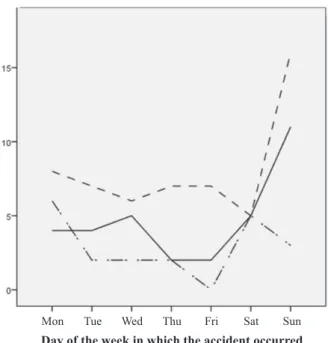
years, with a predominance of male victims (69.7%). The trafic accidents were distributed among all weekdays, with a higher concentration at weekends
(41.3% on Saturdays and Sundays) and at night
(51.4%) (Figure 1).
The highest proportion of trafic accident victims referred to motorcycle drivers (56.9%), followed by
car passengers (31.2%). The smallest percentages of
victims were passengers of heavy vehicles, trucks and
buses (5.5%), followed by cyclists (6.4%).
All patients were severe trauma victims with NISS
scores ranging between 41 and 75 points. Table 1 shows
the distribution of the affected body region according
to the type of vehicle. A large number of victims had
associated injuries, such as fractures and traumatic
brain injuries. In the motorcycle accident victims, the
most affected body regions were the limbs (46.8%) and
skull (24.2%). In the accidents involving cars, 70.6% of
the victims presented skull (42.9%), face (28.6%) and
limb (28.6%) traumas. Victims of accidents involving
heavy vehicles (truck/bus) had greater proportions of
skull (33.3%) and limb (33.3%) injuries. These two
groups showed a smaller number of events (7 and 6,
respectively).
Mon Tue Wed Thu
Day of the week in which the accident occurred Fri Sat Sun
Figure 1- Temporal distribution of trafic accidents according to shift in which the accident occurred and
weekdays. Uberaba, MG, Brazil, January 2008 till July
2010
The mean number of days during the irst hospitalization was 35 days (SE=31.1), ranging from 2
to 155 days, while the mean length of hospitalization at
the Intensive Care Unit was 14 days (SE=13), ranging
from 1 to 87 days.
Among the 109 patients, 19 (17.4%) needed
readmission rate corresponding to 174/1,000 persons/
year. When comparing individuals who needed
readmission with victims who were not readmitted, a
predominance of male individuals, motorcycle accidents
and lower limb injuries is observed in the two groups
(Table 2).
The return period to the hospital ranged between
6 and 332 days, and the mean length between
discharge and return was 163 days (SE=13). The
causes of the return to hospital were: need to
continue the surgical treatment (63.2%), surgical
site infection (26.3%) and fall (10.5%) related to the
physical sequelae of the trauma, responsible for a
Discussion
The consequences of trafic accidents can range from lesser sequelae to deaths or physical disabilities,
which overburden the health system, with extended
and expensive hospitalizations; followed by long-term
rehabilitation programs(10). In this study, most victims
were young and adult men, similar to other studies
in Brazil(11). The impact and economic losses for this
population segment can be strong, including potential
years of life lost, periods of absence from work, early
retirements, physical, emotional and moral limitations
of the victim and negative impact on the family and
social structure the victim is inserted in(11).
The trafic accident sequelae determine important morbidity and mortality in the victims and put a great
economic strain on the country, in the treatment and
the loss of an important part of the income-generating
population, due to deaths and sequelae(12).
In this study, like in others found in the literature, trafic accident records are higher at weekends(1) and
distributed uniformly during the other weekdays. The
enhanced number of accidents at weekends can be
associated with alcohol intake and the use of other
drugs(12). Research reports that most accidents happen
at night and can be explained by fatigue at the end of
the day and the great low of vehicles at rush hours(13-14).
The high level of severity at night is due to factors like Table 1 - Distribution of the affected body region according to the type of vehicle in the accident. Uberaba, MG, Brazil,
January 2008 till July 2010
Affected body region Motorcycle
n = 62
Car n = 34
Bicycle n = 7
Truck/Bus n = 6
Limbs % (n) 46.8 (29) 70.6 (24) 28.6 (2) 33.3 (2)
Skull % (n) 24.2 (15) 32.4 (11) 42.9 (3) 33.3 (2)
Abdomen % (n) 19.4 (12) 26.5 (9) 0 (0) 16.7 (1)
Chest % (n) 9.7 (6) 14.7 (5) 0 (0) 16.7 (1)
Spine % (n) 6.5 (4) 5.9 (2) 14.3 (1) 16.7 (1)
Face % (n) 3.2 (2) 2.9 (1) 28.6 (2) 16.7 (1)
Table 2 - Characterization of trafic accident victims according to readmission within one year after the discharge. Uberaba, MG, Brazil, January 2008 till July 2010
Characteristic Group without readmission
(n= 90)
Group with readmission (n=19)
Sex, % male (n) 71.1 (64) 63.2 (12)
Trauma mechanism, % in each category (n)
Motorcycle 56.7 (51) 57.9 (11)
Car 34 (37.8) 31.5 (6)
Cyclist 5.6 (5) 10.6 (2)
Affected body region % (n)*
Limbs 47.8 (43) 52.6 (10)
Skull 27.8 (25) 31.6 (6)
Abdomen 20 (18) 21.1 (4)
Spine 5.6 (5) 15.8 (3)
Chest 11.1 (10) 10.5 (2)
Face 5.6 (5) 5.3 (1)
Time between discharge and readmission, % in each category (n)
0-14 days --- 26.3 (5)
15-30 days --- 42.1 (8)
31-60 days --- 31.6 (6)
Causes of readmission, % in each category (n)
Continuity of surgical treatment --- 63.2 (12)
Surgical site infection --- 26.3 (5)
Fall --- 10.5 (2)
visibility, excessive speed, disrespect for trafic signs, alcohol intake and drug use(13). In addition, the long and
uninterrupted work journeys should be considered an
important factor associated with the higher occurrence
of accidents at night(14).
The most common vehicle in accidents was the
motorcycle (56.9%). In recent years, an increase
was observed in the risk of death due to accidents
involving motorcycles(15), mainly in large Brazilian cities
and, when compared to car accidents in emergency
care, this increase is signiicant(15). The growth of the
motorcycle leet all over the country occurred due to the greater acceptance of this type of vehicle in the general
population and its use for speed delivery of products and articles, favoring the cost-beneit relation when compared to other motor vehicles(16).
In general, it can be afirmed that limb injuries and traumatic brain injuries stood out among the most
severe injuries when compared to other body regions.
The distribution patterns of the injuries can be due to
the type of accident the motorcycle victims were victims
of, with frequent limb injuries(17).
In this study, the length of hospitalization ranged
between 2 and 155 days, similar to the indings in the literature(18). The nature of the lesions can
inluence the length of the patients’ hospitalization, type of treatment and conditions upon discharge.
Hospitalization at an intensive care unit occurred for
all study participants, with a mean length of 14 days.
The relation between the longer ICU hospitalization,
severity and incidence of complications after the
trauma is discussed in the literature(19).
The results related to readmissions after the trauma
in the study population support the indings from other studies involving severe limb trauma victims, who need
multiple surgical procedures, extended hospitalization
and rehabilitation. In a study developed to analyze
hospitalizations of all patients over 18 years of age,
most patients returned to the hospital within 30 days(4).
In this study, surgical site infection was the cause
of readmission for 26.3% of the patients. The most
frequent intra-hospital complications in the orthopedic
trauma victims are surgical wound infection with the
need for a new surgical approach and osteomyelitis(20).
The presence of these complications represents a severe
condition that inluences the morbidity and mortality of the patients who stay. Other studies have already
reported that orthopedic trauma patients submitted to
surgeries present high rates of surgical site infection
and that this situation is related to the severity and
complexity of the injuries, the number of surgeries on
the injury site and clinical risk factors like preexisting
diseases(21). These infections are severe complications
for the patients, the multiprofessional team and hospital
institutions. They extend the length of the hospitalization,
double the readmission rates and increase care costs
by more than 300%. In addition, they cause important
physical limitations, which signiicantly reduce the operated patients’ quality of life(22). The incidence of
trauma-related orthopedic infections can range between
4.2%(22) and 22.7%(22).
Another relevant aspect are the temporary and
permanent disabilities after trafic accidents, which contribute to increase the readmission rate and reduce
the functional ability, muscle strength, postural instability
and higher fall rates of the victims, which have been
assessed in studies on these people’s rehabilitation(23).
The role of the multiprofessional and mainly the
nursing team is highlighted in planning for discharge, as
a fundamental tool for comprehensive care during the
hospitalization and after discharge. Health education is
an important strategy to direct the care needed, to be
delivered to the patient at home, with a view to avoiding
readmissions and facilitating the early identiication of signs of complications after the discharge, promoting
improvements in the users’ health. This study is limited
by the sample size and the length of the monitoring,
established in function of the time available to conduct
the study.
Conclusions
After the discharge, most readmissions happened
more than 30 days after the discharged and were
related to victims of motorcycle accidents who suffered
orthopedic traumas. Most hospital readmissions in this
study were planned, due to the need to continue the
therapeutic assessment.
References
1. Silva MAI, Pan R, Melo L, Bortoli PS, Nascimento
LC. Perfil dos atendimentos a crianças e adolescentes
vítimas de causas externas de morbimortalidade,
2000-2006. Rev Gaúcha Enferm. 2010;31(2):351-8.
2. Bastos YGL, Andrade SM, Soares DA.
Características dos acidentes de trânsito e das
vítimas atendidas em serviço pré-hospitalar em
cidade do Sul do Brasil, 1997/2000. Cad Saúde
Pública. 2005;21(3):815-22.
3. Ministério da Saúde (BR). Consulta Pública nº 17, de
29 de Agosto de 2012. Minuta de Portaria que aprova,
na forma do anexo, o texto da “Linha de Cuidado ao
Trauma”. Diário Oficial [da] República Federativa do
Brasil [Internet]. Brasília: Ministério da Saúde; 2012
[acesso 29 ago 2013]. p. 50. Disponível em: http://
www.cro-ce.org.br/pdf/consulta-publica.pdf.
4. Maurer PP, Ballmer PE. Hospital readmissions
are predictable and avoidable? Swiss Mid Wkly.
2004;134(41-42):606-11.
5. Clarke A, Rao M. Developing quality indicators
to assess quality of care. Qual Saf Health Care.
2004;13(4):248-9.
6. Moreira ML, DutilhNovaes HM. Internações no sistema
de serviços hospitalares, SUS e não SUS: Brasil, 2006.
Rev Bras Epidemiol. 2011;14(3):411-22.
7. Heggestada T. Do Hospital length of stay and staffing
ratio affect elderly patients risk of readmission? A
nation-wide study of Norwegian hospitals. Health Serv
Res. 2002;37(3):647-65.
8. Japiassú AM, Cukier MS, Queiroz AGCM, Gondim CRN,
Penna GLA, Almeida GF, et al. Fatores preditores precoces
de reinternação em unidade de terapia intensiva. Rev
Bras Ter Intensiva. 2009;21(4):353-8.
9. Castro MSM, Carvalho MS, Travassos C. Factors
associated with readmission to a general hospital in
Brazil. Cad Saúde Pública. 2005;21(4):1186-2000.
10. Debieux P, Chertman C, Mansur NSB, Dobashi E,
Fernandes HJA. Lesões do aparelho locomotor nos
acidentes com motocicleta. Acta Ortop Bras. 2010;18(6):
353-6. D
11. Abreu AMM, Jomar RT, Thomaz RGF, Guimarães
RM, Lima JMB, Figueirò RFS. Impacto da lei seca na
mortalidade por acidentes de trânsito. Rev Enferm UERJ.
2012;20(1):21-6.
12. Ferreira TFA, Nápolis ACR, Lima CS, Araújo LC,
Garcia CB, Lima OS, et al. Estudo da gravidade das
pacientes vítimas de acidentes de trânsito atendidos
pelo hospital de clínicas de Uberlândia de dezembro
de 2005 a março de 2006 segundo índices de trauma.
Biosci J. 2009;25(2):152-60.
13. Bastos YGL, Andrade SM, Soares DA. Características
dos acidentes de trânsito e das vítimas atendidas em
serviço pré-hospitalar em cidade do Sul do Brasil,
1997/2000. Cad Saúde Pública. 2005;21(3):815-22.
14. Silva DW, Andrade SM, Soares DA, Nunes EFPA,
Melchior R. Condições de trabalho e riscos no trânsito
urbano na ótica de trabalhadores motociclistas. Physis
2008;18(2):339-60.
15. Abreu AMM, Lima JMB, Griep RH. Acidentes de
trânsito e a frequência dos exames de alcoolemia com
vítimas fatais na cidade do Rio de Janeiro. Esc Anna
Nery. 2009;13(1):44-50.
16. Bacchieri G, Barros AJD. Acidentes de trânsito no
Brasil de 1998 a 2010: muitas mudanças e poucos
resultados. Rev Saúde Pública. 2011;45(5):949-63.
17. Gawryszewski VP, Coelho HMM, Scarpelini S, Zan
Renato JMHPM, Rodrigues EMS. Perfil dos atendimentos
a acidentes de transporte terrestre por serviços de
emergência em São Paulo, 2005. Rev Saúde Pública.
2009;43(2):275-82.
18. Andrade LM, Lima MA, Silva CHC, Caetano JA.
Acidentes de motocicleta: características das vítimas e
dos acidentes em hospital de Fortaleza – CE, Brasil. Rev
Rene. 2009;10(4):52-9.
19. McKevitt EC, Calvert E, Ng A, Simons RK, Kirkpatrick
AW, Appleton L, et al. Geriatric trauma: resource use
and patient outcomes. Can J Surg. 2003;46(3):211-5.
20. Castro RRM, Ribeiro NF, Andrade AM, J BD. Perfil
dos pacientes da enfermaria de ortopedia de um
hospital público de Salvador-Bahia. Acta Ortop Bras.
2013;21(4):191-4.
21. Thu LT, Dibley MJ, Ewald B, Tien NP, Lam LD.
Incidence of surgical site infections and accompanying
risk factors in Vietnamese. Orthopaedic Patients. J Hosp
Infect. 2005;60(4):360–7.
22. Maksimovic J, Markovic-Denic L, Bumbasirevic
M, Marinkovic´ J. Incidence of surgical site infections
in the departments of orthopedics and traumatology.
Received: July 3rd 2014
Accepted: Mar 22nd 2015
23. Souza JAG, Iglesias ACRG. Trauma no idoso. Rev