(1) Universidade Federal de Santa Maria – UFSM – Santa Maria (RS), Brasil. Work developed in Reference Center in Worker’s Health – CEREST Regional Santa Maria-RS.
Source of support: Scholarship conceded by Coordenação de Aperfeiçoamento de Pessoal de Nível Superior (CAPES) – Coordination for the Improvement of Higher Education Personnel.
Conlict of interest: non-existent
Personal protective equipment headphones:
evaluation of effectiveness in workers exposed to noise
Equipamento de proteção individual auricular:
avaliação da efetividade em trabalhadores expostos a ruído
Marília Trevisan Sonego(1)
Valdete Alves Valentins dos Santos Filha(1)
Anaelena Bragança de Moraes(1)
Received on: October 26, 2015 Accepted on: December 20, 2015
Mailing address: Marília Trevisan Sonego Rua João Goulart, 430/305
Bairro Camobi, Santa Maria (RS), Brasil CEP 97105-220
E-mail: [email protected]
ABSTRACT
Purpose: to evaluate the effectiveness of the use of equipment of individual hearing protection (auricular protector) of insertion in workers exposed to noise, checking if its use with and without orientation about its adequate use, provides the necessary seal in the hearing impairment and extra-hearing impairment prevention.
Methods: it is a descriptive pre-experimental study, of cross-sectional, which used a quantitative method
for the data analysis. 75 workers were evaluated (150 ears), with exposure to occupational noise from different sectors and functions of several companies or self-employed workers. All of them were submit-ted to tonal audiometry in three distinctive moments: i) for obtaining the hearing threshold; ii) using auricu-lar protector of the moldable foam type without orientation about its adequate use; iii) using the auricuauricu-lar protector after the orientation of the phonoaudiologist that evaluates.
Results: the comparison between the values obtained in the audiometric evaluation with the use of auri-cular protector, with and without orientation of the professional phonoaudiologist, revealed a statistically signiicant gain only in the case of rehabilitation of the device in the auditory canal.
Conclusion: the comparison between the answers evidences a higher effectiveness and attenuation of the auricular protector of the moldable foam type, after the adequate orientation of the phonoaudiologist.
Keywords: Ear Protective Devices; Workers; Occupational Health; Noise, Occupational; Audiometry
RESUMO
Objetivo: avaliar a efetividade do uso de equipamento de proteção individual auricular (protetor auricular) de inserção, do tipo espuma moldável, em trabalhadores expostos a ruído, veriicando se a sua utilização sem e com orientação sobre o seu uso adequado, proporciona a vedação necessária para a prevenção de agravos auditivos e extra-auditivos.
Métodos: trata-se de um estudo pré-experimental descritivo, de corte transversal que utilizou o método
quantitativo para a análise dos dados. Foram avaliados 75 trabalhadores (150 orelhas), com exposição a ruído ocupacional de diferentes setores e funções de várias empresas ou trabalhadores autônomos. Todos foram submetidos à audiometria tonal em três momentos distintos: i) para obtenção do limiar audi-tivo; ii) utilizando protetor auricular do tipo espuma moldável sem orientação sobre o seu uso adequado somente com as instruções contidas na embalagem; iii) usando o protetor auricular após orientação do fonoaudiólogo avaliador.
Resultados: a comparação entre os valores obtidos na avaliação audiométrica com a utilização do pro -tetor auricular, sem e com orientação do proissional fonoaudiólogo, revelou um ganho estatisticamente signiicante somente no caso de readaptação do dispositivo no conduto auditivo.
Conclusão: a comparação entre as respostas evidencia uma maior efetividade e atenuação do protetor auricular, do tipo espuma moldável, após orientação adequada do fonoaudiólogo.
INTRODUCTION
The personal protective equipment (PPE) is a device of personal use, which aims to reduce the risks existent in the environment and to protect against the emergence of possible diseases caused by working conditions 1.
The PPE, especially the auricular protectors, are always necessary when there is the presence of risk of physical noise, characterizing the work activity as unhealthy, or even, when the environment of work presents, noise or elevated levels of sound pressure, above the limits of tolerance observed in the national legislation 2.
It is indispensable to clarify that the use of PPE is always recommended when the collective measures do not offer complete protection or while they are implanted, as the reduction of production of occupa-tional noise is the irst option for preventing the hearing losses 1. Adversely to what the legislation recommends,
many companies provide the auricular protector, preliminarily, without analyzing the general context of the working environment and tracing strategies to reduce the noise 3. This popularity of the auricular
protectors is, probably, related to its facility of access and implementation of low costs to the employer 4.
Absolutely, all the measures of health and security of the worker are valid for preventing not only the Noise-induced Hearing Loss (NIHL), but also a number of effects provoked by noise 5,6. Among the damages
observed are the tinnitus, the changes in sleep, the communications disorders, neurological, vestibular, digestive, behavior, cardiovascular and hormonal 7,8.
To avoid the incidence of hearing and extra-hearing symptoms in workers it is indispensable the recognition and evaluation of the environmental risks for the hearing, the adoption of collective protection measures, of engineering and administrative, as well as the individual protection accompanied by actions of education and motivation for the self-care and the preservation of health, besides the monitoring and audiometric management, as well as the periodic evalu-ation of the developed program 9. It is known that the
success of a Hearing Loss Prevention Program (HLPP) or Hearing Conservation Program (HCP) depends on its coverage, technical competence of the proposers and executors and also on the worker that needs to be conscious of the risks that he takes when he does not use the hearing PPE and the beneits provided by it in virtue of its inclusion in working routine 10,11.
Although the Brazilian standardization determines the free supply of auricular protectors by the employers, as well as the requirement of its use, storage and
conservation, of orientation and training of the worker about its correct use, it is great the number of workers that do not know how to care, handle, pack and even place it correctly 12,13. This unawareness can inluence
in the acceptance of the hearing PPE use, because it is necessary to clarify why and how to use it 14a partir
do campo da Sa\u00fade do Trabalhador. Com esse objetivo abordam-se conceitos e teorias da determina\ u00e7\u00e3o social em sa\u00fade do trabalhador, e a gest\u00e3o de sa\u00fade e seguran\u00e7a no trabalho, a im de fundamentar medidas de preven\ u00e7\u00e3o da Perda Auditiva Induzida por Ru\ u00eddo Ocupacional (PAIRO.
It is fundamental that the health professionals, specially the phonoaudiologists, recognize the workers exposed to noise as well as the ones that need some reliable knowledge about the mechanisms and functions of the hearing system. We believe that this is a complementary way for the possible prevention of hearing impairment and extra-hearing impairment provoked by the exposure to noise.
The objective of the present study was to evaluate the effectiveness of the use of auricular PPE, of moldable foam type, in workers exposed to noise, verifying if its use without and with adequate orien-tation, provides the seal, known as necessary to the prevention of hearing and extra-hearing symptoms.
METHODS
It is a descriptive pre-experimental study, of cross-sectional which used the quantitative method. This research was approved by Ethics Committee on Human Research of Universidade Federal de Santa Maria under number 26498714.0.0000.5346. All the workers agreed in participate of the research and signed the free and Informed Consent (IC) according to the resolution number 466/12 of National Commission on Ethics in Research – CONEP/2012.
The sample was constituted of workers of different sectors, with exposure to occupational noise, residents in a city in the countryside of Rio Grande do Sul state, which houses a Reference Center in Worker’s Health. It was excluded of the research all the workers who presented some change of external ear, preventing the use of auricular PPE of insertion of foam type.
analysis of the results obtained in the three moments of the audiometry - 1º) identiication of the tonal hearing threshold of the participants without the use of auricular PPE; 2º) irst measure, with the use of auricular PPE and without external orientation, only with the instruc-tions supplied by the manufacturer on the packaging of the product; 3º) second measure, with the use of auricular PPE and with orientation and supervision of the phonoaudiologist about the adequate use – we observed the presence of the occlusion effect. Because it was not possible to extinguish it, isolate it or quantify it because it was a random effect, we seek to minimize it by selecting those results where the attenuation found limits to levels informed by the manufacturer of PPE moldable foam type (Noise Reduction Rating – NRR – 29dB and Noise Reduction Rating – Subject Fit – NRRsf – of 16dB). This way, the inal sample for the data analysis numbered 102 ears.
The data collection occurred in a CEREST (Reference Center in Worker’s Health) after the autho-rizations provided by the companies that presented the noise risk and invitation for the workers to participate in the research. All the evaluations were performed at the same day, without breaks between the exams, only the short period of time which all the participants used in the adaptation of PPE. These were performed in acoustic cabin and with the requirement of previous acoustic rest of 14 hours 15.
With the intention of meet the criteria of inclusion, the subjects were submitted to the following procedures: • Clinical-occupational anamnesis: questions
about the history of the worker related to hearing complaints, extra-hearing complaints and exposure to noise;
• Visual inspection of the external acoustic meatus: to verify possible obstructions that would become
unviable to participate in the research, and it was used an otoscope of Heidji brand.
• Immitanciometry: performed with probe tone of 226 Hz, in order to verify the conditions of the middle ear and, the research of the acoustic relection of the contralateral stapes muscle (CSM) in the frequencies of 0,5; 1; 2 and 4 kHz, and it was used
the analyzer of middle ear Interacoustics brand,
model AT 235 Impedance Audiometrics.
The subjects performed the audiometry through an audiometer AC40 of Interacoustics brand, supra-aural headphones model TDH-39 and bone vibrator model B-71 properly calibrated, in the frequencies of 0,25; 0,5; 1; 2; 3; 4; 6 and 8 kHz in the aerial way and, 0,5; 1; 2; 3 and 4 kHz by bone way (in the cases with aerial thresholds superior to 25dB) for bilateral obtaining of auditory threshold.
Subsequently, to each worker it was requested to put the auricular PPE of insertion, moldable foam type, new, with Certiicate of Approval (CA) 5674, NRRsf of 16dB, manufactured by 3M of Brazil LTDA, according to how he use it in his workplace, without receiving orientation of the evaluator, only with the information contained in the packaging of the device and one new audiometry was performed. The same protector was used in the two measures.
After the placement of auricular PPE it was asked how the worker perceived his voice, verifying if there was the sensation of autophony and, only then (after the worker putting the protector), it was performed the last audiometry. Among the three moments evaluated, we consider as a break the time of placement of the auricular PPE, in the external acoustic meatus, of each participant.
The auricular PPE of insertion of foam type was selected to this research due to its self-moldable quality that allows adapting it in all the anatomical sizes and shapes of canals of the workers, avoiding the variability of the models of the device. Through the compar-isons between the second audiometry (with auricular PPE and without orientation) with the third audiometry (with auricular PPE and orientation about its adequate use), it was possible to evaluate the value of attenuation
(seal of auricular PPE) due to the orientation of the evaluator/researcher phonoaudiologist.
The data was analyzed statistically, using the computational applicative STATISTICA 9.1. Initially, it was performed the descriptive analysis of data and subsequently the inferential analysis. For the statistical treatment it was used the Wilcoxon test, adopting the level of signiicance of 5% (p≤0,05).
RESULTS
All the workers evaluated, from the several companies, were exposed to occupational noise, although 14,6% have believed not being effectively exposed to noise. The participants informed that they have worked, in average, for 14 years and three months (min= 1 month; max= 45 years) in the current Source: Catalogue 3M
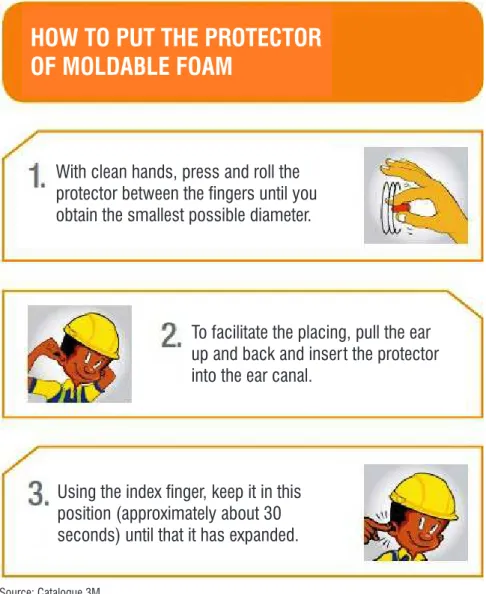
Figure 1. Orientation provided by the manufacturer of auricular PPE of insertion of moldable foam kind.
With clean hands, press and roll the
protector between the ingers until you
obtain the smallest possible diameter.
HOW TO PUT THE PROTECTOR
OF MOLDABLE FOAM
To facilitate the placing, pull the ear
up and back and insert the protector
into the ear canal.
return to work and dismissal; 46,6% already observed the identiication of the environmental risks, specially the map of risk, as well as informative signs in their workplace and 17,3% have the possibility of change of function or breaks during the working hours.
Considering the evaluated ears, 44,1% presented normal hearing, 46,1% presented suggestive thresholds of NIHL and 9,8% have some other hearing alteration not characteristic of NIHL, conform classiication of NR-715.
The distribution of the descriptive measures of the hearing thresholds, obtained in the tonal audiometry with the use of PPE, by frequency, is showed in Table 1.
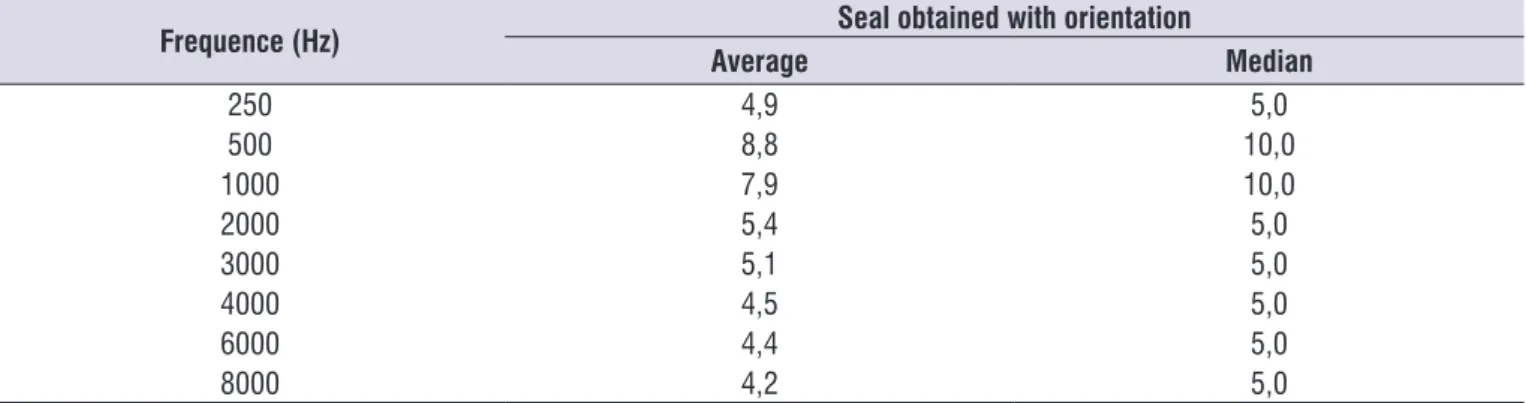
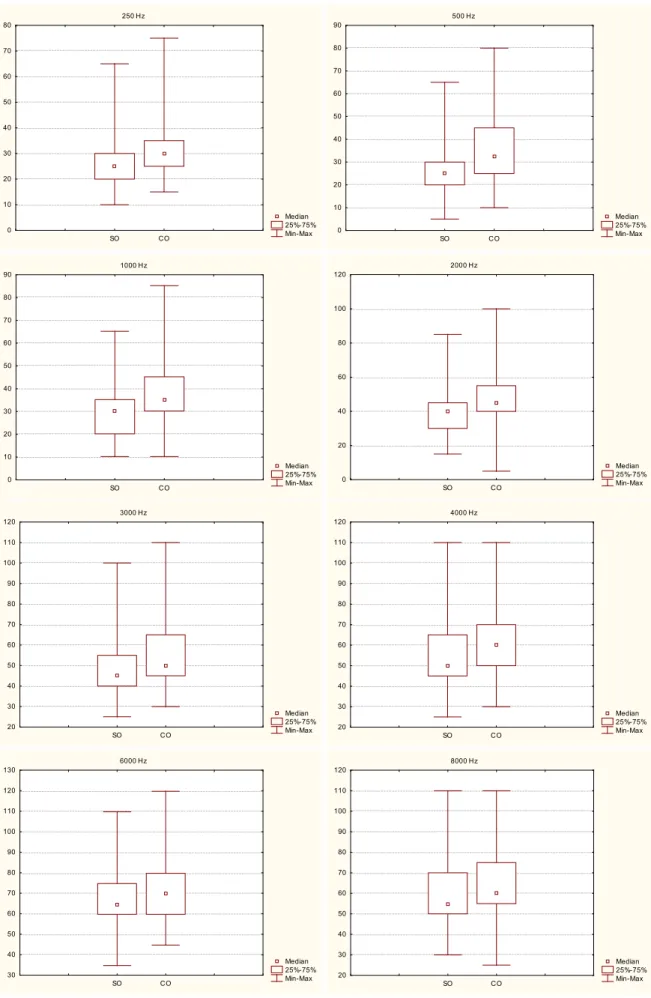
Comparing the results between the second audiometry (with auricular PPE and without orientation) and the third audiometry (with auricular PPE and orien-tation about the adequate use), in all the frequencies there was signiicant difference (p<0,001) (Table 2 and Figure 1).
companies, and more than the half (57,3%) have already been exposed to noise in previous jobs.
In the occupational anamnesis, when they were questioned about the use of auricular PPE in the daily working hours, 57,3% of the workers informed that they use auricular PPE, from these 48,8% speciied the use of shell type, 48,8% of plug type and 2,3% both types combined. About the dynamics of prevention of hearing loss in the work environment, when questioned if they know about the Hearing Conservation Program (HCP) and the existence of the same in the company that they act, 12% referred that they know it and that the Program functioned, 90,6% afirmed to receive the auricular PPE and 20,0% had help for the management of the device. In relation to the education in occupational health, 29,3% already had lectures or events of Internal Commission for Accident Prevention as well as Internal Week for Prevention of Accidents in the Workplace for example; 76,0% informed to perform audiometric exams in the admission, periodical, change of function,
Table 1. Distribution of the descriptive measures obtained in the audiometry with auricular protector, without and with orientation of the phonoaudiologist (n=102)
Frequence (Hz) Audiometry without orientation Audiometry with orientation
Average Median Min. Max. Average Median Min. Max.
250 26,9 25,0 10,0 65,0 31,8 30,0 15,0 75,0
500 25,2 25,0 5,0 65,0 34,0 32,5 10,0 80,0
1000 29,1 30,0 10,0 65,0 37,0 35,0 10,0 85,0
2000 41,0 40,0 15,0 85,0 46,4 45,0 5,0 100,0
3000 49,6 45,0 25,0 100,0 54,8 50,0 30,0 110,0
4000 56,4 50,0 25,0 110,0 60,9 60,0 30,0 110,0
6000 67,8 65,0 35,0 110,0 72,2 70,0 45,0 120,0
8000 60,9 55,0 30,0 110,0 65,2 60,0 25,0 110,0
Subtitle: Hz – Hertz; Min – minimum; Max – maximum.
Table 2. Average and median values, obtained in the audiometric evaluation after the orientation of the phonoaudiologist (n=102)
Frequence (Hz) Seal obtained with orientation
Average Median
250 4,9 5,0
500 8,8 10,0
1000 7,9 10,0
2000 5,4 5,0
3000 5,1 5,0
4000 4,5 5,0
6000 4,4 5,0
8000 4,2 5,0
250 H z
Median 25%-75% Min-Max
SO C O
0 10 20 30 40 50 60 70 80
500 H z
Median 25%-75% Min-Max
SO C O
0 10 20 30 40 50 60 70 80 90
1000 H z
Median 25%-75% Min-Max
SO C O
0 10 20 30 40 50 60 70 80 90
2000 H z
Median 25%-75% Min-Max
SO C O
0 20 40 60 80 100 120
8000 H z
Median 25%-75% Min-Max
SO C O
20 30 40 50 60 70 80 90 100 110 120
4000 H z
Median 25%-75% Min-Max
SO C O
20 30 40 50 60 70 80 90 100 110 120 3000 H z
Median 25%-75% Min-Max
SO C O
20 30 40 50 60 70 80 90 100 110 120
6000 H z
Median 25%-75% Min-Max
SO C O
30 40 50 60 70 80 90 100 110 120 130
Subtitle: Hz – Hertz; Min – minimum; Max – maximum; SO – without orientation; CO – with orientation.
levels less elevated, close to the limits of safety2, are
potentially harmful, but the risk seems to be
underesti-mated both by management and the employees 24.
In occupational health practices, we realize that many workers still do not have the consciousness of their rights and duties25. In occupational anamnesis,
performed in this study, we could identify that there were few workers who knew the attribution of the employers for the maintenance of their health.
When we relate the use of hearing protection to the existing legislation, as the providing, orientation and training for the adequate use of PPE, we observe that, although the employees receive the device, they are not trained to use it 20,22,26. The correct use of
auricular PPE, the control of noise and other measures of education in health, contribute in a signiicant way to minimize the effects of noise on the health of the workers. The providing of hearing protector should not be done without the elaboration of an adaptation work25. For this purpose, increasingly, studies are done
with educational actions, aiming to elucidate the best way to empower the workers in their rights and duties, in health and quality of life, as well as to stimulate them to good practices in the workplace6,24,27.
In the present study, there was signiicant difference when comparing the evaluation without and with the orientation of the phonoaudiologist about the adequate collocation of the auricular protector of insertion, moldable foam type (Table 2). It is relevant to highlight that there is an important component in the performed measures – the subjectivity of the test – which depends on the psychoacoustic conditions of the listener, the way how he puts the protector, his physical and psycho-motor conditions in the moment of the test, his ability in discriminating the sound16. The evaluated workers has
already performed the audiometric exam periodically in their work routine and, during the evaluations, there were breaks so the participants could reposition the auricular protector, without and with orientation of the phonoaudiologist, ignoring the effect of learning and possible improvement in the responses.
In the comparison between the values of the evaluation with the use of auricular PPE based on the collocation informed on the packaging and after the orientation of the professional phonoaudiologist (Figure 1), it was possible to observe a gain of 5 to 10dB only with the readaptation of the device in the auricular canal in an adequate way. In the literature consulted, only one study used similar method to this research, with the aim of evaluating the real attenuation offered
DISCUSSION
There are several methods in the literature 16-18 to
evaluate the attenuation and effectiveness of auricular PPE. According to the purpose of this study, we seek to ind accessible alternatives to the routine of audiometry for occupational purposes and viable in locations where the technological investment is still very strict. This discussion will be supported in research with similar objectives, even if they differ in relation to materials and methods used.
In the present research, the evaluated workers act, in average, for more than one decade with exposure to noise of machinery and most of them with previous jobs in similar exposure. In stable conditions, the increasing of the hearing threshold in acute frequencies such as 3, 4 and 6 kHz, generally, reach a plateau after about
10 to 15 years of exposure 6Noise-Induced Hearing
Loss (NIHL. It is probable that this time of exposure has contributed for the results obtained in the tonal audiometry of the participants, since the report of most of the workers is suggestive of NIHL 13.
In general, the adequate use of auricular PPE can help in the hearing conservation, however what is observed in literature is that, as well as in this present study, there are many workers who still did not add this device in their working activities 4,10,13,19,20. Contrary
to these studies, authors afirm that the use of hearing protection has been increasing due to a greater awareness of the responsible of the companies, mainly, after the changes in the legislation. In their research, most (100%, 92,3%, 56,8%, respectively) of workers referred to use effectively some type of auricular protector 21-23.
The active phonoaudiologist in occupational health has to be aware and verify, together with the team of work security, if those employees that referred to use the auricular protector, do it continuously, because, otherwise, the attenuation becomes not effective 4.
It becomes relevant to elucidate the dificulty of perception of the workers that are continually exposed to noise, because a minority of the workers evaluated informed that they do not believe that they were effec-tively exposed to noise, that is, they thought there was not a level of elevated sound pressure in their workplace capable of causing them any harm. It is worth mentioning that in companies with levels of noise more elevated, the perception of risk is greater, on the other hand in situations in which the levels are lower (close to the limits of safety2), the use of auricular
and capable of promoting actions referring to the health of the worker. It revealed, thus, his convenient condition of demanding his space together with the acting multi-professional team, also provided for the current legislation, together with workers exposed to noise. The presence of the phonoaudiologist can favor the health of the worker exposed to noise, because, more than diagnosing, the phonoaudiologist with his technical-scientiic know-how can orientate employers and workers in relation to the care with hearing health.
The method used to evaluate the attenuation offered by the auricular protector, constituted itself as an important limitation to the present study. Thus, it is suggested to new research that the essay to measure the attenuation provided by auricular PPE is performed in ield, using loudspeaker boxes, which is considered gold standard in this type of evaluation.
CONCLUSION
The results obtained in the evaluated moments show the condition of hearing of the workers and, comparatively, a greater effectiveness and attenuation of the auricular protector, of moldable foam type, after adequate orientation of the phonoaudiologist.
REFERENCES
1. BRASIL. Ministério do Trabalho e Emprego. Legislação – Normas Regulamentadoras. NR 6 – Equipamento de Proteção Individual - EPI. Brasília, 2008. Disponível em: <http://portal.mte.gov.br/ data/iles/8A7C816A47594D 04014767F2933F5800/ NR-06%20(atualizada)%202014.pdf>. Acesso em: 10/02/ 2015.
2. BRASIL. Ministério do Trabalho e Emprego. Legislação – Normas Regulamentadoras. NR 15 - Atividades e Operações Insalubres. 2009. Disponível em: <http://portal.mte.gov.br/data/ files/8A7C816A47594D040147D14EAE840951/ NR-15%20(atualizada%202014).pdf>. Acesso em: 10/02/2015.
3. Vendrame AC. EPI: Não basta fornecer, tem de cumprir a legislação. Internet. Disponível em: <http://viaseg.com.br/artigos/epi.htm> Acesso em: 26/01/2015.
4. Arezes PM, Miguel AS. Assessing the use of hearing protection in industrial settings: A comparison between methods. Int. J. Ind. Ergon. 2013;43:518-25.
by the hearing protector, silicone plug type (NRRsf 17dB) and, comparing the attenuation provided by the manufacturer 17. The authors concluded that the levels
of attenuation found in the research were signiicantly compatible to the informed by the manufacturer of the PPE used. The referred study did not clarify if the authors did orientation about the collocation of the auricular protector or not, one of the main purposes of the present study, as it concerned in comparing the seal obtained with the same device with and without orientation of phonoaudiologist.
With the objective of reducing the subjectivity, inherent to the research with human beings, in the measurement performed with Auditory Steady State Response (ASSR) in ield, the referred researchers found values of attenuation inferior to the informed by CA, noticing a difference even bigger in the protector of insertion of silicone when comparing with the shell type. They also clarify that the sample was consti-tuted of 10 volunteers without historical of exposure to noise, taking, in average, two hours for the evalu-ation, however with good reproducibility in the tested frequencies 16.
The level of education was not contemplated in the occupational anamnesis of this study, however, it is characterized as an important bias and a question to be discussed in new approaches with workers exposed to noise, once that the degree of education seems to intervene in the effective use of auricular PPE21, and it is
more used among workers with a superior level of quali-ication 4, besides inluencing in the comprehension of
the orientations of the phonoaudiologist.
Some politics of hearing conservation in the companies is of extreme relevance, because it has the potential of education and it can make the employees aware about the use of hearing protectors and the risks to which they are exposed, if they do not make the adequate adaptation. In the companies that adopt stricter postures referring to the non use of the auricular protector, the number of workers that try to adapt themselves to some of the different models of the device is superior to the others24.
Quadro II. Diário Oicial da União: Programa de Controle Médico de Saúde Ocupacional (PCMSO); 1998:64-6.
16. Queiroz JL, Fernandes JC. Aplicação de exame de resposta auditiva de estado estável para avaliação da atenuação de protetores auriculares. In: XXX Encontro Nacional de Engenharia de Produção, São Carlos, SP, Brasil. 2011.
17. De Faria CAR, Suzuki FA. Avaliação dos limiares auditivos com e sem equipamento de proteção o individual. Braz. J. Otorhinolaryngol. 2008;74(3):417-22.
18. Samelli AG, Rocha CH, Theodósio P, Moreira RR, Neves-Lobo IF. Training on hearing protector insertion improves noise attenuation. CoDAS. 2015. No prelo.
19. Silva MC, Orlandi CG, Chang EM, Siviero J, Pinto MM, Armellini PFS et al. Níveis de ruído na lavanderia de um hospital público. Rev CEFAC. 2011;13(1):472-8.
20. Wictor IC, Bazzanella SL. Avaliação ergonômica do nível de ruído e as causas de acidentes em madeireiras. In: IX SEGeT.2012, Resende-RJ. 21. Moreira AC, Gonçalves CGO. A eiciência de
oicinas em ações educativas na saúde auditiva realizadas com trabalhadores expostos ao ruído. Rev CEFAC 2014;16(3):723-31.
22. Heupa AB, Gonçalves CGO, Coifman H. Effects of impact noise on the hearing of military personnel. Braz. J. Otorhinolaryngol. 2011;77(6):747-53. 23. McCullagh MC, Ronis DL, Lusk SL. Predictors of
use of hearing protection among a representative sample of farmers. Res. Nurs. Heal. 2010;33:528-38. 24. Bockstael A, Bruyne LD, Vinck B, Botteldooren
D. Hearing protection in industry: Companies’ policy and workers’ perception. Int. J.Ind. Ergon. [serial on the internet] 2012 Aug [cited 2015 Feb 25]; 43(8):[512-7]. Available from: <http://dx.doi. org/10.1016/j.ergon.2012.08.009>.
25. Sviech PS, Gonçalves CGO, Morata TC, Marques JM. Avaliação do conforto do protetor auditivo individual numa intervenção para prevenção de perdas auditivas. Rev CEFAC. 2013;15(2):1325-37. 26. BRASIL. Ministério do Trabalho e Emprego.
Legislação – Normas Regulamentadoras. NR 9 – Programa De Prevenção de Riscos Ambientais. Disponível em: <http://portal.mte.gov.br/data/ iles/FF80808148EC2E5E014961B76D 3533A2/ NR09%20(atualizada%202014)%20II.pdf>. Acesso em: 1º/06/2015.
5. Agência Europeia para a Segurança e a Saúde no Trabalho. O impacto do ruído no trabalho. Disponível em: <https://osha.europa.eu/pt/ publications/ factsheets /57> Acesso em: 10/02/2015.
6. Metidieri MM, Rodrigues HFS, De Oliveira Filho FJMB, Ferraz DP, De Almeida Neto AF, Torres S. Noise-Induced Hearing Loss (NIHL): Literature review with a focus on occupational medicine. Intl. Arch. Otorhinolaryngol. 2013;17(2):208-12.
7. Nunes CP, Abreu TRM De, Oliveira VC, Abreu RM De. Sintomas auditivos e não auditivos em trabalhadores expostos ao ruído. Rev. Baiana Saúde Pública. 2011;35(60):548-55.
8. Brisolin D, Bidel RMR, Severo CDM, Zago VLP, Paini JFP. Ruído: conhecimento dos trabalhadores e seus efeitos no organismo. Rev. de Enferm.. 2012;8(8):42-54.
9. Dantas ANM, Higuchi MIG. Abordagem dos proissionais de saúde frente ao programa de prevenção de perda auditiva no pólo industrial de Manaus. Rev CEFAC. 2013;15(6):1418-26.
10. Singh LP, Bhardwaj A, Deepak KK. Occupational Noise-Induced Hearing Loss in Indian Steel Industry Workers: An Exploratory Study. Hum. Fac. Ergon. Soc. 2012;55(2):411-24.
11. Costa, CB, Gama WU, Momensohn-Santos, TM. Eicácia do Protetor Auditivo de Inserção em Programa de Prevenção de Perdas Auditiva. Intl. Arch. Otorhinolaryngol. 2009;13(3):281-6.
12. Sviech PS, Gonçalves CGO, Morata TC, Marques JM. Avaliação do conforto do protetor auditivo individual numa intervenção para prevenção de perdas auditivas. Rev CEFAC. 2013;15(5):1325-37. 13. Leão RN, Dias FAM.Peril audiométrico de
indivíduos expostos ao ruído atendidos no núcleo de saúde ocupacional de um hospital do município de Montes Claros, Minas Gerais. Rev CEFAC. 2010;12(2):242-9.
14. Meira TC, Ferrite S, Cavalcante F, Corrêa MJM. Exposição ao ruído ocupacional: relexões a partir do campo da Saúde do Trabalhador. Interfac EHS. 2012;3(7):26-45.