(1) Faculdade de Filosoia e Ciências da Universidade Estadual Paulista, UNESP, Marília, SP, Brazil.
(2) Instituto Brasileiro de Fluência, São Paulo, SP, Brazil.
Study conducted at the Laboratório de Estudos da Fluência – LAEF and at the Laboratório de Investigação do Processamento Auditivo Central – LIPAC, Departamento de Fonoaudiologia, Faculdade de Filosoia e Ciências, Universidade Estadual Paulista “Júlio de Mesquita Filho” – UNESP – Marília (SP), Brasil.
Research support source: FAPESP
Conlict of interest: Nonexistent
The role of auditory temporal cues
in the fluency of stuttering adults
Juliana Furini(1)
Luana Altran Picoloto(1)
Eduarda Marconato(1)
Anelise Junqueira Bohnen(2)
Ana Claudia Vieira Cardoso(1)
Cristiane Moço Canhetti de Oliveira(1)
Received on: March 28, 2017 Accepted on: August 11, 2017
Mailing address:
Cristiane Moço Canhetti de Oliveira Av. Hygino Muzzi Filho, 737, Vila Universitária – Marília, São Paulo, Brasil CEP: 17525-000
E-mail: [email protected]
ABSTRACT
Purpose: to compare the frequency of disluencies and speech rate in spontaneous speech and reading in adults with and without stuttering in non-altered and delayed auditory feedback (NAF, DAF).
Methods: participants were 30 adults: 15 with Stuttering (Research Group - RG), and 15 without stuttering (Control Group - CG). The procedures were: audiological asses-sment and speech luency evaluation in two listening conditions, normal and delayed auditory feedback (100 milliseconds delayed by Fono Tools software).
Results: the DAF caused a signiicant improvement in the luency of spontaneous spe-ech in RG when compared to spespe-ech under NAF. The effect of DAF was different in CG, because it increased the common disluencies and the total of disluencies in sponta-neous speech and reading, besides showing an increase in the frequency of stuttering--like disluencies in reading. The intergroup analysis showed signiicant differences in the two speech tasks for the two listening conditions in the frequency of stuttering-like disluencies and in the total of disluencies, and in the lows of syllable and word-per--minute in the NAF.
Conclusion: the results demonstrated that delayed auditory feedback promoted luency in spontaneous speech of adults who stutter, without interfering in the speech rate. In non-stuttering adults an increase occurred in the number of common disluencies and total of disluencies as well as reduction of speech rate in spontaneous speech and reading.
INTRODUCTION
Speech is a high complexity linguistic and motor act, taking into consideration that it requires the harmonic and temporal coordination of neural, muscular (respiratory, phonatory and articulatory) and auditory processes. Fluency is the result of the synchrony between neuronal activities necessary for speech1. Therefore, luency is one of the aspects of
speech production, characterized as a multifaceted phenomenon, composed by the following elements:
hesitations or disluencies, reformulations, luent silent
pauses, speech rate or speech velocity, smoothness or ease of emission, grammatical ability and semantic complexity2,3. Disluencies may present with muscular
tension and impair the smoothness of speech4, and
speech rate5.
Stuttering has been described as a disorder in the temporal motor sequence of speech6, and a luency
disorder that interrupts rhythm and time, producing frequent repetitions, prolongations and blocks of syllables and words7. Persistent Developmental
Stuttering presents characteristics of chronicity and varying degrees of severity8. It is the main and
most prevalent luency disorder, and it is not only related to disluencies, but also to readiness in motor
programming of slowed speech9,10 and abnormal motor
preparation11.
Many studies12-16 with neuroimaging performed in
persons who stutter have shown relevant results on the auditory regions and their connections with other brain areas in the speech production. The presence
of a generalized motor sensorial temporal deicit due
to the communication impairment between the brain areas related to the speech of stutters was described12.
Deicits in auditory and motor integration were reported
by several researchers13,14. Atypical development of
the auditory-motor and thalamic-cortical circuits of the basal ganglia was found in children with stuttering, which in turn, affects the speech planning and execution
processes required to achieve motor control of luent
speech15. Adults who stutter showed hyperactivity in
right hemisphere regions such as the inferior frontal cortex (IFC) and the anterior insula but at the same
the literature17-21, arousing thus the interest among
researchers about the topic of stuttering and hearing.
Studies in luent individuals have shown that delayed auditory feedback (DAF) has caused dificulties in speech luency16-22, and decrease in speech rate23-25.
In persons who stutter the delay in the delayed
auditory feedback caused the increase of luency26-29
and the decrease of stuttering30. There is no consensus
among the researchers about the effect of DAF caused in the speech rate of people with stuttering.
A systematic review of researches related to the
effects of altering auditory feedback on speech luency
in stutterers concluded that the exclusive use of delayed auditory feedback does not provide conclusive results31. The authors suggest some considerations for
the future researches planning as: expansion of the number of participants, existence of the control group, masking of groups, among others.
The purpose of this study was to compare the
frequency of disluencies and the speech rate of sponta -neous speech and reading between the non-altered auditory feedback (NAF) and delayed auditory feedback (DAF) in adults with and without stuttering.
METHODS
This study was approved by the Research Ethics Committee of the Universidade Estadual Paulista “Júlio de Mesquita Filho” (UNESP) under the protocol number 0669/2013. All participants signed the Informed Consent Form before participating in the study. All the recommendations of the Resolution CNS 466/2012 were followed.
This study is a cross-sectional prospective study with comparison between groups. The sample consisted of 30 adults, aged from eighteen to forty-six years (mean = 28.66 years, SD = 10.04). The research group (RG) consisted of 15 adults with persistent devel-opmental stuttering, being 12 of the masculine gender and 3 of the feminine gender. The control group (CG)
was composed of 15 luent adults, matched by gender
and age at RG.
specialist professional in the area; present at least 3%
of stuttering-like disluencies, observed in the speech
for a minimum of 12 months, and; present stuttering
classiied at least as mild degree according to the
Stuttering Severity Instrument - SSI-332.
For the control group composition of luent adults
(CG), the following inclusion criteria were followed: do not present current or previous stuttering complaint; negative stuttering familial history; present less than 3%
of stuttering-like disluencies in the luency evaluation.
The exclusion criteria for the two groups were: to present other speech and hearing complaints, auditory, neurological, behavioral, learning disorders, or other pertinent alterations that could generate diagnostic errors.
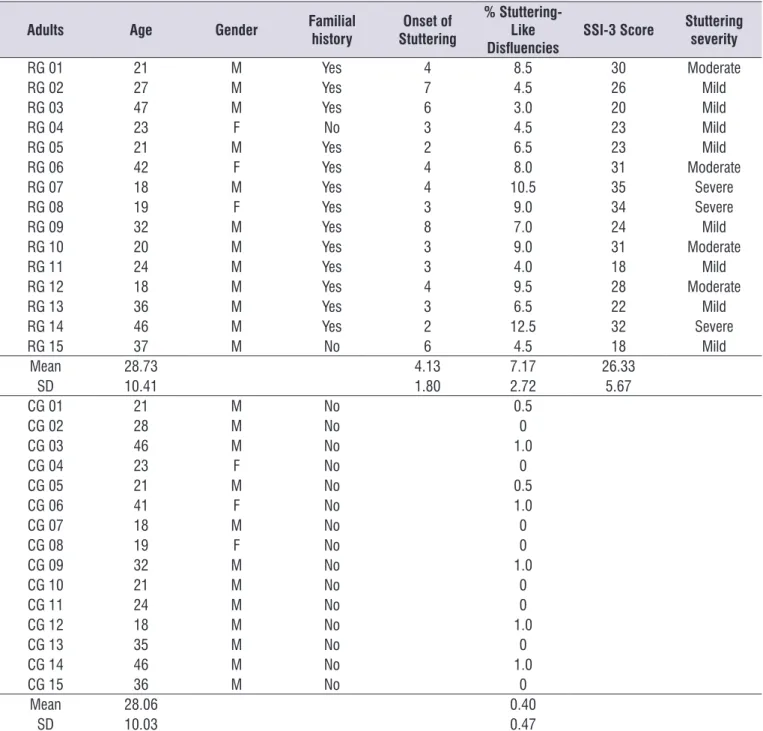
Regarding the characterization of adults from RG, it was possible to verify that the mean age at the beginning of stuttering was 4.13 years. Most of the participants (86.6%) had familial persistent develop-mental stuttering, with a variation in the percentage of
stuttering-like disluencies from 3.0 to 12.5% (mean
= 7.17, SD = 2.72) (Table 1). The stuttering severity ranged from mild to severe, with a SSI-3 total average score of 26.33 (from 18 to 35). The adults from CG were matched by gender and age at RG, and the
stuttering-like disluencies percentage ranged from 0 to 1% (mean
= 0.40, SD = 0.47).
Procedures
Initially the adults received information about the objectives of the study, and explanation about the procedures that were performed and provided written consent for participation in the research. The data collection was performed through audiovisual recording, transcription and analysis of the
sponta-neous speech luency and reading in both groups (RC
and CG).
The collected speech samples consisted of sponta-neous speech (monologue) and reading of a text, in two different listening conditions, namely: non-altered auditory feedback (NAF) and delayed auditory feedback (DAF). The oral reading was carried out through a text suitable for adults33.
The audiovisual recordings of a self-expressive
speech sample composed of 200 luent syllables and
a text reading were performed using a camera, tripod, earphone and microphone connected to a computer in which software was used (Fono Tools). Adult’s speech was recorded and processed using a software that performed Delayed Auditory Feedback (DAF) and it was returned to the adult’s ear with a delay of 100 milli-seconds through the earphone.
After the adults’ speech collection, they were
transcribed in full, considering the luent and not luent syllables. Subsequently, analyzes of the speech samples were performed and the typology of dislu -encies was characterized, according to the following description34:
• Common Disluencies: hesitations, interjections,
revisions, uninished words, segments repetition,
words repetition and phrases repetition.
• Stuttering-Like Disluencies: two or more repetitions of sounds and/or syllables and/or words, prolonga-tions, blocks, pauses and intrusions.
To characterize the frequency of disruptions, the following measures were used: percentage of speech
discontinuity, percentage of common disluencies and percentage of stuttering-like disluencies. The speech rate was measured in low of syllables (SPM) and words
per minute (WPM).
The Stuttering Severity Instrument (SSI-3)32 was
used for each stuttering adult participant classifying stuttering as mild, moderate, severe, or very severe. This test evaluates the frequency and duration of atypical speech disruptions and the presence of
physical concomitants associated with disluencies.
Statistical method
For the statistical treatment were used: the non-parametric Mann-Whitney test for the group comparison, and the Wilcoxon Signal Test for the
intragroup comparison. The values of statistical signii
-cance were set at p<0.05. Signiicant p-values were
Table 1. Description of the participants from the research group and the control group
Adults Age Gender Familial
history
Onset of Stuttering
% Stuttering-Like
Disluencies SSI-3 Score
Stuttering severity
RG 01 21 M Yes 4 8.5 30 Moderate
RG 02 27 M Yes 7 4.5 26 Mild
RG 03 47 M Yes 6 3.0 20 Mild
RG 04 23 F No 3 4.5 23 Mild
RG 05 21 M Yes 2 6.5 23 Mild
RG 06 42 F Yes 4 8.0 31 Moderate
RG 07 18 M Yes 4 10.5 35 Severe
RG 08 19 F Yes 3 9.0 34 Severe
RG 09 32 M Yes 8 7.0 24 Mild
RG 10 20 M Yes 3 9.0 31 Moderate
RG 11 24 M Yes 3 4.0 18 Mild
RG 12 18 M Yes 4 9.5 28 Moderate
RG 13 36 M Yes 3 6.5 22 Mild
RG 14 46 M Yes 2 12.5 32 Severe
RG 15 37 M No 6 4.5 18 Mild
Mean 28.73 4.13 7.17 26.33
SD 10.41 1.80 2.72 5.67
CG 01 21 M No 0.5
CG 02 28 M No 0
CG 03 46 M No 1.0
CG 04 23 F No 0
CG 05 21 M No 0.5
CG 06 41 F No 1.0
CG 07 18 M No 0
CG 08 19 F No 0
CG 09 32 M No 1.0
CG 10 21 M No 0
CG 11 24 M No 0
CG 12 18 M No 1.0
CG 13 35 M No 0
CG 14 46 M No 1.0
CG 15 36 M No 0
Mean 28.06 0.40
SD 10.03 0.47
Subtitle: RG = research group; CG = control group; SD = standard deviation; M = male; F = female; SSI-3 = Stuttering Severity Instrument
RESULTS
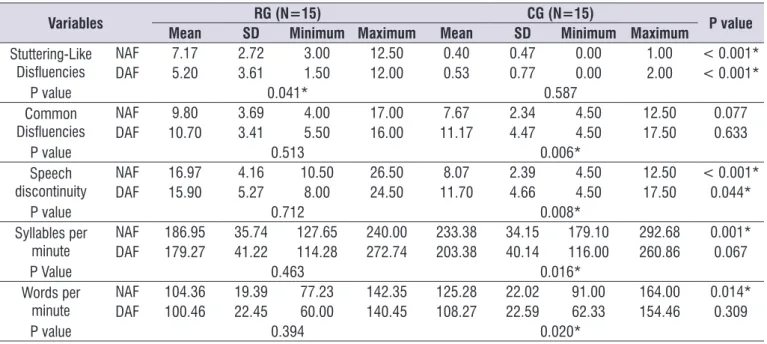
Results regarding spontaneous speech are presented in Table 2. The intragroup comparison of adults with stuttering (RG) showed a statistically
discontinuity, lows of syllable and word-per-minute
between NAF and DAF conditions. There was an
increase in the common disluencies occurrence and
speech discontinuity in spontaneous speech with
Table 2. Intragroup and intergroup comparisons regarding the occurrence of stuttering-like disluencies, common disluencies, speech discontinuity, low of syllables and words per minute, in the conditions of non-altered and delayed auditory feedback in spontaneous speech
Variables RG (N=15) CG (N=15) P value
Mean SD Minimum Maximum Mean SD Minimum Maximum
Stuttering-Like
Disluencies NAFDAF 7.175.20 2.723.61 3.001.50 12.0012.50 0.400.53 0.470.77 0.000.00 2.001.00 < 0.001*< 0.001*
P value 0.041* 0.587
Common
Disluencies NAFDAF 10.709.80 3.693.41 4.005.50 16.0017.00 11.177.67 2.344.47 4.504.50 17.5012.50 0.0770.633
P value 0.513 0.006*
Speech
discontinuity NAFDAF 16.9715.90 4.165.27 10.508.00 24.5026.50 11.708.07 2.394.66 4.504.50 17.5012.50 < 0.001*0.044*
P value 0.712 0.008*
Syllables per
minute NAFDAF 186.95179.27 35.7441.22 127.65114.28 272.74240.00 233.38203.38 34.1540.14 116.00179.10 260.86292.68 0.001*0.067
P Value 0.463 0.016*
Words per
minute NAFDAF 104.36100.46 19.3922.45 77.2360.00 140.45142.35 125.28108.27 22.0222.59 62.3391.00 154.46164.00 0.014*0.309
P value 0.394 0.020*
* Statistically signiicant values (p <0.05) - Mann-Whitney test for intergroup comparison and Wilcoxon Signal Test for intragroup comparison between NAF and DAF. Subtitle: RG = research group; CG = control group; N = number of adults; SD = standard deviation, NAF = Non-altered auditory feedback; DAF = Delayed auditory feedback.
minute. RG showed more disluencies (stuttering-like disluencies and speech discontinuity) and lower low
of syllables and words per minute in relation to CG (Table 2).
The results regarding the reading are presented in Table 3. The RG intragroup comparison did not show
statistically signiicant difference between NAF and DAF
conditions for the different variables analyzed. Fluent
adults (CG) showed statistically signiicant differences for all variables, i.e. stuttering, common disluencies, speech discontinuity, low of syllables and words per
minute between NAF and DAF conditions. There was
an increase in the occurrence of stuttering-like dislu -encies and speech discontinuity, as well as a decrease
in the amount of common disluencies in the delayed
auditory feedback condition. Regarding the speech
rate, CG presented a reduction in the low of syllables
and words per minute in DAF in relation to NAF (Table 3).
The comparison between RG and CG in reading showed that in both NAF and DAF conditions there
were statistically signiicant differences for all variables, namely stuttering-like disluencies, common dislu
-encies, speech discontinuity, low of syllables and words per minute. RG presented more disluencies (stuttering-like disluencies, common disluencies and speech discontinuity) and lower low of syllables and
DISCUSSION
The relevance of studies about the inluence of temporal auditory cues on speech luency in stutterers
has been emphasized in the literature26,28-30. Differences
in the nervous system areas related to the auditory-motor circuit were found in persons with stuttering,
and these differences may impair the speech luency
planning and execution12,15. Thus, this study analyzed
the effect of delayed auditory feedback in adults with
stuttering in the frequency of disluencies and speech
rate in spontaneous speech and reading of text, and
compared it with luent adults, through a speciic
software.
The data obtained in the spontaneous speech allowed to verify in the intragroup analysis that the adults with stuttering reduced the amount of
stuttering-like disluencies. Therefore, the delay in auditory feedback caused promotion of the speech luency of
adults with stuttering, as described previously26,28-30.
The effect of DAF was satisfactory in adults with
nervous system, as described in the literature36, in the
adequate command of the signals to the motor activity
control necessary to the production of luent speech.
Researches37 also suggest that the act of monitoring
another speech, as with the chorus effect that delayed auditory feedback causes, assists the stuttering speaker to generate temporal patterns and articulatory
gestures that are necessary in luent speech. The
authors believe that DAF can improve sensorimotor multimodal integration, particularly in the neural system related to speech and auditory system processing.
There was a mean reduction in the frequency
of stuttering-like disluencies of 27.5% with delayed
auditory feedback, lower than those reported in other studies that were performed using SpeechEasy 45%29
and 40%30. The difference between these values
can be attributed to some variables, as, two studies analyzed used the SpeechEasy to provoke the delay, and besides the delay was used the frequency altered feedback. Another important variable is that Ritto’s Table 3. Intragroup and intergroup comparisons regarding the occurrence of stuttering-like disluencies. common disluencies. speech discontinuity. low of syllables and words per minute. in the conditions of non-altered and delayed auditory feedback in reading
Variables RG (N=15) CG (N=15) P value
Mean SD Minimum Maximum Mean SD Minimum Maximum
Stuttering-Like
Disluencies NAFDAF 3.673.30 4.483.68 0.000.00 10.0016.50 0.130.53 0.230.55 0.000.00 2.000.50 < 0.001*< 0.021*
P value 0.788 0.013*
Common
Disluencies NAFDAF 6.436.33 4.403.73 0.000.50 13.0013.50 3.372.83 1.011.69 0.000.00 7.003.50 < 0.001*0.004*
P value 0.571 0.002*
Speech
discontinuity NAFDAF 10.109.63 6.256.79 1.001.00 20.5019.50 1.503.37 1.071.73 0.500.00 8.003.50 < 0.001*0.004*
P value 0.294 0.001*
Syllables per
minute NAFDAF 217.72193.62 66.4057.57 109.0996.00 300.00352.94 313.97255.67 33.5341.81 200.00260.86 333.33352.94 <0.001*0.004*
P value 0.100 0.002*
Words per minute NAFDAF 102.1799.95 28.0527.87 57.2749.92 164.11147.00 127.72142.47 15.7721.05 116.0897.00 168.33168.33 <0.001*0.008*
P value 0.570 0.009*
signiicant effect on lows of syllables and words per minute. It is worth mentioning that the indings were
similar to a study that showed both the statistically
signiicant effect on the reduction in the frequency of stuttering, and also there was no signiicant effect
on the speech rate with DAF37-39. Therefore, the data
suggest that the reduction of stuttering with the effect of DAF is not directly related to the reduction of the speech rate.
In the comparative analysis between spontaneous speech and reading of the effect of DAF on adults with
stuttering the results showed a positive and signiicant effect only for stuttering-like disluencies in spontaneous
speech. The data suggest a tendency to decrease the
analyzed variables, except for common disluencies in
spontaneous speech, in which there was an increase. The results regarding the effects of delayed auditory
feedback on spontaneous speech and reading of luent adults showed that there was a signiicant effect for all measures assessed on the frequency of disluencies and the speech rate, except for stuttering-like dislu -encies in spontaneous speech.
In relation to the increase of the disluencies caused by the delay in the auditory feedback of luent adults
in the spontaneous speech found in this investigation,
the data corroborate reports that described dificulties in the luent speech with DAF17,22,29. One possible
explanation for this inding is that delayed auditory feedback causes in the luent speakers the adoption of
motor control strategies based on auditory feedback, but it results in an interference in a speech monitoring system already effective, and for this reason, increases
stuttering-like disluencies29.
According the literature, the most cited effect of
delayed auditory feedback in luent persons is the
reduction of speech rate23-25. It should be noted that
the indings of this study conirm this statement, since
in both spontaneous speech and reading there was a
decrease in the low of syllables and words per minute in luent adults.
The speech rate showed a tendency to decrease under the effect of delayed auditory feedback in both groups, both for spontaneous speech and for reading.
However, in relation to the frequency of disluencies,
the adults’ behavior with and without stuttering was different, because the RG showed a tendency to
decrease disluencies (except for common disluencies
in spontaneous speech) and the CG a tendency to
increase disluencies (with exception for common disluencies in reading). This inding suggests that the
decrease of speech rate does not necessarily increase
the luency for different speakers.
In the intergroup comparison of spontaneous speech, it was observed that the delay in auditory feedback decreases the differences between adults with and without stuttering for the analyzed variables,
because there were more statistically signiicant differ -ences for NAF in relation to DAF. This result was already expected, since the main characteristic of stuttering is the increase in the amount of stuttering-like
disluencies35. Adults with stuttering showed signii
-cantly more stuttering-like disluencies in both NAF and DAF compared to luent adults, which possibly also led
to an increase in speech discontinuity in adults with
stuttering, thus showing statistically signiicant differ -ences between groups in both listening conditions.
It is also known that, due to the increase of the
disluencies in the low of stutterers’ speech, in general occurs a decrease in the low of syllables and words
per minute5. The indings of this study corroborate this
description as adults with stuttering showed lows of syllable and words per minute signiicantly lower than the luent adults in the non-altered auditory feedback
condition.
In summary, these indings contributed to charac -terize the effect of delayed auditory feedback on spontaneous speech and reading of adults with and without stuttering, and to reinforce the positive effect of
delay in reducing the frequency of stuttering-like dislu -encies in spontaneous speech in adults with stuttering. Further researches may investigate the variability of
delayed auditory feedback results speciically in the
different severities of stuttering.
CONCLUSION
The results showed that the delayed auditory
feedback promoted luency in the spontaneous speech
of adults with stuttering, without interfering in the speech rate. However, in adults without stuttering, there
was an increase in the number of common disluencies
and speech discontinuity in spontaneous speech and reduction of speech rate.
REFERENCES
1. Oliveira CMC, Bohnen AJ. Diagnóstico diferencial
dos distúrbios da luência. In: Lamônica DAC, Britto
DBO (ed). Tratado de linguagem: perspectivas contemporâneas. Ribeirão Preto (SP): Booktoy, 2017.p.175-82.
2. Merlo S. Hesitações na fala semi-espontânea: análise por séries temporais. [Dissertação] Campinas(SP): IEL-Universidade de Campinas; 2006.
3. Bohnen AJ. Estudo das palabras gaguejadas por crianças e adultos: caracterizando a gagueira como um disturbio da linguagem. [Tese]. Porto Alegre (RS): Universidade Federal do Rio Grande Sul; 2009.
4. Sasisekaran J. Nonword repetition and nonword reading abilities in adults who do and do not stutter. J Fluency Disord. 2013;38(3):275-89.
5. Arcuri CF, Osborn E, Schiefer AM, Chiari BM. Speech rate according to stuttering severity. Pró Fono R. Atual. Cient. 2009;21(1):45-50.
6. Alm PA. Stuttering and the basal ganglia circuits: a critical review of possible relations. J Commun Disord. 2004;37:325-69.
7. Liu J, Wang Z, Huo Y, Davidson SM, Klahr K, Herder CL et al. A Functional imaging study of self-regulatory capacities in persons who stutter. PLoS One. 2014;9(2):898-91.
8. Juste FS, Ritto AP, Silva KGN, Andrade CRF.
Sequential diadochokinesus in luent and stuttering
children: rate of production and type of errors. Audiol Commun Res. 2016;21e:1-7.
9. Andrade CRF, Juste, FS, Fortunato-Tavares TL.
Lexical priming in luent and with developmental
stuttering children. CoDAS. 2013;25(2):95-105. 10. Celeste LC, Martins-Reis VO. The impact of
a dysluency environment on the temporal
organization of consonants in stuttering. Audiol Commun Res. 2015;20(1):10-7.
11. Vanhoutte S, Cosyns M, Van Mierlo P, Batens K, Corthals P, De Letter M et al. When will a stuttering moment occur? The determining role of speech motor preparation. Neuropsy. 2016;86:93-102. 12. Joos K, Ridder D, Boey RA, Vannester S. Functional
to time-varying auditory perturbation during connected speech production in persons who stutter. Brain Lang. 2014;129:24-9.
14. Daliri A, Wieland EA, Cai S, Guenther FH, Chang SE. Auditory-motor adaptation is reduced in adults who stutter but not in children who stutter. Dev Sci. No prelo 2017.
15. Chang SE. Subtle differences in brain network connectivity in children who stutter. Procedia Soc Behav Sci. 2015;193:285.
16. Lu C, Long Y, Zheng L, Shi G, Liu L, Ding G et al. Relationship between speech production and perception in people who stutter. Front Hum Neurosci. 2016;10:224.
17. Chon H, Kraft SJ, Zhan J, Loucks T, Ambrose NG. Individual variability in delayed auditory
feedback effects on speech luency and rate in normally luent adults. J Speech Lang Hear Res.
2013;56(2):489-504.
18. Roob MP, Lynn WL, O’Beime A. An exploration of dichotic listening among adults who stutter. Clin Linguist Phon. 2013;27(9):681-93.
19. Jansson-Verkasalo E, Eggers K, Jarvenpaa A, Suominen K, Van den Bergh B, De Nil L et al. Atypical central auditory, speech-sound discrimination in children who stutter as indexed by the mismatch negativity. J Fluency Disord. 2014;41:1-11.
20. Daliri A, Max L. Modulation of auditory processing during speech movement planning is limited in adults who stutter. Brain Lang. 2015;143:59-68. 21. Prestes R, Andrade AN, Santo RBF, Marangoni
AT, Schiefer AM, Gil D. Temporal processing and long-latency auditory evoked potential in stutterers. Braz J Otorhinolaryngol. No prelo 2017.
22. Chester J, Baghai-Ravary L, Möttönen R. The effects of delayed auditory and visual feedback on speech production. J Acoust Soc Am. 2015;137(2):873-83. 23. Stuart A, Kalinowski J. The perception of speech
25. Yamamoto K, Kawabata H. Temporal recalibration in vocalization induced by adaptation of delayed auditory feedback. Plos One. 2011;6(12):1-8.
26. Foundas AL, Mock JR, Corey DM, Golob EJ, Conture EG. The SpeechEasy device in stuttering and nonstuttering adults: Fluency effects while speaking and reading. Brain Lang. 2013;126(2):141-50.
27. Hudock D, Kalinowski J. Stuttering inhibition via altered auditory feedback during scripted telephone conversations. Int J Lang Commun Disord. 2014;49(1):139-47.
28. Carrasco ER, Schiefer AM, Azevedo MF. Effect of the delayed auditory feedback in stuttering. Audiol Commun Res. 2015;20(2):116-22.
29. Ritto AP, Juste FS, Andrade CRF. The effect of the SpeechEasy® device on acoustic and speech motor parameters of adults who stutter. Audiol Commun Res. 2015;20(1):1-9.
30. Ritto AP, Juste FS, Stuart A, Kalinowiski J, Andrade CRF. Randomized Clinical trial: the use of SpeechEasy® in stuttering treatment. Int J Lang Commun Disord. 2016;51(6):769-74.
31. Andrade CR, Juste FS. Systematic review of delayed auditory feedback effectiveness for stuttering reduction. J Soc Bras Fonoaudiol. 2011;23(2):187-91.
32. Riley G. Stuttering severity instrument for young children (SSI-3) (3rd ed.). Austin, TX: Pro-Ed. 1994. 33. Saraiva RA, Moojen SPM, Munarski R. Avaliação
da compreensão leitora de textos expositivos para fonoaudiólogos e psicopedagogos. Casa do Psicólogo, 1° ed. 2006.
34. Andrade CRF. Fluência. In: Andrade CRF,
Béi-Lopes DM, Fernandes FDM, Wertzner HF,
editores. ABFW - Teste de linguagem infantil
nas áreas de fonologia, vocabulário, luência e
pragmática. 2a ed. Barueri (SP): Pró-Fono; 2011. p. 51-81.
35. Civier O, Bullock D, Max L, Guenther FH. Computational modeling of stuttering caused by impairments in a basal ganglia thalamo-cortical circuit involved in syllable selection and initiation. Brain Lang. 2013;126(3):263-78.
36. Smith A, Sadagopan N, Walsh B, Weber-Fox C. Increasing phonological complexity reveals heightened instability in inter-articulatory coordination in adults who stutter. J Fluency Disord. 2010;35(1):1-18.
37. Park J, Logan KJ. The role of temporal speech cues
in facilitating the luency of adults who stutter. J
Fluency Disord. 2015;46:41-55.
38. Kalinowski J, Stuart A, Sark S, Armson J. Stuttering amelioration at various auditory feedback delays and speech rates. Europ J Dis Commun. 1996; 31(3):259-69.