ABSTRACT
BACKGROUND AND OBJECTIVES:Fear of pain and
move-ment avoidance is a belief contributing to increase disability and mood changes in chronic low back pain patients. Exposure is a technique used for such belief, however there is still no consensus about the best way to perform it in low back pain patients. his study aimed at evaluating graded exposure for fear of pain and movement avoidance belief in chronic low back pain patients.
CONTENTS:he following databases were queried for the pe-riod from 2000 to 2015: Pubmed, PsycInfo, Web of Science, Ci-nahl and LILACS. Eligibility criteria were established for studies selection. Studies were irst selected by title and abstract. hen they were read in full. he search has resulted in 91 studies. From these, 38 were selected to be read in full. Among selected studies, 10 were excluded and 19 were repeated. Applying eligibility cri-teria, nine studies were included: for are before and after studies, one is a case report, one is a quasi-experimental study and three are randomized clinical trials.
CONCLUSION: Most studies of this review have compared in vivo exposure and graded activity, however they have not speciied how this was done. here is still no clarity about the advantages or methods to perform graded exposure in low back pain patients and further intervention studies on the subject are needed.
Keywords: Exposure, Fear of pain and movement avoidance, Low back pain.
RESUMO
JUSTIFICATIVA E OBJETIVOS: Medo da dor e evitação do
movimento é uma crença que contribui para o aumento da inca-pacidade e alterações do humor em pacientes com lombalgia crô-nica. A exposição é uma técnica utilizada para essa crença, porém ainda não há um consenso sobre a melhor forma de executá-la
Graded exposure for fear of pain and movement avoidance belief in
chronic low back pain patients
O uso da exposição gradual para a crença de medo da dor e evitação do movimento em
pacientes com lombalgia crônica
Érica Brandão de Moraes Vieira1, Cibele Andrucioli de Mattos Pimenta1
1. Universidade de São Paulo, Escola de Enfermagem, São Paulo, SP, Brasil.
Submitted in January 30, 2016. Accepted for publication in May 25, 2016. Conlict of interests: none – Sponsoring sources: none.
Correspondence to:
Av. Dr. Enéas de Carvalho Aguiar, 419 São Paulo, SP, Brasil.
E-mail: [email protected]
© Sociedade Brasileira para o Estudo da Dor
em pacientes com lombalgia. O objetivo deste estudo foi analisar o uso da exposição graded para a crença de medo da dor e evita-ção do movimento em pacientes com lombalgia crônica.
CONTEÚDO: Para busca da literatura analisaram-se as bases e bancos de dados Pubmed, PsycInfo, Web of Science, Cinahl e LILACS, no período entre 2000 e 2015. Critérios de elegibi-lidade foram estabelecidos para seleção dos estudos. Os estudos foram selecionados primeiramente a partir do título e resumo. Em seguida foram lidos na íntegra. Resultaram da busca biblio-gráica 91 estudos. Destes, 38 foram selecionados para a leitura na íntegra. Entre os selecionados, 10 foram excluídos após leitura na íntegra e 19 estavam repetidos. Aplicando-se os critérios de elegibilidade, restaram 9 estudos, que foram incluídos: quatro são estudos antes e depois, um relato de casos, um é estudo quase experimental e três são ensaios clínicos randomizados.
CONCLUSÃO: A maioria dos estudos desta revisão comparou exposição ao vivo com atividade graded, porém não especiicam como foram realizadas. Ainda não há clareza sobre as vantagens ou métodos de como realizar a exposição graded em pacientes com lombalgia, necessitando de maiores estudos de intervenção sobre o tema.
Descritores: Exposição, Lombalgia, Medo da dor e evitação do movimento.
INTRODUCTION
Cognitive-behavioral factors, such as dysfunctional beliefs, contribute to increased disability and mood changes in chronic low back pain patients1-3. Among beliefs considered
important to understand low back pain presentations, fear of pain and movement avoidance have been relevant4-9.
Fear is an emotional reaction to an immediate, speciic and identiied threat, aiming at protecting individuals from an imminent danger by promoting self-defense with struggle or escape response10. he term kinesiophobia, created in 1990,
refers to excessive, irrational and debilitating fear of move-ment and physical activity, resulting in an erroneous inter-pretation that movement would worsen the injury or would contribute to the occurrence of new injuries11. his idea was
irst described by Lethem et al.12 and Slade et al.13, was
re-formulated in 200014, 200715 and 20138 and has become the
Fear-Avoidance Model.
he model states that individuals experiencing a painful in-jury may deal with this in an adaptive or maladaptive way. If injury and painful experience are not perceived as
ing, they may be faced and treated adaptatively. Maladaptive coping occurs when, after injury and painful experience, neg-ative cognitions, such as catastrophizing, lead to fear of pain, movement avoidance behaviors, decreased daily activities and increased disability7,14. If a previously neuter movement is
fol-lowed by pain, this will be avoided in the future9. Avoidance
behaviors in general become persistent because they occur in response to a future expectation of pain and not necessarily to current pain16. Anxiety and hypervigilance are present in
such patients9,11.
Patients with high fear and movement avoidance are at higher risk of disability and need intervention aiming at changing this belief17. here is relationship between fear of pain and
move-ment avoidance and anxiety, depression and disability17-19.
A Brazilian cross-sectional study has observed that fear and movement avoidance behavior was a factor associated to in-creased disability in low back pain patients20. Another study
has observed that the higher the fear of these patients, the high-er the indices of disability, anxiety, depression and fatigue21.
here are several intervention studies on fear of pain and movement avoidance with favorable results, however there is still no consensus about the best strategy to be used to change this belief. Graded exposure of low back pain patients con-sists initially in ranking situations and movements avoided by patients for fear of pain. hen, patients perform movements chosen in the rank in a graded way, that is, starting from the movement causing less fear until the movement of major fear. his graded exposure strategy is already broadly used for pho-bias, which also involve exaggerated fear22,23,30.
Review studies on the subject have found contradictory re-sults and major methodological deiciencies, indicating the need for further investigations24,25. So, expanding existing
re-views this study was developed to analyze the efect of graded exposure on fear of pain and movement avoidance beliefs of chronic low back pain patients.
CONTENTS
For literature search Pubmed, PsycInfo, Web of Science, Ci-nahl and LILACS databases were analyzed between 2000 and
2015. he following research question was used for this study: “Which is the efect of graded exposure intervention on fear of pain and movement avoidance belief in chronic low back pain patients?”
Search strategy was developed according to PICO strategy concepts, acronym for Patient, Intervention, Comparison and Outcomes, which involves the fundamental elements of the search question, resulting in a more reined search focused on the objectives26. PICO strategy for this question is applied
as follows:
P: chronic low back pain patients; I: Graded exposure; C: there is no; O: Fear of pain and movement avoidance. Search was carried out with controlled and uncontrolled de-scriptors. Boolean operators AND and OR were used.
Search strategy was: (“Back Pain”[Mesh] OR “Low Back Pain”[Mesh]) AND (“Virtual Reality Exposure herapy”[Mesh] OR “Implosive herapy”[Mesh] OR “exposure”[All Fields]) AND (“fear-avoidance”[All Fields] OR “fear avoidance”[All Fields] OR “fear-avoidance belief ”[All Fields] OR “fear avoid-ance belief ”[All Fields] OR “fear-avoidavoid-ance attitude”[All Fields] OR “fear avoidance attitude”[All Fields] OR “fear-avoidance model”[All Fields] OR “fear “fear-avoidance model”[All Fields] OR “kinesiophobia”[All Fields] OR “pain-related fear”[All Fields] OR “pain related fear”[All Fields] OR “fear of pain”[All Fields] OR “Fear”[Mesh]”).
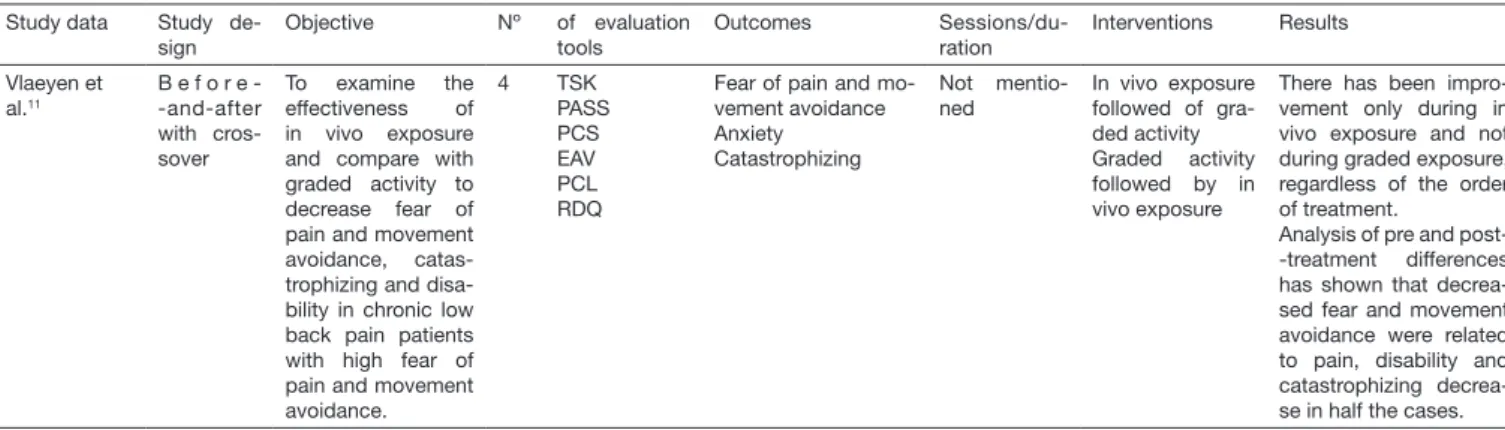
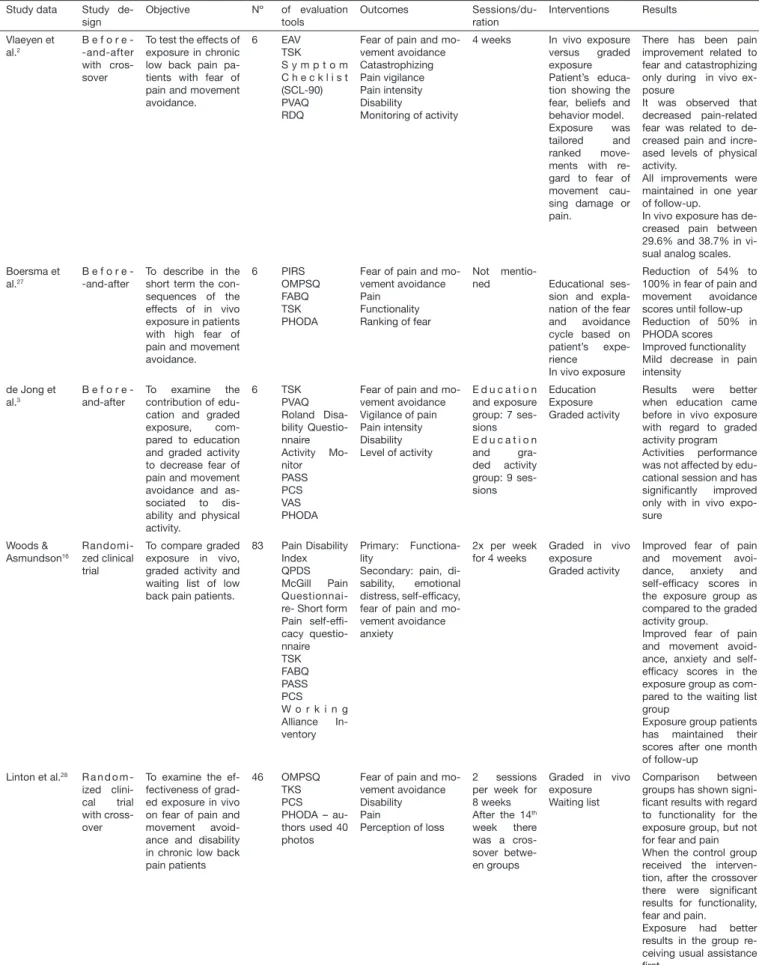
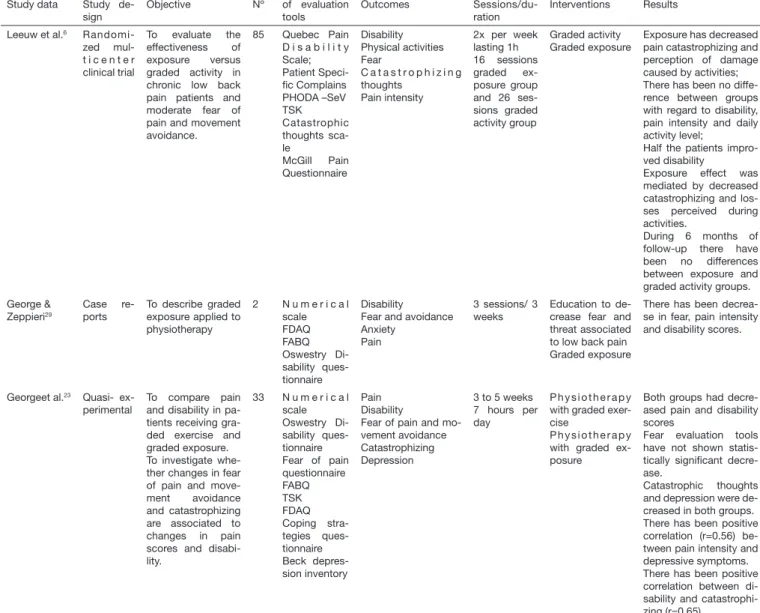
Inclusion criteria were studies with adult patients with chron-ic low back pain, who used graded exposure intervention and had as primary or secondary outcome fear of pain and move-ment avoidance. hese could be case series, before-and-after studies and clinical trials, in English, Spanish and Portuguese. Studies were initially selected by title and abstract. hen they were read in full. Search resulted in 91 studies. From these, 38 were selected to be read in full. Among selected articles, 10 were excluded after reading in full and 19 were repeated. Applying eligibility criteria, 9 studies remained and were in-cluded. From these 9 studies, four are before-and-after stud-ies, one case report, one is a quasi-experimental study and three are randomized clinical trials, being that one clinical trial is also a multicenter study. Summary of evaluated studies is shown in table 1.
Table 1. Evaluated studies
Study data Study de-sign
Objective Nº of evaluation
tools
Outcomes
Sessions/du-ration
Interventions Results
Vlaeyen et al.11
B e f o r e --and-after with cros-sover
To examine the effectiveness of in vivo exposure and compare with graded activity to decrease fear of pain and movement avoidance, catas-trophizing and disa-bility in chronic low back pain patients with high fear of pain and movement avoidance.
4 TSK
PASS PCS EAV PCL RDQ
Fear of pain and mo-vement avoidance Anxiety
Catastrophizing
Not mentio-ned
In vivo exposure followed of gra-ded activity Graded activity followed by in vivo exposure
There has been impro-vement only during in vivo exposure and not during graded exposure, regardless of the order of treatment.
Analysis of pre and post--treatment differences has shown that decrea-sed fear and movement avoidance were related to pain, disability and catastrophizing decrea-se in half the cadecrea-ses.
Table 1. Evaluated studies – continuation
Study data Study de-sign
Objective Nº of evaluation
tools
Outcomes
Sessions/du-ration
Interventions Results
Vlaeyen et al.2
B e f o r e --and-after with cros-sover
To test the effects of exposure in chronic low back pain pa-tients with fear of pain and movement avoidance.
6 EAV
TSK S y m p t o m C h e c k l i s t (SCL-90) PVAQ RDQ
Fear of pain and mo-vement avoidance Catastrophizing Pain vigilance Pain intensity Disability
Monitoring of activity
4 weeks In vivo exposure versus graded exposure
Patient’s educa-tion showing the fear, beliefs and behavior model. Exposure was tailored and ranked move-ments with re-gard to fear of movement cau-sing damage or pain.
There has been pain improvement related to fear and catastrophizing only during in vivo ex-posure
It was observed that decreased pain-related fear was related to de-creased pain and incre-ased levels of physical activity.
All improvements were maintained in one year of follow-up.
In vivo exposure has de-creased pain between 29.6% and 38.7% in vi-sual analog scales. Boersma et
al.27
B e f o r e --and-after
To describe in the short term the con-sequences of the effects of in vivo exposure in patients with high fear of pain and movement avoidance. 6 PIRS OMPSQ FABQ TSK PHODA
Fear of pain and mo-vement avoidance Pain
Functionality Ranking of fear
Not
mentio-ned Educational
ses-sion and expla-nation of the fear and avoidance cycle based on patient’s expe-rience
In vivo exposure
Reduction of 54% to 100% in fear of pain and movement avoidance scores until follow-up Reduction of 50% in PHODA scores
Improved functionality Mild decrease in pain intensity
de Jong et al.3
B e f o r e -and-after
To examine the contribution of edu-cation and graded exposure, com-pared to education and graded activity to decrease fear of pain and movement avoidance and as-sociated to dis-ability and physical activity. 6 TSK PVAQ Roland Disa-bility Questio-nnaire Activity Mo-nitor PASS PCS VAS PHODA
Fear of pain and mo-vement avoidance Vigilance of pain Pain intensity Disability Level of activity
E d u c a t i o n and exposure group: 7 ses-sions E d u c a t i o n and gra-ded activity group: 9 ses-sions
Education Exposure Graded activity
Results were better when education came before in vivo exposure with regard to graded activity program
Activities performance was not affected by edu-cational session and has signiicantly improved only with in vivo expo-sure Woods & Asmundson16 Randomi-zed clinical trial
To compare graded exposure in vivo, graded activity and waiting list of low back pain patients.
83 Pain Disability Index QPDS
McGill Pain Questionnai-re- Short form Pain self-efi-cacy questio-nnaire TSK FABQ PASS PCS W o r k i n g Alliance In-ventory
Primary: Functiona-lity
Secondary: pain, di-sability, emotional distress, self-eficacy, fear of pain and mo-vement avoidance anxiety
2x per week for 4 weeks
Graded in vivo exposure Graded activity
Improved fear of pain and movement avoi-dance, anxiety and self-eficacy scores in the exposure group as compared to the graded activity group.
Improved fear of pain and movement avoid-ance, anxiety and self-eficacy scores in the exposure group as com-pared to the waiting list group
Exposure group patients has maintained their scores after one month of follow-up
Linton et al.28 R a n d o m
-ized clini-cal trial with cross-over
To examine the ef-fectiveness of grad-ed exposure in vivo on fear of pain and movement avoid-ance and disability in chronic low back pain patients
46 OMPSQ
TKS PCS PHODA – au-thors used 40 photos
Fear of pain and mo-vement avoidance Disability Pain
Perception of loss
2 sessions per week for 8 weeks After the 14th
week there was a cros-sover betwe-en groups
Graded in vivo exposure Waiting list
Comparison between groups has shown signi-icant results with regard to functionality for the exposure group, but not for fear and pain When the control group received the interven-tion, after the crossover there were signiicant results for functionality, fear and pain.
Exposure had better results in the group re-ceiving usual assistance irst.
Table 1. Evaluated studies – continuation
Study data Study de-sign
Objective Nº of evaluation
tools
Outcomes
Sessions/du-ration
Interventions Results
Leeuw et al.6
Randomi-zed mul-t i c e n mul-t e r clinical trial
To evaluate the effectiveness of exposure versus graded activity in chronic low back pain patients and moderate fear of pain and movement avoidance.
85 Quebec Pain D i s a b i l i t y Scale; Patient Speci-ic Complains PHODA –SeV TSK Catastrophic thoughts sca-le
McGill Pain Questionnaire
Disability Physical activities Fear
C a t a s t r o p h i z i n g thoughts
Pain intensity
2x per week lasting 1h 16 sessions graded ex-posure group and 26 ses-sions graded activity group
Graded activity
Graded exposure Exposure has decreased pain catastrophizing and perception of damage caused by activities; There has been no diffe-rence between groups with regard to disability, pain intensity and daily activity level;
Half the patients impro-ved disability
Exposure effect was mediated by decreased catastrophizing and los-ses perceived during activities.
During 6 months of follow-up there have been no differences between exposure and graded activity groups. George &
Zeppieri29
Case re-ports
To describe graded exposure applied to physiotherapy
2 N u m e r i c a l scale FDAQ FABQ Oswestry Di-sability ques-tionnaire
Disability
Fear and avoidance Anxiety
Pain
3 sessions/ 3 weeks
Education to de-crease fear and threat associated to low back pain Graded exposure
There has been decrea-se in fear, pain intensity and disability scores.
Georgeet al.23 Quasi-
ex-perimental To compare pain and disability in pa-tients receiving gra-ded exercise and graded exposure. To investigate whe-ther changes in fear of pain and move-ment avoidance and catastrophizing are associated to changes in pain scores and disabi-lity.
33 N u m e r i c a l scale Oswestry Di-sability ques-tionnaire Fear of pain questionnaire FABQ TSK FDAQ Coping stra-tegies ques-tionnaire Beck depres-sion inventory
Pain Disability
Fear of pain and mo-vement avoidance Catastrophizing Depression
3 to 5 weeks 7 hours per day
P h y s i o t h e r a p y with graded exer-cise
P h y s i o t h e r a p y with graded ex-posure
Both groups had decre-ased pain and disability scores
Fear evaluation tools have not shown statis-tically signiicant decre-ase.
Catastrophic thoughts and depression were de-creased in both groups. There has been positive correlation (r=0.56) be-tween pain intensity and depressive symptoms. There has been positive correlation between di-sability and catastrophi-zing (r=0.65)
FABQ = Fear Avoidance Beliefs Questionnaire; TSK = Tampa Scale for Kinesophobia; HADS = Hospital Anxiety and Depression Scale; PHODA = The Photograph Series of Daily Activities; PASS = Pain Anxiety Symptoms Scale; PCS = Pain Catastrophizing Scale; FDAQ = Fear of Daily Activities Questionnaire; VAS = visual analog scale; PCL = Pain Cognition List; RDQ = Roland Disability Questionnaire; PVAQ = Pain Vigilance and Awareness Questionnaire; PIRS = Pain and Impairment Relationship Scale; OMPSQ = Orebro Musculoskeletal Pain Screening Questionnaire.
DISCUSSION
Before-and-after studies with crossover among participants, aimed at comparing the efects of graded exposure technique and graded activity technique in chronic low back pain pa-tients2,11. In all studies, there was a single education session
where pain was analyzed as a common condition which could be managed by patients. hen, explanations were given about fear of pain and movement avoidance vicious cycle. Educa-tion efectiveness was not evaluated in such studies and was equally ofered to all groups. Two studies have used cutof point above 40 in the Tampa Scale for Kinesiophobia to select patients with higher fear of pain and movement avoidance. Both studies used photos from the Photograph Series of Dai-ly Activities (PHODA) to rank fear, where patients ranked
movements represented by the photos which they considered would damage their spine2,11.
he irst study, with four patients11, has compared the
ef-fects of graded exposure followed by graded activity and in a second moment the same interventions in inverted order, on fear of pain and movement avoidance, anxiety, disability and catastrophic thoughts. Graded activity is diferent from graded exposure for using individual exercises performed ac-cording to functional capacity and not acac-cording to fear rank-ing2,30. Results have shown that fear of pain and movement
avoidance were decreased after graded exposure, regardless of interventions order. here has also been improvement in pain intensity, pain control, catastrophic thoughts and disability with the exposure intervention.
chronic low back pain and high fear of pain and movement avoidance. Patients were submitted to one of two interven-tion sequences: graded exposure followed by graded activity or graded activity followed by graded exposure. Results were the same of previous study: fear of pain and movement avoid-ance improvement after graded exposure, regardless of treat-ment order. Graded exposure has also improved pain inten-sity, disability and physical activity. Improvements remained after one year of follow-up2.
Another before-and-after study has investigated the efects of in vivo exposure in six patients with high fear of pain and movement avoidance. Initially educative sessions were held to explain the model and cycle of fear of pain and movement avoidance and then efects of in vivo exposure were tested on fear of pain and movement avoidance, pain and functionality beliefs. Fear of movement was ranked with PHODA. Results have shown 54 to 100% reduction on fear of pain and move-ment avoidance scores and 50% on PHODA scores. Patients improved functionality and had mild pain intensity decrease. he three analyzed studies2,11,27 were before-and-after studies
(without control group), with convenience sample of four to six patients. An education session has always preceded in vivo exposure or graded activity and so there is no analysis show-ing the isolated efect of education. here are major weak-nesses in such studies design.
he irst study evaluating the efects of education on graded exposure and activity was published in 2005. his is a before-and-after study with six patients divided in two groups. One group received education and graded exposure and the other education and graded activity. Education consisted of one ses-sion focused on increasing patient’s willingness to engage in activities avoided for a long period and on correcting wrong interpretations and concepts which occurred during the de-velopment of fear of pain and movement avoidance. Evaluat-ed variables were fear of pain and movement avoidance, pain intensity, disability and daily activity level. Evaluations before and after educative intervention have shown decreased fear of pain and movement avoidance and of catastrophizing after education session for both groups.
Only daily activity level was not changed by educational ses-sion and only signiicantly improved when in vivo exposure was performed after education. Results have shown improve-ment in all variables in the group receiving education and in vivo exposure, which was not true for the group receiving graded activity3.
his before-and-after study design, the convenience sample, the small sample size (six patients) and no blinding when evaluating outcomes, weaken this study results.
he irst randomized clinical trial using graded exposure in low back pain patients was published in 2008. In addition, this was the only study using self-eicacy belief as one out-come, together with the belief of fear of pain and movement avoidance. In this study, 83 patients were randomized in three groups: in vivo graded exposure, graded activity and waiting list. Primary outcome was disability. Other evaluated second-ary efects were self-eicacy and fear of pain and movement
avoidance, anxiety, depression, painful experience and cata-strophic thoughts. Graded activity involved the development of healthy behaviors through positive reinforcement of pre-deined activities.
Graded exposure was performed in eight sessions lasting four weeks. In the irst session, an interview was carried out and patients received education about the belief of fear of pain and movement avoidance and about formulation of prob-lems in this context. Still in this session, activities feared by patients and fear of movement by means of PHODA were evaluated. From the second to the ifth session, graded expo-sure or graded activity were performed; inal sessions, from the sixth to the eight, were used to evaluate treatment process and to give patients orientations about preventing relapses. It was observed that the exposure group had signiicantly better results in all analyzed variables as compared to the graded activity and waiting list groups16.
Some important considerations about self-eicacy and fear of pain and movement avoidance beliefs were clariied by this study. Authors have observed that both self-eicacy and fear of pain and movement avoidance are related to disability in chronic low back pain patients. It is supposed that self-eicacy improvement in the exposure group was due to the fact that patients faced feared movements in a successful way, which has promoted a mastery experience for these patients. Decreased fear of pain and movement avoidance, possibly as consequence of exposure, allowed patients exposed to feared activities to become more conident on their ability to per-form such movements, which might be the reason for the re-adjustment of their beliefs. Reduction in the perception of threat by performing feared activities and the disconirmation of negative beliefs have probably resulted in improved pain, hypervigilance behavior, feeling of threat, decreased anxiety and catastrophizing16.
his study was better than the others due to randomization, control group, sample size and better description of the edu-cation session, but there has been no analysis allowing the observation of the isolated efect of the education session. Another clinical trial with crossover, also published in 2008, has compared usual assistance followed by graded exposure and graded exposure followed by usual assistance on disability related to labor activities in 46 patients with chronic low back pain, reduced function and fear of pain and movement avoid-ance. Participants were randomized in two groups: exposure and usual assistance and outcomes were fear of pain and movement avoidance, perception of loss, pain and disability. Results have shown that variables pain, fear of pain and move-ment avoidance have improved in the group receiving usual assistance irst, followed by exposure, but not in the group receiving the inverse order of assistance. Authors have con-cluded that exposure was efective only when associated to usual assistance28. In this study28 it is not clear what authors
A randomized multicenter clinical trial carried out in differ-ent places in the Netherlands has evaluated the effectiveness of in vivo exposure versus graded activity in chronic low back pain patients. Eighty-five patients with chronic low back pain and moderate to severe fear of pain and movement avoidance were randomized in two groups. Primary out-comes were disability and the perception of damage caused by physical activities. Secondary outcomes were fear of pain and movement avoidance, catastrophic thoughts and pain intensity. Sessions were carried out twice a week in a total of 16 sessions for the exposure group and 26 sessions for the graded activity group. Results have shown further reduction in catastrophizing and perception of loss in the exposure group. Approximately half the patients of both groups have improved disability.
here has been no diference between groups in disability and pain intensity. In six months of follow up, exposure was not more efective than graded activity with regard to outcomes6.
In this study6, the design, number of sessions both for the
graded exposure and the graded activity group was superior as compared to previous studies, and the number of sessions for the graded activity group was much higher than for the exposure group. his suggests that it is not clear which is the best “dose” of these interventions to improve self-eicacy and fear of pain and movement avoidance beliefs, and disability in chronic low back pain patients. his is the irst study showing the non-superiority of graded exposure over graded activity in six months of follow up.
Last two published studies presented a clinical approach which to date had not been given by previous studies. In ad-dition, the ten situations of the Fear Daily Activities Ques-tionnaire (FDAQ) tool, which had not been used so far, were used to rank fear23,29.
In a case report, two patients were evaluated while perform-ing lumbar spine movements and stabilization tests and re-ceived as intervention stabilization exercises and graded expo-sure. Fear was ranked by means of the ten movements of the FDAQ tool in a numeric scale from zero to 100. hen two movements with scores equal to or above 40 were selected. here has been reduction in fear, pain intensity and disability scores for both patients29.
A quasi-experimental study with 33 chronic low back pain patients who received physiotherapy associated to graded exposure or physiotherapy associated to graded exercise, has compared outcomes fear, disability and fear of pain and movement avoidance. he program had 12 blocks of 7 daily hours and has varied from three to ive weeks. Patients also received psychological therapy, biofeedback and medical fol-low up. Psychological treatment focused on decreasing fear and catastrophizing, changing dysfunctional responses with regard to pain and using adaptative coping strategies. For ex-posure, patients ranked the ten FDAQ situations in a nu-meric scale from zero to 100, and have selected two activities with the highest scores.
here has been no post-test diference for both groups with regard to fear of pain and movement avoidance. Both groups
have decreased pain intensity and disability in a similar way. here has been correlation between pain and depressive symp-toms and between catastrophizing and disability23.
he study had no control group, was not randomized or blind for evaluation and has not analyzed individual efects of psy-chological therapy and biofeedback interventions.
Again, it is observed a question about the superiority of grad-ed exposure over gradgrad-ed activity to change self-eicacy and fear of pain and movement avoidance, pain and disability be-liefs. When a therapy is more broadly tested (more studies) and with more rigorous designs, often “initial certainties” are weakened, which requires a set of studies with robust designs to clarify questions. his is supposed to be the current status of in vivo exposure, graded activity and education to change beliefs and disability of chronic low back pain patients, which justiies further studies on the subject.
CONCLUSION
Most studies of this review have compared in vivo exposure and graded activity. Just one study has evaluated the effec-tiveness of education before exposure and has observed ben-eficial effects of education alone. Sessions content, number and duration, accurate description of performed movement, how many times the movement was performed, how were educative sessions or the session to understand the fear of pain, catastrophizing, immobility and disability cycle were not adequately described; also the training of intervention-ists was not adequately explained. In light of the few num-ber of publications on the subject, advantages or the way to perform graded exposure in low back pain patients are still not clear.
REFERENCES
1. Pincus T, McCracken LM. Psychological factors and treatment opportunities in low back pain. Best Pract Res Clin Rheumatol. 2013;27(5):625-35.
2. Vlaeyen JW, de Jong J, Geilen M, Heuts PH, van Breukelen G. he treatment of fear of movement/(re)injury in chronic low back pain: Further evidence on the efective-ness of exposure in vivo. Clin J Pain. 2002;18(4):251-61.
3. de Jong JR, Vlaeyen JW, Onghena P, Goossens ME, Geilen M, Mulder H. Fear of mo-vement/(re)injury in chronic low back pain: education or exposure in vivo as mediator to fear reduction? Clin J Pain. 2005;21(1):9-17; discussion 69-72.
4. Grotle M, Vøllestad NK, Brox JI. Clinical course and impact of fear-avoidance beliefs in low back pain: prospective cohort study of acute and chronic low back pain: II. Spine. 2006;31(9):1038-46.
5. Vlaeyen JW, De Jong JR, Onghena P, Kerckhofs-Hanssen M, Kole-Snijders AM. Can pain-related fear be reduced? he application of cognitive-behavioural exposure in vivo. Pain Res Manag. 2002;7(3):144-53.
6. Leeuw M, Goossens ME, van Breukelen GJ, de Jong JR, Heuts PH, Smeets RJ, et al. Exposure in vivo versus operant graded activity in chronic low back pain patients: results of a randomized controlled trial. Pain. 2008;138(1)192-207.
7. Vlaeyen JW, Linton SJ. Fear-avoidance model of chronic musculoskeletal pain: 12 years on. Pain. 2012;153(6):1144-7.
8. Crombez G, Eccleston C, Van Damme S, Vlaeyen JW, Karoly P. Fear-avoidance mo-del of chronic pain: the next generation. Clin J Pain. 2012;28(6):475-83.
9. Vlaeyen JW, MPhil SJ, Morley Linton SJ, Boersma K, Jong JD. Pain-related fear: exposure-based treatment of chronic pain. Seatle: IASP; 2012.
10. Lucchetti G, Oliveira AB, Mercante JP, Peres MF. Anxiety and fear-avoidance in mus-culoskeletal pain. Curr Pain Headache Rep. 2012;16(5):399-406.
exaggerated pain perception--I. Behav Res her. 1983;21(4):401-8.
13. Slade PD, Troup JD, Lethem J, Bentley G. he fear-avoidance model of exaggerated pain perception--II. Behav Res her. 1983;21(4):409-16.
14. Vlaeyen JW, Linton SJ. Fear-avoidance and its consequences in chronic musculoske-letal pain: a state of the art. Pain. 2000;85(3):317-32.
15. Leeuw M, Goossens ME, Linton SJ, Crombez G, Boersma K, Vlaeyen JW. he fear--avoidance model of musculoskeletal pain: current state of scientiic evidence. J Behav Med. 2007;30(1):77-94.
16. Woods MP, Asmundson GJ. Evaluating the eicacy of graded in vivo exposure for the treatment of fear in patients with chronic back pain: a randomized controlled clinical trial. Pain. 2008;136(3)271-80.
17. Denison E, Asenlöf P, Sandborgh M, Lindberg P. Musculoskeletal pain in primary he-alth care: subgroups based on pain intensity, disability, self-eicacy, and fear-avoidance variables. J Pain. 2007;8(1):67-74.
18. Costa Lda C, Maher CG, McAuley JH, Hancock MJ, Smeets RJ. Self-eicacy is more important than fear of movement in mediating the relationship between pain and disability in chronic low back pain. Eur J Pain. 2011;15(2):213-9.
19. Woby SR, Urmston M, Watson PJ. Self-eicacy mediates the relation betwe-en pain-related fear and outcome in chronic low back pain patibetwe-ents. Eur J Pain. 2007;11(7):711-8.
20. Salvetti Mde G, Pimenta CA, Braga PE, Corrêa CF. [Disability related to chronic low back pain: prevalence and associated factors]. Rev Esc Enferm USP. 2012;46(Spec no):16-23. Portuguese.
21. de Moraes Vieira EB, de Góes Salvetti M, Damiani LP, de Mattos Pimenta CA. Self--eicacy and fear avoidance beliefs in chronic low back pain patients: coexistence and associated factors. Pain Manag Nurs. 2014;15(3):593-602.
22. Crombez G, Vervaet L, Lysens R, Baeyens F, Eelen P. Avoidance and confrontation of painful, back-straining movements in chronic back pain patients. Behav Modif. 1998;22(1):62-77.
23. George SZ, Wittmer VT, Fillingim RB, Robinson ME.Comparison of graded exercise and graded exposure clinical outcomes for patients with chronic low back pain. J Orthop Sports Phys her. 2010;40(11):694-704.
24. Pincus T, Smeets RJ, Simmonds MJ, Sullivan MJ. he fear avoidance model di-sentangled: improving the clinical utility of the fear avoidance model. Clin J Pain. 2010;26(9):739-46.
25. Salvetti MG, Kurita GP, Longo ES, Pimenta CA. Efeitos da intervenção exposição ao vivo e atividades graduais sobre a incapacidade e a crença de medo e evitação em pa-cientes com dor lombar crônica. Rev Bras Terap Comport Cogn. 2012;14(3):123-33. 26. da Costa Santos CM, de Mattos Pimenta CA, Nobre MR. he PICO strategy for
the research question construction and evidence search. Rev Lat Am Enfermagem. 2007;15(3):508-11.
27. Boersma K, Linton S, Overmeer T, Jansson M, Vlaeyen J, de Jong J. Lowering fear--avoidance and enhancing function through exposure in vivo. A multiple baseline study across six patients with back pain. Pain. 2004;108(1-2):8-16.
28. Linton SJ, Boersma K, Jansson M, Overmeer T, Lindblom K, Vlaeyen JW. A rando-mized controlled trial of exposure in vivo for patients with spinal pain reporting fear of work-related activities. Eur J Pain. 2008;12(6):722-30.
29. George SZ, Zeppieri G. Physical therapy utilization of graded exposure for patients with low back pain. J Orthop Sports Phys her. 2009;39(7):496-505.