ABSTRACT
BACKGROUND AND OBJECTIVES:he adequate use of
opi-oids is still a major challenge to date. here are several mismatches in the clinical practice although these agents have started to be used in the 1980s. Understanding the importance of such subject, the Brazil-ian Society for the Study of Pain has invited a number of professionals to develop recommendations, based on existing literature, to help the composition of a practical guide for patients’ adequate treatment. CONTENTS:his review has discussed the following recom-mendations: indication of opioid therapy, its titration and wean-ing; opioids rotation and monitoring of results, thus evidencing good clinical practice.
CONCLUSION: It is important to adequately elect patients to receive long-term opioids, by evaluating adverse efects and matching the dose to each clinical situation.
Keywords:Chronic pain, Long-term use, Opioid.
RESUMO
JUSTIFICATIVA E OBJETIVOS: O emprego adequado de
opi-oides ainda é um grande desaio no mundo contemporâneo. Di-versas são as inadequações na prática clínica, apesar do uso desses agentes ter se iniciado desde a década de 1980. Compreendendo a importância desse tema, a Sociedade Brasileira de Estudo da Dor convidou vários proissionais para desenvolver recomendações que facilite; baseado na literatura médica existente, a composição de um guia prático para o tratamento adequado dos pacientes. CONTEÚDO: Nessa revisão foram discutidas as seguintes re-comendações: indicação de terapia com opioides, sua titulação e retirada; rotação de opioides, monitoração de resultados, eviden-ciando a boa prática clínica.
CONCLUSÃO: É importante eleger de maneira adequada os
pacientes que utilizarão opioide em longo prazo, avaliando os efeitos adversos e adequando a dose a cada situação clínica. Descritores: Dor crônica, Opioide, Uso prolongado.
Recommendations for the use of opioids in Brazil: Part I*
Recomendações para uso de opioides no Brasil: Parte I
Durval Campos Kraychete1, José Tadeu Tesseroli de Siqueira2, João Batista Santos Garcia3 and Specialists Group
*Received from Brazilian Society for the Study of Pain, São Paulo, SP, Brazil.
1. Federal University of Bahia, Salvador, BA, Brazil. 2. University of São Paulo, São Paulo, SP, Brazil. 3. Federal University of Maranhão, São Luis, MA, Brazil
Correspondence to: Durval Campos Kraychete
Rua Rio de São Pedro, 327/401 – Bairro Graça 40150-350 Salvador, BA, Brasil.
E-mail: [email protected]
© Sociedade Brasileira para o Estudo da Dor
INTRODUCTION
Adequate and monitored use of opioids is still a challenge for health professionals. So, by initiative of a specialists group with institutional validation of the Brazilian Society for the Study of Pain (SBED), we have decided for a publication with the pri-mary proposal of presenting recommendations to guide health professionals in the use of opioids to control acute and chronic pain. his program will progressively discuss: indication of opi-oid therapy, its titration and discontinuation; opiopi-oid rotation, monitoring of results; patients’ clinical status and speciic popu-lations; addiction, abuse and dependence; adverse efects; in ad-dition to all treatment pillars, aiming at optimizing therapeutic results with this class of drugs.
Recommendations presented here and in future publications in sequential manner aim at starting the composition of a practi-cal guide for adequate patients’ management, disclosing avail-able information about the use of opioids in diferent clinical situations; encouraging studies related to opioids safety and ef-fectiveness and demystifying the inadequate association between addiction/dependence and the use of opioids.
INDICATIONS OF OPIOID THERAPY
Before starting opioid therapy it is critical to have patient’s com-plete documentation, which includes the following data: 1) pain evaluation; 2) general clinical status; 3) psychossocial history; 4) psychiatric conditions; 5) possible illegal drug abuse1,2; informed
consent term for the use of opioids (directive 859 of the National Sanitation Surveillance Agency (ANVISA) from 11/12/2002) (Figure 1).
Observations:
• he complete illing of this Term and respective signature are mandatory for drugs supply.
• his term shall be illed out in two copies remaining one iled at the pharmacy in charge of delivering the drugs and the other in patient’s medical chart.
PAIN HISTORY AND EVALUATION
Figure 1. Informed consent term according to ANVISA directive 859 from 11/12/2002
INFORMED CONSENT TERM Codeine, Morphine, Methadone
I________________ (patient’s name), identiied and signed below, he-reby declare having been clearly informed about all indications con-traindications and major adverse effects related to the use of Codei-ne, Morphine and Methadone for Chronic Pain relief.
All medical terms were explained and all my questions have been answered by the physician _______________ (name of prescribing physician).
I also express my agreement and spontaneous will to be submitted to the above-mentioned treatment, taking the responsibility and the risks for possible undesirable effects.
So, I declare that:
I have been clearly informed that the drugs may have, as major bene-it, pain relief and quality of life improvement.
I was also clearly informed about potential adverse effects, contrain-dications, risks and warnings about their use to relieve chronic pain:
Codeine
Analgesic drug, considered weak opioid, used to relieve moderate pain.
Contraindications: diarrhea associated to pseudomembranous co-litis caused by the use of cephalosporins, lincomycin or penicillin; diarrhea caused by poisoning; hypersensitivity to codeine or other opioids; cases of drug dependence, including alcoholism.
Adverse effects: sleepiness; intestinal constipation; nausea and vomiting after irst doses; allergic reactions; respiratory depression; mental confusion; blurred or double vision; dry mouth; appetite loss; urethral spasm.
Pharmacological interactions (interfering with codeine action): alcohol; sedatives; anti-histamines; monoamine-oxidase inhibitors (MAOI); tricyclic antidepressants.
Morphine
Strong opioid analgesic indicated for patients without adequate mo-derate, severe or very severe pain control. Its dosage may be gradu-ally increased according to individual needs to reach analgesia.
Contraindications: hypersensitivity to morphine or some compo-nents of the formula; severe respiratory failure.
Adverse effects: sedation (may last 3 to 5 days, improving from then on); nausea and vomiting (tolerance is rapidly developed – 5 to 10 days); respiratory depression (cancer patients develop fast toleran-ce); intestinal constipation; mental confusion (may occur in the irst days of treatment); urinary retention.
Less frequent adverse effects: weakness; headache; insomnia; anorexia; dry mouth; pruritus; palpitations.
Pharmacological interactions (interfering with morphine action): alcohol; sedatives; anti-histamines; monoamine-oxidase inhibitors (MAOI); phenothyazines, butyrophenones, tricyclic antidepressants.
Methadone
Synthetic opioid drug with high analgesic potency, indicated as alter-native in cases of severe and dificult to treat pain.
Contraindications: hypersensitivity to methadone or any compo-nent of the formula; severe respiratory failure.
Adverse effects: respiratory depression; circulatory depression; de-lirium; dizziness; nausea and vomiting; excessive sweating.
Less frequent adverse effects: weakness; headache; euphoria; insomnia; dry mouth; anorexia; intestinal constipation; palpitations; urinary retention.
Pharmacological interactions (interfering with methadone action): alcohol, morphine agonists/antagonists (buprenorphine, nalbuphine, pentazocine); monoamine-oxidase inhibitors (MAOI); other morphine derivatives (analgesics or antitussives); H1 anti-histamines; sedati-ves; barbiturates; benzodiazepines; anxiolytics other than benzo-diazepines; neuroleptics; clonidine and alike; luoxetine and other serotoninergics; cimetidine, rifampicin, phenytoin and other hepatic enzymatic inducers.
The use of any above-related opioid requires further precautions and care in cases of pregnancy, breastfeeding, elderly patients and chil-dren.
Their use may impair motor abilities and physical capacity, needed to perform potentially hazardous tasks, such as drive cars or operate machines.
When impossible to prevent and treat adverse effects, the drug shall be discontinued, according to medical decision.
Demystiication of opioid analgesics: they do not induce addic-tion; they do not cause clinically signiicant respiratory depression in cancer patients, even with chronic obstructive pulmonary disease (COPD); they do not accelerate death; they do not make patient a zombie.
I am aware that there might be the need to change doses as well as the type of drug which will be part of my treatment.
I am aware that I may discontinue this treatment at any time, without implying any type of embarrassment between me and my physician, who is willing to continue treating me under any circumstance. I authorize the Ministry of Health and the Departments of Health to use information regarding my treatment, provided anonymity is as-sured.
Finally I declare having understood and agreed with all terms of this Informed Consent.
So, I do it by spontaneous will and by joint decision between me and my physician.
In addition, I was informed about the mandatory return of opioids which, for any reason, have not been used. This commitment is join-tly undertaken by my relative or guardian who, together with me, signs this Informed Consent Term. Drugs shall preferably be returned to the same place where they were received.
My treatment will use one of the following drugs: • Codeine
• Morphine • Methadone
Model: patient’s data
Patient:
Patient’s I.D.:
Gender Male ( ) Female ( ) Age:
Address:
City and State: ZIP code: Te l e p h o n e : ( )
Guardian (if appropriate):
Guardian’s I.D.:
________________________________________ Signature of patient and Relative or Guardian
Observation: if the patient is disabled, this Informed Consent Term may be signed solely by duly identiied relative or guardian.
Model: physician’s data
Physician in Charge: CRM:
Ofice address:
City: ZIP code: Telephone: ( )
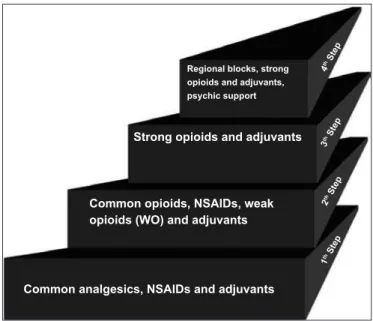
proposed to be added to original WHO ladder because, although most cancer pains are efectively treated with opioids or by com-bining non-opioids and adjuvants, not all pains are relieved by this strategy5,6. (Figure 2).
4
th Ste
p
3
th Ste
p
2
th Ste
p
1
th Ste
p
Regional blocks, strong opioids and adjuvants,
psychic support
Strong opioids and adjuvants
Common opioids, NSAIDs, weak opioids (WO) and adjuvants
Common analgesics, NSAIDs and adjuvants
Figure 2. Modiied pain ladder with four steps. Adapted5,6.
NSAIDS: non-steroid anti-inlammatory drugs.
Personal background shall include possible use of drugs and/ or procedures patient has been submitted to. It is also im-portant to characterize the impact of pain on patient’s daily activities: at work, school, at home and during leisure time, in addition to patient’s psychossocial condition. In the history of use of psychoactive drugs involving abuse and/or depen-dence, try to identify whether patient or relatives have history of usage or are participating in treatment programs for sub-stances with risk of addiction, including urine and blood test for some identiiable substances, such as alcohol, marijuana, tobacco, benzodiazepines, opioids, cocaine, amphetamine, barbiturates, hallucinogens and solvents7. For patients under
benzodiazepines, especially the elderly, there is the need for special care; in such cases, opioids titration shall be slow and progressive.
OPIOIDS TITRATION AND WITHDRAWAL
Titration, method used to determine the optimal dose of a substance, consists in using the lowest recommended dose (Table 1) of a given opioid, and gradually increasing it until efective analgesia is achieved with tolerable adverse efects. Short-acting opioids shall be used during initial titration pe-riod and shall be replaced by long-acting formulations when the efective dose is reached and stabilized.
he objective of the treatment is to determine the opioid dose which improves function and/or decreases pain intensity in at least 30%8. So, opioids shall be titrated for patients who: 1)
have never used these drugs and have to start treatment; 2) are being treated with weak or strong opioids and are presenting
severe or intolerable adverse efects, or who need opioid rota-tion; 3) are no longer responding to weak opioids and require replacement by strong opioids; 4) are receiving strong opioids and require higher doses (due to increased pain intensity or to the development of tolerance) even when in association with adjuvant drugs; 5) are in severe distress and need fast and efective intervention due to previous and persistent un-dertreatment9,10.
On the other hand, optimal opioid dose should be evaluated by the balance of three factors: a) effectiveness: 30% to 50% decrease in initial pain intensity or improvement of factors related to quality of life (level of activities at work or at home, dietary habits, level of autonomy, cognitive aspects, sleep quality; and level of social activities); b) plateau dose: when increasing dose does not improve analgesia. his is related to maximum efective dose; c) adverse effects: should be evalu-ated and controlled since the beginning of treatment. It has to be reminded that for patients at risk of abuse, there shall be strict monitoring of suspicious aberrant behaviors11.
Table 1. Initial opioid doses and usage interval
Drugs Initial dose Interval (hours)
Codeine 15-30mg 4-6
Tramadol 50mg 4-6
Morphine 5-10mg 3-4
Methadone 5-10mg 8-12
Hydromorphone oros 8mg 24
Oxycodone 10-20mg 12
Transdermal fentanyl 12-24μg 72
Titration ends when: 1) optimal dose (efective and stable) is reached; 2) favorable results are not reached due to insuf-icient analgesia after increasing two or three doses; 3) there are intolerable adverse efects or other medical complications (undesired interactions, co-morbidities); 4) there are evidenc-es of abuse or dependence. On the other hand, opioids should be discontinued when: 1) pain generating prescription is re-solved; 2) patient does not respond to any drug even with opi-oid rotation; 3) high opiopi-oid doses were used and patient, even with partial pain relief, remains disabled; 4) there are aberrant behaviors (abusive use) and/or intolerable adverse efects12.
Recommendations for withdrawal, based on speciic evidenc-es and guidelinevidenc-es, are conlicting. In general, if withdrawal is slow, there will be 10% total daily dose decrease every week, and for fast withdrawal, 25 to 50% every two or three days. More prolonged withdrawal is recommended for patients with anxiety disorders, opioid-dependent, those with cardio-respiratory co-morbidity and for those preferring slow with-drawal13.
Dose should be maintained or increased if patient, during withdrawal, has withdrawal syndrome, signiicant pain in-crease or changes in quality of life. Withdrawal may take from two to three weeks to three to four months and it is necessary to avoid sedatives, especially benzodiazepines14. It is
been associated to premature birth and spontaneous abortion, in addition to risk to mother’s health. Also, for psychiatric patients, withdrawal may signiicantly increase anxiety and insomnia, and special care shall be taken with patients with co-morbidities which may be worsened by anxiety. It is rec-ommended that patients with aberrant behaviors are referred to a specialized rehabilitation program. One may conclude that the withdrawal process requires constant medical visits, pain, withdrawal symptoms and beneits evaluation15.
OPIOIDS ROTATION
Implies changing from one opioid to the other when patients experience therapeutic eicacy decline, or when analgesia is associated to adverse efects impairing quality of life. he in-cidence of this practice varies from 15 to 40%16.
Opioid rotation may adequately decrease adverse efects or relieve pain in 50% to 70% of cancer patients. Reasons for changing opioids are poorly studied and complex, involving pharmacokinetic and pharmacodynamic factors, such as in-creased drug metabolism or dein-creased sensitivity of the opi-oid receptor. When thinking about changing the opiopi-oid, it is necessary to understand that the eicacy of the technique is related to diferences among potencies of such agents and to the variety of opioid actions on the receptor17.
Reasons for opioid rotation
Increased pain or adverse efects intensity is normal due to disease progression, tolerance, genetic polymorphism and inadequate agent absorption (swallowing incapacity, hypo-tension – limiting transdermal transportation). In addition, females seem to have better response to opioids as compared to males17. Genetic polymorphism in genes coding
catechol-O-methyltransferase may afect morphine requirements, den-sity of µ receptors and severity of adverse efects on central nervous system. Genetic diferences may also interfere with opioid metabolism, with ultrafast metabolizers, afecting re-sponse to treatment.
Gene CYP2D6 allele variants are present in 1 to 7% of the population and this helps metabolism of such drugs, increas-ing toxicity due to fast conversion to active (with metabolites build up) or more potent molecules. On the other hand, 7% of Caucasians are slow metabolizers. So, the use of polyphar-macy with agents using the CYP isoenzymes route, decreases the clearance of each drug. Opioids using the glucoronidation metabolism route (hydromorphone) may be an alternative to decrease such complications18.
Similarly, adverse efects are diicult to handle when there is interaction with other drugs, changes in protein binding (higher agent free fraction) and chronic renal failure. Toler-ance to opioids should be considered, as well as cross toler-ance for action on the receptor. However, it seems that cross tolerance is incomplete or asymmetric both for experimental animals and humans, favoring the hypothesis that rotating opioids may improve analgesia19.
One may, then, conclude that the following are reasons to
rotate opioids:
• Pain ≥ 4 (pain numerical scale), in spite of dose increase;
• Development of tolerance;
• Poor response to irst line opioid;
• Inability to tolerate efective dose;
• When maximum dose allowed for each drug is exceeded (for codeine it is 360mg and for tramadol 600mg);
• Presence of adverse efects (myoclonia, constipation, nau-sea, vomiting, dysphoria, delirium and excessive sedation);
• Inability to swallow (including patients in total parenteral nutrition);
• Need for alternative drug administration routes (patients with peripheral blood low changes and with poor absorption of transdermal drugs);
• Decrease treatment costs;
• Non-acceptance of the drug by patient;
• Impossibility of reaching adequate blood concentration;
• Clinical presentation of hyperalgesia20.
Problems with opioid rotation
Most common opioid rotation mistakes are related to incor-rect conversion dose for the new administration route; dif-icult dose titration; and inadequate use of adjuvants21.
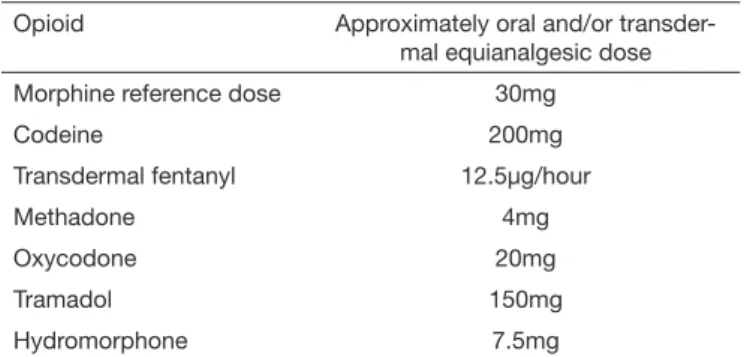
Equi-analgesic dose is deined as dose frequency of two agents to produce the same efect. For such, there are diferent empiri-cal tables or based on old studies with cancer patients using low or single opioid dose in a short period of time in individ-uals with no co-morbidities. However, these tables in general supply higher doses than that of the previous agent and really should be used with caution.
So, the proposed opioid should be titrated and response should be adjusted and monitored according to clinical ei-cacy and patient’s individual characteristics, such as age, renal function, adverse efects and type of painful syndrome. Opi-oid response for musculoskeletal, neuropathic and cancer pain varies widely and this is not considered by conversion tables22.
It is important to stress that most severe adverse efects with opioids are seen in the irst week after replacing the agent. So, it is necessary to: 1) treat patient, not the equivalence table; 2) choose only one conversion table; 3) start therapy conser-vatively, titrating the opioid and monitoring its efect23.
Equianalgesia
hand, intrathecal route may decrease morphine dose in up to 300 times. Implantable infusion pumps also help reaching satisfactory analgesia23,24.
Table 2. Equivalence for opioids available in Brazil
Opioid Approximately oral and/or
transder-mal equianalgesic dose
Morphine reference dose 30mg
Codeine 200mg
Transdermal fentanyl 12.5μg/hour
Methadone 4mg
Oxycodone 20mg
Tramadol 150mg
Hydromorphone 7.5mg
http://www.agencymeddirectors.wa.gov/Files/OpioidGdline.pdf
In Brazil, due to lack of immediate release opioid for oxycodone and hydromorphone, escapes are empirically done with mor-phine. However, the pharmacological association of agents act-ing on the same type of receptor is not recommended.
Methadone
For methadone, remember that there is inter-individual pharma-cokinetic variation, as well as potential to induce late toxicity due to its half-life, which varies from eight to 59 hours. Methadone build-up during treatment days or weeks may be life threatening, due to respiratory depression, especially during sleep. We stress that for chronic non-cancer pain one should start methadone with doses below 30 mg and not exceed 40 mg/day. On the other hand, this initial dose may be hazardous for slow methadone acethylators or patients with sleep apnea. In addition, there are reports on cardiotoxicity (increased QT interval and torsades de points rhythm) with sudden death.
So, the equianalgesic ratio may vary from 16:1 to 2.5:1 depend-ing on previous opioid extension or exposure, on total opioid dose, on the reason for rotation (pain or adverse efects), in ad-dition to interaction with other drugs. Conversion rate of 5:1 for morphine doses below 300 mg and if the reason for rotation is pain, may be decreased to 3:1. On the other hand, 10:1 con-version rate for morphine doses above 300 mg shall be used for anxious or depressed patients, those with delirium or needing fast dose increase and for those with creatinine equal to or above 1.5 mg/dL.
If the reason for rotation is pain, this rate may be decreased to 5:1. Methadone should be up- or down-titrated every 48 or 72 hours, approximately 30 to 50%, evaluating clinical criteria, level of patient’s satisfaction and the need for escape dose. Other stud-ies suggest the slow withdrawal of the opioid to be replaced by methadone in three days, with 1/3 decrease per day of the agent and addition of 1/3 per day of total methadone dose. Morphine requisition is inversely proportional to age, but for methadone this relationship is independent.
Some authors have also not correlated dose equivalence in the conversion of morphine to methadone to gender, cancer and its treatment features, biochemical or hematological parameters.
On the other hand, there are few studies on the transition of methadone to a diferent opioid. Other authors suggest that 10mg methadone would be equivalent to 20, 33 or 77.5mg mor-phine, to 4, 5 or 50mg hydromorphone, to 200, 400 or 2000µg fentanyl. his broad variation in the literature, in addition to methadone pharmacokinetic and pharmacodynamic character-istics, suggests that methadone should be gradually withdrawn until the complete introduction of the new agent25,26.
MONITORING OF LONG TERM USE OF OPIOIDS
Brazilian Traic Code, Law 11705, Art. 165. his fact should be evaluated by the physician during opioid titration period; 19) understand that inadequate pain evaluation and measurement, low expectation with regard to treatment, lack of communica-tion with the health team, fear of adverse efects and dependence may interfere with the results of analgesia and that continuous education of the health team and of patients is needed, explain-ing any pendexplain-ing issues (includes informed consent).
CONCLUSION
It is important to adequately select patients who will use opi-oids in the long term; start titration and maintenance evaluating adverse efects and adjusting the dose to each clinical situation; observe when opioid should be withdrawn or rotated, as well as monitor patients in the long term.
Authors of the Specialists group:
Alexandre Annes Henriques, Anderson Arantes Silvestrini, Ângela Maria Sousa, Ariel de Freitas Q. Américo, Cláudio Fer-nandes Corrêa, Daniel Ciampi Andrade, Eduardo Grossmann, Erich Talamoni Fonof, Gualter Lisboa Ramalho, Guilherme A. M. de Barros, Grace Haber, Inês T. V. e Melo, Irimar de Paula Posso, Janaina Vall, João Marcos Rizzo, João Valverde Filho, José Oswaldo de Oliveira Júnior, Judymara Lauzi Gozzani, Karine A. S. Leão Ferreira, Lia Rachel C. do Amaral Pelloso, Lin Tchia Yeng, Manoel Jacobsen Teixeira, Mario Luiz Giublin, Maria Te-resa R. Jalbut Jacob, Miriam Seligman Menezes, Mirlane Gui-marães Cardoso, Newton Monteiro de Barros, Onofre Alves Neto, Patrick Raymond Stump, Rioko Kimiko Sakata, Roberto T. de Castro Bettega, Rogério Teixeira, Sandra Caires Serrano, Sílvia Maria de Macedo Barbosa, Telma M. Zakka, heodora Karnakis, Toshio Chiba, Waleska Sampaio, William Gêmio Teix-eira, William Jacobsen Teixeira.
ACKNOWLEDGMENTS
his recommendation was developed by the Brazilian Society for the Study of Pain with support of Janssen do Brasil.
REFERENCES
1. Becker WC, Sullivan LE, Tetrault JM, Desai RA, Fiellin DA. Non-medical use, abuse and dependence on prescription opioids among U.S. adults: psychiatric, medical and substance use correlates. Drug & Alcohol Depend. 2008;94(1-3):38-47.
2. Manchikanti L, Giordano J, Boswell MV, Fellows B, Manchukonda R, Pampati V. Psychological factors as predictors of opioid abuse and illicit drug use in chronic pain patients. J Opioid Manag. 2007;3(2):89-100.
3. World Health Organization (WHO). WHO’s pain ladder for adults. Disponível em: http://www.who.int/cancer/palliative/painladder/en/.
4. ANVISA. Portaria do Ministério da Saúde nº 472 de 12/11/2002.
5. Miguel R. Interventional treatment of cancer pain: the fourth step in the World Heal-th Organization analgesic ladder? Cancer Control. 2000;7(2):149-56.
6. Krames ES. Interventional pain management. Appropriate when less invasive thera-pies fail to provide adequate analgesia. Med Clin North Am. 1999;83(3):787-808. 7. Fishbain DA, Cole B, Lewis J, Rosomof HL, Rosomof RS. What percentage of
chro-nic nonmalignant pain patients exposed to chrochro-nic opioid analgesic therapy develop abuse/addiction and/or aberrant drug-related behaviors? A structured evidence-based review. Pain Med. 2008;9(4):444-59
8. Mercadante S. Opioid titration in cancer pain: a critical review. Eur J Pain. 2007;11(8):823-30.
9. Kahan M, Wilson L, Mailis-Gagnon A, Srivastava A; National Opioid Use Guideline Group. Canadian guideline for safe and efective use of opioids for chronic noncancer pain: clinical summary for family physicians. Part 2: special populations. Can Fam Physician. 2011;57(11):1269-76.
10. Chou R, Fanciullo GJ, Fine PG, Adler JA, Ballantyne JC, Davies P, et al. American Pain Society-American Academy of Pain Medicine Opioids Guidelines Panel. Clinical guidelines for the use of chronic opioid therapy in chronic noncancer pain. J Pain. 2009;10(2):113-30.
11. Manchikanti L, Ailinani H, Koyyalagunta D, Datta S, Singh V, Eriator I, et al. A systematic review of randomized trials of long-term opioide management for chronic non-cancer pain. Pain Physician.2011;14(2):91-121.
12. Stein C, Reinecke H, Sorgatz H. Opioid use in chronic noncancer pain: guidelines revisited. Curr Opin Anaesthesiol. 2010;23(5):598-601.
13. Furlan AD, Reardon R, Salach L. he opioid manager: a point-of-care tool to facilitate the use of the Canadian Opioid Guideline. J Opioid Manag. 2012;8(1):57-61. 14. Gudin JA, Mogali S, Jones JD, Comer SD. Risks, management, and
monito-ring of combination opioid, benzodiazepines, and/or alcohol use. Postgrad Med. 2013;125(4):115-30.
15. Ho KY, Chua NH, George JM, Yeo SN, Main NB, Choo CY, et al. ;Pain Association of Singapore Task Force. Evidence-based guidelines on the use of opioids in chronic non-cancer pain--a consensus statement by the Pain Association of Singapore Task Force. Ann Acad Med Singapore. 2013;42(3):138-52.
16. Nalamachu SR. Opioid rotation in clinical practice. Adv her. 2012 ;29(10):849-63. 17. Vissers KC, Besse K, Hans G, Devulder J, Morlion B. Opioid rotation in the
mana-gement of chronic pain: where is the evidence? Pain Pract. 2010;10(2):85-93. 18. Anderson R, Saiers JH, Abram S, Schlicht C. Accuracy in equianalgesic dosing:
con-version dilemmas. J Pain Symptom Manage. 2001;21(5):397-406.
19. Boubekeur N, Delorme J, Roussel P. Échelle d’équivalences des antalgiques (EDEA): mise au point d’un outil pour la conversion équianalgésique. Douleurs. 2006;7(4): 201-6.
20. Nalamachu SR. Opioid rotation in clinical practice. Adv her. 2012;29(10):849-63. 21. Vissers KC, Besse K, Hans G, Devulder J, Morlion B. Opioid rotation in the
manage-ment of chronic pain: where is the evidence? Pain Pract. 2010;10(2):85-93. 22. Knotkova H, Fine PG, Portenoy RK. Opioid rotation: the science and the limitations
of the equianalgesic dose table. J Pain Symptom Manage. 2009;38(3):426-39. 23. Webster LR, Fine PG. Review and critique of opioid rotation practices and associated
risks of toxicity. Pain Med. 2012;13(4):562-70.
24. Fine PG, Portenoy RK; Ad Hoc Expert Panel on Evidence Review and Guidelines for Opioid Rotation. Establishing “best practices” for opioid rotation: conclusions of an expert panel. J Pain Symptom Manage. 2009;38(3):418-25.
25. Benítez-Rosario MA, Salinas-Martín A, Aguirre-Jaime A, Pérez-Méndez L, Feria M. Morphine-methadone opioid rotation in cancer patients: analysis of dose ratio predic-ting factors. J Pain Symptom Manage. 2009;37(6):1061-8.
26. Moryl N, Santiago-Palma J, Kornick C, Derby S, Fischberg D, Payne R, et al. Pitfalls of opioid rotation: substituting another opioid for methadone in patients with cancer pain. Pain. 2002;96(3):325-8.
27. Baldini A, Von Korf M, Lin EH. A review of potential adverse efects of long--term opioid therapy: a practitioner’s guide. Prim Care Companion CNS Disord. 2012;14(3).
28. Atluri S, Akbik H, Sudarshan G. Prevention of opioid abuse in chronic non--cancer pain: an algorithmic, evidence based approach. Pain Physician. 2012;15(3 Suppl):ES177-89.
29. De Maddalena C, Bellini M, Berra M, Meriggiola MC, Aloisi AM. Opioid-induced hypogonadism: why and how to treat it. Pain Physician. 2012;15(3 Suppl):ES111-8. 30. Baldacchino A, Balfour DJ, Passetti F, Humphris G, Matthews K. Neuropsychological