doi: 10.1590/0101-7438.2017.037.03.0525
COST-EFFECTIVE BANDWIDTH PROVISIONING IN MICROWAVE WIRELESS NETWORKS UNDER UNRELIABLE CHANNEL CONDITIONS
Brigitte Jaumard
1, Mejdi Kaddour
2*, Alvinice Kodjo
3,
Napole˜ao Nepomuceno
4and David Coudert
3Received May 12, 2017 / Accepted November 1, 2017
ABSTRACT.Cost-effective planning and dimensioning of backhaul microwave networks under unreliable channel conditions remains a relatively underexplored area in the literature. In particular, bandwidth as-signment requires special attention as the transport capacity of microwave links is prone to variations due to, e.g., weather conditions. In this paper, we formulate an optimization model that determines the mini-mum cost bandwidth assignment of the links in the network for which traffic requirements can be fulfilled with high probability. This model also aims to increase network reliability by adjusting dynamically traffic routes in response to variations of link capacities induced by channel conditions. Experimental results show that 45% of the bandwidth cost can be saved compared to the case where a bandwidth over-provisioning policy is uniformly applied to all links in the network planning. Comparisons with previous work also show that our solution approach, based on column generation technique, is able to solve much larger instances in significantly shorter computing times (i.e., few minutes for medium-size networks, and up to 2 hours for very large networks, unsolved so far by previous models/algorithms), with a comparable level of reliability.
Keywords: microwave networks, mixed-integer linear programming, column generation.
1 INTRODUCTION
The advent of broadband mobile services (high definition TV, Voice over IP, Video On De-mand) has generated a rapid growth in data traffic, and consequently the need for higher data bandwidth. Due to this growth, “Backhauling” that means “getting data to the backbone”, has become a central challenge for network operators. Not only do the operators need to improve
*Corresponding author.
1Department of Computer Science and Software Engineering, Concordia University, Montreal (QC) H3G 1M8, Canada. E-mail: [email protected]
2LITIO Laboratory & Department of Computer Science, University of Oran 1, Oran, Algeria. E-mail: [email protected]
3Universit´e Cˆote d’Azur, Inria, CNRS, I3S, France. E-mails: [email protected]; [email protected]
customers experience, but they also have to generate sufficient revenues with regard to their cap-ital and operational expenditures. To solve this problem, operators have to install infrastructures that improve their network capacity while using cost-effective technologies. With this regard, microwave technology provides a low-cost alternative to optical fiber when rapid deployment of backhaul high speed data connection is required, in particular for remote or sparsely populated areas (Anderson, 2003). Wireless backhaul market is forecast to grow from $17.85 Billion in 2015 to $33.15 Billion in 2020 (marketsandmarkets.com, 2015). This fast growth is driven by the vast deployment of 4G networks all over the world. Moreover, high-speed wireless backhauls are foreseen as a critical component to support upcoming 5G networks.
Microwave communication refers to terrestrial point-to-point digital wireless communications, usually employing directional antennas in clear line-of-sight (LOS) and using an electromag-netic wave with a very short wavelength, typically between .039 inches (1 millimeter) and 1 foot (30 centimeters). This makes microwave communications generally free of interference, with nominal capacity near to 500 Mbps nowadays, between two locations that can be several kilo-meters apart, up to 50 km. However, many questions about how to plan the capacity of wireless microwave networks remain open, especially because of the difficulties in diagnosing channel impairments induced by environmental conditions. Indeed, the provisioning or dimensioning of microwave wireless networks entails a complex design aiming to balance bandwidth-cost effi-ciency and network reliability, in order to cope with channel fluctuations due to environmental conditions, such as rain or multipath propagation. In particular, adaptive modulation and cod-ing schemes, have shown to dramatically improve link performance (Goldsmith & Chua, 1997; 1998), but they are more susceptible to errors when using high level QAM (Quadrature Ampli-tude Modulation) due to channel impairments. In order to maintain an acceptable BER (Bit Error Rate), these techniques involve the variability of link capacity. To deal with this uncertainty, many network operators highly overprovision bandwidth during network planning to avoid traf-fic bottlenecks and enable smooth capacity degradation under adverse scenarios. This approach, however, incurs avoidable costly investments in addition to spectrum underutilization. As an ex-ample, the capital expenditure needed to install one microwave link in France is arounde23.000,
while the operational cost can reache22.000 on a year basis (Nepomuceno, 2010).
Our solution approach relies on a mixed integer linear programming formulation based on the concept of network configuration, which refers to the network’s state in terms of the used band-width and modulation scheme on each transmission link. In order to handle the computational complexity of the problem, the main problem is decomposed, using the column generation tech-nique, into a master subproblem, which determines bandwidth assignment and used configu-rations, and a pricing subproblem, which tries to improve the current solution by finding new efficient network configurations. Due to its non-linearity and combinatorial nature, we further propose a heuristic procedure to solve the pricing subproblem.
The paper is organized as follows. In Section 2, the recent related studies on dimensioning mi-crowave networks are discussed. The bandwidth provisioning model, subject to bandwidth/-modulation probability distributions and dynamic routing, is detailed in Section 3. We then describe our solution approach in Section 4. Numerical results are discussed in Section 5 and conclusions are drawn in the last section.
2 RELATED WORK
The inherent variability and unpredictability that characterize microwave transmission due, e.g., to rain precipitation, multipath fading or presence of obstacles, lead to outage events or at least to frequently changing transport capacity. Hence, many works in the literature were concerned with the idea of network reliability. This is typically defined as a numerical parameter, which rep-resents the probability that a subset of nodes in a probabilistic network is connected. However, computing this measure is a classical computationally difficult problem (Ball, 1986; Hansen et al., 1999), even for the case in which the subset of nodes is restricted to a single source-destination pair, namely, the two-terminal network reliability problem (Brecht & Colbourn, 1988).
The problem of determining the minimum cost bandwidth assignment of a network while guar-anteeing a reliability level of the solution was studied in Claßen et al. (2011a,b). The authors proposed a chance-constrained programming approach to derive optimal bandwidth assignment and routing of traffic demands while minimizing the network cost and guaranteeing that network flows remain feasible with high probability. Under the assumption that links suffer fading inde-pendently, they proposed reformulations to standard MILP models. To the best of our knowledge, the work Claßen et al. (2014) is the closest to ours. The authors formulated an alternative bud-get constrained problem for which they present a reliability analysis based on different budbud-gets. Instead of minimizing bandwidth costs, their model aims to maximize the reliability of the net-work while some budget is not exceeded.
Recently, Coudert et al. (2017) designed an algorithm to compute the exact reliability of a back-haul network, given a discrete probability distribution on the possible capacities available at each link. The algorithm computes a conditional probability tree which provides an upper and lower bound on the reliability. Then, it improves these bounds by branching in the tree. The authors provided also an algorithm that exploits properties of the conditional probability tree used to cal-culate reliability of a given network design subject to a limited budget. A computational study showed that the proposed methods can calculate reliability of large backhaul networks.
In contrast to static routing considered in these previous approaches, we leverage in this paper a dynamic routing scheme to further reduce bandwidth utilization. The general idea is that de-pending on the available capacity on each link, which may vary over time dede-pending on channel conditions, traffic flows can be rerouted on alternative paths with enough capacity. Hence, over provisioning bandwidth is no longer necessary to make sure that traffic requirements are met in almost all conditions. A necessary assumption here is that network state (i.e., modulation at each link) typically does not change for a period that is long enough with respect to the time required to propagate rerouting decisions.
3 PROBLEM STATEMENT
3.1 System Model
The topology of a microwave network can be modeled as a digraphG = (V,L), where each node v ∈ V denotes a radio base station and each linkℓ ∈ L represents a microwave link fromu tov, withu, v ∈ V. Let ω+(v)(ω−(v)) denotes the set of outgoing (incoming) links ofv. The sets of possible bandwidth values is denoted byB, whereas the set of available mod-ulation schemes is denoted by M. But note that not all the links are eligible to every band-width/modulation combination. So,Bℓ⊆BandMℓ⊆M denote the subsets of bandwidths and
The adaptive nature of the used modulation scheme at some point in time given a bandwidth choice made by the operator is captured through a given discrete probability distributionπ, such that
(b,m)∈Bℓ×Mℓ
πℓ,bm=1, ℓ∈L (1)
whereπℓ,bm denotes the probability that modulationm is used together with bandwidthb on
linkℓ.
Let’s now introduce a notion that will be used extensively in the rest of the paper: anetwork configuration ccaptures the global radio state of the network at some point in time as it refers to the bandwidth selection and the used modulation scheme on each link. Formally, the binary parameteraℓ,bmc denote whether linkℓuses bandwidthband modulationmwithin configuration c. Note that only one bandwidth and one modulation value can be associated with each link in a given configuration.
Given some network bandwidth provisioning, we assume also that the used modulations schemes on the different links can be modeled as independent random variables. We believe that this as-sumption remains reasonable as long as link fades or outages depend more on the characteristics inherent to each link (e.g., distance, topography of the terrain) rather than a common external factor such as the weather. Hence, the probabilitypcof a network configurationccan be written as:
pc=
ℓ∈L
(b,m)∈Bℓ×Mℓ
πℓ,bmacℓ,bm c∈C (2)
whereCrepresents the set of all possible configurations.
The main notations used throughout this paper are summarized in Table 1.
3.2 Optimization Model
Given a set of traffic demands, represented by a matrixSD = (Dsd), where Dsd denotes the amount of traffic from nodes to noded, both inV, we introduce here an optimization model where the objective is to assign the bandwidth values on the links ofLin such a way to minimize the necessary cost to provision the granted demands with a given reliability levelpmin, generally
close to 1. This probability measure, typically specified by the network operator, constitutes a minimal threshold on the cumulative probability of the configurations retained in the solution. It requires that the determined network provisioning is able to satisfy almost all the traffic demands during at least(pmin∗100)% of the time.
Table 1–Key Notations.
Parameters Definition
V set of nodes L set of links
B set of possible bandwidths
Bℓ⊆B subset of bandwidths available on linkℓ∈L
M set of modulation schemes
Mℓ⊆M subset of modulations available on linkℓ∈L
πℓ,bm probability that a given bandwidth/modulation pair(b,m)∈Bℓ×Mℓis used on
linkℓ
C set of possible configurations
pc probability of configurationc∈C, as formulated with Equation (2) Dsd traffic demand from nodesto noded
pmin minimum reliability level
COSTb cost associated with bandwidthb∈B PENAL1 penalty factor of demand dissatisfaction
PENAL2 penalty factor of divergence from the probability distribution of the links Decision variables
xc indicates if configurationcis used
zℓ,b indicates if bandwidthbis used on linkℓ
zb bandwidth cost of linkℓ
yℓ,bm amount of unfeasibility w.r.tπℓ,bm
ϕsdℓ flow froms∈Vtod∈V on linkℓ
aℓ,bm indicates if(b,m)∈ Bℓ×Mℓis used on linkℓ
acℓ,bm indicates if(b,m)∈ Bℓ×Mℓis used on linkℓfor configurationc∈C
δsd unsatisfied flow amount froms∈V tod∈V
Below are the variables of our model:
• xc=1: if network configurationcis included in the solution, 0 otherwise.
• zℓ,b=1: if the bandwidth of linkℓisbover all the selected configurations, 0 otherwise.
• zℓ: represents the bandwidth cost of linkℓ.
• yℓ,bm: amount of unfeasibility with respect to the modulation probability distribution for a
given linkℓ∈ Land(b,m)∈ Bℓ×Mℓ.
The role of yℓ,bm is to increase the reliability level beyond the operator’s initial requirement
without increasing the bandwidth cost. In fact, as it will become apparent soon, obtaining an initial feasible solution with a very highpmincan be very difficult and time-consuming, especially
if many configurations have very low probabilities. Alternatively, this variable may drive the solution to a sufficiently close reliability level, though the starting point is a much lowerpmin.
Our optimization model can be stated as follows:
min
ℓ∈L
zℓ+PENAL1
(s,d)∈SD
c∈C
δsdc pcxc
+PENAL2
ℓ∈L
(b,m)∈Bℓ×Mℓ
yℓ,bm (3)
subject to:
c∈C
pcxc≥ pmin (4)
c∈C
aℓ,bmc pcxc+ yℓ,bm =zℓ,bπℓ,bm
ℓ∈L, (b,m)∈Bℓ×Mℓ (5)
b∈Bℓ
zℓ,b=1 ℓ∈L (6)
COSTbzℓ,b≤zℓ ℓ∈L,b∈ Bℓ (7)
zℓ,b∈ {0,1} ℓ∈L,b∈ Bℓ (8)
zℓ≥0 ℓ∈L (9)
xc∈ {0,1} c∈C (10)
yℓ,bm ∈ [0,1] ℓ∈L, (b,m)∈Bℓ×Mℓ. (11)
Note that in the objective constraint (3), the termsPENAL1 andPENAL2 are positive constants prioritizing the minimization of unsatisfied demand and probability distribution unfeasibility, respectively. δsdc is here a constant referring to the amount of unhandled traffic from nodes to noded in configurationc. The probability unfeasibilityyℓ,bm for each link is determined in
constraint (5) according to the selected configurations(xc), the assigned bandwidthb(zℓ,b)and
the used modulationm(aℓ,bmc ).
Constraint (4) ensures that the cumulative probability of the selected configurations is no less than the minimum reliability levelpmin. Constraints (6) ensure that a linkℓis assigned a unique
bandwidthb ∈ Bℓ. Constraints (7) determine the bandwidth cost value for a given link. With
constraints (8) and (10), we define explicitly variableszℓ,bandxc as binary variables. Note that
variableszℓare not defined as integers in constraints (9) as integrality is implicitly entailed by
the other constraints. Finally, variablesyℓ,bm, corresponding to the probability unfeasibility, are
Observe that the number of constraints is in the order of O(|L| × |B| × |M|). This remains quite reasonable as the number of elements inB×Mis fairly limited in practice.
3.3 An Illustrative Example
Figure 1–Examples of a 4-node network.
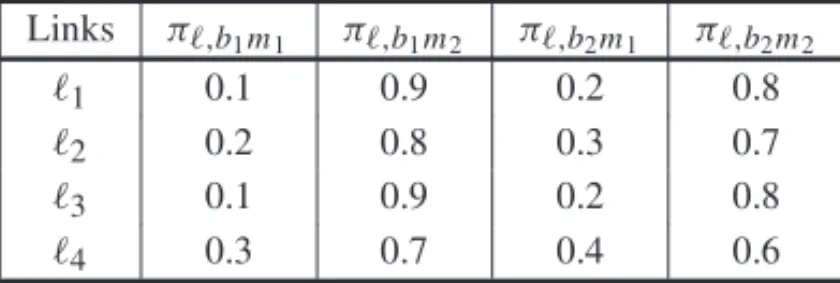
Table 2–Modulation discrete probability distributions. Links πℓ,b1m1 πℓ,b1m2 πℓ,b2m1 πℓ,b2m2
ℓ1 0.1 0.9 0.2 0.8 ℓ2 0.2 0.8 0.3 0.7 ℓ3 0.1 0.9 0.2 0.8 ℓ4 0.3 0.7 0.4 0.6
Table 3–The 8 most probable network configurations withb1.
L/M c1 c2 c3 c4 c5 c6 c7 c8
ℓ1 m1 0 0 0 0 1 0 0 0
m2 1 1 1 1 0 1 1 1 ℓ2
m1 0 0 1 0 0 1 0 0 m2 1 1 0 1 1 0 1 1
ℓ3 m1 0 0 0 1 0 0 1 1
m2 1 1 1 0 1 1 0 0
ℓ4 m1 0 1 0 0 0 1 1 1
m2 1 0 1 1 1 0 0 0
pc 0.4536 0.1944 0.1134 0.0504 0.0504 0.0486 0.0216 0.0126
Consider the small microwave network shown in Figure 1 having four links. The following band-width and modulation values are available on each link:
• B ={b1=7 MHz, b2=14 MHz}
• M ={m1=QPSK, m2=16-QAM}
is 256. Table 3 shows only the 8 most probable configurations when the bandwidth is set to 7 MHz on each link.
Assume that there is one traffic demand of 40 Mbps from nodea to noded, and the required reliability level is 0.85. By assigning justb1 on each link, it can be seen that each network configuration fromc1toc5is able to carry this demand as at most one link is limited to 14 Mbps,
while other ones offer 28 Mbps. The cumulative probability of these configurations is 0.8622, which is more than required. Now, if the reliability level is increased to 0.90, more configurations are needed. However, among the remaining configurations, onlyc7andc8can handle a demand
traffic greater than 28 Mbps, which is not sufficient. Thus, additional bandwidth is needed which results in higher network cost. Note also that even a reliability level of 0.85 could not be reached if a static routing scheme was used with bandwidthb1assigned on each link.
4 SOLUTION APPROACH
4.1 Outline
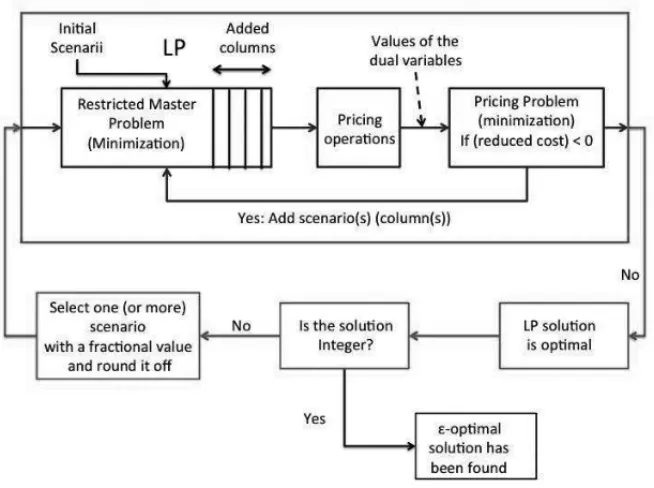
A straightforward solution approach to our model (3)-(11) is to include all the possible network configurations inC: this is clearly intractable even with moderate-size network instances. Al-ternatively, we describe hereafter a solution process based on theColumn Generationtechnique (CG) which splits the original problem into two subproblems: theRestricted Master Problem (RMP) and thePricing Problem. The RMP is a linear-relaxed version of the original problem where only a limited subset of configurations are considered, while the pricing is another prob-lem created to generate only the variables (configurations) which have the potential to improve the objective function, i.e., to find variables with negative reduced costs. As depicted in Figure 2, the process alternates between these two problems until the following optimality condition is satisfied: no more configurations with a negative reduced cost can be derived. At this point, if all the variables of the RMP have integer values, the process is done and the solution is optimal. Otherwise, the RMP is solved again by enforcing integrality constraints on the current variables (or columns)xcand alsozℓ,b. This latter solution can be thought as an upper-bound solution of
the original problem, not necessarily optimal. Nevertheless, as shown by our experimentations, the gap with the lower-bound LP-relaxed solution is generally very narrow.
The objective of the pricing problem consists in minimizing the reduced cost of variablesxc. The
reader who is not familiar with linear programming is refereed to the seminal books of Bazaraa et al. (1977) and Chvatal (1983) for its computation. Indeed, in linear programming, the reduced cost is the amount by which an objective function coefficient would have to decrease before it would be possible for a non basic variable to assume a positive value in the optimal solution. It is therefore written as follows:
COSTc=PENAL1
(s,d)∈SD
c∈C
δcsdpc
initial cost of variablexc
Figure 2–The column generation decomposition technique.
whereCOLUMNcis the column vector associated with variablexcanduis the dual vector of the
linear program associated with (3)-(11) (i.e., where the domain of the binary variables has been changed to[0,1]).
We now omit thecindex in order to alleviate the notations. Based on (3)-(5), this leads to:
COST=
ℓ∈L
pℓ
PENAL1
(s,d)∈SD
δsd−u(4)−
ℓ∈L
(b,m)∈Bℓ×Mℓ
u(5)ℓ,bmaℓ,bm (13)
where u(4) (≥ 0) and u(5)ℓ,bm (≶ 0) are dual values corresponding to constraints (4) and (5), respectively. pℓrepresents the probability that the linkℓuses the affected bandwidth/modulation
in the configuration under construction. Here, each variableδsd represents the unsatisfied flow
amount for the demand(s,d)∈ D, and each binary variableaℓ,bm indicates if the bandwidthb and modulationmare used on linkℓ. The set of constraints of the pricing problem can be written as follows:
pℓ=
(b,m)∈Bℓ×Mℓ
πℓ,bmaℓ,bm ℓ∈L (14)
ℓ∈ω−(v)
ϕℓsd−
ℓ∈ω+(v)
ϕsdℓ =
⎧ ⎪ ⎪ ⎨
⎪ ⎪ ⎩
−Dsd+δsd v=s
Dsd−δsd v=d
0 otherwise
(s,d)∈SD
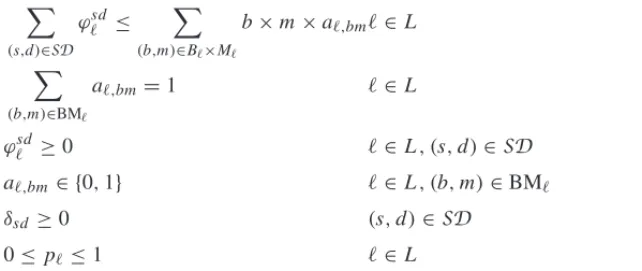
ϕℓsd≤
(b,m)∈Bℓ×Mℓ
b×m×aℓ,bmℓ∈L (16)
(b,m)∈BMℓ
aℓ,bm=1 ℓ∈L (17)
ϕsdℓ ≥0 ℓ∈L, (s,d)∈SD (18)
aℓ,bm ∈ {0,1} ℓ∈L, (b,m)∈BMℓ (19)
δsd ≥0 (s,d)∈SD (20)
0≤ pℓ≤1 ℓ∈L (21)
where the variableϕℓsd represents the amount of flow transported from nodes to noded. Con-straints (15) enforce the flow conservation at each node, while conCon-straints (16) limit the flow carried on each link to the transport capacity as defined by the selected bandwidth/modulation pair. Constraints (17) ensure that a unique pair bandwidth/modulation is selected for linkℓ.
Unfortunately, finding exact solutions to this problem is rather challenging as the objective func-tion includes a highly non convex term (product of pℓvariables). In the sequel, a heuristic
ap-proach is proposed with the aim to find high-quality solutions in a timely manner.
4.2 Modified Column Generation (MCG) heuristic
The main difficulty to solve the pricing problem stems from the presence of a non convex term in the objective. However, it can be easily seen that this term (ℓ∈LPℓ) does not affect the sign of
the objective value, as it is the product of positive quantities. Hence, if the reduced cost of some configuration is negative, it will still be the case if this term is omitted from the objective. So, the modified pricing problem becomes a regular MILP that can be solved with off-the-shelf solvers. Obviously, this trick does not apply without some loss in the solution quality. In fact, nothing prevents now from getting configurations with very low probabilities. As a result, compared to exact pricing solutions, much more iterations between the RMP and the pricing may be required to build the final solution.
To mitigate this effect, we consider only the configurations that satisfy the totality of the traffic requirements (i.e.,δsd =0,∀(s,d)∈SD). Furthermore, the speed of the resolution process is
increased by trying to add several configurations in one iteration. To this end, we define a local search heuristic which looks for other configurations with negative reduced cost starting from the one returned by the modified pricing. Such configurations, called neighbor configurations, are found by modifying only the modulation of a number of randomly selected links while ensuring the satisfaction of the traffic requirements. Algorithm 1 describes the process.
Algorithm 1: Local Search Heuristic.
Input : a configurationcwith negative reduced cost (redcost(c) <0) Output: a set of configurationsNc
it er ←1;c¯←c;Nc← ∅
whileit er ≤#Max I t erdo
I(c¯)←a set ofneighbor configurations ofc¯ foreachc′∈ I(c¯)do
ifredcost(c¯) <0then Nc← Nc∪ { ¯c}
end end ¯
c←arg min
c′∈I(c)¯
redcost(c′) it er ←it er+1
end return Nc
links ofc. This modified pricing problem is used to verify the existence of a routing solution for these configurations. If so, they will be added to the solution. This contributes to increase the network reliability without increasing the bandwidth cost.
4.3 Initial Solution of the RMP
A certain number of network configurations must be given to the RMP model in order to obtain the first feasible solution of the problem. In particular, as stated in (4), the cumulative probability of these configurations must be no less thanpmin. Finding such configurations can be tedious for
large network instances and high values of pmin.
We tackle this issue by solving a modified version of the RMP, where the objective function is rewritten as follows:
max
c∈C
pcxc−PENAL1
(s,d)∈SD
c∈C
δsdc pcxc (22)
So, our aim here is to generate as many configurations as possible, in particular those that are able to satisfy all the traffic demands, so that constraint (4) holds. Naturally, this latter constraint is dropped from the formulation.
The objective function of the corresponding pricing problem needs to be modified to reflect the new reduced cost. It can be written as:
max
ℓ∈L
pℓ
⎛
⎝ ⎛
⎝1−PENAL1
(s,d)∈SD
δsd
⎞
⎠−
ℓ∈L
(b,m)∈Bℓ×Mℓ
u(5)ℓ,bmaℓ,bm
⎞
⎠ (23)
while the set of constraints is not modified.
Again, we work around the non-linearity in the objective using the heuristic approach described in the previous section. As the objective now is a maximization, a new configuration will be added to the initial RMP if its reduced cost is strictly positive. Finally, the process switches to the main RMP model as soon as a feasible solution is obtained.
5 NUMERICAL RESULTS
In this section, we describe and discuss several numerical experiments that have been conducted to evaluate the computational performance of our approach and the quality of the obtained provi-sioning solutions. The experimental problem data consists in a set of real-world network topolo-gies proposed by SNDlib (Orlowski et al., 2010) with the traffic demands rescaled as in Claßen et al. (2014): Atlanta (15 nodes, 44 links), Polska (12 nodes, 36 links), France (25 nodes, 90 links) and Germany50 (50 nodes, 176 links) (see Fig. 4).
Besides, the monetary cost of 1 MHz of bandwidth is set to $1000. Note also that the overall resolution time is limited to two hours. Other relevant parameters are: pmin= 0.9;PENAL1 =
40,000;PENAL2 =50. Theses values are chosen with the aim to obtain solutions that are more focused on satisfying almost fully traffic demands rather than achieving a very high reliability level.
Table 4–Modulation schemes and bandwidth efficiency.
MCS Bandwidth efficiency Required SNR (bps/hz) (dB) m1: 16-QAM coded 3.6 21.02 m2: 16-QAM uncoded 4.0 21.02 m3: 64-QAM coded 5.4 27.45 m4: 64-QAM uncoded 6.0 27.45 m5: 256-QAM coded 7.2 33.78 m6: 256-QAM uncoded 8.0 33.78
5.1 Resolution process
First, let us point out that the high variability of the probability distributions described above and the independence between link probabilities produce a tremendous number of possible con-figurations with very low probability value. In order to prevent generating such meaningless configurations, e.g., with probability of the order of 10−75, the following restriction is added to the pricing problem:pℓ≥0.1 forℓ ∈L.
Table 5–Column Generation Process.
Topology Polska Atlanta France Germany50 # Total conf. 606 635 629 454 # Used conf. 78 16 102 17
For each considered topology, Table 5 shows that the total number of configurations generated by our solution process, using the MCG heuristic, represents only a tiny fraction of the overall number of possible configurations, i.e.,ℓ∈L|Bℓ×Mℓ|. That means that our solution process
focuses primarily on the most significant configurations in terms of probability and demand satisfaction. Also, we can observe that the best solutions in terms of cost will retain only a limited number of configurations while reaching the desired reliability level. Note that most generated configurations satisfy all traffic demands, i.e.,δsd=0 for all(s,d)∈SD.
5.2 Solution quality
every link. We observe a significant cost saving ranging from 33% to 45%, while reaching a high reliability level. This gain is more noticeable with larger networks, but it goes with some decrease of the service reliability. This is due in part to the additional constraint on pℓ(pℓ ≥ 0.1), but
mainly to the fact that it is much harder to achieve the same reliability when the network is con-stituted by more links as configuration probabilities tend to zero. For instance with Germany50, for a configurationcwhere each linkℓ∈ Eis such thatpℓ=0.9, we have pc=0.9176≃10−8.
Figure 5–Cost savingvs.the worst case.
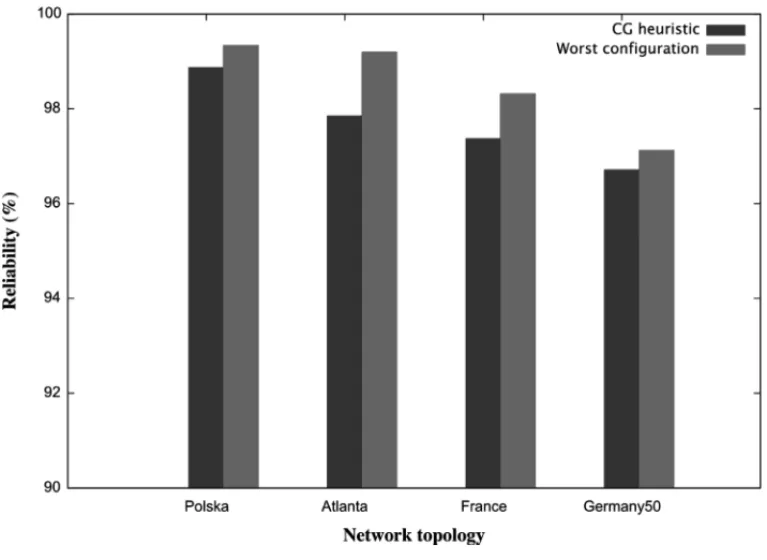
Another way to assess the performance of our method is to measure the reliability gaps between our solutions and the worst case provisioning. As depicted in Figure 6, one can see that the reliability level is only slightly compromised while the bandwidth cost is significantly reduced.
5.3 Comparison with some results from Claßen et al. (2014)
Figure 6–Reliabilityvs.the worst case.
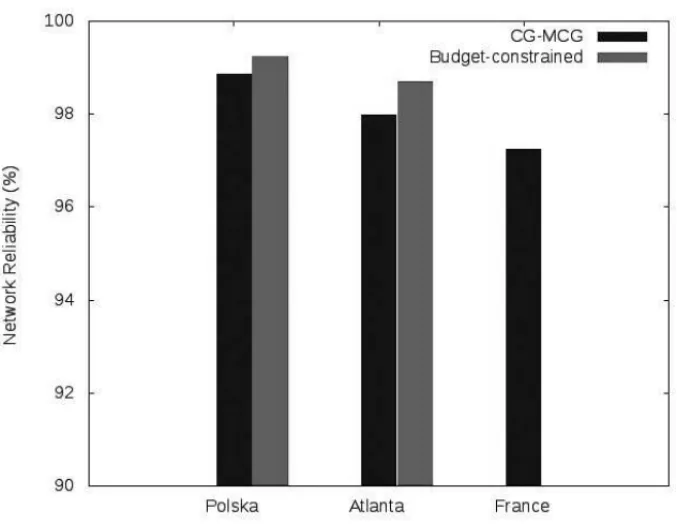
In case of budget-constrained model, the reported solutions, which were obtained using the fastest method (i.e., adding cutset inequalities), achieve 36%, 39% and 40% of cost savings for Polska, Atlanta and France networks, respectively (Germany50 has not been considered in Claßen et al., 2014). Results depicted in Figure 7 show that, using the methods presented in this paper, we obtained a lower cost for Atlanta and France. Whereas, Figure 8 shows that achieved reliability are inferior by no more than 1% for Polska and Atlanta, while our approach performs better on the France instance as no solution has been found using the budget-constrained model with the same cost.
In sum, budget-constrained model provides better solutions for small network instances while our approach based on column generation scales much better. We even believe that obtaining feasible solutions with the budget-constrained approach in a reasonable amount of time is very unlikely for large instances, such as Germany50. Table 6 summarizes a comparison of the computation times required in both cases with a similar cost. Not only our approach is the fastest one, but it also provides good results for large instances in a relatively limited amount of time.
6 CONCLUSION
Figure 7–Cost comparison with Claßen et al. (2014).
Table 6–Resolution time (minutes).
Polska Atlanta France Germany50
CG-MCG 7 32 131∗ 148∗
Budget-constrained
21 120 nf –
(Claßen et al., 2014)
∗: CG process is stopped after 2 hours. nf: no feasible solution was reported, – : not considered.
decomposition approach to separate the bandwidth assignment from traffic routing that depends on the current network’s state. Each valid solution must conform to a minimum operator-specified reliability level in presence of fluctuations in the transport capacity of links. As our model raises a number of difficulties due the non-convexity of the pricing subproblem, a computationally-efficient heuristic has been proposed. Numerical results confirm the substantial operational costs gains that can be made while achieving a satisfactory reliability level. Also, the potential of our approach on large scale instances has been assessed. In particular, our approaches was able to solve instances that were not reachable by previous methods.
As future work, we plan to improve the heuristic used to solve the pricing problem in order to increase the reliability of the solutions, and eventually find solutions with smaller cost. We would also like to propose a fixed budget formulation in order to build the Pareto front of the solution space. Moreover, correlation between the links fades due to environmental (weather) conditions will a subject of a thorough investigation.
REFERENCES
[1] ANDERSONH. 2003.Fixed Broadband Wireless System Design. John Wiley & Sons, first edition. [2] BALL MO. 1986. Computational complexity of network reliability analysis: An overview.IEEE
Transactions on Reliability,35(3): 230–239.
[3] BAZARAAM, JARVISJ & SHERALI H. 1977.Linear Programming and Network Flows. Wiley, New York.
[4] BRECHTTB & COLBOURNCJ. 1988. Lower bounds on two-terminal network reliability.Discrete Applied Mathematics,21(3): 185–198. ISSN 0166-218X.
[5] CHVATALV. 1983.Linear Programming. Freeman.
[6] CLASSENG, COUDERTD, KOSTERAMCA & NEPOMUCENON. 2011a. Bandwidth assignment for reliable fixed broadband wireless networks. In12th IEEE International Symposium on a World of Wireless Mobile and Multimedia Networks (WoWMoM 2011), pages 1–6.
[8] CLASSENG, COUDERTD, KOSTERAMCA & NEPOMUCENON. 2014. Chance-Constrained Opti-mization of Reliable Fixed Broadband Wireless Networks.INFORMS Journal on Computing,26(4): 893–909. 10.1590/0101-7438.2017.037.03.052510.1287/ijoc.2014.0605.
[9] COUDERTD, LUEDTKEJ, MORENOE & PRIFTISK. 2007. Computing and maximizing the exact reliability of wireless backhaul networks. InInternational Network Optimization Conference, Lisbon, Portugal, Feb. 2017. URLhttps://hal.inria.fr/hal-01593041.
[10] DOMINIAKS, BAYERN, HABERMANNJ, RAKOCEVICV & XUB. 2007. Reliability analysis of IEEE 802.16 mesh networks. In2nd IEEE/IFIP International Workshop on Broadband Convergence Networks, BcN 2007, pages 1–12.
[11] GOLDSMITHA & CHUAS-G. 1997. Variable-rate variable-power MQAM for fading channels.IEEE Trans. Commun.,45: 1218–1230.
[12] GOLDSMITHA & CHUAS-G. 1998. Adaptive coded modulation for fading channels.IEEE Trans. Commun.,46(5): 595–602.
[13] HANSENP, JAUMARDB & NGUETSEG-B D. 1999. Best second order bounds for two-terminal network reliability with dependent edge failures.Discrete Applied Mathematics,96(97): 375–393. [14] KUOFC, ZDARSKYFA, LESSMANNJ & SCHMIDS. 2010. Cost-efficient wireless mobile backhaul
topologies: An analytical study. InGlobal Telecommunications Conference (GLOBECOM 2010), 2010 IEEE, pages 1–5, Dec 2010.
[15] marketsandmarkets.com. 2015. Mobile and wireless backhaul market by equipment (mi-crowave, millimeter wave, sub 6 ghz, test and measurement), by services (network, system integration, professional) – worldwide market forecasts and analysis to 2015-2020, December 2015. URLhttp://www.marketsandmarkets.com/Market-Reports/ mobile-wireless-backhaul-market-1034.html.
[16] NEPOMUCENON. 2010.Network optimization for wireless microwave backhaul. PhD thesis, Ecole doctorale STIC, Universit´e Nice-Sophia Antipolis, Dec. 2010.
[17] ORLOWSKIS, WESSALY¨ R, PIORO´ M & TOMASZEWSKIA. 2010. Sndlib 1.0 – survivable network design library.Networks,55(3): 276–286. 10.1590/0101-7438.2017.037.03.052510.1002/net.20371. URLhttp://dx.doi.org/10.1002/net.20371.