Published online 23 April 2007 in Wiley InterScience (www.interscience.wiley.com) DOI: 10.1002/ett.1215
Letter
Wireless Systems
New quasi-orthogonal BCH-derived sequences for CDMA applications
Cesaltina N. E. Ricardo
1, Manuel D. Ortigueira
1* and Jose´ Anto´nio B. Gerald
21UNINOVA/DEE Campus da FCT da UNL, Quinta da Torre, 2825-114 Monte da Caparica, Portugal 2
Instituto Superior Te´cnico and INESC, R. Alves Redol, 9, 21000-029 Lisboa, Portugal
SUMMARY
Based on two methods recently proposed—the ‘Ranging Criterion’ (RC) and the ‘Generators Ranging Criterion’ (GRC)—new (quasi-orthogonal) even BCH-derived sequences are generated which are very attractive for synchronous or quasi-synchronous Code Division Multiple-Access (CDMA) systems. Numerical results show that the new family of BCH-derived sequences can contain a higher number of quasi-orthogonal sequences with lower correlation values and higher processing gains (PGs) than the spreading sequences typically used in the third generation of mobile communications system, UMTS or in the recent large area synchronised CDMA (LAS-CDMA) technology. It is shown that the even BCH-derived sequences are easily generated by a linear shift register generator, allowing the construction of systems with receiver structures of low complexity as compared with those of quasi-synchronous systems using low correlation zone sequences, as for instance the LAS-CDMA system. Copyright#2007 John Wiley & Sons, Ltd.
1. INTRODUCTION
In recent years, the Code Division Multiple-Access (CDMA) technology has been used in cellular mobile communication systems (for instance, UMTS/IMT-2000 and IS-95) with two aims: (1) to counterbalance the pro-blem of spectrum overload due to the excessive growth of the number of users; (2) to follow the new tendencies of the telecommunications market in providing a large variety of services, including broadband applications, with identical quality of service of wired networks. These requirements are completely satisfied by the current UMTS system, that uses the wideband CDMA (W-CDMA) tech-nique to provide higher capacity, coverage, and spectral and power efficiencies, than the systems based on TDMA, FDMA or narrowband CDMA (as IS-95) [1–4].
Additionally, the Direct Sequence CDMA (DS-CDMA) form provides some other important features such as resis-tance against multipath fading and low interference. In these systems, each user is identified by a specific pseudo-noise (PN) code [5–9]. So, the average perfor-mance of these systems can degrade significantly when the number of active users increases, due to the increase in the level of multiple-access interference (MAI) in the channel [7, 9–14]. This depends on the (out-of-phase auto and cross) correlation properties of the PN spreading sequences [13, 14]. Hence, reduced values of out-of-phase autocorrelation and cross-correlation should be required, respectively, to make easier the synchronisation and to minimise (or eliminate) the MAI. This issue is very impor-tant, because it allows the capacity of CDMA systems to increase [7, 9, 11, 13]. For instance, the well-known
Received 19 June 2005
Copyright#2007 John Wiley & Sons, Ltd. Revised 3 February 2006
orthogonal binary Walsh-Hadamard sequences are used to eliminate the MAI in synchronous channels (in-phase channels), like the downlink transmission in mobile com-munication systems. However, these sequences have the worst values of cross-correlation when compared with other (orthogonal and non-orthogonal) PN sequences usually used in asynchronous (or quasi-synchronous) CDMA systems [14–17].
Recently, quasi-synchronous CDMA (QS-CDMA) sys-tems using sets of orthogonal [18, 19] and
quasi-orthogo-nal [19] spreading sequences have been actively
investigated, due to their superior immunity against syn-chronisation errors [18, 19], higher bandwidth efficiency [20], and consequently, better performance, when com-pared with those obtained with the traditional spreading sequences [18, 19, 21]—the quasi-orthogonal spreading sequences are characterised by a correlation zone almost zero around the zero-phase shift. We find applications of these results in (quasi-synchronous) large area synchro-nised CDMA (LAS-CDMA) [19] and multicarrier CDMA (MC-CDMA) [17, 19] systems, which are both strong can-didates for the fourth generation of mobile communication systems.
In this paper we study a new family of quasi-orthogonal spreading sequences, the even BCH-derived sequences— belonging to the class of pseudo-noise even balanced (PN-EB) sequences discussed in References [22, 23]—having very good correlation properties. This new family of sequences allows a higher performance —measured by the Processing Gain (PG)—in additive white Gaussian noise (AWGN) channels than that provided by the odd ones commonly used in CDMA systems: the Gold sequences [24], the BCH sequences [24], the Gold-Like sequences [24], the m-sequences [24] and the large set of Kasami sequences [24]. The main reason for the choice of these odd PN sequences is due to the existence of a large number of sequences with small (out-of-phase auto and cross) correlation values and their simple generation pro-cedure (the Gold sequences, the m-sequences, the Gold-Like and the large set of Kasami sequences are easily gen-erated by the linear feedback shift register generator [24]).
The numerical results we obtained confirmed that the new family of even BCH-derived sequences contains a high number of (quasi-orthogonal) sequences with low correlation levels, better than those presented by the even sequences of the recent UMTS system [16, 17] and higher PGs, even when compared with the LS sequences [19, 25] of the LAS-CDMA system. These characteristics can make the even BCH-derived sequences very attractive in fading dispersive channels, either in synchronous or quasi-synchronous channels.
The paper outline is as follows. In Section 2, we present the PG definition that we will use and describe the steps for generating the new family of BCH-derived sequences. We give two examples of sequence generation to make easier to understand the procedure. In Section 3, we present some simulation results to illustrate the behaviour of the new sequences. At last we will present some conclusions.
2. ABOUT THE QUASI-ORTHOGONAL BCH-DERIVED SEQUENCES
2.1. The processing gain
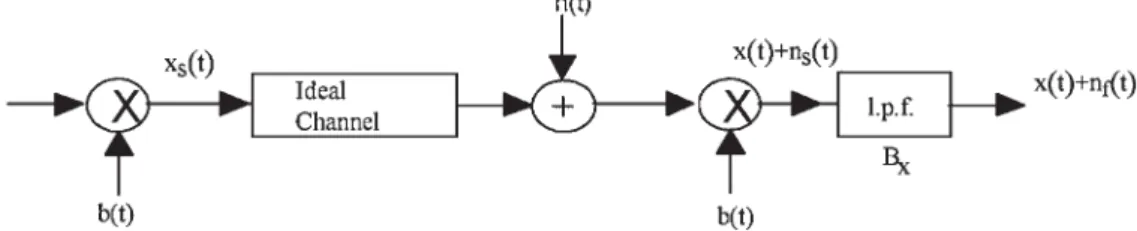
Consider the base-band DS-SS communication system of Figure 1, wherexðtÞis the information signal, with bit rate
Rb, andbðtÞis a periodic PN spread spectrum sequence,
with chip rateRc>>Rb. The low-pass filter has the same
bandwidthBxofxðtÞ. We assume that in each periodTof bðtÞ, there areNrectangular pulses of durationsuch that
N ¼Tand amplitudeai¼ 1, fori¼0;1;2;. . .;N1.
The receiver output signal is the sum of the recovered information signalxðtÞwith the filtered spread noise signal
nfðtÞ. Assume that there is no spreading: we receive a
sig-nal that is the sum of the origisig-nal sigsig-nal and noise, with powers equal respectively toSoandNo. If we have
spread-ing, we receive again the original signal with a filtered spread noise, with powers equal toSsandNs, respectively.
The performance of the system depends only on the spread noise power because, ideally, we do recover the original
Figure 1. Ideal base-band DS-SS system.
signal xðtÞ. In this case, the signal power, with (Ss) or
without (So) spreading, is the same at the output system,
that is Ss¼So. As the noise output power depends on
the spreading, the output signal to noise ratio with,
Ss=Ns, and without,So=No, spreading are different.
These considerations led, Ortigueiraet al.[26], to pro-pose the system performance analysis according to a new definition of PG, given as:
PG¼Ss=Ns So=No
ð1Þ
Using Ss¼So in Equation (1), we can obtain the final
result:
PG¼No Ns
ð2Þ
Remark that this definition of PG is different from the usual, in which the PG is defined as the quotient between the spread and the original signal bandwidths leading, in the case of a binary signal source, to a PG that is the quo-tient between the spreading chip rate and the source bit rate [5, 6]. To compute the PG defined in Equation (2), we have to analyse the effect of spreading over the noise. The non band-limited noise case was considered in Refer-ence [26], where it was shown thatPG1. This indicates that the spreading has no effect on white noise.
To study the band-limited case, we considered a noise signal, nðtÞ, with bandwidth Bn smaller than the spread
spectrum signal bandwidth, that is narrowband noise. After spreading, the power spectrum of nsðtÞis the sum of weighted repetitions of power spectrum ofnðtÞlocated at multiple frequencies of 2p=T. Inside the reference band,
Bx, the total number of replicas decreases withT, and this
decreasing stops when T41=ðBnþBxÞ. In this last case,
there will be only one replica of the power spectrum of
nðtÞinside the bandBxand located at the zero frequency.
Hence, the PG defined by Equation (2), will be given by Reference [26]:
PG¼ 1
TAð0Þ
2 ð3Þ
whereAðnÞis the Discrete Fourier Transform (DFT) of the sequenceai, fori¼0;1;2;. . .;N1.
From Equation (3), we can conclude that the PG is not defined ifAð0Þ ¼0. This is an ideal situation that needs a sequence with zero mean value and a strictly band-limited noise. We do not find the second situation in practice but if the noise spectrum assumes very small out of band values, the PG can be made very high by using a spreading signal
with a zero mean value. This can be achieved through two distinct ways:
(1) Adding one extra zero symbol to the period of a binary
m-sequence [24] or a similar odd-balanced (binary) sequence in order to achieve an equal number of ones and zeros; or,
(2) Using Manchester pulses instead of rectangular ones in the odd-balanced (binary) sequences.
This last option was not considered due to the increase in the complexity of the system, corresponding costs and band duplication. So, in the following we shall be inter-ested in constructing zero mean sequences to achieve high PGs.
2.2. The design of even BCH-derived sequences
Taking option (1) of Subsection 2.1 as reference, we will apply two methods —the Ranging Criterion (RC) [22] and the Generators Ranging Criterion (GRC) [23] —to gener-ate new classes of sequences with zero mean value, namely
the even (quasi-orthogonal)-BCH-derived sequences
obtained from the family of odd-balanced BCH sequences by inserting an extra zero.
Assume we have a set of odd-balanced BCH sequences [24]. To apply the RC we follow the next four steps:
(1) Insert the extra zero at the end of sequence;
(2) In all those sequences that still present higher out-of-phase autocorrelation levels, move the extra zero into the longest run of zeros;
(3) For those sequences without out-of-phase autocorrela-tion values improvement, place the extra zero into the run of zeros nearest to the½ððNþ1Þ=2Þ þ1position; (4) For the cases, in which the steps (2) and (3) did not improve the result of step (1), place the extra zero into the nearest run of zeros of the location in step (1).
In the following example, we illustrate the RC applica-tion to one odd-balanced BCH sequence.
Example 1. Consider the odd-balanced BCH sequencea1
of period 63 generated by the primitive polynomial
x6þx5þx3þx2þ1, that is
a1¼ ð10110010010000011011100011010100
0111011001101011100101011001011Þ
To generate the new even BCH-derived sequence, the four steps of RC are applied consecutively to the odd-balanced BCH sequence, as described above. For each step, the autocorrelation function of the new sequence is
calculated and compared with that of the next step. At the end of RC, we choose the even sequence with the lowest out-of-phase autocorrelation levels. Thus, applying the step (1) of RC, we obtain the even sequence of length 64,
a1ð1Þ¼ ð10110010010000011011100011010100
01110110011010111001010110010110Þ
with maximum absolute value of out-of-phase (normal-ised) autocorrelation,jRa1
ð1ÞðnÞj ¼0:375.
Next, for step (2), we have,
a1ð2Þ¼ ð10110010010000001101110001101010
00111011001101011100101011001011Þ
with maximum absolute value of out-of-phase (normal-ised) autocorrelation, jRa1
ð2ÞðnÞj ¼0:3125. Doing the
same for steps (3) and (4), we obtain a maximum value of out-of-phase autocorrelation to the new sequences equal to that of step (2), which is 0.3125. So, comparing all the obtained results, we observe that the even BCH sequence
a1ð2Þhas the best out-of-phase autocorrelation values. To apply the GRC to the odd-balanced BCH sequences, we follow the steps:
(1) Insert the extra zero at the end of sequence;
(2) In all those sequences that still present higher out-of-phase autocorrelation levels, move the extra zero into the longest run of zeros;
(3) For those sequences that did not improve their auto-correlation levels with the previous two steps, the extra zero should be placed at the nearest phase defined by the first or the second large run of zeros of one of the two generating sequences of the odd-balanced BCH sequence, as indicated in the Example 2 below.
To note that the steps (1) and (2) of GRC are equivalent, respectively, to the steps (1) and (2) of RC.
Next, we give an example of GRC.
Example 2. Consider the odd-balanced BCH sequencea1
of Example 1.
In this case, the steps (1) and (2) of GRC give the same results of steps (1) and (2) of RC of Example 1. Hence, we do not repeat them here.
To apply the step (3) of GRC, we considera1 decom-posed on its generating sequences a11 anda12, such that
a1¼a11a12, where is the modulo-2 addition. Let us apply the step (3), for instance, to the sequencea11(of length 63), given by:
a11¼ ð1011010011011000100100001110000
01011111100101010001100111101110Þ
We will obtain the even sequence (of length 64)
a11ð3Þ¼ ð10110100110110001001000011100000
10011111100101010001100111101110Þ
Leta12ð3Þbe the sequence of length 64, resultant ofa12
by inserting one zero at the end of sequence, that is
a12ð3Þ¼ ð00000110100110010010100000110100
11001001010000011010011001001010Þ
Now, doing the modulo-2 addition of a11ð3Þ anda12ð3Þ
sequences, we obtain the even BCH-derived sequence
a1ð3Þ¼ ð10110010010000011011100011010100
01010110110101001011111110100100Þ
with maximum absolute value of out-of-phase (normal-ised) autocorrelation function,jRa1
ð3ÞðnÞj ¼0:25.
We can note thata1ð3Þ has a lower value of out-of-phase
autocorrelation peak than that provided by steps (1) and (2) of GRC, which are, respectively, 0.375 and 0.3125.
3. NUMERICAL RESULTS
Table 1 presents the numerical results of out-of-phase (nor-malised) autocorrelation function of the new even BCH-derived sequences obtained with RC and GRC criteria
Table 1. (Periodic) out-of-phase (normalised) autocorrelation function results with RC and GRC criteria applied to odd-balanced BCH sequences of period 63.
Number of sequences by correlation level
Maximum correlation levels 0.1875 0.25 0.3125 0.375 0.4375 0.5 Total
Even BCH 1 49 37 7 1 1 96
BCH with RC 9 73 14 0 0 0 96
BCH with GRC 12 78 6 0 0 0 96
applied to two families of odd (balanced) Dual-BCH sequences of period 63. (Remark that, each family con-tains 64 odd BCH sequences of period 63, of which only 48 sequences are balanced.) We can observe that the RC and GRC allow a higher number of sequences with low correlation levels when compared with the even BCH sequences (with the extra zero insert at the end of sequence). Notice that the GRC gives slightly better results in this case. We also analysed the cross-correlation results (they are not indicated in the paper), and we concluded that the even BCH-derived sequences can have lower cross-correlation values than the traditional odd PN sequences referred in Section 1.
Table 2 compares the quasi-orthogonal (binary) families of (optimised) even BCH-derived (with GRC) and GMW-derived sequences [19, 27] and the orthogonal (ternary) families of LA and LSy sequences [19, 25] relative to the parameters: (a) sequence lengthN, (b) family sizeMand (c) (out-of-phase auto and cross) correlation peak valuej"j
inside the zone of lengthZ. The sequences were compared taking in account a fixed correlation zoneZand an identi-cal sequence length N (whenever possible). The results showed that the families of even BCH-derived and LS sequences have a very similar number of sequences for the same correlation zone Z, which is larger than that of families of LA or GMW-derived sequences. We also observe that the (optimised) even BCH-derived sequences possess worse correlation levels than the orthogonal (LS and LA) sequences or the quasi-orthogonal GMW-derived sequences inside the zoneZ. However, when we consider the outside of correlation zoneZ, the LS and LA sequences present higher correlation values than the even BCH-derived sequences or the traditional spreading sequences [28]. These high correlation levels of the LS and LA
sequences can make impractical the CDMA communica-tions in presence of highly dispersive channels due to the highest interference levels. By the above described rea-sons, the (quasi-orthogonal) even BCH-derived sequences can be a good alternative to the LS and LA sequences in very dispersive channels.
In what concerns to the construction procedure, the even BCH-derived sequences have lower complexity of hard-ware implementation than the GMW-derived sequences [27] or the LS and LA sequences. (The even BCH sequences can be easily generated by a linear shift register generator or by a cyclically read memory table.) In the spe-cial case of CDMA systems which use sequences with zero correlation zones (as the LS and LA sequences), the mechanisms of dispreading and code acquisition are more involved and difficult than that in the conventional DS-CDMA systems [29]. This complexity can still be larger when the parameterZincreases (to accommodate the high-est delay dispersion of the channel), once a new construc-tion of zero correlaconstruc-tion zone sequences will be required [30]. This can be a disadvantage when compared, for instance, with the optimised even BCH-derived sequences which do not need of a new construction of sequences for variations of Z.
Figures 2 and 3 show the results we obtained for the PG as a function of the period, for odd sequences (LS [19, 25],
Gold, large set of Kasami, BCH, Gold-like and m
-sequences [24]) and even -sequences (even BCH-derived, Walsh/Hadamard [6, 31] and m-sequences with Manche-ster pulses), respectively.
In these simulations, the base-band DS-SS system of
Figure 1 and a PN code with a chip rate
Rc¼400Kchips=s were used. It was also assumed a base-band noise signal (obtained by low-pass filtering) with bandwidthBnequal to the signal bandwidth, that is, Bn¼Bx¼1KHz. (Remark that the noise bandwidth is
narrower than that of the spread signal.) The PG was cal-culated using Equation (2). In these conditions, the alias-ing occurs when the sequence period has a number of chips greater than 200. Figure 2 shows that the LSz sequences can provide a higher PG (for lengths less than 150) than the (balanced) Gold, Kasami,m-sequences (all with iden-tical gains), and the non-balanced BCH and Gold-like sequences. We expect similar results to balanced sequences in the PG when the BCH and the Gold-like sequences are balanced as the Gold sequences.
Table 2. Comparison of orthogonal and quasi-orthogonal sequences relative to period N, family-size M, absolute correlation peakj"jinside the correlation zone of lengthZ.
LS LA Even GMW-derived BCH-derived
N 72 272 18 156 64 256 63 255
M 8 16 4 8 7 15 4 6
j"j 0 0 0 0 48 420 1 1
Z 9 17 3 16 9 17 9 17
y
The ternary sequences LS can have a lengthNwhich can be odd or even depending on the number of ‘zero’ symbols used in the generating process [19].
z
The odd and even LS sequences have identical PG and non-zero mean value.
In Figure 3, we can observe that all the sequences with zero mean value, including the (quasi-orthogonal) even BCH-derived sequences generated by the GRC method, present a very high PG when compared with the odd
sequences, in the case of no aliasing. This confirms our previous statements in Section 2. These results also show that the (quasi-orthogonal) even BCH-derived sequences have better resistance against the narrowband interference
Figure 2. Performance of odd sequences.
Figure 3. Performance of even sequences.
than the LS sequences. This last result is due to the lowest spectral content of even BCH-derived sequences around the low frequencies when compared with that of LS sequences.
Another result, not illustrated in these figures, is that the optimised even BCH-derived sequences present a slightly smaller gain (a few dBs) than the non-optimised even BCH sequences (with the extra zero placed at the end sequences period). This is justified by the fact that the non-optimised even BCH sequences presented a lower spectral content at low frequencies when compared with the same optimised even BCH-derived sequences. However, the improvement in the correlation results largely justifies the use of the optimised ones.
4. CONCLUSIONS
In this paper, we presented and studied a family of sequences that due to the fact of presenting good correla-tion properties (excepting the Hadamard sequences) and existing in high number make them useful in CDMA sys-tems. These new sequences are easily generated from pre-existing odd BCH sequences through two similar criteria: the RC and the GRC. The steps of both procedures were described and exemplified.
We illustrated the characteristics of the sequences, in terms of the PG and the cross-correlation levels they assume. The new (quasi-orthogonal) optimised BCH-derived sequences, allow a very high PG in selective noise condition, which can be important in fading channels, where the traditional odd sequences present smaller effi-ciency. This subject deserves further research in future. Nevertheless, the results already obtained confirm the the-oretical predictions and represent a high motivation for the study and development of new even spreading sequences suitable for SS systems.
It was also shown that the RC and GRC criteria can pro-vide families of even PN sequences presenting a high num-ber of quasi-orthogonal sequences with reduced out-of-phase correlation levels. This feature can make them attractive for quasi-synchronous systems.
REFERENCES
1. Whu E. On wideband CDMA: capacity-enhanced techniques.
EE359 Wireless Communications Series2002.
2. Moradi H, Kenari MN, Ahmadian M, Salahi A. Performance of WCDMA spreading in downlink for FDD mode. InProceedings of the 1st IEEE International Conference on Circuits and systems for communications (ICCSC’02)2002; pp. 254–257.
3. Prasad R, Ojanpera¨ T. An overview of CDMA evolution toward wideband CDMA.IEEE Communications Surveys1998;1(1):2–29. 4. Gharavi H, Alamouti S. Video transmission for third generation wireless communication systems. Journal of Research of the National Institute of Standards and Technology2001;106(2):455– 469.
5. Cooper GR, McGillen CD.Modern Communications and Spread Spectrum.McGraw-Hill: Singapore, 1986; 268–318.
6. Proakis JG. Digital Communications. McGraw-Hill: Singapore, 1995; 422–423, 695–752.
7. Adachi F, Sawahaski M, Suda H. Wideband DS-CDMA for next generation mobile communications systems.IEEE Communications Magazine1998;36(9):56–69.
8. Frenger P, Orten P, Ottosson T. Code-spread CDMA using maximum free distance low-rate convolutional codes.IEEE Transactions on Communications2000;48(1):135–144.
9. Dahlman E, Gudmundson B, Nilsson M, Sko¨ld J. UMTS/IMT-2000 based on wideband CDMA.IEEE Communications Magazine1998; 36(9):70–80.
10. Okumura Y, Adachi F. Variable-rate data transmission with blind rate detection for coherent DS-CDMA mobile radio.IEEE Transac-tions on CommunicaTransac-tions1998;E81-B(7):1365–1373.
11. Moshavi S. Multi-user detection for DS-CDMA communications.
IEEE Communications Magazine1996;34(10):124–136.
12. Hofstad R, Klok M. Improving the performance of third generation wireless communication systems.Advances in Applied Probability
2004;36(4):1046–1084.
13. Ka¨rkka¨inen K. Meaning of maximum and mean-square cross-corre-lation as a performance measure for CDMA code families and their influence on system capacity.IEICE Transactions on Communica-tions1993;E76-B(8):848–854.
14. Tseng S-M, Bell M. Asynchronous multicarrier DS-CDMA using mutually orthogonal complementary sets of sequences.IEEE Trans-actions on Communications2000;48(1):53–59.
15. Sudjai M, Rgheff M. The MAI performance of orthogonal codes for channel cover in asynchronous CDMA systems. InProceedings of London Communications Symposium 2000 (LCS’00), London, UK, 2000.
16. Nobilet S, He´lard J, Mottier D. Spreading sequences for uplink and downlink MC-CDMA systems: PAPR and MAI minimization. Eur-opean Transactions on Telecommunications2002;13(5):465–474. 17. Popovic´ B. Spreading sequences for multicarrier CDMA systems.
IEEE Transactions on Communications1999;47(6):918–926. 18. Sugano K, Umehara D, Morihiro Y, Kawai M. Quasi-synchronous
CDMA performances using orthogonal cyclic shift m-sequences.
Korea-Japan Joint Conference on Satellite Communications, 23rd, 2003; pp. 85–89.
19. Fan P. Spreading sequences design and theoretical limits for quasi-synchronous CDMA systems.Eurasip Journal on Wireless Commu-nications and Networking2004;1:19–31.
20. Kim Y, Cheun K, Yang K. A bandwidth-power efficient modulation scheme based on quaternary quasi-orthogonal sequences. IEEE Communications Letters2003;7(7):293–295.
21. Manzoli U, Merani M. Multicarrier DS-CDMA performance with different assignment strategies of quasi-orthogonal codes.The 13th IEEE International Symposium on Personal, Indoor and Mobile Radio Communication, Lisbon, Portugal, 2002;4:1474–1481. 22. Ina´cio J, Gerald J, Ortigueira M. New PN even balanced (PN-EB)
sequences for high processing gain DS-SS systems. InProceeding of 42nd Midwest Symposium on Circuits and Systems, Las Cruces, New Mexico, USA, 1999;2:891–895.
23. Ina´cio J, Gerald J, Ortigueira M. Design of new PN even balanced (PN-EB) sequences suitable for high processing gain DS-SS sys-tems. InProceeding of The International Conference on Signal Pro-cessing Applications and Technology, Orlando, Florida, U.S.A, 1999.
24. Sarwate D, Pursley M. Crosscorrelation properties of pseudorandom sequences and related sequences. InProceedings of the IEEE1980; 68(5):593–619.
25. Choi B-Jo, Hanzo L. On the design of LAS spreading codes. In Pro-ceedings of 56th IEEE Vehicular Technology Conference (VTC’2002), Vancouver, Canada, 2002; pp. 2172–2176.
26. Ortigueira M, Gerald J, Ina´cio J. Higher processing gains with DS spread spectrum.Actas do ‘XV Simpo´sio Brasileiro de Telecomuni-cac¸es’, Recife, Brasil, 1997; pp. 207–210.
27. Tang X, Fan P. A class of pseudo-noise sequences over GF(P) with low correlation zone.IEEE Transactions on Information Theory
2001;47(4):1644–1649.
28. Wei H, Yang L, Hanzo L. Interference-free broadband single- and multicarrrier DS-CDMA.IEEE Communications Magazine 2005; 43(2):68–73.
29. Guo X, Chen J, Suehiro N. Code acquisition of ZCZ-CDMA systems based on complete complementary codes.Wireless Communications and Mobile Computing2003;3(5):585–595.
30. Weng J, Le-Ngoc T, Xu Y. ZCZ-CDMA and OFDMA using M-QAM for broadband wireless communications.Wireless Communi-cations and Mobile Computing2004;4(4):427–438.
31. Dinan E, Jabbari B. Spreading codes for direct sequence and wide-band CDMA cellular networks.IEEE Communications Magazine
1998;36(9):48–54.

![Table 2 compares the quasi-orthogonal (binary) families of (optimised) even BCH-derived (with GRC) and GMW-derived sequences [19, 27] and the orthogonal (ternary) families of LA and LS y sequences [19, 25] relative to the parameters: (a) sequence length N](https://thumb-eu.123doks.com/thumbv2/123dok_br/16566612.737818/5.850.66.416.163.277/compares-orthogonal-families-optimised-sequences-orthogonal-sequences-parameters.webp)