Proceedings of the 1" R.C.A.N.S. Congress, Lisboa, October 1992
(
CienciasciaTerra (UNL) Lisboa NP12 pp.7-22 1993J
7 figs.The Neogene of Portugal
M. Telles Antunes &
Joao
Pais
Centro de Estratigrafia e Paleobiologia da UNL, Faculdade de Ciencias e Tecnologia, Quinta da Torre, P-2825 Monte de Caparica, Portugal.
ABSTRACT
Key words: Neogene; Portugal.
After a brief historical introduction, this paper deals with the main concerned geotectonic units: the Lower Tagus and Alvalade basins, the Western and Southern borders, and their infillings. Most of the Neogene events and record concern areas South of the Iberian Central Chain, a nearly inverse situation as that of Paleogene times.
In the most important of these units, the Lower Tagus basin, there are quite thick detrital series, mostly marine in its distal part near Lisboa (albeit with several continental intercalations), and mainly continental in its inner part. Sedimentological record is almost complete since Lowermost to Upper Miocene. The richness of data (paleontology, isotope chronology, paleoclimate, etc.) it gives and the possibility of direct marine-continental correlations render this basin one of the more interesting ones in Western Europe.
Alvalade basin is separated from the previous one by a barrier of Paleozoic rocks. Two transgressions events (Upper Tortonian and Messinian in age) are recorded. Active sedimentation may be correlated to Late Miocene tectonics events.
In Algarve, chiefly marine units from Lower to Upper Miocene are well developped. The Lower unit (Lagos-Portimao Formation) is best exposed in Western Algarve, but desappears eastwards. Middle Miocene is not as well known, whereas Upper Miocene main outcrops are in Eastern Algarve. Cacela Formation is remarquable for its beautiful fossils. Sedimentation as a whole refletcts the tectonic activity and in special the evolution of the Algarve flexures. There is scant evidence of post-Lower Miocene volcanism, the latest known in Portugal. Pliocene has not been recognized there beyond doubt. .
Miocene sediments are much less important to the North of the Central Iberian Chain. Continental beds near Leiria that yielded the well-known"Hisp anotherium fauna" are lower Middle Miocene.
Pliocene corresponds to dramatic changes in paleogeography. At Setiibal Peninsula there is some evidence of a minor Lower Pliocene transgression. Continental detrital sediments, often coarse, occupy rather large areas. In Western Portugal between the Seta hal Peninsula and Pombal there is good evidence of a marine Upper Pliocene transgression, followed up by dune sands overlain
bymarsh clays, diatomites, lignites and boghead levels that can be partly Pleistocene in age.
FOREWORD
After years of research dedicated to the Mediterranean Neogene (Project N't
Zfi,
lUGS-UNESCO), there has been a considerable development in activities concerning the Atlantic Neogene.Within this framework, the hinge-like situation of Portugal is quite interesting, considering the fact that the Neogene units here are well represented and complete. This is particularly true for the Tagus basin, that has a very rich record.
At the beginning of the XIX century, research has been conducted by the remarkable mineralogist (and politician) Jose Bonifacio de Andrada e Silva (1763-1838). Towards the 30's and 40's, the contributions due to Baron Von
Eschwege, Alexandre Vandelli, Daniel Sharpe and a few others followed. Meanwhile, there was a considerable development in investigations with the second Geological Commission (1857-1867), mainly due to the field works of Carlos Ribeiro and the important contributions of Francisco Pereira da Costa.
After being abandoned for a while, the studies were vigorously restarted at the Geological Survey with Jorge Candido Berkeley Cotter, towards the end of the century. Lithostratigraphic classification, now considered classical but still used in the Lisboa Miocene, is due to him.
CienciasdaTerra (UNL). 12
After a long eclipse, there was a remarkable resumption of Neogene studies due to Portuguese geologists or foreign geologists at the service of Portugal. G. Zbyszewski deserves a special reference for his work.
Finally, we have tried to develop and coordinate efforts to reach the knowledge that, in spite of the amount of data already obtained, is far from being complete. This justifies the follow-up of researches that are frequently done with the collaboration of colleagues from other countries.
THE NEOGENE
The Neogene is widely represented in Portugal. However, its geographical distribution is not homogeneous. Generally
speaking,the Miocene formations are particularly important to the South ofthe Central Mountain Range and the Nazare fault in the continent as well as in the continental shelf as far as Algarve. Special reference is made to the Miocene of the terminal part of the Lower Tagus basin due to its remarkable importance in the frame of Western Europe. It will be followed up by references to the Miocene in the inner (Ribatejo) part of the same basin; to the southern basins where Miocene units are better developped; and finally to Miocene or supposedly Miocene units to the North of the Iberian Central Chain.
The Pliocene, whose paleogeography is quite different, mainly corresponds to a band that basically stretches along the shore line. The importance of the inland Pliocene deposits is quite limited.
C <ll
(I)
o
o
o~
~
MQridional border
150Km
{j
/l:o
Mediterranean Sea
o
Basinsrn
Borderlands and moderately deformed chainsI;::'""·"1
Alpine chaino
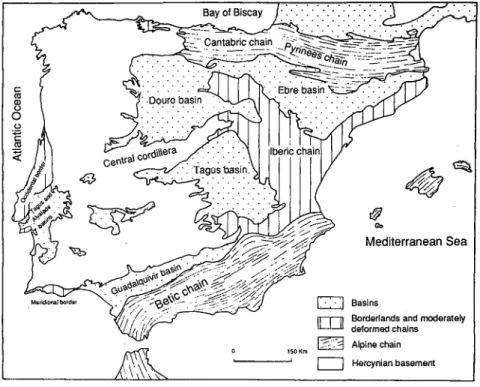
Hercynian basementFig. 1 - Morphostructural units of the Iberian Peninsula (Lautensachin Ribeiroet al.,
1979,modified).
THE MIOCENE OF THE TAGUS BASIN
The Neogene of the lower Tagus basin is remarkable in several ways: its geographical position, in the limits of the Mediterranean and Atlantic domains; the very complete representations of nearly all stages, from the Lower Aquitanian up to the Pliocene; the richness of the data provided; the possibilities of geological correlations and their economical importance.
In Lisboa, the thickness of the Miocene does not exceed 300 meters, and the Pliocene is hardly represented; to the South, the thickness of the whole Neogene increases to about 1200 meters (results obtained from deep boreholes) whereas the outcropping Pliocene reaches the thickness of 50 meters or more.
8
Generally, several marine ingressions and the same amount of intercalated regressions were situated at the terminal region of the basin; one may enumerate several sedimentary cycles framed by transgression and the following regression, seven for the Miocene and one or two for the Pliocene. Subsidence was intensive and was compensated by active sedimentation. The continental debris arrived in large quantities mainly during the orogenic movements which reactivated old hercynian faults.
The Miocene in the western region of the Tagus basin
Proceedings of the 1" R.C.A.N.S. Congress, Lisboa, October 1992
~
q:
IJJ
o
0
0
Quaternary~
Tertiaryo
ES]
... CretaceousI-
[?Z2d
Jurassic
Z
<!.
-
Triassic..J
\-
~
Carboniferousd.
Devonian, Silurian and Ordovician
[]]]
Cambrian CIlPrecambrian Q;)
c :J
m;]
+++ Igneous rocks ~...
cIII
---
Main faults...
E
'Ill u,
0
50 Km eliQ;)CJ
CienciasciaTerra (UNL),12
Z
-0:
u <:>
I
-Z -0:
I
-«
Fig. 3 - Main Tertiary deposits of Portugal.
Aquitanian does not grade down to a marine Chattian. Thus, the lower layers which correspond to. the first sedimentary cycle, have supplied apparently archaic fossils (certain ostracods, pollens, etc.), suggesting an Oligocene age. Another important fact is the presence of glauconite dated by K-Ar to 24±1 Maand 21,1±O,5 Ma. As far as accuracy is concerned, the method used is subjecttoerrors that are not always controllable. The date in question seemsto overtake the 22.5 Ma limit accepted by some authors. Otherauthors, in fact, place the Oligocene-Miocene limit at 24 or even 25 Ma.
In some places, the Aquitanian overlays unconformally older units. Elsewhere, there is a continuous passage evidencing the development of the first miocene transgression.
The region between Lisbon and the Arrabida chain is important. In the present state ofknowledge, seven miocene cycles (marked TOtoT6) and at least a cycle belonging to the Pliocene (Fig. 5) have been identified. One hastonote the considerable wealth of these facies as well as paleontological information. The positions of the levels containing mammals are easily referred in relation to the marine formations. These allow the possibility of doing direct correlations of the first order between marine and continental horizons, at least for the lower Miocene and the first stages ofthe Middle Miocene. One may also recognize
10
climate changes. Changes are important in marine fauna: tropical conditions were predominant, at least since the genesis of the coralline barrier reefs of the Aquitanian; maximum sea temperatures, comparable to the present day Gulf of Guinea, were reached at the Upper Burdigalian and Langhian. Later, the prevailing conditions were closer to those existing at the present day in the moroccan coast with a slight increase in Middle Tortonian; however temperature never reached again the earlier maximum.
The fauna and vegetation ofthe continent indicate humid periods alternating with relatively dry ones, leading to
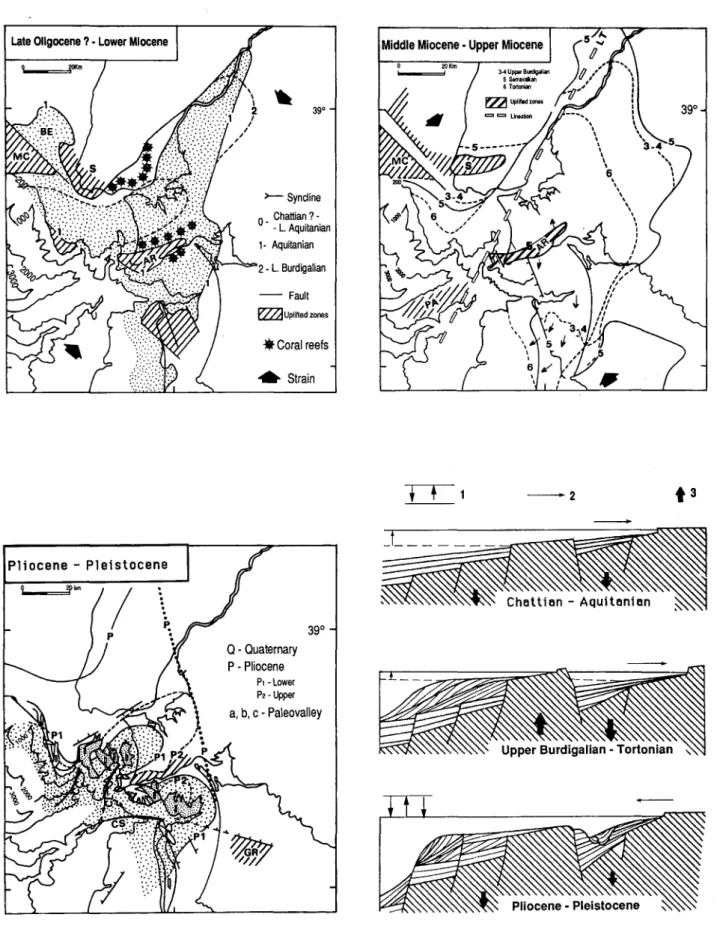
forestal environments rather than savannah or steppe. Transgressions and regressions also had palaeogeographical consequences (Fig. 5; Fig. 6): limited ingression forming a narrow gulf (TO); aquitanian gulf spread outtothe hinterland uptothe region of Almeirim (Tl); similar circunstances for (T2) in the great Aquitanian transgression and for the Burdigalian; at the late Burdigalian-early Langhian two brief oscillations (T3 and T4) gave rise to important changes with the submergence of the Sado basin and the coast North of the Serra de Sintra; at the apogee of the Serravallian transgression (T5) the Serra de Sintra-Canecas anticline probably became an island while the maximal progression inland was responsible for the establishment of the Tejo/Sado basin beyond Santarem (these indications allow one to correlate the continental deposits of Ribatejo with the marine formations); lastly,the gulf has clearly shrunk during the Lower Tortonian.
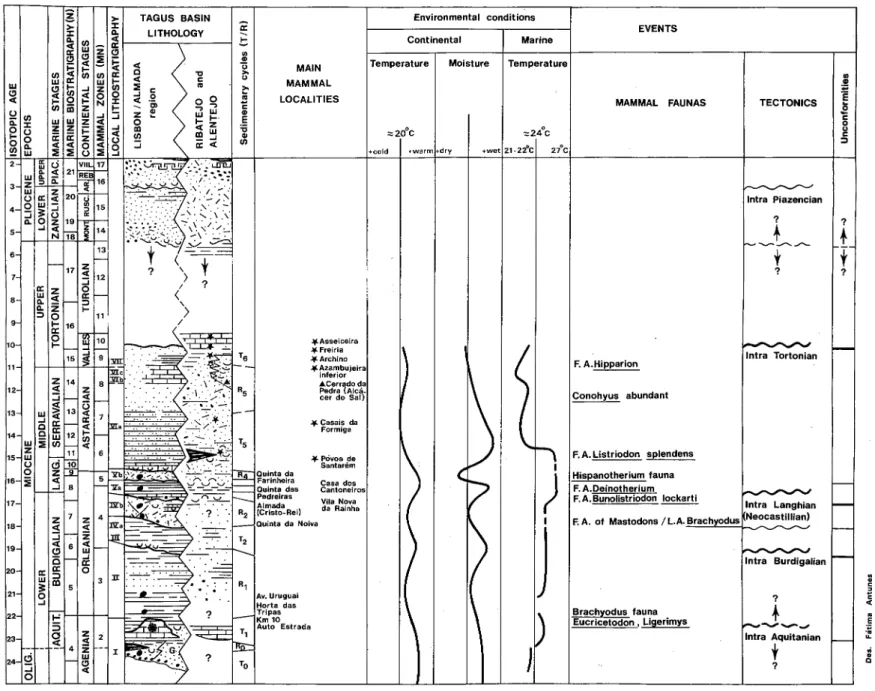
The fundamental lithological characteristics are indicated as a whole in the given scheme (Fig. 4).
The Pliocene formations, or supposed as such, are more reduced and not as well known. Firstly, a series of feldspathic sediments, mostly coarse and of continental facies, have never been properly dated. They overlie the marine lower Upper Miocene. However, as the last well dated layers are not later than Lower Tortonian, there is a considerable poorly defined gap (Messinian or Zanclean?). These sediments show the setting up or the renewal of an important hydrographic network. The mouth could be situated further to the South, near Fonte da Telha.
The preceding series is overlaid by marine layers that are more or less coarse, mostly sandy, with a mollusc fauna reported to the Piazencian, and some plants (dealt with later in this paper).
The Pliocene gulf was not well developedtothe East. On the other hand, the deposits related to the Pliocene transgression stretch from the North of Portugal to the Algarve. This is limited to the costal region that is more or less reached by marine erosion.
The Miocene of Ribatejo
The oldest formations are as follows:
- the Serra de Almerim Aquitanian, the only
outcropping marine formation of this age. It is equivalent
to part of the layers with Venus ribeiroi, occurring in
Lisboa and its surroundings;
- poorly known marine layers, drilled to a certain
depth by boreholes (fagus right bank, Coruche map); -detrital assemblage ofAmeiro and Ota, comprising intercalations of oysters in its upper part.
This heterogeneous last unit is poorly defined. It is often
admitted that it may comprise palaeogene layers,
exceeding a burdigalian age (up to an
"helvetian"
one).However, one may recognize that the majority of the outcrops are more modem. On the right bank of the Tagus, one may have a precise view of the stratigraphy and age of most of the series, which corresponds mainly to the upper part of the Middle Miocene and to the lower part of Upper Miocene (continental stages: Astaracian and Vallesian). This is due to the recent discovery and reinterpretation of
a certain number of mammalian localities. There is
initially a predominance ofsands and clays with carbonate
levels as well as lignites; above this there are some
important limestone layers, specially arCartaxo-Almoster-Santarem, with some intercalated sandy beds. We are now able to date these limestones as Upper Vallesian and can
consequently recognize that its deposition occurred
during a quite short time span and does not seem to attain Uppermost Miocene (Turolian).
The lack or paucity of available information has made difficult the whole interpretation for the Miocene of the left bank of the Tagus , where the upper limestone horizons are absent.
On the other hand, the argillaceous layers outcrop in large outspreading extensions (mainly in the valleys) and stretch to the Sado basin. Their age corresponds more or less to the second half of the Middle Miocene and/or to the lower part of Upper Miocene. In places, these deposits
overlie oyster deposits, which seem to represent the
apogee of the Serravallian transgression. The argillaceous layers are covered by arkosic sands with beds with gravel and pebbles, probably of Pliocene age.
The Neogene infilling of the Tagus basin corresponds, with minute variations, to the mean-water bed and the flood plain of a river and its tributaries, carrying materials from the "Hesperic Massif' or from the limestone massif to the West. Later on, in an environment characterized by advanced relief leveling, with extensive zones subject to a lacustrine regime and a certain aridity, the carbonate sedimentation was predominant.
At Ribatejo, the last Miocene layers are overlain, with a clear contrast, by generally coarse - grained detrital deposits which correspond to a fluvial sedimentation.
These deposits cover erosion surfaces. The most
important layers ascribed to the Pliocene are the ones that made up the infilling of the Rio Maior graben basin (and also to a lesser degree that of Vale de Santarem graben). These consist of a rather thick succession of industrially
exploited white sands, overlain by diatomites and
important layers of lignite and some boghead coal.
Proceedings of the 1" R.C-A.N.S. Congress, Lisboa, October 1992
The Miocene of the Alvalade basin
To the South of the Tagus basin, in an area corresponding to the present day hydrographic Sado basin, another basin (the Alvalade basin) was formed. This basin is separated. from the Tagus basin by a horst of paleozoic rocks (Senhor das Chagas-Valverde), and was only crossed by the Ri ver Sado in Quaternary times. Formerly, its identity was not recognized; all the corresponding area and the geologic units of its infilling were regarded as a part of one
Tagus-Sado basin. Indeed the Senhor das
Chagas-
Valverde horstacts as a barrier. Shallow marine, mainly sandy beds were deposited at both sides of this barrier. No one clearly doubted that the corresponding transgressive events were correlative; they were instead treated together. However
accurate dating was possible on the basis of small
mammals; marine beds to the North and West of Senhor das Chagas - Valverde dated from Late Serravallian and perhaps LowerTortonian were, for the first time, recognized as certainly not correlative of the much later southern ones, recognized as Upper Tortonian and Messinian
(Antuneset al.,1986). Hence both sides of the barrier had
independent geologic histories and must be regarded as
distinct entities - the northern part being just a part of the
Tagus basin, the southern part an independent basin, that we named Alvalade basin. Its shallow marine sediments filled in a SW-NE through (then a gulf) between Paleozoic blocks, a western one more or less corresponding to the extant Cereal and Grandola serras, and eastewards the "Sui Portuguesa" zone of the Hesperic massif. Evidence points to a marine ingression from the Southwest through
the Odemira - S. Teotonio region. Recent hydrogeologic
data concerning subsurface draining pattern show that it corresponds to the dual basin former situation; it thus
corroborates our viewpoints about it (Ribeiro & Costa,
1992).
THE MIOCENE OF ALGARVE
Most Neogene in Algarve is of Miocene age.
No unit was ascribed to or dated as Pliocene, which docs not mean that deposits of this age do not occur. Those of
Morgadinho (Antuneset al.,1986b) are probably (at least
in part) Pliocene in age.
The Cenozoic units of Algarve are shown in the fig. 6, and will be discussed by age order from the earliest one.
Lagos- Portimao Formation
This unit overlies Carboniferous, Jurassic, Cretaceous and possibly Paleogene units. In some places a very clear angular unconformity can be observed, whereas in other places stratigraphical hiatuses or paraconformities are recognizable.
"tl
C
..
0 °
..,'"
w W I-' 1-'. ..: zIn w
_ . . I
a: ..:
Xl
:;:
'E
~c
g
:::l TECTONICS EVENTS
MAMMAL FAUNAS
27°C
"24°e Marine
Temperature
+wetI21-22°C Moisture
+warml+dry
Environmental conditions
Continental
:;20oe Temperature
+cold
MAIN MAMMAL
LOCALITIES
8l u
'"
u
e
s
CGl
E
:;;
Gl
en
a: C
TAGUS BASIN
LITHOLOGY
z
>- :I:
~ Q.
~en_~1
I
a: W
z el
elel:o-i=;:-i;( ..:
ffl~enffl:: ~
~
elln;:tz:g:J
s
..: ; : 0 1 - ' ° : 1 :
..:.-(l)mzNt: -~
~CI) ww~;i....l
~lo-~:I: ZZi=:O..l In
I-'U
a:a:z:o":
!!l°
~..:..:
0 " :g
..I!!lw :O:OU:O..l
Intra Piazencian
?
t
~-...---...--.
t
??
t
t
?8
9
10
11
)
12
13
Fig. 4 - Lithological, chronostratigraphical, environmental conditions and main events table from Tagus basin.
~
~
e.
E!
...
~
-§
.,
.S;
~
22
'23
24-4!:2
..J
o
'a:w
I~
..II--I-' :5
s
4t.,
. Z
L2
'~
-W
~
II
are
abundant. An Aquitanian age cannot be excluded for it. As for the top, thereare
many sea-urchins, Bryozoa, pectinids and fishes. Foraminifera pointout to a Burdigal ian or Lower Langhian age (Antuneset al., 1981).This Formation is the most spectacular Miocene unit in western Algarve. It makes up a considerable portion of the costal sea cliffs.
Calcareous sandstones with pebbles
This is an assemblage of poorly exposed carbonate rocks rich in detrital material.Itwas formed after the Lagos -Portimao Formation, which it overlies with a distinct erosion surface (Praia da Rocha).
The lower part of this unit consists of sandy limestones with sand-wave type structures (Olhosde
Agua),
Theseare
followed by very fossiliferous limestones rich in quartz pebbles. Pectinids are most frequent among the fossils. Oyster banks are also known.
These deposits correspond to a shore line facies.
Orbulina indicates a post Lower Miocene age. Relative
position shows that this unit is older than the glauconite silts at PraiadaGale, K-Ardated (1O.l±0.25Ma),The best outcrops are the highest part of Praia da Rocha cliffs (near . Albufeira) and the beach near Olhos de
Agua,
Olhos de Agua sands
Near Olhos de Agua, there is an outcrop of a thick sand series between the calcareous sandstones with pebbles unit and the Faro-Quarteira sands.
This succession starts by alternating sandy and pelitic layers (flaser facies) overlain by cross-bedded brownish sands and followed by feldspathic white sands. Over these sands there are beach sands and conglomerates with oysters, pectinids and remnants of abraded aquatic Vertebrata. Mollusks indicate estuarine environments and brackish waters.
The majority of the fishes are marine, frequently of very large size(Carcharocles megalodon,lsurus hastalis).The degree of abrasion of the vertebrate remnants suggests that they were rolled by waves in shallow, sandy bottoms
ar
a beach. The Sirenians point out to shallow seashore environments, rich in aquatic vegetation. The presence of fish likeLates,
as well as that of feldspathic sands seems to show the existence of a large river whose mouth was close by. The presence of large crocodilians asTomistomacf.
lusitanica
corroborates these views and indicates sub-tropical conditions.Mollusks do not seem time characteristic enough. Vertebrata are compatible with a post-Langhian age but are certainly pre-Pliocene.
Mem Moniz spongoliths
Overlying the Cretaceous of inner Algarve there are white spongoliths.
Proceedings of the 1,( R.C.A.N.S. Congress, Lisboa, October 1992
These deposits are unknown elsewhere in Portugal, but closely similar ones are widespread in the Mediterranean periphery. They were accumulated in a trough related to tectonic events.
The rock is essentially composed of sponge spicules. It contains many Foraminifera, calcareous nannoplankton, diatoms and fish remnants.
Planktic Foraminifera allow the reporting of these deposits to Globorotalia
acostaensis,
N16 Blow zone, Tortonian. The calcareous nannoplankton show the arrival of cold waters by upwelling (Antuneset al., 1981)Glauconitic silts
At Praia da Gale, this unit is separated through an erosion surface from the
Lagos-Portimao
Formation.Glauconite-rich silts allowed K-Ar dating: at Praia da Gale, near the base, 1O.l±0.25 Ma, lower Tortonian; at Galvanas, near the top, 6.9l±0.81
Ma,
uppermostTortonian (Antunes et al., 1984). This unit may be more or less correlative to the Mem Moniz spongoliths.Cacela Formation
The upper and uppermost Miocene deposits are well represented in eastern Algarve but they also outcrop in the Lagos region. At CaccIa, the type locality, these deposits lie directly over the Triassic; at Galvanas, over the glauconiferous silts at Campina de Faro.
This unit comprises mainly yellow, orange, or green silts (the latter being rich in glauconite). One exception is the spectacular Galvanas conglomerate, with blocks exceeding one meter interbedded in the glauconiferous silts (K-Ar age, 6.n±0.17Ma) (Antunesat al.,1984). Conglomerates are related to strong tectonic instability and were probably formed in the sub-marine slopes associated to the southern Algarve flexure.
The lower conglomerates at Cacela and overlying silts yielded the richest mollusk fauna of the portuguese' Miocene. This fauna was described by F. A. Pereira da Costa (1866, 1867) and byDollfusetal.(1903, 1904), and revised by Chavan (1940). Planktic Foraminifera indicate N16 - 17 of Blow,Globorotalia humerosa zone, Upper Tortonian.
The middle and upper members of the CaccIa Formation, also silty, correspond to confined marine facies with a scarce and poorly preserved impoverished mollusk fauna and a few plant remnants.
These sub-units
are
related to the Messinian crisis.Volcanism
CienciasdaTerra (UNL),12
...\
I I
:
I I
I
I
\
\~-4
5
""
I I I I
--
...,
\ \,
\
,
\
\
\ 6,
,,
\
,
\,
\
,
I
,
,
II
• Coral reefs
>--Syncline
o_
Chattian?-- L.Aquitanian 1- Aquitanian
2 - L.Burdigalian - - Fault
~UPlift.d zones
. . Strain
+
+
- - 2--Q- Quaternary P- Pliocene
p, -Lower pz· Upper
a,b,c - Paleovalley
~~
chettten - Aquit6ni6n
Fig. 5 - The three main phases of the paleogeographic evolution of the Lisboa region (fagus basin) (Coppier&Mougenot, 1982,
modified). Maps: inland transgressions borders after Antunes (1979, modified); offshore: AR - Arrabida chain; BE - Ericeira basin; CC - Cascais canyon; CL - Lisboa canyon; CS - Seuibal canyon; GR - Grandola massif; Tagus lineation; MC - Camoes mountain; PA - Albuquerque platform; S - Sintra massif. Schematic geological sections corresponding to the three paleogeographical phases; 1 - relative sea level change; 2 - transgressions or regressions; 3 - tectonic movement.
the only occurrence which could be recognized is that of a basanite outcrop that cuts and contact metamorphoses Lower Miocene, Lagos-Portimao Formation at Figueira (Mexilhoeira Grande). Alteration did not allow reliable
K-Ar dating. This is the last volcanic event so far known in
Portugal.
MIOCENE(?) AND OTHER NEOGENE TO THE
NORTH OF THE CENTRAL MOUNTAIN CHAIN
The Neogene deposits to the North of the Central Mountain Chain and their extensions to the Nazare great fractures are poorly known or absent. The only exceptions are marine Pliocene sandy deposits well represented at S. Pedro de Muel, Monte Real, Leiria and Pombal, as well as the continental beds with lignites, clays and diatomites which overlie them. We will return to this point in the chapter about Pliocene.
The Miocene around Alcobaca, Leiria and Coimbra
In this rather extensive area there are outcrops of sandy-argillaceous sediments which, according to their stratigraphic position, were ascribed (according to Choffat) either to the Oligocene or to the Miocene. In fact, to the West of Pombal they are covered by well dated marine
Pliocene formations; on the other hand, they clearly
overlie late Cretaceous and Eocene detrital continental series. Dating was, however, uncertain, or at least not accurate, until the discovery of fossil mammals at Amor; this partly cleared the situation.
However, the well dated part is limited to the region westward of the Leiria diapir; elsewhere, the interpretation of these deposits, mostly of fluvial facies (sometimes marshy or swampy), is problematic due to the absence of any direct proof of age.
However, there are some indications of marine deposits, even if their characterization is rather uncertain:
- at Casal Verde, 2 Km to the North-East of Paiao,
Figueira da Foz, siliceous rocks surprisingly contain
Foraminifera such as
Globigerina
and Miliolids; there hasbeen intensive diagenetic, secondary silification, probably
after limestones with clastic elements deposited in
marine environments, their age being uncertain;
- boreholes drilled in the region of Marinha Grande,
West of Leiria, cut through clays and greenish grey
marls with Foraminifera(Ammobaculiles,etc.),Ostracoda,
Characeae and Pelecypoda ascribed to the Miocene; no outcrops are known.
The deposits at Amor are most interesting, for they are the only ones to the North of the Nazare fault that allow accurate dating. An initial survey at three points yielded large and small mammals, reptiles, amphibians and fish, as well as gastropods. It is interesting to note the existence
Proceedings of the 1" R.C-A.N.S. Congress, Lisboa, October 1992
of two different biotopes, although contemporary. One of them corresponds to fluvial sedimentation, the other to a
marsh with many amphibian and freshwater fish
remnants. The mammalian fauna indicates the beginning of Middle Miocene, Langhian MN5 mammal unit of Mein
like the V-b of Lisboa with
"Hispanotherium
fauna". Thefossiliferous horizon seems to correspond to a very limited time span although the area where the formation outcrops
is rather extensive, reaching Monte Real (clays withHelix,
Planorbis, Unionids and some rodents as Cricetodonts)
and further more northwards; at Carvide, layers which could be more or less correlative have produced, besides
Helix and Chara, Cerithium and Gobius (teleost fish)
which may indicate slightly brackish waters maybe
communicating with the sea. The supply of detrital
material, namely bipyramidal quartz issued from Lower Lias marls, show that the nearby diapir was moved during the neo-castillan phase. This miocene series seems to be represented northwards till Pombal region. However it is poorly exposed there among outcrops from earlier units.
There are other deposits (sands and clays with some lignite layers) in the region of Leiria-Alencarce and Fonte
da Moura, from where plant macroremains, the only
fossils collected so far, do not allow any accurate dating even if they have been regarded as Miocene.
Possible Miocene in Beira Alta
Among the units that overlie the Beira Alta basement, there are essentially argillaceous sediments derived from the Beira pre-ordovician slates and graywackes. Shale clasts of variable sizes form the bulk of these sediments which generally evolve to greenish and often reddish clays. Other important components are cobbles of vein quartz, whereas the contribution from granites is rather limited. Several small outcrops spared by erosion witness their former vast extension. Their origin is certainly related to rejuvenation of the shale and granite relief. It is known that such deposits are later than the Ludian (Upper Eocene) arkoses from Coja. On the other hand, they are covered by blocks and other coarse grained sediments, more or less equivalent to the ranas described in Spain and elsewhere in Portugal, possibly of Villafranchian age. These occur to the South-East of the Caramulo Mountain, at Arganil, Folques, and elsewhere.
Hence, a Miocene age is possible but far from being proved. In Spain, always North of the Central Chain in the Douro basin, the Miocene is largely represented to the East ofToro. Remarkable deposits at Palencia, Valladolid,
etc., are ascribed to the Middle Miocene; others are
reported to the Upper Miocene.
Older Miocene deposits are not known; the
"Hispanotherium fauna" has never been found. These
CienciasdaTerra (UNL),12
::!:
w ::!:
:I: III
!«
::!: III Wo
Z
w~ w w
o
Cl'" II:l-ii: 0 LITHOSTRATIGRAPHY BIOSTRATIGRAPHY KIAr AGE TECTONICS «
«~ wIII ~ ..J
,..,...,.
o
> w III (Mammal units MN" ' Main phases ..J
III III III V 0
:::l Planktic foram.zonesN."J Subsidence
>
CIl Uplifting 1\
Z'
~
<,
Alluvial deposits and dunar sandsa: I-' ~ ....
:/...
~ Terraces and calc. tuff. N-S Compressionw Ul 1\
1 ~ iii L.·.·~·\."':-·:. FaroIQuartelra sands E-W(?)
:::J oJ
.. .. .. 'io==::
Slits.Q: Q.
Clayey limestones ~
2
c.5 I- _ -_- _
-_-2.-_-_
IILlgnltes with vertebrates from MN 20w Z Marls Morgadlnho and Algoz
Z w. . . . .
3 W N
o
«a:: SandsQ
U . . . . V
4 ..J
n. Z
«
5 N _ ?
?
z
" .. .. " ..iii
~ ES:!:> '-' CACELA FORMATION IN 16-N 171 I
6 Ulw ~ ei!>
I
~ ..~.~'"' "V~
.
IK/Ar 6,12tO,17 Mal VGalvanas conglomerate
~
I7 " '-', ,-,6.. Q
.
" IKIAr 6,91 t 0,18 Mal ~I
" G .. N-S Compression
II: .. .. " I
8- W
Z .. .. .. .. Camplna de Faro
o, « " .. .. .. ..
glauconite slits Distension I
n. Z .. " " ..
9 :::l
0 " " " " I
I- "
..
" ? ?I
a:..
... '~
[.':
IK/AR Mal10 0 10,1t0,25
~
~ ?I- .. .. .. ....!.!:i"i:!
'~"mt'7.'""1 . : ; Mem Moniz
•• ~L..,;
11
~"
..
t'~".~. Spongollthst
12 w .. ?~?,' ?
" .Sands V
Z
~~~
..;,..; and N-S Compression>w ~," Calcareous
>
conqtornera-13 II:Cl oJ .~'.«0 ~ 'I~' sandstones
<
tesW'ithma-- W W w « ?' •••z:with "sand rlne fossils Olhos de AQua ? 1\
14
:i:z
..J a: ,,,,~\Z C ? White felds, sands
t
W a:
..
:~.~~.< waves andW C w V
I-
c
Ul limestones ') pat. sands~
15 0 ::!: ~
s
d ~ ,','5--,ywith quartz ( • Brown sandst
Z pebbles
...
16 « ~
,-:' ":4?
~
VoJ
..
-...,."..,..
~
17 ~
..
.. v .."
'"' .. ,..., v ..
V V .. ,....
..
'"'
Z v v v v v
18 « ..
'"'
..
,..., " ..::;
.. ..
v .. ..« ~ ,...,
..
,...,'"'
.. E-W and N-S19 o .. .. .. .. ..
0 v v
..
.. v ~LAGOS PORTIMAO Distension
a: .. " ,.., " v
20 II: :::J ,..., " v v .. ..
W III v .. .. v v
3:
..
v v .. .. .. FORMATION ~" r "
"
V ..21 0 v
..
..
.. v..
..J
-
" v"
,...
"i .. v r- .. v v
22 « v "
l- v
. .
5 ?
23 0«
z
24 w O ? 0
~
o
0 °etb0ooo· 0 0 0 0
w _£.cb"o':?~ Gula Conglomerates com?fsslon
oJ
26 ~
Fig. 6 - The Cenozoic of Algarve.
PLIOCENE
According to current ideas, during the Pliocene there was a succession of events comprising a marine transgression followed by a regressive phase and finally a new transgression. The latter has been ascribed to the Calabrian; the Calabrian stage, being included in the Pleistocene, is not dealt with in this text. Also avoided, are formations as interesting as the highest raised terrace covers (about 120 to 190 meters). Their remnants in the coastal morphology are evident from the northern coasts down to Algarve.
In the present state of our knowledge, Pliocene deposits comprise: a) - fossiliferous sands and conglomerates between the Arrabida chain in the South and the region
of Pombal; b) - arkosic sands developed mainly to the
South of the Tagus river: non marine gravels, sands and clays in depressions such as in Rio Maior and Vale de
Santarcrn,
the Tagus basin at Cartaxo, Serra de Almerim,etc. and maybe even further North at Pampilhosa; c) -clay deposits with diatomite and lignite, particularly
important near Leiria, Obidos, Rio Maior and Vale de
Santarem.
Summing up, the study of the Portuguese Pliocene is in part rather restricted by the lack of updated stratigraphy as well as the lack of accurate dating.
The Pliocene in the Tagusbasin
Setubal Peninsula
Pliocene layers are well represented to the South of the Miocene outcrops between Cacilhas and Trafaria, in the left bank of the Tagus River. They follow the axial part of a syncline,limited southwards by the Arrabida Chain and by the costal cliffs of Fonte da Telha and Adica and further inland towards Pinhal Novo and Montijo.
Over the last Miocene layers, one can see coarse layers of conglomerates and arkosic sands. These correspond to
a sedimentation that proceeded under the double
influence of high energy sea and rivers. Some rather poorly preserved molluscs were collected in this series at
Alfeite. Other known fossils are land plants which
provide ecological information but are not useful for age determination. Indirect reasons lead to the assumption that they may represent the Tabianian (Lower Pliocene) with a modest transgression followed by a regression shown by layers with plant fossils.
High above them are sands and gravels with clay intercalations that have produced a varied malacological fauna with a costal marine character regarded as Astian. They may be ascribed to the Upper Pliocene (Piazencian), according to earlier interpretations (Piazencian according
to Dollfus& Cotter, 1909; Piazencian - Astian according
toZbyszewski,1959) corroborated by the interpretation
of
Brebion
(1971) after his detailed revision of thegastropods. No doubt there was a new sea ingression, more important than that of the Lower Pliocene, even if its inland progression did not exceed about 25Km from the present coast.
Proceedings of the 1" R.C.A.N.S. Congress, Lisboa, October 1992
Uppermost units regarded as Pliocene comprise fine sands with rounded pebble layers, clays and diatomites.
The sands no doubt show eolian transport representing the progression of coastal dunes further inland. A
stratigraphic revision hastobe done, for the relationships
between certain clay layers, gypsum, diatomites and lignites are still not clear. As for their age, different authors, lacking decisive proofs, tentatively ascribed them to the Pliocene, but a Pleistocene age was also possible. On account of the Upper Pliocene age of the underlying layers and the importance of this series, it can be entirely Quaternary or nearly so.
The assemblage of lignites, as well as the levels with marine fossils that follow them, are overlain in some local ities by the Belverde conglomerates and yielded archaic lithic industries.
Inland detrital residual soil related to the Pliocene
On the right bank of the Tagus river, a few remnants of sands and clays (sometimes with lignites) are preserved at
Azambuja, Cruz do Campo, the surroundings of
Santarcrn,
etc.
On the other hand, to the South of the river Tagus there are far more extensive outcrops of arkosic sands with pebble bands (mainly towards the top): these are fluvial deposits corresponding to a predominantly south-southwest drainage pattern.
The sands of Rio Maior should be referred for its
economic importance. These may represent the
progression of dunes further inland between the
Candeeiros and Montejunto Hills, starting from a broad littoral abrasion platform which is today at about a 200 metres level. They seem to be correlated to the fine sands of Coina in the Seuibal Peninsula; if this is so, those sands were formed after the marine levels of Alfeite and Fonte da Telha with an Upper Pliocene fauna. Hence the diatomites
and lignites that at Rio Maior and Obidos overlie those
sands may be Quaternary, at least in part.
Pliocene in Estremadura
In the region of the Caldas da Rainha diapir and furtherto
the North until Leiria and Pombal, a well characterized Pliocene transgression is responsjble for the deposition of fossiliferous conglomerates and sands on Miocene or older formations. These sediments are overlain by continental diatomites and lignites (Obidos, Barracao, etc.) and these ones by marine or fluviomarine deposits without fossils that may be Calabrian in age.
Fig. 7 - Main neogene lithological units from Tejo and Alvalade basins, and from Algarve (southern Portugal). 00
Cacela Formation
Morgadinhodeposits
Lagos-Portimao Formation
Guia conglomerates
Faro-Quarteirasands
ALGARVE
Calcareous sandstones and
limestoneswith pebbles
I
Galvanas- ,I
co,!&!omerat~--=---Glaucooiti~ilts~m
Mem Monizspongolithes
J;amQirla de Faro_
---r-I
Olhos de Agua sands
1
-I::::::::::::::::::::::::::::::::::::::::::::i:::::::::~:~:::::::Ii~:I::::::::::::i:::::::::::~::::::i::li:::::::::::i:::::::::::::::~:::::::::::::::::::::::~:::::::::::::::::::::::::~::::~:::I::
ALVALADE BASIN
MaratecaFormation
Sands, sandstones and
conglomerates
Esbarrondadoiro Formation
"BenficaComplex"
Alfeite beds
Clays, sands, conglomerates
lignites and diatomites
TEJOBASIN
(Lisboa/Almada region)
Quinta
das Conchas limestone
Vale de Chelas sands
Musgueiralimestone
Sands with
Placuna miocenica
Aquitanian
Burdigalian
I I
-CHRONOST.
•
r-:
("/.l
...
~
s:
~
ffi
I
Piacenzian
U
0
~
Zanclean
Messinian
Tortonian
-Serravallian
•
~
Z
~
g
I
Langhian
...
:::E
'·0
I@~
,Casal Vistosolimestone
Quinta
do Bacalhau sands
Blue clays from Areeiro
"BancoReal"
Estefania sands
I I
-Clays and limestones
I
I
I
with
Venus ribeiroi
N
...
~
:::i
'--~
...
~
-§
..
.51different facies, not a chronologie one. Brebion, also correlated the gastropod fauna to the Upper Pliocene. Recent data on calcareous nannoplankton assemblages may indicate Martini's NN16, or Okada&Burky CNl2a correlated to the Lower Piazencian and thus compatible with former dating. Furthermore, all other available data indicates an Upper Pliocene age. Taking into account the small span of the Pliocene (about 3Ma), this practically means that at least part of the diatom and lignite beds must be Pleistocene in age, although the chronological limits are still not accurate enough.
For stronger reason the transgression which follows it, well marked in the geomorphology of coastal regions from the extreme North down to the Algarve, has to be treated as Pleistocene.
As elsewhere in Europe, the Pliocene palaeogeographies are rather different from the Miocene ones - the so-called "Pliocene revolution". Even if the data concerning Pliocene are incomplete and not always accurate, we may suppose that in the Senibal Peninsula there was a very limited marine ingression followed by another regression (Fig.
5;
Fig. 6). This small transgression corresponds to the lower layers of Alfeite. Its age has been regarded as Lower Pliocene (Zanclean) accordingto
its position and without good direct dating evidence.Later on, a new and more important transgression much enlarged the small former gulf at the Setiibal Peninsula. The region between Pombal and Caldas da Rainha has
REFERENCES
Proceedings oCtile 1" R.C-A.N.S. Congress, Lisboa, October 1992
been flooded then. A larger abrasion platform was developped. It may be related to the Calabrian transgression in several places. Further inland this platform is limited by beautiful fossil cliffs. Its surfaces
are frequently covered by rather thin detrital, quaternary layers where no fossils have been found.
Pliocene (?) and/or Pleistocene in Algarve
Morgadinho and Algoz deposits
This unit comprises thick sandy deposits in association (towards the top) with marls, lignite clays, lacustrine limestone and a silty calcareous crust.
At Morgadinho and Luz de Tavira these sands overlie the Cacela Formation and are overlain by the Faro-Quarteira sands, as at Algoz (where the substractum is not known).
At Morgadinho, the lignite clays yielded a few small mammals, fish, gastropods, fresh water Ostracoda, pollens and spores (Antunes
et al.,
1986b). The mammalian fauna indicates an age span between the Upper Pliocene and the lower Middle Pleistocene, MN 17 to MN 20mammal units.In the present state of knowledge, we may think that Morgadinho and Algoz deposits arecorrelated. The Algoz mammalian fauna is dated from about 1Ma (Antunes
et al.,
1986a).Alberdi, M.T.; Antunes, M.T.; Sondar, P.Y.&Zbyszewski, G. (1978) - Les Hipparion du Portugal.Ciencias da Terra (UNL),Lisboa,
4: 129-156, figs. 1-10, 2 pis.
Antunes, M. T. (1979) - Vertebrados mioccnicos de Olhos de Agua (Algarve), interesse estratignifico.Bol. Mus. Lab. Min. Geol. Fae.
Ciencias de Lisboa,16(1): 343-352.
Antunes, M. T. (1979) -"Hispanotheriumfauna" in Iberian Middle Miocene, its importance and paleogeographical meaning.Ann.
Geol. Pays llelleniques,Athens, t.hors ser.(I): 19-26, 1 fig.
Antunes, M. T. (1984) - Essai de synthese sur Ics mammiferes du Miocene du Portugal.Vol. d' Hommage au geologue C. Zbyszewski,
ed. Recherche sur les Civilisations, Paris: 301-323.
Antunes, M.T. (1990) - The proboscidean data, age and paleogeography: evidence from the Miocene of Lisbon. European Neogene
Mammal Chronology, Edt. E.H. Lindsayet al., Plenum Press,New York: 253-262.
Antunes, M. T.; Azzaroli, A.; Faure, M.; Guerin, C.& Mein, P. (1986a) - Mammiferes pleistocenes de Algoz, en Algarve.: une
revision. CienciasdaTerra (UNL), Lisboa, 8: 73-86.
Antunes, M.T.; Bizon, G.; Nascimento,A.& Pais,J. (1981) - Nouvelles donnees sur la datation des depOts miocenes del'Algarve
(Portugal) et revolution geologique regionale.CienciasdaTerra (UNL), Lisboa, 6: 153-168,2 figs.
Antunes, M.T.; Calvo, 1.P.; Hoyos, M.; Morales, 1.; Ordonez, S.; Pais,J.&Sese, C. (1987) - Ensayo de correlacion entreel Neogeno
de las areas de Madrid y Lisboa (Cuencas Alta y Baja del rio Tajo).Comun. Servo Geol. de Portugal,Lisboa, 73(1/2): 85-102.
Antunes, M.T.; Civis, 1.; Dabrio, CJ.; Sierro, FJ.; G1ez-Delgado,1.A.;Flores,lA.; Pais,J.& Valle, M. (1990) - El Neogeno del
Algarve (Portugal) y de la cuenca del Guadalquivir (Espana).Aetas de Paleontologia, Univ. Salamanca,68: 65-73.
Antunes, M.T.; Fonseca, B.&Rocha, R. (1973) - Notes sur la Geologie et la Paleontologic du Miocene de Lisbonne. XI - Coupe de
I'Avenida Paulo VI, Lumiar: Stratigraphie ct Paleontologic. Conclusions generales. Rev. Fae. Ciencias de Lisboa,2& ser. - C,
XVI1(2): 459-514.
Antunes, M. T.&Ginsburg, L.(1983) - Les Rhinocerotides du Miocene de Lisbonne systematique, ecologic, paleobiogeographic,
valeur stratigraphique.CienciasdaTerra (UNL), Lisboa, 7: 17-98, figs.I-31, 16 pI.
Antunes, M. T.; Ginsburg, L.&Mein, P. (1983) - Mammiferes miocenes de Azambujeira, niveau inferieur (Santarern, Portugal).
Ciencias da Terra (UNL), Lisboa, 7: 161-186.
Antunes, M. T., Ginsburg,L.,Torquato,J.R.&Ubaldo, M.L. (1973) - Agcs des couches
a
mammiferes de la basse vallce du TageCienciasdaTerra(UNL),12
Antunes, MT.; Jonet, S.&Nascimento, A. (1981) - Vertebres (crocodiliens, poissons) du Miocene marin de I' Algarve occidentale. CienciasdaTerra (UNL), Lisboa, 6: 9-38, 2 figs, 5 pI.
Antunes, M. T.&Mein, P. (1971) - Notes sur la Geologie et la Paleontologic du Miocene de Lisbonne. IX - Rongeurs et Insectivores (Burdigalien inferieur et Helvetien inferieur),Rev. Fac. Cienc Lisboa,2"ser., C, XVI(2): 327-349,4 pI.
Antunes, M. T. & Mein, P. (1977) Contributions ala Paleontologic du Miocene moyen continental du Bassin du Tage. III -Mammiferes.Povoa de Santarern, Pero Fi1ho et Choes (Secorio).Conclusions generales.Ciencias da Terra (UNL),Lisboa, 3: 143-165,3 pI.
Antunes, M. T.&Mein, P. (1979) - Le gisement de Freiria de Rio Maior, Portugal, et sa faune de mammif'eres; nouvelle espece de Rotundomys, consequences stratigraphiques.Geobios,Lyon, 12(6): 913-919.
Antunes, M. T.& Mein, P. (1981) - Vertebres du Miocene moyen de Arnor (Leiria). Importances tratigraphique.Ciencias da Terra
(UNL.),Lisboa, 6: 169-188,1 pI.
Antunes, M. T.&Mein, P. (1983) - Petits mammiferes de 1afin du Miocene moyen dans les depots marins de Cerrado da Pedra, Alcacer do Sal. Consequences stratigraphiques.Comun. Servo Geol.Portugal,Lisboa, 69(2): 373-379,5 figs.
Antunes, M. T. & Mein, P. (1986) - Petits manuniferes du Burdigalien inferieur (Universidade Catolica, Avenida do Uruguay). Ciencias da Terra (UNL), Lisboa, 8: 123-138.
Antunes,M.T.;Mein, P.; Nascimento, A.&Pais, 1. (1986b) - Le gisement pleistocene de Morgadinho, en Algarve.Ciencias da'Terra (UNL),Lisboa, 8: 9-22, 1 pI..
Antunes, M.T.,Mein, P.&Pais, 1. (1986) - Depositos messinianos do Sulde Portugal, mamfferos (incluindo Rodentiae Lagomorpha) e idades
KlAr.
CienciasdaTerra (UNL), Lisboa, 8: 55-64, 1 fig.Antunes, M. T.& Pais, J. (1984) - Climate during Miocene in Portugal and its evolution.Paleob. Contin.,Montpellier, XIV(2): 75-89.
Antunes, M.T.; Regencio de Macedo, C.; Pais, J.&Portugal Ferreira, M. (1984) - Datacao K-Arde glauconites do Miocenico superior de Galvanas e da Campina de Faro (Algarve oriental).Memories e Noticias, Coimbra, 98: 1-7.
Antunes, M. T; Soulie-Marsche,I.;Mein, P.& Pais, J. (1992) - Le gisement de Asseiceira, Portugal (Miocene superieur). Donnees complementaires sur Freiria de Rio Maior.CienciasdaTerra (UNL), Lisboa, 12: 219-253,10 figs., 7 pI.
Antunes, M. T.&Torquato, J.R. (1969) - Notes sur la Geologie et la Paleontologic du Miocene de Lisbonne. VI - La coupe de Quinta da Silveria (Helveticn Vb et Vc): stratigraphie et evolution morphologique.Bol. Soc. Geol. Portugal,Lisboa, XVII: 1-30, 7 figs., 12 pI.
Antunes, M.T.& Zbyszewski, G. (1973) - Le Meotien-Pontien de la basse vallee du Tage (r.droite), Portugal. Essai de synthese biostratigraphique.Bol. Soc. Geol. Portugal,Lisboa, XVIII(II-III): 203-217, 2 figs.
Azevedo, M. T. M. (1983) -0 sinclinalda Albufeira, evoluciio pos-miocenica e reconstituiciio paleogeogrdfica.Dissertacao de Doutoramento, Universidade de Lisboa, 302 p., 105 figs
Baldy, P. (1977) -Geologie du plateau continental portugais au Sud du Cap de Sines.These 3eme Cycle Univ. Paris VI, 120 p. Baldy, P.; Boillot. G.; Dupeuble, P.; Malod, J.; Moita,I. & Mougenot, D. (1977) - Carte geologique du plateau continental
sud-portugais et sud-espagnol (golfe de Cadix).Bull. Soc.Geol. France, Paris, 29(4): 703-724.
Barbosa, B. P.& Reis, R. P. B. Penados (1989) - Litoestratigrafia e modelo deposicional dos sedimentos aluviais do Neogenico superior da Bacia do Tejo (Tomar-Lavre), Portugal.Comun. Servo Geol. de Portugal,Lisboa, 75: 89-97.
Barbosa, B. P.& Reis, R. P. B. Penados (1991b) - Urn modelo aluvial hiimido em depositos pliocenicos da Bacia do Baixo Tejo (Portugal).!Congreso del Grupo Espanol del Terciario (Comunicaciones],Vic,: 32-35.
Barbosa, B. P.; Reis, R. P. B. Penados&Cunha, P. M. R. R.Proen~a(1990) - Proposal of correlation of the main tertiary infill episodes in the northern margin of Baixo Tejo Basin (Tomar region).6th Meeting European Geol. Soc., Lisboa,: 9-10.
Bergounioux, F.M.; Zbyszewski, G.& Crouzel, F. (1953) - Les mastodontes miocenes du Portugal.Mem. Servo Geol. Portugal, Lisboa, I(n.s.), 139 p.
Boillot, G.&Musellec, P. (1972) - Geologie du plateau continental portugais au nord du cap Carvoeiro. Structure au Nord et au Sud du Canyon de Nazare. C.R. Acad.Sc.Paris,274: 2852-2854.
Bourcart, J.&Zbyszewski, G. (1940) - La faune de CaccIa en Algarve (Portugal).Comun. Servo Geol. Portugal,Lisboa, XXI: 3-61, 3 pI.
Cabral, 1.(1986) - A ncotcctonica de Portugal continental - estado actual dos conhecimentos.Maleo, Lisboa, 2 (14): 3-5.
Cabral, J., Dias, R.P. & Brum, A. (1984) - Estudo de falhas afectando forrnacoes plio-quaternaries na zona da Fonte da Telha (Peninsula de Scnibal).Comun. Servo Geol. Portugal,Lisboa, 70: 83-91, 8 fig.
Cabral, 1.& Ribeiro,A.(1988) - Carta neotectonica de Portugal continental na escala 1:1 000 000.Servo Geol. Portugal,Lisboa. Cachao, M. (1990) - Posicionamento biostratigrafico da jazida pliocenica de Camide (Pombal).Gaia, Lisboa, 2: 11-16.
Cachao, M.& Silva, C.M. (1990) - The Pliocene of the portuguese West margin (Pombal-Marinha Grande sector). Biostratigraphy, paleoecology, sedimentary evolution.!XR.C.M N.S. Congress, Barcelona: 83-85.
Cardoso, J.L. (1984) -0Plioccnico marinho de Caldas da Rainha e de Pombal; sedimentologia e micropaleontologia, enquadramento palcogeografico e palcoccolcgico.Vol. d' hommage augeologueG.Zbyszewski,Ed. Recherche sur les civilisations, Paris: 155-201, 8 figs., 12 quad., 3 est.
Chavan, A. (1940) - Les fossiles du Miocene superieur de Cacela.Comun Servo Geol.Portugal,Lisboa, XXI: 61-106, 2 pI. Choffat, P. (1908) - Essai sur la tectonique de la Chaine de l'Arrabida,Comm. Servo Geol. Portugal,Lisboa, 89 p.
Choffat, P. (1950) - Geologie du Cenozoique du Portugal.Comun. Servo Geol. Portugal,Lisboa, XXX, suplemento, 183 p. Coppier, G.& Mougenot, D. (1982) - Stratigraphie sismique et evolution geologique des formations neogenes et quaternaires de la
plate-forme continentale portugaise au Sud de Lisbonne.Bull. Soc. Geol. France, Paris, 3: 421-431.
Costa, F.A.Pereira da (1866) - Gastcropodes dos depositos terciarios de Portugal.Comun. Geol. Portugal,Lisboa: V-252, 28 est. Cotter, 1.C.B. (1956) -0 Miocenico marinho de Lisboa.Comun. Servo Geol. Portugal,Lisboa, XXXVI, suplemento, 170 p. Cunha, P. M. R. R. Proenca (1987b) - Evolucao Tectono-Sedimentar Terciaria da Regiao de Sarzcdas (Portugal).Comun. ServoGeol.
Portugal,Lisboa, 73(1/2): 67-84.
Proceedings of the 1" R.C.A.N.S. Congress, Lisboa, October 1992
Cunha, P. M. R. R. Proenca (1992) -Estratigrajia e sedimentologia dos depositosdoCretacico Superior e Terciario de Portugal Central, a leste de Coimbra.Dissertacao de Doutoramento, Universidade de Coimbra, 262 p.
Cunha, P. M. R. R. Proenca; Barbosa, B.& Reis, R.P. (1992) - Synthesis of the Piacenzlan onshore record between the Avelro
andSetubal parallels (Western portuguese margin).CienciasdaTerra (UNL), Lisboa, 12: 35-43, 4 figs, 4 phot.
Cunha, P.M.R.R.Proenca,& Reis, R.P.B.Pena dos (1985) - A sedimentologia dumasucessao aluvial intra-crat6nica.0 Terciario arcosico do sector Sudeste da bacia de Sarzedas (Beira Baixa-Portugal).Memories e Noticias,Coimbra, 100: 173-191. Cunha, P. M. R. R. Proenca&Reis, R. P. B. Pena dos (1991) - A etapa sedimentar pliocenica na regiao de Coimbra - G6is (Bacia
Ocidental Portuguesa - Portugal Central).I Congreso del Grupo Espanol del Terciario (Comunicaciones),Vic: 271-274. Diniz, F. (1984) -Apports de la palynologie
a
la connaissance duPliocene portugais. Rio Maior, un bassin de referencepourl'histoirede la flore, de la vegetation et du climat de la facade atlantique del'Europe meridionale.These, Univ. Sc. Techn. Languedoc., Montpellier, 230 p., 27 figs., 16 tab., 11 pI.
Dollfus, G., Cotter, I. C. B.&Gomes, I. P. (1903-1904) - Mollusques tertiaires du Portugal.Planches deCephalopodes, Gasteropodes et Pelecypodes laissees par F.A. Pereira da Costa accompagnees d'une explication sommaire et d'une esquisse geologique.Mem. Comm. Servo Geol. Portugal,Lisboa: 1-48,4 figs., 22 pI.
Ferreira, O.V. (1951) - Os pectinideos do Miocenico do Algarve.Comun. Servo Geol. Portugal,Lisboa, XXXII: 153-180,11 est. Fonseca, B. (1977) - Notes sur la geologie et la paleontologic du Miocene de Lisbonne. XVIII - Coupe de Palenca, rive gauche du
Tage: stratigraphie et micropaleontologie (Coccolithophorides).CienciasdaTerra (UNL), Lisboa, 3: 61-99,4 figs., 9 pI. Grillot, J-C. & Almeida, C. (1981-1982) - Tectonique cassante posthercynienne dans l'Algarve (Sud du Portugal). Incidence sur
l'hydrogeologiekarstique.Rev. Geol. Dyn. Geogr. Physique,Paris, 23(2): 119-130.
Haguenauer, B. (1970) - Sedimentation cyclothematique dans la molasse paralique du bassin neogene du Tage (Portugal).Comun. Servo Geol. Portugal,Lisboa, LIV: 139-189,21 figs.
Heer, O. (1881) - ContributionsIila flore fossile du Portugal.Mem. Servo Geol. Portugal,Lisboa: I-51, 29 est.
Kullberg,I.C.;Pais, I.&Manuppella, G. (1992) - Aspectos da tectonica alpin a no Algarve.Ciencias da Terra (UNL), Lisboa, 11: 293-302, 2 figs ..
Manuppella,G.&Pais, I. (1986) - Controlo estrutural da sedimcntacao neogenica no Algarve.Maleo, Lisboa, 2(13): 26
Mougenot, D. (1976) -Geologie du plateau continental portugais enire le cap Carvoeiro et le cap deSines.These 3eme cycle, Univ. Rennes, 140 p.
Mougenot, D. (1985) - Progradation on the portuguese continental margin. Interpretation of seismic facies.Marine Geology, 69(1-2): 113-130.
Mougenot, D.; Monteiro, I.H.; Dupcuble, P. A.&Malod, J. A. (1979) - La marge continentale sud-portugaise: evolution structurale et sedimentaire.CienciasdaTerra (UNL), Lisboa, 5: 223-246
Mougenot, D.&Varmey, J. R. (1978) - Cartographie geomorphologique de la plate-forme continentale du Portugal et de ses abords. Bull. Soc.
ce«.
France, Paris, 20(5): 785-789.MuselIec, P. (1974) -Geologie du plateau continental portugais au Nord du Cap Carvoeiro.These 3eme CycleUniv, Rennes, 170 p.
Nascimento, A. (1988) -Ostracodos do Miocenico da bacia do Tejo: sistematica, biostratigrajia, paleoecologia, paleogeograjia e
relacoes Medlterraneo-Atlaniico.Dissertacao de Doutoramento, Universidade Nova de Lisboa, 305 p., 33 figs.,15 est.
Pais, I. (1978) - Vegetationde la basse vallce du Tage (Portugal) au Miocene. VIIInt. Congo MediterraneanNeogene.Ann. Geol. Pays lJelieniques,Athens, vol. h.s.(lI): 933-942.
Pais, J. (1981)Contribuicao para0 conhecimento da vegetaciio miocenica da parte ocidental da bacia do Tejo. Dissertacao de
Doutoramento, Universidade Nova de Lisboa, 328 p., 63 figs., 31 est.
Pais,J. (1986) - Evolution de la vegetation et du cIimat pendant le Miocene au Portugal.Ciencias daTerra (UNL),Lisboa, 8: 179-191,4 figs.
Pais, J. (1987) - Macrorrestos degimnospermicas dos diatomitos de Rio Maior (Portugal).Vol.llomenagem aO. Veiga Ferreira,Ed. Delta, Lisboa: 51-66, 4pl.
Pais, J. (1990) - Evolucao do coberto florestal no Neogenico e no Quaternario,Comun. Servo Geol. Portugal,Lisboa, 75: 67-72, 2 figs.
Pais, J.; Legoinha, P.&Kullberg, lC. (1991) - Novos elementos acerca do Ncogenico do Portinho da Arrabida (Serra da Arrabida). III Cong. Nac. Geologia,Coimbra.
Pinto Coelho, A. V.&Bravo, M.S. (1983) Exemplo de vulcanismo tardio em Portugal. Rocha Ignea post-miocenico inferior (Figueira-Algarve).CienciasdaTerra (UNL),Lisboa, 7: 99-114,3 est.
Rcis, R.P.R. Pena dos (1979) - La Formation Argi10-grescuse et conglomeratique de Senhora do Born Sucesso - Etude sedimentologique. Memorias e Noticias,Coimbra, 87: 3-18, 11 figs.
Reis, R.P.B. Pena dos (1983) -A sedimentologia de depositos conunenials. Dois exemplos do Cretacico superior-i-Miocenlco de Portugal.Dissertacao de Doutorarnento, Univ. Coimbra, 404 p.
Reis, R.P.B. Pena dos; Corrochano, A; Bemardes, C.; Proenca Cunha, P.&Dinis, J. (1992) - 0 Meso-cenozoico da margem atlantica portuguesa.Ul Congo Geol Espana e Vlll Cong. Latinamericano de Geologia. Excursiones,Salamanca: 115-138,26 figs. Reis, R. P.B. Pena dos & Cunha, P.M.R.R. Procnca (1989a) - Comparacion de los rellenos terciarios en dos regiones del borde
Occidental del macizo Hesperico (Portugal Central).St Geol. Salmaniicensia,Salamanca, vol. esp. 5: 253-272. Ribeiro, A. (1984) - Neotcctonique du Portugal.Centro de Estudos Geograficos,Lisboa: 173-182.
Ribeiro, A. (1988) - A tectonica alpina em Portugal.Geonovas,Lisboa,10: 9-11.
Ribeiro, A.; Antunes, M.T.; Ferreira, M.P.; Rocha, R.; Soares, A.F.; Zbyszewski, G.; Moitinho de Almeida, F.; Carvalho, D.& Monteiro, I. H.(I979)-Iruroduction
a
la Geologie generale du Portugal.Servo Geol. de Portugal, Lisboa: 1-114.CienciasdaTerra(UNL),12
Roman, F. (1917) - Nouvelles observations sur 1es faunes continentales tertiaires et quaternaires de la basse vallee du Tage,Comun. Com. Servo Geol.Portugal,Lisboa, XII: 70-101, 9 figs., 1 pI.
Roman, F.&Torres, A. (1907) - Le Neogene continental de la basse vallee du Tage (rive droite). Ire partie - Paleontologic par F. Roman avec une note surles empreintes vegetales de Pemes par M.Fliche; 2e partie - Stratigraphie par A. Torres.Mem. Com. Servo
Geol.Portugal, Lisboa: 1-88, 10 figs., 5 pI. we partie): 89-109,9 figs. (2e partie)
Romariz, C.; Oliveira, M.; Almeida, C.; Baptista, R.&Cardoso,J.(1979) - Contributionstothe geology of Algarve, Portugal.I -The miocene facies of Olhos de Agua.Bol. Mus. Lab. Min.Geol. Fac. Cienc. Lisboa,16(1): 243-251.
Sen, S.; Antunes, M. T.; Pais,J.&Legoinha, P. (1992) - Bio and magnetostratigraphy oftwo Lower Miocene sections, Tagus basin (Portugal).CienciasdaTerra (UNL),Lisboa, 11: 173-184, 7 figs.
Teixeira, C. (1979) - Plio-plistocenico de Portugal.Comun. Servo Geol. Portugal,Lisboa, LXV: 3546.
Teixeira, C.&Zbyszewski, G. (1950-1951) - Note sur Ie Pliocene de 1aregion a 1'00est de Pombal.Comun. Servo Geol. Portugal, Lisboa, XXXII: 295-302,4 est.
Teixeira, C.&Zbyszewski, G. (1952) - Contribution a I'etude du littoral pliocene au Portugal.1gemeCongo Geol lniern.,Alger, 13: 275-284.
Vanney, IR.&Mougcnot, D. (1981) -Laplate-forme continentaledu Portugaletdes provinces adjacentes: analyse geornorphologique. Mem. Servo Geol. Portugal,Lisboa, 28: 1-86.
Zbyszewski,G.(1939) - Essais surl 'hidrologie du bassin du Sado (Portugal).Rev. Geographic Physique et Geol. Dynamique,Paris, XII(3): 405427, 9 figs., 1 pl., 1 carte.
Zbyszewski, G. (1943) - Elements pour servir al'etude du Pliocene marin du Sud du Tage: la faune des couchessuperieuresd' Alfeite. Comun. Servo Geol. Portugal,Lisboa, XXIV: 125-156.
Zbyszewski, G. (1946) - Etude geologique de 1a region d'Alpiarca,Comun. Servo Geol. Portugal,Lisboa, XXVII: 145-267,4 figs., 1 map.
Zbyszewski,G. (1949a) - Les vertebres du Burdigalien superieur de Lisbonne.Servo Geol. Portugal,Lisboa: 7-77, pI. A-XXII. Zbyszewski,G. (1949b) - Contribution ala connaissance du Pliocene portugais.Comun. Servo Geol. Portugal,Lisboa, XXX: 5-24,
7 pI.
Zbyszewski, G. (1954a) - Etude geologique de la region de Santarem.Comun. ServoGeol. Portugal,Lisboa, XXXV: 193-225, 11 pI. Zbyszewski,G.(1954b) - L' Aquitanien superieur de Lisbonne et du Ribatejo.Comun. ServoGeol. Portugal,Lisboa, XXXV: 99-154,
16 pI.
Zbyszewski, G. (1957) - Le Burdigalien de Lisbonne.Comun. Servo Geol. Portugal,Lisboa, XXXVIII: 91-215,19 pI.
Zbyszewski, G. (1959) - Etude structurale de la vallee typhonique de Caldas da Rainha.Mem. ServoGeol. Portugal,Lisboa, 3(n.s.): 182p., 10 figs., 11 pI.
Zbyszewski, G. (1962) - Considerations sur la position stratigraphique del'Aquitanien portugais.Comun. Servo Geol. Portugal, Lisboa, XLVI: 297-316.
Zbyszewski, G. (1964) - Les rapports entre les milieux miocenes marins et continentaux au Portugal.Cursillos y Conferencias, Instituto Lucas Mallada, C.S.I.C. (Espana), Madrid, IX: 103-108.
Zbyszewski, G. (1967) - Contributions al'etude du Miocene de la serra da Arrabida,Comun. Servo Geol. Portugal,Lisboa, LI: 37-148, 12 pI.