QUANTIFICATION OF PERMANENT AND VARIABLE
CHARGES IN REFERENCE SOILS OF THE STATE OF
PERNAMBUCO, BRAZIL
(1)Jailson Cavalcante Cunha(2), Hugo Alberto Ruiz(3), Maria Betânia Galvão dos Santos Freire(4), Víctor Hugo Alvarez V.(5) & Raphael Bragança Alves Fernandes(6)
SUMMARY
The electrical charges in soil particles are divided into structural or permanent charges and variable charges. Permanent charges develop on the soil particle surface by isomorphic substitution. Variable charges arise from dissociation and association of protons (H+), protonation or deprotonation, and specific adsorption of cations and anions. The aim of this study was to quantify the permanent charges and variable charges of Reference Soils of the State of Pernambuco, Brazil. To do so, 24 subsurface profiles from different regions (nine in the Zona da Mata, eight in the Agreste, and seven in the Sertão) were sampled, representing approximately 80 % of the total area of the state. Measurements were performed using cesium chloride solution. Determination was made of the permanent charges and the charges in regard to the hydroxyl functional groups through selective ion exchange of Cs+ by Li+ and Cs+ by NH
4+, respectively. All the soils analyzed exhibited variable cation exchange capacity, with proportions from 0.16 to 0.60 and an average of 0.40 when related to total cation exchange capacity.
Index terms: clays, cation exchange capacity, structural charges, pH dependent charges.
(1) Part of the Master Dissertation in Soil Science and Plant Nutrition of the first author, University of Viçosa - UFV. Received for
publication on September 13, 2013 and approved on May 16, 2014.
(2) Postdoctoral Fellow, Rural Federal University of Pernambuco, Agronomy Department - UFRPE/DEPA. Rua Dom Manoel de
Medeiros, s/n, Dois Irmãos. CEP 52171-900 Recife (PE), Brazil. E-mail: [email protected]
(3) Visiting Professor, University of Espírito Santo. Alto Universitário, s/n. CEP 29500-000 Alegre (ES), Brazil. E-mail: [email protected] (4) Associate Professor, UFRPE/DEPA. E-mail: [email protected]
(5) Full Professor, Department of Soil Science, Federal University of Viçosa - DPS/UFV. Av. P. H. Rolfs, s/n. CEP 36570-900 Viçosa
(MG), Brazil. E-mail: [email protected]
RESUMO:QUANTIFICAÇÃO DE CARGAS PERMANENTES E VARIÁVEIS EM SOLOS DE REFERÊNCIA DO ESTADO DE PERNAMBUCO, BRASIL
As cargas elétricas nas partículas dos solos são divididas em estruturais ou permanentes e variáveis. As primeiras desenvolvem-se na superfície da partícula do solo por substituição isomórfica; as segundas, no entanto, evidenciam-se por meio de dissociação e associação de prótons (H+), protonação ou desprotonação e adsorção específica de cátions e ânions. O objetivo deste trabalho foi quantificar as cargas permanentes e as variáveis, em solos de referência do Estado de Pernambuco. Para atingir os objetivos, foram retiradas amostras subsuperficiais de 24 perfis em diferentes regiões (nove da Zona da Mata, oito do Agreste e sete do Sertão), que representam aproximadamente 80 % da área total desse Estado. As determinações realizadas, utilizando solução de cloreto de césio, permitiram quantificar as cargas permanentes e as referentes aos grupos funcionais hidroxila, por meio da troca iônica seletiva de Cs+ por Li+ e de Cs+ por NH
4+, respectivamente. Todos os solos analisados apresentaram capacidade de troca catiônica variável, com proporções no intervalo de 0,16 a 0,60 e média de 0.40, quando relacionada com a capacidade de troca catiônica total.
Termos de indexação: argilas, capacidade de troca catiônica, cargas estruturais, cargas dependentes do pH.
INTRODUCTION
The study of electric charges in clays is important for an understanding of various physicochemical phenomena in the soil because most electrochemical reactions take place at the surface of these clay particles. This analysis is also important for interpreting the results of soil dispersion in response to the use of different sodic solutions in soil particle-size analysis.
Electric charges of soil mineral particles are divided into structural or permanent charges and variable charges. Permanent charges develop on the soil particle surface through isomorphic substitution. Variable charges, in contrast, result from proton (H+)
dissociation and association, protonation or deprotonation, and specific adsorption of cations and anions.
Permanent charges originate from isomorphic ionic substitution in the mineral structure and are manifested at any soil pH (Sposito, 2008). This charge is inherent to the mineral and can also be called a structural charge. Isomorphic ionic substitutions, also referred to as isomorphic substitutions, occur in primary minerals, in their magmatic differentiation, and in secondary minerals in their formation in the soil or through inheritance from primary minerals.
Permanent charges can be either negative or positive. Nevertheless, due to the ionic dimensions, a lower valence cation usually substitutes a higher valence one (Al3+ replacing Si4+, Mg2+ replacing Al3+,
etc.), which causes a positive charge deficit in the crystalline structure and leads to the emergence of negative charges at the surface of soil mineral particles.
Data on permanent electric charges, which constitute the surface charge of soil particles, are
extremely important for an understanding and prediction of the fate of chemical elements in the soil. The 2:1-type clay minerals have predominantly permanent charges. The presence of structural electric charges in minerals is essential for maintaining nutrients in the soil since they appear at any pH value, unlike variable-charge minerals, which mostly have a high zero point charge (ZPC), thus originating a net positive charge at a pH considered optimal for most crops.
Variable charges are those originating from the adsorption of ions onto the surface of organic and mineral soil particles, with the net charge being determined by the ion adsorbed in excess. Ions capable of interfering with the charge when adsorbed are called potential-determining ions, H+ and OH- being the
main ones in the soil solution. Kaolinite, goethite, hematite, and gibbsite are the main soil minerals with this characteristic (Fontes et al., 2001).
The possibility of hydroxylation at the surface is essential to the formation and development of charges in the inorganic constituents with predominance of variable charges. In the presence of water, elements such as Si, Al, or Fe, for instance, located at the surface of minerals like kaolinite, goethite, hematite, and gibbsite, fill their coordination layer with hydroxyl ions, such that the surface becomes hydroxylated.
Some methods have been proposed to quantify the surface charges of soil particles, among which are ion retention, potentiometric titration, electrokinetic techniques, salt titration, and the mineral addition technique.
A method proposed in the 1990s allows measurement of the structural permanent charge (σo)
and, at the same time, measurement of the proton charge density (σH), together with cation and ion
charge and the charges related to the hydroxyl functional groups through ionic exchange of Cs+ by
Li+ and Cs+ by NH
4+, respectively. The success of the
method has been shown by Chorover & Sposito (1995), Fontes & Sposito (1995), Peixoto et al. (1995), and Weber et al. (2005).
The State of Pernambuco, Brazil, has a soil heterogeneity represented by a network of 35 profiles with distinct classifications, allowing thorough examination regarding the origin of the electric charges in the soil. Identification of the contribution of each component to the generation of electric charges in soil particles (permanent or variable electric charges) allows us to obtain important information to understand soil behavior in regard to genesis, chemistry, physics, and fertility, among other areas of soil science.
The aim of this study was to quantify the permanent and variable charges in Reference Soils of the state of Pernambuco, Brazil, according to the classification of a team of soil scientists from the Universidade Federal Rural de Pernambuco (Federal Rural University of Pernambuco) (Ribeiro et al., 1999; Biondi et al., 2011).
MATERIALS AND METHODS
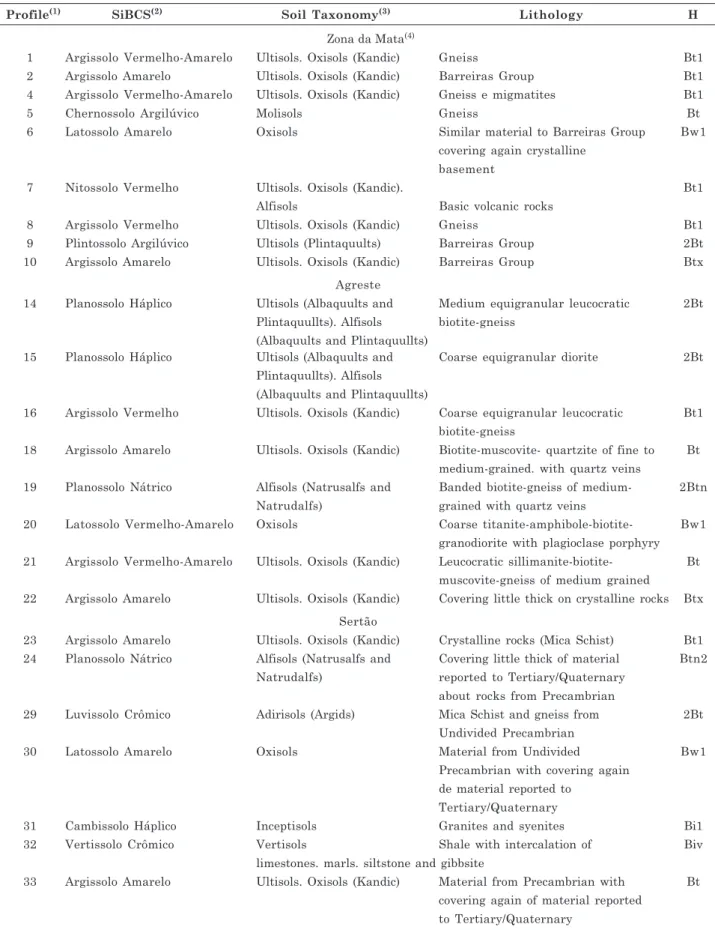
To achieve these objectives, subsurface samples were taken from 24 profiles (nine from the Zona da Mata, eight from the Agreste, and seven from the Sertão), which represent approximately 80 % of the total area of the state (Table 1). The Zona da Mata, Agreste, and Sertão are meso-regions of the state of Pernambuco arising from division of Brazil into geographic meso- and micro-regions (IBGE, 1990).
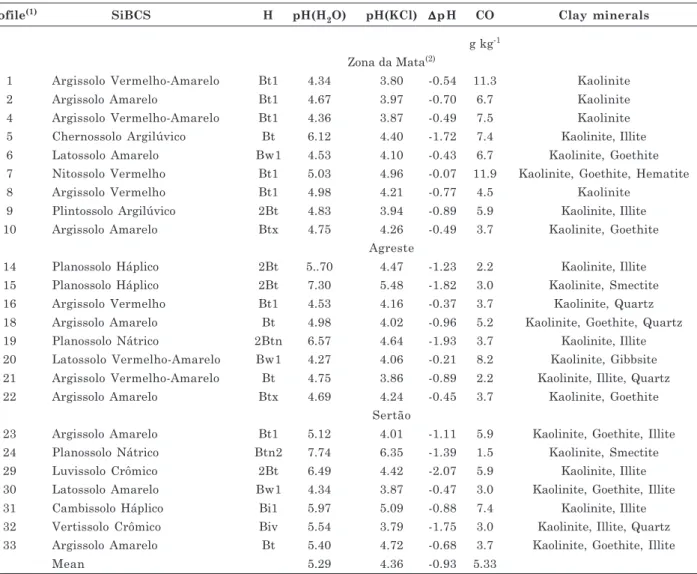
After collection, samples were air dried, soil clods were broken up, and the material was passed through a No. 10 sieve (2-mm grid). The pH in water and in 1 mol L-1 KCl (1:2.5 ratio) (Embrapa, 1997) were
determined to characterize the samples and to allow calculation of the pH. Organic carbon was measured through the wet oxidation method (Yeomans & Bremner, 1988) (Table 2). Clay proportion was also determined (Ruiz, 2005) (Table 3). In addition, mineralogical analysis was performed through X-ray diffraction of the clay fraction, which was separated from the samples after particle-size analyses and mounted on an oriented glass slide through the smear technique. A diffractometer X’Pert Pro (PANalytical) was used, with CoKα radiation and irradiation from 4 to 45 °2θ, with a 2θ step size of 0.01 and a step time of 1 s-1, tension of 40 kV, and current of 30 mA.
In order to quantify the permanent and variable electric charges, the method proposed by Anderson & Sposito (1991) and modified by Weber et al. (2005) was adapted. The different steps are presented below:
l 24 g of a 0.5 mol kg-1 solution of CsCl was added to 3.5 g samples of air-dried soil in 50 mL polycarbonate centrifuge tubes. The suspension was shaken for 25 min using a reciprocal shaker, removing the light organic fraction from the supernatant. It was then centrifuged for 35 min with a relative centrifugal force (RCF) of 1,710 g, discarding the supernatant solution. The ion Cs+ present in the reagent is non-radioactive
(Cs-133), of low risk, and when combined with Cl- it
forms a compound similar to K compounds; therefore, no special caution is required regarding its disposal, but the basic recommendations of reagent use and disposal must be strictly followed;
l RCF was calculated as follows: RCF = 0.00001118 × R × N², where R is the centrifugation radius, in cm, and N is the centrifugation speed, in rotations per minute;
l The previous procedure of shaking and centrifugation was repeated with the remainder of the soil sample, adding 20 g of CsCl solution, but with the concentration reduced to 0.1 mol kg-1. The supernatant
solution was then discarded and the procedure was performed two more times, one with a 0.1 mol kg-1
solution and another with a 0.05 mol kg-1 solution.
The supernatant solutions were discarded;
l The remaining soil paste was homogenized with the aid of a glass stirring rod, and then put in porcelain evaporating dishes. Then, two 0.5 g subsamples were taken in order to determine moisture content and assist in calculations involving the mass of the dry soil paste (MDSP);
l After drying (100 ºC) for 48 h, quantities of 0.35 g of MDSP from each previous subsample were transferred
to 50 mL centrifuge tubes which received 3.5 g of a
0.05 mol kg-1 solution of CsCl at pH 7.0. The
suspensions were shaken for 60 min in a horizontal
shaker and centrifuged at 1,710 g for 15 min,
discarding the supernatant;
l After that, subsamples were washed in 30 g of an ethanol:water solution (95:5, volume:volume). In this procedure, the suspensions were shaken for 10 s in a Vortex mixer, immersed in an ultrasonic bath for 5 min, and once more shaken in a Vortex mixer for 10 s;
l The suspensions were once more centrifuged at
1,710 g for 30 min, discarding the supernatant
solutions. Washing was repeated until no chloride was detected after a test with a 0.01 mol kg-1 solution of
AgNO3. The centrifuge tubes were placed in a
laboratory oven and dried at 65 ºC for 48 h;
l The purpose of washing with ethanol and drying the samples was to reduce the concentration of embedded Cs+ and favor the formation of internal
sphere complexes between Cs+ and siloxane surfaces;
l The soil samples prepared as indicated received 30 g of a 0.01 mol kg-1 solution of LiCl, at pH 7.0, and
were shaken for 30 min in a horizontal shaker and centrifuged at 1,710 g for 40 min, thus extracting Cs+
Profile(1) SiBCS(2) Soil Taxonomy(3) Lithology H
Zona da Mata(4)
1 Argissolo Vermelho-Amarelo Ultisols. Oxisols (Kandic) Gneiss Bt1
2 Argissolo Amarelo Ultisols. Oxisols (Kandic) Barreiras Group Bt1
4 Argissolo Vermelho-Amarelo Ultisols. Oxisols (Kandic) Gneiss e migmatites Bt1
5 Chernossolo Argilúvico Molisols Gneiss Bt
6 Latossolo Amarelo Oxisols Similar material to Barreiras Group Bw1
covering again crystalline basement
7 Nitossolo Vermelho Ultisols. Oxisols (Kandic). Bt1
Alfisols Basic volcanic rocks
8 Argissolo Vermelho Ultisols. Oxisols (Kandic) Gneiss Bt1
9 Plintossolo Argilúvico Ultisols (Plintaquults) Barreiras Group 2Bt
10 Argissolo Amarelo Ultisols. Oxisols (Kandic) Barreiras Group Btx
Agreste
14 Planossolo Háplico Ultisols (Albaquults and Medium equigranular leucocratic 2Bt Plintaquullts). Alfisols biotite-gneiss
(Albaquults and Plintaquullts)
15 Planossolo Háplico Ultisols (Albaquults and Coarse equigranular diorite 2Bt Plintaquullts). Alfisols
(Albaquults and Plintaquullts)
16 Argissolo Vermelho Ultisols. Oxisols (Kandic) Coarse equigranular leucocratic Bt1 biotite-gneiss
18 Argissolo Amarelo Ultisols. Oxisols (Kandic) Biotite-muscovite- quartzite of fine to Bt medium-grained. with quartz veins
19 Planossolo Nátrico Alfisols (Natrusalfs and Banded biotite-gneiss of medium- 2Btn Natrudalfs) grained with quartz veins
20 Latossolo Vermelho-Amarelo Oxisols Coarse titanite-amphibole-biotite- Bw1 granodiorite with plagioclase porphyry 21 Argissolo Vermelho-Amarelo Ultisols. Oxisols (Kandic) Leucocratic sillimanite-biotite- Bt
muscovite-gneiss of medium grained
22 Argissolo Amarelo Ultisols. Oxisols (Kandic) Covering little thick on crystalline rocks Btx Sertão
23 Argissolo Amarelo Ultisols. Oxisols (Kandic) Crystalline rocks (Mica Schist) Bt1 24 Planossolo Nátrico Alfisols (Natrusalfs and Covering little thick of material Btn2
Natrudalfs) reported to Tertiary/Quaternary about rocks from Precambrian
29 Luvissolo Crômico Adirisols (Argids) Mica Schist and gneiss from 2Bt
Undivided Precambrian
30 Latossolo Amarelo Oxisols Material from Undivided Bw1
Precambrian with covering again de material reported to
Tertiary/Quaternary
31 Cambissolo Háplico Inceptisols Granites and syenites Bi1
32 Vertissolo Crômico Vertisols Shale with intercalation of Biv
limestones. marls. siltstone and gibbsite
33 Argissolo Amarelo Ultisols. Oxisols (Kandic) Material from Precambrian with Bt covering again of material reported
to Tertiary/Quaternary
Table 1. Classification lithology and sampled horizon (H) of the studied reference soils of the State of Pernambuco
(1) Numbering attributed by the Federal Rural University of Pernambuco to the reference soils of the state. (2) Brazilian Soil
l The supernatant solutions were transferred to plastic containers and weighed. The centrifuge tubes, with the remaining soil and the embedded solution, were also weighed [M(CTS + ES)], obtaining the mass of the
embedded solution through this difference [MES =
M(CTS + ES) - MCTS];
l The Cs+ was then extracted from the sites with structural charge by adding 30 g of 1.0 mol kg-1
solution of ammonium acetate (NH4OAc). The
suspension was shaken for 30 min in a horizontal shaker and centrifuged at 1,710 g for 10 min. This extraction was performed three times, gathering the supernatant in a plastic container;
l Cs+ determinations in the extracts of LiCl and
NH4OAc were performed through ICP-OES
(Inductively Coupled Plasma - Optical Emission Spectrophotometry), belonging to the Federal University of Viçosa, at the wavelength of 455.5 nm;
l The variable charge, CECV (molc kg-1 of soil), was
determined by quantifying the exchangeable Cs+
released from the surface after equilibrium of the sample with LiCl:
( ) ( )÷÷
ø ö çç
è æ =
CTS added LiCl LiCl
Cs
M M k
CECV (1)
where kCs(LiCl) is the Cs+ concentration in the LiCl
supernatant, and MLiCl (added), is the mass of the added
LiCl solution (supernatant solution + embedded solution);
The permanent charge, CECP (molc kg-1 of soil),
was calculated as the excess of retained Cs+ after
saturation of the exchange complex with NH4+ to
substitute the Cs+ present in the structure of the
minerals (Anderson & Sposito, 1991):
( ) ( )
(
Cs(LiCl) LiCl(embedded))
CTSadded OAc NH OAc NH
Cs k M
M M k
CECP
-÷ ÷ ø ö ç
ç è æ
= 4
4 (2)
Profile(1) SiBCS H pH(H
2O) pH(KCl) ∆∆∆∆∆p H CO Clay minerals
g kg-1
Zona da Mata(2)
1 Argissolo Vermelho-Amarelo Bt1 4.34 3.80 -0.54 11.3 Kaolinite
2 Argissolo Amarelo Bt1 4.67 3.97 -0.70 6.7 Kaolinite
4 Argissolo Vermelho-Amarelo Bt1 4.36 3.87 -0.49 7.5 Kaolinite
5 Chernossolo Argilúvico Bt 6.12 4.40 -1.72 7.4 Kaolinite, Illite
6 Latossolo Amarelo Bw1 4.53 4.10 -0.43 6.7 Kaolinite, Goethite
7 Nitossolo Vermelho Bt1 5.03 4.96 -0.07 11.9 Kaolinite, Goethite, Hematite
8 Argissolo Vermelho Bt1 4.98 4.21 -0.77 4.5 Kaolinite
9 Plintossolo Argilúvico 2Bt 4.83 3.94 -0.89 5.9 Kaolinite, Illite
10 Argissolo Amarelo Btx 4.75 4.26 -0.49 3.7 Kaolinite, Goethite
Agreste
14 Planossolo Háplico 2Bt 5..70 4.47 -1.23 2.2 Kaolinite, Illite
15 Planossolo Háplico 2Bt 7.30 5.48 -1.82 3.0 Kaolinite, Smectite
16 Argissolo Vermelho Bt1 4.53 4.16 -0.37 3.7 Kaolinite, Quartz
18 Argissolo Amarelo Bt 4.98 4.02 -0.96 5.2 Kaolinite, Goethite, Quartz
19 Planossolo Nátrico 2Btn 6.57 4.64 -1.93 3.7 Kaolinite, Illite
20 Latossolo Vermelho-Amarelo Bw1 4.27 4.06 -0.21 8.2 Kaolinite, Gibbsite 21 Argissolo Vermelho-Amarelo Bt 4.75 3.86 -0.89 2.2 Kaolinite, Illite, Quartz
22 Argissolo Amarelo Btx 4.69 4.24 -0.45 3.7 Kaolinite, Goethite
Sertão
23 Argissolo Amarelo Bt1 5.12 4.01 -1.11 5.9 Kaolinite, Goethite, Illite
24 Planossolo Nátrico Btn2 7.74 6.35 -1.39 1.5 Kaolinite, Smectite
29 Luvissolo Crômico 2Bt 6.49 4.42 -2.07 5.9 Kaolinite, Illite
30 Latossolo Amarelo Bw1 4.34 3.87 -0.47 3.0 Kaolinite, Goethite, Illite
31 Cambissolo Háplico Bi1 5.97 5.09 -0.88 7.4 Kaolinite, Illite
32 Vertissolo Crômico Biv 5.54 3.79 -1.75 3.0 Kaolinite, Illite, Quartz
33 Argissolo Amarelo Bt 5.40 4.72 -0.68 3.7 Kaolinite, Goethite, Illite
Mean 5.29 4.36 -0.93 5.33
Table 2. pH (H2O and KCl), ∆∆∆∆∆pH, organic carbon (OC) and principal clay minerals of the sampled horizons (H) of reference soils of the State of Pernambuco
(1) Numbering attributed by the Federal Rural University of Pernambuco to the reference soils of the state. (2) Location region of
where kCs(NH4OAc) is the concentration of Cs+ in the
supernatant solution of NH4OAc; MNH4OAc (added) is the
mass of the NH4OAc solution added, and MLiCl(embedded) is the massof LiCl embedded per mass unit of the dry adsorbent.
l The total surface charge, CECT (molc kg-1 of soil) was calculated by the sum of CECP and CECV:
CECT = CECP + CECV (3)
RESULTS AND DISCUSSION
In general, the sampled soils show low values of organic matter (OM), high amplitude in the clay content, and predominance of negative electric charge, indicated by the negative value of ∆pH (Tables 2
and 3). Organic carbon (OC) contents ranged from 1.5 to 11.9 g kg-1(average of 5.33 g kg-1), clay contents
from 0.065 to 0.693 kg kg-1 (average of 0.356 kg kg-1),
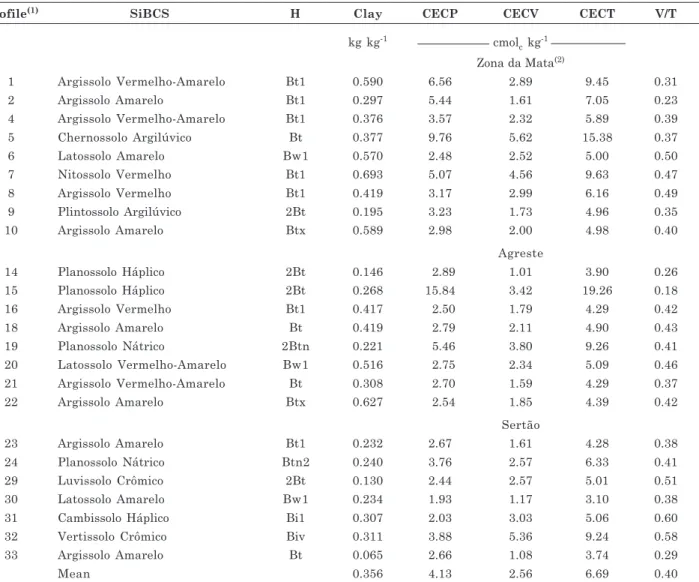
and ∆pH from -0.07 to -2.07 (average of -0.93). Values of the permanent cation exchange capacity (CECP), variable cation exchange capacity (CECV), total cation exchange capacity (CECT) [CECT = CECP + CECV], and the ratio CECV/CECT (V/T), an indication of the proportion of pH-dependent charges in the diagnostic horizon of the soils studied, are shown in table 3. In four soils, V/T was equal to or greater than 0.50, which corresponds to approximately 17 % of the diagnostic horizons studied. The lowest V/T value was 0.18, indicating that all the diagnostic horizons studied showed CEC derived from variable-charge material.
Considering all the profiles analyzed, the average V/T ratio was 0.40 (Table 3). It should be noted that
Profile(1) SiBCS H Clay CECP CECV CECT V/T
kg kg-1 cmol
c kg-1
Zona da Mata(2)
1 Argissolo Vermelho-Amarelo Bt1 0.590 6.56 2.89 9.45 0.31
2 Argissolo Amarelo Bt1 0.297 5.44 1.61 7.05 0.23
4 Argissolo Vermelho-Amarelo Bt1 0.376 3.57 2.32 5.89 0.39
5 Chernossolo Argilúvico Bt 0.377 9.76 5.62 15.38 0.37
6 Latossolo Amarelo Bw1 0.570 2.48 2.52 5.00 0.50
7 Nitossolo Vermelho Bt1 0.693 5.07 4.56 9.63 0.47
8 Argissolo Vermelho Bt1 0.419 3.17 2.99 6.16 0.49
9 Plintossolo Argilúvico 2Bt 0.195 3.23 1.73 4.96 0.35
10 Argissolo Amarelo Btx 0.589 2.98 2.00 4.98 0.40
Agreste
14 Planossolo Háplico 2Bt 0.146 2.89 1.01 3.90 0.26
15 Planossolo Háplico 2Bt 0.268 15.84 3.42 19.26 0.18
16 Argissolo Vermelho Bt1 0.417 2.50 1.79 4.29 0.42
18 Argissolo Amarelo Bt 0.419 2.79 2.11 4.90 0.43
19 Planossolo Nátrico 2Btn 0.221 5.46 3.80 9.26 0.41
20 Latossolo Vermelho-Amarelo Bw1 0.516 2.75 2.34 5.09 0.46
21 Argissolo Vermelho-Amarelo Bt 0.308 2.70 1.59 4.29 0.37
22 Argissolo Amarelo Btx 0.627 2.54 1.85 4.39 0.42
Sertão
23 Argissolo Amarelo Bt1 0.232 2.67 1.61 4.28 0.38
24 Planossolo Nátrico Btn2 0.240 3.76 2.57 6.33 0.41
29 Luvissolo Crômico 2Bt 0.130 2.44 2.57 5.01 0.51
30 Latossolo Amarelo Bw1 0.234 1.93 1.17 3.10 0.38
31 Cambissolo Háplico Bi1 0.307 2.03 3.03 5.06 0.60
32 Vertissolo Crômico Biv 0.311 3.88 5.36 9.24 0.58
33 Argissolo Amarelo Bt 0.065 2.66 1.08 3.74 0.29
Mean 0.356 4.13 2.56 6.69 0.40
Table 3. Clay content, permanent cation exchange capacity (CECP), variable cation exchange capacity (CECV), total cation exchange capacity (CECT = CECP + CECV) and relation CECV/CECT (V/T) in the sampled horizons (H) of reference soils of the State of Pernambuco
(1) Numbering attributed by the Federal Rural University of Pernambuco to the reference soils of the state. (2) Location region of
there was no removal of OM from soils in the CEC determination, thus not allowing differentiation between the amounts of OM and clay minerals contributing to the variable charges for the CECV. To reduce the possible contribution of the OM, determinations were purposely performed with samples from subsurface horizons. Some soils, such as profiles 26 and 33, have low contents of clay and OC, which makes it difficult to infer the amount of CECV originating predominantly from inorganic material. Thus, further research is needed to identify the separate contribution of each constituent present in the soils.
The predominance of CECP in the subsurface horizons of profiles 1, 2, and 4 (Table 3), despite the prevalence of kaolinite in their clay fractions (Table 2), can be explained by the possibility that the method of CEC determination through Cs+ adsorption registers
the charges available in the 2:1 clay minerals that may be present but not detected by X-ray diffraction applied to the natural clay fraction (with no treatment application).
The Cs+ adsorption method, though little studied
in Brazilian soils, proves to be an excellent line of research for soil science because despite detecting electric charges originating from 2:1 minerals not identified with X-ray diffractograms in the absence of treatments, such as clay saturation by cations (Mg2+
and K+, for instance) to identify materials with
uniform expansion of the expansible phyllosilicate (smectites and chlorites, for instance), it would be important in studies on soils with different mineralogies, as well as allowing the observation of the contribution of organic and inorganic constituents to net soil electric charge.
Specifically regarding the representative soils of the State of Pernambuco, the presence of variable charges in all soils of the region should be pointed out. It is sometimes suggested that these soils, especially those from the Sertão region, could have a high proportion of permanent charges in their exchange complexes due to the climatic conditions of the region. The marked presence of materials with variable charge is an indication of past climate conditions that led to the predominant formation of variable charge clay minerals, as well as the possible contribution of kaolinite, which, despite having a low CEC, in large amounts can provide variable electric charges of considerable proportion. The predominance of a more humid past climate in the Northeast region was indicated by De Oliveira et al. (1999) and Pessenda et al. (2010).
CONCLUSIONS
1. The cesium adsorption method was efficient in the determination of electrical charges in Reference Soils of the state of Pernambuco, allowing to identify different amounts of variable and permanent cation exchange capacity in all analyzed soils.
2. All the soils analyzed exhibited variable cation exchange capacity, with proportions from 0.16 to 0.60 and an average of 0.40 when related to total cation exchange capacity.
LITERATURE CITED
ANDERSON, S.J. & SPOSITO, G. Cesium adsorption method for measuring accessible structural surface charge. Soil Sci. Soc. Am. J., 55:1569-1576, 1991.
BIONDI, C.M.; NASCIMENTO, C.W.A. & FABRICIO NETA, A.B. Teores naturais de bário em solos de referência do estado de Pernambuco. R. Bras. Ci. Solo, 35:1819-1826, 2011. CHOROVER, J. & SPOSITO, G. Surface charge characteristics
of kaolinitic tropical soils. Geochim. Cosmochim. Acta, 59:875-884, 1995.
DE OLIVEIRA, P.E.; BARRETO, A.M.F. & SUGUIO, K. Late Pleistocene/Holocene climatic and vegetational history of the Brazilian caatinga: The fóssil dunes of the middle São Francisco River. Palaeogeogr. Palaeoclimatol. Palaeoecol., 152:319-337, 1999.
EMPRESA BRASILEIRA DE PESQUISA AGROPECUÁRIA -EMBRAPA. Centro Nacional de Pesquisa de Solos. Sistema brasileiro de classificação de solos. 3.ed. Brasília, 2013. 353p.
EMPRESA BRASILEIRA DE PESQUISA AGROPECUÁRIA -EMBRAPA. Manual de métodos de análise de solo. 2.ed. Rio de Janeiro, Centro Nacional de Pesquisa de Solos, 1997. 212p.
FONTES, M.P.F. & SPOSITO, G. Medição da densidade de carga estrutural acessível em Latossolos brasileiros com diferentes mineralogias. In: CONGRESSO BRASILEIRO DE CIÊNCIA DO SOLO, 25., Viçosa, MG, 1995. Resumos expandidos... Viçosa, MG, Sociedade Brasileira de Ciência do Solo, 1995. v.1, p.292-294.
FONTES, M.P.F.; CAMARGO, O.A. & SPOSITO, G. Eletroquímica das partículas coloidais e sua relação com a mineralogia de solos altamente intemperizados. Sci. Agric., 58:627-646, 2001.
INSTITUTO BRASILEIRO DE GEOGRAFIA E ESTATÍSTICA - IBGE. Divisão regional do Brasil em mesorregiões e microrregiões geográficas. 1. ed. Rio de Janeiro, Instituto Brasileiro de Geografia e Estatística, 1990. 135p. PEIXOTO, R.T.G.; TRAINA, S.J. & BIGHAM, J.M.
Aplicabilidade do método de adsorção de Cs na determinação de carga elétrica permanente em Latossolos derivados de basalto no Paraná. In: CONGRESSO BRASILEIRO DE CIÊNCIA DO SOLO, 25., Viçosa, 1995. Resumos expandidos... Viçosa, MG, Sociedade Brasileira de Ciência do Solo, 1995. v.1, p.295-297.
RIBEIRO, M.R.; JACOMINE, P.K.T. & LIMA, J.F.W.F. Caracterização e classificação de solos de referência do Estado de Pernambuco. Recife, Universidade Federal Rural de Pernambuco, 1999. 140p.
RUIZ, H.A. Incremento da exatidão da análise granulométrica do solo por meio da coleta da suspensão (silte+argila). R. Bras. Ci. Solo, 29:297-300, 2005.
SPOSITO, G. The chemistry of soil. 2.ed. New York, Oxford University Press, 2008. 329p.
WEBER, O.L.S.; CHITOLINA, J.C.; CAMARGO, O.A. & ALLEONI, L.R.F. Método da adsorção de césio para determinação da carga estrutural em solos altamente intemperizados. Bragantia, 64:109-113, 2005.