http://dx.doi.org/10.1590/1806-9061-2016-0255
Author(s)
Wang DI
Liao BII
Zhang QI
Liu JSI
Duan ZI
Hou ZI
Ning ZI
I National Engineering Laboratory for Animal
Breeding and MOA Key Laboratory of mal Genetics and Breeding, College of Ani-mal Science and Technology, China Agricul-tural University, Beijing 100193, China
II Shenyang Institute of Technology, Liaoning
110003, China
Mail Address
Corresponding author e-mail address Zhonghua Ning
National Engineering Laboratory for Animal Breeding and MOA Key Laboratory of Animal Genetics and Breeding, College of Animal Science and Technology, China Agricultural University, Beijing 100193, China
Tel: +86-10-6273-2028 Email: [email protected]
Keywords
Calmodulin1, eggshell ultrastructure organization, ovalbumin, ovocleidin-116.
Submitted: September/2016 Approved: October/2016
ABSTRACT
Background: Eggshell ultrastructure organization, including effective layer thickness, mammillary layer thickness, and average size of mammillary cones, is important for breeding and significantly influences eggshell mechanical properties. Several matrix proteins were known to be important in eggshell formation. However, the proteins and variations that determine eggshell ultrastructure organization are not known.
Results: In this study, 17 single-nucleotide polymorphisms of three major genes in a hen population using matrix-assisted laser desorption/ ionization time-of-flight mass spectrometry. Five single-nucleotide polymorphisms with a very low minor allele frequency (< 1%) were excluded from further analysis. The remaining 12 single-nucleotide polymorphisms in Hardy-Weinberg equilibrium were used for analysis of associations with eggshell ultrastructure organization. Associations were found for (i) ovocleidin-116 with effective layer thickness (EFF), mammillary layer thickness (MAM), and average size of mammillary cones (SMAM); (ii) ovalbumin with eggshell thickness (ESH), effective layer thickness, and density of the mammillary cone (DMAM); and (iii) calmodulin1 with density of the mammillary cone.
Conclusions: The single-nucleotide polymorphisms identified in the present study may be used as potential markers to improve eggshell quality.
INTRODUCTION
The eggshell is a complex bioceramic that provides protection against physical damage and promotes embryo development (Burley & Vadehra, 1989). Eggshell quality is affected by many factors, including genetics, disease, nutrition, and environmental conditions (Roberts, 2004). Previous studies have shown that eggshell ultrastructure organization, including eggshell thickness and mammillary layer thickness, influences both eggshell quality and egg hatchability. In addition, mammillary cone size contributes to the mechanical properties of the eggshell (Liao
et al., 2013). Thus, appropriate eggshell ultrastructure organization is critical for eggshell quality in hens.
Egg calcification occurs in the uterine fluid over three distinct phases (initiation, active calcification, and termination of shell calcification) (Nys
et al., 2004). Numerous matrix genes involved in eggshell formation
have been intensively studied (Gautron et al., 2001; Hincke, 1995;
Hincke et al., 1999; Nys et al., 2004). Ovocleidin-116 (OC-116) is the
calcite growth during the active calcification phase
of shell formation (Hincke et al., 1999). Ovalbumin is
present in the uterine fluid and is primarily localized in the mammillary knobs of the eggshell (Hincke, 1995). Moreover, ovalbumin is predominant during the initial phase of the eggshell formation process (Panheleux
et al., 1999) and it is critical for the maintenance and
function of the shell gland (Nys et al., 2004). Finally,
calmodulin1 (CALM1) is a calcium-binding protein involved in eggshell formation and is thought to play
a role in calcium ion transportation (Jonchère et al.,
2010). Association studies have shown that specific alleles of these candidate genes are correlated with
measurements of eggshell quality (Dunn et al., 2009).
Therefore, in this study, we aimed at determining if single-nucleotide polymorphisms (SNPs) in OC-116, ovalbumin, and CALM1 were associated with characteristics of eggshell ultrastructure organization in chickens.
MATERIAL AND METHODS
Sample collection
Pureline Rhode Island White layers (n = 384) from 40 half-sib families (one cock mating 9 to 10 hens), representing the sixth generation of a pedigree line from Beijing Zhongnongbangyang Poultry Breeding Co. Ltd., China, were used for this study.
All hens were caged individually in an automated environmental control poultry house and managed under conventional conditions. Commercial diets were
provided ad libitum. The house was automatically
ventilated to maintain ambient temperature between 20 and 28°C. A photoperiod of 16 h light: 8 h dark at light intensity of 15 lx was applied. The sexual maturity age of the flock was 136 days (50% laying rate), and average egg weight and laying rate in week 56 were 59.7 g and 77.8%, respectively. When the hens reached 57 weeks of age, eggs were collected during three consecutive days to ensure at least one egg per hen, and 1.5 mL of whole blood was individually collected by venipuncture. This protocol was approved by the Animal Care and Use Committee of China Agricultural University (permit number: SYXK 2007-0023).
Scanning electron microscopy (SEM)
The eggs were broken, and egg whites and yolks were removed. To facilitate membrane removal, eggshells were boiled in 2% NaOH for 10 min. Shell thickness (after removing the eggshell membrane, ESH), effective layer thickness (palisade layer and vertical
crystal layer, EFF), and mammillary layer thickness
(MAM) were measured by SEM (Panheleux et al.,
1999) at the equatorial region of the eggshell of each egg. The average size of mammillary cones (SMAM) was calculated, using two-dimensional images, as s = L/n, where n is the number of mammillary cones at the intersecting line, and L is the length of the intersecting line (DeHoff & Rhines, 1968). The density of the mammillary cone (DMAM) was calculated as d = c/A, where c is the number of mammillary cones within the field of view, and A is the area of the field.
SNPs and genotyping
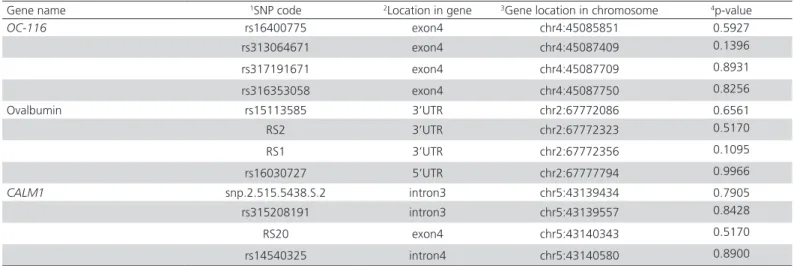
Genomic DNA was extracted from the blood samples using a standard phenol-chloroform method and then quantified using a NanoDrop spectrophotometer (GE Healthcare Life Sciences, Uppsala, Sweden). The final concentrations ranged from 2 to 10 ng/μL. Seventeen SNPs in three genes (CALM1, ovalbumin, and OC-116) were selected from the UCSC database (http:// genome.ucsc.edu/cgi-bin/hgGateway), from the ensemble database at (http://asia.ensembl.org/index. html), and from the preliminary experiment, which included nine registered SNPs and three unregistered SNPs, from the SNP database (Table 1) (five SNPs out of Hardy-Weinberg equilibrium removed). Genotyping of 384 birds was performed using matrix-assisted laser desorption-ionization time-of-flight mass spectrometry on a Mass ARRAY iPLEX Platform (Sequenom, San Diego, CA, USA).
Statistical analysis
Values of the individual records of eggshell ultrastructure organization traits (i.e., ESH, MAM, EFF, SMAM, DMAM) outside the range of the mean ± three standard deviations were discarded. The Hardy-Weinberg equilibrium of genotypes was analyzed
using Chi-square (χ2) tests. SNPs that deviated from the
Hardy-Weinberg equilibrium were excluded. SNPs with a genotype call rate of less than 85% and minor allele frequency (MAF) of less than 1% across all individuals were discarded. The association of the remaining SNPs with eggshell ultrastructure organization traits was assessed using the GLM procedure of SAS statistical package (version 9.2, SAS Institute Inc., Cary, NC, USA). The following model was applied:
Yij = μ + Gi + eij
RESULTS AND DISCUSSION
Phenotypic analysis and SNP summary
Detailed information on the selected candidate genes and the selected SNPs in the present study is shown in Table 1. Descriptive statistics of the eggshell ultrastructure organization traits are presented in Table 2. Genotype quality control and data filtering resulted in the removal of five SNPs, and the remaining 12 SNPs presented genotype call rates of more than 85% and MAFs of less than 1%, and were further analyzed. Association analysis revealed that 10 SNPs from three genes were significantly associated with eggshell ultrastructure organization traits, as shown in Table 3.
Eggshell ultrastructure organization traits
The coefficients of variation of ESH, MAM, EFF and DMAM were about 10%, and 24.58% for SMAM, which may partially explained by the variation of the SNPs in ovocleidin-116, ovalbumin and calmodulin1 genes.
Ovocleidin-116
OC-116 is a major component of the chicken eggshell matrix and plays an important role in calcite
growth during eggshell calcification (Hincke et al.,
1999). SNPs in OC-116 are significantly associated with
eggshell elastic modulus and thickness, as well as with
egg shape (Dunn et al., 2009). In the current study, the
association analysis revealed that four SNPs in the
OC-116 gene were significantly associated with EFF, MAM,
and SMAM in chickens, as shown in Table 3. In addition, the four SNPs caused missense mutations in the amino acids in exon 4. For rs313064671, chickens with the AA genotype had significantly thicker EFFs than those with the CA genotype (p<0.05); this particular SNP caused an amino acid variation that changed a hydrophilic threonine into a conserved hydrophobic proline. Both rs317191671 and rs316353058 were significantly associated with SMAM (p<0.05). For rs317191671, the CC genotype was significantly more frequent than the CA genotype, and the amino acid changed from proline into threonine. For rs316353058, chickens
Table 1 – Details of the genes and SNPs examined in this study
Gene name 1SNP code 2Location in gene 3Gene location in chromosome 4p-value
OC-116 rs16400775 exon4 chr4:45085851 0.5927
rs313064671 exon4 chr4:45087409 0.1396
rs317191671 exon4 chr4:45087709 0.8931
rs316353058 exon4 chr4:45087750 0.8256
Ovalbumin rs15113585 3’UTR chr2:67772086 0.6561
RS2 3’UTR chr2:67772323 0.5170
RS1 3’UTR chr2:67772356 0.1095
rs16030727 5’UTR chr2:67777794 0.9966
CALM1 snp.2.515.5438.S.2 intron3 chr5:43139434 0.7905
rs315208191 intron3 chr5:43139557 0.8428
RS20 exon4 chr5:43140343 0.5170
rs14540325 intron4 chr5:43140580 0.8900
1SNPs (single-nucleotide polymorphisms), coded as rs, were selected from the ENSEMBLE database (http://www.ensembl.org/index.html), and SNPs, coded as snp, from the UCSC
database (https://genome.ucsc.edu/). SNPs, coded as RS, were newly identified in this flock.
2Location in the gene and
3gene location in the chromosome were obtained from the UCSC database Assemble: NOV.2011(ICGSC Gallus-4.0/galGal4) 4p-value in Hardy-Weinberg equilibrium (HWE) test
Table 2 – Descriptive statistics for chicken eggshell ultrastructure organization traits
Trait1 Mean SD CV (%) Maximum Minimum
ESH (µm) 303.63 25.05 8.25 368.00 245.00
MAM (µm) 90.99 11.15 12.25 121.00 60.50
EFF (µm) 212.15 22.67 10.68 275.50 154.80
SMAM (µm) 170.09 41.82 24.58 284.92 68.45
DMAM(N/µm2) 74.55 10.77 14.44 105.30 54.48
with the CC and TT genotypes had significantly thicker SMAMs than chickens with the CT genotype. When CC was mutated into CT, the amino acid alanine changed to valine at this position. For rs16400775, chickens with the AA genotype had significantly thicker SMAMs than those with the AG genotype (p< 0.01), and AA individuals exhibited significantly thicker MAMs than AG and GG individuals, indicating that the A allele was favorable for mammillary cones. This SNP caused a missense mutation resulting in a change from histidine to arginine. Importantly, these three SNP (rs313064671, rs317191671, and rs316353058)
of the OC-116 gene were in the conserved domain
(http://asia.ensembl.org/Gallus_gallus/Transcript/
Domains), suggesting that these SNPs may alter the structure of the conserved domain and affect protein function during the initial phase of shell mineralization
(Jiang et al., 2010).
Ovalbumin
Ovalbumin was the first egg white protein identified in the shell matrix by N-terminal amino acid sequencing and immunochemistry (Hincke, 1995). This protein is localized in the mammillary knobs of the eggshell
(Hincke, 1995) and functions to increase the Ca2+
concentration of nucleation centers in the initial steps of mineralization by binding between carboxylate
groups of ovalbumin and calcium ions on the CaCO3
Table 3 – Means of eggshell traits among SNPs genotypes the evaluatedgenes
Gene Genotype ESH MAM EFF DMAM SMAM
OC-116 rs16400775 AA 304.55 ± 3.74 94.20 ± 1.65a 212.83 ± 3.46 195.34 ± 7.54 78.67 ± 1.60A
AG 302.19 ± 1.96 90.66 ± 0.87b 210.63 ± 1.76 211.35 ± 3.99 73.48 ± 0.84B
GG 305.35 ± 2.43 90.18 ± 1.07b 214.04 ± 2.17 206.81 ± 4.93 74.58 ± 1.02AB
rs313064671 AA 305.76 ± 2.08 90.94 ± 0.93 215.25 ± 1.88a 207.43 ± 4.31 75.44 ± 0.90
CC 303.84 ± 3.47 89.82 ± 1.51 211.37 ± 3.06ab 204.67 ± 7.33 75.13 ± 1.49
CA 300.97 ± 2.28 91.57 ± 1.01 208.82 ± 2.04b 209.58 ± 4.62 73.20 ± 0.98
rs317191671 AA 304.85 ± 3.58 89.80 ± 1.56 212.21 ± 3.17 204.57 ± 7.54 75.71 ± 1.53ab
CA 302.22 ± 2.11 91.55 ± 0.93 210.16 ± 1.90 210.38 ± 4.28 73.06 ± 0.91b
CC 304.96 ± 2.23 90.98 ± 1.00 214.47 ± 2.02 205.78 ± 4.62 75.80 ± 0.96a
rs316353058 CC 303.64 ± 3.51 89.85 ± 1.53 211.10 ± 3.11 202.30 ± 7.39 75.46 ± 1.50a
CT 302.41 ± 2.12 91.42 ± 0.94 210.47 ± 1.91 211.50 ± 4.29 73.07 ± 0.91b
TT 304.96 ± 2.23 90.98 ± 1.00 214.47 ± 2.02 205.78 ± 4.61 75.80 ± 0.96a
OVA RS1 CC 295.16 ± 5.10 91.24 ± 2.32 202.60 ± 4.60b 200.88 ± 10.96 73.88 ± 2.30
CT 305.01 ± 1.94 90.12 ± 0.86 213.91 ± 1.75 a 204.31 ± 4.00 74.65 ± 0.84
TT 303.43 ± 2.21 92.05 ± 0.98 211.65 ± 1.99ab 213.51 ± 4.50 74.52 ± 0.96
rs16030727 CC 300.00 ± 2.09AB 90.29 ± 0.94 209.96 ± 1.91ab 209.71 ± 4.45ab 74.22 ± 0.92
CT 308.25 ± 2.08A 91.65 ± 0.93 215.47 ± 1.87a 201.86 ± 4.25b 75.33 ± 0.90
TT 299.48 ± 4.18B 91.05 ± 1.91 207.17 ± 3.80b 223.23 ± 8.06a 72.64 ± 1.81
CALM1 snp.2.515.5438.S.2 CC 304.81 ± 2.11 91.79 ± 0.99 213.03 ± 1.84 208.30 ± 4.19ab 73.67 ± 0.87
TC 303.34 ± 2.13 91.62 ± 1.00 211.73 ± 1.87 204.04 ± 4.24b 74.91 ± 0.88
TT 301.29 ± 5.49 90.50 ± 2.57 210.79 ± 4.81 229.96 ± 10.92a 76.65 ± 2.26
rs315208191 CC 304.14 ± 2.37 90.87 ± 1.06 212.46 ± 2.15 211.82 ± 4.85ab 74.18 ± 1.02
CT 301.97 ± 2.03 91.22 ± 0.90 210.63 ± 1.83 200.41 ± 4.13b
75.59 ± 0.87
TT 307.20 ± 3.40 90.57 ± 1.53 215.80 ± 3.08 220.97 ± 7.00a
72.29 ± 1.48
RS20 CC 301.29 ± 5.49 90.50 ± 2.57 210.79 ± 4.80 229.96 ± 10.93a 76.65 ± 2.26
CT 303.47 ± 2.13 91.56 ± 1.00 211.92 ± 1.87 204.53 ± 4.25b 74.99 ± 0.88
TT 304.69 ± 2.11 91.85 ± 0.99 212.84 ± 1.84 207.82 ± 4.19ab 73.59 ± 0.87
rs14540325 CC 306.37 ± 3.26 90.78 ± 1.46 216.09 ± 2.97 220.54 ± 6.72a
72.35 ± 1.42
TT 303.96 ± 2.38 90.96 ± 1.06 212.19 ± 2.15 211.17 ± 4.85a
74.38 ± 1.02
CT 302.26 ± 2.07 91.09 ± 0.91 210.58 ± 1.85 200.42 ± 4.19b 75.53 ± 0.89
A,BAmong genotypes within each SNP for each trait, means without a common superscript differ (p<0.01). a,bAmong genotypes within each SNP for each trait, means without a common superscript differ (p<0.05).
surface (Pipich et al., 2008; Schwahn et al., 2004,
Wang et al., 2009). Recent studies have shown that
polymorphisms in the ovalbumin gene are significantly associated with breaking strength and shell thickness
in Rhode Island Red hens (Dunn et al., 2009). In the
present study, we found that the CT genotype was significantly more frequent than the CC genotype
(p<0.05) in RS1, a new SNP that was significantly
associated with EFF. In rs16030727, hens with the CT genotype had significantly thicker ESHs (p<0.01) and EFFs (p<0.05) than those with the TT genotype, whereas hens with the CT genotype had significantly lower DMAMs than those with the TT genotype (p<
0.05; Table 3). Burgess et al. (1992) demonstrated that
ovalbumin does not influence crystal morphology, but slightly accelerates the nucleation of calcium carbonate
in an in vitro precipitation assay. In contrast, Pipich et
al. (2008) reported that the crystallization process starts
immediately in the absence of ovalbumin and yields crystallites, with amorphous calcium carbonate particles formed within minutes after initiation. Moreover, ovalbumin may modify the morphology of calcite crystals and retard the transformation of unstable crystalline vaterites into more stable calcites in a
concentration-dependent manner (Wang et al., 2009; Wang et al.,
2010). Thus, our data further support that ovalbumin influences nucleation and initial mineralization. Because all four SNPs in ovalbumin examined in the study were in the 3’ untranslated region (UTR) and 5’UTR, which may influence the regulation of ovalbumin expression, these SNPs may affect ovalbumin function during initial mineralization and alter the morphology of calcite crystals and vaterites.
CALM1
The CALM1 gene encodes calmodulin (CaM), a ubiquitous eukaryotic calcium-binding protein, which is one of the main mediators of the calcium signal (Carafoli, 1987), and plays an important role in intercellular communication, cell movement, cell differentiation, cell proliferation, and other
physiological and biochemical activities (Hanley et al.,
1990). In humans, two SNPs (rs12885713 [–16C > T]
and rs5871) in the CALM1 gene have been shown
to be predisposing factors for adolescent idiopathic
scoliosis (Zhao et al., 2009). However, few studies have
examined the role of CALM1 in poultry.
In the current study, we found, for the first time,
that four SNPs in the CALM1 gene were significantly
associated with the DMAM trait in chickens, as shown in Table 3. For rs315208191 and snp.2.515.5438.S.2, individuals with the TT genotype had higher DMAMs
than those with the CT genotype. Hens with rs316353058 CC and TT genotypes had significantly greater DMAMs than those with the CT genotype. Additionally, in RS20, chickens with the CC genotype had significantly greater DMAMs than those with the CT genotype. These results indicate that heterozygosity of CALM1 resulted in lower DMAMs compared with homozygosity.
In proteomic analysis of eggshells, CaM protein has
been shown to exhibit moderate expression (Mann et
al., 2006). Moreover, it was demonstrated that Ca2+
-calmodulin-dependent protein kinase II is expressed in the calcified eggshell of layers during the early stages
of eggshell precipitation (Liu et al., 2013; Mann et al.,
2007), indicating that the CALM1 gene may play an
important role in mediating eggshell mineralization. Sun et al. (2013) reported that CaM is expressed in the uterine fluids of both strong and weak eggs, and it is not expressed in strong or weak eggshells. Taken together,
these studies show that the CALM1 gene may not be
abundantly expressed during eggshell mineralization, which would explain why we could not always detect the CALM1 gene in the eggshells. CALM1 may act as an eggshell structure regulatory protein during eggshell formation. Thus, we hypothesized that the four SNPs
in the CALM1 gene may affect the formation of the
eggshell.
In summary, we found that three genes were strongly associated with chicken eggshell ultrastructure
organization. The OC-116 gene was important for
ESH, EFF, and SMAM; ovalbumin was important for
ESH, EFF, and DMAM; and CALM1 was important for
DMAM. The SNPs identified in the present study may be used as potential molecular genetic markers in layer breeding. Further studies with more birds and different breeding flocks are needed to validate the SNPs and linkage analyses performed to definitively demonstrate the functions of these SNPs in eggshell ultrastructure organization and hatchability. Such studies may reveal potential molecular markers for the selection for hatchability.
ACKNOWLEDGEMENTS
The current research was funded by the National System for Layer Production Technology of China (nycytx-41-k22).
REFERENCES
Burley R, Vadehra D. The albumen: chemistry. In: Burley R, Vadehra D, editors. The avian egg: chemistry and biology.New York: Wiley;1989. p. 65-128.
Carafoli E. Intracellular calcium homeostasis. Annual Review of Biochemistry 1987; 56:395-433.
DeHoff RT, Rhines FN. Quantitative microscopy. New York: McGraw-Hill; 1968.
Dunn I, Joseph N, Bain M, Edmond A, Wilson P, Milona P, Nys Y, Gautron J, Schmutz M, Preisinger R, Waddington D. Polymorphisms in eggshell organic matrix genes are associated with eggshell quality measurements in pedigree Rhode Island Red hens. Animal Genetics2009; 40(1):110-4.
Gautron J, Hincke MT, Mann K, Panheleux M, Bain M, McKee MD, Solomon SE, Nys Y. Ovocalyxin-32, a novel chicken eggshell matrix protein. Isolation, amino acid sequencing, cloning, and immunocytochemical localization. The Journal of Biological Chemistry2001; 276(42):39243-52.
Hanley RM, Shenolikar S, Pollack J, Steplock D, Weinman EJ. Identification of calcium-calmodulin multifunctional protein kinase II in rabbit kidney. Kidney International1990; 38:63-6.
Hincke MT. Ovalbumin is a component of the chicken eggshell matrix. Connective Tissue Research1995; 31(3):227-33.
Hincke MT, Gautron J, Tsang CP, McKee MD, Nys Y. Molecular cloning and ultrastructural localization of the core protein of an eggshell matrix proteoglycan, ovocleidin-116. The Journal of Biological Chemistry 1999; 274(46):32915-23.
Jiang R, Xie Z, Chen X, Geng Z. A single nucleotide polymorphism in the parathyroid hormone gene and effects on eggshell quality in chickens. Poultry Science2010; 89(10):2101-5.
Jonchère V, Réhault-Godbert S, Hennequet-Antier C, Cabau C, Sibut V, Cogburn LA, Nys Y, Gautron J. Gene expression profiling to identify eggshell proteins involved in physical defense of the chicken egg. BMC Genomics2010; 11:57.
Liao B, Qiao H, Zhao X, Bao M, Liu L, Zheng C, Li CF, Ning ZH. Influence of eggshell ultrastructural organization on hatchability. Poultry Science 2013; 92(8):2236-9.
Liu Z, Zheng Q, Zhang X, Lu L. Microarray analysis of genes involved with shell strength in layer shell gland at the early stage of active calcification. Asian-Australasian Journal of Animal Sciences 2013; 26(5):609-24.
Mann K, Macek B, Olsen JV. Proteomic analysis of the acid-soluble organic matrix of the chicken calcified eggshell layer. Proteomics 2006; 6(13):3801-10.
Mann K, Olsen JV, Macek B, Gnad F, Mann M. Phosphoproteins of the chicken eggshell calcified layer. Proteomics2007; 7(1):106-15.
Nys Y, Gautron J, Garcia-Ruiz JM, Hincke MT. Avian eggshell mineralization: biochemical and functional characterization of matrix proteins. Comptes Rendus Palevol2004; 3(6):549-62.
Panheleux M, Bain M, Fernandez M, Morales I, Gautron J, Arias J, Solomon SE, Hincke MT, Nys Y. Organic matrix composition and ultrastructure of eggshell: a comparative study. British Poultry Science1999; 40(2):240-52.
Pipich V, Balz M, Wolf SE, Tremel W, Schwahn D. Nucleation and growth of CaCO3 mediated by the egg-white protein ovalbumin: a time-resolved in situ study using small-angle neutron scattering. Journal of the American Chemical Society2008; 130(21):6879-92.
Roberts JR. Factors affecting egg internal quality and egg shell quality in laying hens. The Journal of Poultry Science2004; 41(3):161-77.
Schwahn D, Balz M, Tremel W. Crystallization of the CaCO3 mineral in the presence of the protein ovalbumin. Physica B: Condensed Matter2004; 350:E947-9.
Sun C, Xu G, Yang N. Differential label‐free quantitative proteomic analysis of avian eggshell matrix and uterine fluid proteins associated with eggshell mechanical property. Proteomics2013; 13(23-24):3523-36.
Wang X, Kong R, Pan X, Xu H, Xia D, Shan H, Lu JR. Role of ovalbumin in the stabilization of metastable vaterite in calcium carbonate biomineralization. The Journal of Physical Chemistry B 2009; 113(26):8975-82.
Wang X, Wu C, Tao K, Zhao K, Wang J, Xu H, Xia D, Shan H, Lu JR. Influence of ovalbumin on CaCO3 precipitation during in vitro biomineralization. The Journal of Physical Chemistry B2010; 114(16):5301-8.