Revista Gaúcha
de Enfermagem
Respiratory alterations in workers:
study of single ports
Alterações respiratórias em trabalhadores: estudo de portuários avulsos
Alteraciones respiratorias en trabajadores: estudio de puertos independientes
Tatiele Roehrs Gelatia
Marta Regina Cezar-Vaza
Clarice Alves Bonowb
Andréia Martins do Coutoa
Valdecir Zavarese da Costac
Adriane Maria Netto de Oliveiraa
ABSTRACT
Objective: To identify alterations in the respiratory system in port workers through radiographic and pulmonary function exams; to identify the use of personal protective equipment during port activities; and to relate age, working time, and exposure to substances such as fertilizers to changes in the respiratory system of these workers during port activities.
Method: Descriptive and exploratory study at a maritime port in the south of Brazil, from July 2014 to January 2015. A retrospective and quantitative analysis of the results of chest radiograph and spirometry of 695 port workers’ medical records and prospective analysis of 66 workers were performed.
Results: Most of the workers did not present radiographic alteration (98.7%), and 11.4% presented ventilatory alterations. A positive correlation was identified for the variables age, working time and spirometry result.
Conclusion: There was a change in the respiratory function of single port workers, which may be related to the exposure to fertilizers.
Keywords: Respiratory tract diseases. Occupational health. Environmental risks. Nursing. Occupational risk.
RESUMO
Objetivo: Identificar alterações no sistema respiratório em trabalhadores portuários por meio de exames radiográficos e de função pul-monar; identificar o uso de equipamentos de proteção individual durante as atividades portuárias; e relacionar a idade, tempo de trabalho e exposição a substâncias como fertilizantes às alterações no sistema respiratório desses trabalhadores durante as atividades portuárias.
Método: Descritivo e exploratório em um porto marítimo na região sul do Brasil, de julho de 2014 a janeiro de 2015. Realizou-se análise retrospectiva e quantitativa dos resultados da radiografia de tórax e espirometria de 695 prontuários de trabalhadores e análise prospectiva de 66 trabalhadores.
Resultados: A maioria dos trabalhadores não apresentou alterações radiográficas (98,7%), e 11,4% apresentaram alterações venti-latórias. Identificou-se correlação positiva para as variáveis idade, tempo de trabalho e resultado da espirometria.
Conclusão: Houve alteração da função respiratória de trabalhadores portuários avulsos, que pode estar relacionada à exposição a fertilizantes.
Palavras-chave: Doenças respiratórias. Saúde do trabalhador. Riscos ambientais. Enfermagem. Risco ocupacional.
RESUMEN
Objetivo: Identificar alteraciones en el sistema respiratorio en trabajadores portuarios por medio de exámenes radiográficos y de función pulmonar; identificar el uso de equipos de protección individual durante las actividades portuarias; y relacionar la edad, el tiempo de trabajo y la exposición a sustancias como fertilizantes a las alteraciones en el sistema respiratorio en los trabajadores durante las actividades portuarias.
Método: Descriptivo y exploratorio, llevado a cabo en un puerto marítimo del sur de Brasil, de julio de 2014 a enero de 2015. Se realizó un análisis retrospectivo y cuantitativo de la radiografía de tórax y espirometría de 695 registros de trabajadores del puerto y un análisis prospectivo de 66 trabajadores.
Resultados: La mayoría de los trabajadores no mostró alteraciones en las radiografías (98,7%), y el 11,4% mostraron cambios ventilatorios. Se identificó una correlación positiva para las variables edad, tiempo de trabajo y espirometría.
Conclusión: Hubo un cambio de la función respiratoria en los trabajadores portuarios individuales, que puede estar asociada al exposición a fertilizantes.
Palabras clave: Enfermedades respiratorias. Salud laboral. Riesgos ambientales. Enfermería. Riesgos laborales. How to cite this article:
Gelati TR, Cezar-Vaz MR, Bonow CA, Couto AM, Costa VZ, Oliveira AMN. Respiratory alterations in workers: study of single ports. Rev Gaúcha Enferm. 2017;38(4):e61339. doi: http://dx.doi. org/10.1590/1983-1447.2017.04.61339.
doi: http://dx.doi.org/10.1590/1983-1447.2017.04.61339
a Universidade Federal do Rio Grande (FURG), Escola
de Enfermagem, Rio Grande, Rio Grande do Sul, Brasil.
b Universidade Federal de Pelotas (UFPel),
Departamen-to de Enfermagem, Pelotas, Rio Grande do Sul, Brasil.
c Universidade Federal de Santa Maria (UFSM),
INTRODUCTION
Occupational diseases of the respiratory tract may result from the worker’s exposure to hazards present in the work environment, such as the dispersion of dust from the trans-port of fertilizers and the presence of combustible gases. These risks, depending on the concentration of substances, the time of exposure of the worker and the type of work de-veloped, can produce health damage at all levels of the res-piratory tract, and they may cause different diseases, requi-ring a greater need of response of the respiratory activity(¹).
In the present study, the focus is on port work, in the particularity of the single port worker (SPW), characterized according to the Law No. 12.815/2013, as the one that, syn-dicated or not, provides services without an employment tie with the intermediation of the Management Workforce Management Body (MWMB)(2). Among the different
cate-gories of work, namely: foreman, cargo repairmen and blo-ck workers, those who carry out activities on land; stowage and cargo checkers, that carry out activities on board the ship; and ship watchman, who carry out activities in both environments; all these workers may be exposed to subs-tances such as fertilizers and cereals, the main cargo trans-ported in the port under study(3).
The activities of loading and unloading of different chemical substances produce in the work environment the Particulate Material (PM), an atmospheric pollutant that has been associated with respiratory system diseases(4)
and that may be due to the combustion of gases from the circulation of trucks, or even of the waste generated inside the ships, and left in the port. One of these PMs is ammo-nia (NH3), a colorless gas, which is the main raw material for nitrogen fertilizers(5), which are important nutrients
pro-duced and marketed in Brazil. This gas is transformed into other substances, such as Urea, and mono and diammo-nium phosphate (MAP and DAP), which are transported and handled daily by port workers.
A study confirms the induction of pulmonary disease resulting from this exposure, when workers’ contact with phosphate-based fertilizers led to lung diseases, such as pneumoconiosis, one of the most classic and important examples of occupational respiratory illness. It is a pneu-mopathy related to occupational inhalation of fibers, being subdivided into fibrogenic and non-fibrogenic, from the tissue reaction in the lungs(6).
Thus, in order to instigate the professional participation of nurses in the comprehensive care to the health of the port worker, it is important to reinforce knowledge that su-pports the establishment of the causal nexus of respiratory diseases, avoiding the underreporting of possible cases
and, consequently, strengthening the notification process, which is so decisive in the definition of healthcare policies.
The exposure of these workers to substances such as Urea, MAP, DAP and Pink Potassium Chloride (KCl) insti-gated the present study. It is linked to the Macroproject “Worker’s health, risks, accidents and work-related diseases: a study in a port in the extreme south of Brazil”; developed by the research group that integrates the Laboratory of So-cio-Environmental Processes and Collective Health Produc-tion (LAMSA), which for the present study has the following objectives: to identify alterations in the respiratory system in port workers through radiographic and pulmonary func-tion tests; to identify the use of personal protective equi-pment during port activities; and to relate age, working time, exposure to substances such as fertilizers, and use of personal protective equipment during port activities, to changes in the respiratory system in port workers.
METHOD
This is a descriptive, exploratory, quantitative study, de-veloped in a maritime port in the Southern Region of Brazil, in an area covered by OGMO. The data were collected from July of 2014 to January of 2015. The population of the study were the SPW that are of labor responsibility of the OGMO of said Port. Two methodological procedures were used: Retrospective analysis of secondary data, with 695 workers for the identification of changes in the respiratory system; and prospective analysis by non-participant observation of 66 SPW at their workplace, focusing on the identification of exposure to substances such as fertilizers and the use of respiratory protection during their work development.
Retrospective analysis of secondary data
For the retrospective analysis of secondary data, the source was the medical records of the OGMO Port Work Medicine Clinic. The data used were obtained from medi-cal reports of changes in the respiratory system, based on the results of X-ray examinations and spirometry, in 2014. The choice of this year was due to the massive implemen-tation of clinical evaluation combined with functional and imaging exams in the SPW population.
heal-th treatment, nine were on leave due to accidents at work , eight were suspended and one was inactive in the system. As for the development of other work, other than the port, such information was not recorded in the medical records. It is important to note that the data on respiratory system alterations of the 695 SPW that were in use were included.
The instrument used in the data collection was a questio-nnaire structured with closed questions, consisting of data characterizing the workers, activities they were developing and instruments used at the moment of observation; it was built based on documents advocated by the Ministry of He-alth, as well as from information contained in the OGMO Port Work Medicine Outpatient Clinic’s medical records obtained from a previous study of the data source. The questionnaire was previously tested and applied in other researches of the Laboratory of Socio-Environmental Processes and Collective Health Production (LAMSA), which the research is linked to(7).
Prospective analysis by non-participant observation
The non-participant observation occurred in the ope-rational area of the maritime port, location of the present study. In order to enter this area, a training developed by the OGMO’s Occupational Safety team was required, with duration of eight hours, morning and afternoon shifts. The training was composed of two complementary stages. The first one corresponded to the dialogical explanation of the-oretical content about the occupational risks present in the port and the necessary procedures for the development of the research with safety. The second consisted of a practical exercise on how to proceed with safety to the recognition of the work environment developed in the area of opera-tion on land and on board, locaopera-tion of the present research. Of the active population of 695 SPW, 87 observations were made, with a convenience sample of 66 SPW, of whi-ch 12 were observed more than once. The repetition of the observation of the same worker was due to the multi-functionality and characteristic rotation of the port work, in which workers of the same category can develop different activities on a daily basis. All of them met the inclusion cri-teria, that is, being in the exercise of their daily activities to be observed. The work categories observed were the foreman, the stowage and the cargo checkers, which cons-tituted an intentional sample. On reaching the operational area, the worker was selected to be observed, without their previous determination. Other categories, at the time of the observation, did not perform activity in the operatio-nal area of the port or the access to the work environment was not possible. The observation was conducted in order
to construct a sample with greater number of workplaces with the possible presence of dust and other substances.
For the observation, a checklist-type instrument was used, from the macroproject research to which this study is linked, built from the characteristics of the port environ-ment, oriented to identify the exposure to substances as Urea, granulated NH3, MAP, DAP and pink KCl; besides the use of protection for the head and neck (safety helmet, sa-fety glasses and sasa-fety helmet with facial protector), pro-tection for the upper limbs (leather shawl gloves with can-vas, acrilon gloves and cord gloves), protection for lower limbs (boots and rubber boots), respiratory protection (res-pirator type PFF1 and res(res-pirator with chemical filter), and trunk protection (pants and jacket of the gardener type) by the workers in operation. All the notes were made by two observers (pairs) in order to strengthen the details of the active worker in the port operational area, allowing gre-ater reliability and accuracy in data collection. Right after the observation, the researchers discussed what had been seen, in order to synthesize in a single instrument, checklist type, what has been observed about each worker. In the event of disagreement, or even lack of detail, both aspects were valued and concluded without impairment to the information. The observation occurred during 3 days of the week, in the morning and afternoon shifts (during two days of the week it was not performed, since the observers were in curricular activities of the master’s degree, and on weekends and at night there was no Occupational Safety team) for the period from July of 2014 to January of 2015, with an average of 8 to 9 hours per day.
The Statistical Package for the Social Sciences (SPSS), ver-sion 21.0, was used for the analysis of the data of both pro-cedures, using the descriptive analysis, accounting for simple frequency and percentage. The chi-square test was used to verify the relationship between: the use of individual respi-ratory protection equipment during the port work and the results of radiographic examinations of the chest and spiro-metry, exposure to substances such as urea, granulated NH3, pink KCl, MAP, DAP, and results of chest x-ray and spirometry. The Spearman correlation test was used for the variables: age, working time and the results of chest x-ray and spirome-try tests. The level of statistical significance was alpha 0.05.
The research corresponds to the theoretical production that starts from the master’s dissertation(8). This research was
committed themselves to the confidentiality of the data col-lected and not to divulge the identity of the workers invol-ved, valuing the behavioral adequacy and respect for con-duct codes by the researchers to the participants involved.
RESULTS
Regarding the retrospective analysis of the data, 695 SPW were quantified through medical records from the OGMO Port Work Medicine Clinic for the year 2014. Of
the-se, 381 were from the foreman category, 231 from the sto-wage, 45 were cargo checkers, 06 were cargo repairmen, 22 were ship watchmen, and 10 were block workers.
All were males, with an average age of 51.34 years old and the average working time of 15.03 years. Regarding their marital status, the majority n=491 (70.6%), were mar-ried, 100 (14.3%) were single, and 34 (4.8) were widowers. Regarding their skin color, 491 (70.6%) SPW self-reported as being white, 98 (14.1%) black, and 34 (4.8%) dark-skinned (“pardos”). More details can be found in Table 1.
Of the 695 SPW, 694 underwent radiographic exami-nations and respiratory function. Regarding the chest x-ray, 686 (98.7%) did not present radiographic alterations, three (0.4%) had a clinical diagnosis of pulmonary broncho vascular branch accentuation and residual aspect nodule located in the middle third of the right lung, three (0.4%) were diagnosed with fibrous lesions in the upper lobe of both lungs, one (0.1%) had a diagnosis of pulmonary hype-rinflation, and one (0.1%) was diagnosed with a “lung spot” (nodular lesion).
Regarding the pulmonary function examination, 694 SPW performed a spirometric test. Of these, 74 (10.6%) pre-sented moderate restraint; three (0.4%) prepre-sented mildly restricted ventilatory disorder; and three (0.4%), ventilatory disorder with severe restriction.
In the prospective procedure, it was possible to per-form 87 observations (167 hours and 10 minutes), of 66 SPW, of which 76 workers (87.4%) were of the foreman
category, eight (9.1%) of the stowage and three , 4%) cargo checkers. From the characterization data available in the workers’ medical records, all were male, with an average age of 51.7 years old (standard deviation - SD ± 8.36), with a minimum of 37 years old and a maximum of 73 years old. The average working time was 15.35 years (SD ± 1.85), with a minimum of 5 years and a maximum of 17 years. Regarding the skin color, most self-reported being white (n=49; 74.7%) and, regarding the marital status, 56.0% were married. Of these, 17 (25.7%) were smokers, six (9%) were abstinent smokers, 42 (63.6%) were non-smokers, and there was no information about one of them.
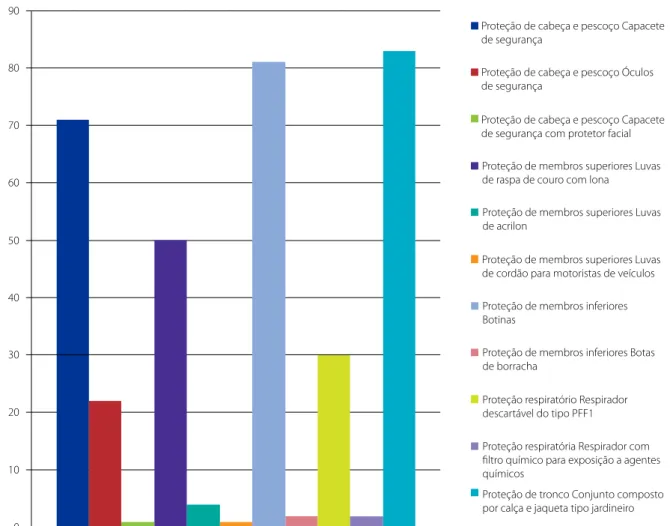
The use of personal protective equipment by port workers was observed during the performance of their activities. The respiratory mask was visualized in 32 obser-vations, the safety glasses in 22, and the gloves in 54 ob-servations. Other equipment is described in Figure 1. The
Table 1 - Profile of the active population of single port workers, according to work category. Maritime port of the south of Rio Grande do Sul, 2014.
Foreman n=%
Stowage n %
Cargo checkers n %
Cargo repairmen n %
Ship watchmen n %
Block workers n % Marital
status Single 185 26.6 83 11.9 7 1.0 2 0.3 6 0.9 6 0.8
Married 170 24.5 129 18.6 31 4.5 4 0.6 14 2.0 4 0.5
Separated 16 4.2 16 2.3 4 0.6 0 0 1 0.1 0 0
Widower 10 2.6 3 0.4 3 0.4 0 0 1 0.1 0 0
Skin
color White 299 43.0 187 26.9 45 6.5 3 0.4 19 2.7 8 1.2
Black 60 8.6 33 4.7 0 0 3 0.4 2 0.3 2 0.3
Dark-skinned 22 3.2 11 1.6 0 0 0 0 1 0.1 0 0
Total SPW N 381 231 45 6 22 10
Proteção de cabeça e pescoço Capacete de segurança
Proteção de cabeça e pescoço Óculos de segurança
Proteção de cabeça e pescoço Capacete de segurança com protetor facial
Proteção de membros superiores Luvas de raspa de couro com lona
Proteção de membros superiores Luvas de acrilon
Proteção de membros superiores Luvas de cordão para motoristas de veículos
Proteção de membros inferiores Botinas
Proteção de membros inferiores Botas de borracha
Proteção respiratório Respirador descartável do tipo PFF1
Proteção respiratória Respirador com
filtro químico para exposição a agentes químicos
Proteção de tronco Conjunto composto por calça e jaqueta tipo jardineiro 90
80
70
60
50
40
30
20
10
0
Figure 1 –Personal protective equipment used by individual port workers and visualized during observation. Maritime
port of the south of Rio Grande do Sul, 2014
Source: Research data, 2014.
average time of use of individual respiratory protection equipment was 100.1 minutes (SD ± 58.4).
The chi-square test was performed in order to verify the relationship between the use of respiratory protec-tion (respiratory mask with PFF1 respirator, welding mask and goggles) during the port work and the results of the chest X-ray examinations (p=0.239) and spirometry ( p=0.232), indicating no significant relationship between the variables.
At the chest x-ray examination, 65 (98.4%) workers sho-wed results within normal limits. One worker (1.5%) pre-sented abnormal radiological findings indicated by altered pulmonary hyperinflation. At the spirometry examination, the majority of workers presented spirometry within nor-mality (90%). One (1.5%) ventilatory disorder with mild restriction, and five (7.6%) were diagnosed with respiratory restriction with moderate restraint.
As to exposure to fertilizers during the port work, 19 workers (28.7%) directly handled Urea when observed, five (7.5%) with DAP, four (6.0%) with granulated NH3, two (3,0%) with MAP, two (3.0%) with pink KCl, and one (1.5%) with MAP-DAP. Regarding smoking, of the seven SPW who had any respiratory changes, four were smokers. Further details about workers who had some change in the respi-ratory system are in Table 2.
DISCUSSION
The functional capacity of the lungs is predominantly linked to its main function of continuously performing ga-seous exchanges between inspired air and blood from the pulmonary circulation, providing oxygen and removing carbon dioxide (CO2)(9). The results of the present study
allowed to visualize the occupational exposure of the port worker to substances that may be contributing to the oc-currence of respiratory system alterations, such as pulmo-nary hyperinflation, which is a mechanism that limits the airflow, mainly among individuals with Obstructive Pulmo-nary Chronic Disease (OPCD)(10).
These conditions may be related to the presence of PM due to the movement of cargoes in the port environment. Urea (NH4), MAP (NH4H2PO4) and DAP (NH4) 2HPO4), the main fertilizers transported in the port under study, when exposed to certain conditions such as humidity and heat release their main substance, ammonia, and it reacts in the atmosphere with sulfur oxides, forming ammonium sul-phate that reaches the soil with rain, causing acidification, which can cause irritation in the nose, throat and eyes(11).
Exposure to NH3 causes respiratory changes that cause coughing and sneezing, for example, in addition to gastroin-testinal changes due to ingestion, such as inflammation and ulceration/coagulation with necrosis of the gastrointestinal
mucosa. This can be potentiated and aggravated when dis-solved in water as it passes into a corrosive and hyperosmo-tic form, which may increase, for example, the risk of glauco-ma. Although not combustible, it may, when in contact with nitrates, present a risk of fire and explosion(12). Moreover, the
accumulation of fertilizers in the soil, when in contact with moisture and heat, favors the occurrence of its volatilization, thus eliminating the NH3 present in its composition, for the environment. When it is eliminated, it comes into contact with sulfur oxides, which are present in the atmosphere, and, when in high concentrations, also increase the concentra-tion of nitrate, which, in contact with blood, oxidizes the he-moglobin, making it difficult to transport oxygen to tissues and interfering with the alveolar hematose(13).
Port workers are daily exposed to the dust from the loa-ding of fertilizers, incluloa-ding the port environment with po-tential to cause health problems and respiratory diseases. NH3, the feedstock of the fertilizers mentioned above, is an important source of nutrition for living systems, being pro-duced mainly by the liver, transformed into glutamine (or urea), and eliminated by feces and urine. When this process does not happen in a harmonic way, either through an or-ganic failure or through occupational exposure, its accumu-lation can occur in regions such as the brain, affecting the neurotransmitters, hindering the brain function, and leading to an increase in the intracellular osmolarity, thus resulting in
Table 2 - Characterization of the observed workers who had alterations in the spirometry and chest X-ray, according to personal variables of exposure to substances such as fertilizers and smoking habits. Maritime port of the south of Rio Grande do Sul, 2014
SPW Age Working
time
Category
of work Exposure
Observed exposure
time
Spirometry result
Result of the
Chest X-ray Smoker
Urea Pink
KCl Map Dap
1 59 years
old 15 years Foreman No No No No - No change
Pulmonary
hyperinflation Yes
2 42 years
old 16 years Foreman No Yes No No 100 min
Moderate
restraint No change No
3 65 years
old 16 years Foreman Yes No No No 135 min
Moderate
restraint No change Yes
4 58 years
old 16 years Stowage No No No No
-Light
restraint No change No
5 56 years
old 16 years Foreman No No No No
-Moderate
restraint No change Yes
6 57 years
old 16 years Foreman No No Yes No 120 min
Moderate
restraint No change Yes
7 49 years
old 17 years Foreman No No No No
-Moderate
cerebral vasodilation(14). This was also identified in a
hairdres-sing study conducted in Palestine, in which sputum blood samples were collected, showing an increase in the level of neutrophil count and a high level of nitric oxide when expo-sed to levels of 3 to 61 mg of NH3(15).
Over time, NH3 has its potential damages, and the port worker has high averages of working time (over 15 years), which strengthens the aspects discussed above. This is in line with a publication by the Health Protection Agency, in which they point out that the adverse effects of ammonia depend on factors such as duration and form of exposure. Being that the exposure to low levels of ammonia can cause eye, nose and ear irritation, and at higher levels it can cause burns and swelling in the airways and lung damage and death(16).
According to a report based on the database of Ha-zardous Substances Emergency Events Surveillance of the department of public health in nine states, ammonia was identified as one of the top five chemicals that caused he-alth changes such as irritation and severe skin, mouth, thro-at, lungs, and eye burns. Going against another study, whi-ch indicated that high levels of oxygen free radicals (OFR) in the airway induce the inflammation of proteases, which may lead to the development of DPOC(17).
These conditions alter the worker’s organic health, which added to age, working time, exposure to substan-ces such as fertilizers and non-use of personal protective equipment, make the worker more susceptible to develop respiratory system changes. A study that evaluated 413 workers from four fertilizer industries of a maritime port in southern Brazil, exposed to the work of acidification of the phosphate rock identified respiratory symptoms such as cough in 93 (30.5%) of them, chronic cough in 45 (14.7%), chronic bronchitis in 26 (8.5%), rhinitis in 132 (43.3%), and conjunctivitis in 108 (35.4%) of the workers(18).
In this context, in addition to the very characteristic of the port environment, of having sources of exposure to he-alth, there is a prevalence of exhaustive service time. Thus, SPW also have a labor overload, which is a potentiator for changes in organic health, since there is an important phy-siological demand that can make them more or less sus-ceptible. According to a study carried out in a maritime port with 232 SPW, it showed that the workers that deve-lop their activities in the quay (predominant place of work of the SPW of the present study) showed a 69% increase in the prevalence of high levels of workload(19).
In this context, another study carried out with SPW from a maritime port in southern Brazil found that 25.4% were smokers, and 91.4% of the workers reported knowing colleagues who worked under the influence of illicit dru-gs(20). It is thus understood that there is a need to
deve-lop health actions and strategies geared to the profile of
the SPW, since in addition to the very characteristic of port work, there are habits and attitudes that favor the physio-logical changes in worker health.
In order to detect respiratory changes, the chest radio-graphy and the spirometry are considered as efficient exa-ms, although the spirometry may lack sensitivity to detect changes in its initial phase. In this way, harmful exposure makes the use of IPE inherent by workers, however, through the data it can be verified that half of the observed workers did not wear a respiratory protection mask or safety glasses. More than half of them wore gloves. Although the respira-tory protection is performed mainly by respirarespira-tory masks, identifying the use of other personal protective equipment shows a positive behavior, to avoid the effect of the subs-tances present in the port activities, that can be absorbed by other forms of contact, not only through the respiratory.
It is possible to observe that the nursing action in this work context should involve the intervention to the cor-rect use and adequate adaptation to the individual protec-tion equipment, in view of these being one of the main preventive measures to help in the minimization of the occurrence of respiratory system alterations, that are rela-ted to work. In addition, it should be highlight the use of clinical diagnoses exams as instruments for the design of the professional action, as they allow the follow-up of the continuity of care before the diagnosis obtained, as well as it facilitates the collection of clinical information for actions regarding the health of the port worker.
CONCLUSION
Regarding the first objective of identifying alterations in the respiratory system in port workers through radiogra-phic and pulmonary function tests, it can be said that the port environment has the potential to develop alterations in the respiratory health of single port workers. Exposure to fertilizers may be related to altered respiratory functions, since the statistical analysis showed a correlation between the working time and the spirometry results.
Regarding the second objective of identifying the use of personal protective equipment during port activities, it can be said that the use of most equipment was observed, which is a positive behavior, but it should be strengthe-ned and intensified as a tool to protect the health of port workers. Thus, nursing, through educational actions and clinical protocols aimed at the respiratory system, should be based on the socio-environmental context in which the worker is inserted, acting jointly with managers, workers and health and occupational safety staff.
per-sonal protective equipment, during port activities, changes in the respiratory system in dock workers, the third objec-tive of the study, the variables age, working time and spi-rometry results, found a positive correlation, pointing out that the longer the working time, the worse the result of the spirometry. In relation to the variable exposure to fertilizers and the results of the chest x-ray and spirometry tests, there was no significant relationship between the variables. It is understood, therefore, that the results indicate a small num-ber of workers, and no generalizations are possible, and it is necessary and important to study more about the port work in the specificity of single port workers.
Among the limitations of the study, we can mention its design, which does not allow the presentation of streng-thened links between exposure and changes in the res-piratory system, however, it induces borderline evidence, which instigates other researches, with other designs.
REFERENCES
1. Ministério da Saúde (BR). Organização Pan-Americana da Saúde. Doenças rela-cionadas ao trabalho: manual de procedimentos para os serviços de saúde. Brasília (DF): Ministério da Saúde; 2001 [citado 2017 mar 20]. Disponível em: http:// bvsms.saude.gov.br/bvs/publicacoes/doencas_relacionadas_trabalho1.pdf. 2. Presidência da República (BR). Lei nº 12.815, de 5 de junho de 2013. Dispõe
sobre a exploração direta e indireta pela União de portos e instalações portuárias e sobre as atividades desempenhadas pelos operadores portuários; altera as Leis nos 5.025, de 10 de junho de 1966, 10.233, de 5 de junho de 2001, 10.683, de 28 de maio de 2003, 9.719, de 27 de novembro de 1998, e 8.213, de 24 de julho de 1991; revoga as Leis nos 8.630, de 25 de fevereiro de 1993, e 11.610, de 12 de dezembro de 2007, e dispositivos das Leis nos 11.314, de 3 de julho de 2006, e 11.518, de 5 de setembro de 2007; e dá outras providências. Brasília (DF); 2011 [citado 2017 mar 25]. Disponível em: http://www.planalto.gov.br/ ccivil_03/_ato2011-2014/2013/Lei/L12815.htm.
3. ogmo-rg.com.br [Internet]. Rio Grande: Órgão Gestor de Mão de Obra do Tra-balho Portuário Avulso do Porto Organizado do Rio Grande; c2017 [citado 2017 mar 27]. Disponível em: http://www.ogmo-rg.com.br/sesstp.html.
4. Valavanidis A, Vlachogianni T, Fiotakis K, Loridas S. Pulmonary oxidative stress, inflammation and cancer: respirable particulate matter, fibrous dusts and ozone as major causes of lung carcinogenesis through reactive oxygen species mecha-nisms. Int J Environ Res Public Health. 2013[cited 2017 Mar 26];10(9):3886-907. Available from: http://www.mdpi.com/1660-4601/10/9/3886. 5. Norskov J, Chen J, Miranda R, Fitzdimmons T, Stack R. Sustainable ammonia
synthesis: exploring the scientific challenges associated with discovering alter-native, sustainable processes for ammonia production. Washington, DC: United States Department of Energy Office of Science; 2016 [cited 2017 Mar 28]. Avail-able from: https://www.osti.gov/scitech/servlets/purl/1283146.
6. Ministério da Saúde (BR). Secretaria de Atenção à Saúde. Departamento de Ações Programáticas Estratégicas. Pneumoconioses. Brasília (DF): Ministério da Saúde; 2006 [citado 2017 mar 15]. Disponível em: http://bvsms.saude.gov.br/ bvs/publicacoes/06_0443_M.pdf.
7. Almeida MCV, Cezar-Vaz MR, Rocha LP, Cardoso LS. Dock worker: profile of oc-cupational diseases diagnosed in an ococ-cupational health service. 2012 [cited 2017 Jun 10];25(2): 270-6. Available from: http://www.scielo.br/pdf/ape/ v25n2/en_a18v25n2.pdf.
8. Gelati TR. Alterações da função respiratória em trabalhadores portuários e a ex-posição a fontes de riscos ocupacionais [dissertação]. Rio Grande (RS): Programa de Pós-graduação em Enfermagem, Universidade Federal do Rio Grande; 2015. 9. Mendes R. Patologia do trabalho. 2. ed. São Paulo: Atheneu; 2005. v. 2. 10. Zhao Y, Shusterman D. Occupational rhinitis and other work-related upper
respiratory tract conditions. Clin Chest Med. 2012 [cited 2017 Mar 28];33(4): 637-47. Available from: http://www.sciencedirect.com/science/article/pii/ S0272523112001013?via%3Dihub.
11. Rocha FR, Bruggemann AKV, Francisco DS, Medeiros CS, Rosal D, Paulin E. Relação da mobilidade diafragmática com função pulmonar, força muscular respiratória, dispneia e atividade física de vida diária em pacientes com DPOC. J Bras Pneumol. 2017 [citado 2017 mar 27];43(1):32-7. Disponível em: http:// jornaldepneumologia.com.br/detalhe_artigo.asp?id=2635.
12. Public Health England (UK). Ammonia: general information. London: PHE; 2016 [cited 2017 Jun 10]. Available from: https://www.gov.uk/government/uploads/system/ uploads/attachment_data/file/561050/ammonia_general_information.pdf. 13. Yara [Internet]. York: Yara; c2017 [cited 2017 Mar 27]; Yara’s various production
process: Nitrogen [approx. 3 screens]. Available from: http://yara.com/about/ production_sites/production_process_story/production_processes/. 14. International Fertilizer Industry Association (FR), United Nations Environment
Pro-gramme (FR). O uso de fertilizantes minerais e o meio ambiente. Associação Nacion-al para Difusão de Adubos [tadutor]. Paris; 2000 [citado 2017 mar 28]. Disponível em: http://www.anda.org.br/multimidia/fertilizantes_meio_ambiente.pdf. 15. Nemer M, Kristensen K. Nijem E, Bjertness M. Skogstad; Respiratory function
and chemical exposures among female hairdressers in Palestine. Occup Med (Lond). 2013[cited 2017 Mar 27];63(1):73-6. Available from: https://academic. oup.com/occmed/article-lookup/doi/10.1093/occmed/kqs190.
16. Nemer M, Kristensen P, Nijem K, Bjertness E, Skare O, Skogstad M. Lung function and respiratory symptoms among female hairdressers in Palestine: a 5-year prospective study. 2015. [cited 2017 Mar 28];5(10):e007857. Available from: https://www.duo.uio.no/bitstream/handle/10852/47612/BMJ%2BOpen-2015-Nemer-.pdf?sequence=2.
17. Ayana R, Anderson MPH. Top five chemicals resulting in injuries from acute chem-ical Incidents — Hazardous Substances Emergency Events Surveillance, Nine States, 1999-2008. MMWR Surveill Summ 2015; [cited 2017 Mar 28];64(2):39-46. Available from: https://www.cdc.gov/mmwr/pdf/ss/ss6402.pdf
18. Ayana R, Anderson MPH, Wu J. Top five industries resulting in injuries from acute chemical incidents — Hazardous Substance Emergency Events Surveillance, Nine States, 1999-2008. MMWR Surveill Summ 2015 [cited 2017 Mar 27];64(2):47-53. Available from: https://www.cdc.gov/mmwr/pdf/ss/ss6402.pdf
19. Huttner MD, Moreira JS. Avaliação ambiental e epidemiológica do trabalhador da indústria de fertilizantes de Rio Grande, RS. J Pneumologia. 2000 [citado 2017 mar 29];26(5):245-53. Disponível em: http://www.scielo.br/scielo. php?script=sci_arttext&pid=S0102-35862000000500005.
20. Cezar-Vaz MR, Bonow CA, Silva MRS, Farias FLR, Almeida MCV. The use of illegal drugs and infectious contagious diseases: knowledge and inter-vention among dockworkers. Int J Environ Res Public Health. 2016 [cited 2017 Mar 29];13(1):125. Available from: http://www.mdpi.com/1660-4601/13/1/125.
Corresponding author:
Marta Regina Cezar-Vaz E-mail: [email protected]