Vol. 34, No. 03, pp. 841 – 850, July – September, 2017 dx.doi.org/10.1590/0104-6632.20170343s20150279
* To whom correspondence should be addressed
MULTI-OBJECTIVE OPTIMIZATION OF
SUPERCRITICAL WATER GASIFICATION OF
LEFTOVER BRAZILIAN GINSENG ROOTS AFTER
PHYTOCHEMICAL RECOVERY STEPS
J. Q. Albarelli
1, A. Mian
2, D. T. Santos
1*, A. V. Ensinas
2,
F. Maréchal
2and M. A. A. Meireles
11 LASEFI/DEA/FEA, School of Food Engineering, University of Campinas. Cidade Universitária “Zeferino Vaz”,
Rua Monteiro Lobato, 80, 13083-862, Campinas, SP, Brazil
*E-mail: [email protected]; Phone: +55 19 3521 0100; Fax: +55 19 3521 4027
2 Industrial Process and Energy Systems Engineering (IPESE), École Polytechnique Fédérale de Lausanne (EPFL),
Station 9, 1015, Lausanne, Switzerland
(
Submitted: April 30, 2015; Revised: April 29, 2016; Accepted: April 30, 2016)Abstract – The present study aims at studying the supercritical water gasification (SCWG) of leftover Brazilian ginseng roots after phytochemicals extraction for synthetic natural gas (SNG) production, envisioning the development of a promising Brazilian ginseng roots valorization using sub/supercritical fluids in different steps. A multi-objective energetic-economic-environmental optimization of the proposed SCWG process was assessed through the use of computational simulation tools. The results showed that, for a given leftover biomass input of 20MW, a specific cost of 62-66 USD/MWh of SNG is obtained, which is higher than the average price on the Brazilian market. On the other hand, the production process of SNG from this residue showed to be a promising option, being energetically self-sufficient and environmentally friendly. In order for this alternative process to become more economically attractive we proposed the construction of the SCWG and the sub/supercritical extraction units in the same location, sharing part of the same high-pressure equipment.
Keywords: Hydrothermal Gasification, Pfaffia glomerata, Biorefinering, Biomass Valorization, Computational
Simulation.
INTRODUCTION
During recent years, the interest on biomass utilization
for power generation has increased since it has significant environmental benefits. It is an abundant resource that
could provide renewable energy with low SO2 and CO2 emissions, contributing positively to limit the greenhouse
effect. Gasification combined with a gas engine or gas
turbine has the advantage of having a higher electric
efficiency and lower electricity production costs than direct combustion (Bridgewater, 1995). In addition, different
types of liquid fuels can be synthesized from the produced synthetic natural gas (SNG), such as Fischer-Tropsch crude fuel, dimethyl ether and methanol, to generate renewable fuels to substitute fossil fuels, especially in the transportation sector which is responsible for a large part of the global CO2 emissions.
of Chemical
J. Q. Albarelli, A. Mian, D. T. Santos, A. V. Ensinas, F. Maréchal and M. A. A. Meireles 842
Different gasification technologies have been studied for
biomass conversion, including the use of the supercritical
water gasification (SCWG) process. Sometimes referred to as hydrothermal gasification, SCWG benefits from the
special properties of near-supercritical and supercritical water as solvent and reactant, respectively. This process is performed at conditions near or above the critical point of water: 647 K (374 °C) and 22.1 MPa. This technology achieves high conversions and avoids energy-intensive biomass-drying processes, which are required in
conventional gasification technologies, allowing its direct
use for wet biomasses (Kruse, 2009; Zöhrer and Vogel, 2013).
This work is a part of a project that aims at providing
routes to valorize the Brazilian ginseng plant. Recently, scientists have shown great interest in Brazilian ginseng
(Pfaffia glomerata) roots, due to the pharmaceutical
properties of the roots attributed to the β-ecdysone content demonstrating similar effects to Panax ginseng (Zimmer
et al., 2006). In addition, other important compounds
have been identified and could be also recovered with a
subsequent extraction process. Our research group has demonstrated that pressurized ethanol, with or without the addition of CO2, can successfully be applied as solvent for
extracting selectively β-ecdysone from P. glomerata roots (Leal et al., 2010; Santos et al., 2014). On the other hand, a recent patent developed by us described that water can be used as extracting solvent for obtaining a saponin-rich extract that can be used directly as surfactant (Meireles et al., 2013). So, a two-step process using pressurized ethanol with or without the addition of CO2 at sub/supercritical
state in the first extraction step and subcritical water in
the second seems very promising. Since the wet residue from this two-step extraction process normally constitutes a high proportion of the inlet ginseng, the valorization of this residue can be the key factor to increase economic attractiveness of the proposed extraction process. Since in
supercritical water gasification (SCWG) biomass does not
need to be dried, using this wet residue is one alternative route that should be analyzed.
Fuel production systems involve a large number and various types of interactions with the world outside their physical boundaries. The process designer must, therefore, face many issues, which deal primarily with the energetic, economic and environmental aspects of the system. In
general, objectives involved in the design optimization process are: energetic (e.g., maximum energy efficiency,
minimum fuel consumption, minimum irreversibility and so on), economic (e.g., minimum cost per unit of time,
maximum profit per unit of production) and environmental
(e.g., limited emissions, minimum environmental
impact). The multi-objective optimization of a process represents a paradigmatic application of a single objective optimization, since it suffers from the difficulty to find a final global optimum. The mathematical approaches are
generally unsuccessful in finding the global optimum and
most of them terminate at local optima in the multi-modal optimization problem. In this context, the present study aims at evaluating the SCWG of leftover Brazilian ginseng roots after phytochemicals recovery for SNG production by computational simulation through the use of a
multi-objective energetic-economic-environmental optimization
for the SCWG process, envisioning the development of a novel Brazilian ginseng roots valorization using sub/
supercritical fluids during all the plant material processing.
MATERIAL AND METHODS
Description of the proposed valorization route for Brazilian ginseng roots
In the present study, the production of synthetic natural gas (SNG) from leftover Brazilian ginseng roots after phytochemical recovery through supercritical
water gasification (SCWG) was evaluated. A simplified
representation of the SCWG process is presented in Figure 1. This process was experimentally validated using
a demonstration plant (maximum flow rate of 1 kg/h),
which was described by Waldner (2007) for the continuous SCWG of wet biomasses built at the Paul Scherrer Institute in Switzerland. The key independent variables of the process are related to the operating pressure, which was set at 30 MPa for this study, and the maximum temperature to
be achieved in the salt separation step, which highly affects
the utility integration problem.
An inlet mass flow of 20MW presenting a solid
concentration of 20% is used. The considered elementary composition of the residue in the analyses is shown in Table 1. The elementary composition was measured experimentally using a isoperibolic bomb calorimeter, analyzing the leftover Brazilian ginseng (Pfaffia glomerata) roots after two semi-continuous sequential phytochemical recovery processes, i.e., employing pressurized ethanol with addition of CO2 (10:90 %, w/w, ethanol:CO2) in the
supercritical state (20 MPa and 303 K) in the first extraction
step and distilled pressurized water in a subcritical state (12 MPa and 353 K) in the second.
The first step in the SCWG process is the waste slurry
compression to 30 MPa and heating to near the critical conditions of 623-653 K. In this step, the hydrolysis of the organic matter occurs, and the salts in the waste slurry can be separated when the solution is heated above the pseudo-critical point (Gassner and Maréchal, 2009). To avoid incrustations and damage to the equipment, the salts
are separated in a cyclone preview that enters the gasifier. The liquid hydrolysate is sent to a fixed bed of a nickel-
or ruthenium-based catalyst, which converts 99.9% of the organic matter into CH4, CO2 and H2 with traces of
CO. After the gasification, a product separation unit is
Figure 1. Block diagram of the supercritical water gasifi cation (SCWG) process to produce synthetic natural gas (SNG) and electricity from
the leftover ginseng
Table 1. Experimentally determined elementary composition of the leftover Brazilian ginseng (Pfaffi a glomerata) roots after the considered two sequential phytochemical recovery processes (on a dry basis)
Composition (%)
Carbon 44.6
Hydrogen 6.2
Oxygen 48.0
Nitrogen 1.0
Sulphur 0.2
the required purity of 96 mol% by the natural gas grid. A high-pressure water absorption column coupled with a
membrane is analyzed for the fi nal CO2 removal. The fi nal
obtained product is grid quality SNG with methane content of 96% v/v and pressure of 7 MPa. A steam-based cycle cogeneration system was considered to supply heat and power to the process. Live steam at 793 K and 9 MPa and condensing extraction steam turbines are simulated, and the entire system is integrated with the process design when the heat cascade problem is solved. For the cogeneration unit, the waste gases from the SCWG gas cleaning system were considered as fuel. When extra thermal energy was
required, a post-oxidation steam-injected gas turbine that
operated with crude SNG was considered (Figure 1). Computational optimization methodology
The basic concept of the developed simulation model is the decomposition of the problem into several parts. First, the SCWG process described in the previous section
is simulated in commercial fl owsheet software: Belsim
Vali (Belsim Vali, 2013). The model determines the species conversion and calculates the associated heat and power balances. A detailed description of the considered
model was published by Gassner et al. (2011). Then, an energetic-economic-environmental model is constructed in the OSMOSE platform (OSMOSE, 2013). OSMOSE
(OptimiSation Multi-Objectifs de Systemes Energetiques integres, which means “Multi-Objective OptimiZation of
integrated Energy Systems”) is a computational platform that was built in Matlab (Mathworks, 2013), developed and continuously improved at École Polytechnique Fédérale de Lausanne in Switzerland for the design and analysis of integrated energy systems. The platform allows one to link several commercial softwares such as Belsim Vali and Aspen Plus for a complete suite of computation and result analysis tools (optimization, sensitivity analysis, Pareto curve analysis, etc.).
The energetic-economic-environmental model is constructed as follows:
Energetic model: uses the heat and cooling streams simulated in the Belsim Vali model to enable heat integration
of the thermal fl uxes using the pinch analysis methodology (Linnhoff , 1982). The minimum energy requirement is
computed from the hot and cold process streams using the heat cascade method, which accounts for the potential heat recovery. The potential fuels are assembled in a
superstructure, which integrates diff erent possibilities and
computes the optimal solution by minimizing the operating cost using a linear programming model (Molyneaux et al., 2010). The optimal thermal process integration is computed in the OSMOSE platform after the maximum heat recovery
potential between hot and cold streams is defi ned.
Economic model: uses the mass streams simulated in the Belsim Vali model and the solution found in the
J. Q. Albarelli, A. Mian, D. T. Santos, A. V. Ensinas, F. Maréchal and M. A. A. Meireles 844
correlations from the literature (Turton, 2009; Ulrich and Vasudevan, 2003). The total investment cost is calculated using multiplication factors to consider indirect expenses such as labor, transportation, fees, contingencies and auxiliary facilities. The operating costs consider the cost of labor, maintenance (5% of the total investment), the main raw materials and electricity (when necessary). The production cost is the sum of the operating cost and the depreciation cost, which is the total investment cost
annualized. The Marshall & Swift coefficient (Marshall &
Swift Equipment Cost Index, 2013) was used to update the cost data to the year 2013 from the values in the reference literature. The main economic assumptions in the economic analysis are shown in Table 2.
Environmental model: uses the mass streams simulated in the Belsim Vali model and equipment sized in the economical model to calculate the environmental impact using the impact data developed by the IPCC (Intergovernmental Panel on Climate Change), which considers a time horizon of 100 years for the GWP (global warming potential). The environmental performance indicators in this methodology are calculated while solving the optimal design problem according to Gerber (Gerber,
2012). In this context, a LCA model is defined to consider
the impact contributions from the involved material
and the energy flows during the operation phases and environmental effects related to the construction, operation
and end of life of the process equipment. For the LCA, the emission contribution for the IPCC07 (Intergovernmental Panel on Climate Change 07) impact assessment method was considered and reported in terms of GWP 100 as the environmental performance indicator (Ecoinvent centre, 2013).
The proposed SCWG process was evaluated by
performing a multi-objective optimization using an
evolutionary algorithm (Molyneaux et al., 2010; Gassner and Maréchal, 2009) using the OSMOSE platform.
The considered multi-objective optimization
methodology, which was presented in detail by Gassner and Maréchal (2009), applies a two-step approach to overcome the complexity of the design problem, which falls in the category of Mixed-Integer Non-Linear Problems (MINLP). The optimization algorithm consists of a bi-level optimization. The so-called “master optimization” uses a genetic evolutionary algorithm to address variables that concern the unit size (real variables) and unit use (integer variables). The optimization sub-problem considers the linearized costs and is used to assure the maximum energy recovery potential and minimal environmental impact
among process streams. The optimal process configurations
that result from this methodology are available in the
Pareto curve, which allows displaying the trade-off of the best solutions with respect to the considered objective functions. The set of points identifies the bounds of the
feasibility region and the non-feasibility region (all the
region where the value of the objectives are lower (in case
of minimization) or higher (in case of maximization) than the Pareto points.
The objectives defined for the multi-objective
analysis were: (i) SNG production; (ii) annual cost; (iii)
environmental impact. The calculation of each objective
is described in detail in the following section “Process
performance indicators”. The multi-objective optimization
problem aimed at maximizing the SNG production, minimizing the annual costs and environmental impact. To reduce the computation time, which may limit the initial population and number of evaluations that must be performed by the optimizer, the number of variables must be accurately selected. The decision variables that are
Table 2. Economic assumption used in the analysis
Data Value
Economic data
Project lifetime 25 years
Construction and startup 2 years
Depreciation 10 years
Interest rate 15 % year
Marshall and Swift index 1530
Days worked in a year 90 % days/year
Table 3. Assumed variables for the multi-objective optimization problem
Process Unit Parameter Value Units
SCWG: salt separation unit
Maximum temperature [743 853] K
ΔTss int [20 40] K
ΔTss bottom [20 40] K
ΔTss top [20 40] K
SCWG: gasifier unit Gasifier pressure [22 30] MPa
Gasification temperature [623 673] K
Heat recovery steam cycle Pressure level [2 7] MPa
considered in this study are reported in Table 3. An initial population of 100 cases was selected, and 2500 maximum evaluations were set as stopping criteria.
Process performance indicators
To estimate the conversion potential of different SCWG plant configurations three main performance indicators are
defined:
(i) SNG production: was estimated by the model developed
with the commercial flowsheet software: Belsim Vali
(Belsim Vali, 2013)
(ii) Annual cost: was defined as the operational cost (Eq. 1)
plus the annualized investment (Eq. 2), considering that the process operates 90% of the days/year.
y electricit cost material raw cost e maintenanc cost labor cost cost l
Operationa = + + +
where i is the annual interest rate and n is the project
lifetime in years.
(iii) Environmental impact: the environmental impact life cycle analysis (LCA) method was employed. The emission contribution for the IPCC07 impact assessment method was considered and reported in terms of GWP 100.
The economic performance of the proposed SCWG process was evaluated in terms of the total investment (Eq. 3) costs and break-even price of product (Eq. 5) that would
make the technology profitable.
(
equipment cost)
.fminvestment
Total =
∑
where fm is the multiplication factor to consider indirect expenses such as labor, transportation, fees, contingencies and auxiliary facilities.
production SNG investment Annualized t cos l Operationa cost
Production = +
Break-even price = selling price - production cost = 0
The energy efficiency (Eq. 6) was also calculated to
evaluate the process.
∑
∑
• • • •+
×
+
×
=
η
consumed inlet inlet produced products products eE
m
LHV
E
m
LHV
)
(
)
(
where LHV is the low heating value of the flow,
m
• is themass flow, and
E
• is the net electricity balance.RESULTS AND DISCUSSION
The multi-objective optimization problem developed in this study aimed at finding the trade-off of the three selected conflicting objective functions, which minimizes
the annual cost and environmental impact and maximizes the synthetic natural gas (SNG) production from leftover
Brazilian ginseng roots by a supercritical water gasification
(SCWG) process after phytochemical recovery via sub/ supercritical-based processes. The results of the
multi-objective energetic-economic-environmental problem are
depicted in Figure 2 in terms of the Pareto curve.
Each Pareto point represents an optimized configuration
design for the SCWG process, which produces SNG. The decision variables that correspond to the optimized plant
configurations of three selected Pareto points (Figure 2) are reported in Table 4. The more relevant energy flows and the related conversion efficiency are reported in Table 5 for
three Pareto points.
The results of the optimization presented in the Pareto frontier (Figure 2) show that, for the same biomass input of 20MW, the SNG production varies between 9.6 and 11.6 MW while the total yearly cost increases from 4.7 and 6.1
MUSD, which gives a specific cost of 62-66 USD/MWh
of SNG. The curve trend shows that the increase in the
efficiency reduces environmental impact due to the fact
that the production of a renewable SNG is considered, replacing the same amount of fossil natural gas from the grid. The environmental impact is negative for all the optimum values presented in the Pareto curve and
decreases even more with the increase of the efficiency,
while requiring more investment.
As observed in Table 4, an increase in the gasifier
pressure leads to higher biomass-to-biofuel conversion due to the reduction on the amount of crude SNG that must be burned to close the thermal energy balance of the plant. The increase in the SNG production by increasing the temperature in the salt separation unit and increasing
the pressure in the gasifier results in an increase in the
( )
( )
1 11 Cost Investment Total investment Annualized − + + × ×
= n n
J. Q. Albarelli, A. Mian, D. T. Santos, A. V. Ensinas, F. Maréchal and M. A. A. Meireles 846
Table 4. Decision variables of three selected optimized supercritical water gasifi cation plant confi gurations
Pareto Point A Pareto Point B Pareto Point C Unit
Results
Environmental impact -0.0189 -0.0205 -0.0227 kgCO2/kWhBM
SNG produced 9.62 10.42 11.60 MW
Annual cost 4.71 5.16 6.07 MUSD*
Variables
Maximum temperature 799.34 830.92 833.15 K
ΔTss int 37.90 33.86 35.80 K
ΔTss bottom 33.73 38.59 38.11 K
ΔTss top 34.42 34.69 33.77 K
Gasifi er pressure 22.00 24.72 30.00 MPa
Gasifi cation temperature 635.86 623.15 623.15 K
Pressure level 4.67 4.82 4.73 MPa
Super-heating ΔT 62.32 79.60 53.07 K
* Million US dollar
Table 5. Main results of three selected optimized supercritical water gasifi cation plant confi gurations
Pareto Point A Pareto Point B Pareto Point C Unit
Power Input
Leftover ginseng input power 20 20 20 [MW]
Power Output
SNG output power 9.6 10.4 11.6 [MW]
Effi ciencies
Energy effi ciency 48.1 52.1 58.0 [%]
annual cost of the SCWG process and a decrease in the
environmental impact. The energy efficiency of the
SCWG process increases 20% from Pareto Point A to C, representing a better use of the wet leftover ginseng to product, but at the expense of a 29% increase in the costs. The environmental impact also decreases 20% from Point A to C, representing a higher reduction when higher SNG
is produced. The decision variables that most influence
the present results are the maximum temperature in the salt separator and the temperature and pressure levels of
the gasification reactor. The Pinch point of the evaluated process, i.e., the plant configuration when optimal
thermal process integration is achieved, increases with the increase in the temperature of the salt separator and, as a consequence, the amount of heat required above the Pinch Point, which is provided by burning part of the crude product, is reduced. During the optimization the
gasification temperature is driven to the lower bounds to
allow maximizing the energy recovery between the salt
separator output and gasification reactor input. The pressure level of the gasification step is increased, raising the power
generation from vapor/liquid expanders that are placed in
the separation phase. This affects the net electricity balance
of the process and, as a consequence, impact contribution
and profitability. In addition, high-pressure levels slightly
reduce the thermal energy demand of the SCWG process. The optimization of the steam cycle regarding the pressure levels and superheating temperature showed similar pressures, around 4.7 MPa, and superheating temperature for all Pareto points. It is important to highlight
that, for all evaluated configurations, no external fuel was
necessary to supply heat for the SCWG process, only low-quality product from the SNG production and a part of high-quality SNG (when necessary) were used to close the overall energy balance.
In the following sections, the energetic, economic and environmental performance indicators are presented to highlight the dependencies among these performance indicators and the comparison with literature data.
Energetic evaluation
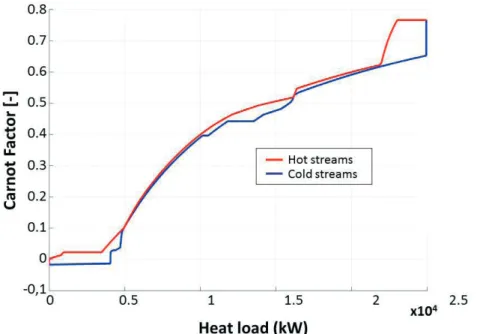
Thermal process integration for each optimized point of Figure 2 was performed. Figure 3 presents the exergy composite curves of optimized Pareto point B of the SCWG process. No external fuel was necessary at any evaluated point. It can be observed that the proposed SCWG process from leftover ginseng presented good thermal process integration by observing the reduction of the area between the hot and cold streams in the Carnot factor-heat load
diagram. This occurs because the difference in the thermal requirement temperature almost completely fulfills its energy demand by the cooling demand of the final step
of the SCWG process. The energy demand of the SCWG process after thermal process integration is supplied by
the cogeneration system using as fuel the waste gases, generated by the SNG cleaning system.
The set of utility streams that was activated during the optimization is included in the reported heat cascade curves (i.e., graphical representation of the overall heating and cooling demands in a process). Regarding the utility integration, it is interesting to show how the steam network
was fitted in the heat cascade curve by optimizing the
pressure level and steam superheating. The achieved results of this integration, which is calculated while optimizing the remaining hot and cold utilities, are reported in Figure 4. Steam superheating allows one to increase the mean thermodynamic temperature of the steam cycle, which
increases the steam network efficiency. The Pinch Point
activation is achieved in the obtained optimal solution.
Concerning the energy efficiency of this system
(48.1-58.0 %), similar results were found when considering
different biomasses in a SCWG process: algae 48 %
employing solar panel to electricity, (Mian et al., 2013a); algae 54%; (Mian et al., 2013b); sugarcane bagasse 43-49 % (Mian et al., 2014).
In the work of Mian et al. (2013a), considering also
a 20 MW biomass input at the gasification step, the use
of a solar system could increase the SNG production from
12 MW of SNG to 14 MW of SNG. This configuration
could also be analyzed considering the current proposed valorization route for Brazilian ginseng wet residue in order to diminish the crude product burning, but as already presented by Mian et al. (2013a) this technology would imply a much higher cost for the investment. Therefore, in the present analysis this option was not taken into consideration.
Economic evaluation
The economic evaluation is a challenging part of this
study mainly because of the difficulties in estimating the
costs of the SCWG plant at large scale. The literature
nonlinear cost function, which was considered to define
the capital expenses for the global plant, led to the Pareto curve depicted in Figure 2.
Production cost was calculated for the present study as 62-66 USD/MWh of SNG. This today represents a cost 2.1 to 2.2 times higher than the actual cost for natural gas in the Brazilian market (30 USD/MWh of SNG). Table 6 shows
the breakeven price for SNG using different wet biomass
sources. A reduction in breakeven price for SNG is possible
when considering the SNG production inside a biorefinery
J. Q. Albarelli, A. Mian, D. T. Santos, A. V. Ensinas, F. Maréchal and M. A. A. Meireles 848
Figure 3. Exergy composite curves of optimized Pareto point B of the SCWG process
Figure 4. Integration of the steam network with the supercritical water gasification process
Table 6. Breakeven price for synthetic natural gas (SNG) production through supercritical water gasification process using different wet
biomass sources
Biomass source SNG breakeven price
(USD/MWh) Reference
Algae 41-47 Mian et al. (2013b)
Sugarcane bagasse 56-82 Mian et al. (2014)
production process of SNG from the leftover ginseng co-located with the sequential sub/supercritical-based
extraction process unit inside a sugarcane biorefinery
producing ethanol, CO2, heat and electricity, which could
be directly used in these specific processes, avoiding the
need to buy these materials from outside. Besides, this
final approach would result in mutual benefits for each
production plant.
In addition, environmental benefits of the substitution
of fossil fuels should also be taken into account in a decision-making process for implementing this alternative
SNG production technology. A subsidiary benefit of this
process is the separation of the salts that can be further recycled as fertilizer for the growth of Brazilian ginseng roots.
Environmental effects
For the life cycle analysis (LCA), the emission contribution for the IPCC07 (Intergovernmental Panel on Climate Change 07) impact assessment method was considered and reported in terms of GWP 100 (global warming potential considering a time horizon of 100 years) as the environmental performance indicator. The impact is analyzed for the global warming potential of the leftover ginseng conversion into SNG, including materials for construction of the process equipment. It must be highlighted that the impact of the process equipment is not
so relevant in the final results, the operation of the system
being responsible for the real gain in the GWP reduction. It was considered that the biomass is produced locally; therefore, the impact of the feedstock logistics of a big plant is not an issue. The impact reduction increased with the increase in the SNG production. Impact reduction in the same range was found when wet algae was used as an input biomass (Mian et al., 2013b) on a same scale as the SCWG plant.
CONCLUSIONS
The multi-objective optimization procedure was useful
to identify the Pareto curve for an optimized supercritical
water gasification (SCWG) process for production of
synthetic natural gas (SNG) from wet leftover Brazilian ginseng roots after a two-step phytochemicals recovery
process, accounting for the three objective functions:
energy-economic-environmental. To that extent, it was
possible to identify the main decision variables affecting the set of optimal solutions and their influence on costs,
emissions and energy performances. The SCWG of wet leftover ginseng showed to be a promising technology with
energy efficiency above 50% for the biomass conversion
into biofuels, which is higher than most of the biomass conversion processes. Besides that, the possibility of fossil fuel substitution makes this conversion process
very attractive from the environmental point of view. The production cost can represent a barrier to the feasibility of this proposed route, but probably by analyzing the overall proposed Brazilian ginseng valorization route, including the two-step extraction process also using sub/supercritical
fluids, the attractiveness of this final step could increase.
ACKNOWLEDGMENTS
Juliana Q. Albarelli thanks FAPESP (processes 2013/18114-2 and 15/06954-1) for the post-doctoral fellowships. Diego T. Santos thanks FAPESP (processes 2010/16485-5 and 2012/19304-7) and CAPES for the post-doctoral fellowships. M. Angela A. Meireles thanks CNPq for the productivity grant (301301/2010-7). The
authors acknowledge the financial support from CNPq and
FAPESP (Processes 2009/17234-9; 2012/10685-8).
NOMENCLATURE
SCWG - SuperCritical Water Gasification
SNG - Synthetic Natural Gas
OSMOSE - OptimiSation Multi-Objectifs de Systemes
Energetiques integers LCA - Life Cycle Analysis
IPCC07 - Intergovernmental Panel on Climate Change 07 GWP 100 - Global Warming Potential considering a time horizon of 100 years
REFERENCES
Ahmad S., Linnhoff B. and Smith R. Cost optimum heat exchanger networks-2. Targets and design for detailed capital cost models. Computers and Chemical Engineering, 14, 757– 767 (1990).
Albarelli J.Q., Mian A., Santos D.T., Ensinas A.V., Maréchal F. and Meireles M.A.A. Valorization of sugarcane biorefinery residues using supercritical water gasification: case study and perspectives. Journal of Supercritical Fluids, 96, 133–143 (2015).
Belsim Vali. v. 4.7.0.0. Available from: www.belsim.com (2013). Bolliger R. Méthodologie de la synthèse des systèmes
énergétiques industriels. Ph.D. Thesis. École Polytechnique Fédérale de Lausanne (2010).
Bridgewater A.V. The technical and economic feasibility of biomass gasification for power generation. Fuel, 74, 631–653 (1995).
Ecoinvent centre. Implementation of Life Cycle Impact Assessment Methods. Ecoinventreport. St. Gallen, July 2010. Available from: http://www.ecoinvent.org/fileadmin/ documents/en/03_LCIA-Implementation-v2.2.pdf (2013). Gassner M. and Maréchal F. Methodology for the optimal
J. Q. Albarelli, A. Mian, D. T. Santos, A. V. Ensinas, F. Maréchal and M. A. A. Meireles 850
Gassner M., Vogel F., Heyen G. and Maréchal F. Optimal process design for the polygeneration of SNG, power and heat by hydrothermal gasification of waste biomass: Thermo-economic process modelling and integration, Energy & Environmental Science, 4, 1726-1741, (2011).
Gerber L. Integration of Life Cycle Assessment in the conceptual design of renewable energy conversion systems, Ph.D. Thesis. École Polytechnique Fédérale de Lausanne (2012). Kruse A. Hydrothermal biomass gasification. Journal of
Supercritical Fluids, 47, 391–399 (2009).
Leal P.F., Kfouri M.B., Alexandre F.C.,. Fagundes F.H.R, Prado J.M., Toyama M.H. and Meireles M.A.A. Brazilian ginseng extraction via LPSE and SFE: global yields, extraction kinetics, chemical composition and antioxidant activity. Journal of Supercritical Fluids, 54, 38–45 (2010).
Linnhoff B. User Guide on Process Integration for the Efficient Use of Energy, 1st ed. Rugby: IChemE, 1982.
Mathworks. v. R2012b. Available from: http://www.mathworks. com/products/matlab (2013).
Meireles M.A.A., Vardanega R. and Santos D.T. Processo de Obtenção de um Extrato a Partir de Pfaffia glomerata. Brazil. Patent number: BR1020130128961 (2013).
Mian A., Albarelli J.Q., Ensinas, AV. and Maréchal F. Integration of Supercritical Water Gasification in Combined 1G/2G Ethanol Production. Chemical Engineering Transactions, 39, 1795-1800 (2014).
Mian A., Ambrosetti G., Ensinas, AV. and Maréchal F. Optimal design of solar assisted hydrothermal gasification for microalgae to synthetic natural gas conversion. Chemical Engineering Transactions, v. 35, p.1009-1014 (2013a).
Mian A., Ensinas, AV. and Maréchal F. Multi-objective optimization of SNG production through hydrothermal gasification from microalgae. Computer Aided Chemical Engineering, 32, 337-342 (2013b).
Molyneaux A., Leyland G. and Favrat D. Environomic multi-objective optimisation of a district heating network considering centralized and decentralized heat pumps. Energy, 35, 751–758 (2010).
OSMOSE Platform: A tool for the design and analysis of integrated energy systems. 01 June 2013. Available from: http://leni.epfl.ch/osmose
Santos, D.T., Albarelli J.Q., Rostagno M.A., Ensinas, AV., Maréchal F. and Meireles M.A.A. New proposal for production of bioactive compounds by supercritical technology integrated to a sugarcane biorefinery. Clean Technology and Environmental Policy, 16, 1455-1468 (2014).
Turton, R. Analysis, synthesis, and design of chemical processes (3rd ed.) Prentice Hall, Upper Saddle River, 2009.
Ulrich, G. A guide to chemical engineering process design and economics a practical guide (2nd ed.), CRC, Boca Raton, 2003.
Waldner M.H. Catalytic hydrothermal gasification of biomass for the production of synthetic natural gas. . Ph.D. Thesis. Eidgenössische Technische Hochschule Zürich (2007). Zimmer A.R., Bruxel F., Bassani V.L. and Gosmann G. HPLC
method for the determination of ecdysterone in extractive solution from Pfaffia glomerata. Journal of Pharmaceutical and Biomedical Analysis, 40, 450–453 (2006).