Instrumental Development of Teachers’ Reasoning in
Dynamic Geometry
1 2Desenvolvimento Instrumental do Raciocínio dos Professores em Geometria Dinâmica Muteb M. Alqahtani3
Rutgers University, Newark-NJ, USA
Arthur B. Powell4
Rutgers University, Newark-NJ, USA
Abstract
To contribute to understanding how teachers can develop geometrical understanding, we report on the discursive development of teachers’ geometrical reasoning through ins-trument appropriation while collaborating in an online dynamic geometry environment (DGE). Using the theory of instrument-mediated activity, we analysis the discourse and DGE actions of a group of middle and high school mathematics teachers who participated in a semester-long, professional development course. Working in small teams, they colla-borated to solve geometric problems. Our results show that as teachers appropriate DGE artifacts and transform its components into instruments, they develop their geometrical knowledge and reasoning in dynamic geometry. Our study contributes to a broad unders-tanding of how teachers develop mathematical knowledge for teaching.
Keywords: Dynamic geometry, Instrumental genesis, Mathematical knowledge for
tea-ching, Collaboration.
Resumo
Com o intuito de contribuir para o entendimento de como os professores podem desen-volver a compreensão da geometria, este artigo trata do desenvolvimento discursivo do raciocínio geométrico dos professores através de apropriação de instrumentos enquanto colaborando em um ambiente de geometria dinâmica (AGD) online. Utilizando a teoria da atividade mediada por instrumentos, analisamos o discurso e as ações AGD de um grupo de professores de matemática do ensino fundamental e médio que participaram de um curso de desenvolvimento profissional com duração de um semestre. Trabalhando em pequenos grupos, eles interagiram para resolver problemas geométricos. Nossos resultados mostram que na medida em que se apropriam dos artefatos AGD e transformam seus componentes em instrumentos, os professores desenvolvem o conhecimento e raciocínio geométricos em geometria dinâmica. Nosso estudo contribui para uma compreensão ampla de como os professores desenvolvem o conhecimento matemático para o ensino.
Palavras-chave: Geometria dinâmica, Gênese instrumental, Conhecimento para o
ensi-no de matemática, Colaboração.
1 This paper is based upon work supported by the National Science Foundation, DRK-12 program, under award DRL-1118888. The findings and opinions reported are those of the authors and do not necessarily reflect the views of the funding agency.
2 A version of this article was presented at the 2015 Annual Meeting of the American Educational Research Associa-tion, 16-20 April 2015, in Chicago, Illinois, USA.
3 Rutgers University Graduate School of Education, New Jersey, USA. E-mail: [email protected] 4 Associate Professor of Mathematics Education in the Department of Urban Education at the Newark campus of
An important area of mathematics is Geometry. It supports understanding of concepts and procedures in other areas such as algebra, calculus, and analysis as well as forms of argumentation such as deductive reasoning and proof. It provides visual images alongside analytical representations of mathematical concepts, whi-ch promote students’ learning by emphasizing and suppressing aspects of concepts (Davis, 1992; Goldenberg, 1988; Piez & Voxman, 1997). Geometry’s vital role su-ggests that mathematics educators would do well to investigate how learners can develop deep geometrical understanding and what support teachers might provi-de. Teachers’ understanding of geometry is part of their subject matter knowledge (Ball, Thames, & Phelps, 2008; Herbst & Kosko, 2014; Hill, Rowan, & Ball, 2005; Hill, Schilling, & Ball, 2004; Shulman, 1986, 1987), which is significantly related to students’ achievement (Ball, Hill, & Bass, 2005; Campbell et al., 2014; Hill et al., 2005; Rowan, Chiang, & Miller, 1997). To contribute to understanding how teachers can develop geometrical understanding, we report on the development of teachers’ geometrical reasoning through instrument appropriation while collaborating in an online dynamic geometry environment (DGE). Our central guiding question is this: How do teachers evolve their geometrical reasoning through instrument appropria-tion in collaborative cyberlearning environment that includes DGE?
Theoretical perspective and literature review
To address our guiding research question, we recruit theoretical perspectives about teachers’ mathematical knowledge and instrument-mediated activity. Con-cerning teachers’ knowledge, we use the notion of mathematical knowledge for tea-ching (Ball et al., 2008; Hill et al., 2005; Hill et al., 2004). To understand teachers’ instrument appropriation, we employ Rabardel’s (2005) theory, instrument-me-diated activity, which generates several models to explain an artifact’s mediating role and instrumental development. The basic concept of the theory is that subjects (users, operators, learners,…) engage in an activity in which actions are performed upon an object (matter, reality, object of work,…) to meet a goal using an artifact (material or conceptual component). The artifact gains the status of instrument as subjects develop utilization schemes, including usage schemes and instrument-me-diated collective utilization schemes. For individuals, the usage scheme constitutes their basic knowledge of how to operate with the artifact, whereas the instrument--mediated collective utilization scheme is related to the actions that individuals perform collectively on an object such as a mathematical task to achieve specific goal (Lonchamp, 2012; Rabardel & Beguin, 2005).
Utilization schemes become part of individuals’ knowledge and allow them to use artifacts effectively. Given an artifact employed by teachers to accomplish a mathematical task and subsequently to reflect on pedagogical matters, we view the developed utilization schemes as part of their mathematical knowledge for teaching. Using Shulman’s (1986, 1987) categories, Hill, Ball, and Schilling (2008) divide this knowledge into two main knowledge domains: subject matter knowledge and peda-gogical content knowledge. In this study, we focus on the domain of subject matter knowledge. More particularly, we analyze one of the three knowledge subdivisions (common, specialized, and horizon), the “common content knowledge” of geometry that teachers develop in a collaborative, cyberlearning environment.
Researchers have examined teachers’ development of common content knowled-ge of knowled-geometry. Some studies employed tests and surveys (Baturo & Nason, 1996; Bjuland, 2004; Chinnappan & Lawson, 2005; Yanik, 2011; Zazkis & Leikin, 2008) and others used interviews to gauge how teachers solve geometrical problems (Ca-vey & Berenson, 2005; De Villiers, 2004; Lavy & Shriki, 2010; Sinclair & Yurita, 2008; Steele, 2013; Stols, 2012). Unlike these studies, our study seeks to understand the development of teachers’ geometrical knowledge as they collaborate online to construct geometric objects and solve geometric problems as well as to appropriate instrumentally artifacts of a dynamic geometry environment.
Appropriating dynamic geometry environments mandates teachers to attend to key tools of DGEs such as dragging and dependency. Dragging allows users to be-come aware of direct and indirect motion dependency. Direct motion dependency represents the variations of dragging basic elements such as points. When dragging these elements determine the motion of other objects, an indirect motion depen-dency occurs (Mariotti, 2006). Motion dependepen-dency can be interpreted using logical dependency, which follows the theory of geometry (Mariotti, 2006). Teachers’ de-veloped utilization schemes can account for these types of dependencies. Dragging can inform teachers’ utilization schemes by allowing them to experience motion dependencies then interpret them using the theory of geometry.
Data source and methodology
We draw our data for this study from an online professional development course. Thirteen in-service middle and high school mathematics teachers engaged in small teams in a cyberlearning environment called Virtual Math Teams with GeoGebra (VMTwG). VMTwG is a product of a collaborative research project among investiga-tors at Rutgers University and Drexel University. VMTwG contains chat rooms with collaborative tools for mathematical explorations, including a multi-user, dynamic version of GeoGebra, where team members can construct dynamic objects and drag their base elements around on their screens. For fourteen weeks in fall 2013, the teams met synchronously twice a week for two hours each meeting. During their meetings, they worked collaboratively to construct geometric objects and to sol-ve open-ended geometric problems. They were guided by prompts to discuss the mathematical ideas in which they were engaged and to explain reasons for their GeoGebra actions. The problems were organized in Topics, each containing several tasks. For this report, we analyze the work of Team 1, consisting of four middle and high school teachers, to illustrate the evolution of its geometrical reasoning. We chose this team because its members were the most expressive while working collaboratively in VMTwG.
To understand the evolution of Team 1’s geometrical reasoning, we analyze Team 1’s discourse and instrumentation. Using conventional content analysis (Hsieh & Shannon, 2005), we analyze their discursive data to understand the developmental process of instrument appropriation, which provides insight into how their geo-metrical reasoning evolves. The discursive data includes the logs of the team’s chat communications and GeoGebra actions. From the team’s chat log, we examine how the evolution of the team’s understanding of dynamic geometry and its discursive interaction while solving the geometrical problems. In the next section, we present
a few episodes that we believe illustrate the team’s understanding of motion and logical dependencies that parallels their appropriation of tools.
Results
Our analysis reveals evidence of simultaneous change in the teachers’ mathe-matical discourse and instrumental appropriation of VMTwG, indicating develo-pment in their geometrical knowledge and reasoning. As an example, our analysis presented here shows how the team works on their understanding of an important dynamic-geometry concept—dependency—and how this understanding can be mu-tually constitutive of instrument appropriation.
During the first collaborative session with simple constructions, Team 1’s mem-bers evidenced understanding of motion dependency in dynamic geometry. In its second session, this team worked to identify and construct different types of trian-gles and then to reexamine previously-examined triantrian-gles to discover dependencies involved in their construction (Figure 1).
Figure 1 – screenshot of a task about examining dynamically different triangles
The vertices of first triangle (poly1) were constructed as independent objects, so the team did not belabor discussing it. Poly 2 is an isosceles triangle; the lengths of DE and DF are equal. Point F is constrained to a hidden circle with radius DE. Points D and E are independent objects. Here is an excerpt from Team 1’s discussion in which, by dragging base points of poly2, the team members notice dependencies among objects:
The team discusses dependencies among points, segments and angles. In lines 386 to 388, ceder states that F is dependent on D then dismisses her assertion in line 392. Before then, sunny blaze summarizes her understanding in a form of questions: “so as I’m dragging E, F moves. so F depends on E?” (Line 390). This indicates the struggle they had to identify the dependency when the points are par-tially constrained. They used different vocabulary, such as “sometimes dependent” (Line 397), while trying to understand dependency in a dynamic geometry environ-ment. Even though the teachers had already seen and, a week before, constructed dependent objects in their first collaborative session, they struggled with this new and more complex situation. The concept of dependency is key to developing utili-zation schemes that permit users to identify motion dependencies and build logical dependencies in their geometric constructions.
Their struggle to appropriate a concept of dependency was important and ena-bled Team 1 to use it appropriately in latter sessions. In the following excerpt, from the session subsequent to the previous excerpt, team members use the concept to
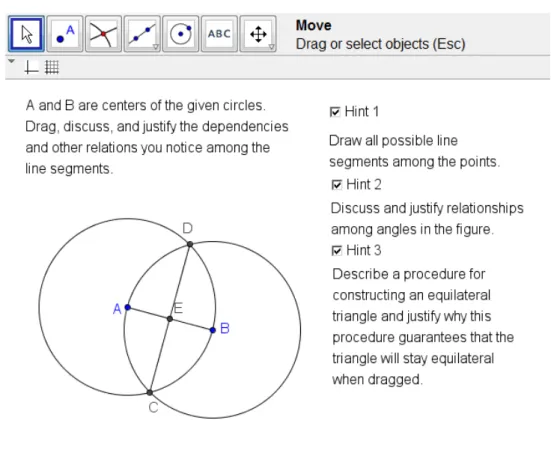
Figure 2 – a task that concerned perpendicular bisectors
In this task, two given circles were constructed using the same radius. Their points of intersections were connected to create a perpendicular bisector to radius AB. The excerpt shows that the team uses the concept of motion dependency to identify relations among the objects in Figure 2. At line 197, ceder states that points C, D, and E are dependent on A and B. Another teacher at line 199 states that the two circles share the same radius and that dragging the center of one circle affects
the size of the other, which makes the circles logically dependent on the centers. The teachers have appropriated the concepts of motion and logical dependency and used them to understand constructions in this task.
This appropriation is part of their development of utilization scheme. Their first type of utilization schemes, the usage schemes, were evident in how teachers used dragging to describe the behavior of the points, line segments, and circles. Their no-ticings helped them identify relationships among the geometric objects. The team’s collaborative work to develop a construction procedure in the second task indicates that they developed an instrument-mediated collective utilization scheme.
The teachers’ work on these tasks helped them deepen their understanding of de-pendency. In summary, to appropriate the concept of dependency (both motion and logical), the teachers needed a situation where dependencies are the key relations among geometrical objects. This need alongside the dragging capability generated discussions about how to use the notion of dependency in this type of environment. Such explicit discussions were an important step that the teachers went through to understand how to recognize and to apply these new concepts of motion and logi-cal dependency in a context of dynamic mathematics. This step helps the teachers overcome the difficulty of using everyday vocabulary in new mathematical setting (Pimm, 1987). The next step was testing their understanding in another situation, in this example another triangle, and apply their initial understanding to the new si-tuation. After developing and testing their collective understanding of dependency, the teachers revisited their understanding in another task and used dependency to discuss relationships among the geometrical objects.
Conclusion
The results show how teachers appropriate VMTwG as artifact and transform its components into instruments. The teachers in Team 1 appropriated tools in VMTwG, such as chat functionality and dragging in GeoGebra, that helped them notice motion dependency and build logical dependency among geometric objects. This appropriation evidences their utilization schemes that transformed VMTwG artifacts into instruments. With these utilization schemes, the teachers developed their geometrical knowledge and reasoning about motion and logical dependency as they engaged in an instrumentation process. This parallels teachers’ develop-ment of their geometrical knowledge and reasoning. Interaction in the environdevelop-ment required teachers to develop utilization schemes. Developing these schemes promo-tes teachers’ development of their geometrical knowledge and reasoning as well as their knowledge about DGEs.
Showing the process of appropriation of dependency in collaborative dynamic en-vironment provides insights into how new concepts and tools can be appropriated. This study also informs the design of learning environments. It shows how online collaboration in solving dynamic geometry problems promote learning through an instrument appropriation process. New research can examine how teachers’ appro-priation of other DGEs tools shapes their mathematical knowledge.
References
BALL, D. L., HILL, H. C., & BASS, H. (2005). Knowing mathematics for teaching: Who knows mathematics well enough to teach third grade, and how can we decide? American Educator, 29(3), 14-17, 20-22, 43-46.
BALL, D. L., THAMES, M. H., & PHELPS, G. (2008). Content Knowledge for Teaching: What Makes It Special?
Journal of Teacher Education, 59(5), 389-407.
BATURO, A., & NASON, R. (1996). Student teachers’ subject matter knowledge within the domain of area measu-rement. Educational Studies in Mathematics, 31(3), 235-268.
BJULAND, R. (2004). Student teachers’ reflections on their learning process through collaborative problem sol-ving in geometry. Educational Studies in Mathematics, 55(1-3), 199-225.
CAMPBELL, P. F., NISHIO, M., SMITH, T. M., CLARK, L. M., CONANT, D. L., RUST, A. H., . . . CHOI, Y. (2014). The Relationship Between Teachers’ Mathematical Content and Pedagogical Knowledge, Teachers’ Perceptions, and Student Achievement. Journal for Research in Mathematics Education, 45(4), 419-459.
CAVEY, L. O., & BERENSON, S. B. (2005). Learning to teach high school mathematics: Patterns of growth in understanding right triangle trigonometry during lesson plan study. Journal of Mathematical Behavior, 24(2), 171-190.
CHINNAPPAN, M., & LAWSON, M. J. (2005). A framework for analysis of teachers’ geometric content knowledge and geometric knowledge for teaching. Journal of Mathematics Teacher Education, 8(3), 197-221.
DAVIS, R. B. (1992). Understanding “understanding”. The Journal of Mathematical Behavior, 11, 225-241. DE VILLIERS, M. (2004). Using dynamic geometry to expand mathematics teachers’ understanding of proof.
International Journal of Mathematics Education in Science & Technology, 35(4), 703-724.
GOLDENBERG, E. P. (1988). Mathematics, metaphors, and human factors: Mathematical, technical, and peda-gogical challenges in the educational use of graphical representation of functions. The Journal of Mathematical
Behavior.
HERBST, P., & KOSKO, K. (2014). Mathematical Knowledge for Teaching and its Specificity to High School Ge-ometry Instruction. In J.-J. Lo, Leatham, Keith R., Van Zoest, R. Leatham & L. R. (Eds.), Research Trends in
Mathematics Teacher Education (pp. 23-45). Switzerland: Springer International Publishing.
HILL, H. C., BALL, D. L., & SCHILLING, S. G. (2008). Unpacking pedagogical content knowledge: Conceptualizing and measuring teachers’ topic-specific knowledge of students. Journal for Research in Mathematics Education, 372-400.
HILL, H. C., ROWAN, B., & BALL, D. L. (2005). Effects of teachers’ mathematical knowledge for teaching on student achievement. American Educational Research Journal, 42(2), 371-406.
HILL, H. C., SCHILLING, S. G., & BALL, D. L. (2004). Developing measures of teachers’ mathematical knowledge for teaching. Elementary School Journal, 105(1), 11-30.
HSIEH, H.-F., & SHANNON, S. F. (2005). Three approaches to qualitative content analysis. Qualitative Health
Research, 15(9), 1277-1288.
LAVY, I., & SHRIKI, A. (2010). Engaging in problem posing activities in a dynamic geometry setting and the deve-lopment of prospective teachers’ mathematical knowledge. The Journal of Mathematical Behavior, 29(1), 11-24. LONCHAMP, J. (2012). An instrumental perspective on CSCL systems. International Journal of
Computer--Supported Collaborative Learning, 7(2), 211-237.
MARIOTTI, M. A. (2006). Proof and proving in mathematics education. Handbook of research on the psychology
of mathematics education: Past, present and future, 173-204.
PIEZ, C. M., & VOXMAN, M. H. (1997). Multiple representations—Using different perspectives to form a clearer picture. The Mathematics Teacher, 164-166.
PIMM, D. (1987). Speaking Mathematically: Communication in Mathematics Classrooms: Routledge & Kegan Paul London.
RABARDEL, P., & BEGUIN, P. (2005). Instrument mediated activity: from subject development to anthropocen-tric design. Theoretical Issues in Ergonomics Science, 6(5), 429-461.
ROWAN, B., CHIANG, F.-S., & MILLER, R. J. (1997). Using research on employees’ performance to study the effects of teachers on students’ achievement. Sociology of Education, 256-284.
SHULMAN, L. S. (1986). Those who understand knowledge growth in teaching. Educational Researcher, 15(2), 4-14.
SHULMAN, L. S. (1987). Knowledge and teaching: Foundations of the new reform. Harvard Educational Review,
57(1), 1-22.
SINCLAIR, N., & YURITA, V. (2008). To be or to become: How dynamic geometry changes discourse. Research in
Mathematics Education, 10(2), 135-150.
STEELE, M. D. (2013). Exploring the mathematical knowledge for teaching geometry and measurement through the design and use of rich assessment tasks. Journal of Mathematics Teacher Education, 16(4), 245-268. STOLS, G. (2012). Does the use of technology make a difference in the geometric cognitive growth of pre-service mathematics teachers? Australasian Journal of Educational Technology, 28(7), 1233-1247.
YANIK, H. B. (2011). Prospective middle school mathematics teachers’ preconceptions of geometric translations.
Educational Studies in Mathematics, 78(2), 231-260.
ZAZKIS, R., & LEIKIN, R. (2008). Exemplifying definitions: a case of a square. Educational Studies in
Mathema-tics, 69(2), 131-148.