Working Paper CEsA CSG 142 / 2016
‘POLICY EXTERNALISATION’ INHERENT
FAILURE: INTERNATIONAL FINANCIAL
INSTITUTIONS’ CONDITIONALITY IN
DEVELOPING COUNTRIES
Alice Nicole SINDZINGRE
Abstract
Conditionalities – i.e. ‘exchanging finance for policy reform’ in an asymmetrical relationship between the ‘donor’ and the ‘recipient’ – are central mechanisms of the reform programmes of international financial institutions (IFIs). As they are imposed by outside entities, they can also be viewed as ‘policy externalisation’, which is paradoxically a massive intrusion in the shaping of a country’s domestic policies. The resilience of such devices is remarkable, however. Indeed, in the early 1980s, many developing countries were facing balance of payments difficulties and called upon these international financial institutions for financial relief. In exchange for this relief, they devised economic reforms (fiscal, financial, monetary), which were the conditions for their lending. These reforms were not associated with better economic performance, and this led the IFIs to devise in the 1990s different reforms, which this time targeted the functioning of the government and its ‘governance’, economic problems being explained by governments’ characteristics (e.g., rent-seekers). The paper demonstrates the limitations of the device of conditionality, which is a crucial theoretical and policy issue given its stability across time and countries. These limitations stem from: i) the concept of conditionality per se - the mechanism of exchanging finance for reform; ii) the contents of the prescribed reforms given developing countries economic structure (typically commodity-based export structures) and the weakness of the concept of ‘governance’ in view of these countries’ political economies; and iii) the intrinsic linkages between economic and political conditionalities, whose limitations thus retroact on each other, in particular regarding effectiveness and credibility.
WORKING PAPER
CEsA neither confirms nor informs any opinions expressed by the authors in this document.
CEsAis a research Centre that belongs to CSG/Research in Social Sciences and Management that is hosted by the Lisbon School of Economics and Management of the University of Lisbon an institution dedicated to teaching and research founded in 1911. In 2015, CSG was object of the international evaluation process of R&D units carried out by the Portuguese national funding agency for science, research and technology (FCT - Foundation for Science and Technology) having been ranked as “Excellent”.
Founded in 1983, it is a private institution without lucrative purposes, whose research team is composed of ISEG faculty, full time research fellows and faculty from other higher education institutions. It is dedicated to the study of economic, social and cultural development in developing countries in Africa, Asia and Latin America, although it places particular emphasis on the study of African Portuguese-speaking countries, China and Pacific Asia, as well as Brazil and other Mercosur countries. Additionally, CEsA also promotes research on any other theoretical or applied topic in development studies, including globalization and economic integration, in other regions generally or across several regions.
From a methodological point of view, CEsA has always sought to foster a multidisciplinary approach to the phenomenon of development, and a permanent interconnection between the theoretical and applied aspects of research. Besides, the centre pays particular attention to the organization and expansion of research supporting bibliographic resources, the acquisition of databases and publication exchange with other research centres.
AUTHORS
AUTHOR
National Centre for Scientific Research (CNRS), EconomiX-University Paris-West; Visiting Lecturer, School of Oriental and African Studies (SOAS), University of London, department of economics. Email: [email protected]. An earlier version of this article was presented at the ‘First Lisbon Conference’, Calouste Gulbenkian Foundation and ISCTE-Lisbon University Institute, Lisbon, 3-4 December 2014. This article was also presented at the 5th Congress of the French Association of Political Economy (Association Française d’Économie Politique, AFEP), Lyon, 1-3 July 2015, and at the Department of Economics Research Seminar of the ISEG-Lisbon School of Economics and Management, University of Lisbon, 19 October 2015. The author thanks the participants for their very pertinent remarks, in particular Luis Francico Carvalho and Luis Mah. She is particularly grateful to Joana Leite for her constant encouragement and very relevant comments.
CONTENTS
INTRODUCTION ... 4 1. CONDITIONALITIES AS THE ‘EXCHANGE OF FINANCE FOR ECONOMIC REFORM’: THE REFORMS OF THE ‘WASHINGTON CONSENSUS’ AS A PARADGIMATIC EXAMPLE ... 7
1.1. THE CONCEPTUAL PREMISES OF THE ‘WASHINGTON CONSENSUS’ AND THEIR
DIFFERENT FORMS ... 7 1.2. THE CONDITIONALITIES OF THE PROGRAMMES OF THE INTERNATIONAL FINANCIAL INSTITUTIONS (IMF AND WORLD BANK) ... 10 2. THE INCLUSION OF POLITICAL CONDITIONALITIES IN THE INTERNATIONAL FINANCIAL INSTITUTIONS’ PROGRAMMES... 18 3. THE LIMITATIONS OF CONDITIONALITY ... 22 3.1. THE LIMITATIONS INHERENT IN THE MECHANISM OF CONDITIONALITY PER SE ... 22 3.2. THE LIMITATIONS OF CONDITIONALITIES ON GOVERNANCE AND THE INHERENT LINKS BETWEEN ECONOMIC AND POLITICAL CONDITIONALITIES ... 28 CONCLUSIONS ... 34 REFERENCES ... 36
INTRODUCTION
Conditionalities – i.e. ‘exchanging finance for policy reform’ in an intrinsically asymmetrical relationship between the ‘donor’ and the ‘recipient’ – are central mechanisms of the reform programmes of international financial institutions (IFIs) (or now an economic union such as the European Union). As these conditionalities are imposed by outside entities to a government, they can also be viewed as ‘policy externalisation’. Paradoxically, such externalisation is simultaneously a massive intrusion in the shaping of a country’s domestic policies and therefore in its sovereignty over its own public policies (while this sovereignty is definitional of a state). Policy externalisation and the associated conditionalities on reform programmes are likely to meet deep resistance from recipient countries - civil societies and governments -, create divisions between the ‘winners’ and ‘losers’ (sometimes deliberately), and have often ended in failure. Well-known examples are the tensions generated by the ex-‘troika’ programmes devised for Southern Europe since 2010, and particularly in Greece.
The resilience of such devices - conditional lending and policy externalisation - over the ‘longue durée’ is remarkable. The reform programmes required by the ex-‘troika’ from Southern Europe countries - and more generally by international lenders vis-à-vis countries affected by analogous macroeconomic problems - are thus strikingly similar to those that have been prescribed to developing countries, notably in Sub-Saharan Africa from the 1980s onwards (despite obvious differences, stemming from, e.g., different monetary systems). Sub-Saharan African countries have been said to be ‘experimentation laboratories’ of such reforms, and as similar causes induce similar effects, conditionalities triggered much resistance from African governments and societies.
Indeed, in the early 1980s, a great number of developing countries were facing severe terms of trade shocks and therefore balance of payments difficulties, which stemmed from a significant drop in the prices of the primary commodities exported by these countries. They called upon the international financial institutions (IFIs, the IMF and the World Bank) for financial relief – being members of these institutions, and financial assistance being an element of the mandate of the IMF vis-à-vis its members. In
exchange for their financial assistance (made of credits and loans), which at this time was thought to be temporary, the IFIs devised a set of economic reforms that these countries should implement, typically targeting fiscal, financial and monetary issues. These reforms were the conditions for their lending and were later summarised as the ‘Washington Consensus’ - paradigmatic examples being, among others, stabilisation and adjustment programmes, and compulsory compliance with a wide range of indicators, as in IFIs debt sustainability assessments. During the 1980s and 1990s, however, this forced externalisation of domestic policies to external agencies (the IFIs) and the prescribed reforms were not associated with better economic performance. In Sub-Saharan Africa, for example, these decades were even coined ‘the lost decades in spite of policy reform’ (Easterly, 2001), and the resumption of growth in the 2000s stemmed less from the implementation of IFIs reforms than from global processes on which Sub-Saharan African countries (and IFIs policies) have limited control (e.g., China’s growth and subsequent high commodity prices).
Instead of drawing lessons and questioning the reforms’ conceptual framework or the mechanism of conditional lending, on the contrary this mixed economic success in the 1990s led the IFIs to deepen and extend the domains of conditionalities to the functioning of the government of the developing country in difficulty, and to devise additional reforms, this time targeting its ‘governance’. The underlying theoretical framework here was that the economic problems of developing countries also stemmed from the characteristics of governments – being, e.g., rent-seekers, plagued by corruption and whose policies are ‘captured’ by interest groups, in line with the theories of public choice or those of ‘positive political economy’.
The paper elaborates a critical analysis of conditional lending, and through the comparison of these two sets of conditionalities (economic and ‘governance’ conditionalities), it demonstrates their respective limitations, which explain their recurrent failure. Such an argumentation is particularly crucial given the stability of conditionality, conditional lending and exchange of finance for reform as a financing mechanism for international lending agencies – across time and space and whatever the outcomes, e.g., for African or Latin American countries in the 1980s or European countries in the 2010s. These inherent limitations of conditionality are examined via
examples from developing countries, especially in Sub-Saharan Africa since the 1980s, and in the light of the current theoretical debates on the inaccuracy of IFIs policy reforms, aid ineffectiveness and the integration of the political economy of developing countries in the understanding of their economic performance.
The paper thus shows that the limitations of conditionality stem from: i) the concept of conditionality per se (the mechanism of ‘exchanging finance for reform’), as conditionality and ‘policy externalisation’ express sheer power relationships and generate asymmetric ‘games’ perpetuating conditionality despite its failure; ii) the reforms prescribed in exchange for financing (summarised as the ‘Washington Consensus’, or ‘orthodoxy’, or ‘neoliberalism’) and the theoretical flaws of their underlying conceptual framework (even more inaccurate for economies that are typically based on the export of commodities), as well as the theoretical weakness of the concept of ‘governance’ in view of developing countries’ political economies; and iii) the intrinsic linkages between economic and political conditionalities, whose limitations thus retroact on each other, in particular regarding conditionalities’ effectiveness and credibility – among other linkages, the power asymmetry that is constitutive of conditionality paradoxically nullifies the latter’s apparent technical rationale and the credibility of sanctions for noncompliance.
The paper is structured as follows. Firstly, it explains the main features of the conditionalities attached what has been coined as the ‘Washington consensus’. Secondly, the paper examines the context and elements of the conditionalities that focus on the concept of ‘governance’. Thirdly, it shows the limitations of conditional lending, both inherent to conditionality itself and those stemming from the economic and political economy characteristics of the countries to which economic and ‘governance’ conditionalities are applied.
1. CONDITIONALITIES AS THE ‘EXCHANGE OF FINANCE FOR
ECONOMIC REFORM’: THE REFORMS OF THE
‘WASHINGTON CONSENSUS’ AS A PARADGIMATIC
EXAMPLE
1.1. THE CONCEPTUAL PREMISES OF THE ‘WASHINGTON CONSENSUS’ AND THEIR DIFFERENT FORMS
The ‘Washington consensus’ and attached conditionalities can be understood only in their context, in particular the evolution of the theories of the desirable role of the state and those of the public policies that are effective in developing countries. These evolutions closely follow the evolution of development economics theories since WWII, and have been subject to drastic changes (Adelman, 2000a). Indeed, after WWII, developing countries pursued a resource intensive development strategy with limited industrialisation. In some East Asian countries – the so-called ‘developmental states’, Japan, Korea, Taiwan -, governments implemented with spectacular success a mix of government and market and ‘entrepreneurial’ policies, where the state helped the functioning of markets (in providing the legal framework, infrastructure, and if necessary being an entrepreneur in last resort) (Aoki et al., 1996; Amsden, 1989; Wade, 1990). Developmental states promoted industrialisation via targeted policies (incentives, subsidies, tariffs, policies towards labour markets, technology, etc.). These states showed that opposing states to markets is a fallacy. ‘Developmental state’ governments displayed a capacity for implementing public policies, and, moreover credible policies.
From 1940 to 1979, the early theorists of development - Arthur Lewis, Paul Rosenstein-Rodan, Albert Hirschman, among others - viewed government as a prime mover and the only entity able to reallocate factors of production from a low-productivity sector (traditional) to a high-productivity sector (industrial) with increasing returns, to correct coordination failures, and to move the economy out of low-level equilibrium traps. Rosenstein-Rodan (1943), in particular, highlighted the importance of spillover effects,
the possibility of coordination failures in developing countries and of poverty traps, which justified government intervention. The creation of complementarities (in demand, in markets) was viewed as crucial for development, which could not happen if left only to private sector (Matsuyama, 1997). In this regard, industrialisation had to be planned by the state.
From the early 1980s onwards, the neoclassical paradigm progressively became preeminent in the economic theoretical literature as well as in development policy agencies. Instead of the many determinants of development defended by the first theorist after WWII (e.g., path dependence processes, non-linearities, low physical capital), these theories isolated single causalities that would explain economic stagnation, and state intervention has been seen as ineffective (Adelman, 2000b). The state became viewed as fostering rent-seeking, corruption and predation. Hence the best policies for development were those promoting a limited state, e.g. trade barriers, here viewed as creating an anti-export bias, which was the real cause of balance of payments problems. The best incentives provided by public policies regarding the allocation of resources are, in this view, the most neutral in terms of discrimination among foreign and domestic markets, with international trade being able to be a substitute for low aggregate domestic demand, as in, e.g., export-led growth (Adelman, 2001). ‘Getting prices right’ and removing price distortions are here the overarching objectives.
From the 1980s onwards, this paradigm has constituted the basis for the programmes of the IFIs, the IMF and the World Bank. The set of policy reforms put forward by the IFIs was later coined as the ‘Washington consensus’ by John Williamson (1990). Williamson summarised this ‘consensus’ as the recommendation of a list of ten reforms: fiscal discipline; reordering public expenditure priorities; tax reform; liberalising interest rates; competitive exchange rates; trade liberalisation; liberalisation of inward foreign direct investment (but not capital account liberalisation); privatisation; deregulation (easing barriers to entry and exit); the establishment of property rights.
As theoretical thinking also evolved in the 1980s, notably on optimal public policies – being irrigated by concepts such as, e.g., market and coordination failure -, the ‘Washington consensus’ has been subject to debate. The above views have also been questioned due to the failure of their implementation in Latin America and in Sub-Saharan
Africa (SSA). The 1990s thus witnessed more balanced views of the role of the state, in particular at low levels of development: markets may be inefficient in the presence of externalities (e.g., leading to oligopolies) and be affected by failures, which may be a typical characteristic of low-income developing countries. States may be inefficient in terms of allocation of resources, but they may be better than markets in addressing externalities and correcting coordination failures that stem from externalities, economies of scale, and collective action problems. Markets and states are here viewed as complementary. Regarding developing countries, this has inspired what has been coined as the ‘Post-Washington consensus’ (Stiglitz, 1997): here the state has the role of establishing infrastructure - educational, technological, financial, physical, environmental, social, and more specifically promoting education and technology, supporting the financial sector, investing in infrastructure, preventing environmental degradation, creating and maintaining a social safety net. For Stiglitz, these roles are particularly important in developing countries, as in these countries market failures (information problems, missing markets) are larger and capacities of government to correct them are weaker.
For its part, the IMF has viewed the role of the state through the lens of its mandate since its creation, in particular the surveillance of fiscal deficits, and has therefore a strong focus on the public sector in developing countries. In the first stabilisation programmes in developing countries in the 1980s, the IMF prescribed a ‘first generation’ of reforms of the civil services centred on macroeconomic stabilisation, notably the reduction of the wage bill, and in the 1990s, in view of the disappointing results and the above mentioned theoretical evolution, it insisted on a ‘second generation’ of reforms of the civil services, which were based on improving ‘incentives’ and a ‘high-quality public sector’. The IMF also considers that under certain conditions, public investment has positive impacts in developing countries (Clark and Rosales, 2013).
Despite analyses associated with the ‘Post-Washington consensus’ in the 2000s and many other studies on the necessary role of the state, the views on the minimal state remain pervasive in mainstream economics and IFIs operational thinking – sometimes close to an ‘anti-government ideology’ (Krugman, 2008). The rise of China in the 2000s, however, has promoted views of the role of the state that are closer to the first phase of
development thinking in the aftermath of the WWII, which were coined as the ‘Beijing Consensus’. A similar perspective, coined ‘new structural economics’ was advocated within the World Bank in the late 2000s by Justin Yifu Lin, then chief economist (2008-2012) (Lin, 2011). For Lin, economic development requires an industrial upgrading that entails large externalities to firms’ transaction costs and returns to capital investment. Thus, in addition to an effective market mechanism, the government should play an active role in facilitating industrial upgrading and infrastructure. As underscored by Ricardo Hausmann (2012) in his comments on Lin, this confirms that development is about structural transformation and accumulating more productive knowledge, a process exposed to market failures.
1.2. THE CONDITIONALITIES OF THE PROGRAMMES OF THE INTERNATIONAL FINANCIAL INSTITUTIONS (IMF AND WORLD BANK)
The abovementioned views constitute the context of the IFI conceptual framework and ground its key conditionalities, which are centred on fiscal balance, monetary adjustment (devaluation), liberalisation and privatisation. As is well-known, the IMF stabilisation programmes that were implemented from the 1980s onwards in developing countries are based on a theoretical relationship between policy targets and macroeconomic aggregates, e.g., growth. The underlying model reflects the Monetary Approach to the Balance of Payments (or the Jacques Polak’s model, or Financial Programming), which was developed in the 1950s within the IMF.
The model’s main focus – the core of IMF Financial Programming - is the balance of payments effects of credit creation by the banking system. The World Bank uses the same identities in its model for evaluating debt sustainability. The purpose of the IMF monetary model is the integration of monetary, income and balance of payments analysis. This model became the basis of the IMF conditionalities applied to its credits. Over time, the model was adapted, broadening and deepening of IMF credit arrangements, and included new specifications (Agenor, 2004).
A typical IMF programme is a set of macroeconomic identities. The IMF monetary model consists of a series of macroeconomic accounting identities that link growth, inflation, money supply, current account, and budget deficit, with intermediate policy targets (e.g., domestic credit to the private sector, reserve accumulation) designed to be consistent with macroeconomic targets like growth, current account adjustment, and inflation, which are supposed to resolve the country’s difficulties (Polak, 1997; Baqir et al., 2003). IMF programmes have the theory of ‘absorption’ as a background: private consumption, domestic investment and government expenditure should not be in excess in regard to domestic income. This is why IMF stabilisation programmes are focused on the reduction of domestic demand and fiscal deficits, on the stabilisation of public spending (i.e. wage bill, investment, equipment, maintenance and recurrent costs), and on the increase of public revenues, the broadening the tax base, and export growth. Hence the mechanisms of an IMF programme are short-term loans to promote balance of payments viability and redress fiscal imbalances and other disequilibria involving structural impediments to growth: typically a stand-by arrangement with credit available in instalments, conditional on the recipient country’s authorities’ agreement to restrict macro policies.
The notions of conditionality and conditional lending are therefore a key feature of an IMF programme: for the IMF, conditionality implies that the borrowing government ‘agrees to adjust its economic policies to overcome the problems that led it to seek financial aid’, and loan conditions ‘ensure that the country will be able to repay’ the IMF (IMF, 2016a). The disbursement of ‘tranches’ of loans is contingent on the implementation of a set of reforms monitored via criteria of performance, i.e. contingent on whether the country meets the intermediate policy targets.
In the 1990s, besides the IMF model itself, theories of credibility and reflections on conditionality, together with theories of ‘global public goods’, provided an additional justification of IMF conditionality, and, more generally that of IFIs. Via the signing of an agreement that conditions finance to the implementation of a set of measures, the IFIs give credibility to the poorest countries, which otherwise are not credible vis-à-vis international investors (Rodrik, 1995).
Despite the implementation of the programmes’ conditionalities, however, growth performances remain mixed in many countries, in particular from the early 1980s onwards (after the international debt crisis and terms-of-trade shocks that affected developing countries, notably Latin American and SSA countries) – ‘the lost decades’ of the 1980s and, for SSA, also the 1990s. Lending was prolonged, one programme followed the other, conditionalities accumulated and repeated themselves, and as coined by the IMF Independent Evaluation Office, some countries became ‘prolonged users’ of IMF conditional lending (IMF-IEO, 2002). In the 2010s, certain SSA countries are entering into their third decade under IFI programmes. Despite decades of reforms and conditional lending, SSA growth and income levels remain low, and are, moreover, characterised by a spectacular divergence when compared with the rest of the world: conditionalities did not improve economic performances and at best have been inefficient (figure 1).
Figure 1: GDP per capita, Sub-Saharan Africa vs. the world, 1960–2014 (constant 2005 US dollars)
Source: World Bank World Development Indicators (online), April 2016.
The IMF progressively understood that short-term relief financing in fact addressed structural issues: until the early 1980s, IMF conditionality focused on macroeconomic policies, and then the complexity and scope of structural conditions
0 1000 2000 3000 4000 5000 6000 7000 8000 9000 1 9 6 0 1 9 6 2 1 9 6 4 1 9 6 6 1 9 6 8 1 9 7 0 1 9 7 2 1 9 7 4 1 9 7 6 1 9 7 8 1 9 8 0 1 9 8 2 1 9 8 4 1 9 8 6 1 9 8 8 1 9 9 0 1 9 9 2 1 9 9 4 1 9 9 6 1 9 9 8 2 0 0 0 2 0 0 2 2 0 0 4 2 0 0 6 2 0 0 8 2 0 1 0 2 0 1 2 2 0 1 4 World Sub-Saharan Africa (all income levels)
increased, due to the IMF’s growing involvement in low-income and transition countries (IMF, 2016a).
For the IMF, in addition to demand management and stabilisation policies, governmental and private practices may impede efficient production of goods and services (i.e., supply): this requires changes to the economy, which is to say structural policies. Stabilisation policies are important in the short run, because it is easier to alter the various components of overall demand for a short time than it is to make a country’s resources more productive. Stabilisation policies include taxing and spending actions, and changes to interest rates and the money supply. On the longer term, structural changes are required to improve aggregate supply. For the IMF, structural policies not only foster growth, but also the successful implementation of stabilisation policies. Their areas are typically price controls, management of public finances, public sector enterprises, financial sector, social safety nets, labour markets, and public institutions and governance. The latter refer to government salaries, e.g., in tax administration, which, if they are too low, can encourage corruption while employment in the public sector must be limited to business needs, or to inefficient legal systems, too complex business regulations and tax administration, which are detrimental to business climate, contracts enforcement, foreign direct investment and therefore growth (Abdel-Kader, 2013).
Regarding the World Bank, it was also in the early 1980s that the first adjustment programmes were devised and implemented, firstly in SSA countries, and for the same reasons as the IMF programmes, i.e. the severe balance-of-payment crises affecting commodity-dependent countries, which had been induced by the shocks created by the sharp drop in the terms-of-trade due to the fall in commodity prices. The World Bank is by mandate more focused on development, on sectoral issues and project financing. World Bank programmes’ main elements are privatisation and liberalisation, especially financial and trade liberalisation: in particular, the suppression of state subsidies (e.g., subsidies to the agricultural sector, or subsidised credit), tariff reduction, dismantling of marketing boards (objectives also being ‘getting prices right’ and limiting state intervention viewed as distorting prices), in addition to civil service reforms (e.g., in the initial programmes, the freezing of recruitment and wages, voluntary incentives-induced retirement).
Due to the prolonged problems of low-income countries, especially in SSA, the 1980s witnessed closer coordination between the IMF and the World Bank for these low-income countries via the devising of joint programmes - the ESAFs/Enhanced Structural Adjustment Facility, a concessional facility launched in 1987 and conditioned to the acceptance by recipient governments of a series of conditionalities. The ESAF programmes displayed quantitative macroeconomic benchmarks (monetary, fiscal - reduction of fiscal deficits, action on the public spending, contraction of the wage bill and numbers of civil servants, reduction of state subsidies and transfers, e.g. to state-owned-enterprises/SOEs -, international reserves, external debt) and structural benchmarks (e.g., reforms of state-owned-enterprises, financial sector, structural fiscal policy, tax and expenditure management). The stabilisation programmes of the IMF and the adjustment programmes of the World Bank, which support their lending activities, are linked in the different models that underlie them – and also in practice at the country level. While for the IMF the model is derived from the Monetary Approach to the Balance of Payments, for the World Bank the underlying model of the programme is a variant of the ‘two-gaps growth model’ (Khan et al., 1990).
The set of reforms and the content of conditionalities devised by the IMF have evolved over time. Their limited effectiveness in low-income countries led the IMF to launch in 1999 the Poverty Reduction and Growth Facility (PRGF), which succeeded the ESAF, jointly with the Poverty Reduction Strategy Papers (PRSPs) of the World Bank, with these new facilities hoping to be more effective in insisting on a greater ‘ownership’ of conditionalities by borrowing countries. Conditionalities also evolved after the 2008 global financial crisis. Until the 2008 crisis, conditionalities and their conceptual framework had displayed a remarkable stability across countries – developing and developed. After the 2008 crisis – and the ensuing Eurozone crisis (and the creation of the ‘troika’ and some episodes of divergences with EU own conditionalities) –, the IMF recognised the weakness of some of its prescriptions - notably regarding fiscal policy -, and of the underlying conceptual framework (e.g. the calculation of the multiplier, Blanchard and Leigh, 2013). The IMF recommended ‘parsimony’ (i.e. a focus on conditions that are really ‘macro-critical’), flexibility and ‘clarity’ in the specification of conditions (IMF, 2012; 2014). It has even been argued that the IMF has taken a
sustainability (e.g. more tax on the richest, IMF, 2013) and more flexibility regarding the pace of fiscal consolidation and the composition of fiscal stimulus (Ban, 2014; Ban and Gallagher, 2015).
The IMF reformed its lending and conditionality in 2009 in order to promote ‘national ownership’ of the prescribed policies (IMF, 2010). While the overarching goal remains balance of payments viability and macroeconomic stability, the borrowing country is said to have the primary responsibility for selecting, designing, and implementing the policies. Compliance is based on a series of mechanisms, i.e. disbursements in instalments linked to observable policies, quantitative performance criteria and indicative targets, and structural benchmarks (often non-quantifiable reforms) (IMF, 2016a). Structural conditionalities have also been reclassified: a key consideration here is the likelihood that a condition is ‘macro-critical’ and falls within the areas that the IMF considers to be within its core expertise, i.e. macroeconomic stabilisation - fiscal, monetary and exchange rate policies, including the underlying institutional arrangements and related structural measures, and financial systems issues related to the functioning of both domestic and international financial markets. Structural reforms that are aimed at strengthening public sector resource management and accountability are here crucial for the IMF. The new classification distinguishes the fiscal policy measures (taxation); public sector resource management and accountability (public sector governance, transparency and financial management); monetary policy, exchange rate policy, accounting, and transparency, which are included in the public sector resource management and accountability category; public enterprise pricing and privatisation; financial sector reforms (IMF, 2009).
Indeed, the IMF has been criticised by its own auditor (the IMF Independent Evaluation Office/IEO) for advising budget cuts to ‘some of the largest advanced economies’ like Germany, US and Japan in 2010-2011, and endorsing austerity in a ‘premature’ way. The IEO acknowledges, however, that observing that after the 2008 crisis, policies pursued so far did not improve the growth outlook, the IMF has reconsidered its fiscal policy prescriptions, calling for a more moderate pace of fiscal consolidation and recommending fiscal expansion where it is necessary (IMF-EIO, 2014). A review by the IMF of a decade of lending conditionalities – influenced by the problems
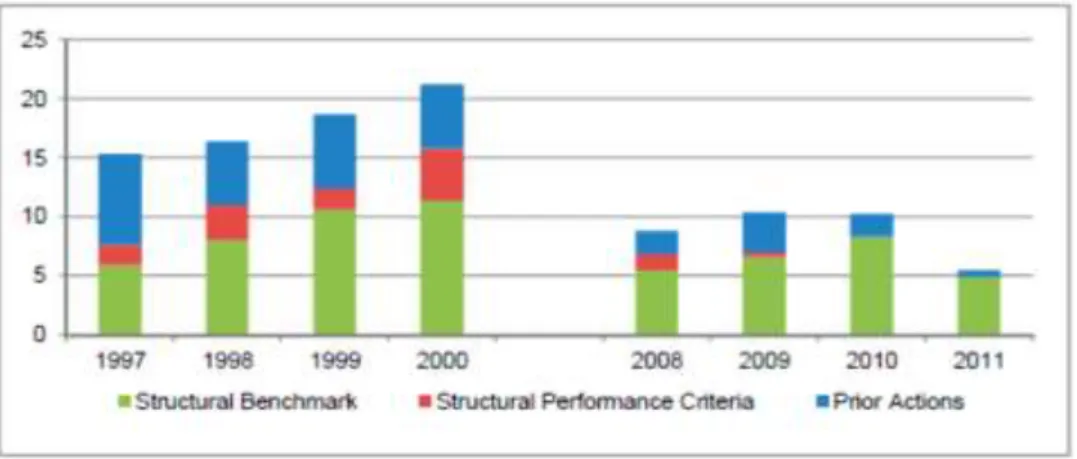
of the Euro area - , while positively acknowledging that it is more flexible and focused, underscored its weakness regarding the ‘ownership’ of programmes and conditions, their transparency and their social consequences (IMF, 2012). The criticisms of conditionality had already led to a decrease in numbers of conditions during the 2000s, e.g. on trade policies (IMF-IEO, 2009). According to IMF own figures, the number of conditionalities decreased since the 2008 crisis (figure 2).
Figure 2: Structural conditionality in IMF Stand-by arrangements, 1997-2000 vs. 2008-11 (number of conditions per programme per year)
Source: IMF-EIO (2014).
The IMF also displayed adaptability for its facilities and the associated conditionalities in developing countries, notably low-income countries. It may also be noted that, with higher growth rates during the 2000s, some developing countries (e.g., in SSA) were less in need of IMF external financing. The IMF Poverty Reduction and Growth Facility (PRGF) has been replaced in 2010 by new and more flexible lending instruments (gathered in the Poverty Reduction and Growth Trust/PRGT), which took into account the vulnerability of these countries to external shocks, including the major shock of the 2008 financial crisis. The PRGT has three lending instruments: the Extended Credit Facility to provide flexible medium-term support, with more focused and streamlined conditionality; the Standby Credit Facility to address short-term and precautionary needs; the Rapid Credit Facility, offering emergency balance-of-payment
support without the need for programme-based conditionality1. The IMF has devised a non-financial instrument, the Policy Support Instrument (PSI) in order to support low-income countries that do not want (or need) IMF financial assistance, but seek to consolidate their performance with IMF monitoring and support2. Though the objectives of the PSI are in line with the IMF ‘traditional’ conceptual framework, by definition they do not include the usual conditional lending mechanisms.
Yet, conditionality remains the centrepiece of the act of borrowing from the IMF. The device of ‘lending-conditional-to-reform’ exhibits a remarkable stability, with, moreover, much similarity in the content of reforms across borrowing countries, be they developing or developed, as shown by the conditionalities attached to the financial rescue of Southern Eurozone countries from 2010 onwards (Sindzingre, 2015) – differences lying mainly in the types of facilities and arrangements. With the debt problems affecting developed economies since the 2008 crisis, this similarity across borrowing countries also refers to the repetition of conditionality-based programmes: as has been the case with its ‘prolonged lending’ over decades to developing countries, the IMF has been described as engaged in ‘serial lending’ with some advanced economies (Reinhart and Trebesch, 2016).
Indeed, in 2016 as in previous decades, a typical set of reforms prescribed in exchange for an IMF loan (to a developing or developed country) thus included fiscal reforms and adjustment together with structural reforms (for example, the increase in revenue, hiring freeze and control of the wage bill, as for Ghana, IMF, 2016b; cut in subsidies, e.g., to fuel, as for Yemen, IMF, 2016c; the raising of taxes, reduction of subsidies in the energy sector and privatisation of state-owned enterprises, as for Pakistan, IMF, 2016d; deregulation and restructuring state-owned enterprises, as for Ukraine, IMF, 2015a), public financial management (e.g., debt) and monetary policy (e.g., inflation targeting) - conditionalities being monitored via ‘quantitative performance criteria’, ‘indicative targets’, and ‘macro-critical benchmarks’ (as for Kenya, IMF, 2015b). Equally, in order to cope with the important fall in commodity prices of 2016, and the
1 See ‘IMF Support for Low-Income Countries’, 1 April 2016: http://www.imf.org/external/np/exr/facts/poor.htm
subsequent terms-of-trade shock and decline in growth rates, the reforms that the IMF recommends to SSA economies consist in, e.g., exchange rate flexibility and reduction of fiscal deficits ‘even at the cost of short-term output losses’ (IMF, 2016e: 13).
Similarly, regarding the Southern Eurozone countries, while the IMF acknowledges that ‘regional institutions’ (i.e. the other partners of the ex-‘troika’) had ‘broader mandates’ than its own and prescribed ‘additional conditions’ (IMF, 2012: 10), it still defends structural reforms for, e.g., the labour and product markets (in Greece, for example, it defends reforms that were already prescribed more than three decades ago in developing countries, such as reduction in the numbers of civil servants and ceilings on pensions3).
2. THE INCLUSION OF POLITICAL CONDITIONALITIES IN THE
INTERNATIONAL
FINANCIAL
INSTITUTIONS’
PROGRAMMES
The limited effectiveness of the first stabilisation and adjustment programmes in the 1980s led the IFIs to examine causalities that would not be strictly confined to the conventional economic determinants of growth and stagnation.
The 1980s and 1990s precisely witnessed the growing influence in academic studies of theories of rent-seeking (Krueger, 1974), bureaucracy’s inefficiency, and ‘heavy hand’ of government, in the light of rational choice and public choice theories (Bates, 1988): states became increasingly held responsible of economic failure. Rent-seeking behaviour has been said to be even more likely in resources-based economies (Auty, 2001), in line with the so-called ‘resource-curse’ arguments. Studies in public choice-inspired political economy were enriched by reflections on ‘governance’ developed for the analyses of the firm, contracts and regulation, and in developing
https://blog-countries, typically for the understanding of privatisation’s successes and failures (Estache and Wren-Lewis, 2009).
In the same vein, in order to explain the mixed economic performances of states in developing countries, theories in political science and political economy during the 1980s qualified these states with concepts such as neopatrimonialism, predation, corruption, cronyism, nepotism, patronage, clientelism, personal rule, authoritarianism (states being said to be, e.g., ‘quasi-states’, ‘kleptocratic’, ‘vampire states’ and the like). The argument of ‘extraction’ has been particularly popular, with these economies having been analysed as ‘extractive economies’ – an argument that in fact continues Olson’s (1993) analyses on the detrimental effects on development of ‘roving bandits’ (vs. ‘stationary’ ones), as in a world of ‘roving banditry’ there are no incentives to production or accumulation. In ‘extractive’ economies, governments typically ground their legitimacy on the extraction of natural resources and have no incentive to promote human capital, developmental institutions and growth, and they may even have an interest in preventing development (Acemoglu and Robinson, 2006; 2012).
In the 1990s, many economic studies explored the ‘political economy of policy reform’, or theories of ‘endogenous policies’ and of ‘bad policies’, the latter being viewed as the key determinants of stagnation. Irrespective of the type of political regime, ‘bad policies’ are here viewed as stemming from governments’ inability to use transfers in separating efficiency and distribution, and inability to commit credibly – in line with 2004 Nobel Prize winners Finn Kydland and Edward Prescott (1977) and their argument that the credibility of policy and the capacity for a government to credibly commit is crucial for these policies’ effectiveness (this argument has been a justification for the creation of independent agencies and ‘hand-binding’ devices, e.g., independent central banks). It has also been argued, however, that all governments face a problem of credibility for their policies, as there is no meta-level above government that has the coercive capacity to enforce its policies and promises (Acemoglu, 2003). In this view, political attitudes are determined by economic incentives, and the form of political and economic institutions results from conflict between groups that have diverging interests (the ‘elites’ and the ‘citizens’): this endogeneity of political and economic institutions (e.g., the locking-in by
oligarchies of financial capital enabling that of human capital) may lead to stagnation (Acemoglu and Robinson, 2006).
This inherent lack of credibility affecting developing countries’ governments more than others has thus fed the argument that developing countries’ governments should create independent ‘agencies of restraint’ (Collier, 1991) and ‘hand-binding’ devices, which would give to their policies and commitments the credibility they lack. As mentioned above, for the IFIs conditional lending typically constitutes such a device. Indeed, confronted with their programmes’ mixed outcomes, the IFIs have argued that policy externalisation is beneficial in predatory states, because in such states policies lack credibility, especially external credibility vis-à-vis international markets and investors: rulers’ domestic policies must therefore be ‘locked’ by external ‘hand-binding’ devices that are costly to renege; such costs are incentives to comply with conditions and reforms, and give domestic policies credibility. Examples of such ‘agencies of restraint’ are international treaties, regional or monetary arrangements, the allocation of policymaking to independent agencies (e.g., central banks, revenue collection agencies) or agreements with the IFIs (e.g. stabilisation or adjustment programmes). For the IFIs, such hand-binding devices are also beneficial for citizens in predatory or dictatorial regimes, as they protect them against these regimes’ arbitrariness and clientelism.
The concept of ‘failed’ states – or ‘fragile’, or ‘collapsed’ states - was also crafted within the IFIs and the broader donor community in the 2000s, and was viewed as providing a better account of some situations of programme and conditionality failure. Such ‘fragile’ states include a significant number of low-income countries, and notably SSA countries: e.g., for the Fund for Peace-Foreign Policy Fragile States index, in 2014, the worst cases were (in decreasing order) South Sudan, Somalia, Central African Republic, Sudan, D.R. Congo, Chad, Yemen, Syria, Afghanistan, Guinea, Iraq, Haiti, Pakistan, Nigeria, Zimbabwe,…4 ‘State failure’ has also been explained by initial endowments, e.g., geography and demography (which may be endogenous to each other): ‘state failure’ is indeed the incapacity to provide public goods such law and order, defence, contract enforcement, infrastructure, which is typically hindered when
demographic densities is low, as is the construction of state authority in the context of scattered populations (Herbst, 2000).
In this theoretical context, from the 1990s onwards, the improvement of recipient countries ‘governance’ thus became an additional objective within the IFIs programmes, with conditionalities increasingly extended to non-economic issues. The conceptual framework keeps the mix of coercion and provision of incentives that characterise economic conditionalities. This period witnessed studies within the IFIs that argued that aid is effective only in countries that are willing to implement the ‘good policies’ – i.e. in fact the conditionalities put forward by IFIs programmes (Burnside and Dollar, 2000; 2004). Beyond the IFIs, this legitimised for donors the selectivity of their aid flows, i.e. aid should be firstly directed towards the countries that show willingness to implement conditionalities (the ‘good policies’). An illustration of this extension of economic conditionalities to conditionalities regarding governments’ behaviour is the assessment by the World Bank, in order to calculate its IDA5 resources allocation, of countries’ economic policies and institutions ‘quality’ and their compliance with conditionalities via the indicators of the Country Policy and Institutional Assessment (CPIA) (16 criteria grouped in 4 clusters: economic management; structural policies; policies for social inclusion and equity; and public sector management and institutions)6.
Hence from the late 1990s onwards, IFI programmes included conditionalities related to governance. It may be noted that they focused on administrations and their behaviour, and were distinct from other conditionalities, conceived as more ‘economic’, which nonetheless usually affect ‘governance’ (e.g., politically influential interest groups), such as trade liberalisation. Programmes focused, for example, on corruption, accountability, decentralisation and the creation of independent agencies (e.g. for improving the levying of taxes), in line with the theories of independent ‘agencies of restraint’ as key instruments of policy credibility and hence effectiveness. They also focused on the strengthening of ‘democracy’, typically the implementation of elections or the support to parliaments. A key issue is that conditionalities on governance are not political reform. In putting forward the improvement of ‘governance’, IFIs and other
5 International Development Association, the World Bank’s fund for the poorest countries. 6
donors focus on mechanisms that are presented as technical and a matter of incentives, (e.g. involving the functioning of civil services) rather than political. For example, ‘dysfunctionings’ are identified (by donors or consultancy firms), and donors formulate conditions for their financing in terms of technical reform of the management of public administration.
3. THE LIMITATIONS OF CONDITIONALITY
Conditionalities, however, are confronted with a series of limitations. Moreover, the addition of governance conditionalities to economic conditionalities has induced unexpected effects and paradoxes. Though the IFIs conducted several reflections on conditionality, e.g., on its time span (short or longer term), it has remained difficult, however, for them to question its very existence.
3.1. THE LIMITATIONS INHERENT IN THE MECHANISM OF CONDITIONALITY PER SE
Conditionalities multiplied since the first stabilisation and adjustment programmes but recipient countries’ economic performances did not markedly improve. In the case of SSA for example, there are no clear links between GDP per capita growth and net World Bank financing – as well as net official development assistance in general (figure 3).
Figure 3: Net financial flows from the IBRD and IDA, and net official development assistance (billions current US dollars) to Sub-Saharan Africa (left scale) and Sub-Saharan Africa GDP per capita
growth (right scale), 1960-2014
Source: World Bank World Development Indicators, May 2016. IBRD: International Bank for Reconstruction and Development, the part of the World Bank offering non-concessional financing. IDA: International Development Association, the part of the World Bank offering concessional financing to the
poorest countries.
When they improved, such as in SSA countries in the second half of the 2000s, this was, in fact, due less to the implementation of conditionalities than to these countries’ dependence on commodities (precisely the key factor of their fiscal problems and hence their need for IFI conditional lending): i.e. this was due to the increase in international commodity prices in the 2000s. As shown by figure 4, in SSA growth rates have closely followed international commodity prices in that period.
-2 0 2 4 6 8 10 -10 0 10 20 30 40 50 60 1 9 6 0 1 9 6 2 1 9 6 4 1 9 6 6 1 9 6 8 1 9 7 0 1 9 7 2 1 9 7 4 1 9 7 6 1 9 7 8 1 9 8 0 1 9 8 2 1 9 8 4 1 9 8 6 1 9 8 8 1 9 9 0 1 9 9 2 1 9 9 4 1 9 9 6 1 9 9 8 2 0 0 0 2 0 0 2 2 0 0 4 2 0 0 6 2 0 0 8 2 0 1 0 2 0 1 2 2 0 1 4 Net official development assistance and official aid received (current US$) Net financial flows, IDA (current US$)
Net financial flows, IBRD (current US$)
GDP growth (annual %)
Figure 4: Growth rate of Sub-Saharan Africa GDP (right scale) and energy and non-energy prices indices (2010=100, 2005 US dollars) (left scale), 1960-2015
Source: World Bank World Development Indicators, and World Bank Commodity Price Data (‘pink sheet’: http://go.worldbank.org/4ROCCIEQ50), April 2016.
Indeed, in commodity-dependent economies, the reform programmes that started in the early-1980s did not modify the root cause of fiscal crises, i.e. vulnerability to external shocks due to a distorted export structure that is based on primary commodities with volatile prices. Behind higher growth rates during the 2000s, the economic structures that generated the dependence on conditional-to-reform lending and the associated externalisation of domestic policies have remained unchanged. These improvements are vulnerable to any reversal of the international environment, the latter being obviously out of the control of borrowing governments’ domestic policies - e.g., China’s growth deceleration or the fall in commodity prices from 2014 onwards.
Equally, the argument that IFI conditional-to-reform lending provides borrowing governments’ policies with credibility vis-à-vis international and domestic agents is not confirmed. For some studies, IMF conditionality appears to be ineffective, and there is no empirical evidence showing that conditionalities have enhanced recipient countries’ ‘ownership’ (Dreher, 2008). It has even been argued that IMF programmes have a negative impact on borrowing countries’ growth (Przeworski and Vreeland, 2000).
-2,0 0,0 2,0 4,0 6,0 8,0 10,0 0 20 40 60 80 100 120 140 1 9 6 0 1 9 6 2 1 9 6 4 1 9 6 6 1 9 6 8 1 9 7 0 1 9 7 2 1 9 7 4 1 9 7 6 1 9 7 8 1 9 8 0 1 9 8 2 1 9 8 4 1 9 8 6 1 9 8 8 1 9 9 0 1 9 9 2 1 9 9 4 1 9 9 6 1 9 9 8 2 0 0 0 2 0 0 2 2 0 0 4 2 0 0 6 2 0 0 8 2 0 1 0 2 0 1 2 2 0 1 4 Energy price index (2010=100) Non-energy price index (2010=100) Sub-Saharan Africa (all income levels) GDP growth (annual %)
Moreover, for a country the mere fact of having signed a reform programme with the IMF in exchange for financing can even be a negative signal for international investors (Thacker, 1999). When conditionalities appear to be effective, there seems to be a tautological process that conditionalities are effective mostly in countries that show willingness to reform (Wei and Zhang, 2010) – which may question the argument that conditionality should be abandoned in favour of selectivity, i.e. lending to governments that already have ‘good’ policies and institutions.
A justification of conditionalities is that financing cannot be given without programmes of economic reforms and conditions, as otherwise money would line private and corrupt pockets. The World Bank has consistently justified its adjustment programmes in arguing that privatisation and liberalisation break the rents that characterise developing countries, especially the rents of political rulers and the monopolies of the interest groups and oligarchs thus rewarded in exchange for political support. A similar argument is that without conditions money would be wasted in inefficient policies: conditions oblige governments to make a use of financing that pave the way of future growth, and projects that yield profit or social welfare.
These arguments, however, do not always hold: conditionalities may indeed destabilise anti-developmental rulers and oligarchs, but the latter can sometimes adapt them to their own advantage. Equally, the argument that conditionalities channel the lent money in a way that is more economically efficient may not be valid, as argued by a large ‘heterodox’ literature since the first stabilisation and adjustment programmes in the 1980s. In developing countries, from the 1980s onwards, several studies pointed at the failures of the design, the fallacies of the underlying theories and the inadequacy of conditionalities to borrowing countries’ characteristics (Mosley et al., 1991; Taylor, 1993; Adelman, 2001). Both regarding developing countries and developed countries (e.g. in the EU after 2010 and the ex-‘troika’ programmes), such studies argue that these conditionalities are not conducive to growth and actually aggravate countries’ macroeconomic problems, e.g. debt and fiscal deficits, and, for developing countries, do not foster structural transformation and departure from commodity-dependence and aid-dependence. Since the 2008 crisis, even non-‘heterodox’ economists have underscored that the economic content of conditions – macroeconomic stabilisation, the standard
Washington consensus, i.e. reduction of fiscal imbalances, privatisation, liberalisation -, are not credible regarding their aims of restoring growth (Wyplosz, 2013; O’Rourke, 2014).
In addition, the externalisation of policies and the very mechanism of conditionality inherently generate resistance from governments (e.g., policy reversal) and citizens, and may induce endless detrimental games and moral hazard effects (conditionality may also be impossible to implement). The focus of IFI programmes on ‘ownership’ and ‘participation’ of recipient governments, together with the notion of ‘partnership’ put forward as a description of the relationship between the donor and the recipient, stumble over the intrinsic asymmetry of the relationship: one party finances and exchanges its financing for compulsory reform and the other is in need for financing and has no other choice than to accept this relationship. An IMF Independent Evaluation Office’s assessment observed that in 2007 only about half of the structural conditions were complied with on time (IMF-EIO, 2007), which contradicts the objective and requirement of ‘ownership’ and internalisation of reforms. Over decades of lending and mixed results, the relationships between IFIs and governments have been described as a ‘ritual dance’ (Kahler, 1992), with some ‘aid fatigue’ on both sides, and as a ‘game’ with permanent negotiations - politics of recipient countries have even been coined the ‘politics of non-reform’ (Van de Walle, 2001).
Conditionality indeed implies and highlights the inherent divergence of interests and asymmetry between the providing IFIs (or other donors) and the finance-receiving government (including other social groups in the finance-receiving country). Aid is typically affected by the ‘Samaritan dilemma’ (Gibson et al., 2005): e.g., if the recipient government knows that donors condition their aid on a reduction of poverty, it has little incentive to exert high effort toward this objective, as in doing so it will receive less aid in the future. The ‘Samaritan’s dilemma’ is aggravated by moral hazard: the donor can never know if a poor outcome is the result of low effort (‘bad policies’) or ‘bad luck’ (Svensson, 2005). Rulers may also exploit policy externalisation in order to stay in power: e.g., using the IFIs and their conditionalities as ‘scapegoats’ (Vreeland, 1999), manipulating conditionalities in order to put forward their own policies and interests, or practicing ‘double-edge diplomacy’ (Putnam, 1988). On their side, aid agencies may not
enforce conditions, due to their own institutional incentives to lend (or make grants). It has thus been argued that the device of conditionality has in fact contributed to the erosion of the credibility of the IMF vis-à-vis borrowing countries (notably the credibility of the IMF threat of sanctioning non-compliance) due to the dual role of the IMF as a creditor and a monitor of reform (Marchesi and Sabani, 2007). More generally conditionality has contributed to the erosion of the effectiveness and legitimacy of IMF policies, even if their objective is growth.
This policy ineffectiveness may perpetuate aid dependence (Sindzingre, 2012), which is detrimental per se – due to, e.g., Dutch disease effects of aid or to its volatility (Bulir and Hamann, 2008). Indeed, since the 1980s, some SSA countries depend on external aid for basic public goods such as infrastructure, health or education. Net official development assistance (ODA) to SSA represented in 2014 2.8% of GNI, 12.6% of gross capital formation and 7.8% of imports of goods, services and income7. Besides the small island economies of Oceania, SSA is the region of the world that is the most dependent on aid. This poor performance is driven by SSA low-income countries: the ratio net ODA/GNI is by far the highest for low-income countries as a category – 8.8% in 2014 – and some SSA countries, typically oil producers, do not depend on foreign aid (figure 5).
7 Source: World Bank World Development Indicators, 2016, table 6.11. http://wdi.worldbank.org/table/6.11
Figure 5: Net Official Development Assistance (ODA) received in percentage of Gross National Income (GNI), 1960-2014
Source: World Bank World Development Indicators, May 2016.
3.2. THE LIMITATIONS OF CONDITIONALITIES ON GOVERNANCE AND THE INHERENT LINKS BETWEEN ECONOMIC AND POLITICAL CONDITIONALITIES
Since the 1980s, in many developing countries, the implementation of conditionalities has not produced tangible outcomes for citizens in terms of standard of living, inequality or corruption. The implementation of ‘good governance’ programmes has often been confined to reforms of the form of institutions, e.g. the introduction of elections, of agencies of restraint, e.g. for tax, the drafting of constitutions, etc. Similarly, the same oligarchies have kept the power, and in some countries, whatever the donors’ governance conditionalities, whatever the formal democratic institutions (elections, parliaments, anti-corruption agencies) rulers could remain decades in power, with no visible opposition from donors when they formally implemented IFIs programmes.
In addition, geopolitical motives may drive IFI loans. Aid is typically a dimension of donors’ foreign policy (Alesina and Dollar, 2000) and does not always go to the less
0 2 4 6 8 10 12 14 16 18 20 1 9 6 0 1 9 6 2 1 9 6 4 1 9 6 6 1 9 6 8 1 9 7 0 1 9 7 2 1 9 7 4 1 9 7 6 1 9 7 8 1 9 8 0 1 9 8 2 1 9 8 4 1 9 8 6 1 9 8 8 1 9 9 0 1 9 9 2 1 9 9 4 1 9 9 6 1 9 9 8 2 0 0 0 2 0 0 2 2 0 0 4 2 0 0 6 2 0 0 8 2 0 1 0 2 0 1 2 2 0 1 4 Low income countries Sub-Saharan Africa (all income levels) Middle income countries
corrupt, the more democratic or the poorest (Alesina and Weder, 2002; Easterly and Williamson, 2011; Deaton, 2013). ‘Good governance’ conditionalities may here clash with other priorities, which can contribute to the weakening of the credibility of governance requirements for the citizens of recipient countries. Donors here reveal that they do not always believe themselves in these conditionalities and may forget that conditionalities are not complied with when other ‘superior’ interests are at stake – typically regarding their own foreign policy. Recipient countries’ citizens may therefore also not believe donors when they recommend these conditionalities.
Also, the fact that reforms centre mostly on institutional forms and do not address the structure of local political economy explains that these conditionalities cannot be effective: this ineffectiveness in terms of, e.g., inequality and voicing of citizens also contributes to the lack of credibility of ‘good governance’ conditionalities for recipient countries citizens.
Here IFIs are trapped by their own organisation and conceptual frameworks: the fact that they devised a concept of ‘good governance’ that is primarily technical due to their Articles of Agreement, prevents the IFIs from intruding in the domestic politics of their members (as borrowing countries are IMF members), despite the fact that conditionalities by definition impinge on political economy and that ‘governance’ is intrinsically a political concept, which refers to the core of political economy – corruption, inequality – of a government and public administration. This ex ante prevents the conditionalities attached to the concept of governance to be effective, if they are confined to forms, e.g. changing organisational charts, providing incentives, but not touching core political structures and their historical determinants. Donors may also be trapped in the ‘double edge diplomacy’ of local rulers, which always have two divergent agendas, one internal, e.g., staying in power, and one for the external, e.g., donors or investors.
The ‘governance’ conditionalities exhibit several contradictions. Good governance has to be endogenous, internalised, as, e.g. ‘participation, ‘ownership’ cannot by definition be prescribed. ‘Ownership’ contradicts with the intrinsic asymmetry of the lending relationship (likely to generate resistances). ‘Good governance’ cannot come from the outside, as prescriptions from external agencies are ‘processed’ by local norms: these prescriptions are external inputs and are necessarily retransformed according to
local political and social norms and by various groups and interests. ‘Institutions’ are indeed composite entities and result from complex combinations of economic, political, social elements (Sindzingre, 2007).
Moreover, the combination of economic and governance conditionalities may be self-contradictory and generate a series of paradoxes. Political conditionalities, participation, democracy, may contradict with the IFIs economic conditionalities. The requirements by donors in the 1990s of the simultaneous implementation of economic reform and political reform (democratisation) often had detrimental effects, typically the generation of political business cycles (e.g., fiscal deficits created by the costs of elections) in countries in fiscal problems, and hence the aggravation of these problems while IFIs require countries to reduce their fiscal deficits. The injunction of compliance with economic and political conditionalities is a ‘double bind’ for recipient rulers in low-income countries with limited resources: requirements of democracy are costly in developing countries given a pervasive context of patronage politics and clientelist redistribution that are difficult to break, and they may therefore increase fiscal deficits that other conditionalities require to reduce (Williamson, 1994). Here, in the context of the asymmetry of the conditionality relationship, a recurrent solution for developing countries’ governments is to ask donors for more aid for implementing the ‘good governance’ reforms: donors thus typically finance these governance’ reforms, e.g., elections, the functioning of agencies created for improving accountability, transparency, the training and equipment of customs and tax administrations. Equally, in countries under assistance programmes, it is typically donors who finance fiscal deficits, e.g. via budget support, while conditionality on spending makes it so that education or health are sacrificed by rulers in favour of more discretionary spending driven by their political interests and the local political economy (and usually indifferent to citizens’ welfare) – health and education becoming funded via multiple projects from a great number of external donors (which generate detrimental coordination problems that weaken public policies effectiveness, which in turn fosters the need for external financial support). In fine, the asymmetry of aid dependence and conditional financial support (loans or grants), and their detrimental consequences, perpetuate themselves in vicious circles.