Exercise as early mobilization in patients using vasoactive drugs
Exercise as early mobilization in patients using vasoactive
drugs
Correspondence: Giulliano Gardenghi, Rua Gurupi, Quadra 25, Lote 6 a 8 Vila Brasília,74905-350 Aparecida de Goiânia GO, Brazil. [email protected]
Received on: July 5, 2020; Accepted on: August 10, 2020.
Amanda Mariano Morais1 , Daiane Naiara da Penha1 , Danila Gonçalves Costa1 ,
Vanessa Beatriz Aparecida Fontes Schweling1 , Jaqueline Aparecida Almeida Spadari1 ,
Giulliano Gardenghi1,2 . 1. Hospital e Maternidade São Cristóvão, São Paulo, SP, Brazil. 2. Hospital ENCORE, Aparecida de Goiânia, GO, Brazil.
ABSTRACT
Introduction: The functional benefits of early mobilization (EM) capable of minimizing limitations and deformities in the face of immobility are clear, but there are many barriers to conduct EM as a routine practice in the Intensive Care Unit (ICU), including the use of vasoactive drugs (VAD), since it is directly related to weakness acquired in the ICU, in addition to the resistance of the multidisciplinary team to mo-bilize the patient using VAD. Objective: The objective of this literature review is to raise a scientific basis in the management of critically ill patients using DVAs for EM in the ICU. Methods: It is an integrative review of the literature, with research in the databases: PEDro, Pubmed, Lilacs, with articles published between 2011 and 2018, in Portuguese and English, using the terms: vasoactive drugs, early mobility, exercise in UCI, vasopressor and its equivalents in Portuguese. Results: Nine studies were included that analyzed the EM intervention in patients using VAD, with or without ventilatory support. There was no homogeneous treatment among the researched works, varying between exercises in bed and outside, with passive and / or active action. However, regardless of the conduct, there was an improvement in the cardiovascular response without relevant changes regarding the use of VAD. Conclusion: EM is not contraindicated for patients in the ICU with the use of VAD, and it was shown to be effective and safe without promoting relevant hemodynamic and cardiorespiratory changes, which would determine its absolute contraindication
Key-words: Vasodilator agents, Early ambulation, Intensive care units, Physical therapy specialty. RESUMO
Introdução: São claros os benefícios funcionais da mobilização precoce (MP) capaz de minimizar limi-tações e deformidades diante do imobilismo, porém são muitas as barreiras para conduzir a MP como prática de rotina na unidade de terapia intensiva (UTI), entre elas, o uso de drogas vasoativas (DVA), visto que está diretamente relacionada à fraqueza adquirida na UTI, além da presença da resistência da equipe multidisciplinar em mobilizar o paciente em uso de DVA. Objetivo: O objetivo desta revisão de literatura é levantar embasamento científico no manejo do paciente crítico em uso de DVA para MP em UTI. Méto-dos: É uma revisão integrativa da literatura, com pesquisa nas bases de daMéto-dos: PEDro, Pubmed, Lilacs, com artigos publicados entre 2011 e 2018, em português e inglês, utilizando os termos: vasoactive drugs, early mobility, exercise in ICU, vasopressor e seus equivalentes em Português. Resultados: Foram incluídos nove trabalhos que analisaram a intervenção de MP em pacientes com uso de DVA, com ou sem suporte ventila-tório. Não houve um tratamento homogêneo entre os trabalhos pesquisados, variando entre exercícios no leito e fora, de ação passiva e/ou ativa. Porém, independente da conduta, houve melhora da resposta car-diovascular sem alterações relevantes quanto ao uso da DVA. Conclusão: A MP não é contraindicada para pacientes em UTI com uso de DVA e mostrou-se eficaz e segura sem promover alterações hemodinâmicas e cardiorrespiratórias relevantes, que determinassem sua contraindicação absoluta.
Palavras-chave: Vasodilatadores, Deambulação precoce, Unidades de terapia intensiva, Fisioterapia.
Literature Review
Brazilian Journal of
Exercise Physiology
ISSN Online: 2675-1372 ISSN Printed: 1677-8510RBFEx
Introduction
Early mobilization (EM) is understood to mean physical therapy performed on the critical patient, in the first 48 hours of an installed disease, as a process of im-proving functionality and reducing time in Intensive Care Units (ICU) [1,2].
The functional benefits of EM are clear [3], capable of minimizing limitations and deformities [3-5]. It has better results when started early [4], with a positive ef-fect on improving quality of life and longevity after discharge [6].
The prolonged stay in the ICU is associated with bed immobilization, which is responsible for the development of weakness acquired in the ICU due to the loss of skeletal muscle of 1-1.5% per day at rest [3,7] this loss may reach 3% [8] and still last for five years after hospital discharge [5,7]. Even with these data, immobility is con-sidered a public health problem, since less than 10% of critical patients in Brazil are mobilized in a hospital environment, which impacts on the increase comorbidities and mortality [3,9].
Because it is little practiced, there are few national studies that demonstra-te such a practice [9-11], however we know that patients who are most commonly mobilized early, are on mechanical ventilation [1,2,4-6,8,10-13], and a part, under the effect of several medications, due to the severity of the clinical scenario. In agre-ement with this data, in the United States of America it was observed that non-me-chanically ventilated patients were less likely to be mobilized and, in addition, the exercises performed were limited to the bed [14].
There are many barriers to conduct EM as a routine practice in the ICU, ran-ging from the poorly prepared and untrained multiprofessional team, lack of equi-pment, instability of the patient’s clinical condition, sedation and use of vasoactive drugs (VADs), and it is also necessary constant monitoring of hemodynamic reper-cussions. [7,15]
The literature states that VADs are among the most widely used drugs in all intensive care centers [16]. Many critically ill patients use these to optimize cardiac output and systemic and pulmonary vascular tone, due to their peripheral, pulmo-nary, cardiac and renal effects, with vasoconstriction, inotropism, chronotropism, bronchodilation and others. They are able to reestablish blood flow in vital organs in states of circulatory shock [17-19] for having fast and powerful action, improving the prognosis and survival of patients. However, the use of VADs is associated with weakness acquired in the ICU regardless of other factors, so that this loss of muscle strength will be more pronounced when associated with bed immobilization. There-fore, it should be used with caution and with hemodynamic and laboratory monito-ring [20,21] because the response in alpha and beta receptors is directly related to the dose applied [19,21].
Resistance is perceived among physicians regarding the mobilization of pa-tients using mechanical ventilation and drugs (sedation and vasoactive), which we fear often extends to the multidisciplinary team [5,22,23]. They use the risk of chan-ges as a justification to the risk of cardiovascular criteria (mean arterial pressure, cardiac output and blood flow), since during EM there is an increase in oxygen con-sumption due to muscle activation, which can result in adverse events, especially if the team is not adequately prepared to perform this procedure [23].
A better understanding of the risks when mobilizing patients who are using VADs can reduce the distance between research and clinical practice. Having know-ledge of the barriers that imply in performing EM and the concomitant use of VADs, the purpose of this literature review is to raise scientific basis in the management of critically ill patients using VADs for EM in the ICU.
Methods
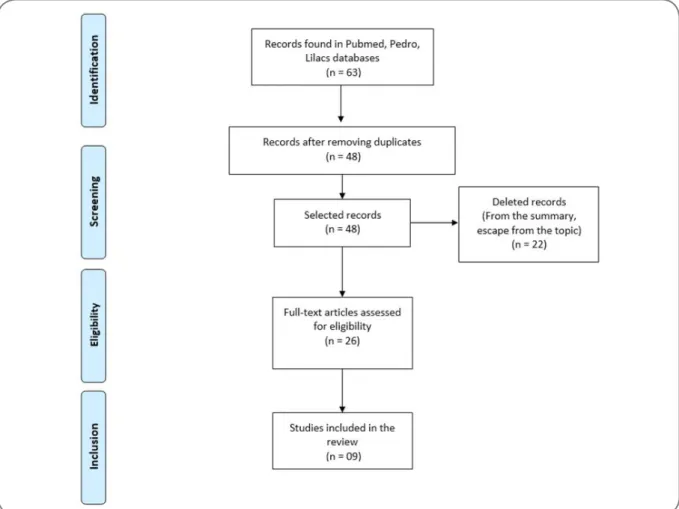
This study is an integrative literature review and research was carried out through the databases: PEDro, Pubmed, Lilacs, with articles published between 2011 and 2018, in Portuguese and English, using the terms: vasoactive drugs, early mobi-lity, exercise in ICU, vasopressor and its equivalents in Portuguese. The articles were evaluated according to the recommendation of “Oxford Center for Evidence-Based Medicine”: A) Systematic review (with homogeneity) of controlled and randomi-zed clinical trials. Controlled and randomirandomi-zed clinical trial with narrow confiden-ce interval. Therapeutic results of the “all or nothing” type; B) Systematic review (with homogeneity) of cohort studies. Cohort study (including randomized trial of lower quality). Observation of therapeutic results / Ecological study. Systematic re-view (with homogeneity) of case-control studies. Case-control study; C) Case reports (including lower quality cohort or case-control); D) Expert opinion without critical evaluation or based on basic subjects (physiological study or study with animals). In all the databases consulted, 63 articles were found and only nine were selected that fit the inclusion criteria, who underwent motor physiotherapeutic intervention in patients using VADs. Narrative / integrative or systematic review articles and stu-dies that did not make clear the use of VADs were excluded. The selection flowchart follows below, in figure 1.
Results
Nine articles were included, where patients were submitted to physical the-rapy intervention, with or without the use of VADs, with constant hemodynamic monitoring.
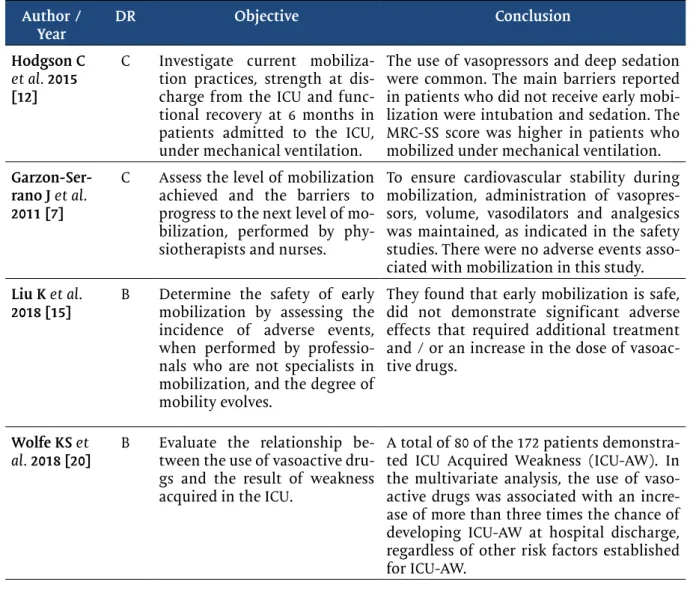
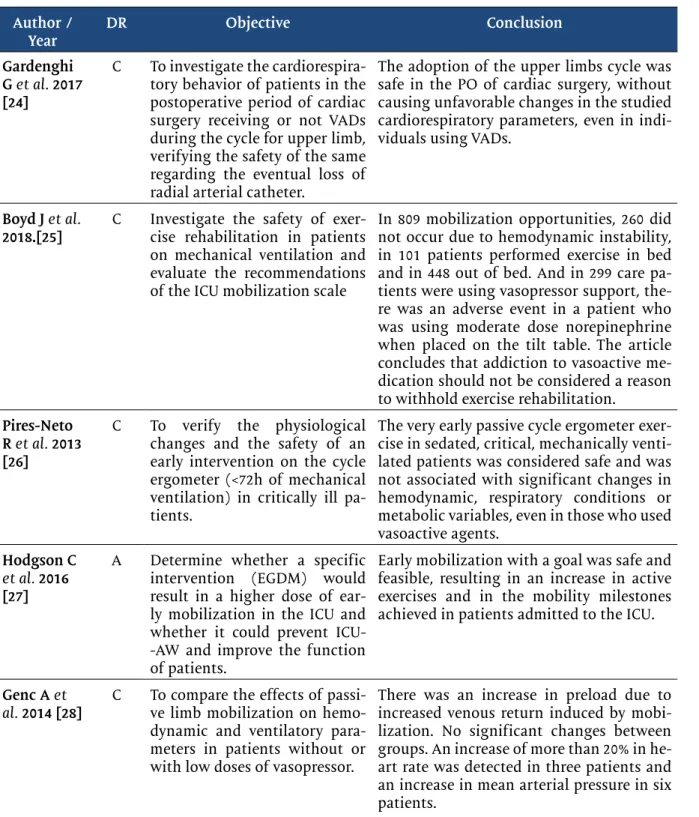
The results obtained through the selected studies are shown in tables I and II. Table I shows the name of the author, year of publication, the degree of evidence, the objective of the study and the conclusion obtained through the observed results. Ta-ble II shows the name of the author, year of publication, the sample of patients with their respective distribution and the physiotherapeutic intervention. It is important to note that the interventions described in Table II were different, but all were per-formed in a hospital environment. The results show that the use of VADs was not an obstacle to the performance of EM, as they did not cause hemodynamic instability, in addition to potentially improving the cardiovascular response to muscle activation. In addition, there were no adverse events that required an increase in the dose of VADs, showing, therefore, that their presence is not a contraindication for physical therapy interventions.
Table I - Degree of recommendation, objective of the study and the conclusion of the articles of early mobilization in patients using VAD.
Author /
Year DR Objective Conclusion
Hodgson C
et al. 2015
[12]
C Investigate current mobiliza-tion practices, strength at dis-charge from the ICU and func-tional recovery at 6 months in patients admitted to the ICU, under mechanical ventilation.
The use of vasopressors and deep sedation were common. The main barriers reported in patients who did not receive early mobi-lization were intubation and sedation. The MRC-SS score was higher in patients who mobilized under mechanical ventilation.
Garzon-Ser-rano J et al. 2011 [7]
C Assess the level of mobilization achieved and the barriers to progress to the next level of mo-bilization, performed by phy-siotherapists and nurses.
To ensure cardiovascular stability during mobilization, administration of vasopres-sors, volume, vasodilators and analgesics was maintained, as indicated in the safety studies. There were no adverse events asso-ciated with mobilization in this study. Liu K et al.
2018 [15] B Determine the safety of early mobilization by assessing the incidence of adverse events, when performed by professio-nals who are not specialists in mobilization, and the degree of mobility evolves.
They found that early mobilization is safe, did not demonstrate significant adverse effects that required additional treatment and / or an increase in the dose of vasoac-tive drugs.
Wolfe KS et
al. 2018 [20] B Evaluate the relationship be-tween the use of vasoactive dru-gs and the result of weakness acquired in the ICU.
A total of 80 of the 172 patients demonstra-ted ICU Acquired Weakness (ICU-AW). In the multivariate analysis, the use of vaso-active drugs was associated with an incre-ase of more than three times the chance of developing ICU-AW at hospital discharge, regardless of other risk factors established for ICU-AW.
Gardenghi G et al. 2017 [24]
C To investigate the cardiorespira-tory behavior of patients in the postoperative period of cardiac surgery receiving or not VADs during the cycle for upper limb, verifying the safety of the same regarding the eventual loss of radial arterial catheter.
The adoption of the upper limbs cycle was safe in the PO of cardiac surgery, without causing unfavorable changes in the studied cardiorespiratory parameters, even in indi-viduals using VADs.
Boyd J et al.
2018.[25] C Investigate the safety of exer-cise rehabilitation in patients on mechanical ventilation and evaluate the recommendations of the ICU mobilization scale
In 809 mobilization opportunities, 260 did not occur due to hemodynamic instability, in 101 patients performed exercise in bed and in 448 out of bed. And in 299 care pa-tients were using vasopressor support, the-re was an adverse event in a patient who was using moderate dose norepinephrine when placed on the tilt table. The article concludes that addiction to vasoactive me-dication should not be considered a reason to withhold exercise rehabilitation.
Pires-Neto R et al. 2013 [26]
C To verify the physiological changes and the safety of an early intervention on the cycle ergometer (<72h of mechanical ventilation) in critically ill pa-tients.
The very early passive cycle ergometer exer-cise in sedated, critical, mechanically venti-lated patients was considered safe and was not associated with significant changes in hemodynamic, respiratory conditions or metabolic variables, even in those who used vasoactive agents.
Hodgson C
et al. 2016
[27]
A Determine whether a specific intervention (EGDM) would result in a higher dose of ear-ly mobilization in the ICU and whether it could prevent ICU--AW and improve the function of patients.
Early mobilization with a goal was safe and feasible, resulting in an increase in active exercises and in the mobility milestones achieved in patients admitted to the ICU.
Genc A et
al. 2014 [28] C To compare the effects of passi-ve limb mobilization on hemo-dynamic and ventilatory para-meters in patients without or with low doses of vasopressor.
There was an increase in preload due to increased venous return induced by mobi-lization. No significant changes between groups. An increase of more than 20% in he-art rate was detected in three patients and an increase in mean arterial pressure in six patients.
DR = Degree of recommendation. ICU = Intensive Care Unit; MRC-SS = Medical Research Council Sum--Score; ICU-AW = Weakness acquired in the ICU; VAD = vasoactive drug; PO= Postoperative; EGDM = Early mobilization at the highest level of activity.
Table I – Continuation
Author /
Table II - Sample of patients with respective distribution in groups and type of intervention perfor-med on a patient using VAD.
Author/
Year No. of patients and distribution Treatment
Hodgson C
et al. 2015 N: 192VAD: 127 (68%) Mobilization was performed with exercises in bed, standing beside the bed or walking. On the third day, all mobilized patients were mechanically ventilated by an endotracheal tube.
Garzon-Ser-rano J, et al. 2011
N: 63 patients; 179 interven-tions; 131 interventions per-formed by nurses (50% of these patients with VADs), 48 inter-ventions performed by phy-siotherapists (65% of these pa-tients with VADs)
Level 1: Passive ROM for upper limbs and lower lim-bs, globally, and sitting on the bed.
Level 2: includes transferring the patient to a chair via a mechanical lift and / or sitting by the bed. Level 3: standing by the chair or side of the bed. Level 4: activities include walking the patient. Liu K et al.
2018 Patients admitted to the ICU: 839 selected patients: 232. 587 sessions were conducted. The incidence of adverse events, among all rehabilitation ses-sions, was 2.2%.
Level 1: No mobilization or exercises in bed. Level 2: Patient with elevated SP, including cycle ergometer and active mobilization.
Level 3: Bedside sedestation. Level 4: Active transfer to the chair. Level 5: Static or walking gait. Wolfe KS et
al. 2018 Sample of 172 patients The patients included in the study received physical and early occupational therapy within 72 hours of MV (early mobilization) or standard care as reques-ted by the physician.
Gardenghi
G et al. 2017 N: 26 patients Control group without VAD: 13 patients VAD group: 13 patients All sub-mitted to CS (myocardial re-vascularization and / or valve replacement) by median ster-notomy.
It was performed in the 1st PO, cycle ergometer for upper limbs for 5 minutes, with parameters evalua-ted during the activity: HR, SPO2, dyspnea, upper
limbs effort (Borg) and perfusion pressure (MAP).
Boyd J et al.
2018 Sample of 91 patients Exercises in or out of bed, evolving in the mobility scale according to the patient's clinical condition. Pires-Neto
R et al. 2013 19 patients on mechanical ventilation, 13 patients using VADs
They performed only passive lower limbs cycle ergo-meter exercise for 20 minutes using a cycleelectric ergometer, evaluating the following variables: MAP, SBP, HR and SPO2.
Hodgson C
et al. 2016 There were 50 patients enrolled in the study, 21 patients in the control group and 29 patients in the intervention group.
The EGDM protocol included active functional acti-vities, including walking, standing, sedestation and rolling. The patient could receive assistance from the team or equipment, but actively participated in the exercise at the highest functional level. EGDM starts at the highest level of activity that a patient can sus-tain and work to maximize activity.
Genc A et
al. 2014 Total patients: 120. GROUP 1 did not receive vasopressor (38 patients) GROUP 2 recei-ved vasopressor dopamine <10 μg / kg / min, noradrenaline / adrenaline <0.1 μg / kg / min (82 patients).
1 daily session of 10 repetitions of flexion-extension in each joint, both of upper and lower limbs.
VAD = Vasoactive Drug; ROM = Range of Motion; ICU = Intensive Care Unit; SP = supine position; MV = Mechanical Ventilation; CS = Cardiac Surgery; PO = Postoperative; HR = Heart Rate; SPO2 = Peripheral
Oxygen Saturation; MAP = Mean Arterial Pressure; SBP = Systolic Blood Pressure; EGDM = Early mobi-lization at the highest level of activity.
Discussion
The literary survey carried out and demonstrated in the results provided evi-dence that EM in the ICU, in the presence of VADs, can be a safe alternative in the care of critical patients, seeking to minimize the negative repercussions of bed im-mobilization.
The consensus of experts published in 2014 by Hodgson et al. [29] was unab-le to reach an agreement regarding the dose of VADs that can be considered safe to initiate early mobilization. However, Boyd et al. [25] evaluated the safety limits for exercise in intensive care units in patients using VADs, based on the same system of signs and colors as the consensus mentioned above, in which green means low risk of adverse events, yellow, when there are risks for mobilization, but the benefits overlap risks as long as the team is qualified and trained in the processes and red, when there is a potential risk of adverse events with serious consequences. In this prospective cohort study, there were 91 patients, and the authors recorded the most advanced form of exercise (that is, the exercise with the greatest muscle activation) used each day, defining active exercises performed in or out of bed as rehabilitation exercises. VADs were categorized, according to individual dose, into low, moderate and high doses. Patients who used more than one VAD were categorized according to the hi-ghest level of one of the medications [25].
In summary, there were 809 mobilization opportunities, with the physiothe-rapist who made the decision on the indication of mobilization, in 260 (32.1%) of these opportunities rehabilitation did not occur because passive mobilizations were performed, which for the authors was not considered a rehabilitation intervention. In the total of mobilizations performed, on 299 occasions the patients were using inotropes or vasopressors, in 144 (48.16%) of these occasions the exercise was not performed. The exercises in bed occurred in 41 (13.71%) of these sessions, and in 114 (38.12%) occasions they were performed out of bed. Of all these occasions, only one adverse event occurred when patients were on VAD support. This adverse event was defined as cardiovascular instability and occurred when using the tilt table in a pa-tient who was classified as receiving a moderate level of inotropic support (0.15 mcg / kg / min noradrenaline). At the conclusion of the study, they suggest that addiction to vasoactive medication should not be considered a reason to retain exercise reha-bilitation [25].
Camargo et al. [2] performed a single passive cycle ergometer exercise for lower limbs for 20 minutes in 19 hemodynamically stable patients, deeply sedated and mechanically ventilated. Among those evaluated, 13 (68%) were using noradre-naline. The hemodynamic, respiratory and metabolic variables were evaluated mi-nute by mimi-nute before, during and after exercise. The variables analyzed included: cardiac output, systemic vascular resistance, central venous oxygen saturation in the blood, respiratory rate and tidal volume, oxygen consumption, carbon dioxide, blood lactate production and levels. In conclusion, exercise was considered safe, not being associated with significant changes in hemodynamic, respiratory conditions or me-tabolic variables, even in those that required vasoactive agents.
Passive exercises (PE) are widely used in the treatment of unconscious pa-tients and an early start is recommended. Genc et al. [28] aimed to determine the effects of PE on hemodynamic and respiratory parameters in critically ill patients receiving vasopressor or inotropic support at a low dose. The medical records of 120 patients were evaluated and were retrospectively grouped into two groups in which thirty-eight patients did not receive vasopressor / inotropic support (group 1) and 82
patients received low-dose vasopressor / inotropic support (group 2). Central venous pressure, heart rate, mean arterial pressure, and oxygen saturation were recorded be-fore and immediately after PE. No statistically significant difference was observed in the rate of change in hemodynamic or respiratory parameters between the two groups after PE. This retrospective study confirmed that PE results in similar hemo-dynamic and respiratory changes in critically ill patients who received low doses of vasopressor / inotropic support compared to those who did not.
In a recent study by Gardenghi et al. [24], 26 patients underwent cardiac sur-gery for myocardial revascularization or valve replacement, performed with median sternotomy, and half were using dobutamine and norepinephrine with doses at me-dical discretion. They were submitted to active exercises on the 1st PO day using a cycle ergometer for upper limbs for 5 minutes with intensity assessed by effort and dyspnea (4 and 5 on the Borg scale), and by the parameters of HR, SpO2 and MAP. Gardenghi et al. were able to demonstrate that EM in this group was safe, as there were no related adverse events, and mainly, there were no abnormal hemodynamic changes even in patients using VADs.
Liu et al. showed that EM is safe, even when performed by professionals who are not specialized in EM, in a hospital without a culture of mobilization, perfor-ming basic training for only one month. They determined the safety of mobilization by assessing the incidence rate of adverse events in rehabilitation sessions. During 587 sessions there were 13 adverse events that included seven episodes of patient intolerance and six of orthostatic hypotension, and activity was stopped. There were no serious adverse events that required additional treatment such as increasing the dose of VAD [15]. In addition, it was observed that patients who received therapy for about 20 minutes, the real time being determined according to the case of each pa-tient, took an average time of 1.2 days to get out of bed.
Garzon-Serrano et al. [7] evaluated the level of mobilization performed by physiotherapists and nurses in patients admitted to the ICU, on a scale of 0 to 4, where 4 was the highest level of mobilization. Activities were carried out at the bed-side, transfers from bed to chair and gait training, so mobilization was considered a process of improving mobility in the ICU. The use of VADs was not a predictor of exclusion for mobilization, and they were used to maintain stable hemodynamic parameters, and their use did not promote adverse effects on patients. The level of patient mobilization achieved by physical therapists was higher than that achieved by nurses. Among the professionals, different mobilization barriers were identified, such as hemodynamic instability and renal replacement therapy, which were barriers more considered by nurses, while neurological impairment was classified as a higher barrier by physical therapists. Due to a direct relationship between the level of mo-bilization and the beneficial effects of it, initiatives to standardize this intervention among intensivists become important.
In the prospective multicenter cohort study carried out by Hodgson et al. [12], developed in 12 ICUs in Australia and New Zealand, with 192 patients, the prac-tice of EM, strength at discharge from the ICU and functional recovery of patients on mechanical ventilation were investigated. As barriers to EM, sedation and intuba-tion were identified. Activities were performed in bed, bedside and out of bed, with sedation, orthostasis, ambulation and active movements for upper limbs and lower limbs in flexion and extension, after an average of 5 days of hospitalization. Ambu-lation was performed after day 7 of hospitalization. 209 mobilizations were recorded, and there were no serious adverse events, except for 6 records where interruption due to cardiovascular or respiratory instability occurred, without the need for
medi-cal intervention. The use of VAD was present in 66% of the patients and was not an impediment to treatment. Thus, the MRC-SS score was higher in patients who were mobilized on MV (50.0 ± 11.2 versus 42.0 ± 10.8, P = 0.003). And yet, more than 50% of patients discharged from the ICU developed weakness acquired in the ICU associated with death after discharge.
In the study by Wolfe et al. [20], which consists of a secondary analysis of patients who were selected to receive early mobilization within 72 hours of MV, pa-tients were subjected to tests of muscle strength by the bed by a blind therapist, to assess whether had developed muscle weakness acquired in the ICU (ICU-AW). Of the 172 patients analyzed, 80 demonstrated ICU-AW at hospital discharge. The authors reported that the use of VADs was associated with a three-fold increase in the chances of developing ICU-AW, regardless of other established risk factors. They mention that this effect is directly associated with the duration of vasoactive medi-cation and the cumulative dose of norepinephrine, which is not seen in vasopressin and phenylephrine. They also observed that only the β-adrenergic groups of VADs (noradrenaline, epinephrine, dopamine and dobutamine) were significantly linked to the development of ICU-AW [20].
In 2016 Hodgson [27] followed an EM protocol, where patients performed ac-tivities at the highest level they could, aiming to maximize the safety of the mobiliza-tion. Patients were not excluded because they were using VAD, they were only exclu-ded from early mobilization if they had a norepinephrine dose> 0.2ug / kg / min or a 25% increase in the dose of any VAD in the last 6 hours. It resulted in an increase in mobility minutes performed by patients in the ICU, reaching a higher level of activity after discharge. On the other hand, four adverse events were reported, namely agita-tion and transient hypotension and only one was necessary to interrupt the therapy, none of which required complementary drug therapy.
This article has limitations that should be noted. As it is a literature review, it is not possible through it to specify that all literature on the subject has been inclu-ded, no matter how much the authors have tried to do so. It also includes different populations, which can interfere with the conclusion.
Conclusion
In the search to reduce the distance between scientific research and clinical practice, this literature review showed that early mobilization for ICU patients using vasoactive drugs proved to be effective and safe without promoting relevant hemo-dynamic and cardiorespiratory changes, which would determine their absolute con-traindication. Thus, in view of the beneficial responses, early mobilization can and should be used as a resource in intensive care, as long as there is a monitoring of risks by the multidisciplinary team.
Conflict of interest statement
No conflicts of interest with potential potential for this article have been reported. Financing source
There was no external funding source for this study. Authors’ contributions
Conception and design of the study: Gardenghi G and Spadari JAA. Data acquisition: Morais AM, Pe-nha DN, Costa DG and Schweling VBAF. Analysis and interpretation of data: Gardenghi G and JAAS. Writing of the manuscript: Morais AM, Penha DN, Costa DG and Schweling VBAF. Critical review: Gardenghi G and Spadari JAA.
References
1. Hodgson C, Needham D, Haines K, Bailey M, Ward A, Harrold M, Young P, Zanni J et al. Feasibility and inter-rater reliability of the ICU Mobility. Scale Heart & Lung: The Journal of Agute and Critical Care 2014;43(1):19–24. https://doi.org/10.1016/j.hrtlng.2013.11.003
2. Camargo JBG, Cavenaghi OM, Mello JRC, Brito MVC, Ferreira LL. Mobilidade funcional de pacientes críticos em terapia intensiva: um estudo piloto. Revista de Atenção à Saúde 2020;18(63):14-20.
3. Aquim EE, Bernardo WM, Buzzini RF, Azeredo NAG, Cunha LS, Damasceno MCP et al. Diretri-zes Brasileiras para Mobilização Precoce em Unidade de Terapia Intensiva. Rev Bras Ter Intensiva 2019;31(4):434-43. https://doi.org/10.5935/0103-507x.20190084
4. Timenetsky KT, Neto AS, Assunção MSC, Taniguchi L, Eid RAC, Corrêa TD. Mobilization practices in the ICU: A nationwide 1-day point- prevalence study in Brazil. PLoS ONE 2020;15(4):e0230971. https:// doi.org/10.1371/journal.pone.0230971
5. Hashem MD, Nelliot A, Needham DM. Early mobilization and rehabilitation in the ICU: moving back to the future. Respiratory Care 2016;61(7):971-9. https://doi.org/10.4187/respcare.04741
6. Tipping CJ, Harrold M, Holland A, Romero L, Nisbet T, Hodgson CL. The effects of active mobili-zation and rehabilitation in ICU on mortality and function: a systematic review. Intensive Care Med 2017;43:171-83. https://doi.org/10.1007/s00134-016-4612-0
7. Garzon-Serrano J, Ryan C, Waak K, Hirschberg R, Tully S, Bittner EA, Chipman DW, et al. Early mobilization in critically ill patients: patients’ mobilization level depends on health care provider’s profession. PM&R 2011;3(4):307-13. https://doi.org/10.1016/j.pmrj.2010.12.022.
8. Morris PE, Griffin L, Berry M, Thompson C, Hite RD, Winkelman C, Hopkins RO et al. Receiving early mobility during an intensive care unit admission is a predictor of improved outcomes in acute respiratory failure. Am J Med Sci 2011;341(5):373-7. https://doi.org/10.1097/MAJ.0b013e31820ab4f6. 9. Fontela PC, Lisboa TC, Forgiarini-Júnior LA, Friedman G. Early mobilization practices of mecha-nically ventilated patients: a 1-day point-prevalence study in southern Brazil. Clinics 2018;73:e241. http://doi.org/10.6061/clinics/2018/e241
10. Feliciano VA, Albuquerque CG, Andrade FMD, Dantas CM, Lopez A, Ramos FF et al. A influência da mobilização precoce no tempo de internamento na Unidade de Terapia Intensiva. ASSOBRAFIR Ciên-cia 2012;3(2):31-42
11. Pires-Neto RC, Lima NP, Cardim GM, Park M, Denehy L. Early mobilization practice in a single Brazilian Intensive Care Unit. J Crit Care 2015;30(5):896-900. https://doi.org/10.1016/j.jcrc.2015.05.004 12. Hodgson C, Bellomo R, Berney S, Bailey M, Buhr H, Denehy L, Harrold M et al. Early mobilization and recovery in mechanically ventilated patients in the ICU: a bi-national, multi-centre, prospective cohort study. Crit Care 2015;19(1):81. https://doi.org/ 10.1186/s13054-015-0765-4
13. McWilliams D, Jones C, Atkins G, Hodson J, Whitehouse T, Veenith T, Reeves E, et al. Earlier and enhanced rehabilitation of mechanically ventilated patients in critical care: a feasibility randomised controlled trial. J Crit Care 2018;44:407-12. https://doi.org/10.1016/j.jcrc.2018.01.001
14. Jolley SE, Moss M, Needham DM, Caldwell E, Morris PE, Miller RR, Ringwood N, et al. Point preva-lence study of mobilization practices for acute respiratory failure patients in the United States. Crit Care Med 2017;45(2):205-15. https://doi.org/10.1097/CCM.0000000000002058
15. Liu K, Ogura T, Takahashi K, Nakamura M, Ohtake H, Fujiduka K, Abe E, Oosaki H, et al. The safety of a novel early mobilization protocol conducted by ICU physicians: a prospective observational study. J Int Care 2018;(6):10. https://doi.org/10.1186/s40560-018-0281-0
16. Mendonça LBA, Madeiro AC, Lima FET, Barbosa IV, Brito MEM, Cunha LGP. Uso de catecolaminas de infusão contínua em pacientes de unidade de terapia intensiva. Rev Enferm UFPE on line 2012;6(1):26-31.
17. Fonseca JCL. Drogas vasoativas – Uso racional. Rev Soc Cardiol 2001;14:49-53.
18. Ostini FM, Antoniazzi P, Filho AP, Bestetti R, Cardoso MCM, Filho AB. O uso de drogas vasoativas em terapia intensiva. Simpósio: Medicina Intensiva: I. Infecção e choque; 1998;31:400-11.
19. Udesen NLJ, Helgestad OKL, Banke ABS, Frederiksen PH, Josiassen J, Jensen LO et al. Impact of concomitant vasoactive treatment and mechanical left ventricular unloading in a porcine model of profound cardiogenic shock. Crit Care 2020;24(1):95. https://doi.org/ 10.1186/s13054-020-2816-8 20. Wolfe KS, Patel BK, MacKenzie EG, Giovanni SP, Pohlman AS, Churpek MM et al. Impact of
vasoacti-ve medications on ICU-acquired weakness in mechanically vasoacti-ventilated patients. Chest 2018;154(4):781-7. https://doi.org/10.1016/j.chest.2018.02018;154(4):781-7.016
21. Jentzer JC, Coons JC, Link CB, Schmidhofer M. Pharmacotherapy update on the use of vasopressors and inotropes in the intensive care unit. J Cardiovasc Pharmacol Ther 2014;20(3),249-60. https://doi. org/10.1177/1074248414559838
22. Conceição TMA, Gonzáles AI, Figueiredo FCXS, Vieira DSR, Bündchen DC. Critérios de segurança para iniciar uma mobilização precoce em unidades de terapia intensiva. Revisão sistemática. Rev Bras Ter Intensiva 2017;29(4):509-19. https://doi.org/10.5935/0103-507x.20170076.
23. Fontanela PC, Jr Forgiarini LA, Friedman G. Atitudes clínicas e barreiras percebidas para a mobi-lização precoce de pacientes graves em unidades de terapia intensiva adulto. Rev Bras Ter Intensiva 2018;30(2);187-194. https://doi.org/10.5935/0103-507x.20180037
24. Gardenghi G, Kushida CL, Dias AB, Cruz JB, Lima KR, Souza AH. Estudo piloto da viabilidade no uso de cicloergômetro para membros superiores no primeiro dia pós-operatório de cirurgia cardíaca. Rev Pesqui Fisioter 2019;9(2):179-86. http://doi.org/10.17267/2238-2704rpf.v9i2.2303
25. Boyd J, Paratz J, Tronstad O, Caruana L, McCormack P, Walsh J. When is it safe to exercise mechani-cally ventilated patients in the intensive care unit? An evaluation of consensus recommendations in a cardiothoracic setting. Heart Lung 2018;47(2):81-6. https://doi.org/10.1016/j.hrtlng.2017.11.006 26. Pires-Neto RC, Kawaguchi YMF, Hirota AS, Fu C, Tanaka C, Caruso P et al. Very early passive cycling exercise in mechanically ventilated critically ill patients: physiological and safety aspects - A case se-ries. PLoS One 2013;8(9):e74182. https://doi.org/10.1371/journal.pone.0074182
27. Hodgson CL, Bailey M, Bellomo R, Berney S, Buhr H, Denehy L, Gabbe B et al. A binational multi-center pilot feasibility randomized controlled trial of early goal-directed mobilization in the ICU. Crit Care Med 2016;44(6):1145-52. https://doi.org/10.1097/CCM.0000000000001643
28. Genc A, Koca U, Ali G. What are the hemodynamic and respiratory effects of passive limb exercise for mechanically ventilated patients receiving low-dose vasopressor / inotropic support?. Crit Care Nurs Q 2014;37(2):152-8. https://doi.org/10.1097/CNQ.0000000000000013
29. Hodgson C, Stiller K, Needham D, Tipping C, Harrold M, Baldwin C, Bradley S, et al. Expert Consen-sus and recommendations on safety criteria for active mobilization of mechanically ventilated criti-cally ill adults. Crit Care 2014;18(6):658.