Vol.56, n.4: pp. 587-598, July-August 2013
ISSN 1516-8913 Printed in Brazil BRAZILIAN ARCHIVES OF
BIOLOGY AND TECHNOLOGY
A N I N T E R N A T I O N A L J O U R N A L
Quality Index Method (QIM) to Assess the Freshness and
Shelf Life of Fish
Daniella Cristina Bernardi
*, Eliane Teixeira Mársico and Mônica Queiroz de Freitas
Departamento de Tecnologia dos Alimentos; Faculdade Veterinária; Universidade Federal Fluminense; Rua Vital Brazil Filho, 64; 24230340 - Niterói - RJ - Brasil
ABSTRACT
The aim of this work was to develop a sensory method as the objective measure of quality of the fishes at all the key stages of fishery chain, from catch to consumer. The Quality Index Method (QIM) is based on a structured scaling for quality measurements and provides accurate and precise information concerning the freshness and a prediction of the remaining shelf-life for specie-specific fishes. The method is discussed and some future outlooks and need are pointed in order to stimulate the implementation of QIM in the relevant parts of the fishery chain giving unique information of the quality.
Key words: sensory analysis; fish quality; QIM, shelf life
*Author for correspondence: [email protected]
INTRODUCTION
Consumers demand for high-quality, safe, and healthy foods is increasing on a global basis (Sen 2005). Consumer studies appear to indicate that quality is still the key buying cue for fish purchases (Alasalvar et al. 2011). Besides, in order to secure the food safety, it is important to keep the quality of fishes at a high level in each link of the whole complex chain from catch to consumer (Hyldig and Nielsen 2004). Fresh fish is a highly perishable product. The supplies of fishes are unstable and fresh fish can be stored only for a short time. For commercialization, it is essential to estimate accurately its freshness, one of the most important aspects of fish and fish products (Olafsdóttir 1997; Huidobro et al. 2001). Thus, the need for rapid analytical techniques to measure the food quality and freshness is greater than ever. Many methods have been tested, but sensory evaluation is still considered as the most effective
technique to assess fish freshness and quality deterioration (Martinsdóttir 2002; Alasalvar et al. 2011). Often fish is sold and priced on freshness criteria. The fishes are brought on shore at designated landing sites where it is graded by fish inspector into different price groups based on the freshness using sensory analysis (Chebet 2010). Therefore, researchers have been working to improve the sensory methods (Huidobro et al. 2001).
advantages assigned to all the sensory analysis, such as non-destructive, quick and cheap way of assessing the freshness changes, QIM takes into account specific aspects of each species, or product, assessing the quality and freshness of the fish by sensory analysis of a set of attributes considered relevant and it allows estimating the remaining shelf-life time of a lot (Huidobro et al. 2001; Esteves and Anibal 2007). It was developed initially for whole fishes stored in ice but currently it is also applied, among other products, to frozen fishes and fillets (Nunes et al. 2007). Actually, QIMs are available for a large range of fish and crustacean species, both wild and farmed (Nielsen 2005). Most of the scoring systems are based upon the changes taking places during the storage in melting ice (Martinsdóttir 2002).
This method had been expected to become the leading reference method for the assessment of fresh fish within the European community (Hyldig and Green-Petersen 2004). However, more studies are needed to evaluate the applicability of QIM for the handling, storage and processing of the fishes under different conditions. A further interesting initiative is the development of software for QIM using a convenient hand-held terminal that allows data to be electronically imputed during the sensory assessment (Howgate 2009).
This study aimed to present information about QIM, an objective tool to evaluate freshness that lately has received great attention from the industry, marketing and inspection sector, mainly in Europe, in order to stimulate the implementation of QIM in the relevant parts of the fishery chain, and so, facilitating the fish trade, improving the quality assurance and ensuring the traceability of quality information of fish for the consumers.
IMPORTANCE
OF
SENSORY
EVALUATION OF FISH
Sensory evaluation is one of the most important methods for assessing freshness and quality in the fishing sector and in fish-inspection services. Sensory methods performed in a proper way are a rapid and accurate tool providing unique information about the food (Hyldig et al. 2007). They can be very fast, reliable, non-destructive on raw fish and no expensive instruments are needed. They give direct measurement of the perceived
attributes and provide information assisting in better understanding of consumer responses. However the panelists need training and retraining under the supervision of experienced panel leaders using fish samples of known freshness stage (Martinsdóttir 2002).
Sensory evaluation can be practiced at different levels in fish processing such as after landing, arriving at the fish plant (whole), at the reception, or processing halls of fish factories; evaluation of raw/cold and cooked fillets at the reception, or processing halls of fish factories, or at auction sites, very common in Europe (Martinsdóttir 2002; Hyldig et al. 2010). Traditionally, sensory methods have been seen as a subjective assessment of the quality. However, they can be turned into an objective tool (Hyldig et al. 2007). Progress has been made in sensory evaluation during the last years mainly because of the use of computers and data analysis. The work of collecting and analyzing data is not very time-consuming and the information on the results can be used and correlated with other information on the products as well. No single instrumental method has so far been foreseen to replace the sensory methods (Martinsdóttir et al. 2003).
THE QIM-METHOD
European fisheries research institutes have developed such a tool, by which sensory assessment is performed in a systematic way with an objective quality assessment method (Hyldig et al. 2007). The Quality Index Method (QIM), as it has come to be known, is a systematic, objective guideline that simplifies the quality-assessment process. It originated from Tasmania, during the late 1970s and early 1980s, by the Tasmanian Food Research Unit (TFRU) of the Commonwealth Scientific and Industrial Research Organization (CSIRO), but most QIM schemes have been developed in Europe, where the method is widely applied (Nielsen 2005).
species (Hyldig et al. 2010). It does not measure the quality itself, or freshness but rather the degree, or rate of change in important criteria used to describe these qualities (Green 2011).
QIM uses a practical rating system in which the fish is inspected and demerit points are recorded (Sen 2005). This approach was derived from the understanding that during the storage of fish, changes occur that are readily detectable and often measurable. This is also in keeping with the fact that the vast majority of chemical, biochemical, and microbiological tests on fish products start from either zero, or a low value and increase with both temperature and period of storage (Hyldig et al. 2010). The use of a scaling method establishes
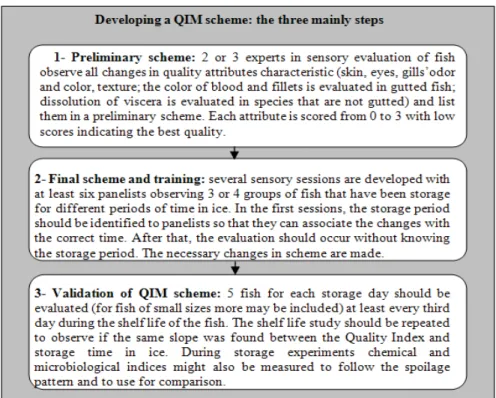
robust data, reflecting the different quality levels of the fish in a simple and well-documented way. The QIM is based on significant sensory quality parameters using the well-defined characteristics changes of outer appearance attributes for raw fish and a score system from 0 to 3 demerit points (Hyldig and Green-Petersen 2004; Martinsdóttir 2002). The technique (described in Fig. 1) is based on selecting a number of quality attributes characteristic for a particular species and allocating the scores to each attribute depending on the state of freshness, or quality of the selected food item (Sveinsdóttir et al. 2003).
Figure 1 – A general chart of the process necessary to develop a QIM scheme (Matinsdóttir 2002).
The attributes to be evaluated when applying, or developing the QIM schemes are skin, eyes, gills and texture. The odor of gills, and for some species, the odor and mucus of the skin are also evaluated. The color of the blood and fillets (or the cut surface at the flaps) is evaluated in the gutted fish. For some fish species that are not gutted, such as redfish, dissolution of viscera is evaluated as well (Martinsdóttir 2002).
al. 2010). The sum of all the attributes is called demerit points, or QIM index points. This value increases linearly with the storage time on ice of a given fish.
Using the QIM system, the linear relationship between the quality index (QI) and the storage time on the ice makes it easy to calculate the remaining shelf-life of fish (Hyldig et al. 2007). Since all the fishes have their own distinctive spoilage patterns and sensory attributes, QIM schemes are developed for the individual species (Green 2011). All the schemes have been developed using the seafood that have been produced according to good manufacturing practice (i.e., held in melting ice since the capture). This makes it possible to identify the seafood that shows atypical characteristics, or which appears to have spoiled more quickly than expected, which can be linked to poor practices such as high temperature spoilage, inadequate icing, etc (Archer 2010).
Although schemes can be readily expressed and constructed in different languages, a numerical value as an output is universal and can be understood by all. The score can be used to judge the handling and storage procedures, efficiencies of personnel, and duration of transport, and it is particularly useful in troubleshooting (Hyldig et al. 2007). The main advantages in using QIM are that it is non-destructive and it takes into account the differences between the species (Green-Petersen 2010). According to Nielsen (2005), QIMs are easier to use than some sensory methods and do not require any equipment other than the human senses. All the quality descriptors are well defined, and most of the schemes include thorough instructions with illustrations. As a result, limited training is needed to achieve accurate results. Martinsdóttir (2002) reported that as the Quality Index increased linearly with the storage time on the ice, the information was well suited to use in the production management. QIM is well suited to teach the inexperienced people to evaluate the fish, train the panelists and monitor the performance of the panelists since it is an objective method and includes instructions and easily understood illustrational material.
The QIM approach can be used by all links in the seafood supply chain – farmers, distributors, buyers, and consumers – assuring more uniform evaluation and fewer misunderstandings. With the QIM, it is possible to give more detailed information of the sensory quality, and thereby,
fulfill the primary producer’s demand. Using QIM scores, farmers can sort crops into quality categories and market them to the most appropriate customer segments. The processors can use the QIMs to estimate the shelf-life and plan the production more efficiently (Nielsen 2005). The QIM can also measure the influences of transport/storage on the sensory quality and the remaining shelf-life when the fish/fish product is stored on the ice (Hyldig and Green-Petersen 2004). For the electronic auctions, where buyers purchase the fishes unseen, QIMs have an obvious advantage over other sensory methods. The quality indexes can also play an important role in the traceability, because such data can be applied through the entire chain to check the accuracy (Nielsen 2005).
Hyldig et al. (2007) found that the result obtained in the scheme could be used as an index of what the material might be like for an appropriate end use. This may be a judgment of its ability to withstand a process, or its selection for a particular grade of the product, or it may foreshadow what the product is anticipated to be like when it is cooked and eaten by the consumer (Hyldig et al. 2007).
QIM DATA ANALYSIS
QIM SCHEMES
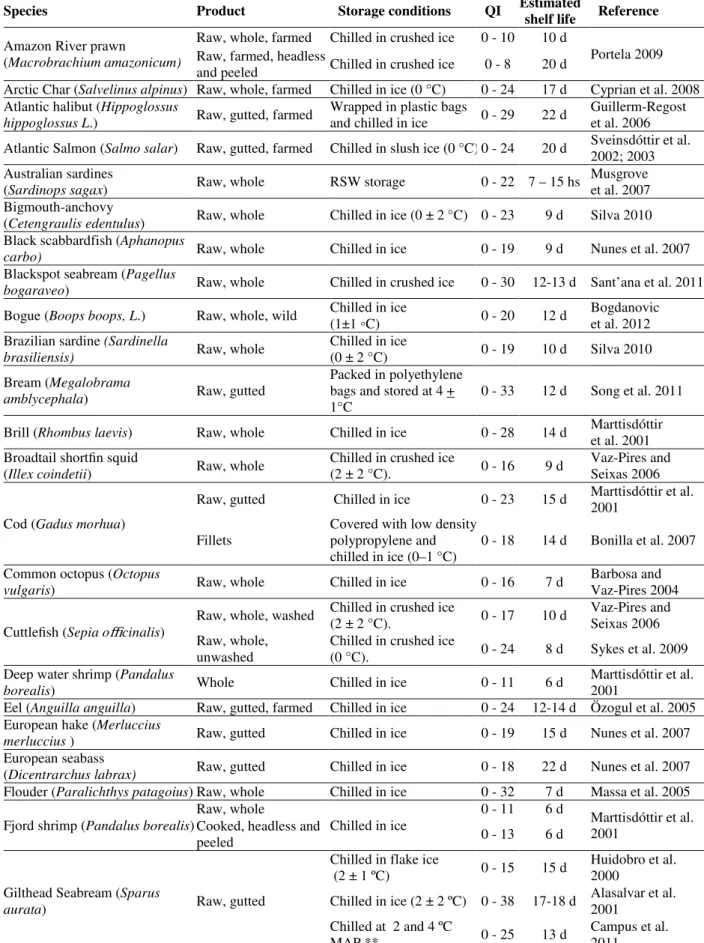
QIM advantages have led to the development of specific schemes for different species in several countries. QIM schemes are available for a range of wild and farmed fishes and crustaceans, particularly in Europe. Table 1 summarizes the schemes built for 49 different fishes species, between 2000 and 2011 available in the scientific literature, with the respective storage conditions, Quality Index (QI) range and estimated shelf life. Besides these species, there are seven more compiled by Barbosa and Vaz-Pires (2004) built between 1992 and 1999.
Although there are 49 fish species listed in Table 1, 56 specifically designed QIM schemes are presented for different products, sometimes of the same species. In the case of shrimps for example, there are two schemes for each species,
Macrobrachium amazonicum (Portela 2009),
Pandalus borealis (Martinsdóttir et al. 2001) and
Litopenaeus vannamei (Oliveira et al. 2009), one
for raw and whole, and other for the headless and/or peeled crustacean. It’s interesting to notice that for all these schemes the parameters odour and colour were evaluated.
Other species that present two developed QIM schemes are cod (Gadus morhua), cuttlefish (Sepia
officinalis), and gilthead seabream (Sparus
aurata). For cod, one scheme was developed to
evaluate the raw and gutted fishes (Martinsdóttir et al. 2001) and one for the raw cod fillets with skin (Bonilla et al. 2007), the unique scheme for fillets developed between 2000 and 2011 available in scientific literature. The number of parameters included in the QIM scheme developed for fresh cod fillets (8) were lower than that developed for the raw gutted fishes (10). The same was observed for the shelf-life (14 days for fillets, 15 for fish). Vaz-Pires and Seixas (2006) developed the first QIM scheme for the cuttlefish using raw samples, whole and washed with tap water before the storage on the ice. Sykes et al. (2009), reporting this as not a common procedure in the fishing industry, developed a QIM scheme for unwashed cuttlefish. Different parameters between the schemes were used and head and mantle cavity were included as attributes, with three and four parameters to evaluate each one. This allowed a more accurate analysis of spoilage in
S. officinalis. As show- in Table 1, lower QIM
scores and a higher shelf life for the one washed before storage were obtained.
QIMs schemes were proposed for the raw and gutted gilthead seabream (Sparus aurata) stored
on the ice (Huidobro et al. 2000) and for gilthead seabream packed under MAP (Campus et al. 2011). Comparing both, the QIM scheme developed by Campus et al. (2011) has a higher number of parameters (13 instead of 8) and higher total demerit points (25 instead of 15). These authors included in the scheme some useful parameters to discriminate early fish freshness modifications, namely rigor state, pupil and muscle color. Moreover belly firmness, which was found always to sunken in the latter stages of storage in MAP, and the gills mucus, which was related to microbial proliferation and degradation of gills tissues, were also included in the parameter list. The maximum storage time was 15 and 13 days to gilthead seabream storage on the ice and at 4°C for MAP 60% CO2 and 40% N2,
respectively (Campus et al. 2011).
Differing from gilthead seabream, processed herring (Clupea harengus) named Maatjes herring,
a lightly salted and fermented ready-to-eat fish product, very popular in The Netherlands, had developed just one QIM scheme for both the stored in air and under modified atmosphere packaging (MAP) (Lyhs and Schelvis-Smit 2005). According to the authors, for the first time, the taste was included in a QIM scheme. Since natural variations and processing of the maatjes herring limited the use of the QIM scheme, they proposed that the product-specific differences and storage conditions must be specified in more detail. Most of the scoring systems shown in Table 1, for example, 52 from a total of 55 proposed schemes, representing 94,54%, are based upon the changes taken place during the storage in melting ice. However, it is also possible to develop the QIM schemes that can be used, for example, to evaluate the freshness in the thawed fish such as for Maatjes herring (Clupea harengus) (Lyhs and
Schelvis-Smit 2005), frozen fish for hake
(Merluccius capensis and M. paradoxus) (Herrero
et al. 2003) and Refrigerated Sea Water (RSW) storage for Australian sardines (Sardinops sagax)
Table 1 - QIM schemes built for 49 different fish species, between 2000 and 2011 available in the scientific literature, with the respective storage conditions, Quality Index (QI) range and estimated shelf life.
Species Product Storage conditions QI Estimated
shelf life Reference
Amazon River prawn
(Macrobrachium amazonicum)
Raw, whole, farmed Chilled in crushed ice 0 - 10 10 d
Portela 2009 Raw, farmed, headless
and peeled Chilled in crushed ice 0 - 8 20 d
Arctic Char (Salvelinus alpinus) Raw, whole, farmed Chilled in ice (0 °C) 0 - 24 17 d Cyprian et al. 2008
Atlantic halibut (Hippoglossus
hippoglossus L.) Raw, gutted, farmed
Wrapped in plastic bags
and chilled in ice 0 - 29 22 d
Guillerm-Regost et al. 2006 Atlantic Salmon (Salmo salar) Raw, gutted, farmed Chilled in slush ice (0 °C) 0 - 24 20 d Sveinsdóttir et al. 2002; 2003
Australian sardines
(Sardinops sagax) Raw, whole RSW storage 0 - 22 7 – 15 hs
Musgrove et al. 2007 Bigmouth-anchovy
(Cetengraulis edentulus) Raw, whole Chilled in ice (0 ± 2 °C) 0 - 23 9 d Silva 2010
Black scabbardfish (Aphanopus
carbo) Raw, whole Chilled in ice 0 - 19 9 d Nunes et al. 2007
Blackspot seabream (Pagellus
bogaraveo) Raw, whole Chilled in crushed ice 0 - 30 12-13 d Sant’ana et al. 2011
Bogue (Boops boops, L.) Raw, whole, wild Chilled in ice (1±1
◦C) 0 - 20 12 d
Bogdanovic et al. 2012 Brazilian sardine (Sardinella
brasiliensis) Raw, whole
Chilled in ice
(0 ± 2 °C) 0 - 19 10 d Silva 2010 Bream (Megalobrama
amblycephala) Raw, gutted
Packed in polyethylene bags and stored at 4 +
1°C 0 - 33 12 d Song et al. 2011 Brill (Rhombus laevis) Raw, whole Chilled in ice 0 - 28 14 d Marttisdóttir et al. 2001
Broadtail shortfin squid
(Illex coindetii) Raw, whole
Chilled in crushed ice
(2 ± 2 °C). 0 - 16 9 d Vaz-Pires and Seixas 2006
Cod (Gadus morhua)
Raw, gutted Chilled in ice 0 - 23 15 d Marttisdóttir et al. 2001
Fillets
Covered with low density polypropylene and
chilled in ice (0–1 °C) 0 - 18 14 d Bonilla et al. 2007 Common octopus (Octopus
vulgaris) Raw, whole Chilled in ice 0 - 16 7 d
Barbosa and Vaz-Pires 2004
Cuttlefish (Sepia officinalis)
Raw, whole, washed Chilled in crushed ice (2 ± 2 °C). 0 - 17 10 d Vaz-Pires and Seixas 2006 Raw, whole,
unwashed
Chilled in crushed ice
(0 °C). 0 - 24 8 d Sykes et al. 2009 Deep water shrimp (Pandalus
borealis) Whole Chilled in ice 0 - 11 6 d
Marttisdóttir et al. 2001
Eel (Anguilla anguilla) Raw, gutted, farmed Chilled in ice 0 - 24 12-14 d Özogul et al. 2005
European hake (Merluccius
merluccius ) Raw, gutted Chilled in ice 0 - 19 15 d Nunes et al. 2007
European seabass
(Dicentrarchus labrax) Raw, gutted Chilled in ice 0 - 18 22 d Nunes et al. 2007
Flouder (Paralichthys patagoius) Raw, whole Chilled in ice 0 - 32 7 d Massa et al. 2005
Fjord shrimp (Pandalus borealis)
Raw, whole
Chilled in ice 0 - 11 6 d Marttisdóttir et al. 2001 Cooked, headless and
peeled 0 - 13 6 d
Gilthead Seabream (Sparus
aurata) Raw, gutted
Chilled in flake ice
(2 ± 1 ºC) 0 - 15 15 d Huidobro et al. 2000 Chilled in ice (2 ± 2 ºC) 0 - 38 17-18 d Alasalvar et al. 2001 Chilled at 2 and 4 ºC
MAP ** 0 - 25 13 d
Cont. Table 1
Species Product Storage conditions QI Estimated
shelf life Reference
Goldband goatfish(Upeneus
moluccensis) Raw, gutted Chilled in flake ice 0 - 18 8 d Özyurt et al. 2009
Haddock (Melanogrammus
aeglefius) Raw, gutted Chilled in ice 0 - 23 15 d
Marttisdóttir et al. 2001
Hake (Merluccius capensis and
M. paradoxus) Raw, gutted Frozen at - 20 ºC 0 - 17 20 m Herrero et al. 2003
Herring (Clupea harengus) Raw, gutted Chilled in ice 0 - 20 8 d Marttisdóttir et al. 2001 Horse Mackerel (Trachurus
trachurus) Raw, gutted Chilled in ice 0 - 16 7 d Nunes et al. 2007
Hybrid striped bass (Morone
saxalis x Morone chrysops) Raw, whole, farmed Chilled in ice 0 - 14 14 d
Nielsen and Green 2007 Lobster (Panulirus Argus) Pre-cooked, whole Chilled in ice pack at 0 - 4º C 0 - 12 10 d Silva 2009
Maatjes herring (Clupea harengus)
Raw, beheaded, ungutted and brined
Thawed and chilled at
4 ºC unpacked 0 - 25 1 d Lyhs and Schelvis-Smit 2005 Thawed and chilled at
4 ºC MAP ** 4 d
Maroccan Sardine (Sardina
pilchardus) Raw, whole Chilled in crushed ice 0 - 22 4 d
Triqui and Bouchriti 2003 Meder’s mangrove crab
(Neoepisesarma mederi) Raw, whole
Packed in polyethylene zip bag and chilled in flake ice (0-2 °C)
0 - 23 6 d Noojuy and Boonprab 2008
Mediterranean anchovies
(Engraulis encrasicholus) Raw, whole Chilled in ice 0 - 23 5 d
Pons-Sachéz-Cascado et al. 2006 Mediterranean Hake (Merluccius
merluccius var. mediterraneus) Raw, gutted
Chilled in flake ice
(0 °C) 0 - 19 14 d
Baixas-Nogueras et al. 2003 Plaice (Pleuroectes platessa) Raw, whole Chilled in ice 0 - 24 13 d Marttisdóttir et al. 2001
Pollock (Pollachius virens) Raw, gutted Chilled in ice 0 - 23 18 d Marttisdóttir et al. 2001
Rainbow trout (Onchorhynchus
mykiss) Raw, whole Chilled in ice 0 - 100 14-16 d
Wünnenburg and Oehlenschäger 2008
Red mullet (Mullus barbatus) Raw, gutted Chilled in flake ice 0 - 18 11 d Özyurt et al. 2009
Redfish (Sebastes
mentella/marinus) Raw, whole Chilled in ice 0 - 23 18 d
Marttisdóttir et al. 2001 Sea Bass (Dicentrarchus
labrax)
Raw, whole, farmed
and wild Chilled in flake ice (2-4o C) 0 - 39 16-18 d Alasalvar et al. 2002 Senegalese sole (Solea
senegalensis) Raw, whole, farmed Chilled in ice 0 - 22 15 d
Gonçalves et al. 2007
Shrimp (Litopenaeus vannamei) Raw, whole, farmed Raw, headless, farmed Chilled in ice 0 - 10 0 - 8 12 d 14 d Oliveira et al. 2009
Silver scabbardfish (Lepidopus
caudatus) Raw, whole Chilled in ice 0 - 17 11 d
Nunes et al. 2007
Sole (Solea vulgaris) Raw, whole Chilled in ice 0 - 28 15 d Marttisdóttir et al. 2001
Tilapia (Oreochromis niloticus) Raw, gutted, farmed Chilled in ice (0,3ºC ± 0,35) 0 - 19 15 d Rodrigues 2008
Tub gurnard (Chelidonichthys
lucernus) Raw, whole Chilled in ice 0 - 22 18-19 d Bekaert 2006
Turbot (Scophtalmus maximus) Raw, whole Chilled in ice 0 - 28 15 d Marttisdóttir et al. 2001
Whitemouth croaker
(Micropogonias furnieri) Raw, gutted Chilled in ice 0 - 22 14 d
Teixeira et al. 2009
DIFFERENT
PROCEDURES
AND
PROCESSING TECHNOLOGY
The usefulness of QIM is to determine how different ways of handling, processing, and storage conditions affect the fish shelf life such as under MAP and temperature abuse during the storage (Martinsdóttir et al. 2003). The QI is not only species related, but also related to the processing technology adopted, so different schemes should take into account products’ specific differences (Lyhs and Schelvis-Smit 2005). Huidobro et al. (2001) investigated the effect of washing gilthead seabream (Sparus aurata) with tap water during
the storage on the results of sensory evaluation by QIM. The results indicated that washing reduced the demerit points assigned when the raw gilthead seabream was evaluated with the QIM. The maximum allowable score for this species was not reached in the washed fishes even when the storage period set on the basis of both sensory and microbiological considerations was exceeded. Washing also delayed the limit of microbiological acceptability.
The QIM evaluations were also performed on whole herring (Clupea harengus L.) by Nielsen
and Hyldig (2004), from ten seasonally and geographically distributed cruises and related to handling procedures. A significant difference was found between how fast the changes occur (i.e., the slope values) in the odor of whole herring
(Clupea harengus L.), the appearance of eyes and
the odor of gills in ice and tank-stored herring
(Clupea harengus L.). Tank stored herring (Clupea
harengus L.) obtained higher demerit points than
the ice stored herring (Clupea harengus L.) for all
the descriptors, except blood on gill cover. The QIM evaluations performed on herring (Clupea
harengus L.) from ten cruises over a nine-month
period showed the onboard storage methods to have profound influence on the quality.
Nielsen and Green (2007) developed a QIM for farmed hybrid striped bass (Morone saxalis x
Morone chrysops). Two farms participated in the
QIM development with different fishes: one farmer harvested directly from the pond; the other included a purging step in which residual feed was removed from the stomachs of the fishes by placing the fish in a tank with clear fresh water. The differences in the quality due to these procedures could be quantified with the QIM. It was found that hybrids harvested directly from the
pond more frequently had muddy, or earthy odors than the purged fish. It was inferred that fish farmers could use such data to get a better picture of how different practices influenced the quality of their products and adjust their procedures accordingly. Using the QIM scores, they can sort crops more precisely into quality categories and market them to the most appropriate customer segments.
Besides handle, different storage condition can also present different effects. Cyprian et al. (2008) reported that during the fish storage, it is not uncommon that a batch is temporarily exposed to higher temperature. Based on that, changes during the storage were observed in two groups of farmed arctic char (Salvelinus alpinus) using the QIM method. One group was stored on ice up to 18 days and the other was stored at 18°C for 24 h (temperature increased from 3 to 12°C), then iced and stored up to 18 days. This increase in the temperature for a short time led to two days shorter storage life of arctic char (Salvelinus
alpinus) stored on ice (15 days for the
temperature-abused fishes and 17 days for the other group). The spoilage in abused fishes was predominantly bacterial, while in well-handled fishes, it occurred as a result of both bacterial and chemical activities.
Campus et al. (2011) evaluated the effect of MAP packed farmed gilthead seabream (Sparus aurata)
The knowledge of shelf-life limiting factors of different fishes species from different the aquatic environments and under different packaging conditions is still limited, hence, studies are needed to optimize the packaging technique and to assess the quality of the fishes during the storage. Specific QIM schemes for variable combinations of fishes species aquatic environment (related to specific microbial contamination) packaging technology need to be developed (Campus et al. 2011).
FUTURE TRENDS
Thus, it is evident that there is strong need for further studies to provide the European fish sector with multilingual tool for all the important fishes species (Martinsdóttir et al. 2003). The QIM has not been developed for all the commercially important fish species in Europe. Studies are also needed to evaluate the effects of different environmental factors (i.e., packaging, processing, and transport) on the sensory properties and consequently, on the applicability of the QIM. The knowledge of these influences could open up the opportunities for greater control of sensory quality and differentiation of the products. This would also stimulate improvements in the production of seafood of enhanced quality to meet consumers’ preferences (Hyldig et al. 2007). Adoption of QIM in the EU and other countries would greatly aid in standardizing the trade in fish and fishes products worldwide (Green 2011). In Brazil, for example, there are some studies developing the QIM scheme for important commercial species such as
Piaractus mesopotamicus, Colossoma
macropomum, Colossoma macropomum (F) x
Piaractus mesopotamicus (M) (Borges et al.),
Lophius gastrophysus (Bernardi et al.) and
Priacanthus arenatus (Amaral et al.) (unpliblished
data).
It is foreseen that the QIM will be useful to give the feedback to the fishermen concerning the quality of their catch, which may influence better handling on-board. A so-called ‘catch-index’ containing the QIM points may contribute to quality assurance in the whole chain. Fish processing plants would also like to control the freshness stage of their raw material. The QIM-evaluation of raw material kept on ice could provide accurate and precise information concerning the freshness and a prediction of the
freshness of fillets later to be inspected by the buyers. Sensory evaluation might also contribute to a ‘processing index’ (Nielsen et al. 2002; Hyldig and Nielsen 2004). Given the usefulness of this method, it is expected that the QIM will become the leading reference method for the assessment of fresh fishes in Europe in the future (Hylgig and Green-Petersen 2004).
The QIM schemes have been developed from the viewpoint of the industry and technical studies, but there have also been studies on developing a version for the consumer QIM (C-QIM) (Warm 2000). C-QIM is developed with the use of an external panel testing their own vocabulary in comparison with the QIM terms of experts. In this scheme, only the intrinsic quality parameters are considered such as the appearance, odor and texture (Hyldig and Nielsen 2004). C-QIM is a tool for decision making for the consumer buying the fish in a market, or at the fishmonger (Nielsen et al. 2002) and its introduction may help the consumer to get a good sensory quality product and learn more about the quality and its variation (Hyldig et al. 2007). Further work in this area is ongoing as new tools are being investigated for the delivery of the QIM with new species and wider use by the industry and consumer groups (Green 2011). According to Nielsen et al. (2002), further attempt to combine the QIM for the raw fishes, profiling for the cooked fillet and C-QIM might, therefore, prove to be a successful in ‘translating’ the values for sensory quality through the chain. Fish trade via e-commerce is growing and information on the freshness and quality of the fishes traded unseen must be as inevitable as information on the price given (Martinsdóttir et al. 2003). Objective and standardized sensory methods would make information on fish quality more reliable and readily accessible and would facilitate and enhance the quality and process management in the fish industry. Moreover, a standardized sensory method would facilitate the communication between the buyers and sellers of the fishes and fulfill the demands of inspection authorities and regulations for tracking and tracing the information about the quality of the fishes. It would minimize the cost and effort if the buyers and sellers used the same method (Martinsdóttir 2002).
Nielsen et al. (2002) pointed its limitation that only the intrinsic quality cues were considered in the QIM (or other descriptive and discriminative sensory methods). Thus, there was need of a more global approach that also involves the extrinsic quality cues, and suggested the creation of a Total Food Model for the fish, which should contain both objective and subjective quality cues. The model should not only consider the consumer perspective but should also include the perceived quality in the different parts of the chain. In this way it would be possible to recommend the appropriate sensor method for quality measurement in a specific link of the chain.
CONCLUSIONS
Considering the increase in the demand for information about the quality and freshness by the consumers and growth of e-commerce, QIM appears to be an easy, rapid and efficient tool to assess the storage history and estimate the remaining shelf-life of the fish. The implementation of this standardized method for all the key stages of fishes chain for evaluating the quality freshness of the fishes would help the industry supply safe, high-quality and health-promoting fish-products, giving a unique value to it. The cooperation between the research institutes and industry would be considered essential for QIM promotion and optimization, developing new schemes for different handling, storage and packaging conditions.
REFERENCES
Alasalvar C, Grigor JM, Ali Z. Practical evaluation of fish quality by objective, subjective, and statistical testing. In: Alasalvar C, Shahidi F, Miyashita K, Wanasundara U, editors. Handbook of seafood quality, safety and health applications. New Delhi: Blackwell Publishing Ltd; 2011. p.13-29.
Alasalvar C, Taylor KDA, Öksüz A, Garthwaite T, Alexis, MN, Grigorakis K. Freshness assessment of cultured sea bream (Sparus aurata) by chemical,
physical and sensory methods. Food Chem. 2001; 72:
33-40.
Alasalvar C, Taylor KDA, Öksüz A, Shahidi F, Alexis M. Comparison of freshness quality of cultured and wild sea bass (Dicentrarchus labrax). J Food Sci.
2002; 67: 3220-3226.
Archer M. Sensory assessment score sheets for fish and shellfish - Torry & QIM. Edinburgh: Seafish; 2010. Baixas-Nogueras S, Bover-Cid S, Veciana-Nogués T,
Nunes ML, Vidal-Carou MC. Development of a Quality Index Method to evaluate freshness in mediterranean hake (Merluccius merluccius). J Food Sci. 2003; 68(3): 1067-1071.
Barbosa A, Vaz-Pires P. Quality Index Method (QIM): development of a sensorial scheme for common octopus (Octopus vulgaris). Food Control. 2004; 15:
161-168.
Bekaert K. Development of Quality Index Method scheme to evaluate freshness of tub gurnard (Chelidonichthys lucernus). In: Luten JB, Jacobsen C,
Bekaert K, Sæbo A, Oehlenschlager J, editors. Seafood research from fish to dish. Wageningen: Wageningen Academic Publishers; 2006. p. 289-296. Bogdanovic T, Simat V, Frka-Roic A, Markovic K.
Development and application of Quality Index Method scheme in a shelf life study of wild and fish farm affected bogue (Boops boops, L.). J Food Sci.
2012; 0: 51-58.
Bonilla AC, Sveinsdottir K, Martinsdottir E. Development of Quality Index Method (QIM) scheme for fresh cod (Gadus morhua) fillets and
application in shelf life study. Food Control. 2007;
18(4): 352-358.
Campus M, Bonaglini E, Cappuccinelli R, Porcu MC, Tonelli R, Roggio T. Effect of modified atmosphere packaging on Quality Index Method (QIM) scores of farmed gilthead seabream (Sparus aurata L.) at low
and abused temperatures. J Food Sci. 2011; 76(3):
185-191.
Chebet L. “Rapid” (alternative) methods for evaluation of fish freshness and quality [Msc Thesis]. Akureyri, Iceland: University of Akureyri; 2010.
Cyprian OO, Sveinsdóttir K, Magnússon H, Martinsdóttir E. Application of Quality Index Method (QIM) scheme and effects of short-time temperature abuse in shelf life study of fresh water artic char (Salvelinus alpinus). J Food Prod. Technol. 2008;
17: 303-321.
Esteves E, Aníbal J. Quality Index Method (QIM): utilização da análise sensorial para determinação da qualidade do pescado. In: XIII Congresso do Algarve: Actas Proceedings; 2007 Nov; Racal-Clube, Lagos, Portugal. Lagos: Racal-Clube; 2007. p. 365-373.
Gonçalves AC. Qualidade e valorização em aquacultura: Propriedades sensoriais e período de conservação útil de peixe e bivalves [Doc Thesis]. Lisboa, Portugal: Universidade de Lisboa; 2010. Green DP. Sensory evaluation of fish freshness and
Green-Petersen DMB. Sensory quality of seafood – in the chain from catch to consumption [PhD Thesis]. Copenhagen, Denmark: University of Denmark; 2010.
Guillerm-Regost C, Haugen T, Nortvedt R, Carlehög M, Lunestad BT, Kiessling A, et al. Quality characterization of farmed atlantic halibut during ice storage. J Food Sci. 2006; 71(2): 83-90.
Herrero AM, Huidobro A, Careche M. Development of a Quality Index Method for frozen hake (M. Capensis and M. Paradoxus). J Food Sci. 2003; 68(3):
1086-1092.
Howgate P. Traditional methods. In: Rehbein H, Oehlenschläger J, editors. Fishery products: quality, safety and authenticity. Oxford: Blackwell Publishing Ltd, 2009. p.19-41.
Huidobro A, Pastor A, Tejada M. Quality index method developed for raw gilthead seabream (Sparus aurata). J Food Sci. 2000; 65: 1202-1205.
Huidobro A, Pastor A, López-Caballero ME, Tejada M. Washing effect on the Quality Index Method (QIM) developed for raw gilthead seabream (Sparus aurata).
Eur Food Res Techno. 2001; 212(4): 408-412.
Hyldig G, Bremner A, Martinsdóttir E, Schelvis R. Quality Index Methods. In: Nollet LML, Boylston T, Chen F, editors. Handbook of meat, poultry and seafood quality. Oxford: Blackwell, 2007. p. 499-510.
Hyldig G, Green-Petersen, DMB. Quality Index Method - an objective tool for determination of sensory quality. J Aquat Food Prod. Technol. 2004;
13(4): 71-80.
Hyldig G, Martinsdóttir E, Sveinsdóttir K, Schelvis R, Bremner A. Quality Index Methods. In: Nollet LML, Toldrá F, editors. Handbook of seafood and seafood products analysis. New Jersey: CRC Press; 2010. p. 463-481.
Hyldig G, Nielsen J. QIM - a tool for determination of fish freshness. In: Shahidi F, Simpson BK, editors. Seafood quality and safety- advances in the new millennium. St John´s: Science Tech. Publishing Company; 2004. p. 81-89.
Lyhs U, Schelvis-Smit R. Development of a Quality Index Method (QIM) for maatjes herring stored in air and under modified atmosphere. J Aquat Food Prod Technol. 2005; 14: 63-76.
Martinsdóttir E, Sveinsdottir K, Luten JB, Schelvis-Smit R, Hyldig G. Reference manual for the fish sector: sensory evaluation of fish freshness. Ijmuiden: QIM Eurofish; 2001.
Martinsdóttir E. Quality management of stored fish. In: Bremner A, editor. Safety and quality issues in fish processing. Hirtshals: Woodhead Publishing Ltd.; 2002. p. 360-378.
Martinsdóttir E, Luten JB, Schelvis-Smit AAM, Hyldig G. Developments of QIM - past and future. In: Luten JB, Oehlenschlåger J, Ólafsdóttir G, editors. Quality of fish from catch to consumer. Netherlands: Wageningen Academic Publishers; 2003. p. 265-272. Massa AE, Palacios DL, Paredi ME, Crupkin M.
Postmortem changes in quality indices of ice-stored flounder (Paralichtys patagonicus). J Food Biochem.
2005; 29: 570-590.
Musgrove R, Carragher J, Mathews, Slattery S. Value-adding australian sardines: factors affecting rates of deterioration in sardine (Sardinops sagax) quality
during post-harvest handling. Food Control. 2007;
18:1372-1382.
Nielsen D. Quality Index Method provides objective seafood assessment. Glob Aquacutl Advoc. 2005;
36-38.
Nielsen D, Green D. Developing a quality index grading tool for hybrid striped bass (Morone saxatilis x Morone chrysops) based on the Quality Index
Method:. IntJ Food Sci Tech. 2007; 42(1): 86-94.
Nielsen D, Hyldig G. Influence of handling procedures and biological factors on the QIM evaluation of whole herring (Clupea harengus L.) Food Res Int.
2004; 37(10): 975-983.
Nielsen D, Hyldig G, Larsen E. Eating quality of fish – a review. J Aquat Food ProdTechnol. 2002; 11:
125-149.
Noojuy N, Boonprab K. Quality Index Method (QIM) and its related indexes for meder’s mangrove crab (Neoepisesarma Mederi, H. Milne Edwards 1853)
stored in ice. Kmitl Sci J. 2008; 8(2): 52-59.
Nunes ML, Batista I, Cardoso C. Aplicação do índice de qualidade (QIM) na avaliação da frescura do pescado. Lisboa: Publicações Avulsas do IPIMAR; 2007.
Ólafsdóttir G, Martinsdóttir E, Oehlenschläger J, Dalgaard P, Jensen B, Undeland I, et al. Methods to evaluate fish freshness in research and industry.
Trends F Sci Technol. 1997; 8: 258-265.
Oliveira VM, Freitas MQ, Clemente SCS, Mársico ET. Método do Índice de Qualidade (MIQ) desenvolvido para camarão (Litopeneaus vannamei) cultivado. Rev. Univ. Rur.Série Ciências da Vida. 2009; 29: 60-71.
Özogul Y, Özyurt G, Özogul F, Kuley E, Polat A. Freshness assessment of european eel (Anguilla anguilla) by sensory, chemical and microbiological
methods. Food Chem. 2005; 92: 745-751.
Özyurt G, Kuley E, Özkütük S, Özogul F. Sensory, microbiological and chemical assessment of the freshness of red mullet (Mullus barbatus) and
goldband goatfish (Upeneus moluccensis) during
Pons-Sánchez-Cascado S, Vidal-Carou MC, Nunes ML, Veciana-Nogués MT. Sensory analysis to assess the freshness of mediterranean anchovies (Engraulis encrasicholus) stored in ice. Food Control. 2006; 17:
564-569.
Portela CDG. Tecnologia pós-despesca dos camarões de água doce Macrobrachium rosenbergii e Macrobrachium amazonicum [Doc Thesis].
Jaboticabal, Brazil: Universidade Estadual Paulista; 2009.
Rodrigues TP. Estudo de critérios para avaliação da qualidade da tilápia do Nilo (Oreochromis niloticus)
cultivada; eviscerada e estocada em gelo [Msc Thesis]. Niterói, Brazil: Universidade Federal
Fluminense; 2008.
Sant'ana LS, Soares SM, Vaz-Pires P. Development of a Quality Index Method (QIM) sensory scheme and study of shelf-life of ice-stored blackspot seabream (Pagellus bogaraveo). LW T/Food Sci Tech. 2011;
44: 2253-2259.
Sen DP. Advances in fish processing technology. New Delhi: Allied Publishers Pvt Ltd; 2005.
Silva KB. Avaliação do frescor e vida útil da lagosta (Panulirus argus), pré- cozida e armazenada sob
refrigeração [Msc Thesis]. Recife, Brazil: Universidade Federal Rural do Semi-Árido; 2009. Silva SC. Validade comercial de sardinhas inteiras e
refrigeradas avaliadas por análises físico-químicas, bacteriológicas e sensorial. Niterói, Brazil: Universidade Federal Fluminense; 2010.
Song Y, Liu L, Shen H, You J, Luo Y. Effect of sodium alginate-based edible coating containing different anti-oxidants on quality and shelf life of refrigerated bream (Megalobrama amblycephala). Food Control.
2011; 22: 608-615.
Sveinsdóttir K, Martinsdóttir E, Hyldig G, Jørgensen B, Kristbergsson K. Application of Quality Index Method (QIM) scheme in shelf-life study of farmed atlantic salmon (Salmo salar). J Food Sci. 2002;
67(4): 1570-1579.
Sveinsdóttir K, Hyldig G, Martinsdottir E, Jørgensen B, Kristbergsson K. Quality Index Method (QIM) scheme developed for farmed atlantic salmon (Salmo salar). FoodQual Pref. 2003; 14: 237-245.
Sykes AV, Oliveira AR, Domingues PM, Cardoso CM, Andrade JP, Nunes ML. Assessment of european cuttlefish (Sepia officinalis, L.) nutritional value and
freshness under ice storage using a developed Quality Index Method (QIM) and biochemical methods.
LWT/ Food Sci Tech. 2009; 42:424-432.
Teixeira MS, Borges A, Franco RM, Clemente, SCS, Freitas, MQ. Método de Índice de Quaidade (MIQ): protocolo sensorial para corvina (Micropogonias furnieri).Rev Bras Ciênc Vet. 2009; 16: 83-88.
Triqui R, Bouchriti N. Freshness assessments of maroccan sardine (Sardina pilchardus) comparison of
overall sensory changes to instrumentally determined volatiles. JAgr Food Chem. 2003; 51: 7540-7546.
Vaz-Pires P, Seixas P. Development of new Quality Index Method (QIM) schemes for cuttlefish (Sepia officinalis) and broadtail shortfin squid (Illex coindetii). Food Control. 2006; 17(12): 942-949.
Warm K, Nielsen J, Hylgig G, Martens M. Sensory quality of five fish species. J Food Qual. 2000; 23(6):
583-602.
Wünnenburg A, Oehlenschläger J. Untersuchungen zur saisonalen Abhängigkeit der Haltbarkeit von Zuchtforellen (Onchorhynchus mykiss) während der
Eislagerung mittels der Qualitäts-Index-Method (QIM) an Ganzfisch und Sensorik gegarter Filetproben. Archiv für Lebensmittelhyg. 2008; 59:
221-226.