Di
gitalisation and
Re
structuring:
which
Soc
ial Dialogue?
WP1 “Literature review and experts interviews”
PORTUGAL
By Raquel Rego – Research Fellow at ICS-ULisboa – [email protected]
Table of contents
Annexes - List of figures and tables – pg.2
1. Introduction – pg. 3
State of the art on the social dialogue
Digitalisation related developments leading to restructuring
2. Methodology – pg. 7
3. Digitalisation related restructuring – pg.9
The national situation
Collective Bargaining (and national social partners’ view) Social Pacts
European experience
National social partners’ initiatives
4. Social Dialogue in selected sectors – pg.15
Tourism
Financial services (bank) Postal services
Industry
5. Conclusion – pg.22
6. References – pg. 25
Annexes - List of figures and tables
Figure 1: Evolution of the collective bargaining agreements per type (2005-2016) Table 1: Some economic indicators (2011-2017)
Figure 2: Evaluation of the economic situation, Portugal (Autumn 2011 - Autumn 2017) (%) Figure 3: Restructuring in Portugal – evolution of the number of jobs in risk (2007-2017) Table 2: List of names of the interviewed social partners, both national and sector levels Table 3: Collective bargaining on technological change (2016-2017)
Figure 4: Bankruptcy, insolvency and recovery of companies and special processes of revitalization in court (2007-2016)
1. Introduction
The introductory section will shortly present the state of the art of the social dialogue in the respective country (main institutions, bargaining arenas) and the digitalisation related developments leading to restructuring.
State of the art on the social dialogue
The recent financial and economic crisis led to a period of austerity in Portugal as in many other European countries. The socialist government, in power since 2005, faced with an inability to get approval for its crisis plan by the national Parliament, thus resigned in 2011. Furthermore, following the request for financial assistance, a Memorandum of Understanding (MoU) was signed with a supra-national troika, composed of the International Monetary Fund, the European Commission and the European Central Bank. The socialist Government then lost the general election and, consequently, the MoU was implemented by a right-wing coalition for three years (May 2011-May 2014).
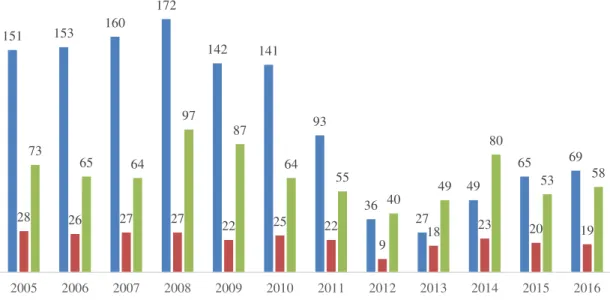
As Távora and González (2016) maintain, the changes introduced by the MoU had an immediate negative impact on the processes and outcomes of collective bargaining, continuing with the pre-crisis path of reform. In fact, in 2003, the first compilation of labour legislation also served as the opportunity to introduce changes that would contribute to the subsequent sharp drop of collective bargaining – cf. Figure 1 in Annex - and consequently to a decrease in the social protection of workers. We should also recall that, despite the low trade union density in Portugal (a little under 20%1), the coverage of collective agreements was nevertheless high
considering that administrative procedures were applied to extend those sector agreements to the entire sector, providing effective average coverage of over 65%. Furthermore, Portuguese collective bargaining usually focuses on raising wages, which means that, under the new framework that targeted the collective bargaining system, the most immediate effect was a generalised freeze on wages.
During the MoU years, the government adopted a unilateral approach to introduce labour reforms, despite initially having had a social pact signed by all social partners (in 2012) with the exception of the most representative trade union confederation, CGTP-IN. Some of the most important changes in the recent legal framework are: the expiry of collective agreements, authorisation for including less progressive contents than the law, the establishing of representativeness criteria for extending collective agreements (based on the affiliation rate of employer associations).
Despite the low level of union density and the relative weakness of social movements as is common in Southern European countries (Eurofound, 2018a), Portugal experienced a resurgence in industrial conflict and protest movements with the crisis and subsequent recession, in particular in 2011-2012. As a member of the so-called ‘Southern strike front’
1 According to the Relatório Único, there was an 8.8% level of unionization in 2015 (Dray, 2016). However, this
source comes from reports submitted by companies, thus, the true level is underestimated considering, on the one hand, that the public sector is not considered and, on the other hand, that not all companies are aware of their unionized workers for several different reasons.
(Vandaele, 2016), Portugal saw double the number of general strikes compared with the entire preceding period of democracy. Furthermore, Portugal also saw new protest movements emerge beyond the trade union movement, such as Geração à Rasca (Afflicted Generation) or Que se Lixe a Troika (To Hell with the Troika)2 (Lima and Artiles, 2013).
At the end of this period, the results seem unsustainable, especially considering the impoverishment of the population; already one of the most unequal in Europe. Furthermore, one may also say that the democratic system was also shaken, social dialogue as one of its core institutions was weakened across every level. In the words of Távora and González: ‘…despite
the heavy social costs of the measures, the extent to which they contributed to increased company adaptability and competitiveness is contested. Many argue that while wage freezes and job cuts may help troubled firms return to profit, this reinforces a cost-minimization competitive strategy that does not lead to long-term sustainable growth. In the short term, it depresses domestic demand more than it increases exports and consequently also constrains growth in non-export sectors’ (2016: 262).
In 2015, at the end of the legislative mandate that implemented the MoU, the ballot boxes dictated that the political parties most voted for were the center-right alliance parties that had formed the outgoing government. However, this alliance only obtained a relative majority. The existence of a weaken power in the parliament led to the rejection of its state budget and, consequently, to the government falling. This is how, at the end of November 2015, the current socialist government took power after the socialist party, the second most voted party, have signed agreements with the three left wing political parties with parliamentary representation (Rego and Pernot, 2017).
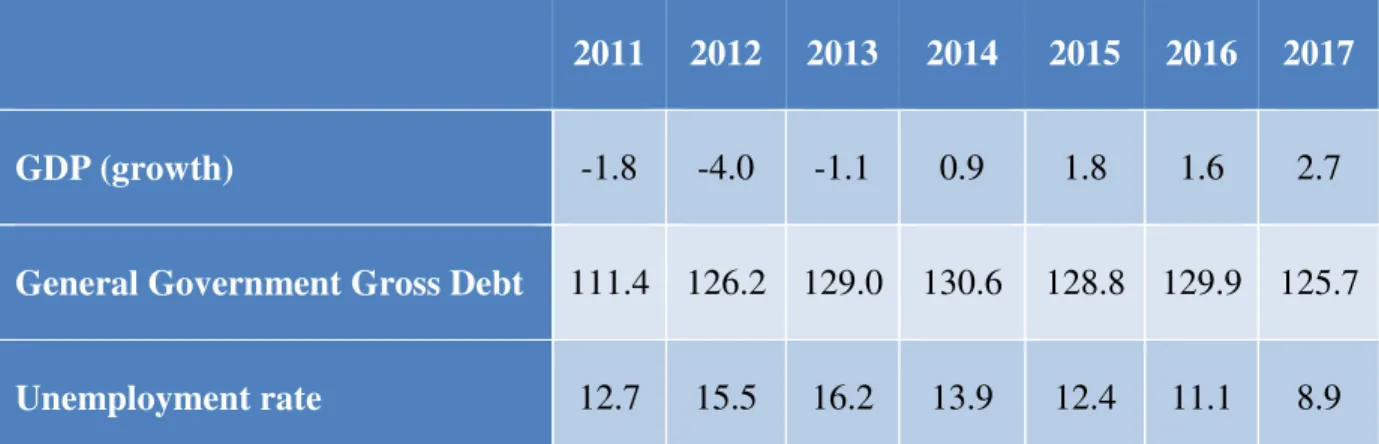
At this moment, the economy has slowly started to change despite the persistence of financial problems – cf. Table 1 in Annex - and with public opinion improving in significant ways – cf. Figure 2 in Annex. While Portugal may fit in the south cluster of industrial democracies, it approximates the EU average more closely and the results of countries such as France or Ireland when it comes to assessing trust in institutions (Eurofound, 2018a)3.
Today, social dialogue still remains very weak and only in June 2018 was a new social pact signed. CGTP once again excluded itself on the grounds. For CGTP, while the social pact contained some positive measures it also deployed measures that contributed to weakening collective bargaining, reducing work payment and increasing precarious working practices, such as extending the trial period from 90 to 180 days (Martins, 2018). Despite significant protests, such as the Lisbon street demonstration of 9 June 2018, which attracted many thousands of workers from all the country, the repeal of several labour reforms is not expected in this legislative mandate. Collective bargaining will thus hardly change substantially. Some ongoing negotiations are mainly related with the need to update wages in keeping with the rise in the national minimum income in 2017.
2 Author translation of the movement names, although the original expression deploys more oral and no religious
references.
3 In 2016, Portugal ranked 5.1, alongside France, and slightly below the EU average (5.2) and clearly above Greece
Digitalisation related developments leading to restructuring
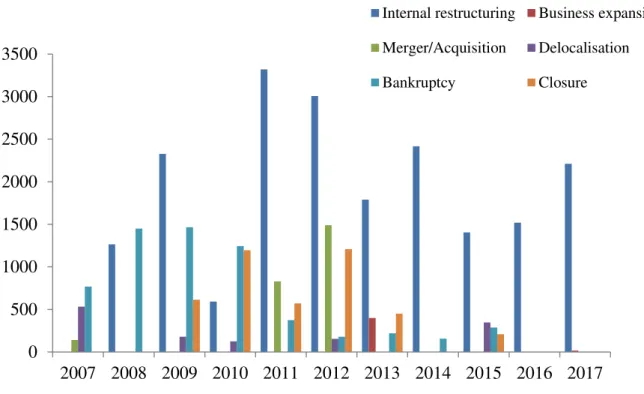
When observing the trends in corporate restructuring data, and despite the important limitations of Eurofound as a source4, companies do not seem to have varied their behaviours very
differently in recent years. Internal restructuring still seems to be the most important cause of threats to jobs – cf. Figure 3 in Annex. Although there is no reliable data available on restructuring due to digitalisation, there are important public policies stimulating Portuguese companies to advance with digitalisation and restructuring, which we now consider.
Indeed, Portugal is performing relatively well; ranked the second country below the EU28 average in the Digital Economy and Society Index of 20185. In fact, in the last years, this
country has been undertaking important investments in digitalisation in accordance with the EU guidelines in the Digital Agenda for Europe as well as general goals to improve skills and inclusion on digital literacy (Eurofound, 2016). In this sense, following the European Digital Agenda, in the same year, Portugal launched the Portugal Digital Agenda (December 2012), which includes objectives ranging from promoting the general conditions through to increasing companies making recourse to e-commerce by 55% before 2020 and promoting usage of online public services6.
Later, in 2015, following the Grand Coalition for Digital Jobs of 2013, the FCT – the Science and Technology Foundation (Fundação para a Ciência e a Tecnologia), the national public science agency took over the coordination of the CPED – the Coalition for Digital Employability (Coligação Portuguesa para a Empregabilidade Digital). The CPED is made up of 18 organizations (public agencies, foundations, professional associations and inclusively one national employer association) and aims to address digitalisation on SMEs in particular considering they account for the large majority of the Portuguese business network and tend not to make great recourse to ICTs. Through a proposal for a National Strategy and Action Plan for Digital Employability for the period 2015-20207, the CPED planned actions and deadlines
susceptible to evaluation through indicators including the number of applications to the entrepreneurship program, the number of best practices, studies, etc.
4 Although the ERM is based on newspaper reports and only covers redundancies of 100 workers or more, as
Eurofound itself states, it is ‘the only available European data source mapping large-scale restructuring activity.’ (Eurofound, 2018b: 80).
5 Source: https://ec.europa.eu/digital-single-market/en/desi (accessed 13.07.2018). 6 Source: http://www.portugaldigital.pt/objetivos/ (accessed 13.07.2018).
7 As we may read in the CPED website archive (empregabilidadedigital.pt): ‘The proposal, which is based around
several key pillars, was intended to be submitted to government figures in the areas of economics, education, science and employment and was presented in June 2015. The aims are as follows: to reduce significantly the shortage of ICT professionals; to bring about continuous improvement in the working population’s opportunities to acquire the ICT skills necessary for employment in the public and private sectors as well the skills of the general public; to leverage the number of companies that make use of digital technology and the number of digitally-based companies; and to develop the digital economy and markets’.
In 2017, a new program was launched by the Portuguese Government, the Interface, with the aim of providing support to Portuguese industry through knowledge-transfers between universities and firms and funding for investment in R&D.
Furthermore, and, also in 2017, the government launched Indústria 4.0, a program with a €4.5 billion budget over four years, based on a mix of funding instruments (loans, tax aid and private investment) to be implemented by private players through an online platform. Indústria 4.0 has three major goals: to speed up the adoption of technologies and the Industry 4.0 concepts by the Portuguese business network; to promote Portuguese technological companies at an international level; to make Portugal an attractive pole for investment within the Industry4.0 context (Vicente, 2018).
Despite the numerous programs, there is no direct involvement from the social partners in either the design or the oversight of implementation, as Gasparri and Tassinari (2017) noted, and we may correspondingly assume most measures address companies.
Concerning corporate restructuring in general terms, it is worthwhile briefly mentioning that although insolvencies tend to decrease, collective redundancy is still an often used strategy do deal with restructurting – cf. Figure 4 and 5 in Annex - certain changes in the institutional framework over recent years. The main framework remains the same as that of the troika period (Rego, 2014). In fact, the current framework leads employers to make greater recourse to redundancies, wages freezes (Bergström, 2018) or (as mentioned by our interviewees) mutually agree contract terminations instead of early retirement and other possible solutions.
The new measures intend not only to change names but also to make certain improvements to the support mechanisms available8. We will now highlight probably the two most significant
measures9.
Firstly, this introduced a new formulation for the recovery mechanisms of companies. In fact, the Capitalizar program (capitalizar.pt) revises the existing program and integrates the following goals, among many others:
• Adding more requirements for recovery as most cases, were in effect, already bankrupt, • Setting out a list of experts to provide technical support,
• Separating collective and individual companies,
• Empowering the already existing function of administrator judicial (judicial administrator),
• Launching the business recovery mediator role,
8 Regular changes are not expected to help the dissemination of the support mechanisms available for companies
and workers undergoing restructuring but, as seen before (Rego, 2014), each time the Portuguese get a new government, there is a trend towards a new name for those mechanisms associated with few actual improvements.
9 Other changes have been made but without any objective data collected. In fact, according to our interviewee
from the public agency for competition and innovation, IAPMEI, an early warning tool for companies facing difficulties was launched in 2015 but did not have much impact and so is now undergoing reformulation and is due for implementation by the end of 2018.
• Replacing SIREVE by a new out-of-court recovery mechanism, the RERE10.
Secondly, recent legislation protecting workers under the scope of a business transfer was prepared. Law 14/2018, dated 19 March 2018, changes legislation from 2009, settling the legal regime applicable to the transfer of a business or establishment and reinforces the rights of workers. This new framework assures for instance that workers may maintain their rights (retribution, seniority, social benefits, etc.), whether settled by contract or acquired, that they have time to organize their representation before the transfer, and that they may refuse any transfer.
2. Methodology
This section will present the approach, based on in-depth interviews and desk research.
This report is based on qualitative research, both on secondary and primary data collection. Secondary data was collected mainly in May and June 2018. The sources include national public agencies, in particular the Centro Relações Laborais-CRL (Labour Relations Centre) and the Direcção-Geral de Emprego e Relações de Trabalho-DGERT (General Directorate of Employment and Labour Relations) from the Ministry of Labour; European agencies, such as the European Restructuring Monitor-ERM, from Eurofound; and press articles.
Primary data was collected through semi-structured interviews with trade unions and employers organisations, including companies whenever a company agreement was in effect rather than a sector agreement. Questions were translated and adapted from the common DIRESOC grid together with the common informed consent form. The fieldwork took place mainly in June 2018. Only one interview took place in the north of the country as the headquarters of the entire national and many of the sector organisations are located in the capital.
The anonymization of organisations was never requested and, considering both their characteristics and the scale of the national country, was never feasible thus we did not hide their names. However, taking into account the informed consent requirements of some of our interviewees, we anonymised all interviewee names. The interviewees were the main representatives and often also the negotiators for the respective organisation.
We conducted eleven interviews with the following organisations – full names in Table 2 in Annex:
10 The RERE was set up by Law 8/2018, dated 2 March 2018. The previous mechanism, SIREVE had a very low
impact as Rego (2014) reported: ‘REVITALIZAR deploys two main tools: the SIREVE (Corporate Recovery System by Via Extrajudicial) and the PER (Special Recovery Process)The SIREVE was founded to replace the PEC and relieve courts and improve the terms and conditions for the extrajudicial recovery of firms in difficulty, which circumstantially saw their economic structure and/ or financial potential deteriorating but still retaining potential viability. According to the SIREVE report of June 2014 (SIREVE, 2014), 406 companies applied for assistance since SIREVE began operations in September 2012, but only 79.6% of them were eligible under the SIREVE stipulations. Most companies are micro or small sized (84%), representing a total of 13,280 workers, mainly in manufacturing and services, and especially in North Portugal. SIREVE is only recent but its impact seems low level.’ (2014:8).
Sector Type Organisation acronym Date
National National union association CGTP-IN 19.06.18
National National union association UGT 21.06.18
National National employer association CIP 25.06.18
National National employer association CCP 29.06.18
Bank Sector union association SBSI 29.06.18
Industry Sector employer association ANIET 14.06.18
Industry Sector union association FIEQUIMETAL 19.06.18
Postal Sector union association SNTCT 19.06.18
Postal Sector union association SINDETELCO 26.06.18
Postal Company CTT 29.06.18
Tourism Sector union association Sindicato dos Trabalhadores na Industria de Hotelaria, Turismo, Restaurantes e Similares do Sul
26.06.18
In the case of other social actors, we held an exploratory interview (02.06.2018) with a representative of a public innovation agency (IAPMEI).
Despite some protest groups emerging in the austerity period, with no direct relationship to trade unions but also demanding changes in the labour sphere (Lima and Artiles, 2013), they were not contacted: on the one hand, because digitalisation does not seem to represent a current concern; on the other hand, because these groups still lack official recognition, without regular seats on public agencies for instance, thus no formal capacity for influence. These social actors, such as the Precários Inflexíveis (Inflexible precarious), which defend precarious worker interests in particular (fake independent workers, short-term contracts, etc.), play no relevant role in social dialogue, but do exert pressure through the promotion of debates, participation in demonstrations staged by third parties, and providing the public with information through the social media.
Finally, we would like to mention some constraints experienced during the fieldwork. In addition to the usual difficulties in getting feedback from social partners without reminders and phone calls, there were some postponements, delays and refusals (these latter also caused further delays). These cases may be related to:
• The overlap with a period of protests, especially by the CGTP-IN members, who participated in the 9 June demonstration;
• The coincidence with the beginning of the summer break;
• The overburdening of some social partners; this may be the case of tourism sector, either with labour relations issues and with the increase in interview requests stemming from the growth of the sector, which turned into a fashionable subject; furthermore, a research is being conducted at the same time by a law professor from the University of Lisbon on the digitalisation impact on collective bargaining and commissioned by a public agency;
• The centralisation of decision-making and the lack of resources of Portuguese social partners.
In fact, unusually, we encountered an important number of refusals during our fieldwork.
3. Digitalisation related restructuring
This part of the report should provide answers to the research questions. Please, before discussing sectoral developments, report briefly the national situation.
The national situation
Despite the attention paid to digitalization, nothing seems to have changed in the social dialogue - both at the collective bargaining and the social concertation levels - nor in the behaviours of social partners.
The general perception is that the Portuguese economy is going to follow the trend of technological development and digitalization with this seen, in general terms, as a positive advance. The two main national social partners11, CIP and CGTP, known for their contrasting
views, agree that digitalization is not the only driver of change and also that technological change has been present since the beginning of the digital era, leading to important innovations. CIP and CGTP disagree on the identification of the consequences of digitalization. While the employers’ side focuses on the business efficiency, the workers’ side is worried over job losses and working conditions. Both sides however seem to agree that employment is growing and, thus, the digitalization impact has also involved coping with a lack of qualified workers. Finally, both CIP and CGTP consider that platforms are making new forms of work emerge that fall beyond existing regulations and raise new questions, especially on the best ways to assure social protection and reinforce the social security budget. While agreeing on the diagnosis, CIP and CGTP are not expected to converge easily in the solution to be found.
Collective Bargaining (and national social partners’ view)
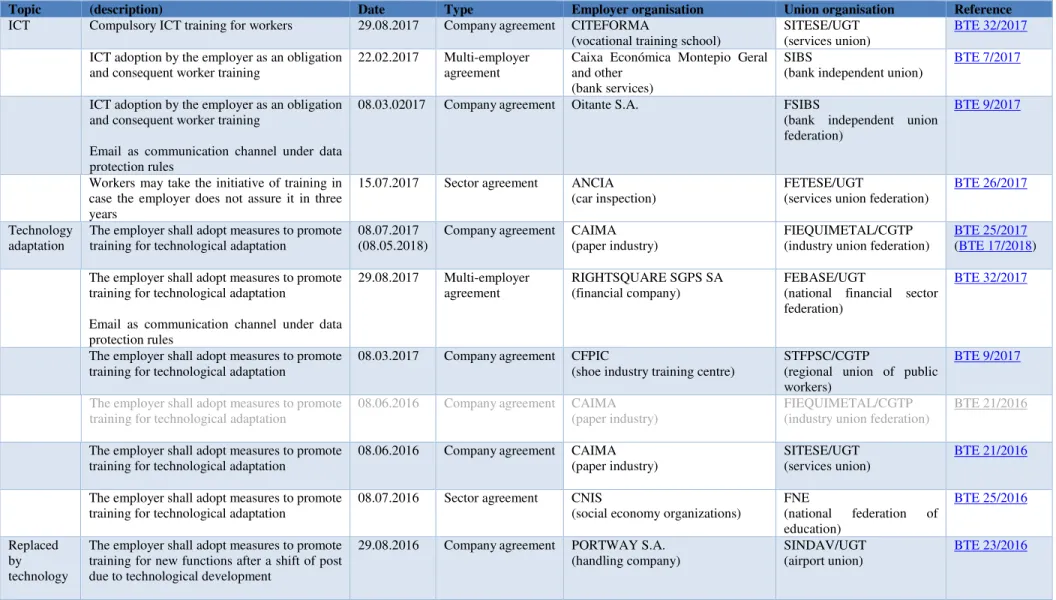
Analysing in particular the feasible references to digitalization in collective bargaining processes, we stress that the collective bargaining agreements identified in the last three years that make references to technological topics seem to be more of an intent than a compromise with concrete measures12. In this sense, based on the CRL report on the collective bargaining
11 Although there is no objective criteria to assess Portuguese social partners’ representativeness, these two
organisations are often considered the main organisations from both sides of labour relations.
12Although the impact of digitalisation on collective agreements might be identified through other forms, usage
of words like ‘technology’ allows us to make initial content analysis and to approach such a number of documents – cf. Table 3 in Annex. We would also note that there is ongoing research, carried out by a law professor from the University of Lisbon, which intends to analyse the impact of digitalisation on collective bargaining. This research was commissioned by a public agency, the Centro de Relações Laborais-CRL (Labour Relations Centre) of the Ministry of Labour, and was announced at the seminar organised by the CRL entitled ‘the digital economy and collective bargaining’ on the 25 September 201812. The coordinator expects to have results for dissemination by
the end of 2018. The fieldwork carried out for this research has in some moments made social partners confused with DIRESOC demand of interview too.
contents (CRL, 2016, 2017, 2018), we have identified ten agreements with some sort of technological topic between 2015-2017:
• five mention that the employer shall adopt measures to promote training for workers in order to enable technological adaptation,
• four making reference to the same content but for ICTs in particular and
• just one mentioning that the employer shall provide training for workers unable to adapt to their current functions due to technological change.
In 2015, collective bargaining agreements apparently contain no specific mention of technological contents but they do appear in 2016 and afterwards. In fact, the content analysis made by the CRL of collective agreements reveals that, out of a total of 146 collective bargaining agreements of all types in 2016, only four reference technological change – cf. 3 Table in Annex13.
Note that all national social partners refer to the significant decrease in collective bargaining in their interviews. Furthermore, despite not undertaking collective bargaining but rather delegating that power to their affiliated members, some do have general guidelines for collective bargaining practices. In this sense, UGT launched a collective bargaining model in the mid-2000s. However, it makes no reference to digitalization or technological change and has yet to be updated. Additionally, CCP launched a handbook in 201514 with the aim of
identifying topics that could be introduced into collective bargaining and proposing a standard formulation for its members. This document also makes no reference to digitalization or technological change, the closest topic being teleworking but providing mainly a reference to the property and limits of use of technological tools that merely transposes the content of general legislation15.
In any case, all our interviewees, recognize that Portugal is experiencing an unprecedented period in collective bargaining. According to CIP, the main employer association, in particular, collective bargaining has changed its paradigm in recent years, and CIP stands in defence of the labour law changes attained. From the union perspective, and particularly from that of CGTP, the expiring collective agreement mechanisms should be revoked by the current left wing coalition in parliament. For CGTP, collective bargaining should include topics related with digitalization inclusively to prevent health and security problems at work, but the context is not favourable. UGT also considers that some topics were neglected at the bargaining table in recent years due to the difficulties in achieving agreements on wages, which constitutes the overall priority.
13 Through the interviews, we sought to ascertain more about these agreements making reference to the need for
employers to encourage training related with technological change, especially how far these statements came into practice.
14 Mello, A. S. e (coor.) (2015). Manual para a Renovação da Contratação Colectiva no Comércio e Serviços –
Orientações para a contrataçãop colectiva de trabalho, CCP.
15 Within this scope, it is worth mentioning that telework did not have an important impact on the world of work,
as Eurofound concludes in its Living and Working in Europe 2017, Portugal reporting the sixth lowest level of teleworking in the EU28 (Eurofound, 2018a).
As the CIP interviewee said, collective bargaining on digitalization in the future will be a trade-off between more flexibility proposed by employers and more rights, such as the right to disconnect demanded by workers. In fact, the different interests seem to become clear: for employers, it is up to the workers to demand protection; and, for workers, it is up to employers to make concessions considering the gains made from technology.
If much is still to be done in Portuguese collective bargaining, the CIP representative also questions himself whether collective bargaining will provide the main monitoring and regulatory tool for those changes.
Note collective bargaining is currently playing a relatively small role but this also requires understanding through taking into consideration that:
- It is now possible not to have collective bargaining in Portugal both due to the expiry mechanisms and as collective bargaining is voluntary ;
- Collective bargaining has been increasing but still did not attain the level of the pre-troika the period – covering potentially about 600,000 of workers in 2016 after having formerly covered almost two million workers in 2008 (Dray, 2016);
- The unemployment rate has been decreasing since 2013 when it reached 17.3%, standing at 8.5% in the third trimester of 2017, thus, running close to the level in effect a decade earlier16;
- At the same time, the employment rate has been increasing and mainly through short term contracts - Portugal had 22% of short term contract employment in 2016 while the European average was 14% (Dray, 2016).
Moreover, as the CIP representative stated, some internal regulations include references to the digitalization related topics while digitalization cannot be found directly in the collective bargaining agreements. Some sector examples were reported by other interviewees correspondingly conveying how not all labour conflicts are solved through collective bargaining.
The banco das horas (working time bank), a measure intensified under the MoU period, already provides a solution helping employers to manage the fluctuation of human resources needs. In any case, clauses related with:
• training, namely in ICTs, and • professional categories17
16 According to several of our interviewees and other employer representatives, there is a lack of qualified workers.
The talent manager of NOVABASE, the largest Portuguese IT company, created in 1989 and employing 2000 workers with 17 nationalities, reveals that in-house training, at the Novabase Campus, is fundamental but that many workers are then recruited by international companies (Monteiro, 2018). Furthermore, considering other sectors, in some Portuguese municipalities, there are initiatives to increase the workforce as well as to attempt to fight population aging. Vila da Feira, for instance, created a specific bureau to support potential new inhabitants coming from other countries, in particular Portuguese emigrants (Lusa, 2018b).
17 Different interviewees in fact mentioned that the reduction and emergence of new professional categories was a
are possibly areas where restructuring led by digitalization might find solutions.
CIP recognizes that, although all technological revolutions are associated with the loss of jobs, digitalization is not a recent phenomenon, and changes emerge especially when considering teleworking or frequent worker displacements. Additionally, CCP also considers that the changes due to the introduction of digital technology began many years ago. According to this employers’ association interviewed, companies have to take opportunities to develop their potential and some sectors are clearly investing not only in digitalization at the production level but also in the design of products.
As said before, CGTP-IN agrees that digitalization is in general a positive phenomenon but the largest worker association sustains that technological innovations must be at the service of workers, which means that they should correspond to reductions in the working schedule and improvements to the work-life balance. Furthermore, CGTP considers that digitalization is contributing to the precariousness of the workforce and to increased hours of work with a corresponding worsening in the health of workers, especially through stress due to increases in the pace of work.
If we also analyse the reflection disseminated in a union conference at the end of 2017, the CGTP discourse is more pessimistic, considering that the idea of a third category of workers (between employees and independent workers) corresponds essentially to a deregulation of labour relations and to decreasing worker rights. Furthermore, the trend towards the individualisation of labour relations and the weakening of collective bargaining mean an important attack on the trade union actions of recent decades (CGTP, 2017).
Overall, CGTP approaches digitalisation as just one driver for change through giving the example of Triumph. Despite the existence of a market and innovative means of production, this lingerie factory closed at the beginning of this year and the state did not support its acquisition by the workers. Almost 500 workers, almost all women, were made redundant, wasting skilled workers18.
UGT also considers digitalization as positive in general terms, responsible not only for job losses but also for new jobs. One of the difficulties UGT identifies involves ascertaining how far we might blame digitalization for collective redundancies, for instance, when taking into consideration how these increased during the financial crisis and recession in any case. In fact, this social partner attributes importance to undertaking prospective studies, such as the sector studies developed in the 1990s by INOFOR, a public agency for qualifications, or potentially more complex studies, including those estimating the number of jobs at risk19. UGT
18 Lusa (2018), Fábrica da antiga Triumph sem comprador, 3 May 2018, in Internet: https://www.jornaldenegocios.pt/empresas/detalhe/fabrica-da-antiga-triumph-sem-comprador (accessed 02.07.2018).
19 Some examples of these prospective studies feature in the ILO Inception Report for the Global Commission on
the Future of Work, from 2017, but others exist mainly based on the US case, as detailed by the Frey and Osborne article: Frey C. B. and Osborne, M. A. (2017), The future of employment: How susceptible are jobs to computerisation? Technological Forecasting & Social Change, 114, 254-280.
simultaneously recognizes how difficult it is to prevent impacts due to the speed and the global nature of these changes.
All the national social partners still do not yet know how to deal with these new forms of work, but training would seem to be the main measure for anticipating such changes in the case of the traditional workforce.
Social Pacts
A social pact was recently signed between the Portuguese government and all the national social partners with the exception of CGTP-IN, the most representative union organization who rarely signs such tripartite agreements. On 18 June 2018, the agreement ‘Combater a precariedade e reduzir a segmentação laboral e promover um maior dinamismo da negociação coletiva’ (Fighting precariousness and reducing labour segmentation and fostering more active collective bargaining) introduced several changes to the labour code in order to limit fixed term and temporary contracts and encourage permanent contracts, in particular for the long term unemployed and individuals seeking their first job. Only one national social partner mentioned this recent social pact as making reference to digitalization. In fact, the social pact only mentions the compulsory communication of recruited workers to the social security system through electronic means and with no other digitalization associated topic.
Considering that today Portuguese collective agreements might be contrary to the general law, this social pact stresses that the changes announced in the social pact cannot be withdrawn by collective agreements. Furthermore, this social pact announces the obligation of registering contracts on the Social Security platform, which will protect worker rights in addition to simplifying bureaucracy. Finally, it is worth noting that this social pact also intends to withdraw individually negotiated time banks, one of the employer flags of flexibility, among other aspects.
European experience
According to CIP, CGTP and UGT, there is a perception that other European countries are more advanced in the debate on how to cope with digitalisation even while providing no actual concrete examples. CIP, for instance, maintains that European countries provide interesting examples, such as France and Scandinavia, but again with no concrete cases. The European level experience is perceived as being responsible for a series of debates, especially at the sectoral level but, once again, without either any concrete conclusions or examples provided. The Uber discussion for instance raised significant protests from Portuguese taxi sector employers in 2015 and 2017, both in Lisbon and Oporto20, and UGT considers that the diversity
20 As Gasparri and Tassinari (2017) tell us: ‘In Portugal, Uber started operating in 2014 and was subsequently
subject to a ban by the Court of Lisbon in April 2015 after one of the main taxi driver associations, Antral, presented a claim of unfair competition against the platform. (…) [T]he issue is not fully settled and the government [is] called to approve a specific law on the matter. In the meantime, protests from taxi drivers against Uber have continued - though partially – as have operations in the country, and the issue remains insofar unresolved’.
of Member-states presents a problem to achieving clear solutions but with no other reference made to this subject. 21In sum, Europe seems to be a distant reality from the daily life.
Concerning the European Union framework, there are no objective references either, with the exception of criticism CIP addressed to the proposed Directive on transparent and predictable working conditions (Directive 2013/50/EU of the European Parliament and of the Council on 22 October 2013, harmonizing transparency requirements in relation to information about issuers of securities admitted for trading on regulated markets)22. One CIP comment states the
perception that the EC proposal is outdated and disconnected from the expectations of younger generations, especially when suggesting that the definition of worker corresponds to a minimum of rights. Considering how the current changes raise some concerns in some groups, CIP sustains that: ‘Let us be clear and coherent: Given the unpredictability that dominates the
world, there is only one logical and sound option and it imposes flexibility.’ (CIP, 2018: 23)23.
CIP also argues that this European legal framework imposes bureaucracy. In fact, these criticisms seem to align with others CIP made of the Portuguese government when implementing communication between companies and the social security system via the Internet without a transition period. CIP stressed that companies needed time to adapt.
National social partner initiatives
Digitalization would seem primarily a concern of employers if we consider digitalization in social partners’ initiatives. In this sense, the two national employer social partners interviewed, CIP and CCP, reveal two actions related with this topic, and just one sector union having participated in a project on the topic.
The CIP representative sustains that its mission is to provide data that may be used by members. In this sense, the Portuguese business confederation recently launched the Conselho Estratégico para a Digitalização (Strategic Council for Digitalisation24). This council aims to prepare
recommendations, views and decision proposals. Launched at the end of 2017, it has prepared a view on the new General Data Protection Regulation, according to our interviewee, but with no further products yet known. The importance given to this consultative council (with 51 individuals, with just five women) reflects in its leader being a former junior minister and a member of the successful candidacy of the current President of the Portuguese Republic, in addition to a director of Microsoft Portugal. Additionally, at its congress in April 2018, CIP addressed the digitalization subject and prepared the discussion with a special issue of its magazine Indústria – Revista de Empresários e Negócios (CIP, 2018).
CCP has also launched a working group under the Forum of Services to discuss ‘economia digital, logística e infraestruturas’ (digital economy, logistics and infrastructures) during the mandate 2018-2019. This Forum was a 2013 initiative to encourage debate among members
21 In fact, the state is responsible for the attempt to regulate the activity. Parliament and the government have been
preparing legislation for regulating Uber after strong protests from taxi drivers. A first draft law did not receive ratification by the President of the Republic and thus a new proposal is ongoing, foreseeing a 5% contribution to the state, with a proportion of these revenues allocated to funding electric taxis (Villalobos, 2018).
22 Further information here: https://eur-lex.europa.eu/legal-content/PT/TXT/?uri=CELEX%3A32013L0050 23 Author’s own translation.
and non-members on the intelligent specialization of the Portuguese economy25. The core aim
of these debates is to influence public policies.
At a sectoral level, the main metal trade union federation, affiliated to CGTP, FIEQUIMETAL, participated in a European project, coordinated by IRES-Lucia Morosini/CGIL and funded by DG Employment, Social Affairs and Inclusion, between 2016-2017. The Smart Industrial Relations - Smart production in the manufacturing industry and work organisation: new scenarios for Industrial Relations was perceived as an opportunity to exchange experiences over five workshops26.
4. Social Dialogue in selected sectors
Tourism
While tourism has long since been an important sector to the Portuguese economy, it has grown so substantially in recent years that certain social problems appeared for the first time in some national regions. The most impressive facet derives from how the excessive demand for houses in Lisbon and Oporto, either for sale to non-nationals or for tourism accommodation, led to expulsion of elderly residents from these city centres. In fact, in Lisbon for instance, local accommodation grew 3000% between 2010 and 2017 (Soldado, 2018). The human condition of many such residents led to the June 2018 enacting of legislation with a transitional basis in aiming at protecting older and other vulnerable residents (Lusa, 2018a).
Data from 2016 reports how tourism revenues increased by +10.7%. Furthermore, indicators started to show this growth even under the troika. According to the 2014 tourism statistics from the INE, the national agency, sector revenue increased +12.4% year-on-year and broke the EUR 10 billion mark.
The boom in the tourism sector, whether in accommodation, restaurants or other sub-sectors, seems interwoven with the growth of employment, including undeclared employment, which is traditionally important in this sector, as well as new forms of employment. According to the trade union interviewed, the South Portugal trade union of hotels, tourism, restaurants and similar, affiliated to the federation FESAHT, belonging to the most representative trade union confederation, CGTP, workers’ recruitment is taking place online and that raises some problems. Some workers are facing unfair conditions, thus the online communication is rendering them vulnerable.
25http://www.forumservicos.com(accessed 09.07.2018). 26
The final report is not available but further information can be found at the SMART project website:
In fact, joining a service firm or showing interest in collaborating with such a company tends increasingly to be made through the Internet and in some cases the only communication between worker and employer is made by email. To accept these job offers, sometimes announced through an Open day at universities for young graduates, implies accepting conditions that may not be in accordance with either the labour code in terms of parental rights or the GDPR, for instance. This is the case of Ibersol group (Ibsersol SGPS SA) that manages different trademarks like Burger King, Pizza Hut or KFC, providing an online recruitment platform27.
In any case, this sector has also been investing in technology throughout its operations: the room maid service, café orders, or transport platforms. Digital technology is here associated with efficiency, reductions in workforce requirements and the overburdening of workers. Large companies have been reducing their employee numbers, particularly through redundancy for the last two decades. However, the sector is also very dynamic and needs an intensive workforce with new companies constantly emerging. Therefore, redundancies seem to be less noted. Collective bargaining was resumed in 2016 after ceasing in 2012 between possibly the most relevant employer association, AHRESP, and the trade union federation FESAHT - to which our union interviewed is affiliated. However, according to our trade union interviewee, not every problem gets solved through collective bargaining. The counting of the work time incurred in the stops made by train workers before their return home was not considered and represented a problem for instance that had to be solved through dialogue but not through formal channels. Furthermore, as our interviewee sustains, there are other priorities for collective bargaining, such as payment for working on public holidays or the reposition of wages. In his own words, digitalization may be withdrawing labour rights but is not yet a priority.
The future seems to indicate continuity for a sector still in development, with the retention of more qualified workers, but also with the replacement of many jobs, and, more precisely, with machines assuming many tasks. The impacts may not be that important considering the growth in the sector and the seasonal characteristics of the workforce.
Financial services (bank)
The banking sector possibly represents the sector where digitalization has received greatest discussion at the European level, especially in European social dialogue channels. The topic is not recent and this sector stands out for having better qualified workers than the overall average. Since the 1990s, when ATMs entered into generalized usage, digitalization has remained a crucial phenomenon. Henceforth, the process of technological change has never slowed and does in fact seem to advance too swiftly. Today, clients do not need to go to banks and the front
27 The recruitment platform can be accessed here: http://www.ibersol.pt/pessoas/oportunidades-de-trabalho/
office seems to require ever less people. Bank branches are fewer in number and with ATMs also now on the decrease.
Digitalization is certainly responsible for changes, especially in employment, but one cannot ignore how other factors also play important roles. In fact, financial markets have now been developing in a global direction for decades.
The recent crisis also led the European Commission to prepare a Directive that has triggered important consequences for companies and workers. Since the beginning of 2018, the new legislative framework, the MiFID II/MiFIR, intends to strengthen investor protection and improve the functioning of financial markets, making them more efficient, resilient and transparent (cf. www.esma.europa.eu/). These new orientations oblige workers to properly inform the client of a product or are simply not able to sell certain products. Banks now run compliance departments. Although not directly related with banking services, this represents growth in the sector. While this new legal framework brought about immediate changes, other requirements, such as lifelong learning, are only slowly being implemented, according to the union representative interviewed, the leader of the Banking union from the South and Islands-SBSI.
Changes in bank services are obvious to clients: the number of banks has decreased and, simultaneously, clients can now manage their money and banking services through e-banking, without any human mediation. Some banks exist only online that is certain to increase the incidence of litigation, according to the trade unionist interviewed. The orientation, according to our interviewee, discourages potential investors because they are not properly informed through a face to face medium. Furthermore, the SBSI representative also worries about the reduction in social protection contributions and the future of the welfare state. Taxing enterprises more heavily or estimating human work contributions even when there are no workers feature among the solutions for exploring.
Collective bargaining is apparently SBSI dominated but there are simply not many negotiation processes, although some took place recently, such as bargaining with BNP-Paribas that negotiated in both 2015 and 2017. The main objective targets updating and raising wages following a decade of pay freezes. These negotiations appear difficult considering the reduction in the workforce in the wake of the crisis and the new rules in effect for the sector. No new professional categories/functions were established because those existing are already sufficiently comprehensive.
Although there is also new recruitment in the sector, especially in commercial departments, there are human resource shortcomings in terms of both numbers and quality and correspondingly unable to balance the loss of workforce. Many older workers retired early or accepted mutually agreed contract terminations. Furthermore, some tasks are being separated into different units, as happened with insurance, which also further contributes to workforce reductions. As our trade union interviewee stated, ‘…the anticipation has been made, we can
The SBSI is possibly the largest trade union in Portugal considering all the sectors largely due to its provision of healthcare services, to which employers also contribute. Several selective incentives are provided to members, including private hospital access. This still seems to account for the main attraction for unionization, according to our interviewee. The physical dispersion of the workforce also makes unionization more difficult.
Postal services
Postal services are provided in a liberalised marketplace, although post mail is still almost totally controlled by CTT, the recently privatised (December 2013- September 2014) former national incumbent. In fact, some small and urban companies are now used by large clients, but with about 90% of the total post mail still handled by CTT.
According to SINDETELCO, affiliated into UGT, the union that has been leading the bargaining process, the service quality has decreased and the departure of numerous workers has not been noted because of the decrease in the national unemployment rate. For SNTCT, the union affiliated to the largest confederation, CGTP, the negative effects of privatisation are visible both for workers and clients. In fact, many post offices have been closing. Note that the unpopularity of post office closures is also recognised by the CTT representative. Furthermore, both unions also noted how unusual it is for corporations to pay out dividends in such a short period of time as happened with CTT. In fact, for SNTCT, the fight to renationalise the post office is still alive.
The most important change highlighted by all the social partners interviewed relates to the change in client behaviours, in particular how common citizens and the utilities stopped using post mail. The trend very much seems to be towards usage of online communication, and with many client companies undertaking aggressive campaigns to reduce their postal expenses (for instance, telecommunications lowered the cost of a contract when invoices are sent only by email). The trend is for this situation only to deepen with there now being only two remaining services that are still mediated by post mail, the taxation and court correspondence.
The decline in the number of letters distributed has led the main company in the sector, CTT, and the only bargaining employer, to adopt a new strategy, the internalisation of package distribution. While some years ago, a new company was launched by CTT to provide a faster service in order to deal with e-commerce, CTT Express, CTT is nowadays using postmen to do that job. This change did not require a change in the functional definition of postmen and was well received by members of staff, according to the employer’s representative. Nevertheless, these changes in the postmen functions are not included in the company agreement. Despite the practices of dialogue within the company, for example, the monthly meetings between the human resources department and the workers council, collective bargaining does not cover all the changes and agreements.
Wages have been negotiated regularly between CTT and SINDETELCO, the UGT affiliated trade union, since 2015. SNTCT has also signed the wage rise updates, with the exception of
2016, but with the full document dating back to 2013. All our interviewees report good relations between employer representatives and both trade unions.
The existing company agreement does not include issues such as specific training needs or the mutually agreed contract terminations. The agreement is thus quite a generic document. However, there were negative reactions from the workers council and trade unions over the departure of hundreds of workers, mostly older and sick workers. SNTCT maintains that contract terminations, for instance, are almost always unfavourable for workers. And SINDETELCO recalls that workers were often pressured into signing the mutual termination agreement. According to the employer representative, the company proposal attained a success rate of about 60%. SNTCT considers other solutions should be found to mitigate the impact of restructuring. This union also stresses how precarious jobs are filling permanent needs and that these contracts are used because of seasonal factors.
According to SNTCT, digitalisation is positive when for instance considering the effort to limit the environment impacts of activities (less paper consumption), but is also responsible for the early retirement of older workers, although there are also other reasons, for example cutting labour costs.
In fact, the European Union is responsible for the market liberalisation which has led to the emergence of small companies without any union representation alongside the multinationals already in the market, like DHL or TNT Express. According to SNTCT and SINDETELCO, there are few workers unionised and other countries are reporting very bad experiences. Digitalisation has had an important impact on postal services in Portugal due to investments in digital technology by companies and citizens in general. But also CTT has been investing in digitalisation for years. As the SNTCT representative recalled, the company is investing in different forms: robotization, equipping workers with PDA and electric vehicles, etc. Robotisation for instance has served to improve the speed of distribution ever since the 1980s, now ensuring 600,000 letters are separated in 24 hours.
The main postal service company in Portugal, CTT, has been also diversifying its activities to prepare for change. Although postal services already held this mission, for example selling of savings certificates and philately products, BancoCTT was launched in 2015 and obliged to hire workers. In fact, 100 workers will be hired by 2019. These workers are engaged under a ‘contract with a plurality of employers’, which is possible, for the same group with respect for some requirements, since 2009. The reaction of workers to the fact that they would start simultaneously being bank and post service workers was not acceptable to some, and, according to SNTCT, some refused. The new responsibilities and the way of working, organised into banks/offices also seem to prevent workers from achieving a work-life balance.
The launching of a bank possibly represents the most visible example but CTT has already been creating other business: a service which provides information through geolocation, taking advantage of the network of postmen existing all over the country; and a joint-venture with the leading Portuguese conglomerate, SONAE, launched in June 2018 to create an e-commerce platform (Soares, 2018), among others.
CTT participates in several international meetings and refers to how the Postal Sector Dialogue Committee, in particular, has promoted several actions related to digitalisation. However, CTT simultaneously believes the diversity in the national contexts of the different member states represents an obstacle to one clear overview. Additionally, the sector trade unions participate in some European organisations. Their perception is that in a general way countries such as the UK, where the post service was also privatised, are dissatisfied too with the outcomes of privatisation.
According to the employer representative of CTT, the future will emerge out of what the current activities indicate while trade unions express certain worries. SINDETELCO maintains the future may also bring more risks and refers to how fewer workers also implies greater difficulties in dealing with clients’ problems. A new form of taxation is one possibility but SINDETELCO holds little belief in this happening. Furthermore, SNTCT recalls how the end of the public concession in 2020 may bring still more redundancies.
Industry
Industry is quite a wide sector, thus we started by selecting two distinct sub-sectors: metals and mineral resources. The criterion applied was the diversity in collective bargaining practices. In fact, while the metal employer association, AIMMAP, has been regularly negotiating, at least to update wages, the last agreement by the mineral resources employer association, ANIET, dates back to 2009. Profiting from a collective agreement expiry mechanism, ANIET has not negotiated for almost a decade. Considering that we only achieved one interview in good time with the mineral resources employer representative, this sector is only very partially covered by this report. In any case, we have also interviewed the main industry trade union federation, FIEQUIMETAL. Affiliated to CGTP, this federation represents several sub-sectors: metallurgical, chemical, electrical, pharmaceuticals, paper, energy, mining, etcetera.
Considering the mineral resources activity, ANIET represents three sub-sectors: mines, ornamental rocks and the extraction and transformation of mining resources, which corresponds to about 1% of GDP, with a majority of these activities addressing export markets. The digitalisation processes are apparently far from a topic in these sub-sectors, although there are examples of companies using digital technologies to increase production and meet employee shortages. The extraction and transformation of mining resources sub-sector seems the most relevant within this scope and is also the most relevant for exports, with more than 70% of its production sold to other countries.
In this sense, the ANIET representative interviewed had in June visited a medium sized company with about 84 workers in the extraction and transformation of mining resources sub-sector that had acquired a very modern printer that not only made the design but also performed the production. This machine is perceived as a compliment to the firm’s activities and not a competitor for workers. In fact, instead of using a pneumatic hammer for the complete job, this machine enabled the application of a disassembled system that deploys a diamond wire, which proves more precise, efficient and secure.
Jobs do not seem to be at risk according to the ANIET representative because there is an important lack of workers in the sector, especially in SMEs. Low wages and hard physical work account for the main reasons for this worker shortage but one should also bear in mind that the low national unemployment rate is also decreasing. Furthermore, when there are dismissals, ANIET maintains that these mainly relate to the closure of some companies due to the exhaustion of the respective natural resource. The main driver for the use of digital technologies interrelates with increasing production and environmental protection, with contacts made at international fairs determinant to their adoption and with not all employers seemingly aware of their importance.
We would note that ANIET negotiated its last full collective agreement in 2006 and had only updated wages through to 2009, while now preparing a proposal for resuming bargaining, according to the same source. Collective bargaining is now being launched to raise wages in keeping with the national minimum wage rise in 2015 following the long freeze imposed by the bailout negotiations in 2011. Our interviewee recognised that wages are low across the sector but sustained they could not be higher because not all its members would be able to pay such wages - ANIET has about 200 members and while some are large companies there are also SMEs and inclusively micro enterprises.
The ANIET representative stated that no specific information on the challenges raised by digitalisation had been received from either its national or European confederations. And there was also no significant knowledge on European level experiences. The future is seen as creating more challenges for administrative services than for the production field. In administrative departments, more training seem to be needed for European Directives and regulations such as the General Data Protection Regulation-GDPR, which requires the appointment of a data protection official. In any case, training seems to have only a low rate of implementation. On the trade union side, the FIEQUIMETAl representative stressed that, besides the Smart Industrial Relation project (2016-2017) in which it participated, the trade union organisation currently has no specific initiatives towards digitalisation. At the same time, FIEQUIMETAl is aware that the Ministry of Economy has a group addressing the topic but involving no unions, as well as other initiatives, especially at IndustriAll - to which FIEQUIMETAL is affiliated. The FIEQUIMETAL leader concludes that the debate is being dominated by employers and that they never consider any reduction in working time as a change enabled by digitalisation, digitalisation instead tends to be seen as a means of reducing the workforce.
The other practice that seems to prevail with certain cases of high technological development is the recruitment of precarious workers, thus, with short term and/or temporary contracts. This is the case for instance with the automobile sub-sector, in particular the Volkswagen facilities in Palmela municipality, around 30 km from Lisbon. The Autoeuropa factory has been promoting a network of services in the surroundings ever since the beginning of the 1990s, and has recently hired more workers to meet new car orders. Nevertheless, the FIEQUIMETAL representative declared he was not able to say for sure that these changes are caused by digitalisation in particular. In fact, this and other sub-sectors have made important technological investments ever since. Furthermore, the European Works Council has not discussed this topic.
According to the FIEQUIMETAL representative, digitalization is arriving at a bad moment for collective bargaining. As he said, in some cases, it is simply better not to negotiate, considering that some agreements seem to satisfy only employer interests. The time bank and dismissals due to an incapacity to adapt, two measures introduced to the labour code during the troika, have had an important and negative impact. Hence this union leader perceives the future as likely to be more conflictual.
We may also conclude that collective bargaining is unlikely to solve all labour conflicts. Above all, it is important for organised workers to have a voice. In fact, a Thyssen case was reported by our interviewee as having been solved by informal means. Geolocation was implemented to assure the security of company cars by Thyssen and the union had to intervene to moderate the level of control simultaneously addressed over the workers driving those vehicles.
5. Conclusion section
Lessons learnt from the country analysis. Main digitalisation restructuring dynamics for the four sectors and accompanying social dialogue.
Given Portugal is generally deemed to be dominated by the managing paradigm rather than by the anticipating model (Rego, 2014), nothing seems to have changed in the meanwhile whether in the legal framework or in the behaviours of the social partners. Furthermore, according to many of our interviewees, trends now seem more difficult to anticipate due to the speed of technological change and the globalised nature of the economy.
Portugal is classified in the South cluster by Eurofound (Eurofound, 2018a) and in this sense there are some newly emerging traits worth highlighting, such as the attack on collective bargaining. This helps in understanding why social partners consider wage rises, whenever bargaining is possible, a priority.
Furthermore, this Southern pattern also accounts for an important dimension to state interventions. This also holds true for digitalization policies (Gasparri and Tassinari, 2017). The Portuguese government has deployed many programs specifically to address the population and SMEs to enable them to better deal with ICTs even while not involving the social partners. The labour relations system features certain structural problems with collective bargaining lacking in innovation and apparently likely to remain centred on raising wages after the austerity period. At the same time, concerning macro indicators, it is worth noting that not only has restructuring decreased but employment has also grown, which means that, despite the technology related changes, they apparently do not cause significant harm to employment with this view shared by both employers and trade unions28. In fact, what is foreseen is a need of more qualified
workers. As Vicente says: ‘…in Portugal, rather than a widespread increase in unemployment,
a change in the type and profile of employment is predicted, with decreasing demand for blue-collar workers and administrative support workers. Demand for mid-level technicians in
28 While the interviews focused on the period after 2014, our interviewees do not perceive this as the most relevant
Portuguese industry will fall, with doctorates and graduates in science, technology, engineering and mathematics becoming increasingly important.’ (2018: 409).
Although digitalization causes some concerns, we may assume that social partners do not always identify changes as being related with digitalization. In fact, this does not seem to be a completely new phenomenon and with changes driven by technological innovation occurring for some years now. As the Arntz et al (2016) paper argues, it seems that ‘…the utilisation of
new technologies is a slow process, due to economic, legal and societal hurdles, so that technological substitution often does not take place as expected’, although the ‘likely challenge for the future lies in coping with rising inequality and ensuring sufficient (re)training especially for low qualified workers’ (2016: 4).
There are other factors that require consideration in explaining restructuring in the digital era. We may be moving toward the so-called ‘digital-era governance’ (Kirov, 2017) even if changes in public services for instance still take place within the framework of an important influence from New Public Management. In this sense, both our interviews in the banking and postal service sectors report a shift towards less physical proximity with clients. This stems both from the increasing number of individuals making recourse to online tools and from such companies focusing more on efficiency than on public service.
Despite our very limited number of interviews, we confirmed that tourism and banking are ranked as the leaders in ‘digital maturity’ (Gasparri and Tassinari, 2017), taking advantage of e-commerce. Other service sectors such as the ICTs could certainly also be included. Robotisation would seem to be more specifically relevant to postal services and industry in general.
We would furthermore mention that through our interviews we realized that crowdworkers are now contacting trade unions (Vandaele, 2018), reflecting the need to organise and gain a voice (Johnston and Land-Kazlauskas, 2018). However, although the tourism trade union official interviewed briefly mentioned the poor conditions faced by low qualified crowdworkers, such as on-demand food couriers29, the primary concern remains with traditional members, who
account for the majority of members. In fact, according to the COLLEEM survey, an average of 10% of the adult population has already used online platforms for the sourcing of some type of labour service (Pesole et al, 2018). Thus, we are still talking about a small minority.
In the same sense, CIP made critical comments of the EC proposal but apparently based on ideological principles as there is no reliable evidence. In fact, we would also duly identify how crowdworkers, mostly young and immigrant, may perform very different activities but on-location services, which are more visible to public opinion, emerged in less than a year in Portugal (Ferro, 2018). According to the COLLEEM survey, Portugal has a high relative value of platform work (Pesole et al, 2018). In fact, the country does not stay far from the European trend considering that the EC assessed online platforms for the first time in a May 2016
29 We are aware that there as alternative proposals. Vandaele (2018) for instance mentions three large types:
low-skilled, high-skilled and on-demand crowdworkers. But in this report we just intend to underline that crowdworkers are heterogeneous.