CROSS-CULTURAL COMPETENCY MODEL FOR DIGITAL NOMADS:
A STUDY OF DIGITAL NOMADS LIVING IN CZECH REPUBLIC
Simon Koci
Dissertation submitted as partial requirement for the conferral of Master in International Management
Supervisor: Prof. Shaozhuang Ma, ISCTE Business School, Departamento de Marketing, Operações e Gestão Geral (IBS)
- Spine -
CRO S S -CU L T U RA L CO M P E T E N CY M O D E L F O R D IG IT A L N O M A D S L IV IN G IN C Z E C H R E P U B L ICSi
m
on
K
oc
i
CRO S S -CU L T U RA L CO M P E T E N CY M O D E L F O R D IG IT A L N O M A D S L IV IN G I N CZ E CH RE P U BL ICSi
m
on
K
oc
i
Abstract
The goal of this master thesis is to develop a competency model for Digital Nomads and evaluate its components in Czech culture.
The research is based on primary and secondary data. Secondary data was collected from relevant literature. The primary data was collected via interview and questionnaire. The quantitative method was used to evaluate the components of the cross-cultural competency model by Johnson, Lenartowicz and Apud (2006). The qualitative research aims to compare the reality of the Digital Nomad experience with the current cross-cultural competency model and to further explore competencies.
The research has 4 parts: data collection via interviews and a questionnaire with a sample group of 7 digital nomads from different countries, analysis of data collected during the interviews and questionnaire, evaluation of cultural competencies, identification of cross-cultural competencies and the development a of cross-cross-cultural competence model.
The dimensions, categories and particular elements of cross-cultural competency model are following: knowledge about informational technology, business and local infrastructure, culture, law and language, skills such as self-management or ability to socialize and aptitudes, personal traits and external factors
Keywords:
Cross-cultural competency model, Digital nomads, Czech Republic, Culture
JEL Classification System
J61 - Geographic Labor Mobility; Immigrant Workers
RESUMO
O objetivo desta tese de mestrado é desenvolver um modelo de competências para Digital Nomads e avaliar os seus componentes na cultura Checa.
A pesquisa é baseada em informação primária e secundária. Informação secundária é recolhida da literatura. A informação primária é recolhida via entrevista e questionários. O método quantitativo tenta avaliar os componentes de competencias multiculturais do modelo de Johnson, Lenartowicz e Apud (2006). A pesquisa quantitative procura comparer a realidade com o modelo de competências multicultural e explorer competências.
A pesquisa tem 4 partes: recolha de dados via entrevistas e questionários com um grupo amostral de 7 nomadas digitais de diferentes países, análise de dados recolhidos durante as entrevistas e questionários, avaliação multicultural das competências, identificação multicultural das competências e eventualmente o desenvolvimento multicultural do modelo das competências.
As dimensões, categorias e elementos específicos de competências multiculturais são as seguintes: Conhecimento sobre Tecnologia Informacional, negócios e infraestruturas locais, culturas, leis e linguagens, habilidades como auto-gerência ou habilidade de socializar e Aptitudes, traços pessoais e factores externos.
Keywords:
Cross-cultural competency model, Digital nomads, Czech Republic, Culture
JEL Classification System
J61 - Geographic Labour Mobility; Immigrant Workers
Executive summary
The purpose of this thesis is to explore the life of digital nomads in order to determine which cross-cultural competencies would help digital nomads to approach life and work more efficiently in Czech Republic, as well as creating a relevant cross-cultural competency model. Competencies are developed based on the real-life experience of digital nomads who have lived in Czech Republic.
The cross-cultural competency model is based on qualitative and quantitative research. The research used secondary data collected from literature and primary data from questionnaires and interviews. The methodology can be described in 5 phases:
-Data collection from literature – By collecting information, theories and data from literature, is possible to understand the complex theme of a Digital Nomads’ life. After scrutinizing data from literature, one cross-cultural competency model was chosen to be examined and tested by real-life experiences from digital nomads.
-Data collection for quantitative research – By gathering quantitative data from digital nomads who have lived in Czech Republic via questionnaire, it is possible to analyse which dimensions are the least and most important and to identify elements from the cross-cultural competency model obtained from the literature review.
-Data collection for qualitative research – By interviewing digital nomads it is possible to explore which competencies digital nomads should develop, with a special focus on competencies needed in Czech Republic.
-Data analysis – It is important to compare and analyse the data from the literature review, the interview and the questionnaire in order to create a cross-cultural competency model.
-Cross-Cultural Competency Model Development – The least important competencies were replaced with the most mentioned competencies by digital nomads in their interviews and the model was created.
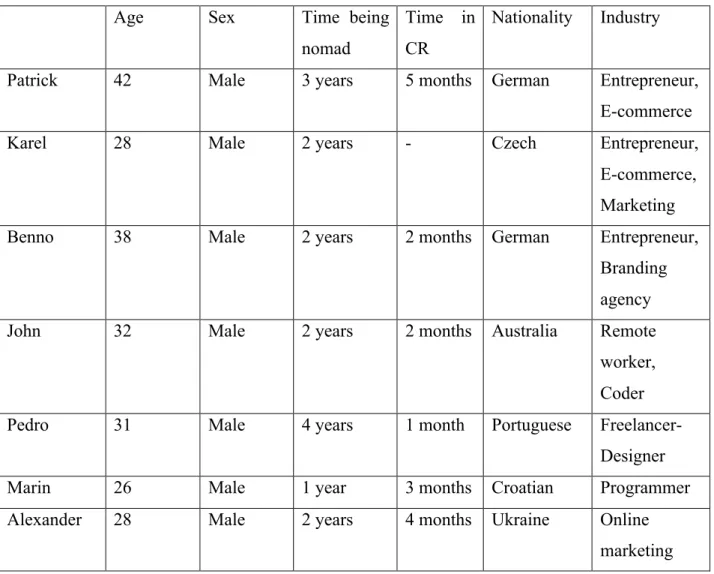
The cross-cultural competence model for digital nomads is based on experiences of 7 digital nomad’s who come from many different countries and even continents. The dimensions and components of the model are based upon the competencies that were mentioned by the Digital
The cross-cultural competencies are following:
1. Knowledge – The knowledge dimension is neither important nor unimportant. Digital nomads mentioned that it is beneficial to have knowledge of information technology, business and local law, infrastructure, culture, and language.
2. Skills – The skills dimensions is divided into abilities section and aptitudes section. As digital nomads said, it is important for them to have mainly two abilities, self-management ability and the ability to socialize. These two abilities are composed of many skills. For digital nomads it is also important to have the skills of analytical thinking and creativity.
3. Personality traits – Digital nomads identify several important personality traits, such as uncertainty tolerance, flexibility, adaptiveness, resilience, persistence, confidence, organization, curiosity, reactiveness, and enthusiasm.
4. External factors – For Digital Nomads, the most important external factors include cost of living, people and cultural influence.
The results of this research is the cross-cultural competency model for digital nomads. Some of the relevant attributes of the competency model were complemented by information gathered from an interview about Czech environment.
Sumário executivo
O propósito desta tese é explorer a vida dos nómadas digitais de modo a descobrir quais são as competências multiculturais e quais ajudariam os nómadas digitais a residirem e trabalharem mais eficientemente na República Checa e criar o modelo de competências multiculturais. As competências são desenvolvidas em base da experiência real dos nomadas que viveram na República Checa.
O modelo multicultural de competências é baseado em pesquisa qualitativa e quantitativa. Para a pesquisa é colecionado informação secundária da literature e informação primária de perguntas e entrevistas. A metodologia pode ser descrita em 5 fases:
- Recolha de dados da literatura – Ao coletar informação, teorias e dados da literature é possivel entender o tema complex que é a vida dos nómadas digitais. Em base de examinação de dados da literatura é escolhida uma competência multicultural do modelo para examinada e testada pelas experiências da vida real dos nómadas digitais. - Recolha de dados para pesquisa quantitative – Ao acumular dados quantitativos dos nómadas que viveram na República Checa via inquérito é possível analizar o quais são as mais e menos importantes dimensões e elementos do modelo de competência multicultural obtido da revisão da literatura.
-Coleção de dados para pesquisa qualitativa – Ao entrevistar nómadas digitais é possivel explorer quais são as competências que os nómadas digitais devem desenvolver com um foco especial na República Checa.
-Análise de dados – É importante comparar e analisar os dados da revisão da literatura e dados da entrevista e inquéritos para criar o modelo multicultural de competências. - desenvolvimento do modelo de competências multiculturais – As competências menos importantes são substituidas pelas competências mais mencionadas pelos nomadas digitais numa entrevista e o modelo é criado.
O modelo de competências multiculturais para nómadas digitais é baseado em vivências de 7 nómadas em vários países e até continents. As dimensões e components do modelo são as seguintes, cujas foram mencionadas pelos nómadas digitais mais frequentemente e foram lhes dadas um certo grau de importância.
As competências multiculturais são as seguintes:
1. Conhecimento A relevância do conhecimento não é importante nem desimportante. 2. Nómadas digitais mencionaram que é benefico ter conhecimento das tecnologias da
informação,negócios e leis locais, infraestrutura, cultura, e linguagem.
3. Capacidades – A dimensão das capacidades é dividida em habilidades e aptitudes. Como os nómadas digitais dizem, é importante para eles terem principalmente duas capacidades, auto-gerência e habilidade de socialização. Estas duas habilidades são compostas por várias capacidades. Para os nómadas digitais é também importante terem pensamento analítico e creatividade.
4. Traços de personalidade – Nómadas digitais veem como importante traços de personalidade tais como tolerância de incerteza, flexibilidade, adaptatividade, resiliencia, persistência, confiança, organização, curiosidade, reactividade e entusiasmo.
5. Factores externos – Custo de vida, pessoas e culturas são o que mais influenciam a vida dos nómadas digitais.
Os resultados da pesquisa são o modelo de competências multiculturais para nómadas digitais. Alguns dos atributos relevantes do modelo foram complementados pela informação colecionada por uma entrevista sobre o ambiente Checo.
ACKNOWLEDGMENTS
Firstly, I would like to thank to all digital nomads who agreed to be interviewed and gave me their time and valuable information.
I would also like to express my gratefulness and big thanks for amazing guidance and help to make this work, to my supervisor, Prof. Shaozhuang Ma.
Finally, I would like to thank to my family and friends who supported me on this journey.
Table of Contents 1. Chapter 1: Introduction ... 4 1.1. Background ... 4 1.2. Research objective and question ... 5 1.3. Thesis structure ... 5 2. Chapter 2: Theoretical Framework ... 7 2.1. Defining digital nomad ... 7 2.1.1. Long-term mobilities ... 7 2.1.2. Digital Nomad ... 9 2.2. Culture ... 11 2.2.1. Defining culture ... 11 2.2.2. National culture ... 13 2.2.3. Organizational culture ... 15 2.2.4. Patterns of cross-cultural business behavior ... 16 2.3. Intercultural Competence Model ... 17 2.3.1. Definition of cross-cultural competence ... 18 2.3.2. Definition of Intercultural competence ... 19 2.3.3. Cross-cultural vs. Intercultural ... 20 2.3.4. Intercultural Competence Models ... 21 2.4. Cultural profile of Czech Republic ... 29 2.4.1. High Power Distance ... 29 2.4.2. Individualism ... 29 2.4.3. Masculinity ... 30 2.4.4. Uncertainty avoidance ... 30 2.4.5. Long term orientation ... 30 2.4.6. Indulgence Vs. Restraint ... 31 2.4.7. Deal-focused, Moderately Formal, Monochronic, Reserved Culture ... 31 3. Chapter 3: Research Methods ... 32 3.1. Research approach ... 32 3.2. Qualitative research ... 33 3.3. Quantitative research ... 33 3.4. Data collection ... 34 3.5. Sample group ... 35 3.6. Data analyse ... 36 4. Chapter 4: Findings ... 38 4.1. Knowledge ... 38
4.1.1. Culture-general knowledge ... 40 4.1.2. Culture-specific knowledge ... 45 4.2. Skills ... 49 4.2.1. Abilities ... 50 4.2.2. Aptitude ... 53 4.3. Personal attributes ... 54 4.4. External factors ... 55 5. Chapter 5: Discussion and conclusion - Cross-Cultural Competence Model for digital nomads ... 59 5.1. Knowlege ... 59 5.2. Skills ... 59 5.2.1. Abilities ... 62 5.2.2. Aptitude ... 63 5.3. Personality traits ... 64 5.4. External Factors ... 66 5.5. Implications ... 69 5.6. Conclusion ... 70 Bibliography ... 72 APPENDIX 1:Interview ... 77 APPENDIX 2: Questionnaire ... 80
Index of Tables and Figures
Figure 1: Hofstede's Onion Model of Culture………..………….……13
Figure 2: Model of Intercultural Communication Competence ……….……….… 27
Figure 3: Dynamic-Systemic-Process Model of International Competencies …………..….. 27
Figure 4: Czech Republic Cultural Profile ……….…..33
Figure 5: Culture-general knowledge - average……….…………47
Figure 6: Elements of factual knowledge average……….………49
Table 1: Deardorff’s pyramid model ………....…… 24
Table 2: Intercultural competence model……….……. 25
Table 3: Cross-cultural competence model by Bartel-Radic and Giannelloni …….………... 26
Table 4: Information about Interviewees. .. ………. 38
Table 5: How important is the knowledge………..…...41
Table 6: Culture-general knowledge …. ……….……….42
Table 7: How important are components of culture-specific knowledge ……… 47
Table 8: How important are elements of factual knowledge………..….. 48
Table 9: Skills………...…. 52
Table 10: Personal attributes… ……….….…..56
Table 11: External factors ……….….…..58
Table 12: Cultural Distance ……….…….... 59
1. Chapter 1: Introduction
1.1. Background
The world is more innovative than ever. The discovery of electricity was the
beginning of this tremendous change. After Alessandro Volta invented the first voltaic pile, it took almost one hundred and fifty years to discover the transistor. Now, we can find a smaller version of this transistor in almost any electronic device such as a computer, tablet or
smartphone. The time when it took dozens of years of research to discover new technology is gone. Nowadays, companies introduce newer and better technologies each year. Technology is not the only thing that has changed- the lifestyles of people have been evolving too. The development of technology enables people to have increased freedom and more options in life than ever before. Technology such as the internet, laptops, and airplanes provides a high degree of mobility, which allows people to work from almost any place on earth. More and more people realize the value of this opportunity and they take a chance to work differently. The people who choose to work while traveling call themselves Digital Nomads.
The term Digital Nomads will be analyzed more in depth in the first part of this work. The term will be compared with other long term mobilities, such as Lifestyle migrants, self-initiated expatriates, Global nomads and others and decomposed in order to truly understand what being a Digital Nomad means. Richards and Wilson (2004) refer to many authors who are speaking about the quickly growing population of people who choose to live a nomadic lifestyle. And there are many reasons for that. It was never as easy and cheap as it is
nowadays to travel the world because of low-cost airlines, low-cost hostels, the coverage of fast internet connection. Even employers are supporting freelance contracts, as it saves costs for them. That supports Levels (2015) assertion that there will be more than hundreds of millions of digital nomads by 2035. Not only is the environment around people changing, but people’s life values and habits as well. The nine-to-five working life is no longer desired by many people. People don’t want own things anymore and get married less. All this cause the increase in the population of Digital Nomads.
1.2. Research objective and question
The goal of this master thesis is to develop a competency model for Digital Nomads and evaluate its components in specific culture - Czech culture, in order to expand theoretical base, from which digital nomads can source the information. This goal should be reached in second major part of this work, the practical part. In the practical part will be chosen intercultural competency model. This intercultural competency model and its elements, in combination with cultural profile of Czech Republic, will be discussed and evaluated in an interview with Digital Nomads. This part should answer the research question of this master thesis, which is following:
What intercultural competencies digital nomads, who are going to live in Czech Republic coming from outside countries, need to develop, in order to work and live in Czech Republic effectively?
Czech culture was chosen because Prague is, according to the Nomadlis.com (Levels, 2013), the fastest growing city in terms number of visits by digital nomads. Last year was Prague in top 10 cities in Europe, recommended by digital nomads to be visited. Currently Prague is moving between 2nd and 3th place (Levels, 2013). Hofstede's dimensions in combination with Gesteland’s dimensions of the patterns of cross-cultural business behavior will help to analyze and describe elements of Czech culture.
1.3. Thesis structure
After defining the term Digital Nomad, the following section will describe the meaning of culture, its definition, what are the elements of culture, what different cultures exist with a special focus on Hofstede dimensions of national culture and organizational culture.
The next section will define and compare intercultural and cross-cultural competence. This section will also analyze, compare and contrast intercultural and cross-cultural competence models. As previously mentioned, the contemporary world is more connected than ever. Companies are expanding to new markets abroad. For companies, it is crucial to have intercultural competent expatriates in order to succeed. Deardorff (2009) provides some examples of when expatriate’s intercultural incompetence caused failure, which cost company money, market share, and their reputation. Digital Nomads can fail too. The failure of a Digital Nomad can affect the company they are working for or their own business. Dozens of
research projects have been conducted on expatriate failures and expatriate preparation. Some common causes of expatriate failure (Hung-Wen, 2007; Martinko, Douglas, 1999; Foster, 1997) are intercultural differences such as gender differences, cultural values, religion, traditions, way of living, speaking, dynamic of friendship, local laws and political situations.
The community of digital nomads is growing rapidly, and yet, there are almost no research projects about preparation processes that can decrease a Digital Nomad’s failure. That only confirms the need of further research.
After all the data is gathered from the interviews, it will be analyzed and a new intercultural competence model will be developed. The new intercultural competence model will fill the gap in current literature about digital nomads and provide the missing information to Digital Nomads who come to Czech Republic, as well as describe the intercultural
2. Chapter 2: Theoretical Framework
2.1. Defining digital nomad
In literature, there are many common terms to describe people who travel the world. These terms include backpackers, drifters, migrants, expatriates (Kannisto 2016), global nomads (Richards, Wilson 2004), digital nomads (Makimoto, 2013). This dissertation will be focused on Digital Nomads. However, it is important to see this concept from a wider
perspective. Therefore, in this section we will discuss concepts that are similar to the Digital Nomad.
Kannisto (2016) has brought up interesting concept - lifestyle mobilities. Lifestyle mobilities include a big range of voluntary relocation from one place to another, where there is a potentially of better or different lifestyle. Kannisto (2016) divided the lifestyle mobilities into three categories: long-term travel, lifestyle migration, and professional lifestyle travel.
2.1.1. Long-term mobilities
Long-term travelersare usually backpackers, drifters or flashpackers. Those are people who go on a journey which lasts from one to few months. After this period of time, they typically return to their home. Some people can live such a lifestyle for many years, keeping a home base in the country of origin (Kannisto, 2016).
Lifestyle migrants leave their homes in one country to find a new home in another country, seeking a better life. Other motivating factors might be cheaper living costs and suitable weather or desired lifestyle (Kannisto, 2016).
Professional lifestyle travelers or self-initiated expatriates
, as some professional
literature might call them, are people traveling from country to country looking for jobs for short period of time. This means, that they will need, eventually, to settle down (Kannisto, 2016).The Global Nomad is another concept that is often mentioned in the literature. Bell-Villada and collective (2011, p.10.) use the definition of Global Nomads by Norma M. McCaig,
which defines a Global Nomad as “anyone who has lived outside of their parent’s country of origin (or their ¨passport country¨) before adulthood because of parent’s occupation.”
Kannisto (2016) explains the concept of global nomads by expanding on many authors such as J. Urry, D. Lisle or G. Van Den Abbeele. The key point is that all those studies of tourism and migration are based on the assumption that people have a place which they leave or return to, which they call home. Tourists leave their home, travel to the desired destination, spend some time and then they return home. Migrants leave one home and find a new home in another place. In both situations, there is reference point called home, where the journey begins and ends. Conversely, global nomads are constantly traveling from one place to another, without necessarily going back to their country of origin.
Richards and Wilson (2004) build on the definition of nomad, which is mentioned in the following section, by saying that global nomad overcome physical and cultural obstacles, as they are looking for difference and differentiation. The backpacker is then in opposition to the classical version of tourist.
Kannisto (2014) states in the book Global Nomad that global nomads are people who are constantly traveling, who explore new destination without a fixed residence, place of employment, or localized group of friends. Kannisto also says that the journey has lasted at least three years. They gather in communities which stay on one place for just a short time. A lot of them have chosen to leave the comfort that regular income, health care, and insurance in their home country. “Global Nomads are homeless, or—depending on your point of view—at home wherever they happen to be” (Kannisto at al., 2014, p.2).
The definition mentioned by Bell-Villada and collective says, that people may become Global Nomad in early age, not necessarily through their own decision. On the other hand, Richards and Wilson’s definition suggests, that a Global Nomad is somebody, who is consistently traveling and seeking something new or different. In some way, that is confirmed by Kannisto’s definition, which goes even further by saying that their home is nowhere and everywhere.
in greater depth, one subcategory of the Global Nomad is the Digital Nomad introduced by Makimoto (2013).
2.1.2. Digital Nomad
Digital Nomad is a moderately new concept. The most of the credits for developing this term gets Tsugio Makimoto. However, there are other people who have tried to explore and describe this phenomenon.
Liegl (2014, p.163) uses Kleinrock’s definition of digital nomads, which describes digital nomad as “a mobile knowledge worker equipped with digital technologies to work anytime, anywhere.” Jarrett Cosette (2016) defines digital nomad as an open-minded freelance and tech workers. On the other hand, Makimoto (2013, p.40) says that digital nomad is now term that “describes a new lifestyle in which people have been freed from the constraints of time and location, thanks to the progress of mobile intelligent devices and high-speed communication networks.”
Makimoto defines digital nomads more as a way of living while Liegl’s definition is more focused on work-side of things. However, all of them concur on the fact, that people living this lifestyle, are people who have skill and knowledge in information and communication technology.
From these definitions, we can deduce, that digital nomads are people working in some digital field, online, and are location independent. In order to fully understand what concept of Digital Nomad truly means, it's necessary to decompose it.
Encyclopædia Britannica (2009) define Nomadism as a way of life for people, who prefer to cyclically or periodically move from one place to another, rather than live continually in the same place. Arntzen (2009, p. 69) provides a definition of Nomads, which defines them as “groups of people and social types, characterized by a lack of permanent residence or settlement.” According to Oxford dictionaries (2016) a nomad is a person who constantly travels from one place to another to find new resources for him and his animals and doesn’t have permanent home.
Richards and Wilson (2004) use the definition of nomad inspired by Kaplan, saying that nomad is the one who is always traveling, without any thoughtfully planned destination, goal or objective for long term and without any place to return to.
Arntzen and Oxford Dictionaries coincide on the fact that nomad is someone without a permanent home, which Encyclopædia Britannica complements by adding the fact, that these nomads don’t stay in one place, but travel from one place to another.
Richards and Wilson put nomads in the modern perspective of a traveller. However, their definition just confirms the core idea of what nomad is, which has been already mentioned before. Nevertheless, Richards and Wilson (2004) expand on the Kaplan definition, by saying that nomad, characterises an idealized way of traveling in which are no limitations from modern society.
According to Cambridge Dictionary (2016) “Digital” is “using or relating to digital signals and computer technology.” Whatis.com (2016) describe a digital in more depth, stating that “digital describes electronic technology that generates, stores, and processes data in terms of two states: positive and non-positive.”
Nonetheless, Dörner and Edelman (2015) say, that digital can be seen not anly as something connected to technology, but also as a new way of engaging with clients. More importantly, rather than seeking the definition of digital as a thing, it is necessary to look at this term as a way of doing things. Cambridge Dictionary and the Whatis.com definitions are more technical, whereas Dörner and Edelman look at this term more from the perspective of how things are done.
From the definitions above, it can be concluded that digital nomads are usually people who decided to conduct life in nomadic manners, moving from one place to another, staying there for some period of time and then leaving again to another place. They are use modern technology to do their jobs, earn money, by working online in some digital field.
2.2. Culture
The culture is great concept which is going in great depths of thinking of people in certain area. Researchers have studied a wide range of the different elements of culture in order to describe it. As Digital Nomads travel to different countries, they experience different cultures, which influence their lives in various ways. Therefore, it is important to understand the concept of culture, as well as its elements, characteristics and the way different cultures interact with each other. All that will be discussed in this section (Hledíková, Janák and Dobeš, 2007).
2.2.1. Defining culture
Many researchers, from different industries, have tried, for many decades, to define the term “culture”. Kroeber and Kluckhohn (1952, p.181) have analyzed dozens concepts and definitions of culture. From that they formulated a new definition which is following: Culture are patterns of behaviour, which can be apperent on first sign, as well as hidden. The behaviour is articulated by symbols, which demonstrate the differentiation of groups of human. “Essential core of culture consists of traditional (i.e. historically derived and selected) ideas and especially their attached values; culture systems may, on the one hand, be considered as products of action, on the other, as conditional elements of future action.”
Geert Hofstede defines culture as “the collective programming of the mind which distinguishes the members of one group or category of people from another” (1991, p.5). Hofstede lists the examples of group or category as following: national culture, gender culture, age group or generation culture, occupation culture or organizational culture.
More recently Spencer-Oatey (2008, p.3) defined culture as „a fuzzy set of basic assumptions and values, orientations to life, beliefs, policies, procedures and behavioural conventions that are shared by a group of people, and that influence (but do not determine) each member’s behaviour and his/her interpretations of the ‘meaning’ of other people’s behaviour.”
From these definitions above, it can be deduced that culture is set of patterns, behaviors, symbols, values, and rules, which are shared by a group of people and have an impact on their behavior. According to Hofstede (1994; 2007), the manifestation of culture can be divided into Symbols, Heroes, Rituals, and Values. All these categories influence the practices within the
culture. Accordingly, Hofstede created, what is called the Onion model, where he locates all mentioned categories. See figure 1.
Figure 1: Hofstede's Onion Model of Culture Source: Hofstede, Hofstede jr., Mikov, 2010. 2.2.1.1. Symbols
Symbols are placed at the top layer of the onion as they are the most changeable. Symbols include items, gestures or words, which have special meaning for people from a particular culture. These symbols are changing all the time. New symbols arise, some very quickly disappear and some stay for longer period of time and can be influenced by time and current trends. Some cultural symbol of one culture may be copied by other cultures. However, the meaning of these copied symbols may not stay the same (Hofstede, 2007)
2.2.1.2. Rituals
Rituals are activities which are performed by people within one culture, which may not have a purpose to gain material outcome, but they have special meaning for members of one culture. The members of the certain culture may think that they perform rituals with completely rational purposes however, the real meaning is to strengthen the relationship. The way of greeting can be the most common ritual performed all over the world, yet in many different ways. Other examples of rituals are religious ceremonies or business meetings (Hofstede, 2007).
2.2.1.3. Heroes
Heroes are people who represent personal features and behavioral patterns, which are highly respected in a given culture. These heroes might be living or dead, real or fictional. In some culture, heroes are fairy tale creatures, which server for younger generation of people as an example of a model behavior (Hofstede, 2007).
2.2.1.4. Values
In the core of the Onion model is the Values of the culture. The values give the general guidance what is good and what is bad, right and wrong, nice and ugly, and so on. These values are learned in early stages of life. They are so deeply imbedded in the minds of an individual that, people outside of the culture can hardly identify them (Hofstede, 2007).
As mentioned in Hofstede’s definition of culture, he divides the culture into levels and different layers. People can be a member of different social groups, which influence their patterns of behavior and cultural norms. National culture will be discussed in further detail in the following section.
2.2.2. National culture
Hofstede (1994) in his research has identified 5 dimensions of national culture differences: Power Distance, Individualism vs. Collectivism, Masculinity vs. Femininity, Uncertainty Avoidance, Long Term vs. Short Term orientation and Indulgence Vs. Restraint.
2.2.2.1. Power Distance
“It is the extent to which the less powerful members of organizations and institutions (like the family) accept and expect that power is distributed unequally” (Hofstede, 1994, p.2). People from the cultures where Power Distance is high tend to accept unequal distribution of power. They expect to be told what to do, and agree that one individual will have more power than the other. On the other hand, people from low Power Distance cultures expect that power will be distributed equally and that they will be treated as an equal.
2.2.2.2. Individualism Vs. Collectivism
“Individualism on the one side versus its opposite, collectivism, is the degree to which individuals are integrated into groups” (Hofstede, 1994, p.2). People in individualistic culture are seen as an individuals, who take care of themselves and are autonomous. In collectivistic culture, the individual is seen as a member of a larger group in which they coexist. In
Individualistic culture, individuals set up their goals according to what they individually want to achieve. In collectivistic culture, individuals set up their goals in accordance with what is beneficial for the whole group (Hofstede, 2007).
2.2.2.3. Masculinity Vs. Femininity
“Masculinity versus its opposite, femininity, refers to the distribution of roles between the sexes which is another fundamental issue for any society to which a range of solutions are found (Hofstede, 1994, p.3).” This dimension shows the degree of separation between a man’s and a woman’s role in society. In masculine cultures, the roles are distinctly separated. High performance, dominance, and materialistic motivation is expected; a woman’s role is expected to involve caring, humbleness, and focus on the quality of life. On the other hand, in feminine culture are these roles close to each other, or even overlap. Both genders are expected to be soft, focused on quality of life, soft and unpretentious (Hofstede, 2007).
2.2.2.4. Uncertainty avoidance
Uncertainty avoidance focuses on the degree to which people in a certain culture are comfortable to deal with uncertainty. In a culture with a high degree of uncertainty avoidance, the rules are very important. If there are no strict guidelines how to act in certain situation it makes people very uncomfortable. The rules of systems in different institutions need to be set up strictly and thought about thoroughly. There is a high chance of punishment if the rules are not followed. In the low uncertainty avoidance cultures, rules don’t play such a big role. People in low uncertainty cultures react to uncertainty calmly (Hofstede, 2007).
2.2.2.5. Long Term Vs. Short Term Orientation
“It can be said to deal with Virtue regardless of Truth. Values associated with long term orientation are thrift and perseverance; values associated with short term orientation are respected for tradition, fulfilling social obligations, and protecting one’s ¨face¨” (Hofstede, 1994, p.5,). Long-term orientation cultures’ values include education, honor, adaptability, responsibility and restraint. For cultures with short term orientation, the associated values are freedom, performance, and independence (Hofstede, 2007).
2.2.2.6. Indulgence Vs. Restraint
Indulgence is a tendency to prioritize having fun and enjoying life whereas restraint, is the opposite which when these needs of having fun and enjoying life are restricted by strict social norms (Hofstede, 2007).
2.2.3. Organizational culture
Since many Digital Nomads work as freelancers, they may come across a variety of different organizational cultures and management styles while working for different
companies in different countries. Hofstede (2010) identifies 6 dimensions of organizational culture. Additionally, similarities can be found in Gesteland’s (1999, 2012) dimensions of the patterns of cross-cultural business behavior:
2.2.3.1. Process-oriented vs. Results-oriented Cultures
“The former is dominated by technical and bureaucratic routines, the latter by a common concern for outcomes” (Hofstede, 1994, p.10). In the process-oriented culture, individuals perceive their days at work as repetitive. They try to not face any risks in the work process and they dedicate just a little effort to their job. Conversely, in result-oriented cultures, individuals put as much effort into their work as they can while being comfortable with taking risks. They perceive that each of their working days is different (Hofstede 2010).
2.2.3.2. Job-oriented Vs. Employee-oriented Cultures
“The former assume responsibility for the employees’ job performance only, and nothing more; employee-oriented cultures assume a broad responsibility for their members’ well-being” (Hofstede, 1994, p.10). In the employee-oriented culture, the organization looks at an employee as the whole package and take into consideration their problems and welfare. Decisions are usually made by a group. In the job-oriented culture, the organization focuses on the results of an employee’s work, instead of their welfare. Employees may feel under pressure. The important decisions are made by individuals (Hofstede, 2010).
2.2.3.3. Professional Vs. Parochial Cultures
“In the former, the usually highly educated members identify primarily with their profession; in the latter, the members derive their identity from the organization for which they work” (Hofstede, 1994, p.10). Organizations in the parochial cultures, which are similar to employee-oriented cultures, look at an employee as a whole, meaning that they take into account their job competence as well as their social and family background. In professional
culture, organizations tend to separate the private life of the employee and their work- they focus only on job competence (Hofstede, 2010).
2.2.3.4. Open System Vs. Closed System Cultures
“This dimension refers to the common style of internal and external communication, and to the ease with which outsiders and newcomers are admitted” (Hofstede, 1994, p.10). In the open systems, people and organization consider themselves as open towards newcomers and outsiders. In closed system cultures, both organizations and employees guard themselves against newcomers. They are secretive even among their known co-workers (Hofstede, 2010).
2.2.3.5. Tightly Vs. Loosely Controlled Cultures
“This dimension deals with the degree of formality and punctuality within the organization” (Hofstede, 1994, p.12). In tightly controlled cultures, the organizations tend to focus on costs, meeting on time, and tight formal control. In loosely controlled cultures, meeting times are set up approximately and there is no such focus on costs (Hofstede, 2010).
2.2.3.6. Pragmatic Vs. Normative Cultures
This “dimension describes the prevailing way (flexible or rigid) of dealing with the environment, in particular with customers” (Hofstede, 1994, p.12). In Normative cultures, the main focus is on doing things exactly according to rules without a major focus on outcome and customer satisfaction. On the other side, in Pragmatic cultures, the main focus is on delivering what customer need and want therefore, the result is more important than correct procedures (Hofstede, 2010).
2.2.4. Patterns of cross-cultural business behavior
While having a different dimension of National and Organisational culture by Hofstede, it is important to see cultural differences from another point of view. Gesteland (1999) identified dimensions of the patterns of cross-cultural business behavior:
2.2.4.1. Rigid-time vs. Fluid-time
This dimension is similar to Hofstede’s dimension Tightly Vs. Loosely Controlled Cultures. It deals with attitudes towards scheduling and time precision. Rigid-time cultures set schedules in concrete and agendas of the meeting are fixed. In contrast, Fluid-time cultures pay less attention to time and punctuality, and deadlines are flexible (Gesteland, 2012).
2.2.4.2. Expressive Vs. Reserved Cultures
This dimension deals with the degree of expressionless in verbal, nonverbal and paraverbal communication. Different cultures give a different meaning to silence or the volume of the speech. There are also different rules in turn taking and conversation overlap. Distances between people, touch behavior, eye contact or gestures may all differ from culture to culture (Gesteland, 2012).
2.2.4.3. Formal vs. Informal Cultures
This dimension deals with the degree of formality in a culture, in regards to status, hierarchies, power, and respect. Informal cultures value status equality; formal cultures emhasize hierarchies and status differences (Gesteland, 1999).
2.2.4.4. Deal-Focus vs. Relationship-focus
Relationship-focused cultures are people-oriented. That means people in such culture want to build some connection with counterpart and trust before pursuing business. They might be uncomfortable doing business with people they don’t know. Deal-focused cultures can be considered as task-oriented. People from this dimension are more open to make a deal with people they don’t know (Gesteland, 1999; 2012).
National and Organizational cultures, as well as dimensions of patterns in cross-cultural business behaviour, give us insight into what behaviour can be expected in different cultures. This might be beneficial for Digital Nomads to expand their knowledge, scan their personal attributes, identify cultural distance and therefore, enhance their intercultural competence.
2.3. Intercultural Competence Model
In order to understand what intercultural skills Digital Nomads should possess, information they should find or what personal attributes they may have, this section will analyze the meaning of cross-cultural and intercultural competence models. Subsequently, one model will be chosen and analyzed in more depth.
Deardorff (2006) lists many terms similar to intercultural competence such as: cross-cultural competence, global competence, intercross-cultural competence, and global citizenship. Fantini (2007) expanded the terminology with international competence, cross-cultural
awareness, and cultural sensitivity. Other literature favors the term cultural intelligence. However, the most mentioned terms are cross-cultural competence and intercultural competence. It is important to analyze and compare definitions of these two terms in order to fully understand the differences. The following section will compare the terms cross-cultural competence and intercultural competence
2.3.1. Definition of cross-cultural competence
Johnson, Lenartowicz and Apud (2006) divide definition of CCC into three categories -international business; workplace diversity; intercultural communications.
2.3.1.1. International business
Literature provides many definitions of cross-cultural competence in international business. Johnson, Lenartowicz and Apud have analyzed many of them from different industries, defined by authors such as Byram, Hofstede or Earley and have proposed following definition:
“Cross-cultural competence in international business is an individual’s effectiveness in drawing upon a set of knowledge, skills, and personal attributes in order to work successfully with people from different national cultural backgrounds at home or abroad “(p. 530, 2006).
2.3.1.2. In workplace diversity
In order to define CCC in workplace diversity were analyzed numerous definitions, mainly across health care, medicine, psychology and education sector. The resulting definition is as following:
“Cultural competence is a set of congruent behaviors, attitudes, and policies that come together in a system, agency, or among professionals and enables that system, agency, or those professionals to work effectively in cross-cultural situations” (Johnson, Lenartowicz and Apud, p. 529, 2006).
2.3.1.3. Competence in Cross-cultural communication
Johnson, Lenartowicz and Apud (2006) have compared definitions of authors such as Collier, Kealey, Miller, Lustig and Koester. They found that definitions by these authors share the same elements.
“The consensus is that ‘competence’ in this field of study means to be appropriate and effective in interactions between individuals from different national cultures “(Johnson, Lenartowicz and Apud, p. 529, 2006).
All three definitions share the same goal, to be effective. That suggests that cross-cultural competence is the ability to deal with things in an international context or
environment in the way that is most likely to secure the desired outcome. The definitions say that there are factors which directly affect an individual’s effectiveness. The first definition puts emphasis on skills, knowledge, and attributes of individuals, which determine their effectiveness. In contrast, the second definition emphasizes both an individual’s personal traits and the surrounding environment. The definition of CCC in workplace diversity points out that companies, agencies, organization or any other international institution should create a working environment and company policy that will enhance its’ effectiveness. It is
interesting to note that the two elements in the first definition- skills and knowledge, can be acquired and developed. Conversely, the two elements from the second definition are more inherent and might be harder to influence.
2.3.2. Definition of Intercultural competence
Deardorff (2006) concluded that the definition of intercultural competence can be complicated to define, as it is continuously evolving. Intercultural scholars and administrators prefer a less specific definition. However, Deardorff mentions two definitions which have ranked the most accurate among the intercultural scholars.
The first definition is a summarization of Byram’s work which is following: “Knowledge of others; knowledge of self; skills to interpret and relate; skills to discover and/or to interact; valuing others’ values, beliefs, and behaviors; and relativizing one’s self. Linguistic competence plays a key role” (Deardorff, 2006, p. 247).
The second definition is a summarization of Lambert’s work which is following: “Five components: World knowledge, foreign language proficiency, cultural empathy, approval of foreign people and cultures, an ability to practice one’s profession in an international setting” (Deardorff, p. 247, 2006).
Deardorff (2006, p. 248) mentions her previous definition which has been top-rated by intercultural scholars, which is following “the ability to communicate effectively and appropriately in intercultural situations based on one’s intercultural knowledge, skills, and attitudes”.
In her definition, Deardorff summarizes elements of Byram’s and Lambert’s work. Byram’s and Lambert’s definitions are very specific and might be seen as different. However, after a closer look and comparison, these elements are quite similar in their nature, which is expressed in Deardorff's definition. Byram’s and Lambert’s definitions are about being open-minded and open to new cultures and experience. This reflects an attitude of acceptance and builds on experience and knowledge, which are transformed into skills and abilities which enable individuals to communicate and interact with people from different culture effectively.
The definitions of CCC and Intercultural competence can be seen in different ways. However, in order to be able to analyze and compare these definitions, it is important to understand what the terms Intercultural and Cross-cultural really mean.
2.3.3. Cross-cultural vs. Intercultural
According to Gudykunst the “cross-cultural involves comparison of communication across cultures” whereas, “intercultural communication involves communication between people from different cultures” (p.1, 2003). Gonzalez (2011) confirms that “cross-cultural means a comparison and contrast between two cultural groups” and “intercultural refers to what happens when people from these two groups come together.” Fries (2006) definitions of Intercultural and Cross-cultural are similar to previous definitions. However, Fries says that the main difference, between these two terms, is the “interaction”. Fries explains the difference between these two terms on the example of the education system. “For example ¨a cross-cultural study of education in Western Europe “would be a comparison of chosen aspects of education in various countries or regions, but would consider each country or region separately and would not suggest any interaction between the various educational systems.” (Fries, p.2, 2006). “On the other hand, the term “intercultural” implies interaction. From an intercultural perspective, it would be possible to study the experiences of students or teachers who move from one educational system to another or to examine the interactions of students from different countries enrolled in a specific class or program” (Fries, p.2, 2006).
Based on previous definitions is possible to conclude that Cross-cultural means to compare and contrast certain aspects of different cultures, whereas Intercultural describes what happens when different cultures meet and interact with each other. Therefore, for purposes of this thesis, the term Intercultural will be used.
From both, intercultural and cross-cultural competence definitions is possible to conclude that the competence is the ability to achieve desirable outcomes. To do so, there are multiple factors which have a direct impact on the process. These factors are knowledge, skills, personal attributes, behaviors and attitudes. It is important to note that Byrams’s and CCC in workplace diversity definitions take into account even external factors which have an influence on Intercultural competence. Nevertheless, for purposes of this work will be used Deardorff's definition, as it covers the majority of previously mentioned factors.
2.3.4. Intercultural Competence Models
Literature provides a variety of intercultural competence models. In Deardorff’s book there are more than 20 intercultural competence models mentioned. In this section will be mentioned only few and further on one analysed. Definition of competency model Competency model describes concrete combination of knowledge, skills and other personal attributes, which are needed to effectively reach the goals in organization (Kubeš, Spillerová, Kurnický, 2004).
2.3.4.1. Cross-cultural competence (CCC) model
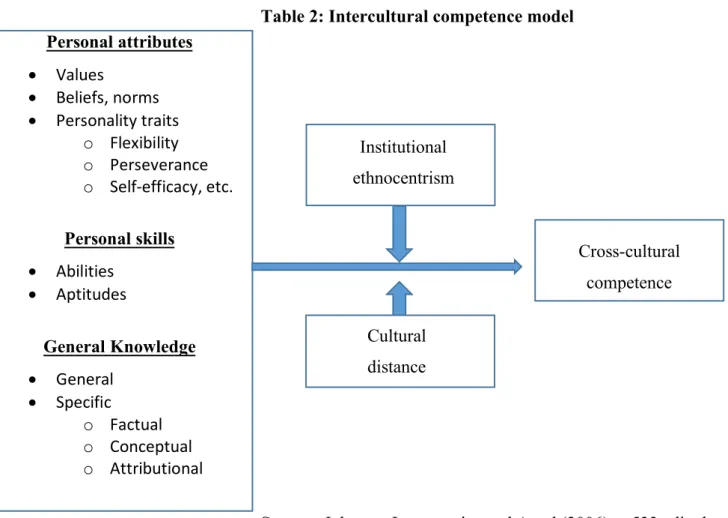
The model of CCC proposed by Johnson, Lenartowicz and Apud (2006) is based on the definition of cultural competence in international business. This model is constituted by personal attributes, personal skills, cultural knowledge and external and internal factors
The Byram (1997) proposed a model of intercultural communicative competence which has three attributes: attitudes, knowledge, and skills.
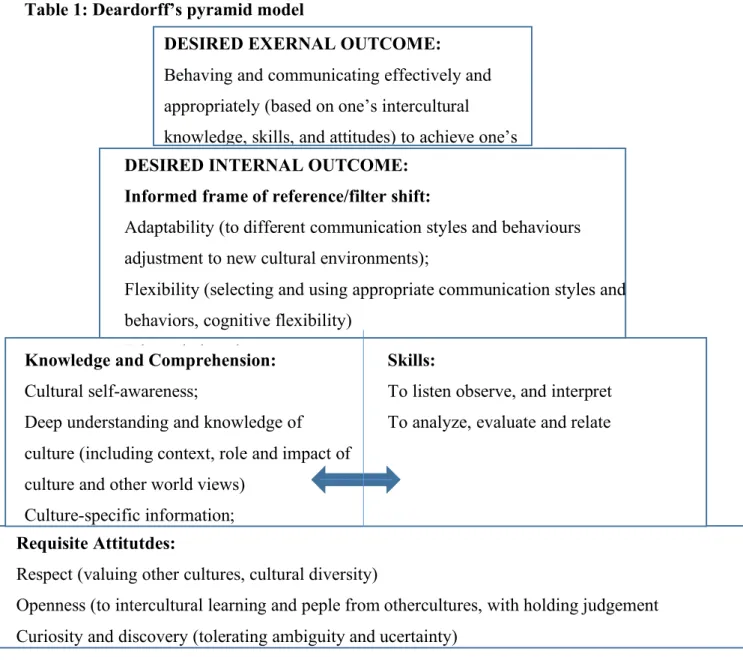
Deardorff's model pyramid model
The following figure represents a model of intercultural competence by Deardorff (2006). Deardorff’s pyramid model incorporates 22 essentials elements of intercultural competence. The vast majority of intercultural scholars and administrators agree on these elements. As previously mentioned Deardorff‘s definition of intercultural competence this
model emphasizes the importance of knowledge, skills, and attitudes. The attitude plays a fundamental role, which Deardorff supports by quoting Lynch and Hanson who say that “After all the books have been read and the skills learned and practiced, the cross-cultural effectiveness of each of us will vary. And it will vary more by what we bring to the learning than by what we have learned” (Deardorff, p. 255, 2006). This model proposes an interesting relationship between attitudes and personal attributes to the outcomes. The outcome is divided into internal and internal outcomes. The internal outcome is an internal frame of reference which enhances the external outcome. The external outcome is appropriate and effective behavior and communication in intercultural interactions (Deardorff, 2006). Appropriateness is a skill to break no valued rules and the effectiveness is the ability to achieve the goals (Deardorff 2006).
Table 1: Deardorff’s pyramid model
Source: Deardorff (p. 254, 2006) edited
Skills:
To listen observe, and interpret To analyze, evaluate and relate Knowledge and Comprehension:
Cultural self-awareness;
Deep understanding and knowledge of culture (including context, role and impact of culture and other world views)
Culture-specific information;
DESIRED INTERNAL OUTCOME: Informed frame of reference/filter shift:
Adaptability (to different communication styles and behaviours adjustment to new cultural environments);
Flexibility (selecting and using appropriate communication styles and behaviors, cognitive flexibility)
Ethnorelative view;
DESIRED EXERNAL OUTCOME: Behaving and communicating effectively and appropriately (based on one’s intercultural knowledge, skills, and attitudes) to achieve one’s
Requisite Attitutdes:
Respect (valuing other cultures, cultural diversity)
Openness (to intercultural learning and peple from othercultures, with holding judgement Curiosity and discovery (tolerating ambiguity and ucertainty)
Knowledge and Comprehension: Cultural self-awareness;
Deep understanding and knowledge of culture (including context, role and impact of culture and other world views)
Culture-specific information;
Skills:
To listen observe, and interpret To analyze, evaluate and relate
Deardorff (2006) notes that intercultural scholars and administrators did not identify particular components of intercultural competence. For instance, they do not describe what knowledge, skills and attitudes are composed of. Conversely, Johnson, Lenartowicz and Apud (2006) are a bit more specific. Their cross-cultural competence model is similar to
Deardorff’s, including both knowledge and skills, however attitudes are replaced with personal attributes. In addition, the Johnson, Lenartowicz and Apud (2006) model incorporates external factors such as institutional ethnocentrism and cultural distance..
Table 2: Intercultural competence model
Source: Johnson, Lenartowicz and Apud (2006) p. 533 edited These two models may be seen as similar, but they are quite different in their nature. In Table 2 we can see that the particular elements of skills and knowledge in Johnson’s, Lenartowicz’s and Apud’s model are different from the elements in Deardorff’s model. It is necessary to note that of Johnson’s, Lenartowicz’s and Apud’s model is more focused on business, in oppose to Deardorff’s, which is focused towards education. Johnson’s,
Institutional ethnocentrism Personal attributes • Values • Beliefs, norms • Personality traits o Flexibility o Perseverance o Self-efficacy, etc. Personal skills • Abilities • Aptitudes General Knowledge • General • Specific o Factual o Conceptual Attributional Cross-cultural competence Cultural distance Institutional ethnocentrism Cultural distance Cross-cultural competence Personal attributes • Values • Beliefs, norms • Personality traits o Flexibility o Perseverance o Self-efficacy, etc. Personal skills • Abilities • Aptitudes General Knowledge • General • Specific o Factual o Conceptual o Attributional
Lenartowicz’s and Apud’s work will be described more in depth in practical section of this thesis.
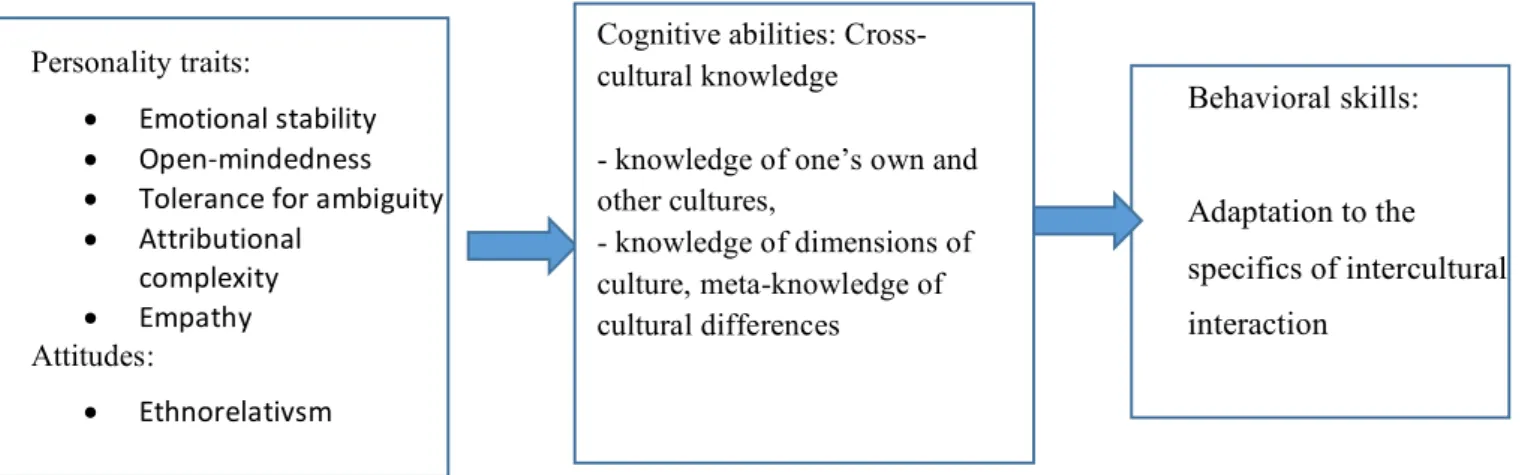
The cross-cultural competence model by Bartel-Radic and Giannelloni (2017)
combines the elements of personal traits and attitudes from the previous two models, as well as knowledge, which is incorporated in cognitive abilities. Even though these categories use the same terms as previous models, they share just a few components.
Table 3: Cross-cultural competence model by Bartel-Radic and Giannelloni
Source: Bartel-Radic and Giannelloni (p. 3, 2017) edited
In their report, Sinicrope, Norris and Watanab (2007) mention many authors and their models. One of those models is Byram’s and Risager’s European Multidimensional Models of Intercultural Competence (EMMIC). Byram proposed a five-factor model which consists of attitude, knowledge, skills of interpreting and relating, skills of discovery and interaction, and critical cultural awareness.
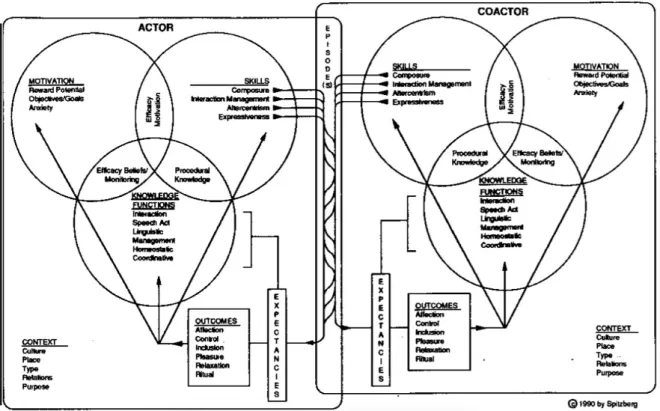
The Model of Intercultural Communication Competence by Spitzberg (2000) is based on three main aspects: Knowledge, Motivation and Skills. These factors are based on listed skills, abilities, and attitude, and analyzed in three levels: the individual system, the episodic system and the relational system. There is no need explore these system more deeply for the purposes of this work. “The model portrays the process of dyadic interaction as a function of
cv cv Personality traits: • Emotional stability • Open-mindedness • Tolerance for ambiguity • Attributional complexity • Empathy Attitudes: • Ethnorelativsm c Bartel-Radic and Giannelloni Cognitive abilities: Cross-cultural knowledge
- knowledge of one’s own and other cultures, - knowledge of dimensions of culture, meta-knowledge of cultural differences Behavioral skills: Adaptation to the specifics of intercultural interaction
two individuals' motivation to communicate, knowledge of communication in that context, and skills in implementing their motivation and knowledge” (Spitzberg, 2000, p. 380,).
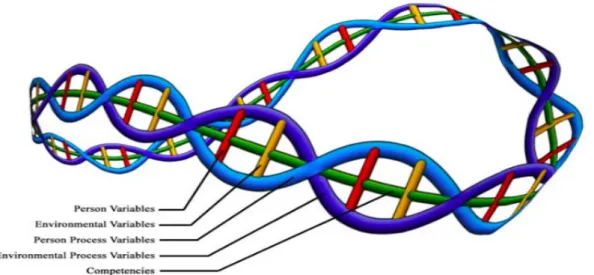
Figure 2: Model of Intercultural Communication Competence Source: Spitzberg, p. 382, 2000 Gerstein, Hurley and Hutchison provide a model from a different perspective. Unlike the other models, the “Dynamic-Systemic-Process (DSP) Model of International Competencies is guided by the assumption that individuals’ learning and development of international competencies is continuous, not sequential but recursive, constantly evolving, cumulative, and highly dynamic” (Gerstein, Hurley and Hutchison, p. 241, 2015).
Figure 3: Dynamic-Systemic-Process Model of International Competencies Source: Gerstein, Hurley and
Hutchison, p. 242, 2015
This DSP model by Gerstein, Hurley and Hutchison (2015) is composed of many variables which consist other elements:
• Person Variables – Personality and previous international experiences. • Environmental Variables – Cultural distance, characteristics of the job and organization.
• Environmental process variables - Training delivery, timing, and rigor.
• Person Process Variables - Emotion, motivation as a personal process, cultural adaptability, cultural environment, coping skills, cognitive complexity and flexibility, cognitive closure, ethnocentrism to ethno-relativism, interpersonal skills.
• Competencies – Motivation, awareness, knowledge, and skills.
As previously mentioned, some components of the model might be called the same thing, however, the models look at the intercultural competence from different points of view. Deardorff’s (2006) model is oriented towards intercultural competence of students and
education. The model presented by Johnson, Lenartowicz and Apud (2006) is focused on the international business. Cross-cultural competence model by Bartel-Radic and Giannelloni (2017) examine how particular components influence each other in the international business environment. The report by Sinicrope, Norris and Watanab (2007) mention Byram’s model, and seek to understand the intercultural competence from a communication perspective. The Model of Intercultural Communication Competence by Spitzberg (2000) examines the interaction between cultures. The Dynamic-Systemic-Process (DSP) Model is made with the
purpose to help “psychologists and trainees develop and employ culturally relevant and effective international skills” (Gerstein, Hurley and Hutchison, 2015, p. 239). The most common components among these models are knowledge, skills, attitudes, personal attributes. As already mentioned, Digital Nomads usually work online, own their own business or do freelancing. Therefore, for purpose of this work, we will explore cross-cultural competence in international business by Johnson, Lenartowicz and Apud (2006).
Knowledge
Johnson, Lenartowicz and Apud (2006) use many authors to explain what this dimension includes, including specific and general knowledge, knowledge of culture, knowledge of the language, and knowledge about the rules of interaction. These terms have wide definitions. Therefore, they use differentiation by Hofstede, who differentiates cultural knowledge to culture-general and culture-specific and Earley‘s and Ang’s approach which explores the cognitive aspects of knowledge acquisition called ‘metacognition’.
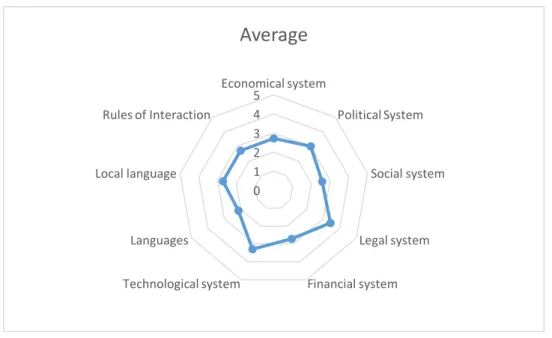
Culture-general knowledge is focused on information about the general environment of a culture such as what are the frameworks based on which can be one culture compared/contrasted with another different culture. It also includes general knowledge about economic, political, legal, social, financial and technological systems that exists and influence each other in one culture (Johnson, Lenartowicz and Apud, 2006).
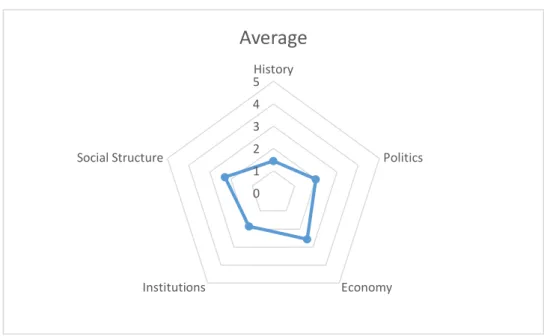
Culture-specific “focus on specific knowledge about another culture. This includes information about geography, economics, politics, law, history, customs, hygiene, what to do, and what not to do” (Johnson, Lenartowicz and Apud, 2006, p. 531). This knowledge is further divided into other three types: factual, conceptual, and attributional. Factual knowledge focus on history of a country, what is its political and economic system, what are the important institutions in that country, and what its social structure. Conceptual knowledge explores a cultural value system of a groups and how these values manifests in behaviors of local people. Attributional knowledge is concerned about what is appropriate behavior in that culture. It is based on factual and conceptual knowledge.
Metacognition has three aspects. Personal aspect (intra-individual, inter-individual or universal) which is about how we view our selves and other at the cultural level. Task variables which deal with the nature of the information acquired. Strategy variable is about what to do
and how to use the knowledge effectively the acquired knowledge (Johnson, Lenartowicz and Apud, 2006).
Skills
Skills are set of „abilities (such as foreign language competence, adapting to the behavioral norms of a different cultural environment, effective stress-management, or conflict resolution) and aptitudes” (Johnson, Lenartowicz and Apud, 2006, p.531). Deardorff (2006) also adds the skill to listen, observe, interpret, analyze, evaluate, and relate.
Personal Attributes
This dimension is a combination of internalized one’s home culture values, norms and beliefs and one’s personality traits such as ambition, courage, curiosity, decisiveness, enthusiasm, fortitude, integrity, judgment, loyalty, perseverance, self-efficacy, tolerance for ambiguity, and more (Johnson, Lenartowicz and Apud, 2006).
External Factors
According to Johnson, Lenartowicz and Apud (2006), the environments, such as physical, economic, political and legal, in which an individual is located has a big influence on the degree of effectiveness in cultural competence. They examine two factors which influence effective use of one’s knowledge, skills, and attributes: institutional ethnocentrism and cultural distance.
Johnson, Lenartowicz and Apud, (2006) say that Institutional Ethnocentrism is a common thing in international business. It is when foreign expatriate in an executive role in the host country is imposing techniques of doing things the way they are done in a home country. The limitations and small space for allowances might have a big impact on one’s effectiveness in multicultural teams.
Cultural distance (Johnson, Lenartowicz and Apud, 2006) is trying to examine and capture the general differences between national cultures. The bigger the cultural distance is, the more difficulties two nationalities may face while working together. The cultural differences might be in cultural values, as well as, environmental variables, too, such as the language, the economy, and the political and legal systems.
2.4. Cultural profile of Czech Republic
The Czech Republic has gone through many changes over the centuries. The Czech culture has been influenced by many different factors including world wars, invasions and political regimes. In 1918, the Czech Republic was called Czechoslovakia. During that time Czechoslovakia went through the Second World War and suffered an invasion by Russia. Russian occupation left the country with a communist regime which has had huge impact on Czech mentality, as it lasted for many decades. In 1993 the Czech Republic was established, and it became member of European Union in 2004. Over the years, Czech Republic was dominated and influenced by other cultures. Another big factor is area and location of Czech Republic; its’ neighbours Germany, Poland and Austria have had a major impact on Czech GDP and culture.
2.4.1. High Power Distance
In the Power Distance dimension, Czech culture reached 45th place of 74 with a Power Distance Index of 57. That makes Czech culture a fairly high Power Distance culture and hierarchical society. For example, it might be shocking for a person from a low power distance culture to experience the inequality in a typical workplace, where the power is centralized and there is big inequality between superiors and subordinates. In another example, someone from a low Power Distance culture may notice a different attitude when visiting a doctor, as the Czech doctor will feel as superior and will treat their patient accordingly (Hofstede, Hofstede, and Minkov, 2010).
2.4.2. Individualism
Czech culture got 58 points in Individualism therefore, it is individualistic culture. A foreigner from collectivistic culture might be surprised with the honesty that is common in Czech culture. “Telling the truth about how one feels is characteristic of a sincere and honest person” (Hofstede, Hofstede and Minkov, p.107, 2010). This will be further discussed in Gesteland’s model. People in individualistic countries walk faster, which could be perceived as a rushed or chaotic environment by a person in a collectivist culture. Individuals are hired based on skills rather than personal attributes. The relationship between employer and
employee is different as well-individualistic individuals don’t create strong relationships with their employers- which will be difficult for a person from a collectivistic culture to cope with (Hofstede, Hofstede and Minkov, 2010).