Andrej Bertoncelj, Darko Kovač • A conceptual model of individual competency...
Zb. rad. Ekon. fak. Rij. • 2008 • vol. 26 • sv. 2 • 215-237 215
Original scientific paper
UDC: 159.944
17.024.4
A conceptual model of individual competency
components as one of the predictors of success
in mergers and acquisitions
*Andrej Bertoncelj
1, Darko Kovač
2Abstract
The increasing challenge of how to balance “soft” human factors with “hard” financial factors in mergers and acquisitions (M&A) to be successful is not new. However, the real challenge lies in the question of how, and with which yardstick, to measure and compare the human factor in both the acquiring and the acquired companies in all phases of M&A. In this study, a model for measuring and comparing the human factor with competencies is presented. The model enables the measuring of soft factors with quantitative criteria. A tripartite individual competency components construct is conceived: cognitive, affective and conative, to which the personal value system is added. The model discussed is based on empirical findings and the cases of two companies and literature. The model enables companies to compare differences in competencies and thus to plan activities how to overcome those differences and achieve a higher success rate in M&A.
Key words: Mergers and acquisitions, competencies, M&A success, model for
M&A success.
JEL classification: G34, J 24, M 12, O 15
1. Introduction
Global mergers and acquisitions (M&A) activity reached $4.4 trillion in 2007 (Dealogic, 2008). The volume of deals in 2007 was 21 percent higher than in 2006
* Received: 07-10-2008; accepted: 15-12-2008
1 PhD, Assistant Professor, Senior Research Associate, University of Cambridge, Institute for
Manufacturing, Mill Lane, Cambridge CB2 1RX, United Kingdom. Scientific affiliation: mergers and acquisitions. Tel: 44 1223 765609. Fax: 44 1223 766142. E-mail: [email protected]
2 MSc, Director, Co&da Ltd., Partizanska 22b, 4260 Bled, Slovenia. Scientific affiliation: human
resource management. Tel: +386 41 69746. Fax: +386 4 5765090. E-mail: [email protected].
and for the first time in five years and only the second time ever the volume in Europe, with $1.78 trillion, was higher than the U.S., with $1.57 trillion (Dealogic, 2008), which was approximately 10 percent of the country’s GDP (Bao and Edmans, 2007). Besides growing in number, the size of individual takeover deals has risen to unprecedented levels, where some mega-deals have already surpassed a value of one hundred billion dollars. Current M&A activity is undergoing its fifth wave and is characterized by typically high-valuations, horizontal deals in the financial services, energy, telecommunications, and high-technology sectors (Angwin, 2001). Despite the popularity of external growth strategies, empirical studies of many scholars suggest that more than half of them fail to produce results; at best they are break-even situations (Hassan et al., 2007; Harding and Rouse, 2007).
Empirical studies of consummated acquisitions and their post-acquisition integration bring us to the conclusion that the high failure rate is a consequence of the current management and governance approach. They reason the M&A process with good practices and measure it with predominantly financial yardsticks. We argue that managers should also focus on companies’ core competences and values, on financial and non-financial performance by aligning the organizational structure and culture. The success of most acquisitions hinges not on dollars but on people (Harding and Rouse, 2007).
Although M&A is a very competitive business activity, it is possible to succeed. But how does one succeed at an activity in which the odds of success are so slim? It is argued that in today’s increasingly holistic environment executives of acquiring companies should implement the concept of balanced management of “financial” and “human” capital. Such an integrated approach can ensure long-term success in M&A through balanced management of critical success factors (CSF), thus delivering financial benefits from the deal (KPMG, 1999; Bertoncelj and Kovač, 2007). CSF in M&A are the set of circumstances, facts and influences that contribute to the overall deal outcome (Lim and Mohamed, 1999). Rochart (1979) suggests that CSF are a useful tool that can be controlled by management in order to achieve desirable outcomes. Similarly, Turner (2004) claims that if CSF are adequately identified and controlled, the chances of success can be greatly increased.
Andrej Bertoncelj, Darko Kovač • A conceptual model of individual competency...
Zb. rad. Ekon. fak. Rij. • 2008 • vol. 26 • sv. 2 • 215-237 217
when implemented together as a single factor, they have a major impact on the success rate.
Soft issues should be carefully considered, as “human” capital plays a critical role in M&A, even though it often takes only second place to commercial and financial considerations (Huang and Kleiner, 2004). It is the great irony of business practice that the only economic component that can add value in and of itself is the one that is most difficult to evaluate. The almost infinite variability and unpredictability of human beings makes us enormously more complex to evaluate than other tangible assets (Fitz-enz, 2000).
Intangible items such as management talent, management expertise, and relationships cannot be appropriately measured in numbers; however, they are the success factors in an innovative economy. Integrating soft factors is becoming an important challenge of M&A, and implementing a measurable method is even more important.
The purpose of this paper is to provide a framework for the empirical work, especially the practitioners. The research asks the question: How can one build a model to take into account “soft factors” as a predictor of M&A success and as a basis for an integration plan? The competency concept, besides other manifoldness benefits, offers the opportunity to investigate usefulness in that manner. Hence the focus of this article is competencies as a measure of human factor impact on M&A.
2. Theory and hypotheses
Measuring the soft factors in economic terms is being challenged. Ulrich (1998) believes that part of the answer lies in the concept of competencies. Competency can be treated as a mediating factor between the requirements of a job and the potential capacity of an individual as competence-in-use. Further, in contemporary work contexts, attitudes and values necessary for ensuring the commitment and identification of an individual with work are becoming more important.
and the labor market. Despite the fact that the interest of this article is competencies as an individual characteristic, it is beneficial to clarify the constructs.
In human resources management the concept of individual competence is widely used (e.g. Boyatzis, 1982; Schroder, 1989; Burgoyne, 1993). Nevertheless creating a precise definition is still a matter of much discussion. Most authors on individual competence refer to the set of skills that an individual should possess in order to be capable of satisfactorily performing a specified job. Practicing managers, when discussing individual competences are mostly concerned with performance, fulfilling tasks, improving efficiency and increasing production, which was well pointed out by Taylor (1911). Ellström (1997) defines competency as a broader concept than skills by grasping affective and motivational factors and personality traits next to different kinds of skills, e.g. technical skills.
Speaking of individual competencies, employees are a key agent, and thus a wide range of factors influence their competencies. Individual competencies are influenced by his or her knowledge, skills, beliefs, attitudes, affection, motivation, drive, volition, intuition. According to Garavan and McGuire (2001) this reasoning advocates that the study of competencies should take place within a context which addresses the employee as a whole person. Thus we argue that a more holistic approach towards the competency model is needed. Hodkinson and Issitt (1995) argue for a more holistic approach to competence in the caring professions, integrating knowledge, understanding, values, and skills that reside within the person who is the practitioner.
We agree with the aforementioned authors that personal traits can not be avoided in a discussion of competencies. Some authors related to personal traits in competency models (Mangham, 1986; Barrick and Mount, 1991; McClelland, 1998; Mansfield, 2004; Boyatzis, 1982; Klemp and Spencer, 1982; Spencer and Spencer, 1993). White (1959) introduced motivation into the term competencies by presuming a relationship between cognitive competencies and motivational action. He defined competence as an effective interaction (of the individual) with the environment and added motivation in addition to competence as achieved capacity.
Only cognitive abilities do not explain competencies sufficiently. Especially the US approach emphasizes an individual’s behavior and attributes, self awareness and social skills and is more personally oriented. McClelland (1998) claims that competencies are fundamentally behavioral and susceptible to learning.
Andrej Bertoncelj, Darko Kovač • A conceptual model of individual competency...
Zb. rad. Ekon. fak. Rij. • 2008 • vol. 26 • sv. 2 • 215-237 219
the first step towards developing flexibility in dealing with diverse and complex managerial situations. Emotional resilience is the meta-ability made up of self-control and self-discipline, the ability to manage emotions appropriately, personal resilience (coping with pressure and adversity, “bouncing back”), a balanced view of the self (both positive and critical; ideal and realistic). Personal drive refers to personal achievement orientation and motivation. It addresses the area of personal ambition for responsibility and implies an ability to motivate oneself and others as well as to take personal risks.
The OECD (2000) definition of competencies focuses on a functional approach, which places complex demands facing individuals at the forefront of the concept of competence. According to this viewpoint, competencies are structured around demands and tasks. Fulfilling complex demands and tasks requires not only knowledge and skills but also involves strategies and routines needed to apply the knowledge and skills, as well as appropriate emotions and attitudes, and effective management of these components. Thus, the notion of competencies encompasses cognitive but also motivational, ethical, social, and behavioral components. It combines stable traits, learning outcomes (e.g., knowledge and skills), belief-value systems, habits, and other psychological features. In this view, basic reading, writing and calculating are skills that are critical components of numerous competencies. According to the OECD (2000), acquiring competencies is viewed as an on-going, lifelong, learning process. This process occurs in multiple settings. The settings and social institutions relevant for the development of competencies besides school are family, peers, work, political life, religious life, cultural life, etc. The conception of competencies as learned contrasts with one in which competencies are considered innate, inborn characteristics.
Conation as an emerging concept can help to clarify the competence model. There are several definitions of conation:
- as the use of will, or the freedom to make choices about what to do (Kane, 1985; Mischel, 1996);
- as a proactive aspect of behavior (as opposed to reactive or habitual), which is the personal, intentional, planful, deliberate, goal-oriented, or striving component of motivation (Baumeister et al., 1998; Emmons, 1986);
- as “the tendency to take and maintain purposive action or direction toward goals” (Snow et al., 1996: 226);
- and as “the achievement aspect of ability, the process through which we fulfill our goals” (Kolbe, 1997: 10). In addition, Kolbe (1997) claims that human beings have a conative style, or a preferred method of putting thought into action or interacting with the environment. It is separated from a person’s intelligence or personality type.
To summarize several definitions, conation could be defined as the volitional steering of action toward some goal.
Some authors (Cappelli and Singh, 1992) argue that competitive advantage is potentially created by competent employees, where such competencies are firm, specific and difficult to imitate. On the other hand it depends on the transferability of competences whether employees will be organizationally bound. It is presumed (Sullivan et al., 1998) that employees with highly transferable competencies are not organizationally bound, as their competencies are portable and can be used to good effect in different organizations. On the contrary employees with low transferability of competencies are less employable, as they are bound by their present employer’s specific-specific skills, which may not be effective in other employment (Hirsch and Jackson, 1996).
Andrej Bertoncelj, Darko Kovač • A conceptual model of individual competency...
Zb. rad. Ekon. fak. Rij. • 2008 • vol. 26 • sv. 2 • 215-237 221
way we take actions, which is especially important from a practical point of view. It could be embraced as VQ (vitality quotient). Casse and Claudel (1999) comprehend Vitality Quotient (VQ) as a measure of basic drive that compels a person to ensure the accomplishment of his “Project-to-Live” and intensity of the Will-to-Live. Individual competences are dynamic (Ordanini and Rubera, 2008; Smart et al., 2007, Slack et al., 2004; Pandza et al., 2003). They change and should be adapted and adopted according to technology changes, market changes, CSF changes, strategy changes, product range changes, etc. They should be assessed accordingly and changes to the mentioned variables accordingly accommodated.
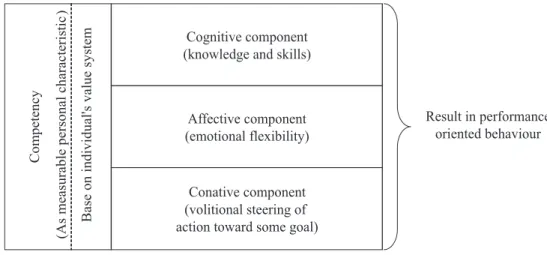
So we could summarize the definition of individual competency as a unitive performance-oriented measurable personal and functional characteristic based on an individual’s value system. This system is composed of cognitive, affective and conative components, which all result in certain behavior, which are dynamic and the acquiring of which is an on-going process (see Figure 1).
Figure 1: Tripartite individual competency components construct
Source: Authors
For the purpose of this article and the model of measuring the M&A success rate with the tripartite model of competencies, the authors use the term individual competency/ competencies. The different level of competencies acquisition can explain, in addition to other reasons why employees resist changes which M&A represent. According to Bijlsma-Frankema (2001), in the last 15 years, management of “the human factor” in mergers and acquisitions has been recognized as an important source of success by an increasing number of authors (Kimberly and Quinn, 1984; Kilmann et al., 1985; Pritchett, 1987; Bueno and Bowditch, 1989; Cartwright and Cooper, 1992; Gilkey, 1991; Lubatkin and Lane, 1996). We argue that the selection of takeover targets exclusively on the basis of financial ratios should be upgraded by the human factor and should be evaluated with non-financial ratios as well. So-called soft factors should be taken into the equation of M&A success and combined with the economic logic of corporate performance and social capital, measured in quantitative and qualitative terms.
Considering soft factors, the impact on the M&A success rate of two Slovene companies was observed and analyzed. It was the basis for the hypotheses:
H1: The M&A success rate can be measured with soft, i.e. human, factors. H2: A model of tripartite components of individual competencies as a measure of “soft, human factor” can, as one of the variables, predict the M&A success rate.
3. Methodology
Data were gathered in the context of broader research of the HRM model in Slovene company in the industry segment of builders` of carpentry and joinery which acquired part of the program of a competitor in 2008. Both companies were privatized in the late 1990s. The acquiring company (Company 1) had, in the year 2007, €41.5 million of total revenues, and the acquired company (Company 2) had, in the year 2007, €31.1 million in total revenues. At the time of acquisition company 1, which was founded in 1948, had 654 employees and company 2, founded in 1955, 518. Company 1 acquired part of the program of company 2 with 92 employees and €8 million of revenue. The relevant companies do not have a competencies system in operation yet, but company 1 is in the process of developing one.
Andrej Bertoncelj, Darko Kovač • A conceptual model of individual competency...
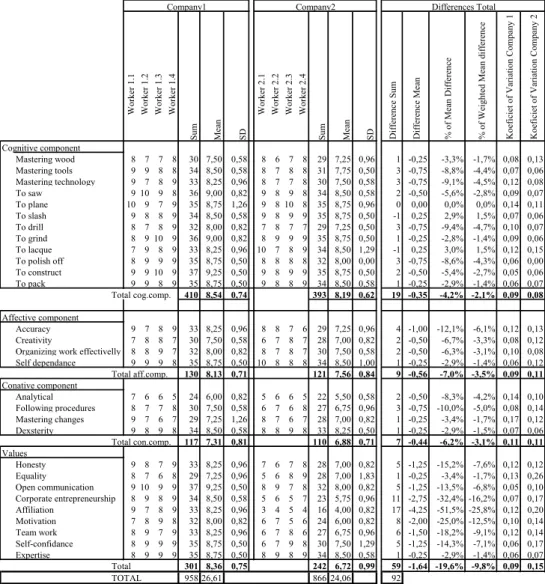
Zb. rad. Ekon. fak. Rij. • 2008 • vol. 26 • sv. 2 • 215-237 223 Four questions produced by Mirabile (1998) were used: if a competency can be described in a way that others can understand and agree with; if its demonstration can be observed; if it can be measured; and if can be influenced by some method of development. A list of elements of the named competency was made. Several answers were offered. Each of the three components of the named competency were selected and clustered as Table 1 exhibits.
Table 1: Difference of level of mastering competency to make furniture in Company 1 and Company 2 with differences
Worker 1.1 Worker 1.2 Worker 1.3 Worker 1.4 Worker 2.1 Worker 2.2 Worker 2.3 Worker 2.4
Sum Mean SD Sum Mean SD
Cognitive component
Mastering wood 8 7 7 8 30 7,50 0,58 8 6 7 8 29 7,25 0,96 1 -0,25 -3,3% -1,7% 0,08 0,13
Mastering tools 9 9 8 8 34 8,50 0,58 8 7 8 8 31 7,75 0,50 3 -0,75 -8,8% -4,4% 0,07 0,06
Mastering technology 9 7 8 9 33 8,25 0,96 8 7 7 8 30 7,50 0,58 3 -0,75 -9,1% -4,5% 0,12 0,08
To saw 9 10 9 8 36 9,00 0,82 9 8 9 8 34 8,50 0,58 2 -0,50 -5,6% -2,8% 0,09 0,07
To plane 10 9 7 9 35 8,75 1,26 9 810 8 35 8,75 0,96 0 0,00 0,0% 0,0% 0,14 0,11
To slash 9 8 8 9 34 8,50 0,58 9 8 9 9 35 8,75 0,50 -1 0,25 2,9% 1,5% 0,07 0,06
To drill 8 7 8 9 32 8,00 0,82 7 8 7 7 29 7,25 0,50 3 -0,75 -9,4% -4,7% 0,10 0,07
To grind 8 9 10 9 36 9,00 0,82 8 9 9 9 35 8,75 0,50 1 -0,25 -2,8% -1,4% 0,09 0,06
To lacque 7 9 8 9 33 8,25 0,96 10 7 8 9 34 8,50 1,29 -1 0,25 3,0% 1,5% 0,12 0,15
To polish off 8 9 9 9 35 8,75 0,50 8 8 8 8 32 8,00 0,00 3 -0,75 -8,6% -4,3% 0,06 0,00
To construct 9 9 10 9 37 9,25 0,50 9 8 9 9 35 8,75 0,50 2 -0,50 -5,4% -2,7% 0,05 0,06
To pack 9 9 8 9 35 8,75 0,50 9 8 8 9 34 8,50 0,58 1 -0,25 -2,9% -1,4% 0,06 0,07
Total cog.comp. 410 8,54 0,74 393 8,19 0,62 19 -0,35 -4,2% -2,1% 0,09 0,08
Affective component
Accuracy 9 7 8 9 33 8,25 0,96 8 8 7 6 29 7,25 0,96 4 -1,00 -12,1% -6,1% 0,12 0,13
Creativity 7 8 8 7 30 7,50 0,58 6 7 8 7 28 7,00 0,82 2 -0,50 -6,7% -3,3% 0,08 0,12
Organizing work effectivelly 8 8 9 7 32 8,00 0,82 8 7 8 7 30 7,50 0,58 2 -0,50 -6,3% -3,1% 0,10 0,08
Self dependance 9 9 9 8 35 8,75 0,50 10 8 8 8 34 8,50 1,00 1 -0,25 -2,9% -1,4% 0,06 0,12
Total aff.comp. 130 8,13 0,71 121 7,56 0,84 9 -0,56 -7,0% -3,5% 0,09 0,11
Conative component
Analytical 7 6 6 5 24 6,00 0,82 5 6 6 5 22 5,50 0,58 2 -0,50 -8,3% -4,2% 0,14 0,10
Following procedures 8 7 7 8 30 7,50 0,58 6 7 6 8 27 6,75 0,96 3 -0,75 -10,0% -5,0% 0,08 0,14
Mastering changes 9 7 6 7 29 7,25 1,26 8 7 6 7 28 7,00 0,82 1 -0,25 -3,4% -1,7% 0,17 0,12
Dexsterity 9 8 9 8 34 8,50 0,58 8 8 9 8 33 8,25 0,50 1 -0,25 -2,9% -1,5% 0,07 0,06
Total con.comp. 117 7,31 0,81 110 6,88 0,71 7 -0,44 -6,2% -3,1% 0,11 0,11
Values
Honesty 9 8 7 9 33 8,25 0,96 7 6 7 8 28 7,00 0,82 5 -1,25 -15,2% -7,6% 0,12 0,12
Equality 8 7 6 8 29 7,25 0,96 5 6 8 9 28 7,00 1,83 1 -0,25 -3,4% -1,7% 0,13 0,26
Open communication 9 10 9 9 37 9,25 0,50 8 9 7 8 32 8,00 0,82 5 -1,25 -13,5% -6,8% 0,05 0,10
Corporate entrepreneurship 8 9 8 9 34 8,50 0,58 5 6 5 7 23 5,75 0,96 11 -2,75 -32,4% -16,2% 0,07 0,17
Affiliation 9 7 8 9 33 8,25 0,96 3 4 5 4 16 4,00 0,82 17 -4,25 -51,5% -25,8% 0,12 0,20
Motivation 7 8 9 8 32 8,00 0,82 6 7 5 6 24 6,00 0,82 8 -2,00 -25,0% -12,5% 0,10 0,14
Team work 8 9 7 9 33 8,25 0,96 6 7 8 6 27 6,75 0,96 6 -1,50 -18,2% -9,1% 0,12 0,14
Self-confidance 8 9 9 9 35 8,75 0,50 6 7 9 8 30 7,50 1,29 5 -1,25 -14,3% -7,1% 0,06 0,17
Expertise 8 9 9 9 35 8,75 0,50 8 9 8 9 34 8,50 0,58 1 -0,25 -2,9% -1,4% 0,06 0,07
Total 301 8,36 0,75 242 6,72 0,99 59 -1,64 -19,6% -9,8% 0,09 0,15
TOTAL 958 26,61 866 24,06 92
Company1 Company2 Differences Total
Difference Sum Difference Mean % of Mean Difference % of Weighted Mean difference Koeficiet of Variation Company 1 Koeficiet of Variation Company 2
Note: Means are based upon a ten-point scale 10 (1 means least, and 10 most)
SD = standard deviation
The goal was not to find the best definition of the named competency, but to use it just as an example to build a model for measuring the human factor and predicting success of M&A based on it. The approach might not be accurate enough considering HRM practices, but sufficient to use it as an example for building a model. Line managers in both companies evaluated four workers from each company to find out the level of mastering selected components (cognitive, affective, and conative) of competency making furniture. A ten-point Likert scale was applied in a manner that each component can be mastered in levels 1 to 10 (1 being the least, and 10 the most).
The challenge is to extract the conative component of competency. Four elements of conative competency were offered: analyzing, following procedures, mastering changes and dexterity. There are few tools to measure the conative component of competency. One of them is the Kolbe A™ Index (Kolbe, 1997) which is making its way into managerial practice. Deamer and Earle (2004) developed the EMAQ (Enterprise Managers Assessment Questionnaire) as a suitable psychometric tool for assessing the potential, initially at the individual level, for a successful entrepreneurial venture. Atman (1987) developed the GOI (Goal Orientation Inventory), an instrument to assess goal accomplished style. Simultaneously, personal values were defined in the same way as described above with using companies’ business plan where companies’ values are exhibited as a base. The values do not change in different competencies; they are the same for all individual competencies in a certain company.
The next step was to calculate differences in competency components for making furniture between the evaluated workers from both companies for each element of components.
Statistic in which a certain term denotes:
- Elements of Cognitive components: CG1, CG2,...CGN
CG1
1,1 – appraisal of worker 1 in Company 1 about CG1 acquisition ...
CG1
2,1 – appraisal of worker 1 in Company 2 about CG1 acquisition ...
CG2
1,1 – appraisal of worker 1 in Company 1 about CG2 acquisition ...
CG2
2,1 – appraisal of worker 1 in Company 2 about CG2 acquisition, etc.
- Elements of Affective components: A1,A2,....AN
A1
Andrej Bertoncelj, Darko Kovač • A conceptual model of individual competency...
Zb. rad. Ekon. fak. Rij. • 2008 • vol. 26 • sv. 2 • 215-237 225 A1
2,1 – appraisal of worker 1 in Company 2 about A1 acquisition ...
A2
1,1 – appraisal of worker 1 in Company 1 about A2 acquisition ...
A2
2,1 – appraisal of worker 1 in Company 2 about A2 acquisition, etc.
- Elements of Conative component: CO1, CO2,..., CON
CO1
1,1 – appraisal of worker 1 in Company 1 about CO1 acquisition ...
CO1
2,1 – appraisal of worker 1 in Company 2 about CO1 acquisition ...
CO2
1,1 – appraisal of worker 1 in Company 1 about CO2 acquisition ...
CO2
2,1 – appraisal of worker 1 in Company 2 about CO2 acquisition, etc.
- Elements of Values component
V11,1 – appraisal of worker 1 in Company 1 about V1 acquisition
...
V12,1 – appraisal of worker 1 in Company 2 about V1 acquisition
...
V21,1 – appraisal of worker 1 in Company 1 about V2 acquisition
...
V22,1 – appraisal of worker 1 in Company 2 about V2 acquisition
P1 means Company 1 (acquiring company) P2 means Company 2 (acquired company)
The mean value for each element of a certain component of competency and the mean value for all elements of a certain component of competency were calculated. The difference of mean value between Company 1 and Company 2 for each element of CG1 -
∆
X
CG1 was calculated and the formula for CG1 is presented:1
CG
X
∆
=X
P CG2 1 -X
P CG1 1 =∑
= N n nCG
N
1 , 21
1
-∑
= N n nCG
N
1 , 11
1
,The above calculation reveals if the assessment of certain elements of the cognitive component of competency acquisition in the acquired company are on average higher or lower compared to the acquired company. The positive value means that the acquiring company will benefit. It is the same for other elements of other components of competencies.
The difference of the mean value between Company 1 and Company 2 for all elements of CG1 -
∆
X
CG1 was calculated. Presented is the formula for CG1:CG
X
∆
=X
P CG2 -X
P CG1 = 2 11
n P CGn iX
N
∑
=-1 1
1
n P CGn iX
N
∑
=A positive value means that the acquiring company will benefit. It is the same for other elements of other components of competencies.
The percent of the difference of mean value between Company 1 and Company 2 for each element of CG1 - ΔX–CG1 and additionally the percentage of the difference of mean value between Company 1 and Company 2 for all elements of CG1 - ΔX–CG1 were calculated. Presented is the formula for CG1:
(%)
CGX
∆
= 1 CG P CGX
X
∆
= 2 1 1 1 1 1 n nP CGn P CGn
i i n P CGn i
X
X
X
= = =−
∑
∑
∑
The weighted average between Company 1 and Company 2 for each element of components of competencies and additionally the weighted average between Company 1 and Company 2 were calculated for all elements of components of competencies. Presented is the formula for CG (CG - X–UCG):
1
UCG
X
= 1 1 2 1* 1 * 2
1 2
P CG P CG
X N X N
N N
+
+ ,
N1 – number of workers in company 1, N2 – number of workers in company 2
Andrej Bertoncelj, Darko Kovač • A conceptual model of individual competency...
Zb. rad. Ekon. fak. Rij. • 2008 • vol. 26 • sv. 2 • 215-237 227
1 1
(%)
P UCG
X
∆
= 1 1 11 1
UCG P CG P CG
X
X
X
−
The above calculation reveals the percentage of a certain element of a certain component of competencies improvement or aggravation comparing situation before M&A.
The percentage of the weighted average between Company 1 and Company 2 and Company 1 according to values of the average of Company 1 was calculated for all elements of components of competencies. Presented is only the formula for CG - ΔX–P1UCG1 (%):
1
(%)
P UCG
X
∆
= 11
UCG P CG P CG
X
X
X
−
The above calculation reveals the percentage of a certain component of competencies improvement or aggravation compared with the situation before M&A.
The coefficient of the variation for the element CG1 was calculated for company 1 - CVP1CG1:
1 1
P CG
CV
= 1 11 1 P CG P CG SD X = 2
1, 1 1
1
1,
1
( 1 )
( 1)
1
1 N
n P CG
n N n n CG X N CG N = = − −
∑
∑
The above calculation was made for all certain elements for both companies. This information reveals how homogeneous the acquiring company is in a certain element of a component of competency (values above 0.1 are desired).
The coefficient of a variation for all CG1 elements was calculated for company 1 - CVP1CG
1
P CG
CV
= 11
1
NP CGn
n
CV
N
∑
=This reveals the average variability of certain elements of components of competencies for acquiring company.
4. Discussion
In the described case it is premature to evaluate M&A success, but certain correlations can be made after finishing the process which is still in progress. However, the results show that differences exist in all components of the observed competency.
Presented model surpasses critique of competency models which attempt to formulate universal models for varying contexts, and for viewing competency models as work-role characteristic without interpreting the overall situation (Garavan and McGuire, 2001). On one hand, the model is universal and multidimensional being composed of cognitive, conative, effective component and values, and on the other hand it is work oriented.
The average coefficient of the variation does not differ much between the observed companies; the level of homogeneity is similar. The assessment of elements of components shows that mean values are lower in the acquired company almost in all elements, and means that competency acquisition is lower in the acquired company. The percentage of mean differences reveals that the acquiring company will have to pay attention to those elements in which the percentage of difference is highest. The average difference in the cognitive component is 4.2 %; in the affective 7 %; in the conative 6.2%. The differences in values are higher (on average 19.6%) where affiliation stands up. Weighted differences are lower. The bottom line results exhibit a possible hindrance in “soft” CSF of M&A measured by components of competencies, though the difference is not so high that it could not be overcome.
Hypothesis 1 was confirmed. We believe that with the presented model it is possible to measure the impact of soft, human CSF on M&A success rate. The basic problem in measuring the soft, human factor is how to measure it. With the built model of tripartite competencies components a measurable yardstick is offered which is, after adjusting in both companies, comparable.
The model is congruent with the competency model developed by Cheetham and Chivers (1998) with five dimensions: meta competences (communication, self-development, creativity, analysis, problem solving) and with four professional core components at the hart of the model, all of which were considered to be important to effective performance, knowledge/cognitive competence, functional competence, personal or behavioural competence and values/ethical competence. Moreover, the model enables us to measure the aforementioned factors.
Hypothesis 2 was consequently confirmed as well. A model of tripartite components of individual competencies as a measurable “soft, human factor” can, as one of the variables, predict the M&A success rate.
Andrej Bertoncelj, Darko Kovač • A conceptual model of individual competency...
Zb. rad. Ekon. fak. Rij. • 2008 • vol. 26 • sv. 2 • 215-237 229
only one competency was observed, and only four workers in each company were evaluated.
Though Grzeda (2004) suggests moving beyond competency to proficiency, the M&A success rate can be evaluated with competency model. We concur with Garavan and McGuire (2001) who claim that worker oriented competence models see measurement concerned with the generation of lists of behaviours or personal attributes that relate to effective role performance, and that a yardstick to measure it is needed. In addition, they state that it is difficult to arrive at a universal understanding of a notion of competence that is amenable to measurement for the purposes of benchmarking levels of competence across industry sectors.
Boon and Van der Klink (2001) point out the problem that many organizations possess very fixed and rather global listings of competencies and do not make efforts to produce a set of firm-specific descriptions or take proactive steps to develop these competencies. Indeed it is a critical point in process of measuring M&A success rate with model of competencies.
Moreover, an additional problem well addressed by Garavan and McGuire (2001) is whether competency frameworks should be based on current organizational priorities or should be future oriented and derived from an organization’s vision statement. With the described model and approach such dilemmas can be overcome. According to Evans and Lindsay (2002) one of the greatest limitations of the Taylor system and the promoters of scientific management is their failure to make use of some of the most important assets of any organization, such as knowledge, talent and creativity of its workers.
5. Model of tripartite competency components
The purpose of this paper was not to do extensive research but to provide a framework for empirical work, especially for the practitioners. Moreover, its purpose is not to compete with existing concepts of developing competencies, but rather to make a model for measuring and, preferably predicting, the M&A success rate with using the tripartite competency components model. The way how a certain company develops competencies is not the focus as long it is measurable.
Due to the reason that approaches to competency development vary, the first obstacle to overcome is to unify the systems. If companies already have a certain competency system, a problem might occur in making a uniform definition of components of a certain competency in both companies, acquired and acquiring, and to assure the same measure. An HRM specialist should be engaged in both companies to eliminate indistinctness. By using several approaches such as analysis, interviews, focus groups, workshops, job analysis, critical-incident technique, observations, etc. the problem might be reduced.
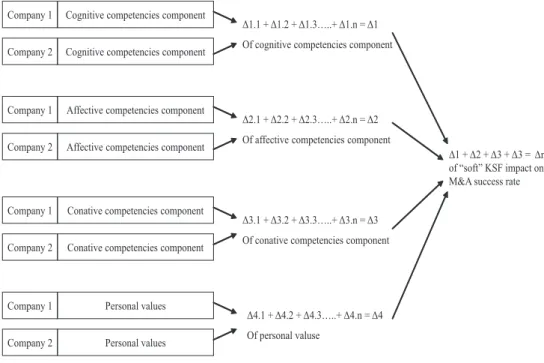
Figure 2: Model for measuring “soft” KSF as one of indicators for M&A success rate with components of competencies construct
Source: Authors
Andrej Bertoncelj, Darko Kovač • A conceptual model of individual competency...
Zb. rad. Ekon. fak. Rij. • 2008 • vol. 26 • sv. 2 • 215-237 231 In this section a model for empirical analysis is formulated. What certain expressions denote is explained. The statistical model for measuring soft CSF as one of the indicators for the M&A success rate can be expressed in the following formula. The mean value of differences in mean values of Company 1 and Company 2 considering all components – X–ΔX–
X
X
∆ =(
)
1
CG A CO V
X
X
X
X
N
∆
+ ∆
+ ∆
+ ∆
=
2 1 2 1
1 1 1 1
2 1 2 1
1 1 1 1
1
1
1
1
1
1
1
1
1
n n n n
P CGn P CGn P An P An
i i i i
n n n n
P COn P COn P Vn P Vn
i i i i
X
X
X
X
N
N
N
N
N
X
X
X
X
N
N
N
N
= = = = = = = =
−
+
−
+
−
+
−
∑
∑
∑
∑
∑
∑
∑
∑
The mean value of percentages of differences in mean values of Company 1 and Company 2 considering all components – X–ΔX –(%)
(%)
X
X
∆ =(
)
1
(%)
(%)
(%)
(%)
CG A CO V
X
X
X
X
N
∆
+ ∆
+ ∆
+ ∆
The mean value of percentages of differences in weighted mean values of Company 1 and Company 2 considering all components:
(%)
Xut
X
∆ =(
1 1 1 1)
1
(%)
(%)
(%)
(%)
P UCG P UA P UCO P UV
X
X
X
X
N
∆
+ ∆
+ ∆
+ ∆
N – Number of components
This piece of information tells us the percentage of how much soft CSF will impact on the M&A success rate, i.e. how much the acquiring company will gain or “lose” with the acquired “soft factor”, measured by the model of competency components.
6. Conclusion and future research
only few cases, it could be intuitively presumed that its implementation could help the successful integration of workers in the M&A process, especially with additional value system analysis, which was not conducted in presented case.
We argue that it is possible to measure the impact of soft human factors on M&A success rate with the presented model. Hence, we are confirming the hypothesis 1. The basic problem in measuring the human factor lies in the question of how to measure it. With the model of tripartite competencies components we propose a measurable yardstick which after its adjustments in both companies would enable a mutual comparison. The presented model of tripartite components of individual competencies is still a work in progress but we nevertheless believe that the measurement of human factors as one of the variables can help predict the M&A success rate and hence the hypothesis 2 is confirmed as well.
Also, there are certain restrictions which need to be addressed in any future studies. These limitations simultaneously provide research opportunities. Future attempts should strive for exploring a uniform competency systems in acquiring and acquired companies, as a worthwhile direction due to the high failure rate of M&A deals. They should take into consideration the fact that such a competency system is dependant on the evolutional development phase the companies are in and may not be in place in either company or only in one of them.
At last, we are aware that there is a cluster of other variables influencing the aforementioned conclusions and reason that further longitudinal and international studies and in-depth analyses are needed. It would be interesting to compare them with our findings, which is a matter of future studies, preferably in more than one emerging economy of Central and Eastern Europe. However, our analysis does provide a framework for a promising investigation in that field.
References
Armstrong, M. (2003) Human resource management practice, Aberystwyth: Cambrian Printers Ltd.
Atman, K.S. (1987) “The role of conation (striving) in the distance education enterprise”, The American Journal of Distance Education, Vol. 1, pp. 14-24. Baumeister, R. F., Bratslavsky, E., Muraven, M.and Tice, D.M. (1998) “Ego
depletion: Is the active self a limited resource?”, Journal of Personality and Social Psychology, Vol. 5, pp. 1252-1265.
Andrej Bertoncelj, Darko Kovač • A conceptual model of individual competency...
Zb. rad. Ekon. fak. Rij. • 2008 • vol. 26 • sv. 2 • 215-237 233 Bertoncelj, A., Kovač, D. (2008) “Management capital and its measurement in
transitional economies: the case of Slovene small and medium enterprises”,
International Journal of Management and Enterprise Development, Vol. 5, No. 4, pp. 444-461.
Bijlsma-Frankema, K. (2001) “On managing cultural integration and cultural change processes in mergers and acquisitions”, Journal of European Industrial Training, Vol. 2/3/4, pp.192-207.
Boyatzis, R. E. (1982) The Competent Manager: A Model for Effective Performance, New York: Wiley.
Boon, J., Van der Klink, M. (2001) Scanning the concept of competencies: how major vagueness can be highly functional, 2nd Conference on HRD Research and Practice Across Europe, University of Twente, Enschede, January, 2001. Boon, J., van der Klink, M. (2002) “Competencies: The triumph of a fuzzy concept”,
Academy of Human Resource Development Annual Conference Proceedings, Honolulu, 27 February- 3 March, , 2002, Vol. 1, pp. 327-334.
Barrick, M. R., Mount, M. K. (1991) “The Big Five personality dimensions and job performance: A meta-analysis”, Personnel Psychology, Vol. 44, pp. 1-26. Bueno, A.F., Bowditch, L. (1989) The Human Side of Mergers and Acquisitions. San
Francisco, CA: Jossey-Bass.
Burgoyne, J. (1993) “The competence movement: issues, stakeholders and prospects”,
Personnel Management, Vol. 6, pp. 6-13.
Cappelli, P.,Singh, H. (1992) Integrating strategic human resources and strategic management in Lewin, D., Mitchell, O. and Shewer, P. (Eds), Research Frontiers in Industrial Relations & Human Resources, Industrial Relations Association, Madison University of Wisconsin.
Cartwright, S.,Cooper, C.L. (1992) Mergers and Acquisitions: The Human Factor.
Oxford: Butterworth-Heinemann.
Casse, P., Claudel, G. (1999) Philosophy in Action. Paris: Edition des Ecrivains. Cheetham, G., Chivers, G. (1996) “Towards a holistic model of professional
competence”, Journal of European Industrial Training, Vol. 20/5, pp. 20-31. Cheetham, G., Chivers G. (1998) “The reflective (and competent) practioneer:
a model of professional competence which seeks to harmonise the reflective practitioner and competence-based approaches”, Journal of European Industrial Training, Vol.7, pp. 267-276.
Cooper, S. (1997) The clinical use and interpretation of the Wechsler Intelligence Scale for children, 3rd ed., Springfield, IL: Charles C. Thomas Publisher. Deamer, I. & Earle, L. (2004) Searching for entrepreneurship. Industrial and
Commercial Training, 2004, 36, pp. 99-103.
Emmons, R. (1986) “Personal strivings: An approach to personality and subjective well-being”, Journal of Personality and Social Psychology, Vol., 51, pp.1058-1068.
Fine, S.A., (1998) Functional job analysis, in The Job Analysis Handbook for Business, Industry and Government, (Eds.) S Gael, New York: Wiley.
Fitz-enz, J. (2000) ROI of Human Capital: Measuring the Economic Value of
Employee Performance, New York: American Management Association.
Garavan, T.N, McGuire, D. (2001) “Competencies and workplace learning: some reflections on the rhetoric and the reality”, Journal of Workplace Learning, Vol. 4, pp.144-163.
Gilkey, R. (1991) The psychodynamics of upheaval: intervening in merger and acquisition transitions, in Kets de Vries, M.F.R. (Eds.), San Francisco, CA: Organizations on the Couch, Jossey-Bass.
Goleman, D. (1995) Emotional intelligence: Why It Can Matter More Than IQ for Character, Health and Lifelong Achievement, New York: Bantam.
Gollwitzer, P. (1990) Action phases and mindsets. In: Higgins, E. and Sorrentino, R. (Eds.), Handbook of Motivation and Cognition: Foundations of Social Behavior, Vol. 2, pp. 53-92, New York: Guilford Press.
Gorsline, K. A (1996) “Competency profile for human resources, no more shoemakers’ children”, Human Resource Management, Vol. 1, pp. 53-66.
Gregory, R. (1998) Foundations of Intellectual Assessment: The Wais-III and Other Tests in Clinical Practice. Boston: Allyn & Bacon.
Grzeda, M.M. (2005) “In competence we trust? Addressing conceptual ambiguity”,
Journal of Management Development, Vol. 24/6, pp. 530-545.
Harding, D., Rouse, T. (2007) “Human Due Diligence”, Harvard Business Review, April 2007, pp. 124-131.
Harvey, P., Butcher, D. (1998) “Those who make a difference: developing businesses through developing individuals”, Industrial and Commercial Training, Vol.1, pp. 12-15.
Hirsch, W., Jackson, C. (1996) Strategies for Career Development: Promise, Practice
and Pretence. Institute for Employment Studies, London: Falmer.
Hodkinson, P., Issitt, M. (1995) The Challenge of Competence, London: Cassell Education.
Hoffmann, T. (1999) “The meanings of competenc”, Journal of European Industrial Training, 1Vol. 6, pp. 275-85.
Huang, C.T., Kleiner, B. (2004) “New Developments Concerning Managing Mergers and Acquisitions”, Management Research News, Vol. 4/5, pp. 54-62.
Andrej Bertoncelj, Darko Kovač • A conceptual model of individual competency...
Zb. rad. Ekon. fak. Rij. • 2008 • vol. 26 • sv. 2 • 215-237 235 Kane, R. (1985) Free will and values, Albany, NY: State University of New York
Press.
Kilmann, R.H., Saxton, M.J. and Serpa, R. (1985) Gaining Control of the Corporate Culture, San Francisco, CA: Jossey-Bass.
Kimberly, J.R., Quinn, R.E. (1984) The Challenge of Managing Corporate Transitions. Homewood, IL: Dow Jones-Irwin.
Klemp, G. O., Spencer, L. M. (1982) Job Competence Assessment, Reading, MA: Addison-Wesley.
Kolbe, K. (1997) The conative connection. Beverly: Addison-Wesley Publishing Company, Inc.
Lubatkin, M.H., Lane, P.J. (1996) “ Psst . . . the merger mavens still have it wrong!”,
Academy of Management Executive, Vol.1, pp. 21-37.
Mansfield, B., Mitchell, L. (1986) Towards a Competent Workforce, Aldershot: Gower.
Mangham, I. (1986) “In search of competence”, Journal of General Management, Vol. 12, No. 2, pp. 5-12.
Mansfield, B. (2004) “Competence in transition”, Journal of European Industrial Training, Vol. 2/3/4, pp. 296-309.
McClelland, D. (1998) “Identifying competencies with behavioural-event interviews”,
Psychological Science, Vol. 5, pp. 331-339.
Mirabile R. J. (1998) “Leadership competency development, competitive advantage for the future”, Management Development Forum, Vol., 2, No.1.
Mischel, W. (1996) From good intentions to willpower. in P. Gollwitzer & J. Bargh (Eds), The psychology of action, New York: Guilford Press.
Schroder, H.M. (1989) Managerial Competence: The Key to Excellence. Iowa: Kendall/Hunt.
OECD. (2000) “The INES Compendium, Contributions from the INES Networks and Working Groups”, Fourth General Assembly of the OECD Education Indicators Programme, 11–13 September, 2000, Tokyo.
Ordanini, A., Rubera, G. (2008) “Strategic capabilities and internet resources in procurement: a resource-based view of B-to-B buying”, International Journal of Operations & Production Management, No. 1, pp. 27-52.
Pandza, K., Horsburgh, S. and Polajnar, A. (2003) “A real options approach to managing resources and capabilities”, International Journal of Operations & Production Management, No. 9, pp. 1010-32.
Pottinger, P. S., Goldsmith, J. (1979) Defining and Measuring Competence, (eds), San Francisco, CA: Jossey-Bass.
Ruth, D. (2006) “Frameworks of managerial competence: limits, problems and suggestions”, Journal of European Industrial Training, No. 3, pp. 206-226. Serpel A., Ferrada X. (2007) “A competency-based model for construction supervisors
in developing countries”, Personnel Review, No. 4, pp. 585-602.
Slack, N., Lewis, M. and Bates, H. (2004) “The two worlds of operations management research and practice: can they meet, should they meet?”, International Journal of Operations & Production Management, No. 4, pp. 372-87.
Smart, P., Bessant, J. and Gupta, A. (2007) “Towards technological rules for designing innovation networks: a dynamic capabilities view”, International Journal of Operations & Production Management, No. 10, pp. 1069-92.
Snow, R.E., Corno, L. and Jackson, D.(1996) Individual differences in affective and conative functions, in: Berlinger, D.C. and Calfee, R.C. (Eds.): Handbook of
Educational Psychology, New York: Macmillan Reference Books.
Snow, R. (1989) “Toward assessment of cognitive and conative structures in learning”, Educational Researcher, No. 9, pp. 8-14.
Snow, R., Swanson, J. (1992) “ Instructional psychology: aptitude, adaptation, and assessment”, Annual Review of Psychology, No.1, pp. 583-626.
Spencer, L., Spencer, S. (1993) Competence at work: A model for superior
performance, New York: Wiley.
Sullivan, S.E.,Carden, W.A. and Martin, D.F. (1998) “Carers in the next millennium: directions for future research”, Human Resource Management, No. 2, pp. 165-185.
Taylor, F.W. (1991) The Principles of Scientific Management. New York, NY: HarperCollins and Norton.
Ulrich, D. (1998) “Intellectual capital Ľ competence *commitment”, Sloan Management Review, No. 2, pp. 15-26.
White, R. H. (1959) “.Motivation reconsidered: The concept of competence”,
Andrej Bertoncelj, Darko Kovač • A conceptual model of individual competency...
Zb. rad. Ekon. fak. Rij. • 2008 • vol. 26 • sv. 2 • 215-237 237
Pojmovni model pojedinačnih sposobnosti očekivanog uspjeha u
spajanjima i preuzimanjima
Andrej Bertoncelj1, Darko Kovač2
Sažetak
Pronalaženje najbolje moguće ravnoteže između “mekanih” ljudskih čimbenika i “tvrdih” financijskih čimbenika s ciljem uspješnih spajanja i preuzimanja (M&A) oduvijek je predstavljalo veliki izazov. Međutim, pravi izazov predstavlja pitanje: na koji način i kojim mjerilom možemo utvrđivati i uspoređivati ljudske čimbenike u okviru poduzeća koja se preuzimaju i već preuzetih poduzeća, u svim fazama M&A? Ovo istraživanje predstavlja model mjerenja i uspoređivanja ljudskog čimbenika i sposobnosti. Model omogućava mjerenje mekanih čimbenika kvantita-tivnim mjerilom. Koncipirane su tri komponente u okviru pojedinačnih sposobnos-ti: kognitivne, afektivne i konativne, uz primjenu osobnog sustava procjene. Razmatrani se model temelji na empiričkim rezultatima, na primjerima dvaju poduzeća i literaturi. Model poduzećima omogućava uspoređivanje razlika, kako bi mogla planirati način njihovog savladavanja i postići veću razinu uspjeha u M&A.
Ključne riječi: Spajanja i preuzimanja, sposobnosti, uspjeh M&A, model uspjeha M&A
JEL klasifikacija: G34, J 24, M 12, O 15
1 Dr. sc., Docent, viši znanstveni suradnik, University of Cambridge, Institute for Manufacturing,
Mill Lane, Cambridge CB2 1RX, Engleska. Znanstveni interes: udruživanja, preuzimanja. Tel: 44 1223 76614. Fax: 44 1223 766142. E-mail: [email protected].
2 Mr. sc., direktor, Co&da Ltd., Partizanska 22b, 4260 Bled, Slovenija. Znanstveni interes: HRM.