Comparative mitogenomic analyses of
Amazona
parrots and Psittaciformes
Nicholas Costa Barroso Lima
1,2,8, André Elias Rodrigues Soares
2, Luiz Gonzaga de Paula Almeida
2, Igor
Rodrigues da Costa
1, Fernanda Midori Sato
4, Patricia Schneider
3, Alexandre Aleixo
5, Maria Paula
Schneider
3, Fabrício R. Santos
6, Claudio V. Mello
7, Cristina Miyaki
4, Ana Tereza R. Vasconcelos
2and
Francisco Prosdocimi
11
Laboratório de Genômica e Biodiversidade, Instituto de Bioquímica Médica Leopoldo de Meis,
Universidade Federal do Rio de Janeiro, Rio de Janeiro, RJ, Brazil.
2
Laboratório de Bioinformática, Laboratório Nacional de Computação Científica, Petrópolis, RJ, Brazil.
3Departamento de Genética, Centro de Ciências Biológicas, Universidade Federal do Pará, Belém, PA,
Brazil.
4
Laboratório de Genética e Evolução Molecular de Aves, Departamento de Genética e Biologia Evolutiva,
Instituto de Biociências, Universidade de São Paulo, SP, Brazil.
5
Coordenação de Zoologia, Museu Paraense Emilio Goeldi, Belém, PA, Brazil.
6
Departamento de Biologia Geral, Instituto de Ciências Biológicas, Universidade Federal de Minas Gerais,
Belo Horizonte, MG, Brazil.
7
Department of Behavioral Neuroscience, Oregon Health & Science University, Portland, OR, USA.
8
Departamento de Bioquímica e Biologia Molecular, Universidade Federal do Ceará, Fortaleza, CE, Brazil.
Abstract
Amazon parrots are long-lived birds with highly developed cognitive skills, including vocal learning. Several parrot mitogenomes have been sequenced, but important aspects of their organization and evolution are not fully under-stood or have limited experimental support. The main aim of the present study was to describe the mitogenome of the blue-fronted Amazon,Amazona aestiva, and compare it to other mitogenomes from the genus Amazona and the or-der Psittaciformes. We observed that mitogenomes are highly conserved among Amazon parrots, and a detailed analysis of their duplicated control regions revealed conserved blocks. Population level analyses indicated that the specimen analyzed here seems to be close toA. aestiva individuals from Bahia state. Evolutionary relationships of 41 Psittaciformes species and three outgroups were inferred by BEAST. All relationships were retrieved with high support.
Keywords: Next-generation-sequencing, Psittacidae, mitogenomics, control region.
Received: February 06, 2017; Accepted: January 22, 2018.
Introduction
Vertebrate mitochondrial genomes (mitogenomes) consist of a circular DNA molecule of about 16 Kb that contains 37 intronless genes. This tightly packed organiza-tion with little overlap of genomic features is thought to be the result of selective pressure (Mindell, 1999; Boore, 1999; Ingman and Gyllensten, 2009). The chicken mito-genome was the first avian one to be completely sequenced and annotated (Desjardins and Morais, 1990) and revealed a remarkable difference in gene order in comparison to
other vertebrate mitogenomes. Its gene arrangement was initially named as “typical” or “ancestral” avian gene order (Desjardins and Morais, 1990). Since then, hundreds of other avian mitochondrial genomes have been described. In October, 2017, 635 complete mitogenomes were available for Aves in GenBank.
Psittaciformes is one of the most conspicuous avian orders, with species characterized by high longevity (Mun-shi-Southet al., 2006; Younget al., 2012) and advanced cognitive abilities (Pepperberg, 1990; Pepperberg and Funk, 1990; Borsari and Ottoni, 2005), including vocal learning (Farabaugh, 1996; Brauth et al., 1997; Pepper-berg, 2002, 2010; Plummer and Striedter, 2002). Regarding the mitogenome, many clades of the family Psittacidae present duplicate copies of the control region (CR) as a re-DOI: http://dx.doi.org/10.1590/1678-4685-GMB-2017-0023
Send correspondence to Francisco Prosdocimi. Laboratório de Genômica e Biodiversidade, Instituto de Bioquímica Médica Leo-poldo de Meis, Universidade Federal do Rio de Janeiro, Centro de Ciências da Saúde (CCS) Bloco E Sala 022, Cidade Universitária-Ilha do Fundão, 21.941-902 Rio de Janeiro, RJ, Brazil. E-mail: [email protected].
sult of at least six independent duplication events (Schir-tzingeret al., 2012). The Amazon parrots, genusAmazona, are among the psittacids that have duplicated CRs, as ini-tially shown by Eberhard et al. (2001). The duplication event that gave rise to a duplicated CR in these parrots also resulted in two pseudogenes, ND6 and pseudo-tRNA-Glu at the 5’-end of CR1 (Eberhard and Wright, 2016). Mitogenomes have been fully sequenced for only two Amazona species, the yellow-shouldered parrot, Amazona barbadensis(Urantowkaet al., 2013) and the yel-low-crowned amazon, Amazona ochrocephala(Eberhard et al., 2001).
In order to thoroughly describe and compare mito-genomes of Amazon parrots, we sequenced, assembled and annotated for the first time the complete mitogenome of the blue-fronted parrot (also known as turquoise-fronted parrot or blue-fronted amazon),Amazona aestiva. This effort was conducted in the context of the whole genome sequencing project that is under way for this species. We also compared the two CRs ofA. aestivawith all CRs available for Ama-zon parrots and identified conserved domains, sequence motifs, and substitution patterns by comparative genomics approaches using both bioinformatics algorithms and manual annotation. Furthermore, all 40 mitogenomes of Psittaciformes species available (as of October, 2017) were used in phylogenomic analyses. Finally, as previous ge-netic studies suggest thatA. aestivaandA. ochrocephala are not reciprocally monophyletic (Eberhardet al., 2004; Ribas et al., 2007; Caparrozet al., 2009; Chaveset al., 2014), we compared the sequence of the COI gene from the mitogenome described here with those of other individuals ofA. aestivaandA. ochrocephalafrom various localities in South America to confirm if this individual has a typicalA. aestivasequence.
Materials and Methods
Sample collection and DNA sequencing
A blood sample was previously (2013) obtained by venipuncture from a captive born maleAmazona aestiva according to a procedure approved by the Animal Ethics Committee of the Universidade Federal de Minas Gerais (UFMG, 202/2007). This individual (FVVF132) is still alive and legally owned by a private breeder, and its blood sample (B04212) is deposited at UFMG’s Centro de Cole-ções Taxonômicas in Brazil. Total DNA was extracted us-ing DNeasy Blood & Tissue Kit (Qiagen). Three libraries with insert sizes of 200 bp, 3 Kbp, and 5 Kbp (Table 1) were sequenced in an Illumina HiSeq for the assembly of the nu-clear genome. We mapped all the resulting reads on the mitogenome ofAmazona barbadensis(GenBank accession number JX524615.1) using Newbler (v 2.9) in order to se-lect putative mitochondrial DNA reads.
Assembly and annotation of the blue-fronted parrot mitochondrial genome
Reads that mapped against theA. barbadensis mito-genome were selected and assembled using MASURCA (v 2.3.2) (Zimin et al., 2013) to produce a circular mito-genome. A total of 19,005 reads were assembled (Table 1) and sequence annotation was performed using MITOS Web Server (Berntet al., 2013). Artemis Genome Browser (Rutherfordet al., 2000) was used for manual annotation of mitogenomic features. We ran tRNAscan-SE (Lowe and Eddy, 1997) to confirm tRNA annotation. BLAST searches of amino acid sequences were performed to check for pre-cise gene boundaries. Tablet (Milneet al., 2013) was used to verify the sequence coverage along the assembled mito-genome. Conserved regions within the control region – CR - (ETAS, boxes and conserved sequence blocks) were de-fined by manual annotation based on an alignment of the CR from five taxa of the genusAmazona.
Identification of control region domains and conserved boxes
After manual annotation of the CRs from four Amazonataxa (A. aestiva, A. barbadensis, A. farinosa, A. ochrocephala auropalliataandA. ochrocephala oratrix), we defined the precise boundaries of the domains as fol-lows: the limit between domains I and II was defined using a 45 nucleotide window graph (Ruokonen and Kvist, 2002; ADN riche en software), where the number of adenines dropped to a minimum and the number of guanines started to increase (Figure S1). We also used the beginning of the F-box, which marks the start of a long stretch of conserved sequence in the alignment, for determining this boundary. To define the limit between domains II and III we followed Ruokonen and Kvist (2002) and considered the start of block CSB-1 as the boundary. Therefore, domain II was placed upstream of CSB-1 and domain III was defined as downstream of its first base. The identification of CSBs and conserved boxes was performed by manual inspection of alignments of these elements to the two copies of the CR in A. aestivaand other species, in agreement with previous definitions (Eberhard and Wright, 2016).
Table 1- Number of reads perA. aestivasequencing library. Total number of raw reads per library, reads that were mapped to the Amazona barbadensismitogenome, and total number of reads used in the assembly of the mitogenomeA. aestiva.
Library Raw reads Mapped reads Assembled reads
200 bp 398,656,732 25,638 15,194
3 Kbp 160,000,000 3,310 844
5 Kbp 417,221,300 13,320 2,967
Whole mitogenome alignment of Amazon parrots
TheA. aestivamitogenome was aligned to the mito-genomes ofA. barbadensisandA. ochrocephala(GenBank accession number NC_027840.1). NUCmer was used for the alignment, and delta-filter and show-snps, from the same program package (Kurtzet al., 2004), were used to mark nucleotide differences in the pairwise comparisons between the mitogenomes ofA. aestivaand the other two species. The location and type of mismatches were tabu-lated and verified relative to the genomic features of theA. aestivamitogenome (Table 2).
Psittaciformes mitochondrial phylogenomics
We aligned all the complete mitochondrial genomes from 40 species of the order Psittaciformes from GenBank (October, 2017; Table S1), ourA. aestivamitochondrion plus three avian outgroups (chicken, zebra finch and pere-grine falcon) using MUSCLE (Edgar, 2004), and visually inspected the alignment in SeaView v4.5.4 (Gouyet al., 2010). We partitioned the alignment in order to accommo-date for the variable evolutionary rates along the different regions of the mitochondrion. For our phylogenetic analy-ses we used all coding genes as well as the 12S and 16S ri-bosomal RNA genes, which accounts for the majority of the mitochondrial genomes. We split the dataset into four parti-tions: 12S and 16S ribosomal genes in one partition, and three partitions for the concatenated coding genes, accord-ing to their codon position. We used PartitionFinder (Lan-fearet al., 2017) to select the evolutionary model for each partition. We estimated the Psittaciformes phylogenetic re-lationships using BEAST v1.8.4(Drummondet al., 2012). We assumed a lognormal uncorrelated relaxed clock (Drummondet al., 2006) for each partition, and a GTR+G (4 categories) nucleotide substitution model, with a Birth-Death speciation process (Gernhard, 2008) for the tree prior. We calibrated the molecular clock by placing three distinct normal priors on the age of divergence between: 1) Neoaves and Galloanseres, 87 Mya±10 Mya; 2) Falconi-formes and Passerimorpha, 60 Mya±5 Mya; and 3) Psit-taciformes and Passeriformes, 50 Mya±5 Mya (Jarviset al., 2014; Prumet al., 2015). We ran three distinct MCMC chains for 50 million states, discarding the first 10% as burn-in. We inspected for convergence using Tracer v1.6, and built a maximum clade credibility tree using TreeAnnotator v1.8 (Drummondet al., 2012).
Haplotype network
Previous molecular phylogenies have shown thatA. aestiva and A. ochrocephala are not reciprocally mono-phyletic (Eberhardet al., 2004; Ribaset al., 2007; Caparroz et al., 2009; Chaveset al., 2014). Also, the parents of the specimen whose mitogenome is being described here were apprehended from the illegal trade and their origin is un-known. Therefore, in order to identify the possible origin of
this specimen, we added its partial cytochrome oxidase I (COI) sequence into a matrix of 108 sequences of 506 bp from individuals of theA. aestiva/A. ochrocephala com-plex with known geographic origin and available in GenBank (Eberhardet al., 2004; Ribaset al., 2007; Capar-rozet al., 2009) (Table S3). The alignment was performed using ClustalW in MEGA6. The haplotype network was constructed by median joining using Network v 4.6 (Ban-deltet al., 1999). We also used the webpage DNA Surveil-lance for species identification of Brazilian parrots (Baker et al., 2003; Chaveset al., 2014) to verify the species of our specimen based on their ND2 sequence. To ratify the other two approaches we aligned the COI gene sequences from 108Amazonaspecimens (Table S3) using MUSCLE (Ed-gar, 2004). The resulting alignment contained 622 sites, 29 of which were variable and 17 informative. We estimated the coalescent history of the mitochondrial genomes of the Amazona aestiva based on this alignment using BEAST v1.8.4 (Drummondet al., 2012). We used a HKY+G nucle-otide substitution model and the skyline plot model coales-cent process (Drummondet al., 2005). We assumed a strict molecular clock, and calibrated the tree using a lin-eage-specific evolutionary rate for the Amazonas sp. (1.2510-8 substitutions per site per year), as inferred by Nabholzet al.(2016). We ran three MCMC chains for 20 million states, with a 10% burn-in. We inspected the results of all chains to observe for convergence in Tracer v1.6.
We also estimated Tajima’s D neutrality test (Taji-ma’s D = 1.031), withp-value (p = 0.80) calculated using 1000 simulations in Arlequin v3.5 (Excoffier and Lischer, 2010). Thep-value was not statistically significant, with no evidence for selection, and the observed frequency of rare alleles was similar to the expected value.
Results
Read mapping and features of the mitochondrial genome ofAmazona aestiva
A total of 42,268 reads ofA. aestivamapped onto the mitochondrial genome ofA. barbadensis(Table 1). The as-sembled mitogenome was obtained from 19,005 reads, with an average coverage of 183-fold and a maximum cov-erage of 302-fold. The resulting A. aestiva mitogenome consisted of a circular molecule of 18,853 bp (GenBank ac-cession number NC_033336, Figure 1). The Light-strand (L-strand) presented 5,692 adenines, 5,986 cytosines, 2,681 guanines and 4,494 thymines. We found 41 mitogenomic features, including protein coding genes, pseudogenes, tRNAs, rRNAs and two control regions (Ta-ble S2).
and 2 control regions (CRs). The Heavy-strand (H-strand) contained the remaining 8 tRNAs and 1 protein coding gene, that of NADH dehydrogenase subunit 6. Of the pro-tein coding genes, 4 had stop codons after the polyadenyl-ation site (Table S2, Figure 1), consistent with Ojalaet al. (1981).
Consistent with the findings of Urantowka et al. (2013) and Eberhard and Wright (2016), we found that the mitogenome ofA. aestivafollows the generalAmazona mi-tochondrial gene order, confirming a CR duplication and pseudogenes for tRNA-Glu and ND6. Specifically, the gene order in this region was CYTB/tRNAThr/ND6pseudo/ tRNAGlu-pseudo/CR1/tRNAPro/ND6/tRNAGlu/CR2/tRNAPhe/ 12s-rRNA. The two CRs ofA. aestivawere shorter than the ones fromA. barbadensis,and CR1 was shorter than CR2. The species difference in CR sizes is due to the different number of tandem repeats near the 3’-end of the CRs. The pseudogenes for ND6 and tRNA-Glu presented few differ-ences in comparison with theA. barbadensisones.
Description of control region domains and conserved sequence motifs
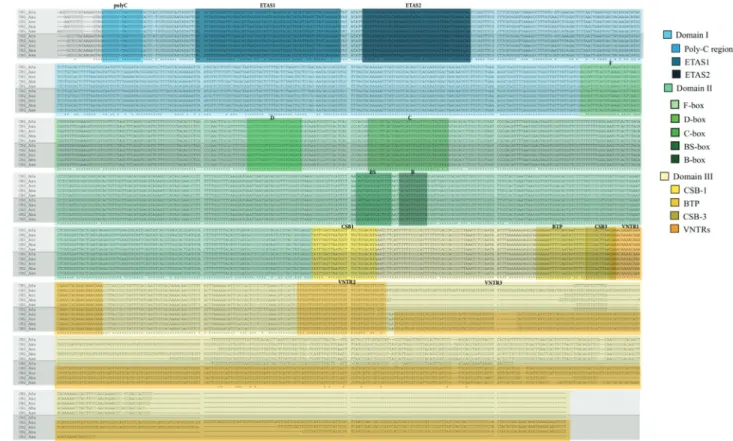
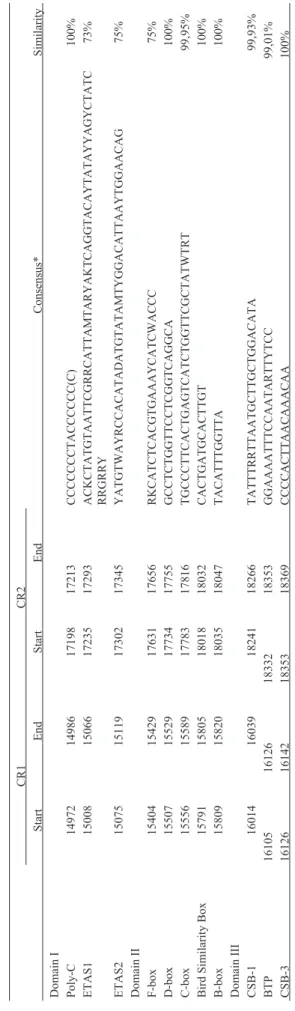
In vertebrates, CRs are normally divided into three domains (Figure 2). Domain I contains Extended Termina-tion Associated Sequences (ETAS), domain II presents se-quence blocks named from A to F, and domain III has conserved sequence blocks (CSB) numbered from 1 to 3 (Ruokonen and Kvist, 2002). In theA. aestivamitogenome we observed that the consensus sequences of sequence boxes and CBSs are quite similar to each other, despite some differences (Table 3). In domain I we identified the poly-C tract (Table 2), with a central TA pair conserved in all CRs but with varying numbers of Cs. We could define ETAS sequences 1 and 2 by alignment of the homologous sequences of A. aestiva with those of A. ochrocephala auropalliata, obtained from Eberhard and Wright (2016). Domain II had five conserved boxes: F, D, C, Bird similar-ity box (Bsb) and B. All consensus sequences from these
boxes were conserved, with minor changes (Table 2, Figure 2). Domain III presented two out of three CSBs. CSB-1, which was used to define the border between domains II and III, was nearly identical in allAmazonaspecies studied, with a shift from an internal AG to GA in the CRs ofA. farinosa. As observed in other avian CRs, CSB-2 was ab-sent (Desjardins and Morais, 1990). CSB-3 was identical among all CRs compared. We also identified a palindromic sequence that may be the bidirectional transcription pro-moter as verified by Eberhard and Wright (2016). Domain III also presented three different microsatellite repeats re-ferred to as variable number tandem repeats (VNTRs). VNTR1 presented four CAAA repeats followed by a single internal repeat of CCA and three more CAAA repeats, and was conserved in allAmazonaCRs compared. VNTR2 pre-sented eight tetranucleotide microsatellite repeats of TTTG that were conserved in all species except inA. farinosa, whose first repeat was TTTC. VNTR3 was composed of several repetitions of an 8 nucleotide motif (TTCATTCG) that was absent in all CR1s but present in almost all CR2s, except for that ofA. farinosa. Most species differences in CRs within theAmazonagenus were in Domain III (simi-larity of 76% over 367 sites without gaps; 824 total sites) and were due to the VNTRs, which varied in length. Do-main II was highly conserved (similarity of 93.9% over 609 sites without gaps; 610 total sites) and Domain I showed considerable variation (similarity of 78% over 431 sites
without gaps; 436 total sites), though not as much as ob-served in Domain III. Within the same species, the two CR copies were almost identical in Domains I and II, but pre-sented size and repeat differences in Domain III (Table 2 and Figure 2).
Comparative mitogenomics of Amazon parrots
Alignment of the complete mitogenomes of Amazon parrots (Amazona aestiva, A. barbadensis and A. ochrocephala) revealed greater differences between A. aestivaandA. barbadensis, with 523 mismatches, includ-ing indels. Most of these mismatches were in codinclud-ing re-gions. In contrast, A. aestiva and A. ochrocephala presented 236 mismatches, mostly in the CR.
Comparative analyses of individual loci from the three species revealed that ND5 had the highest number of mismatches, most of them synonymous. It was possible to identify 3 indels at the C-terminal of theA. barbadensis ND5. This includes a CT insertion that resulted in a frameshift leading to the substitution of a methionine codon for a leucine codon as well as a premature stop codon. However, since this insertion occurs within the 10 last pre-dicted residues, it is possible that it does not cause major problems in protein folding or function (see also Tables S4, S5 and S6). Species differences in tRNAs and rRNAs were not common but were more frequent betweenA. aestiva andA. barbadensis.
Psittaciformes phylogeny
The phylogeny tree obtained (Figure 3) is in accor-dance with previously published phylogenies of Psittaciformes (Tavares et al., 2006; Schirtzinger et al., 2012). As expected, the outgroups (except for chicken, which was used to root the trees) were placed outside the Psittaciformes ingroup. Furthermore, the sister-taxa rela-tionship between Psittaciformes and Passeriformes was re-covered and is congruent with phylogenomic results (Jarvis et al., 2014). Some particular clades were recovered with high support inside the Psittaciformes clade. These were, first, the New Zealand parrots that clustered Strigops habroptilusandNestor notabilisin a previously described basal clade of Psittaciformes (Tavareset al., 2006; Wright et al., 2008). A second well-supported clade contained vari-ous species of cockatoos from Australasia, consistent with its monophyly. The last higher clade recovered with high support contained allAmazonasampled.
The close relationship between the genera Cacatua andCalyptorhynchus,the generaAmazona(Eberhardet al., 2004; Ribaset al., 2007) andAra(Schweizeret al., 2014) were recovered as previously described. Our results were also congruent with the recent taxonomic proposal for the generaPsittacara,Thectocercus,EupsittulaandAratinga (Remsen Jret al., 2013).
Analysis of taxonomic status
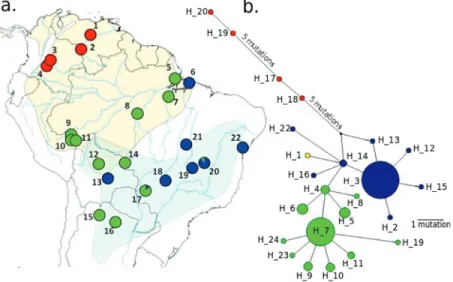
The specimen sequenced here presents a typical ex-ternal morphology ofAmazona aestiva aestiva(Figure S2). The haplotype network based on mitochondrial COI se-quences separated this individual (H_1 in Figure 4) by a single mutation from individuals ofA. aestivafrom the
Bra-Table 2- Number of single nucleotide polymorphisms when comparing the mitogenome ofA. aestivaagainst the mitogenomes ofA. barbadensis
andA. ochrocephala.
Mitogenome feature A. aestiva/ A. aestiva/
A. barbadensis A. ochrocephala
CDS* 272 92
rRNA 10 3
tRNA 32 9
Control Region 203 130
Transitions 405 158
Transversions 27 9
Indel* 91 69
Synonymous 226 74
Missense 46 18
Nonsense 0 0
Codon Position 1 49 14
Codon Position 2 16 8
Codon Position 3 207 70
* CDS = coding sequence; Indel = nucleotide insertion or deletion
Figure 3- Bayesian tree from all Psittaciformes with mitogenome available and three outgroups. Red stars mark branches with 100% support. Values lower than 100% are shown.
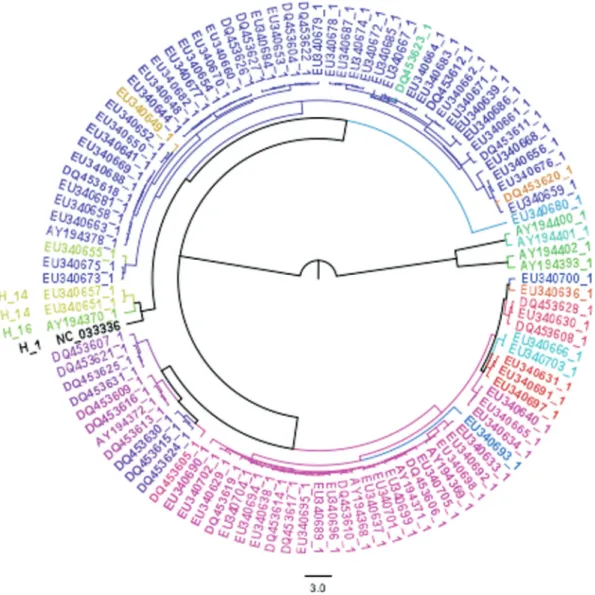
zilian state of Bahia, haplotype 14 (H_14, Figure 4). Unfor-tunately, the subspecies of the individuals with H_14 is unknown (no information in GenBank records, nor in asso-ciated publications). The DNA Surveillance tree (Figure 5) placed this individual as closely related to the H9_clade1_SA, which presents sequences of captive A. aestivaspecimens from the Brazilian states Bahia, Tocan-tins, Minas Gerais, Distrito Federal, and Goiás. The tree built from COI sequences using BEAST (Figure 6) placed this individual in a branch closely related to COIs from haplotype H_14 and H_16, which are also separated from H_14 by one mutation.
Discussion
We have assembled the complete mitogenome ofA. aestiva by selecting mitochondrial reads from the whole genome sequencing reads. The majority of the protein cod-ing genes and tRNAs were found to be encoded by the strand that presents the highest amount of A+C, the L-strand (Lima and Prosdocimi, 2018). We recovered the two copies of the CR, which is known to be an AT-rich se-quence implicated in the initiation and termination of repli-cation and transcription (Shadel and Clayton, 1997; Gibson et al., 2005). In this region, a truncated H-strand replication product (7S DNA) pairs with its complementary sequence on the L-strand and displaces the H-strand forming a loop, known as displacement-loop or simply D-loop (Nicholls and Minczuk, 2014). Based on the chicken mitogenome (Schirtzingeret al., 2012), the ancestral location of the CR in the avian mitogenome is thought to be between the
tRNA-Pro and tRNA-Phe, which corresponds to the Ama-zon parrot CR2. Thus, the CR conventionally described as CR1 is likely a result of a duplication event that inserted this CR1 and its associated pseudogenes into the mitochon-drial genome of an ancestral parrot population that gave rise to the genusAmazona. Based on the mitogenome ofA. aestiva, we suggest that the 1,692 bases between the end of the tRNA-Thr and the start of the tRNA-Pro most likely correspond to the duplicated block. Differences in the length of two CRs in Amazon parrots are due to the pres-ence of a variable number of tandem repeats on the 3’-end (Figure 2).
The two mitochondrial CRs of the genus Amazona share an overall 84,5% identity, both within and across spe-cies, with high conservation of sequence motifs. This ob-servation is consistent with the possibility that both CR copies may be functional and appear to be evolving in con-cert, as originally suggested by Eberhardet al.(2001). In chicken, the preferred start sites for mitochondrial DNA replication are regions flanking the CR (Reyeset al., 2005). If the same is true forAmazonaand if both CR copies are functional, it is possible that the mitogenome of this genus may have a higher replication rate when compared to other mitochondria with single CRs. The presence of more effi-cient mitochondrial DNA replication could in principle increase the expression of components of the electron transport chain, which would concur with the high meta-bolic rates of parrots (Munshi-South and Wilkinson,2010). Interestingly, preliminary genomic results by Wirthlin et al.(2018) point to selective pressure in superoxide
tase genes, suggesting the importance of antioxidant pro-tection mechanisms in these birds.
An overall high level of sequence similarity was ob-served between completeAmazonamitogenomes. The pau-city of polymorphisms in tRNA may indicate conservation of structure and, hence, function. Importantly, the majority of differences within the coding sequence are at the third codon position, leading to synonymous substitutions. The majority of first codon polymorphisms are also synony-mous. The presence of an intergenic region between ND5 and CYTB inA. barbadensiswas due to an insertion of CT creating a premature stop codon. This insertion seems to have occurred after this species diverged fromA. aestiva and A. ochrocephala, since these two species share the same ND5 amino acid sequence, as well as the overlap of the 3’-end of ND5 and the 5’-end of CYTB.
The phylogeny reported here is congruent with a par-titioned Bayesian analysis of 117 parrot species based on
two mitochondrial genes, two nuclear introns and coded gaps (Schirtzingeret al., 2012). As expected,A. aestivawas shown to be a sister group ofA. ochrocephala.
specimens, which is consistent with our morphological subspecies classification.
In sum, the mitochondrial genome of the blue-fronted Amazon,A. aestiva, was described here for the first time and compared to other whole mitogenomes from the genus Amazona. Our data provide a new and high quality mito-genome of anAmazonaspecies. Our analyses confirm the presence of conserved sequences and boxes in the dupli-cated control regions, providing support to previous studies on the organization of this mitogenomic feature. Our data also provide further support for the concerted evolution of these duplicated CRs. The phylogeny confirmed previous findings (e.g., sister relationship between Psittaciformes and Passeriformes, monophyly and basal position of Strigopoidae, monophyly of the Australasian cockatoos, monophyly of subfamily Arinae). Lastly, our data help clarify the haplotype placement of the specimen analyzed, confirming the subspecies classification based on morpho-logical traits.
Acknowledgments
This work was sponsored by Brazilian funding agen-cies CNPq (SISBIOAVES project), FAPESPA, FAPE-MIG, FAPESP (Biota 2013/50297-0), and FAPERJ (E-26/202.810/2015), as well as by NSF (DOB 1343578) and NASA. We gratefully acknowledge all authors from theA. aestivagenome paper, Drs. Morgan Wirthlin, Rafael Lucas Muniz Guedes, Nathalia P. Cavaleiro, Guilherme Loss de Morais, Anderson V. Chaves, Marcus de Melo Teixeira, Michael C. Schatz, Maria Sueli Felipe, and espe-cially Erich Jarvis and Jason Howard from Duke Univer-sity. Also, we would like to thank biologist Paulo Augusto Ribeiro Machado for providing access to the A. aestiva specimen (FVVF132) and Anderson Vieira Chaves for crit-ically reading the manuscript.
References
Baker CS, Dalebout ML, Lavery S and Ross HA (2003) www.DNA-surveillance: Applied molecular taxonomy for species conservation and discovery. Trends Ecol Evol 18:271–272.
Bandelt HJ, Forster P and Röhl A (1999) Median-joining net-works for inferring intraspecific phylogenies. Mol Biol Evol 16:37–48.
Bernt M, Donath A, Jühling F, Externbrink F, Florentz C, Fritzsch G, Pütz J, Middendorf M and Stadler PF (2013) MITOS: Im-proved de novo metazoan mitochondrial genome annota-tion. Mol Phylogenet Evol 69:313–319.
Boore JL (1999) Animal mitochondrial genomes. Nucleic Acids Res 27:1767–80.
Borsari A and Ottoni EB (2005) Preliminary observations of tool use in captive hyacinth macaws (Anodorhynchus hyacinthinus). Anim Cogn 8:48–52.
Brauth SE, Heaton JT, Shea SD, Durand SE and Hall WS (1997) Functional anatomy of forebrain vocal control pathways in
the budgerigar (Melopsittacus undulatus). Ann N Y Acad Sci 807:368–385.
Caparroz R, Seixas GHF, Berkunsky I and Collevatti RG (2009) The role of demography and climatic events in shaping the phylogeography ofAmazona aestiva(Psittaciformes, Aves) and definition of management units for conservation. Divers Distrib 15:459–468.
Chaves AV, Queiroz-Filho ROP, Silva FAA, Miyaki CY and Santos FR (2014) An online mtDNA tool for identification of Neotropical Psittacid species and taxonomic issues: A study case of the Amazona ochrocephala complex. Nat Resour 5:634–652.
Desjardins P and Morais R (1990) Sequence and gene organiza-tion of the chicken mitochondrial genome. J Mol Biol 212:599–634.
Drummond AJ, Rambaut A, Shapiro B and Pybus OG (2005) Bayesian coalescent inference of past population dynamics from molecular sequences. Mol Biol Evol 22:1185–1192. Drummond AJ, Ho SYW, Phillips MJ and Rambaut A (2006)
Re-laxed phylogenetics and dating with confidence. PLoS Biol-ogy 4:e88.
Drummond AJ, Suchard MA, Xie D and Rambaut A (2012) Bayesian phylogenetics with BEAUti and the BEAST 1.7. Mol Biol Evol 29:1969–1973.
Eberhard JR and Wright TF (2016) Rearrangement and evolution of mitochondrial genomes in parrots. Mol Phylogenet Evol 94:34–46.
Eberhard JR, Wright TF and Bermingham E (2001) Duplication and concerted evolution of the mitochondrial control region in the parrot genusAmazona. Mol Biol Evol 18:1330–1342. Eberhard JR, Bermingham E and Zink R (2004) Phylogeny and
biogeography of theAmazona ochrocephala(Aves: Psitta-cidae) complex. Auk 121:318–332.
Edgar RC (2004) MUSCLE: Multiple sequence alignment with high accuracy and high throughput. Nucleic Acids Res 32:1792–1797.
Excoffier L and Lischer HEL (2010) Arlequin Suite Ver 3.5: A new series of programs to perform population genetics anal-yses under Linux and Windows. Mol Ecol Resourc 10:564–567.
Farabaugh SDR (1996) Acoustic communication in parrots: labo-ratory and field studies of budgerigars, Melopsittacus undulatus. In: Kroodsma DE and Miller EH (eds), Ecology and Evolution of Acoustic Communication in Birds. Cornell University Press, New York, pp 97–117.
Gernhard T (2008) The conditioned reconstructed process. J Theor Biol 253:769–778.
Gibson A, Gowri-Shankar V, Higgs PG and Rattray M (2005) A comprehensive analysis of mammalian mitochondrial ge-nome base composition and improved phylogenetic meth-ods. Mol Biol Evol 22:251–264.
Gouy M, Guindon S and Gascuel O (2010) SeaView Version 4: A multiplatform graphical user interface for sequence align-ment and phylogenetic tree building. Mol Biol Evol 27:221–224.
Ingman M and Gyllensten U (2009) Vertebrate mitochondrial DNA. Rev Cell Biol Mol Med 2:57–134.
Kurtz S, Phillippy A, Delcher AL, Smoot M, Shumway M, Anto-nescu C and Salzberg SL (2004) Versatile and open software for comparing large genomes. Genome Biol 5:R12. Lanfear R, Frandsen PB, Wright AM, Senfeld T and Calcott B
(2017) PartitionFinder 2: New methods for selecting parti-tioned models of evolution for molecular and morphological phylogenetic analyses. Mol Biol Evol 34:772–773. Lima NCB and Prosdocimi F (2018) The heavy strand dilemma of
vertebrate mitochondria on genome sequencing age: number of encoded genes or G+ T content? Mitochondrial DNA Part A 29:300-302.
Lowe TM and Eddy SR (1997) tRNAscan-SE: A program for im-proved detection of transfer RNA genes in genomic se-quence. Nucleic Acids Res 25:955–964.
Milne I, Stephen G, Bayer M, Cock PJA, Pritchard L, Cardle L, Shaw PD and Marshall D (2013) Using Tablet for visual ex-ploration of second-generation sequencing data. Brief Bio-inform 14:193–202.
Mindell DP (1999) Avian molecular evolution and systematics. Condor 101:189.
Munn EA (1975) The structure of mitochondria. J Mol Cell Cardiol 7:713.
Munshi-South J, Wilkinson GS and Vega Rivera JH (2006) Diet influences life span in parrots (Psittaciformes). Auk 123:108–118.
Munshi-South J and Wilkinson GS (2010) Bats and birds: excep-tional longevity despite high metabolic rates. Ageing Res Rev 9:12-19.
Nabholz B, Lanfear R and Fuchs J (2016) Body mass-corrected molecular rate for bird mitochondrial DNA. Mol Ecol 25:4438–4449.
Nicholls TJ and Minczuk M (2014) In D-loop: 40 years of mito-chondrial 7S DNA. Exp Gerontol 56:175–181.
Ojala D, Montoya J and Attardi G (1981) tRNA punctuation model of RNA processing in human mitochondria. Nature 290:470–474.
Pepperberg IM (1990) Cognition in an African gray parrot (Psittacus erithacus): Further evidence for comprehension of categories and labels. J Comp Psychol 104:41–52. Pepperberg IM (2002) In search of king Solomon’s ring:
Cogni-tive and communicaCogni-tive studies of grey parrots (Psittacus erithacus). Brain Behav Evol 59:54–67.
Pepperberg IM (2010) Vocal learning in grey parrots: A brief re-view of perception, production, and cross-species compari-sons. Brain Lang 115:81–91.
Pepperberg IM and Funk MS (1990) Object permanence in four species of psittacine birds: An African Grey parrot (Psittacus erithacus), an Illiger mini macaw (Ara maracana), a parakeet (Melopsittacus undulatus), and a cockatiel (Nymphicus hollandicus). Anim Learn Behav 18:97–108.
Plummer TK and Striedter GF (2002) Brain lesions that impair vocal imitation in adult budgerigars. J Neurobiol 53:413–428.
Prum RO, Berv JS, Dornburg A, Field DJ, Townsend JP, Lemmon EM and Lemmon AR (2015) A comprehensive phylogeny of birds (Aves) using targeted next-generation DNA se-quencing. Nature 526:569–567.
Remsen JV, Schirtzinger EE, Ferraroni A, Silveira LF and Wright TF (2013) DNA-sequence data require revision of the parrot genusAratinga(Aves: Psittacidae). Zootaxa 3641:296–300. Reyes A, Yang MY, Bowmaker M and Holt IJ (2005) Bidirectio-nal replication initiates at sites throughout the mitochondrial genome of birds. J Biol Chem 280:3242–50.
Ribas CC, Tavares ES, Yoshihara C and Miyaki CY (2007) Phy-logeny and biogeography of yellow-headed and blue-fronted parrots (Amazona ochrocephala and Amazona aestiva) with special reference to the South American taxa. Ibis 149:564–574.
Ruokonen M and Kvist L (2002) Structure and evolution of the avian mitochondrial control region. Mol Phylogenet Evol 23:422–432.
Rutherford K, Parkhill J, Crook J, Horsnell T, Rice P, Rajandream MA and Barrell B (2000) Artemis: Sequence visualization and annotation. Bioinformatics 16:944–945.
Schirtzinger EE, Tavares ES, Gonzales LA, Eberhard JR, Miyaki CY, Sanchez JJ, Hernandez A, Müeller H, Graves GR, Fleischer RC,et al.(2012) Multiple independent origins of mitochondrial control region duplications in the order Psittaciformes. Mol Phylogenet Evol 64:342–356.
Schweizer M, Hertwig ST and Seehausen O (2014) Diversity ver-sus disparity and the role of ecological opportunity in a con-tinental bird radiation. J Biogeogr 41:1301–1312.
Shadel GS and Clayton DA (1997) Mitochondrial DNA mainte-nance in vertebrates. Annu Rev Biochem 66:409–435. Taanman JW (1999) The mitochondrial genome: structure,
tran-scription, translation and replication. Biochim Biophys Acta 1410:103–123.
Tavares ES, Baker AJ, Pereira SL and Miyaki CY (2006) Phylo-genetic relationships and historical biogeography of neo-tropical parrots (Psittaciformes: Psittacidae: Arini) inferred from mitochondrial and nuclear DNA sequences. Syst Biol 55:454–470.
Urantowka AD, Hajduk K and Kosowska B (2013) Complete mi-tochondrial genome of endangered yellow-shouldered Ama-zon (Amazona barbadensis): Two control region copies in parrot species of theAmazonagenus. Mitochondrial DNA 24:411–413.
Vinograd J, Morris J, Davidson N and Dove WF (1963) The buoy-ant behavior of viral and bacterial DNA in alkaline CsCl. Proc Natl Acad Sci U S A 49:12–17.
Wright TF, Schirtzinger EE, Matsumoto T, Eberhard JR, Graves GR, Sanchez JJ, Capelli S, Müller H, Scharpegge J, Cham-bers GK,et al.(2008) A multilocus molecular phylogeny of the parrots (Psittaciformes): Support for a Gondwanan ori-gin during the cretaceous. Mol Biol Evol 25:2141–2156. Young AM, Hobson EA, Lackey LB and Wright TF (2012)
Sur-vival on the ark: Life-history trends in captive parrots. Anim Conserv 15:28–43.
Zimin AV, Marçais G, Puiu D, Roberts M, Salzberg SL and Yorke JA (2013) The MaSuRCA genome assembler. Bioinfor-matics 29:2669–2677.
Internet Resources
AND riche en,The IUCN Red List of Threatened Species. (Version 2015-3), http://www.iucnredlist.org.
Tracer (version 1.6), http://www.beast2.org/tracer-2/.
Supplementary material
The following online material is available for this article: Table S1 - Species, NCBI accession IDs, and references of the mitogenomes used.
Table S2 - Mitochondrial genome features of the blue-fronted parrotAmazona aestiva.
Table S3 - Sequences analyzed in the taxonomic study. Table S4 -Mitochondrial gene differences between species.
Table S5 - Polymorphisms found in the whole mitogenome alignment ofAmazona aestivaandAmazona barbadensis. Table S6 - Polymorphisms found in the whole mitogenome alignment ofAmazona aestivaandAmazona ochrocephala. Figure S1 - Graph of the sum of adenines and guanines in 45 nucleotide windows
Figure S2 - Photo of individual FVVF132 (“Moisés”) whose mitogenome was analyzed.
Associate Editor: Louis Bernard Klaczko