Structure and ontogeny of the pericarp of six Eupatorieae (Asteraceae)
with ecological and taxonomic considerations
JULIANA MARZINEK1 and DENISE M.T. OLIVEIRA2
1Instituto de Biologia, Universidade Federal de Uberlândia
Rua Ceará, s/n, Bloco 2D, sala 28, Umuarama, 38405-315, Uberlândia, MG, Brasil 2Departamento de Botânica, Instituto de Ciências Biológicas, Universidade Federal de Minas Gerais
Avenida Antonio Carlos, 6627, Pampulha, 31270-901 Belo Horizonte, MG, Brasil
Manuscript received on October 20, 2008; accepted for publication on June 4, 2009
ABSTRACT
The ontogeny of cypselae and their accessory parts were examined using light and scanning electron microscopy for the speciesCampuloclinium macrocephalum,Chromolaena stachyophylla,Mikania micrantha,Praxelis pauciflora, Symphyopappus reticulatus, andVittetia orbiculata, some of these being segregated from the genusEupatorium. A layer of phytomelanin observed in the fruit appears to be secreted by the outer mesocarp into the schizogenous spaces between the outer and inner mesocarp; its thickness was observed to vary among the different species examined. The bristles of the pappus are vascularized, except in M. micrantha, and have cells that are superficially projected and arranged acropetally; inS. reticulatussome of the projections are retrorse and a fracture line on the floral disk that is only seen in this species may indicate a double dispersal process. Numerous differences observed among the cypselae examined here reinforce earlier segregations of the genusEupatorium sensu lato.
Key words:: anatomy, Asteraceae, carpopodium, fruit, pappus, phytomelanin.
INTRODUCTION
The tribe Eupatorieae (Asteraceae) comprises 190 gen-era and 2,000 species (Anderberg et al. 2007) that are encountered primarily in Mexico and Central and South America, with some representatives from North Amer-ica, but with few species in the Old World (King and Robinson 1987). Eupatoriumis a very complex genus and has experienced numerous segregations, as com-piled by King and Robinson (1987).
Wagenitz (1976) suggested that anatomical stud-ies of the fruits of the Asteraceae might aid in eluci-dating its systematics. Characteristics of the indumen-tum (Ritter and Miotto 2006), pappus (Bean 2001), car-popodium (Haque and Godward 1984), and the anatomy of the pericarp itself (Bruhl and Quinn 1990), or a
com-Correspondence to: Denise Maria Trombert Oliveira E-mail: [email protected]
bination of all of the characters cited above (Leszek et al. 1997), have been used to delimit tribes, genera, and even species of this family.
Dhakal 2001). Sometimes this phytomelanin layer is referred to as a “carbon layer” or black pigment layer (see Roth 1977). Panero (2007) indicates the occurrence of phytomelanin as a synapomorphy of the Asteraceae. The Phytomelanin Cypsela Clade (PCC) is composed of more than 5,000 species that produce this substance.
Ontogenetic studies of the reproductive organs of Eupatorieae are generally scarce, and are almost exclu-sively limited to the publications of Pandey and Singh (1983, 1994). In spite of the importance of the Eupato-rieae within the Asteraceae, no single study has focused simultaneously on the ontogeny, indumentum, pappus, and carpopodium of the species within this taxon.
The present work analyzed the development of the pericarp and the accessory parts of the cypselae of six species of Eupatorieae from Brazil (some of them segre-gated fromEupatorium s.l.), emphasizing the most rel-evant structures to taxonomic and ecological questions related to this tribe.
MATERIALS AND METHODS
Specimens of Campuloclinium macrocephalum(Less.) DC.,Chromolaena stachyophylla(Spreng.) R. King and H. Robinson,Mikania micranthaH.B.K.,Praxelis pau-ciflora(H.B.K.) R. King and H. Robinson, Symphyopap-pus reticulatus Baker, andVittetia orbiculata (DC.) R. King and H. Robinson were collected in cerrado veg-etation fragments in the municipality of Botucatu, São Paulo State, Brazil. Reference plant material was pre-pared and deposited in the BOTU Herbarium (Holmgren et al. 1990) as collections 25,552 to 25,557.
Micromorphological analyses of the surfaces of the cypselae were performed with material fixed in glu-taraldehyde (2.5% in 0.1M phosphate buffer, pH 7.3, maintained at 4◦C). Samples were processed and, then,
mounted on aluminum stubbs, gold coated, and subse-quently examined using a scanning electron microscopy (Quanta 200, FEI Company) to generate digital images. Anatomical studies were performed on ovaries and cypselae in different phases of development that had been fixed in FAA 50 for 48 hours (Johansen 1940) and, then, conserved in 70% ethanol (Jensen 1962). The fixed material was dehydrated in an ethanol series and em-bedded in methacrylate (LeicaTM) following the
manu-facturer’s recommendations. Both transversal and
lon-gitudinal sections 6 to 10µm thick were prepared us-ing a rotary microtome, stained with 0.05% toluidine blue at pH 4.7 (O’Brien et al. 1964), and subsequently mounted in synthetic resin. The permanent slides were observed under an Olympus BX41 optical microscope and the images captured digitally.
The following histochemical tests were performed: ruthenium red to indicate the presence of polysaccha-rides and pectins (Jensen 1962); phloroglucinol with hydrochloric acid to stain lignified cell walls (Sass 1951); Sudan IV to stain lipidic substances; Lugol so-lution for starch; ferric chloride with sodium carbon-ate to indiccarbon-ate the presence of phenolic compounds (Jo-hansen 1940); Dragendorff reagent to detect alkaloids (Yoder and Mahlberg 1976); and bromophenol blue for proteins (Mazia et al. 1953).
The results are described in ontogenetic terms. Con-sidering the inferior origin of the ovary, thelato sensu definition of the pericarp was adopted, in which the ex-ocarp is produced by the outer epidermis of the infe-rior ovary, the endocarp by the inner epidermis, and the mesocarp by the ground region where the vascular tis-sues are inserted.
Trichomes distribution was analyzed using both scanning electron and optical microscopy. Ten cypse-lae (n=10) of each species mounted in glycerin were also observed. The terms scarce (when trichomes were present on up to 10% of the cypsela surface), frequent (between 11% and 50%), and abundant (>50%) were used.
The terminology used to designate the outward pro-jected portions of the pappus fibers was adapted from Hickey (1979), considering the angle of divergence be-tween the distal portion of the projected cells and the apex of the bristles. These angles were classified as nar-row (>45◦) or moderate (between 45◦and 65◦) acute. The nomenclature proposed by Barthlott et al. (1998) was used to describe the bristle surfaces.
RESULTS
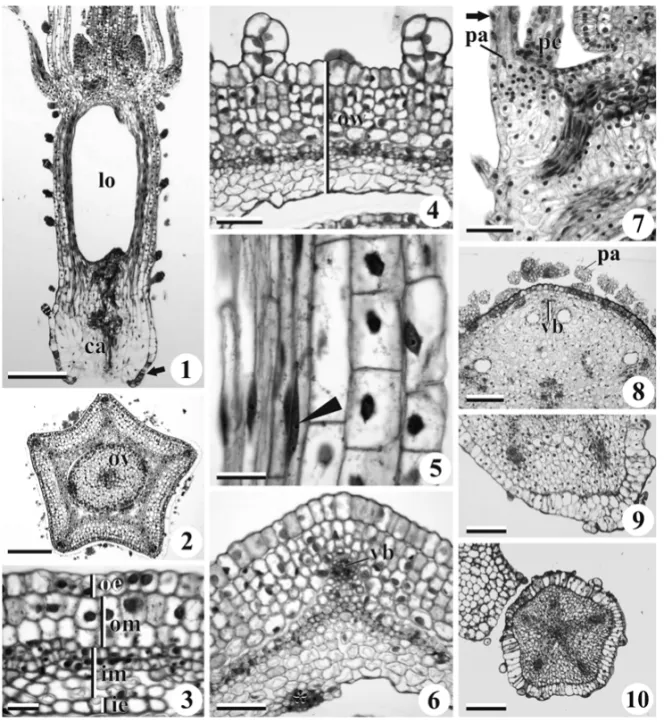
Fig. 1 – Ovary of the floral bud. Figs. 1, 5, 7, 9 – Longitudinal sections. Figs. 2-4, 6, 8, 10 – Transversal sections. Fig. 1 –Campuloclinium
macrocephalum; note lignified basal epidermal cells (arrow). Fig. 2 –Mikania micrantha. Figs. 3-4 – Detail of the ovarian walls ofCampuloclinium macrocephalumandSymphyopappus reticulates, respectively. Fig. 5 –Campuloclinium macrocephalum; note fusiform nuclei of the inner mesophyll cells (arrowhead). Fig. 6 – Detail of the ovarian wall ofMikania micranthashowing the transmission tissue (*). Fig. 7 – Detail of the floral disk ofPraxelis pauciflora; note salient external cells of the pappus with evident nuclei (arrow). Fig. 8 – Detail of part of the floral disk of
Mikania micranthademonstrating secretory cavities near the vascular bundles. Figs. 9-10 – Carpopodium ofSymphyopappus reticulatus. (ca – carpopodium; ie – inner epidermis; im – inner mesophyll; lo – locule; oe – outer epidermis; om – outer mesophyll; ov – ovule; ow – ovarian wall; pa – pappus; pe – petal; vb – vascular bundle). Bars – 250µm (1); 150µm (2, 10); 20µm (3, 5); 50µm (4,6-7,9); 100µm (8).
The outer ovarian epidermis is uniseriate (Fig. 3) with cubical cells, slightly longitudinally elongated (Fig. 5) and vacuolated, with visible nuclei; biseriate tector (Fig. 4), as well as uni- and biseriate glandular trichomes, were observed with variable cell numbers and densities, and will be described in more details below.
Campuloclinum macrocephalum(Fig. 3),Ch. sta-chyophylla, P. pauciflora, and V. orbiculata have two layers in the outer mesophyll, while five to six cell lay-ers are observed inM. micrantha(Fig. 6) andS. reticu-latus(Fig. 4). Procambial strands vascularize the ovary in the outer mesophyll, but differentiated vascular ele-ments are only rarely observed (Fig. 6).
The inner mesophyll demonstrates from four to five cylindrical layers of small-diameter cells arranged lon-gitudinally, with evident fusiform nuclei (Fig. 5). The more internal layers have large intercellular spaces and irregular shapes in comparison with the external layers (Figs. 3-4, 6).
The inner epidermis inCh. stachyophylla,P. pau-ciflora,S. reticulatus(Fig. 4), andV. orbiculatais unis-eriate and little evident, while in Ca. macrocephalum (Fig. 3) andM. micranthathese cells are elongated lon-gitudinally, juxtaposed, with evident nuclei, and of large diameters in comparison with the cells of the inner mes-ophyll. The transmission tissue in all of the species stud-ied can be seen in the inner epidermis where the carpels are joined, and it is composed of a multiseriate region of small diameter cells with pectin-containing cell walls and evident nuclei (Fig. 6).
The floral disk has an uniseriate epidermis that cov-ers varying laycov-ers of elongated parenchyma cells dis-posed obliquely along the periphery; these cells form a protuberance where the pappus is inserted (Fig. 7); there are vascular traces of other floral parts immersed in this same region. InM. micrantha, two lateral secre-tory cavities were observed near the bundles that irrigate the corolla (Fig. 8).
A pappus is present in all of the species studied and is connate at its base. Each bristle is composed of a multiseriate group of cells that are rounded in transver-sal section and longitudinally elongated. The distal ex-tremities of the external cells are projected towards the exterior, and evident nuclei are seen in the cells in this region (Fig. 7).
A protuberance that constitutes the carpopodium and is composed of cubic parenchyma cells with thin walls can be observed at the basal region of the ovary. The walls of the epidermal cells of the carpopodium are lignified in the floral bud ofCa. macrocephalum(Fig. 1) and Ch. stachyophylla; S. reticulatushas an
asym-metrical carpopodium (Fig. 9), with epidermal cells of different sizes that are larger than the internal cells and arranged in a single layer (Fig. 10). The other species have indistinct carpopodium at the median section of the ovary. The ovule trace is single and robust, reaching to the base of the locule (Fig. 1).
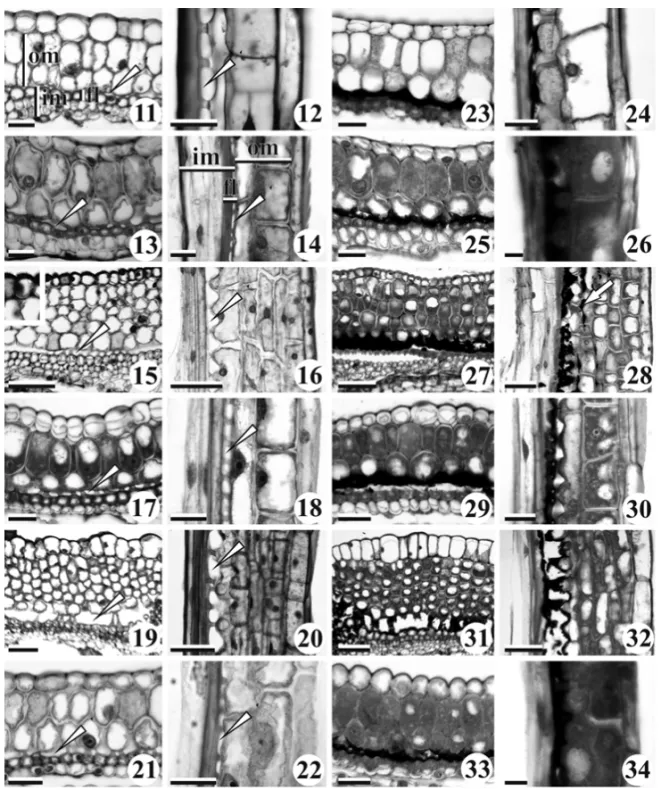
The exocarp remains unaltered during development (Figs. 11, 13, 17, 19, 21), except inM. micrantha, where it develops an ornamented cuticle (Fig. 15). The cellu-lar density of the outer mesocarp distinctly increases in all of the species, and these cells have large nuclei (Figs. 13, 17).
The most significant events that occur in the young pericarp take place in the inner mesocarp, with the most external cells forming numerous anticlinal projections in the direction of the outer mesocarp, and producing schizogenous spaces that are evident between the two mesocarpic regions (Figs. 11-22). These spaces are most ample inS. reticulatus (compare Figs. 19 and 20 with the other species). The lobed contour of the internal periclinal wall of the outer mesocarp (which is in con-tact with the numerous anticlinal projections referred to above) produces large intercellular spaces inM. micran-thaandS. reticulatus, (Figs. 16, 20). The external peri-pheral layer of the inner mesocarp becomes lignified during the later stages of development in all of the spe-cies examined, forming sclereids.
The deposition of phytomelanin is initiated in the intercellular spaces described above, forming a continu-ous, thick, dark layer that is evident in all of the species, but thickest inM. micranthaandS. reticulatus(Figs. 23-34). Phytomelanin occupies the whole space between the outer and inner mesocarp, but did not give a positive reaction in any of the histochemical tests applied.
Fig. 2 – Pericarp during development. From left to right, first and third columns – Transversal sections. Second and fourth columns – Longitudinal sections. Figs. 11-22 – Immature pericarp initiating the formation of schizogenous spaces (arrowhead). Figs. 23-34 – Pericarp during maturation, with phytomelanin deposits. Figs. 11-12, 23-24 –Campuloclinium macrocephalum. Figs. 13-14, 25-26 –Chromolaena stachyophylla. Figs. 15-16, 27-28 –Mikania micrantha; note phytomelanin deposits on the outer mesocarp (arrow). Figs. 17-18, 29-30 –Praxelis pauciflora. Figs. 19-20, 31-32 –Symphyopappus reticulatus. Figs. 21-22, 33-34 –Vittetia orbiculata. (fl – fibrous layer; im – inner mesocarp; om – outer mesocarp). Bars – 20µm (11-14, 17-18, 21-26, 29-30, 33-34); 50µm (15-16, 19-20, 27-28, 31-32).
stachyophylla(Fig. 36),M. micrantha, andP. pauciflo-ra. The inner mesocarp collapses at this time and is partially reabsorbed (Fig. 24).
Macroscopic observations indicated that phytome-lanin deposition inCa. macrocephaluminitiates in the basal region of the fruit and, subsequently, proceeds
to-wards the apex. All the other species examined have small cypselae, making this analysis much more diffi-cult.
Fig. 3 – Cypselae during maturation. Figs. 35-36, 42-43 – Transversal sections. Figs. 39, 41, 44 – Longitudinal sections. Fig. 35 – Phytomelanin deposit in the external intercellular spaces of the vascular bundle ofSymphyopappus reticulatus. Fig. 36 – Interruption of phytomelanin layer in the proximity of a vascular bundle inChromolaena stachyophylla. Fig. 37 – Mature cypsela ofPraxelis pauciflora. Figs. 38-39 – Detail of the micromorphology and anatomy of the floral disk region ofChromolaena stachyophyllarespectively. Figs. 40-41 – Detail of the micromorphology (arrowhead – start of the fracture line) and anatomy of the pappus crown ofSymphyopappus reticulatus. Figs. 42-43 – Mature pericarp of
Campuloclinium macrocephalum. Fig. 44 – Carpopodium ofVittetia orbiculatashowing lignified surface. (ca – carpopodium; fd – floral disk; pa – pappus; pe – pericarp; se – seed). Bars – 75µm (35); 20µm (36); 50µm (37); 100µm (38-39, 44); 30µm (40); 150µm (41-43).
upper region of the fruit: after lignification of the most internal cell walls of the floral disk (Fig. 39), the periph-eral parenchyma cells dehydrate and collapse, thereby reducing their volume in most species (Fig. 38) and in-creasing the distance among the pappus bristles. Only S. reticulatusdemonstrated lignification of the cell walls at the base of the floral disk, generating a fracture line at maturity (Fig. 40) that facilitates the abscission of the floral disk together with the pappus (Fig. 41).
The bristles of the pappus also become lignified during fruit development, but remain alive throughout this phase and show conspicuous nuclei (Fig. 39).
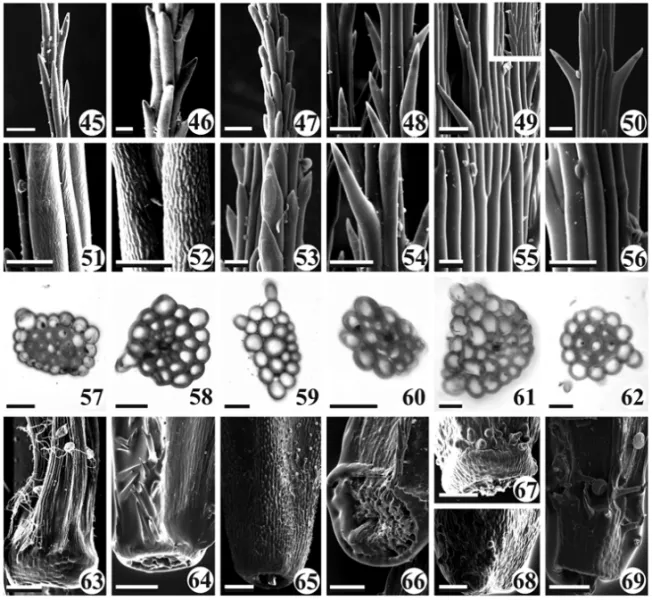
tent, bristly, and isomorphous aspect; the bristles are ordered into a whorl. The pappus has from 14 to 43 bristles, depending on the species: 14-16 inM. micran-tha; 16-19 inP. pauciflora; 17-20 inCh. stachyophyl-la; 22-25 inV. orbiculata; 25-27 inS. reticulatus; and 40-43 inCa. macrocephalum. The distal extremities of the cells projecting from the surface of the bristles have a consistently acute divergence angle that ranges from narrow inCa. macrocephalum(Fig. 45),Ch. stachyo-phylla(Fig. 46) andM. micrantha (Fig. 47), to mod-erate inP. pauciflora(Fig. 48), S. reticulatus(Fig. 49) and V. orbiculata (Fig. 50). These extremities have sharp apices, except inM. micrantha (Fig. 47) where it is rounded; the cell extremities inS. reticulatus are also sometimes rounded.
Micromorphological examination of the bristle sur-faces reveals variable patterns: reticulated inCa. macro-cephalum (Fig. 51); short longitudinal threads in Ch. stachyophylla (Fig. 52); finely striated and with pro-jections demonstrating slight apical compression inM. micrantha(Fig. 53); and more finely striated on the sur-face ofP. pauciflora(Fig. 54), while smooth inS. retic-ulatus(Fig. 55) andV. orbiculata (Fig. 56). Some of the bristle projections on the pappus ofS. reticulatusare retrorsely flexed (see detail in Fig. 49).
The pappus bristles of the species examined here demonstrate completely lignified cell walls (Figs. 57-62). Most bristles are vascularized, with the exception of those ofM. micrantha, but the extension of the vas-cular bundles varied among all the species. Only 1.7% of the total length of the bristles are vascularized inCh. stachyophylla; only 2% inCa. macrocephalum; 4% in P. pauciflora; 10% inS. reticulatus; and inV. orbiculata 37% of the length of each bristle has a small vascular bundle.
The carpopodium is lignified and symmetrical at maturity in most of the species examined (Figs. 63-65, 69), being asymmetrical only inP. pauciflora(Fig. 66) andS. reticulatus(Figs. 67-68). The carpopodium sur-face ranged from: undifferentiated inM. micrantha, hav-ing a thickness of approximately two cell layers inCh. stachyophylla; having from one to three differentiated cell layers inP. pauciflora; approximately four layers in Ca. macrocephalum; four to six layers inS. reticulatus; and approximately eight layers inV. orbiculata.
among the cypselae evaluated, as can be seen by com-paring Figure 37 (P. pauciflora), 38 (Ch. stachyophylla), and 40 (S. reticulatus). Five types of trichomes were observed: two biseriate tectors and three glandular, the latter ranging from uni- to biseriate. Table I lists the five trichome types observed among the species exam-ined, specifying the variations in their horizontal (in the ribs and furrows) and vertical (considering the proxi-mal third, median, and distal regions) distributions on the cypsela.
DISCUSSION
The species examined here demonstrated ovarian struc-tures typical of the Eupatorieae, including an uniseriate epidermis with trichomes, outer mesophyll with closely juxtaposed cells, inner mesophyll composed of paren-chyma cells with ample intercellular spaces, and an in-ner epidermis with differentiated cells in two regions that form the transmission tissue. This data corroborates the only previously published work concerning this tribe (Pandey and Singh 1983, 1994).
Fig. 4 – Micromorphology (first and second rows) and transversal sections of the pappus (third row), and micromorphology of the carpopodium (fourth row). Figs. 45, 51, 57, 63 –Campuloclinium macrocephalum. Figs. 46, 52, 58, 64 –Chromolaena stachyophylla. Figs. 47, 53, 59, 65 –Mikania micrantha. Figs. 48, 54, 60, 66 –Praxelis pauciflora. Figs. 49, 55, 61, 67, 68 –Symphyopappus reticulatus. Figs. 50, 56, 62, 69 –
Vittetia orbiculata. Bars – 50µm (45, 47, 49); 20µm (46, 48, 50-62); 150µm (63-69).
There were distinct differences among the thick-nesses of the phytomelanin layers among the various species studied. Mikania micranthaandS. reticulatus have thicker phytomelanin layers than other species have, which may be related to the greater numbers of secretory layers in the outer mesocarps of these spe-cies. According to Hanausek (1910, 1912) apud Roth (1977), phytomelanin may serve as a protective screen against excessive insolation or in mechanical protection of the pericarp. As the studied species occur in the cer-radobiome, protection against excessive insolation could be very important. Pandey and Dhakal (2001) re-viewed the available literature concerning phytomelanin in the Asteraceae, and pointed out that this substance has a deterrent effect on insect predators, which was con-firmed in experiments with sunflower seeds (Helianthus
spp). However, J. Marzinek and D.M.T. Oliveira (un-published data) analyzed the cypselae ofM. micrantha andS. reticulatusand found insect larvae in 10% and 22% of the fruits, respectively. As these are the species with the thickest recorded phytomelanin layers, the de-terrent effect of this substance cannot be confirmed, and the role of phytomelanin in the cypselae still needs to be elucidated.
(A: apex; M: median region; B: base; –: absent; +: rare; ++: frequent; +++: abundant).
* Type I: tector, biseriate, 4-cells; Type II: tector, biseriate, 4-6 cells of hyaline content; Type III: glandular, biseriate, peduncle with 4-6 hyaline cells,
distal 2-4 cells globoid to spatulate with dense content; Type IV: glandular, uniseriate, peduncle with 6-7 cells, secretory portion unicellular; Type V:
glandular, biseriate, peduncle with 2-4 hyaline cells, distal 8-10 cells with dense content.
Type of trichoma
Type I Type II Type III Type IV Type V
Species Distribution A M B A M B A M B A M B A M B
ribs + + +
furrows + + +
ribs ++ + + ++
furrows + + + +
ribs
furrows + + + +
ribs +++ +++ ++
furrows ++ ++ +
ribs +
furrows ++ ++ ++
ribs ++ ++ ++
furrows + + + +++ ++ + ++
in this study, and by the velocity with which deposition occurred.
The indumenta of the cypselae of the Asteraceae have been examined by numerous authors (e.g. Drury and Watson 1966, Wetter 1983, Blanca and Guardia 1997, Mukherjee and Sarkar 2001), and this character has a significant taxonomic value. Roth (1977) observed that biseriate trichomes are typically found on the peri-carp in this family, and they apparently aid in fixing dis-persed fruits to the soil. Types I and III trichomes re-ferred to in the present study (biseriate non-glandular with four cells, and biseriate glandular with peduncle composed of from four to six hyaline cells, respectively) were common among the Eupatorieae studied. Among the Asteraceae of the cerrado vegetation studied by Castro et al. (1997), type IV trichomes (glandular and uniseriate with peduncle composed of from six to seven cells and unicellular secretory portion) occurred exclu-sively between the Eupatorieae and Heliantheae (sensu Bremer 1994). In their study of the micromorphology of species ofMikania, Ritter and Miotto (2006) reported
that some simple, pluricellular and uniseriate trichomes, as well as many glandular trichomes, were observed on the surface of the fruits ofM. micrantha. However, type IV trichomes that are found in the present examination of this species were not reported by those authors.
An analysis of the occurrence of trichomes among the different species revealed some interesting results (see Table I):P. pauciflorademonstrated a relatively ho-mogeneous distribution of those structures, but has only biseriate tector trichomes known as twin hairs, the most characteristic type of trichome in the Asteraceae;V. or-biculatademonstrated the most heterogeneous distribu-tion of trichomes (including the biseriate tector type, as well as two additional secretory types), all of them rel-atively abundant in the furrows of the cypselae; varia-tions in trichomes between the ribs and furrows are only distinguishable inCa. macrocephalum. Considering the distribution of trichomes among the apical, median, and basal regions of the fruits, all of the species demonstrated a greater density of trichomes near their apices.
cyp-selae of different Asteraceae were quite characteristic. Their internal structure reveals certain characteristics that are taxonomically useful, mainly the arrangement of the support tissues that are preserved even after de-hydration of the cypselae. Studies of the ontogeny of dry pericarps are likewise very informative among the Asteraceae, for few defined layers persist at maturity. However, only phytomelanin and residues of cell walls and vascular bundles remain after drying in the Eupato-rieae, making comparisons among the differenttaxavery difficult. Pandey and Singh (1983, 1994) studied onto-genetic aspects of Eupatorieae fruits, but these authors cited only a few characteristics related to development.
Haque and Godward (1984) observed that the car-popodium (the abscission zone of the cypsela) some-times demonstrated structures that facilitated separation from the inflorescence axis and the subsequent dispersal of the fruit. According to King and Robinson (1987), carpopodium anatomy is very variable in Eupatorieae. Among the species studied,M. micranthahad an indis-tinct carpopodium, while this structure is clearly asym-metrical in bothP. paucifloraandS. reticulatus.Vittetia orbiculatahad the most distinct carpopodium of all the species studied, followed then byCa. macrocephalum. Haque and Godward (1984) examined the carpopodium and its usefulness in the taxonomy of the Asteraceae. These authors reported that Ca. macrocephalum had the most differentiated carpopodium among the Aster-oideae (sensu Bremer 1994) studied. This finding is not in conflict with the present work, however, because these authors did not examine any species ofVittetiathat had a more conspicuous carpopodium thanCa. macro-cephalum.
An analysis of the floral disk ofM. micrantha de-monstrated the existence of two cavities associated with each vascular bundle. Reports of internal secretory struc-tures are rare for the cypselae of the Asteraceae, being more frequently observed in vegetative organs. Castro et al. (1997) reported the presence of ducts in the leaves ofM. officinalis, and Oliveira (1972) observed secretory elements in the leaves, flowers, and fruits ofM. hirsutis-sima var. hirsutissima. These authors did not specify, however, what type of secretions were produced, in much the same way as it was not possible to detect secretions in the cavities inM. micrantha.
Stuessy and Garver (1996) cited the pappus as one
of the most important characteristics of the capitulum. According to Mukherjee and Sarkar (2001), the pappi encountered in the cypselae of the Asteraceae represent a classic source of taxonomic information and, depending on the degree of specificity of these characteristics, these structures can be used to identify genera or even species. It is important to note that the vascular system of the pappus may be differentiated or not. The vascula-ture of the pappus has been described for some repre-sentatives ofChaenactidinaebelonging to the tribe He-liantheae (Robinson 1981), as well as for some species of Helogyne (Eupatorieae), where the vascular bundle may extend for up to half of the length of the bristle (King and Robinson 1987). The bristles examined in the present work were all vascularized, with the excep-tion ofM. micrantha. Variations in the lengths of the bristle vascular bundles clearly demonstrates structural reduction of the calyx among the Asteraceae, reinforc-ing the classical affirmation of Cronquist (1955, 1981) and Ramiah and Sayeeduddin (1958) that the pappus is in fact a modified calyx. King and Robinson (1987) af-firmed that the pappus is formed by a series of capillary bristles in most species of Eupatorieae, a condition that is considered primitive for the tribe. The pappus may even be reduced to five to ten bristles within this group, as inHofmeisteria, or to just a few bristles as in Fleis-chmannia, or they may be totally absent as inAgeratum and some other genera. The presence of reduced vascu-larized lengths in the bristles of Eupatorieae is an indica-tion of the evoluindica-tionary tendency to reduce the number of bristles, even to the point of completely suppressing the pappus. It has been well established that the vas-cular system is very conservative in plants, and that its reduction commonly precedes a reduction of the organ being served (Eames and MacDaniels 1947). This phe-nomenon has been previously reported for some species of Eupatorieae.
de-in a retraction of the more peripheral fibers and the open-ing of the pappus bristles, thus favoropen-ing anemochoric dispersal.
Stuessy and Garver (1996) suggested that the pap-pus has a double function over time: it first has a defen-sive role in the flower, mainly against insects, while it is essential for dispersal in the fruit. This double func-tion of the pappus may be one of the factors responsi-ble for the great evolutionary success of the Asteraceae. The suggestion that the pappus has a role in the defense of the flowers was not supported in the species exam-ined in the present study, however, because field obser-vations revealed the existence of capitula that had been completely destroyed by insect predation (J. Marzinek, unpublished data).
Although the Asteraceae typically have a persis-tent calyx, some cypselae have a rupture line near their apex that seems to direct all of the bristles of the pappus into a single crown-like structure. This structure was ob-served only in S. reticulatus in the present study, but had been reported for Carduus arvensis by Dandeno (1905), who noted that the rupture line facilitates germi-nation because water absorption can occur through the apical region of the cypsela. Shmida (1985) reported that a non-deciduous pappus promotes the dispersal of cypse-lae far from the mother plant. Experiments are needed to more accurately evaluate water uptake by seeds en-closed in the cypselae, and will be important in defining the role of the rupture line in germination.
It is interesting that the pappus is associated with two very distinct dispersal modes in the Asteraceae: bi-otic dispersal by epizoochory (in which the pappus bris-tles take on the form of hooks or become reflexed and able to attach to passing animals); and abiotic dispersal by anemochory (in which the extremities of the bristles tend to be erect). Curiously, diaspores of S. reticula-tusdemonstrate both modes, as the cypsela first escapes from the inflorescence axis by anemochory and, then, after initial dispersal, the backward-reflexed bristle ex-tremities favor biotic dispersal.
Capillary pappi composed of thin and flexible bris-tles, as observed inEmilia fosbergii, favor wind trans-port, but due to their great flexibility they do not facili-tate fixation to the ground (J. Marzinek, O.C. De-Paula
S. reticulatus, if the thick and rigid bristles of the pappus did not separate from the cypsela during dispersal, con-tact with the substrate would be much more difficult. The separation of the pappus crown may also facili-tate water uptake and germination of the seeds of this species, but this hypothesis still needs to be tested.
The taxonomic characteristics of the species of Eu-patorieae here examined (including the anatomy of the pappus, carpopodium, indumentum, and cypsela before maturation) are all very variable and support the segre-gation of the genusEupatoriumas proposed by King and Robinson (1987).
ACKNOWLEDGMENTS
The authors thank Conselho Nacional de Desenvolvi-mento Científico e Tecnológico (CNPq) for the research grants awarded to J. Marzinek and D.M.T. Oliveira; Fun-dação de Amparo à Pesquisa do Estado de São Paulo (FAPESP), Programa BIOTA (Proc. 00/12469-3), and Fundação de Amparo à Pesquisa do Estado de Minas Gerais (FAPEMIG) for financial support; and Dr. Aris-tônio Magalhães Teles for identifying the Eupatorieae species.
RESUMO
A ontogênese das cipselas e de suas partes acessórias em Cam-puloclinium macrocephalum,Chromolaena stachyophylla, Mi-kania micrantha,Praxelis pauciflora,Symphyopappus reticu-latuseVittetia orbiculata, parte delas segregadas do gênero Eupatorium, foi estudada em microscopia de luz e eletrônica de varredura. A camada de fitomelanina presente no fruto apa-rentemente é secretada pelo mesocarpo externo e possui espsura variável entre as espécies, depositando-se em espaço es-quizógeno entre o mesocarpo externo e interno. As cerdas dos pápus são vascularizadas, exceto emM. micrantha, e possuem células projetadas superficialmente, dispostas acropetamente; emS. reticulatus, algumas projeções são retrorsas e a presença de linha de fratura sob o disco floral, observada apenas nesta es-pécie, pode indicar processo duplo de dispersão. As numerosas diferenças registradas entre as cipselas estudadas reforçam se-gregações anteriores do gêneroEupatorium sensu lato.
REFERENCES
ANDERBERGAAET AL. 2007. Compositae. In: KADEREIT
JWANDJEFFREYC (Eds), Families in genera of vascular plants. Vol. VIII. Flowering Plants, Eudicots, Asterales, Berlin, Springer-Verlag, p. 61–576.
BARTHLOTTW, NEINHUISC, CUTLERD, DITSCHF, MEU
-SELI, THEISENIANDWILHELMIH. 1998. Classifica-tion and terminology of plant epicuticular waxes. Bot J Linn Soc 126: 237–260.
BEAN AR. 2001. Pappus morphology and terminology in Australian and New Zealand thistles (Asteraceae, tribe Cardueae). Austrobaileya 6: 139–152.
BLANCAGANDGUARDIAD. 1997. Fruit morphology in
TragopogunL. (Compositae: Lactuceae) from the Iberian Peninsula. Bot J Linn Soc 125: 319–329.
BREMERK. 1994. Asteraceae: Cladistics and Classification. Portland, Timber Press, 752 p.
BRUHLJJANDQUINNCJ. 1990. Cypsela anatomy in the ‘Cotuleae’ (Asteraceae-Anthemideae). Bot J Linn Soc 102: 37–59.
CASTRO MM, LEITÃO-FILHO HFAND MONTEIROWR.
1997. Utilização de estruturas secretoras na identificação dos gêneros de Asteraceae de uma vegetação do cerrado. Rev Bras Bot 20: 163–174.
CRONQUISTA. 1955. Phylogeny and taxonomy of the
Com-positae. Am Midl Nat 53: 478–511.
CRONQUISTA. 1981. An integrated system of classification of flowering plants. New York: Columbia University Press, 1262 p.
DANDENOJB. 1905. The parachute effect of thistle-down. Science 22: 568–572.
DRURYDGANDWATSONL. 1966. Taxonomic implications
of a comparative anatomical study of Inuloideae – Com-positae. Am J Bot 53: 828–833.
EAMES AJ AND MACDANIELS LH. 1947. An introduc-tion to plant anatomy. 2nded., New York, McGraw-Hill,
427 p.
HABERLANDTG. 1914. Physiological plant anatomy. Lon-don: MacmillanapudSHELDONJCANDBURROWSFM. 1973. The dispersal effectiveness of the achene-pappus units of selected Compositae in steady winds with con-vection. New Phytol 72: 665–675.
HANAUSEK TF. 1910. Über die perikarphöker vonDahlia variabilis(W.) Desf. Ber Dt Bot Ges 28: 35–37 apud ROTHI. 1977. Fruits of Angiosperms. In: LINSBAUER
K (Ed), Handbuch der Pflanzenanatomie v. 10, Berlin, Gebrüder Borntraeger, 675 p.
HANAUSEK TF. 1912. Untersuchungen über die kohleähn-liche masse der Kompositen. Denkschr d kais Akad Wiss Wien, Math-Nat Kl 87: 93-142apudROTHI. 1977. Fruits of Angiosperms. In: LINSBAUER K (Ed), Handbuch
der Pflanzenanatomie v. 10, Berlin, Gebrüder Borntraeger, 675 p.
HAQUEMZANDGODWARDMBE. 1984. New records of the carpopodium in Compositae and its taxonomic use. Bot J Linn Soc 89: 321–340.
HICKEY LJ. 1979. A revised classification of the architec-ture of dicotyledonous leaves. In: METCALFCRAND
CHALKL (Eds), Anatomy of the dicotyledons. Oxford: Claredon Press, p. 25–39.
HOLMGRENPK, HOLMGRENNHANDBARNETTLC. 1990. Index Herbariorum. Part I: The Herbaria of the world. New York, International Association for Plant Taxon-omy, 693 p.
JENSENWA. 1962. Botanical histochemistry: principles and
practice. San Francisco: W.H. Freeman, 408 p.
JOHANSEN DA. 1940. Plant microtechnique. New York, McGraw-Hill, 523 p.
KINGRMANDROBINSONH. 1987. The genera of the
Eupa-torieae (Asteraceae). Kansas, Missouri Bot Gard, 581 p. LESZEKP, VINCENTDANDWILSONSL. 1997. The
system-atic value of the surface micromorphology and anatomy of cypselae of some members of the Senecioideae, Liabeae and Vernonieae (Asteraceae). S Afr J Bot 63: 382–399. MARZINEKJ, DE-PAULAOCANDOLIVEIRADMT. 2008.
Cypsela or achene? Refining terminology by considering anatomical and historical factors. Rev Bras Bot 31: 549– 553.
MAZIAJC, BREMERPAANDALFERTM. 1953. The
cyto-chemical staining and measurement of protein with mer-curic bromophenol blue. Biol Bull 104: 57–67.
MUKHERJEESKANDSARKARAK. 2001. Morphology and structure of cypselae in thirteen species of the tribe Aster-eae (AsteracAster-eae). Phytomorphology 51: 17–26.
O’BRIENTP, FEDERNANDMCCULLYME. 1964. Poly-chromatic staining of plant cell walls by toluidine blue O. Protoplasma 59: 368–373.
OLIVEIRAF. 1972. Contribuição para o estudo botânico de Mikania hirsutissimaD.C var. hirsutissima. II. Morfolo-gia externa e anatomia da folha, flor, fruto e semente. Rev Farm Bioquim Univ São Paulo 10: 15–36.
PANDEY AK AND DHAKAL MR. 2001. Phytomelanin in Compositae. Curr Sci 80: 933–940.
ture of seed and fruit in Eupatorieae and Heliantheae (Compositae). Proc Natl Acad Sci India 64: 115–126. PANDEYAK, LEEWW, SACKFDANDSTUESSYTF. 1989.
Development of the phytomelanin layer in fruits of Age-ratum conyzoides(Compositae). Am J Bot 75: 739–746. PANEROJL. 2007. Compositae: key to the tribes of the
He-liantheae Alliance. In: KADEREITJWANDJEFFREYC
(Eds), Families in genera of vascular plants. Vol. VIII. Flowering Plants, Eudicots, Asterales, Berlin, Springer-Verlag, p. 391–395.
PIJL L VAN DER. 1982. Principles of dispersal in higher
plants. New York, Springer-Verlag, 214 p.
RAMIAHNANDSAYEEDUDDINM. 1958. Homology of the pappus in the light of trichome distribution. Curr Sci 10: 402–403.
RITTERMRANDMIOTTOSTS. 2006. Micromorfologia da superfície do fruto de espécies deMikaniaWilld. (Astera-ceae) ocorrentes no estado do Rio Grande do Sul, Brasil. Acta Bot Bras 20: 241–247.
ROBINSONH. 1981. A revision of the tribal and subtribal limits of the Heliantheae (Asteraceae). Smithson Contrib Bot 51: 1–102.
ROTH I. 1977. Fruits of Angiosperms. In: LINSBAUER K
(Ed), Handbuch der Pflanzenanatomie v. 10, Berlin, Ge-brüder Borntraeger, 675 p.
Iowa State University, 228 p.
SHMIDAA. 1985. Why do some Compositae have an
incon-sistently deciduous pappus? Ann Missouri Bot Gard 72: 184–186.
STUESSYTFANDGARVERD. 1996. The defensive role of pappus in heads of Compositae. In: CALIGARIPDSAND
HIND DJN (Eds), Compositae: biology and utilization.
Proceedings of the International Compositae Conference, Kew, R Bot Gard, p. 81–91.
VRIES MA DE. 1948. Over de vorming van phytomelaan bijTagetes patulaL. en enige andere Compositae. The-sis, University of LeidenapudHEGNAUERR. 1977. The chemistry of the Compositae. In: HEYWOODVHET AL. (Eds), The biology and chemistry of the Compositae, Lon-don, Academic Press, p. 284–335.
WAGENITZG. 1976. Systematics and phylogeny of the
Com-positae (Asteraceae). Plant Syst Evol 125: 29–46. WETTER MA. 1983. Micromorphological characters and
generic delimitation of some new world Senecioneae (As-teraceae). Brittonia 35: 1–22.