HORACIO SCHNEIDER
Campus Universitário de Bragança, Universidade Federal do Pará, Alameda Leandro Ribeiro, s/n – 68600-000 Bragança, Pará, Brazil
Manuscript received on January 31, 2000; accepted for publication on February 2, 2000
ABSTRACT
Four DNA datasets were combined in tandem (6700 bp) and Maximum parsimony and Neighbor-Joining analyses were performed. The results suggest three groups emerging almost at the same time: Atelidae, Pitheciidae and Cebidae. The total analysis strongly supports the monophyly of the Cebidae family, group-ingAotus, CebusandSaimiriwith the small callitrichines. In the callitrichines, the data linkCebuelato Callithrix, placeCallimicoas a sister group ofCallithrix/Cebuella, and showSaguinusto be the earliest offshoot of the callitrichines. In the family Pithecidae,Callicebusis the basal genus. Finally, combined molecular data showed congruent branching in the atelid clade, setting upAlouattaas the basal lineage and Brachyteles-Lagothrixas a sister group and the most derived branch. Two major points remain to be clarified in the platyrrhine phylogeny: (i) what is the exact branching pattern ofAotus, Cebus, Saimiriand the small callitrichines, and (ii), which two of these three lineages, pitheciines, atelines or cebids, are more closely related?
Key words:New World monkeys, Platyrrhine, Taxonomy, Molecular, Evolution
INTRODUCTION
The systematics of New World monkeys has been a subject of strong debate during the last three decades. The main protagonists and their taxonomic proposals are: Simons (1972), Hershkovitz (1977), Rosenberger (1981), Ford (1986), and Kay (1990). All of these proposals are based mainly on mor-phological or ecological studies. The majority of the authors agree with the existence of three mono-phyletic clades: the large monkeys with a prehen-sile tail, a group constituted by Alouatta, Ateles, Lagothrix, andBrachyteles; the seed predator
mon-keys, consisting ofPithecia, Chiropotes, and Caca-jao, and the small clawed monkeys, composed of
∗Invited paper
∗∗Member of the Academia Brasileira de Ciências E-mail: [email protected]
the Saguinus, Leontopithecus, Callithrix, and Ce-buellagenera. However, they disagree in relation to
the branching order among these three major clades, within the ateline and callitrichine clades, and also on the placement ofSaimiri, Cebus, Aotus, Callice-bus, andCallimico.
Hershkovitz (1977), placed the small Callim-icoin its own family Callimiconidae, based on its
controversial features: this genus shares small body size and the presence of claws instead of nails with the callitrichines, and single pregnancy and the pres-ence of a third molar with the remaining platyrrhine lineages. On the other hand, based on those am-biguous affinities, other morphologists place Cal-limico as the first callitrichine offshoot to diverge
by Ford (1986) as the earliest offshoot lineages of the New World primate radiation, but Kay (1990), places Cebus as the basal platyrrhine andSaimiri
as a sister group of the callitrichines. Conversely, Rosenberger (1981) considersCebusandSaimirias
sister groups of the callitrichines. The position of the
Callicebusgenus has been also controversial.
Ac-cording to Kay (1990)Callicebusis the most basal
of the callitrichine tree, and Ford (1986) places Cal-licebustogether withCebusandSaimirias the most
basal clade of the platyrrhines. However, Rosen-berger & Coimbra-Filho (1984) and RosenRosen-bergeret al. (1990) argued thatCallicebusandAotusare
sis-ter lineages linked to the pitheciine clade. In a more drastic point of view, Tyler (1991) suggested that
Aotusmust be removed from the ceboid clade and
placed in a sister group of the entire Anthropoidea. Supporting this proposal, Tejedor (1998) addition-ally pointed out thatAotusandCallicebusare
an-cient taxa and suggested that they have a common ancestor. His belief is based on the assumption that the two Miocene genera,Homunculusand Carloce-bus, show many primitive characters shared by both
AotusandCallicebus.
The authors also disagree on the internal ar-rangements within atelines and callitrichines. In the ateline clade the four genera are arranged in three different ways:AtelesandBrachytelesas sister
groups (Rosenberger 1981),Brachyteles, Lagothrix
andAtelesin a non-resolved trichotomy (Ford 1986),
and two clades composed ofAteles-Lagothrix and Alouatta-Brachyteles(Kay 1990). Inside the
cal-litrichines, most of the authors consider the gumiv-orousCebuellaandCallitrixas the most derived
lin-eages. ForSaguinusandLeontopithecusthere are
two proposals: one placesLeontopithecusas a
sis-ter group ofCallithrix-Cebuela(Rosenberger 1981)
and the other placesSaguinusas a sister group of
the gumivorous monkeys (Ford 1986, Kay 1990).
THE MOLECULAR DATA
Molecular data suitable to cladistic analysis of the New World monkeys were first obtained at the
be-ginning of the 90’s, being the first DNA dataset of aligned sequences of the nuclear epsilon globin gene involving all 16 platyrrhine genera and was pub-lished by Schneideret al. (1993). Subsequently, a
series of datasets was generated, some including all extant New World primate genera (Schneideret al.
1996, Canavezet al. 1999a, von Dornam & Ruvolo
1999, Goodmanet al. 1998), while others
concen-trated on particular clades (Canavezet al. 1999b,
Chaveset al. 1999, Meireleset al. 1999, Porteret al. 1997a b, Porteret al. 1999, Pastoriniet al. 1998,
Tagliaroet al. 1997).
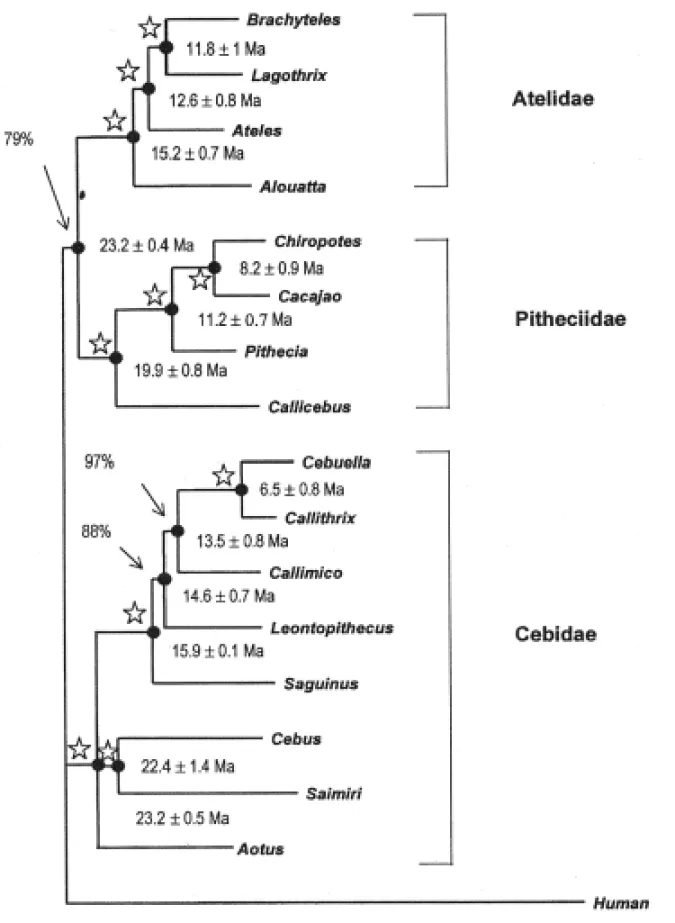
Table I summarizes the results involving four nuclear datasets (IRBP, EPSILON, G6PD, andβ -2M) for all extant New World primates, and addi-tional molecular data (vWF, upstream region EP-SILON,γ-Globin, ND4, and tRNA) including spe-cific clades. The four DNA datasets (EPSILON, IRBP, G6PD andβ-2M) were combined in tandem to perform a total analysis using Maximum parsi-mony (MP) and Neighbor-Joining (NJ) approaches utilizing PAUP version 4.0b3a (Swofford, 1998). Figure 1 shows the consensus tree. Percentages at nodes indicate bootstrap support for that particular node, while nodes with stars mean 99-100% boot-strap support. The branch lengths of the Neighbor-Joining tree (Saitou & Nei, 1987) were estimated by the least-squares method referred to in Takezakiet al. (1995). MP and NJ trees were almost identical,
differing only in the placement ofAotus. The MP
tree placedAotusas the basal lineage of the
Callitri-chine clade, while NJ showedAotusto occur in an
unresolved trichotomy with theCebus-Saimiriclade
and the callitrichines.
TABLE I
DNA Studies that Elucidate New World monkeys Phylogeny
Pitheciine- Aotus, Cebus Callicebus Lagothrixand Callitrichine clade Ateline- andSaimiri as basal Brachyteles Saguinus Callimico GENES Kb AUTHORS Cebid as closely genus of the as sister group as basal and
relationship linked to pitheciine in the ateline genus Callithrixas callitrichines clade clade sister group
BS% BS% BS% BS% BS% BS%
EPSILON 1,8 Schneideret al. PA=79 94 99 86 77∗ 69
1993
IRBP 1,9 Schneideret al. PC=96 99 100 77 100 84∗∗
1996
G6PD 1,2 Von Dorman & AC=40 83 78 72 100 80
Ruvolo, 1999
B2M 1,7 Canavezet al. PA=72 56 87 96 100 92
1999a
vWF 0,7 Chaveset al. 98 84
1999
EPSILON and 1.8 to Porteret al. PAC=100 100 5’ region 4.3 1997a
EPSILON 1.2 – Porteret al. 100
5’ region 1.4 1999
ND4, tRNAs 0,8 Pastoriniet al. 81∗ 80
1998
Gamma- 9,6 Meireleset al. 100
Globin 1999
BS: Bootstrap Support. Bootstrapping involves creating a new data set by sampling N characters randomly with replacement, so that the resulting data set has the same size as the original, but some characters have been left out and others are duplicated. The random variation of the results from analyzing these bootstrapped data sets can be shown statistically to be typical of the variation that you would get from collecting new data sets (Felseinstein, 1985).
PA = Pitheciines×Atelines; PC = Pitheciines×Cebids; AC = Atelines×Cebids; PAC = unresolved trichotomy
∗Saguinus and Leontopithecusas sister group
∗∗Callimico and Leontopithecusas sister group ofCallithrix
ateline-pitheciine clade, but the bootstrap support is not strong (78%) in the MP tree. In addition, Porter
et al. (1997b)’s analysis using 5’upstream region
of epsilon gene in selected primates taxa showed the three major clades in an unresolved trichotomy. The poor resolution of the phylogenetic reconstruc-tion of the three major platyrrhine lineages, resulting from the most robust molecular dataset so far avail-able for the New World monkeys, strongly suggests that the pitheciines, atelines and cebids emerged at almost the same time in the platyrrhine radiation. These lineages are named by Schneideret al. 1996,
Schneider & Rosenberger 1996 and Goodmanet al.
1998, as the Atelidae, Pitheciidae and Cebidae
fam-ilies.
In the Pitheciidae family the four nuclear genes and the joint DNA analysis significantly placed Cal-licebusas a sister group of the traditional pitheciines, Pithecia, ChiropotesandCacajao(bootstrap values
ranging from 78 to 100%). These results were rein-forced by the complementary study of Porteret al.
(1999) encompassing more than 4 Kb of the epsilon globin gene and its upstream region.
The joint analysis strongly supports the mono-phyly of the Cebidae family, groupingAotus, Cebus,
andSaimiriwith the small callitrichines (bootstrap
the epsilon upstream region of Porteret al. (1997a,
1999) also indicate a close relationship between Ce-bus andSaimiri. Among the callitrichines,
addi-tional molecular data of Pastoriniet al. (1998) using
mitochondrial DNA; Chaveset al. (1999), Canavez et al. (1999a b), using nuclear DNA (intron 11 of
von Willebrand,β-2-microglobulin genes), strongly supported the reclassification of Cebuela as belong-ing to the Callithrix genus (See also Porteret al.
1997b, Barrosoet al. 1997) and also significantly
placedCallimicoas a sister group ofCallithrix,
con-trary to the traditional view ofCallimicoas being
basal to the callitrichines. Five of the six genes, and the joint analysis placedSaguinusas the basal
genus of the callitrichine tree with significant boot-strap values (98-100%). Finally, four nuclear genes and the joint analysis showed a congruent branch-ing pattern in the atelid clade, placbranch-ingAlouattaas the
most basal lineage andBrachytelesfrom theAtlantic
forest) andLagothrix(from the Amazonian forest),
as sharing the last common ancestor (bootstrap val-ues ranging from 78 to 100%), contrasting to the widely disseminated view thatAtelesand Brachyte-les share the last common ancestor in the ateline
clade. Furthermore, as shown in Table I, the inves-tigation by Meireles et al. (1999), encompassing
more than 9 Kb of the gamma globin gene complex strongly supports the Lagothrix-Brachyteles clade
(bootstrap value of 100%).
If, at the intergeneric level, the phylogenetic ties are almost elucidated, the same does not occur at the subgeneric level. In almost all polyspecific gen-era, the relationships among species are highly con-troversial. The callitrichines are the most investi-gated group until now at the intrageneric level. In the
Callithrixgenus there are two well defined groups:
a jacchus group with an eastern geographic distribu-tion (Atlantic forest), and an argentata group from the Amazonian region. DNA data from Tagliaro
et al. (1997), Chaves et al. (1999) and Canavez et al. (1999a b), suggest that the Amazonian
Cal-lithrix pygmaeaandC. argentataare closely related
species, as expected in view of their geographic
dis-tribution. On the other hand, the molecular data does not support the recognition of the Amazonian
C. humeraliferaand the recently described species
C. mauesias distinct taxa (Tagliaro et al. 1997).
Furthermore, in the jacchus group, which has a high diversity of morphotypes, Tagliaroet al. (1997)
us-ing highly variable mitochondrial DNA data, found that theC. jacchus, C. kuhli, C. penicillata, andC. geoffroyispecies are very similar and thatC. aurita
is the earliest branch of the Atlantic forest group. In addition, the genetic divergence values between species of theCallithrixgenus are very small,
sug-gesting that speciation in this group is a very recent event.
THE AGES OF THE PLATYRRHINE CLADES
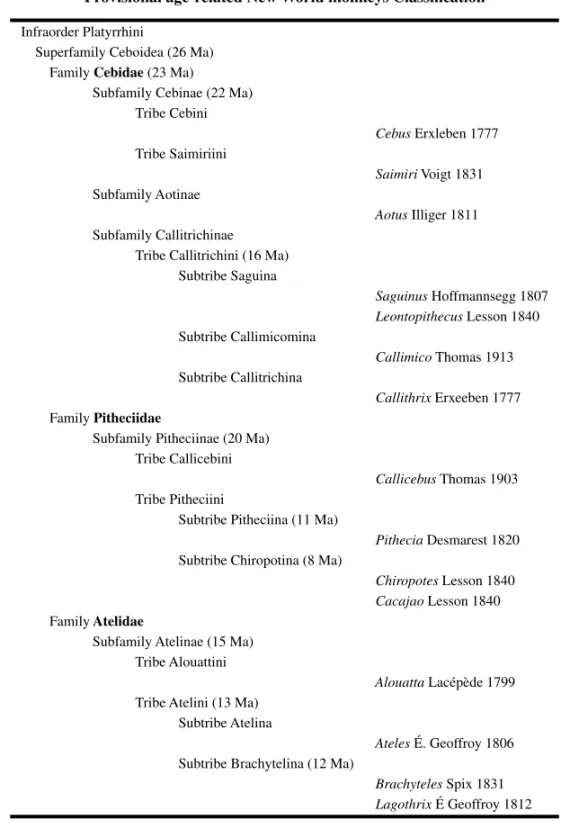
Following Avise & Johns (1999), divergence times were used to construct a provisional age-related clas-sification of the New World monkeys (Table II). Us-ing the catarrhine-platyrrhine split at 40 Ma (Mega annum) in the middle Eocene, according to Good-man et al. (1998, 1999), we estimate that the
platyrrhine families, as total groups (Total groups in-cludes all members of the crown group, the stem of the last common ancestor (LCA) and all extinct taxa) originated in the middle to late Oligocene epoch at 26 Ma.
According to our estimates, based on the joint molecular analysis of the combined nuclear genes and calibrating the molecular clock for the emer-gence of the families at the Oligocene-Miocene boundary (26 Ma), it appears that the Cebidae fam-ily split into the subfamilies Cebinae Aotinae at 22-23 Ma, each one with single extant monogeneric tribes (Cebini forCebusand Aotini forAotus). In
the early to middle Miocene (16-13 Ma), the basal callitrichines branched into monogeneric subtribes Saguinina (Saguinus), Leontopithecina ( Leonto-pithecus), Callimiconina (Callimico), and
Cal-litrichina (Callithrix).
TABLE II
Provisional age-related New World monkeys Classification
Infraorder Platyrrhini
Superfamily Ceboidea (26 Ma) FamilyCebidae(23 Ma)
Subfamily Cebinae (22 Ma) Tribe Cebini
CebusErxleben 1777 Tribe Saimiriini
SaimiriVoigt 1831 Subfamily Aotinae
AotusIlliger 1811 Subfamily Callitrichinae
Tribe Callitrichini (16 Ma) Subtribe Saguina
SaguinusHoffmannsegg 1807 LeontopithecusLesson 1840 Subtribe Callimicomina
CallimicoThomas 1913 Subtribe Callitrichina
CallithrixErxeeben 1777 FamilyPitheciidae
Subfamily Pitheciinae (20 Ma) Tribe Callicebini
CallicebusThomas 1903 Tribe Pitheciini
Subtribe Pitheciina (11 Ma)
PitheciaDesmarest 1820 Subtribe Chiropotina (8 Ma)
ChiropotesLesson 1840 CacajaoLesson 1840 FamilyAtelidae
Subfamily Atelinae (15 Ma) Tribe Alouattini
AlouattaLacépède 1799 Tribe Atelini (13 Ma)
Subtribe Atelina
AtelesÉ. Geoffroy 1806 Subtribe Brachytelina (12 Ma)
BrachytelesSpix 1831 LagothrixÉ Geoffroy 1812
tribes: the monogeneric Callicebini, with the sub-tribe Callicebina (Callicebus), and the Pitheciini
with two subtribes, Pitheciina (Pithecia) and
Chi-ropotina (ChiropotesandCacajao).
For the Atelidae family, we estimate that at about 15 Ma the early atelines divided into two tribes: Alouattini (genusAlouatta) and Atelini,
this later tribe splitting in the middle to late Miocene (13 Ma) into two subtribes, Atelina (Ateles) and
Brachytelina (LagothrixandBrachyteles).
The branching events suggested for the Pitheci-idae and AtelPitheci-idae families are in agreement with fos-sil data. The existence ofStirtonia, Cebupithecia,
pitheci-ines and a sister group of pithecipitheci-ines, respectively) in the middle Miocene scenario, indicates that the stem lineage of pitheciines and atelines were present at that time (Horowitz 1999). However, additional re-liable fossil data are necessary to illuminate several other branching points in the New World monkey phylogenetic tree.
In summary, three evolutionary lineages are strongly established for the New World monkeys: atelines, pitheciines, and cebids. However, two ma-jor points regarding the branching patterns of the most ancient lineages remain to be clarified: (i) what is the exact branching pattern ofAotus, Cebus, Saimiriand the small callitrichines?; and (ii), which
two of these three lineages, pitheciines, atelines or cebids, are more closely related?
On the other hand, at the subgeneric level, all the platyrrhine genera deserve to be well investi-gated. Our preliminary estimates indicate that the majority of the speciation processes seem to have occurred in the Pliocene-Pleistocene scenario (5 Ma or less). However, because the internodes are usu-ally very small when species and populations are compared, even using highly variable mitochondrial DNA, to better understand the recent evolutionary processes of the New World monkeys, a global ap-proach using geomorphology, biogeography, tradi-tional morphology, behavior and cytogenetics, in association with DNA sequencing, should be advo-cated.
ACKNOWLEDGEMENTS
I would like to thank Dr. Iracilda Sampaio and Dr. Colin Beasley for critical reading of the manuscript. I am also grateful to Dr. Miranda van Dorman and Hector Seuanez for providing the G6PD and β 2-M alignments. This work was supported by grants from UFPA, CNPq, FINEP, FADESP.
REFERENCES
Avise JC & Johns GC.1999. Proposal for a standar-tized temporal scheme of biological classification for
extant species. Proc Natl Acad SciUSA96: 7358-7363.
Barroso CML, Schneider H, Schneider MPC,
Sam-paio I, Harada ML, CzelusniakJ & Goodman
M. 1997. Update on the phylogenetic systematics of New World monkeys: further evidence for plac-ing the pygmy marmosetCebuella) within the genus Callithrix.Int J Primatol18:645-668.
Canavez FC, Moreira MAM, Simon F, Parham P &
Seuanez HN.1999b. Phylogenetic Relationships of the Callitrichinae (Platyrrhini, Primates) Based on β2-Microglobulin DNA sequences. Am J Primatol 48:225-236.
Canavez FC, Moreira MAM, Ladoski JL, Pissinati
A, Parhan P & Seuanez HN.1999a. Molecular Phylogenetics of New World primates (Platyrrhine) based onβ2-Microglobulin DNA Sequences. Mol Phylogenet Evol12:74-82.
Chaves R, Sampaio I, Schneider MPC, Schneider H,
Page SL & Goodman M.1999. The place of
Cal-limico goeldiiin the Callitrichine phylogenetic tree: Evidence from von Willebrand Factor Gene Intron II Sequences. Molecular Phylogenet Evol13: 392-404.
Felseinstein J.1985. Confidence limits on Phylogeny: An approach using the bootstrap.Evolution39: 783-791.
Ford SM.1986. Systematics of the New World mon-keys. In: Comparative Primate Biology, Volume I: Systematics, Evolution andAnatomy (DR Swindler & J Erwin, Eds.) pp 73-135 Alan R. Liss, NewYork.
Goodman M.1999. Molecular Evolution 99. The ge-nomic Record of Humankind’s Evolutionary Roots. Am J Human Genet64:31-39.
Goodman M, Porter CA, CzelusniakJ, Page SL,
Schneider H, Shoshani J, Gunnell G & Groves
CP. 1998. Toward a phylogenetic classification of primates based on DNA evidence complemented by fossil evidence.Mol Phylogenet Evol9:585-598.
Horowitz I.1999. A phylogenetic study of living and fossil Platyrrhines.Am Mus Novitates3269:1-40.
Kay RF.1990. The phyletic relationships of extant and fossil Pitheciinae (Platyrrhini, Anthropoidea).J Hu-man Evol19:175-208.
Meireles CM, CzesluniakJ, Schneider MPC, Muniz
JAPC, Brigido MC, Ferreira HS & Goodman M. 1999. Molecular Phylogeny of Ateline New World Monkeys (Platyrrhini, Atelinae) Based on (-Globin Gene Sequences: Evidence thatBrachytelesis the sister group ofLagothrix. Mol Phylogenet Evol12: 10-30.
Pastorini J, Forstner MRJ, Martin RD & Melnick
DJ.1998. A Reexamination of the phylogenetic posi-tion ofCallimico(Primates) incorporating new mito-chondrial DNA sequence data.J Mol Evol47:32-41.
Porter CA, CzelusniakJ, Schneider H, Schneider
MPC, Sampaio I & Goodman M.1997b. Sequences of the primate epsilon-globin gene: implications for systematics of the marmosets and other New World primates.Gene205:59-71.
Porter CA, CzelusniakJ, Schneider H, Schneider
MP, Sampaio I & Goodman M.1999. Sequences from the 5’flanking region of the epsilon-globin gene support the relationship of Callicebus with the pitheciins.Am J Primatol48:69-75.
Porter CA, Page SL, CzesluniakJ, Schneider H,
Schneider MPC, Sampaio I & Goodman M.1997a. Phylogeny and Evolution of selected Primates as De-termined by Sequences of the ,-globin locus and 5’ flanking regions.Int J Primatol18:261-295.
Rosenberger AL.1981. Systematics: the higher taxa. In: Ecology and behavior of neotropical Primates, Vol. 1 (AF Coimbra-Filho & R Mitermeier, Eds.) pp 9-27Acad Brasil Cienc, Rio de Janeiro.
Rosenberger AL & Coimbra-Filho AF.1984. Mor-phology, taxonomic status and affinities of the lion tamarins,Leontopithecus(Callitrichinae, Cebidae). Folia Primatol42:149-179.
Rosenberger AL, Setoguchi T & Shigehara N.1990. The fossil record of callitrichine primates. J Hum Evol19:209-236.
Saitou N & Nei M.1987. The neighbor-joining method: a new method for reconstructing phylogenetic trees. Mol Biol Evol10:1073-1095.
Schneider H & Rosenberger AL.1996. Molecules, Morphology, and Platyrrhine systematics. In: Adap-tative Radiations of Neotropical Primates.MA Nor-conk, AL Rosenberger & PA Garber (eds). Plenum Press, New York.
Schneider H, Schneider MPC, Sampaio MIC, Harada
ML, Stanhope M & Goodman M.1993. Molecular phylogeny of the New World monkeys (Platyrrhini, Primates).Mol Phylogenet Evol2:225-242.
Schneider H, Sampaio I, Harada ML, Barroso CML,
Schneider MPC, CzelusniakJ & Goodman M. 1996. Molecular phylogeny of the New World mon-keys (Platyrrhini, Primates) based on two unlinked nuclear genes: IRBP intron 1 andε-globin sequences. Am J Phys Anthropol100:153-179.
Simons EL.1972. Primate Evolution: An Introduction to Man’Place in Nature. MacMillan, New York.
Swofford DL.1998. PAUP* Beta Version. Phyloge-netic Analysis Using Parsimony (*and other Meth-ods). Sinauer Associates, Inc. Publisher, Sundeland, Ma.
Tagliaro CH, Schneider MPC, Schneider H,
Sam-paio I & Stanhope M.1997. Marmoset phyloge-netics, conservation perspectives, and evolution of the mtDNA control region. Mol Biol Evol14: 674-684.
Takezaki N, Rzhetsky A & Nei M.1995. Phylogenetic Test of the Molecular Clock and Linearized Trees. Mol Biol Evol12:823-833.
Tejedor MF.1998. La position deAotusyCallicebusen la filogenias de los primatas platirrinos.Bol Primatol Lat7:13-29.
Tyler DE.1991. The evolutionary relationships ofAotus.
Folia Primatol56:50-52.