(Annals of the Brazilian Academy of Sciences)
Printed version ISSN 0001-3765 / Online version ISSN 1678-2690 www.scielo.br/aabc
Morphogenetic characteristics of three
Brachiaria brizantha
cultivars submitted to nitrogen fertilization
MARCOS F. SILVA1, EDSON M.V. PORTO1, DORISMAR D. ALVES1
,
CLÁUDIO M.T. VITOR2 and IGNACIO ASPIAZÚ1 1
Universidade Estadual de Montes Claros (UNIMONTES), Departamento de Ciências Agrárias, Avenida Reinaldo Viana, 2630, Bairro Bico da Pedra, 39440-000 Janaúba, MG, Brasil
2Universidade Federal de São João Del-Rei (UFSJD),
Rodovia MG 424, Km 65, Zona Rural, 35701-970 Prudente de Morais, MG, Brasil
Manuscript received on April 20, 2011; accepted for publication on December 27, 2011
ABSTRACT
This study aims to evaluate the morphogenetic characteristics of three cultivars of Brachiaria brizantha
subjected to nitrogen fertilization. The design was a randomized block in factorial arrangement 4x3; three cultivars of B. brizantha - Marandu, Piatã, Xaraés and four nitrogen levels - 0, 80, 160 and 240 kg/ha, with three replications. The experimental units consisted of plastic pots filled with 5 dm3
of soil. Thereupon the establishment fertilization, varieties were sowed directly in the pots, leaving, after thinning, five plants per pot. Forty-five days after planting, it was done a standardization cut at 10 cm tall. Nitrogen levels were distributed according to the treatments, divided in three applications. The morphogenetic characteristics were evaluated in three tillers per sampling unit and data were submitted to analysis of variance and regression. For all evaluated characteristics there was no interaction between factors cultivar and nitrogen levels, verifying only the effects of nitrogen on the variables leaf appearance rate and phyllochron. The dose 240 kg/ha of N corresponds to the greater leaf appearance rate. Cultivar Marandu shows the higher leaf blade: pseudostem and ratio of leaf elongation rate and elongation pseudostem, which favors higher forage quality.
Key words: cv. Marandu, cv. Piatã, cv. Xaraés, morphogenesis, signal grass.
Correspondence to: Dorismar David Alves E-mail: [email protected]
INTRODUCTION
Productivity and perennial characteristics of pastures
are generally associated with the availability of a range
of biotic and abiotic factors that correlate, forming
a complex ecosystem, where genetic factors, soil,
climate, fertility and pasture management determine
its balance and avoid a possible degradation, regarding
to the provision of necessary inputs for their growth.
In order to increase the efficiency of livestock
industry, comes the demand for generation and
diffusion of new technologies that will facilitate
better understanding of forage plants. In this
context, comes the morphogenesis, that can be
defined as the dynamic of generation and expansion
Among the management strategies used to
improve the efficiency of forage production, pasture
fertilization stands out, mainly with nitrogen,
through the significant increase in the tissues
flow (Duru and Ducrocq 2000) and longevity of
plants, in which nitrogen has great importance due
to its complexity in the grazing land ecosystem,
requiring more results in its effect on the generation
and expansion of plant organs.
Among the forage species used for pasture
establishment, those of the
Brachiaria
genus stand
out, occupying 70% to 80% of cultivated grazing
land areas (Valle et al. 2001), where the grasses of
this genus are adapted to different soil conditions
and climate.
Despite the existence of some results on
morphogenic evaluations for this species, the
researches continuity becomes important to
the formation of stronger scientific basis about
management of this species. In recent years, aiming
the objective of diversification of grasslands
in Brazil, the
Empresa Brasileira de Pesquisa
Agropecuária
– Gado de Corte (EMBRAPA - Beef
Cattle) released two new genotypes of
Brachiaria
brizantha
(cvs Xaraés and Piatã) as an option for
implementation of pastures. However, there are few
studies on the morphogenesis of these genotypes.
With that in mind, it is proposed to generate
information about the morphogenesis of three
B.
brizantha
cultivars, providing subsidies to a more
appropriate management of these grasses.
MATERIALS AND METHODS
The experiment was conducted in a greenhouse at the
Gorutuba Experimental Farm, EPAMIG-URENM,
located in Nova Porteirinha, a city bordering Janaúba,
situated in the northern region of Minas Gerais, 15°
47' South, 43° 18' West and 516 m altitude, in the
period of September 2008 to May 2009.
The experiment was conducted according to a
randomized block design with three replications, in
which the samples were constituted of plastic pots
with a capacity of 5 dm
3of soil. The treatments
were distributed in a factorial (3x4) corresponding
to three cultivars of the species
Brachiaria
brizantha
(
B. brizantha
cv. Marandu,
B. brizantha
cv. Piatã and
B. brizantha
cv. Xaraés) and four
nitrogen levels (0, 80, 160 and 240 kg/ha), totaling
36 experimental units.
The soil was classified as an eutrophic Red
Latosol, collected under typical region vegetation,
in a 0 to 20 cm depth, with the following analytical
results: Al
3+= 0.0, Ca
2+= 0.6 and Mg
2+= 0, 2 cmol
c
/
dm
3, K
+=73 cmol
c/dm
3, P = 9.3 mg/dm
3; clay = 21;
silt = 35 and sand = 44 g/kg, respectively, and pH
(water) = 5.0; organic matter = 0.6 dag/kg and base
saturation (V%) = 24.
The collected soil was dried in the shade,
loosened and sieved (6 mm), and then the liming
was carried out, applying a dose of 3 g of calcined
limestone (Neutralization Potential, NP = 123.38
%) per pot, which is necessary for raising base
saturation to 60%, remaining for 30 days in
incubation. Right after this incubation period, it
was performed an establishment fertilization with
90 kg/ha of P
2O
5, 30 kg/ha of KCl and 50 kg/ha
of FTE BR-16, according to the criteria used for
the Soil Fertility Commission of the State of Minas
Gerais (CFSEMG 1999).
After the establishment fertilization, the
species were sowed in the pots at a depth of 1 cm,
using a slight excess of seeds in order to obtain an
adequate plant stand.
In the first 15 days after germination, three
thinnings were carried out until there were only five
plants per pot. At 45 days after planting, all plants
were clipped 10 cm above the ground (standardization
cut). Nitrogen doses were distributed according to
the treatments, and divided in three applications after
the standardization cut, being made in each regrowth
period (35 days interval) and using ammonium
sulfate as nitrogen source.
Water control was made daily by keeping the
Morphogenic evaluations were made at
the beginning of each regrowth period (35 days
interval). For that, three plants per pot were marked,
randomly, receiving a different colored plastic ring
in white, black and red to identify the tillers that
were followed throughout the evaluation period,
totalling three evaluation cuts, which stands for
approximately 105 days.
The study of morphogenesis was performed
twice a week, starting from the standardization cut
throughout the whole experimental period, and the
data registered on previously developed spreadsheets.
Leaf length was measured according to the
stage of their development. For fully expanded
leaves, it was measured the length of the leaf tip
to ligule. In the case of expanding leaves, the same
procedure was adopted, however, considering the
ligule of the last fully expanded leaf as a reference
for measurement. For the leaves in senescence,
it was observed the difference between the final
senescent length (yellowing and blackening) and
initial senescent length. The size of the pseudostem
was considered as the distance from the ground to
the last fully expanded ligule.
From these data, estimations were made of:
a) Leaf appearance rate (LAR), in leaf/tiller/day:
relationship between the number of emerged leaves
per tiller and number of days of evaluation period;
b)
Phyllochron: inverse of leaf appearance rate
(days/leaf/tiller). Represents the average interval
time for the appearance of successive leaves on
each tiller.
c) Leaf elongation rate (LER), in cm/tiller/day: the
difference between final length and initial length of
expanding leaves, divided by the number of days
between measurements.
d) Pseudostem elongation rate (PER), in cm/tiller/
day: relationship between the difference in the length
of the pseudostem, final and initial, and the number
of days of the evaluation period.
e)
Leaf blade final length (LBFL), in cm/tiller:
average length of leaf blades of all expanded leaves.
Data regarding the evaluated characteristics
were subjected to regression analysis in function
of nitrogen levels, and cultivars in function of the
Tukey's test, selecting the equations by the coefficient
of determination (R
2) and by the 5% significance of
the coefficients, according to the t test. The regression
equations were adjusted based on treatment means.
RESULTS AND DISCUSSIONS
No interaction was observed (P > 0.05) between the
factors, N levels and the cultivar of the species
B.
brizantha
, being verified only the isolated effects of
nitrogen on the variables leaf appearance rate and
phyllochron. For the variable leaf appearance rate, it
was noted an effect of nitrogen fertilization and the
equation that best fits the data is presented in Figure
1. The 240 kg/ha level of N had the highest leaf
appearance rate, corresponding to 0.70 leaves/day,
showing an increase of 14 % compared to 0 kg/ha
level of N, which represented 0.60 leaves/day of leaf
appearance rate. The effect of nitrogen fertilization
on leaf appearance is found in literature in a quite
variable way (Duru and Ducrocq 2000, Garcez Neto
et al. 2002), which may be related to differences in
the nitrogen levels among other factors.
According to Alexandrino et al. (2004), under
greenhouse conditions, studying the morphogenesis
of
B. brizantha
cv. Marandu subjected to three N
levels and eight regrowth times, it was observed
that increased N supply caused a positive increase
of leaf appearance, with similar results to this work.
According to Nabinger and Pontes (2001),
leaf appearance rate determines large differences
in the structure of the pasture due to its effect on
the size and number of tillers, which determines
the direct relationship of leaf appearance rate with
the tillering potential for a given genotype, i.e., the
generation of new leaves per tiller.
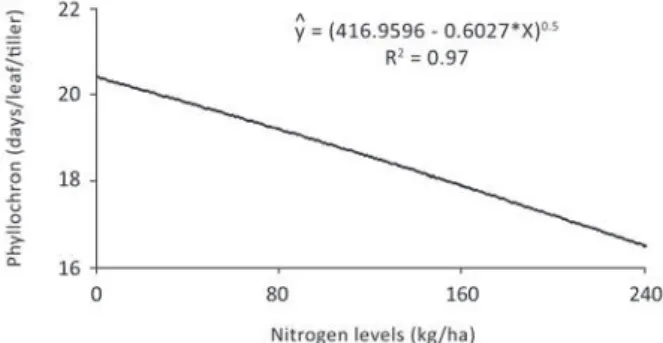
and increasing doses. According to Magalhães et
al. (2007) phylochron indicates the time (in days or
degree days) for the appearance of two consecutive
leaves. More practically, it can be said that it
indicates the time, in days, for the appearance of
successive leaves.
According to Silva et al. (2009), the results
of this study, as well as the reported in literature,
demons trate the importance of nitrogen in reducing
the time for the appearance of successive leaves,
considering that it increases production of new
cells, which have a positive impact on the number
of leaves per plant.
Difference was found between the cultivars
for variables leaf appearance rate and Phyllochron
(Table I). Leaf appearance rate was greater
for cv. Piatã when compared to cvs. Marandu
and Xaraés, which did not differ for the same
variables. This same trend was observed for the
interval of appearance of two consecutive leaves,
i.e., phyllochron.
When compared with the shortest time of
appearance for the cv. Piatã, it is observed an
average difference between five and six-day interval
for the appearance of two consecutive leaves for
cv. Marandu and cv. Xaraés due to this cultivar
presenting, in a given time, a greater generation
number of new leaves. In turn, it was reflected
in the forage canopy. This may show that even
among cultivars of the same species, there may be
difference in their morphological and physiological
characteristics and thus a particular cultivar can
demonstrate superiority over the other cultivars.
Gomide and Gomide (2000) evaluating
Panicum maximum
cultivars, observed differences
among cultivars and among tillers related to the
leaf appearance, which is also evidenced in this
work, in which the
B. brizantha
cultivars showed
differences between themselves, showing that this
variable may be influenced by genotype.
There was no effect of the interaction (P >
0.05) between N rates and cultivar on the variables
leaf elongation rate (LER) and pseudostem
elongation rate (PER), being the effect limited to
the cultivar factor for both variables (Table I). Leaf
elongation rate was not influenced by nitrogen
fertilization, being observed an average of 0.83
cm/tiller/day for the appearance of new leaves.
Figure 1 - Rate of the leaf appearance rate (LAR) of the B. brizantha cultivars in function of increasing nitrogen levels. (*P < 0.05).
Figure 2 - Phyllochron rate of the B. brizantha cultivars in function of increasing nitrogen rates. (*P < 0.05).
Rodrigues (unpublished data), studying
Panicum
maximum
cultivars under NPK fertilization, found
leaf elongation rate of 0.89 cm/tiller/day.
the N rates (200 and 600 kg/ha) did not affect the
rates of elongation, appearance, leaf expansion and
leaf area of guinea grass and setaria grass.
The results in literature about the relative
pseudostem elongation rate have been rather
contradictory (Braz et al. 2008, Patês et al. 2007).
Leaves elongation rate is a variable that
correlates with morphogenic dry mass of forage,
i.e., with the yield (Horst et al. 1978). But Nabinger
and Pontes (2001) state that the leaf elongation is
directly correlated with the leaf length, so when the
results of this study were analyzed, it was found
no difference in leaf blade final length (LBFL),
obtaining an average of 23.15 cm between the
evaluated rates for the variable leaf elongation rate,
and that it probably might represent the lack of
results obtained in the variable leaf elongation.
Leaf elongation and pseudostem elongation rates
values varied (P < 0.05) among cultivars. In Table I
it can be observed that the highest yield found for the
variables leaf elongation and pseudostem elongation
rates was observed for cv. Xaraés. This cultivar also
showed a higher value than the cv. Marandu, which
in turn was superior to cv. Piatã for the variable leaf
elongation rate, while for the variable pseudostem
elongation rate, cv. Xaraés was superior to cv.
Marandu, and cv. Piatã showed a value intermediate
to the two cultivars. This shows that, even within the
same species, it may occur the possibility of variation
in the cultivar behavior, as seen in this study for the
production of leaves and pseudostems.
The product of the ratio between leaf
elongation rate and pseudostem elongation rate for
the cultivars Marandu, Piatã and Xaraés indicates
that for every centimeter of pseudostem elongation
rate, there is an increase in leaf elongation rate of
6.42, 3.78 and 4.63 cm , respectively.
There was no effect of the interaction (P >
0.05) between factors N rates and cultivar on leaf
blade final length (LBFL). According to Duru and
Ducrocq (2000), the longer the stem, the greater the
leaf blade final length. However; this relationship
Variables Cultivars *CV (%)
Marandu Piatã Xaraés
LAR 0.05b 0.07a 0.05b 12.6
Phyllochron 19.93a 14.87b 20.71a 10.9
LER 0.77b 0.68c 1.02a 12.5
PER 0.12b 0.18ab 0.22a 46.9
TABLE I
Leaf appearance rate (LAR) in leaves/tiller/day, phyllochronin day/leaf/tiller of B. brizantha cultivars fertilized with increasing
nitrogen rates, leaf elongation rate (LER) in cm/tiller/day and pseudostem elongation rate (PER) in cm/tiller/day of B. brizantha
cultivars fertilized with increasing nitrogen rates.
Means followed by same letter in the line do not differ (P > 0.05) by
Tukey test. *CV: coefficient of variation.
Pseudostem elongation rate was not influenced
by nitrogen fertilization, averaging 0.17 cm/tiller/
day for the evaluated N rates, a result higher than
that found by Fagundes et al. (2005), who evaluated
Brachiaria decumbens
and found an average
pseudostem elongation rate of 0.14 cm/tiller/day.
These results observed for leaf elongation
and pseudostem elongation rates differ from
those found in several studies (Magalhães et al.
2007, Martuscello et al. 2005, Patês et al. 2007)
which found an increased response of leaves
and pseudostem growth rates with increasing N
rates. However, corroborating the data from this
experiment, Fagundes et al. (2006) evaluated signal
grass in pasture fertilized with N and found no
effect of it on pseudostem elongation rate.
Similar results for absence of N effect on
pseudostem elongation rate were also observed by
E.M.V. Porto (unpublished data) in evaluation of
buffel grass and by Braz et al. (2008) in evaluation
of tanzania grass.
According to Nabinger (1997), N does not exert
great influence on the number of leaves on a tiller or
did not occur, and can be observed in the average
value presented for each evaluated cultivar. It may
be noted that there was no effect of N on pseudostem
elongation rate and, therefore, it did not influence
the leaf blade final length.
Therefore, what could be observed in this
experiment was that there was no effect of N on
pseudostem elongation rate and, therefore, it did
not influence the leaf blade final length when the
average of each cultivar is considered.
The lack of N effect on leaf blade final length
differs from results found in several studies (Garcez
Neto et al. 2002, Alexandrino et al. 2004) who
found a positive linear effect of N on leaf blade final
length. However, corroborating the data from this
experiment, E.M.V. Porto (unpublished data) also
found no interaction between N rates and buffel
grass cultivars for the variable leaf blade final length.
For the
B. brizantha
cultivars, leaf blade final
length values did not differ (P > 0.05) among
themselves, with average values of 20.96, 21.55
and 26.92 cm/tiller for the cvs. Marandu, Piatã and
Xaraés, respectively. However, values were higher
than those found by Marcelino et al. (2006), who
found an average leaf blade final length of 19.22 cm
for Marandu grass under field conditions evaluation.
For Lemaire (1997) this variable is of
funda-mental importance for the efficiency of pasture
productivity, since the changes that occur in the
forage plant morphology, as well as in pasture
structure, due to the number of green leaves
per tiller and the leaf final length, expresses the
maximum number of green leaf tissue per tiller.
CONCLUSIONS
The morphogenetic characteristic leaf appearance
rate responds positively to nitrogen fertilization,
while phylochron responds negatively.
The rate equivalent to 240 kg/ha of N
corresponds to a higher leaf appearance rate for all
evaluated
B. brizantha
cultivars (cv. Marandu, cv.
Piatã and cv. Xaraés).
The cultivars are different considering the
variables leaf appearance rate, phylochron, leaf
elongation rate and pseudostem elongation rate.
The cultivar Marandu has a higher ratio
between leaf elongation rate and pseudostem
elongation rate, which favors higher quality forage.
The cultivar Piatã has higher leaf appearance
rate in a shorter period of time in relation to others.
ACKNOWLEDGMENTS
The Coordenação de Aperfeiçoamento de Pessoal
de Nível Superior (CAPES) and the Fundação de
Amparo à Pesquisa do Estado de Minas Gerais
(FAPEMIG) for financial support.
RESUMO
Este estudo teve como objetivo avaliar as características morfogênicas de três cultivares de Brachiaria brizantha
Palavras-chave: cv. Marandu, cv. Piatã, cv. Xaraés, morfogênese, capim-braquiária.
REFERENCES
ALEXANDRINO E, NASCIMENTO JÚNIOR D, MOSQUIM PR,
REGAZZI AJ AND ROCHA FC. 2004. Características morfogênicas e estruturais na rebrotação da Brachiaria brizantha cv. Marandu submetida a três doses de nitrogênio. R Bras Zootec 33: 1372-1379.
BRAZ TG DOS S, FREITAS FP, MARTUSCELLO JA, SANTOS
MER, PIMENTEL RM AND FONSECA DM. 2008.
Características morfogênicas e estruturais de capim-tanzânia submetido a doses de nitrogênio e densidades de plantas. In: Reunião da Sociedade Brasileira de Zootecnia, 45, Anais..., SBZ.1 CD-ROM.
CFSEMG - COMISSãO DE FERTILIDADE DO SOLO DO ESTADO DE MINAS GERAIS. 1999. Recomendações para o uso de
corretivos e fertilizantes em Minas Gerais: 5a aproximação. UFV, 359 p.
CHAPMAN DF AND LEMAIRE G. 1993. Morphogenetic and structural determinants of plant regrowth after defoliation. In: BAKER MJ (Ed), Grasslands for our world. SIR Publishing, p. 55-64.
DURU M AND DUCROCQ H. 2000. Growth and senescence of the sucessive leaves on tiller. Ontogenic development and effect of temperature. Ann Bot-London 85: 635-643. FAGUNDES JL, FONSECA DM, GOMIDE JA, NASCIMENTO JrD,
VITOR CMT, MORAES RV, MISTURA C, REIS GC AND
MARTUSCELLO JA. 2005. Acúmulo de forragem em pastos de Brachiaria decumbens adubados com nitrogênio. Pes Agropec Bras 40: 397-403.
FAGUNDES JL, FONSECA DM DA, MISTURA C, MORAIS RV DE,
VITOR CMT,GOMIDE JA, JUNIOR DN, CASAGRANDE DR
AND COSTA LT. 2006. Características morfogênicas e estruturais do capim-braquiária em pastagem adubada
com nitrogênio avaliadas nas quatro estações do ano. R
Bras Zootec 35: 21-29.
GARCEZ NETO AF, JÚNIOR DN, REGAZZI AJ, FONSECA DM,
MOSQUIM PR AND GOBBI KF. 2002. Respostas
Morfogênicas e Estruturais de Panicum maximum cv. Mombaça sob diferentes níveis de adubação nitrogenada e alturas de corte. R Bras Zootec 31: 1890-1900.
GOMIDE AM AND GOMIDE JA. 2000. Morfogênese de Cultivares de Panicum maximum Jacq. R Bras Zootec 29: 341-348.
HORST GL, NELSON CJ AND ASAY KH. 1978. Relationship of leaf elongation to forage yield of tall fescue genotypes. Crop Science 18: 715-719.
LEMAIRE G. 1997. The physiology of grass growth under grazing: tissue turnover. In: SIMPóSIO INTERNACIONAL SOBRE PRODUÇãO ANIMAL EM PASTEJO, 1997. Viçosa, MG. Anais... Viçosa, p. 115-144.
MAGALHãES AF, PIRES AJV, CARVALHO GGP, SILVA FF,
SOUSA RS AND VELOSO CM. 2007. Influência do nitrogênio
e do fósforo na produção do capim-braquiária. R Bras Zootec 36: 1240-1246.
MARCELINO KRA, NASCIMENTO JUNIOR D, SILVA SC,
EUCLIDES VPA AND FONSECA DM. 2006. Características morfogênicas e estruturais e produção de forragem do capim-marandu submetido a intensidades e freqüências de desfolhação. R Bras Zootec 35: 1590-1516.
MARTUSCELLO JA, FONSECA DM, NASCIMENTO JÚNIOR D,
SANTOS PM, RIBEIRO JUNIOR JI, CUNHA DNFV AND
MOREIRA LM 2005. Características morfogênicas e estruturais do capim-xaraés submetido à adubação nitrogenada e desfolhação. R Bras Zootec 34: 1475-1482. NABINGER C. 1997. Princípios da exploração intensiva de pastagens. In: SIMPóSIO SOBRE MANEJO DA PASTAGEM: PRODUÇãO DE BOVINOS A PASTO, 13, Anais... FEALQ, p. 15-96.
NABINGER C AND PONTES L DA S. 2001. Morfogênese de plantas forrageiras e estrutura do pasto. In: REUNIãO DA SOCIEDADE BRASILEIRA DE ZOOTECNIA, 38, Anais... SBZ, p. 755-771.
PATêS NMS, PIRES AJV, SILVA CCF, SANTOS LC, CARVALHO
GGP AND FREIRE MAL. 2007. Características morfogênicas e estruturais do capim-tanzânia submetido a doses de fósforo e nitrogênio. R Bras Zootec 36: 1736-1741.
PINTO JC, GOMIDE Já AND MAESTRI M. 1994. Produção de matéria seca e relação folha/caule de gramíneas forrageiras tropicais, cultivadas em vasos, com duas doses de nitrogênio. R Bras Zootec 23: 313-326.
SILVA CCF DA, BONOMO P, PIRES AJV, MARANHãO CMA,
PATêS NMS AND SANTOS, LC. 2009. Características morfogênicas e estruturais de duas espécies de braquiária adubadas com diferentes doses de nitrogênio. R Bras Zootec 38: 657-661.
VALLE CB, EUCLIDES VPB AND MACEDO MCM. 2001.