Cerne, Lavras, v. 18, n. 3, p. 387-395, jul./set. 2012 387 Changes in the structure due to strong winds ...CHANGES IN THE STRUCTURE DUE TO STRONG WINDS IN FOREST AREAS
IN THE PANTANAL, BRAZIL
Suzana Maria Salis 1, Carlos Rodrigo Lehn2, Daly Roxana Castro Padilha3, Patrícia Póvoa Mattos4
(received: September 23, 2010; accepted: February 28, 2012)
ABSTRACT: The Pantanal climate presents marked seasonality and eventually strong winds occur, especially in the beginning of the rainy season, which may last from September or October until April. A phytosociological study was conducted to evaluate the effects of a strong wind on the composition and structure of two forest formations in Pantanal wetland, a semideciduous forest (19º 15’ 32’’S and 55º 45’ 23.7’’W) and a forested savanna - “cerradão” (19° 17’ 21’’S and 55º 45’ 8.9’’W), with trees with diameter at breast height (DBH) ≥ 5 cm. After the strong wind, a reduction of 6% of the basal area and volume in the semideciduous forest was observed, mainly due to the uprooting of Xylopia aromatica trees. In the forested savanna, the basal area and volume reduction was even higher; an estimated 10%, representing 69 uprooted trees per hectare, mainly of Copaifera martii trees. In both areas it was observed that the uprooted trees presented an average height and diameter bigger than the trees that remained intact. Usually, the trees that were uprooted presented higher wood density and the species that had broken branches had a lower density.
Key words: Basal area, natural disturbance, savanna forest, semideciduous forest.
ALTERAÇÕES NA ESTRUTURA DE ÁREAS FLORESTADAS CAUSADAS POR VENTANIA FORTE NO PANTANAL, BRASIL
RESUMO:O clima do Pantanal é sazonal e eventualmente podem ocorrer ventanias fortes, especialmente no início do período
chuvoso, que começa em setembro ou outubro e se estende até abril. Um estudo fitossociológico, para avaliar o efeito de ventania forte na composição e estrutura em árvores com diâmetro a altura do peito (DAP) ≥ 5 cm, foi realizado em duas formações florestais no Pantanal, uma floresta semidecídua (19º 15’ 32’’S e 55º 45’ 23.7’’O) e um cerradão (19º 15’ 32’’S e 55º 45’ 23.7’’O). Depois da ventania forte, ocorreu a redução de 6% da área basal e do volume na floresta semidecídua, principalmente por queda de árvores da espécie Xylopia aromatica. No cerradão, a redução da área basal e do volume foi mais alta, estimada em 10%, com 69 árvores
caídas por hectare, principalmente da espécie Copaifera martii. Em ambas as áreas observou-se que as árvores caídas apresentaram altura e diâmetros maiores do que as árvores que permaneceram intactas. Geralmente, as espécies das árvores caídas apresentaram alta densidade de madeira, enquanto que as espécies que quebraram têm densidade de madeira menor.
Palavras-chave: Área basal, distúrbio natural, cerradão, floresta semidecídua.
1Biologist, Ph.D. in Plant Biology – Embrapa Pantanal – Cx. P. 109 – 79320-900 – Corumbá, MS, Brasil – [email protected]
2Biologist, M.Sc. in Plant Biology – Instituto Federal de Educação, Ciência e Tecnologia de Mato Grosso do Sul/IFMS – Campus Coxim – Rua Pereira Gomes, 355 – Novo Mato Grosso – 79400-970 – Coxim, MS, Brasil – [email protected]
3Biologist, M.Sc. in Plant Biology – Embrapa Pantanal – Cx. P. 109 – 79320-900 – Corumbá, MS, Brasil – [email protected]
4Agronomic Engineer, Ph.D. in Forest Engeneering – Embrapa Florestas – Cx. P. 319 – 83411-000 – Colombo, PR, Brasil – [email protected] 1 INTRODUCTION
The tropical forest is subject to different natural disturbances including strong winds, fire (SANFORD JUNIOR et al., 1985), and tree uprooting (BROKAW; GREAR, 1991) causing alterations in the forest structure (WALKER, 1991) and succession changes in species composition (DITTUS, 1985; WEAVER, 1989). The occurrence of these phenomena are of great importance to maintain species diversity in tropical forests (TERBORGH, 1992), many a time exerting direct influence over the mortality and recruitment process in these formations (WHITMORE, 1990). Adult trees may resist damages caused by strong winds, presenting high probability of surviving and re-establishment, however,
the probability may vary among species (WALKER, 1991).
388
Cerne, Lavras, v. 18, n. 3, p. 387-395, jul./set. 2012
Salis, S. M. et al.
The Pantanal region presents strong climate seasonality. There are strong winds, mainly during the beginning of the rainy season, which may last from October to April. Not much is known about the effects of this natural phenomenon over the structure and composition of the forest formation in the Pantanal area. The objective of this study is to evaluate the effect of a strong wind over a semideciduous forest and a savanna forest (cerradão) in the Pantanal of Nhecolandia, Mato Grosso do Sul State, Brazil.
2 MATERIAL AND METHODS
2.1 Study site
The studied areas are located in Baia das Pedras Farm, Pantanal of Nhecolandia, Aquidauana County, Mato Grosso do Sul State, and they are approximately 4 km apart. The semideciduous forest is located between the coordinates 19º 15’ 32’’S and 55º 45’ 23.7’’W and the savanna forest (cerradão), between 19º 17’ 21’’ S and 55º 45’ 8.9’’W.
According to the Köppen classification, the climate of the region is Awa, tropical, high altitude, mega-thermal, with average temperature during the coldest month above 18°C, dry winters and rainy summers (SORIANO, 2002). The measurements were carried out in November 2005, in Baia das Pedras Farm, approximately five days after a strong wind had damaged several trees, which were uprooted or broken. To estimate the wind velocity, the Beaufort scale was verified, according to Sonnemaker (2000).
2.2 Sampling and data analysis
The phytossociological study was carried out using the transect method (BROWER; ZAR, 1984). Four transects were used in the semideciduous forest (two of 150 m x 10 m and two of 200 m x 10 m) and one in the savanna forest (520 m x 10 m). All trees with diameter at breast height (DBH) ≥ 5 cm, including broken or uprooting trees, were sampled.
To avoid counting trees damaged before the wind effects, it was considered and sampled only trees with green leaves in the broken branches and trunks. To estimate the initial height of the trees (before the wind) it was measured for the broken trees, the length of fallen branches adding to the length of its remaining trunk, or the measure was taken from the fallen tree on the ground.
The trees were identified using specialized literature and by comparison with dried specimens from CPAP Herbarium of the Embrapa Pantanal.
The phytossociological parameters (absolute density, basal area, volume, and synthetic index of importance value), as discriminated by Martins (1991), were calculated using the Fitopac software (SHEPHERD, 1995). To each sampled physiognomy, two phytossociological analyses were carried out: in the first analysis all trees were included and in the second analysis, the uprooting trees were excluded, to evaluate the effect of the strong wind on the vegetation structure. The broken trees remained in the second analyses because they could sprout and still be part of the vegetation structure.
Statistical analyses were carried out (T test for two samples) by comparing the diameter and height of the uprooting or broken trees and the ones that remained intact.
3 RESULTS AND DISCUSSION
According to Beaufort scale, the wind speed was estimated between 67 and 90 km/h, characterized by the capacity to cause damage to the exposed parts or to uproot trees.
Cerne, Lavras, v. 18, n. 3, p. 387-395, jul./set. 2012 389 Changes in the structure due to strong winds ...
Table 1 – Structure of a semideciduous forest and a savanna forest, before and after (values in parenthesis) the strong wind in Pantanal of Nhecolandia, Mato Grosso do Sul State, Brazil.
Tabela 1 – Estrutura de uma floresta semidecídua e de um cerradão, antes e depois (valores entre parênteses) da passagem de uma ventania forte no Pantanal da Nhecolândia, Mato Grosso do Sul, Brasil.
Parameters Semideciduous Forest Savanna Forest
Average height (m) 7.3 ±4.0 (7.2±4.0) 6.1±2.7 (6.1±2.8)
Average diameter (cm) 18.8±14.4 (18.6±14.3) 13.4±8.4
Absolute density (trees.ha-1) 350 (339) 577 (517)
Basal area (m2.ha-1) 15.36 (14.49) 11.36 (10.18)
Total volume (m3.ha-1) 164 (154) 95 (85)
Number of trees of uprooted (tree.ha-1) and % 11 = 3% 69 = 10%
Number of trees of broken (tree.ha-1) and % 21 = 6% 121 = 21%
in the species absolute density were observed in I. laurina, Xylopia aromatic and H. stigonocarpa (Table 3), but the number of species remained the same.
Twenty-one broken trees were observed in one hectare of semideciduous forest, mostly Xylopia aromatica (10 trees), Licania octandra (4) and Inga laurina (3). It was observed in one hectare eleven uprooted trees of the following species: X. aromatica, I. laurina, Eugenia
egensis, and Hymenaea stigonocarpa. Hymenaea
stigonocarpa is among the tallest tree (with average height above 12 m) and with higher number of individuals (13) when compared to the others, so it would be expected to be more vulnerable to damages by strong wind. However, although there were 13 trees of this species in the area, only one was damaged, and it was uprooted. As this is a species with high density wood (0.78 g.cm-3) (VALE et al., 2002), considered a hard and resistant wood, that might have being the cause of the tree being uprooted, without breakage of the trunk.
Walker (1991) also observed the fall of Inga laurina after a strong storm in Porto Rico. According to this author, the difference in the falling down of trees between species is directly related to the diameter and height, as individuals of higher dimensions were uprooted in significantly larger numbers. In semideciduous forest trees of Inga laurina were uprooted and broken too, probably because this species presents a moderate dense wood (0.71 g.cm-3), which is not resistant (LORENZI, 1998). Xylopiaaromatica presents also a low density and coarse texture, according to Lorenzi (1992), which may be the reason why most of the trees of this species on the site were broken by the strong wind. Putz et al. (1983) observed higher occurrence of snapped trees with lighter wood in a semideciduous forest in Panama and Martini et al. (2008)
in a semideciduous forest in Brazil. These authors also observed that the trees with higher wood density were uprooted, as observed with Hymenaea stigonocarpa.
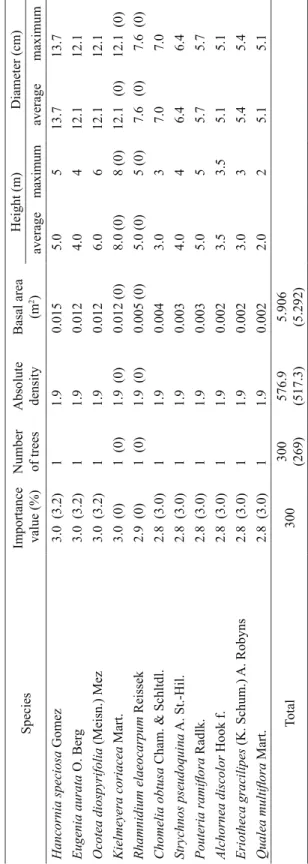
In the savanna forest, 300 trees from 42 species in 0.52 ha were observed, representing an estimated absolute density of 577 trees.ha-1 (Table 3). In the analyses, excluding the uprooted trees, a reduction to 517 trees/ha was observed (Table 1), due mainly to the uprooting of Copaifera martii (25 individuals in one hectare), Protium heptaphyllum, and Qualea grandiflora with two individuals each (Table 3). The wind occurrence through this savanna forest area resulted in 31% of the trees being damaged (three times higher than in semideciduous forest), with 10% (69) fallen trees, and 21% (121) broken ones (Table 1). The 69 fallen trees caused reduction of basal area and volume in the tree community, which was estimated at 10%, representing 10 m³.ha-¹ of wood. Dubs (1992) reported that for most of the species from the savanna forest, most of the lateral roots tend to grow very close to the soil surface, do not head very deep, which in a certain way provides a low mechanical resistance to these species.
390
Cerne, Lavras, v
. 18, n. 3, p. 387-395, jul./set. 2012
Salis, S. M. et al.
Table 2 – Structure of a semideciduous forest before and after (values in parentheses from analyses excluding uprooted trees) the strong wind in Pantanal of Nhecolandia, Mato Grosso do Sul State, Brazil.
Tabela 2 – Estrutura de uma floresta semidecídua antes e depois (valores entre parênteses obtidos com a exclusão das árvores caídas) da passagem de uma ventania forte no Pantanal da Nhecolândia, Mato Grosso do Sul, Brasil.
Species Importance
value (%) Numberof trees
Absolute density
Basal area (m2)
Height (m) Diameter (cm) average maximum average maximum Inga laurina (Sw.) Willd. 36.0 (33.5) 35 (33) 50.0 (47.1) 2.095 (1.759) 8.5 (8.2) 18.0 22.3 (20.9) 67.0
Xylopia aromatica Mart. 34.5 (33.5) 61 (57) 87.1 (81.4) 0.785 (0.732) 5.9 (5.8) 12.0 11.4 34.0
Attalea phalerata Mart. ex Spreng. 26.2 (27.5) 11 15.7 20.895 5.0 6.0 47.5 69.0
Licania octandra Kuntze 20.2 (21.1) 16 22.9 12.235 9.4 15.0 26.6 55.0
Hymenaea stigonocarpa Mart. ex Hayne 20.0 (18.5) 13 (12) 18.5 (17.1) 1.340 (1.127) 12.3 (12.7) 16.0 34.8 (33.3) 52.2 (43.9)
Alchornea discolor Hook f. 11.0 (11.4) 19 27.2 0.108 5.0 6.0 8.1 13.0
Handroanthus impetiginosus (Mart. ex DC.) Mattos 9.0 (9.4) 4 5.7 0.551 16.8 20.0 40.7 50.0
Astronium fraxinifolium Schott 7.5 (7.7) 6 8.6 0.296 12.8 18.0 23.7 39.0
Buchenavia tomentosa Eichler 6.0 (6.1) 4 5.7 0.220 9.0 10.0 26.1 32.0
Sterculia apetala (Jacq.) H. Karst 5.6 (5.8) 2 2.9 0.272 12.0 18.0 34.2 58.0
Protium heptaphyllum L. Marchand 5.5 (5.7) 6 8.6 0.087 6.8 10.0 12.6 20.0
Mouriri elliptica Mart. 5.5 (5.7) 5 7.1 0.131 3.9 5.0 16.9 29.0
Eugenia egensis DC. 5.0 (4.7) 5 (4) 7.1 (5.7) 0.078 (0.075) 4.4 (5.0) 6.0 12.3 (13.8) 25.0
Dipteryx alata Vogel 5.0 (5.1) 4 5.7 0.112 6.8 12.0 17.8 26.0
Cordia glabrata A. DC. 4.8 (5.0) 2 2.9 0.187 12.0 18.0 28.1 48.0
Luehea paniculata Mart. 4.8 (4.9) 3 4.3 0.136 9.5 12.0 21.4 30.0
Terminalia argentea Mart. 4.6 (4.7) 2 2.9 0.160 13.5 17.0 31.8 35.0
Gomidesia palustris (DC.) D. Legrand 4.4 (4.5) 4 5.7 0.050 5.0 6.0 11.6 18.0
Handroanthus ochraceus (Cham.) Mattos 4.2 (4.3) 2 2.9 0.122 9.5 12.0 26.1 36.0
Campomanesia sp. 4.1 4 5.7 0.018 3.1 3.5 7.0 12.0
Rhamnidium elaeocarpum Reissek 4.0 (4.1) 4 5.7 0.012 4.0 4.0 6.0 7.3
Anadenanthera colubrina (Vell.) Brenan 3.8 1 1.4 0.115 9.0 9.0 38.2 38.0
Pouteria ramiflora Radlk. 3.7 (3.8) 2 2.9 0.066 10.5 12.0 20.3 23.0
Miconia albicans (Sw.) Steud. 3.7 3 4.3 0.019 3.5 4.0 8.8 10.0
Qualea parviflora Mart. 3.6 2 2.9 0.051 12.0 12.0 18.0 19.0
Dilodendron bipinnatum Radlk. 3.5 (3.6) 1 1.4 0.093 12.0 12.0 34.4 34.0
Cerne, Lavras, v
. 18, n. 3, p. 387-395, jul./set. 2012
391
Changes in the structur
e due to str
ong winds ...
Table 3 – Structure of a savanna forest before and after (values in parenthesis from analyses excluding uprooted trees) strong winds in Pantanal of Nhecolandia, Mato Grosso do Sul State, Brazil.
Tabela 3 – Estrutura de um cerradão antes e depois (valores entre parênteses obtidos com a exclusão das árvores caídas) da passagem de uma ventania forte no Pantanal da Nhecolândia, Mato Grosso do Sul, Brasil.
Species Importance
value (%) Number of trees
Absolute density
Basal area (m2)
Height (m) Diameter (cm)
average maximum average maximum Qualea grandiflora Mart. 31.6 (31.5) 32 (30) 61.5 (57.7) 1.092 (0.941) 6.1 (5.9) 12 17.4 (16.6) 49.3 Hymenaea stigonocarpa Mart. ex Hayne 25.5 (27.9) 26 (25) 50.0 (48.1) 0.851 (0.847) 7.8 (7.9) 15 15.8 (16.1) 55.1 Table 2 – Continued...
Tabela 2 – Continuação...
Species Importance
value (%) Numberof trees
Absolute density
Basal area (m2)
Height (m) Diameter (cm) average maximum average maximum
Curatella americana L. 3.5 (3.6) 2 2.9 0.044 5.5 8.0 16.5 19.0
Acrocomia aculeata Lodd. ex Mart. 3.5 2 2.9 0.043 7.3 12.0 16.5 18.0
Cecropia pachystachya Trécul 3.4 (3.5) 2 2.9 0.033 6.5 7.0 14.5 16.0
Casearia sylvestris Sw. 3.3 (3.4) 2 2.9 0.024 4.5 6.0 12.3 12.0
Tabebuia aurea (Silva Manso) S. Moore 3.2 (3.3) 1 1.4 0.058 10.0 10.0 27.1 27.0
Erythroxylum suberosum A. St.-Hil. 3.2 2 2.9 0.010 3.0 3.0 8.1 8.6
Ocotea diospyrifolia (Meisn.) Mez 3.2 2 2.9 0.010 3.5 4.0 7.8 9.5
Eugenia aurata O. Berg 2.9 1 1.4 0.022 10.0 10.0 16.9 17.0
Lafoensia pacari A. St.-Hil. 2.9 1 1.4 0.021 5.5 5.5 16.5 17.0
Copaifera martii Hayne 2.9 1 1.4 0.022 5.5 5.5 16.6 17.0
Simarouba versicolor A. St.-Hil. 2.8 1 1.4 0.015 6.0 6.0 13.7 14.0
Byrsonima orbignyana A. Juss. 2.8 1 1.4 0.011 2.0 2.0 11.9 12.0
Qualea multiflora Mart. 2.7 1 1.4 0.005 5.0 5.0 8.0 8.0
Chrysobalanaceae 2.7 1 1.4 0.005 6.0 6.0 8.0 8.0
Zanthoxylum riedelianum Engl. 2.7 1 1.4 0.004 5.0 5.0 7.3 7.3
Vatairea macrocarpa Ducke 2.7 1 1.4 0.003 4.0 4.0 6.4 6.4
Alibertia edulis A. Rich. 2.7 1 1.4 0.003 2.0 2.0 5.7 5.7
Caryocar brasiliense Cambess. 2.7 1 1.4 0.002 2.0 2.0 4.8 4.8
Total 300 245
(237)
350.0
(338.6) (39.964)40.569
392
Cerne, Lavras, v
. 18, n. 3, p. 387-395, jul./set. 2012
Salis, S. M. et al.
Table 3 – Continued... Tabela 3 – Continuação...
Species Importance
value (%) Number of trees
Absolute density
Basal area (m2)
Height (m) Diameter (cm) average maximum average maximum
Copaifera martii Hayne 24.6 (18.6) 43 (30) 82.7 (57.7) 0.463 (0.257) 5.4 (5.0) 10 (8) 10.9 (9.7) 23.5
Protium heptaphyllum L. Marchand 23.2 (24.7) 37 (35) 71.1 (67.3) 0.499 (0.481) 6.0 12 11.8 23.6
Mouriri elliptica Mart. 17.0 (18.8) 23 44.2 0.406 4.7 8 13.0 29.5
Curatella Americana L. 13.3 (14.7) 10 19.2 0.446 8.0 12 22.3 39.5
Qualea parviflora Mart. 11.3 (9.9) 12 (11) 23.1 (21.1) 0.288 (0.173) 7.5 (7.1) 15 15.3 (13.3) 38.2 (21.0)
Alibertia edulis A. Rich. 9.2 (8.6) 15 (12) 28.8 (23.1) 0.103 (0.084) 4.3 (4.8) 6 9.0 14.9
Eugenia egensis DC. 8.3 (8.4) 8 (7) 15.4 (13.5) 0.191 (0.169) 5.6 8 16.6 26.0
Xylopia aromatica Mart. 7.7 (7.0) 10 (8) 19.2 (15.4) 0.113 (0.077) 7.1 (6.9) 10 11.3 (10.4) 17.8 (16.0)
Astronium fraxinifolium Schott 7.6 (7.9) 11 (10) 21.1 (19.2) 0.087 (0.085) 6.2 (6.4) 10 9.1 (9.5) 16.6
Lafoensia pacari A. St.-Hil. 7.4 (8.1) 8 15.4 0.135 4.3 7 13.6 24.2
Dipteryx alata Vogel 6.5 (7.0) 3 5.8 0.124 7.7 12 15.5 21.3
Terminalia argentea Mart. 6.5 (7.0) 6 11.4 11.7 15 26.7 33.1
Alibertia sessilis K. Schum. 5.9 (6.4) 8 15.4 0.047 4.4 7 8.3 11.9
Vatairea macrocarpa Ducke 5.7 (6.2) 3 5.8 0.136 7.0 10 22.6 29.6
Caryocar brasiliense Cambess 5.7 (6.2) 2 3.9 0.155 14.0 18 30.4 38.2
Bauhinia rufa Steud. 5.6 (5.0) 7 (5) 13.5 (9.6) 0.051 (0.033) 5.8 (5.3) 9 9.0 (8.7) 14.4
Campomanesia sp. 4.9 (5.3) 5 9.6 0.049 3.3 5 10.2 18.8
Zanthoxylum riedelianum Engl. 4.9 (5.3) 2 3.9 0.105 7.8 12 21.2 36.0
Agonandra brasiliensis Benth. & Hook. f. 4.1 (4.4) 1 1.9 0.079 12.0 12 31.8 31.8
Tabebuia aurea (Silva Manso) S. Moore 4.0 (3.8) 3 (2) 5.8 (3.9) 0.035 (0.028) 6.3 (6.5) 8 11.4 (12.1) 17.5
Luehea paniculata Mart. 3.9 (4.2) 2 3.9 0.047 10.0 12 16.9 20.7
Handroanthus serratifolius (Vahl) S. O. Grose 3.6 (3.9) 2 3.9 0.030 7.5 10 12.3 18.5
Handroanthus ochraceus (Cham.) Mattos 3.6 (3.8) 2 3.9 0.026 7.5 8 12.4 15.9
Pseudobombax longiflorum (Mart. & Zucc.) A. Robyns 3.5 (3.8) 2 3.9 0.025 5.5 6 12.6 14.0
Gomidesia palustris (DC.) D. Legrand 3.5 (3.7) 2 3.9 0.023 7.0 8 11.9 14.6
Myrtaceae 3.4 (3.6) 2 3.9 0.015 5.5 6 9.7 10.5
Simarouba versicolor A. St.-Hil. 3.2 (3.4) 1 1.9 0.022 7.0 7 16.9 16.9
Handroanthus heptaphyllus (Mart.) Mattos 3.1 (3.3) 1 1.9 0.020 12.0 12 15.9 15.9
Cerne, Lavras, v. 18, n. 3, p. 387-395, jul./set. 2012 393 Changes in the structure due to strong winds ...
T
able 3 –
Continued...
T
abela 3 –
Continuação...
Species
Importance value (%) Number of trees Absolute density
Basal area (m 2) Height (m) Diameter (cm) average maximum average maximum Hancornia speciosa Gomez
3.0 (3.2)
1 1.9 0.015 5.0 5 13.7 13.7 Eugenia aurata O. Ber g
3.0 (3.2)
1 1.9 0.012 4.0 4 12.1 12.1 Ocotea diospyrifolia (Meisn.) Mez
3.0 (3.2)
1 1.9 0.012 6.0 6 12.1 12.1 Kielmeyera coriacea Mart.
3.0 (0)
1 (0)
1.9 (0)
0.012 (0)
8.0 (0)
8 (0)
12.1 (0)
12.1 (0)
Rhamnidium elaeocarpum
Reissek
2.9 (0)
1 (0)
1.9 (0)
0.005 (0)
5.0 (0)
5 (0)
7.6 (0)
7.6 (0)
Chomelia obtusa
Cham. & Schltdl.
2.8 (3.0)
1 1.9 0.004 3.0 3 7.0 7.0 Strychnos pseudoquina A. St.-Hil.
2.8 (3.0)
1 1.9 0.003 4.0 4 6.4 6.4 Pouteria ramiflora Radlk.
2.8 (3.0)
1 1.9 0.003 5.0 5 5.7 5.7 Alchornea discolor Hook f.
2.8 (3.0)
1 1.9 0.002 3.5 3.5 5.1 5.1 Eriotheca gracilipes (K. Schum.) A. Robyns
2.8 (3.0)
1 1.9 0.002 3.0 3 5.4 5.4 Qualea multiflora Mart.
2.8 (3.0)
1 1.9 0.002 2.0 2 5.1 5.1 T otal 300
300 (269)
576.9 (517.3) 5.906 (5.292)
Copaifera martii, mainly species uprooting, presents hard wood, with 0.98 wood density (CORREA, 1931). Therefore, most of the trees did not break with the wind due to trunk resistance. However, the uprooted trees were mainly those above 6 m in height. The most affected species in this site were: Protiumheptaphyllum (21 trees), Qualeagrandiflora (19), Mouririelliptica (15), and Lafoensiapacari (8). These species present moderate wood density, varying between 0.77 and 0.80 (LORENZI, 1992), with medium texture, which might have been the reason they broke.
The diameters and height of fallen and intact trees presented statistically significant differences when comparing the damaged trees in the semideciduous (P < 0.001) and savanna forest (P = 0.014). In this case, all the trees were considered for both areas. Brokaw and Grear (1991) reported similar reduction of the average tree height in a tropical forest in Porto Rico after a storm, suggesting that higher trees were more susceptible to hurricanes and tropical storms. Another analysis for the two species, Copaifera martii and Xylopia aromatica, was carried out with the highest number of broken or uprooted trees. Copaifera martii presented the higher number of fallen trees in the savanna forest. The uprooted trees presented an average height and diameter at breast height bigger when compared to those that were not damaged by the wind (P = 0.014) (Figure 1). However, Xylopiaaromatica, did not present this pattern (Figure 2), probably because this species has a low density and a coarse wood texture (LORENZI, 1992), resulting in being vulnerable to strong winds, independent of their height and diameter.
394
Cerne, Lavras, v. 18, n. 3, p. 387-395, jul./set. 2012
Salis, S. M. et al.
4 ACkNOWLEDGEMENTS
The authors are indebted to Bahia das Pedras Farm owners and to our colleagues Oslain D. Branco, Admar Rodrigues and Ayrton de Araújo from Embrapa Pantanal for their invaluable and willing help in field data collection. The project was financed by the PRODETAB and Embrapa.
5 REFERENCES
BATISTA, W. B.; PLATT, W. J. Tree population responses to hurricane disturbance: syndromes in a south-eastern USA old-growth forest. Journal of Ecology, London, v. 91, p. 197-212, Apr. 2003.
BROKAW, N. V. L.; GREAR, J. S. Forest structure before and after hurricane Hugo at three elevations in the Luquillo Mountains, Puerto Rico. Biotropica, Washington, v. 24, n. 4, p. 386-392, Dec. 1991.
BROWER, J. E.; ZAR, J. H. Field & laboratory methods for general ecology. 2nd ed. Iowa: Wm. C., 1984. 226 p.
COOK, G. D.; GOYENS, C. M. A. C. The impacts of winds on trees in Australian tropical savannas: lessons from Cyclone Monica. Austral Ecology, Adelaide, v. 33, p. 462-470, June 2008.
CORREA, M. P. Dicionário de plantas úteis do Brasil e das exóticas cultivadas. Rio de Janeiro: Ministério da Agricultura, 1931. v. 2, 707 p.
DITTUS, W. P. J. The influence of cyclones on the dry evergreen forest of Sri Lanka. Biotropica, Washington, v. 17, p. 1-14, 1985.
DUBS, B. Observations on the differentiation of woodland and wet savanna habitats in the Pantanal of Mato Grosso, Brazil. In:FURLEY, P. A.; PROCTOR, J.; RATTER, J. A. (Ed.). Nature and dynamics of forest savanna boundaries. London: Chapman & Hall, 1992. p. 431-449.
FRANKLIN, J.; DRAKE, D. R.; MCCONKEY, K. R.; TONGA, F.; SMITH, L. B. The effects of cyclone Waka on the structure of lowland tropical rain forest in Vava´u, Tonga. Journal of Tropical Ecology, Cambridge, v. 20, p. 409-420, July 2004.
Figure 1 – Height of fallen (uprooted and broken) and intact trees of Copaifera martii (Fabaceae) that presented significant differences among the averages (P = 0.014; t = 2.552) in the savanna forest site, in Pantanal of Nhecolandia, Mato Grosso do Sul State, Brazil.
Figura 1 – Altura das árvores afetadas (caídas e quebradas) e intactas de Copaifera martii (Fabaceae), mostrando diferenças
significativas entre as médias (P = 0,014; t = 2,552) na área de cerradão, Pantanal da Nhecolândia, Mato Grosso do Sul, Brasil.
Figure 2 – Height of fallen (uprooted and broken) and intact trees of Xylopia aromatica (Anonnaceae) that did not present significant differences among the averages (P = 0.852; t = 1.596) in the semideciduous forest site, Pantanal of Nhecolandia, Mato Grosso do Sul State, Brazil.
Figura 2 – Altura das árvores afetadas (caídas e quebradas) e intactas de Xylopia aromatica (Anonnaceae), mostrando
diferenças significativas entre as médias (P = 0,852; t = 1,596) na área de floresta semidecídua, Pantanal da Nhecolândia, Mato Grosso do Sul, Brasil.
Height (m)
11
10
9
8
7
6
5
4
3
2
Uprooted/broken trees
Intact trees
Height (m)
15
10
5
0
Uprooted/broken trees
Cerne, Lavras, v. 18, n. 3, p. 387-395, jul./set. 2012 395 Changes in the structure due to strong winds ...
GRESHAM, C. A.; WILLIAMS, T. M.; LIPSCOMB, D. J. Hurricane Hugo wind damage to Southeastern U.S. Coastal tree species. Biotropica, Washington, v. 24, n. 4, p. 420-426, Dec. 1991.
LAURANCE, W. F.; CURRAN, T. J. Impacts of wind disturbance on fragmented tropical forests: a review and synthesis. Austral Ecology, Adelaide, v. 33, p. 399-408, June 2008.
LORENZI, H. Árvores brasileiras: manual de identificação e cultivo de plantas arbóreas nativas do Brasil. Nova Odessa: Plantarum, 1992. v. 1, 368 p.
LORENZI, H. Árvores brasileiras: manual de identificação e cultivo de plantas arbóreas nativas do Brasil. Nova Odessa: Plantarum, 1998. v. 2, 352 p.
MARTINI, A. M. Z.; LIMA, R. A. F.; FRANCO, G. A. D. C.; RODRIGUES, R. R. The need for full inventories of tree modes of disturbance to improve forest dynamics comprehension: an example from a semideciduous forest in Brazil. Forest Ecology and Management, Amsterdam, v. 255, p. 1479-1488, Apr. 2008.
MARTINS, F. R. Estrutura de uma floresta mesófila. Campinas: UNICAMP, 1991. 246 p.
NECHET, D. Ocorrência de tornados no Brasil. Boletim da Sociedade Brasileira de Meteorologia, Rio de Janeiro, v. 26, n. 2, p. 2-11, ago. 2002.
PUTZ, F. E.; COLEY, P. D.; LU, K.; MONTALVO, A.; AIELLO, A. Uprooting and snapping of trees: structural determinants and ecological consequences. Canadian Journal of Forest Research, Ottawa, v. 13, n. 5, p. 1011-1020, Oct. 1983.
SANFORD JUNIOR, R. L.; SALDARRIAGA, J.; CLARK, K. E.; UHL, C.; HERRERA, R. Amazon rain
forest fires. Science, Washington, v. 227, p. 53-55, Jan. 1985.
SHEPHERD, G. J. Fitopac 1: manual do usuário. Campinas: UNICAMP, 1995. Available at: <http://www.taxondata.org/ forum/attachments/Fitopac.pdf>. Access in: 10 mar. 2009.
SONNEMAKER, J. B. Meteorologia. 23. ed. São Paulo: Asa, 2000. 209 p.
SORIANO, B. M. A. Boletim agrometeorológico: 1999, fazenda Nhumirim. Corumbá: EMBRAPA, v. 26, p. 1-19, 2002. Available at: <http://www.cpap.embrapa.br/publicacoes/ online/DOC26.pdf>. Access in: 10 mar. 2010.
TERBORGH, J. Diversity and the tropical rain forests. New York: Scientific American Library, 1992. 235 p.
VALE, A. T.; BRASIL, M. A. M.; LEÃO, A. L. Quantificação e caracterização energética da madeira e casca de espécies do cerrado. Ciência Florestal, Santa Maria, v. 12, n. 1, p. 71-80, abr./jun. 2002.
WALKER, L. R. Tree damage and recovery from hurricane Hugo in Luquillo experimental forest, Puerto Rico. Biotropica, Washington, v. 24, n. 4, p. 379-385, Dec. 1991.
WEAVER, P. L. Forest changes after hurricanes in Puerto Rico’s Luquillo Mountains. Interciencia, Caracas, v. 14, p. 181-192, 1989.
WHITMORE, T. C. An introduction to tropical rain forests. London: Blackwell, 1990. 226 p.
396
Cerne, Lavras, v. 18, n. 3, p. 387-395, jul./set. 2012