189
Vol. 52, Special Number: pp. 189-194, November 2009
ISSN 1516-8913 Printed in Brazil BRAZILIAN ARCHIVES OF
BIOLOGY AND TECHNOLOGY
A N I N T E R N A T I O N A L J O U R N A L
Development of a Gas Chamber for Detecting Broiler
Chicken Halothane Sensitivity and PSE (Pale, Soft,
Exudative) Meat Formation
Denis Fabrício Marchi
1, Alexandre Oba
2, Iris Lamberti Ziober
1, Adriana Lourenço
Soares
1, Elza Iouko Ida
1and Massami Shimokomaki
1*1Departamento de Ciência e Tecnologia de Alimentos; Universidade Estadual de Londrina; Londrina - PR - Brasil. 2Departamento de Ciência Animal; Centro de Ciências Agrárias; Universidade Estadual de Londrina; C.P.: 6001;
86051-970; Londrina - PR - Brasil
ABSTRACT
The objective of this work was to investigate the use of a halothane to screen broiler chickens prone to develop PSE (Pale, Soft, Exudative) meat through a special gas chamber connected to a veterinarian anaesthetic apparatus developed in our laboratory. Anaesthesia was induced with approx. 3.0% halothane at a flow rate of 6.0 Lm-1 in pure oxygen for 5 min. Commercial male broilers (n=342) aged 46 days old were evaluated and classified as either halothane sensitive (HAL+) or insensitive (HAL-), depending on the leg rigidity response. Approximately 27.5% (n=94) of broilers were HAL+ and 72.5% (n=248) were HAL-. This is a simple and rapid technique to evaluate broiler sensitivity to halothane and identify broilers prone to develop PSE meat. The occurrence of PSE meat in HAL insensitive broiler chicken samples suggests that other factors are related to PSE occurrence.
Key words: Halothane test, colour, pH
*Author for correspondence: [email protected]
INTRODUCTION
Broiler breast meat colour abnormalities, such as PSE (Pale, Soft, Exudative) meat, have been subject of studies by our research group in an attempt to find their possible causes and thus develop methodologies to avoid, or at least reduce, the occurrence of PSE meat. Abnormal meat colour, from yellowish (PSE) to excessive red (DFD–like, dark, firm, and dry) may be unacceptable to consumers and inappropriate for meat processing. Our rough estimate is that, in
down, contributing to re-establish Ca2+ homeostasis (Guarnieri et al., 2004). Transportation conditions from the farm to the commercial abattoir can also influence the formation of PSE meat (Simões et al., 2009). An ultrastructural study revealed a shortage of robust sarcomeres within the muscle fibrils (Guarnieri et al., 2004). There is growing evidence that bird exposure to thermal stress conditions just before slaughter is another cause of PSE meat (Barbut, 1998, Shimokomaki and Olivo 2006, Simões et al., 2009). Obviously, PSE meat results from multifactorial agents and the main causes are yet to be elucidated. Intense genetic selection aiming at producing fast weight-gaining birds might result in abnormal muscle biochemical behaviour (Anthony, 1998). In swine, the main cause of PSE meat is already known (Fujii et al., 1991). It has been found to be associated to skeletal muscle disturbance, which may lead to death under animal exposure to stressful heat conditions or halothane anaesthesia (Malignant Hyperthermia), resulting in Pork Stress Syndrome – PSS. The biological linkage of this condition is the halothane gene (hal) or ryanodine receptor gene (ryr1). Ryanodine controls Ca2+ flow in muscle excitation-contraction coupling at the sarcoplasmic reticulum and is responsible for the acceleration of muscle metabolism when the DNA mutation occurs. This alteration causes pork PSE formation (Mickelson and Louis, 1996). The gene hal is then related to halothane sensitivity: normal pigs are dominant (NN), sensitive pigs are recessive (nn), and there are the hybrid ones (Nn). This discovery allowed establishing a genetic pig selection methodology, which is currently commercially available. Recently Oda et al. (2009) observed that the β-RYR genic expression that leads to broiler PSE meat is in relatively lower concentration than in normal birds, suggesting a broiler PSE genetic origin similar to that of pork PSE.
The present work describes the development of a gas chamber to detect broiler sensitivity under halothane anaesthesia for screening and identifying birds prone to develop PSE meat.
MATERIALS AND METHODS
Animals
Male commercial broilers (n=342) aged 46 days raised at the Londrina State University (UEL) farm were submitted to halothane testing using the developed experimental apparatus. Food and water were withdrawn 1.0 h and 10.0 h before sacrificing, respectively. The slaughtering of the commercial birds was carried out at UEL farm and consisted essentially of electrical stunning, bleeding, defeathering, evisceration, carcass water cooling, deboning, and chilling (Northcutt, 2001, Guarnieri et al., 2004). The carcasses were refrigerated at 4°C for 24 h.
Halothane testing
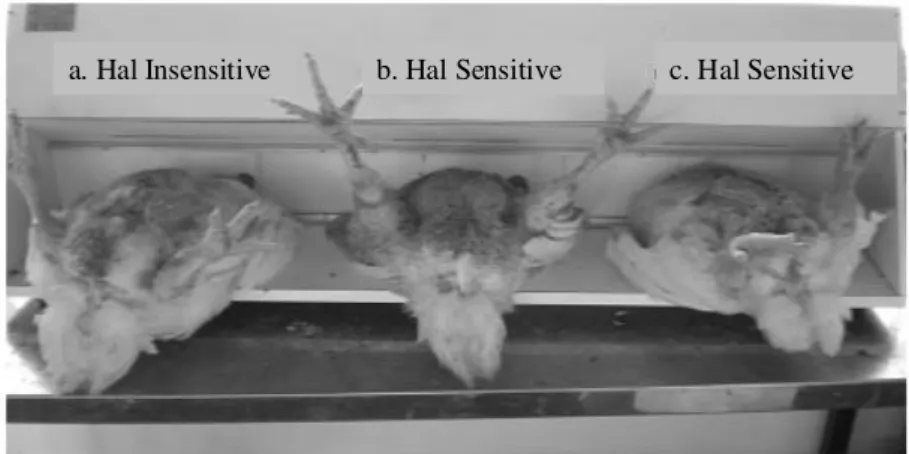
Our especially lab-made experimental anaesthetic chamber (12x12x100-cm) can test three birds at a time accommodated in the three chamber holes. An outside top exhaust is connected to a veterinarian anaesthetic apparatus. Anaesthesia was induced with approx. 3.0% halothane in pure oxygen at a flow rate of 6.0L.min-1. Figure 1 shows the apparatus. Anaesthesia was maintained for 5 min and the birds’ reactions were monitored throughout the experiment. Unconscious birds were examined for leg muscle rigidity. If one or both legs were completely extended and rigid, the birds were classified as halothane sensitive (HAL+) (Fig. 2 b and c), while irresponsive birds were classified as halothane insensitive (HAL-) (Fig. 2 a). Twenty-five HAL+, HAL- birds were sacrificed to determine PSE meat characteristics.
Development of a Gas Chamber for Detecting Broiler Chicken Halothane 191
Figure 1 - Broiler halothane test chamber with anaesthesia equipment. Halothane gas concentration was set at 3.0% in pure oxygen. Three birds can be placed in the halothane chamber per experiment run.
c. Hal Sensitive b. Hal Sensitive
a. Hal Insensitive b. Hal Sensitive c. Hal Sensitive a. Hal Insensitive
Figure 2 - Broiler leg rigidity sensitivity to 3.0% halothane gas: a) HAL- (Hal insensitive), b and c) HAL+ (Hal sensitive
).
RESULTS
Halothane tests
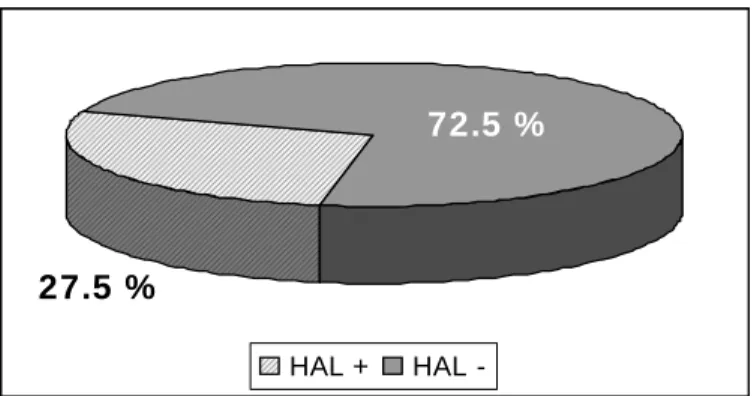
The occurrence of positive and negative halothane sensitivity in the commercial broiler lineage studied is illustrated in Figure 3. From the 342 birds tested, 27.5 % were sensitive to halothane and classified as HAL+, 72.5% were insensitive to halothane treatment and classified as HAL-.
PSE meat occurrence
HAL + HAL -27.5 %
72.5 %
HAL + HAL
-27.5 %
72.5 %
Figure 3 - Occurrence of broiler positive HAL+ and negative HAL – response to halothane test.
0 50 100
%
1 2
PSE meat Normal meat
HAL -HAL +
Figure 4 - Occurrence of PSE meat in halothane sensitive (HAL+) and insensitive birds (HAL-).
DISCUSSION
Other authors have reported results similar to those shown in Figure 3. Cavitt et al. (2004) found 13.2 to 22.9% halothane sensitivity in commercial broiler lineages and Owens et al. (2000) reported a halothane sensitivityvariation from 3.5% to 10.0% in turkey, while Wheeler et al. (1999) obtained 5.0% halothane sensitivity, 85.0% halothane insensitivity, and 10.0% halothane intermediate response in turkey. To prove that poultry hal gene truly plays a role in the manifestation of PSE meat, it is necessary to determine the presence of the ryanodine genotype as routinely carried out in pig PSS (Fujii et al, 1991), which we are currently investigating (Oda et al., 2009). The total PSE
Development of a Gas Chamber for Detecting Broiler Chicken Halothane 193
CONCLUSION
The anaesthetic halothane chamber screening developed at UEL is simple and rapid technique, which is an alternative for the identification of broiler chickens prone to the development of PSE meat. The occurrence of PSE meat in HAL insensitive broiler chicken samples suggests that other factors are related to PSE occurrence.
ACKNOWLEDGMENTS
This work was partially funded by Fundação Araucária/FINEP, Fundação Araucária/CNPq Pronex (Protocol # 09.277). Thanks also go to CAPES Foundation for graduate scholarships to DFM and ILZ. EII and MS are CNPq Research Fellows.
RESUMO
O objetivo deste trabalho foi investigar o uso do halotano para avaliar e identificar frangos propensos ao desenvolvimento de carnes PSE (Pálida, Flácida, Exsudativa) por meio de uma câmara desenvolvida em nossos laboratórios. Esta foi conectada a um equipamento de anestesia veterinária e a anestesia foi então induzida com aproximadamente 3,0% de halotano a um fluxo de 6,0 L/min em puro oxigênio. A sensibilidade de três frangos foi avaliada simultaneamente. Os frangos de linhagem comercial (n=352) com 46 dias de idade foram expostos à 3,0% de halotano por 5 min e classificados como halotano sensível (HAL +) e não-sensível (HAL -), baseado no enrijecimento dos seus membros inferiores. Aproximadamente 27,5% (n=94) frangos foram HAL+ e 72,5% (n=248) HAL-. Amostras do músculo Pectoralis major (n=75) foram coletadas após o abate dos animais para as medidas de pH e cor, determinadas nos filés mantidos a 4 C por 24 h postmortem. Frangos HAL+ apresentaram maior porcentagem de carnes PSE quando comparadas ao grupo HAL-. Este é um teste simples e rápido para a avaliação da sensibilidade das aves ao halotano e identificar frangos propensos ao desenvolvimento de carnes PSE embora amostras de HAL – também apresentaram carnes PSE sugerindo que outros fatores estão relacionados com a formação da anormalidade.
REFERENCES
Anthony, N. B. (1998), Journal of Muscle Foods, 9, 25-33.
Barbut, S. (1998), Estimating the magnitude of the PSE problem in poultry. Journal of Muscle Foods, 9, 35-49.
Cavitt, L. C., Hargis, B. M. and Owens, C. M. (2004), The use of halothane and succinylcoline to identify broilers prone to developing pale, soft, exudative meat. Poultry Science, 83, 1440-1444.
Fujii, J., Otsu, K., Zorzato, F., Leon, S., Khanna, V. K., Weiler, J. E., O´Brien, P. J. and Macleinnan, D. H. (1991), Identification of mutation in porcine ryanodine receptor associated with malignant hyperthermia. Science, 253, 448-451.
Guarnieri, P. D., Soares, A. L., Olivo, R. Schneider, J. P., Macedo, R. M., Ida, E. I. and Shimokomaki, M. (2004), Preslaughter handling with water shower spray inhibits PSE (Pale, Soft, Exudative) broiler breast meat in a commercial plant. Journal of Food Biochemistry, 24, 269-277.
Mickelson, J. R. and Louis, C. F. (1996), Malignant hyperthermia: excitation-contraction coupling, Ca2+ regulation defects. Physiology Review, 76, 537-592. Oda, S. H. I., Schneider, J., Soares, A. L., Barbosa, D.
M. L., Ida, E. I., Olivo, R. and Shimokomaki, M. (2003), Detecção de cor em filés de peito de frango.
Revista Nacional da Carne, 28, 30-34.
Northcutt, J. K. (2001), Preslaughter factors affecting poultry meat quality In Poultry Meat Processing (A. R. Sams, ed.) Boca Raton, pp 5-18.
Oda, S. H. I., Nepomuceno, A. L., Ledur, M. C., Oliveira, M. C. N., Marin, S. S. R., Ida. E. I. and Shimokomaki, M. (2009), Quantitative differential expression of alpha and beta ryanodine receptor genes in PSE (Pale, Soft, Exudative) meat from two chicken lines: broiler and layer. Brazilian Archives of Biology and Technology. In press
Olivo, R., Soares, A. L., Ida, E. I. and Shimokomaki, M. (2001), Dietary Vitamin E inhibits poultry PSE and improves meat function properties. Journal of Food Biochemistry, 25, 271-283.
Owens, C. M., Matthews, N. S. and Sams, A. R. (2000), The use of halothane gas to identify turkeys prone to developing pale, exudative meat when transported before slaughter. Poultry Science, 79, 789–795. Shimokomaki, M. and Olivo, R. (2006), Carnes PSE em
frangos. In Atualidades em Ciência e Tecnologia de Carnes, Shimokomaki et al., ed. Varela, São Paulo, p. 95-104.
Soares, A., L., Ida, E. I., Miyamoto, S., Blazquez, F. J. H., Olivo, R., Pinheiro, J.W. and Shimokomaki, M. (2003), Phospholipase A2 activity in poultry PSE, Pale, Soft, Exudative. Journal of Food Biochemistry, 27, 309-319.
Soares, A. L., Marchi, D. F., Matsushita, M., Guarnieri, P. D., Droval, A., Ida, E. I. and Shimokomaki, M. Lipid oxidation and changes in fatty acids profile related to broiler breast meat colour abnormalities.
Brazilian Archives of Biology and Technology In press.