Vol. 52, Special Number: pp. 195-204, November 2009
ISSN 1516-8913 Printed in Brazil BRAZILIAN ARCHIVES OF
BIOLOGY AND TECHNOLOGY
A N I N T E R N A T I O N A L J O U R N A L
Vehicle Thermal Microclimate Evaluation during Brazilian
Summer Broiler Transport and the Occurrence of PSE
(Pale, Soft, Exudative) Meat
Gislaine Silveira Simões
1, Alexandre Oba
2, Tiemi Matsuo
3,
Alessandro Rossa
4, Massami
Shimokomaki
1and Elza Iouko Ida
1*1Departamento de Ciência e Tecnologia de Alimentos; Universidade Estadual de Londrina; C. P.: 6001;
86051-970; Londrina - PR - Brasil. 2Departamento de Ciência Animal; Centro de Ciências Agrárias; Universidade Estadual de Londrina; C. P.: 6001; 86051-970; Londrina - PR - Brasil. 3Departamento de Estatística; Londrina - PR - Brasil. 4Rua Claudio Zatta, 35; Cafelândia - PR - Brasil
ABSTRACT
The formation of a thermal microclimate within the vehicle during the transport of broilers from farm to slaughterhouse affects the birds’ welfare and potentially promotes the development of PSE meat. Thus, the aim of this work was to evaluate the effects of routine commercial practices on the vehicle microclimate formed during transportation of broilers. Twenty-four hours postmortem Pectoralis major m. samples were classified as PSE meat by determining pH and color (L*, a* e b*). Results showed that broiler located at the rear of the truck and with longer journey presented higher amounts of PSE meat because birds were under harsh conditions of both temperature and relative humidity. The ventilation decreased gradually from the front to the rear of the truck, and the water bath at the farm was beneficial over a long distance by reducing the overall occurrence of PSE meat.
Key words: animal welfare, poultry meat quality, thermal stress, poultry breast meat, color abnormality
* Author for correspondence: [email protected]
INTRODUCTION
Previous work described for the first time the effect of broiler management practices at the farm and during transportation from the farm to the slaughterhouse on the occurrence of PSE in breast fillet meat in the Brazilian winter (Langer et al., submitted). The present work reports further results obtained in an experiment carried out in the summer to evaluate the effect of routine commercial practices on the vehicle microclimate formed in transit and its influence on the formation
considered. In order to maintain a refreshing climate for birds in transit, it is routine practice to submit them to a water bath for a few minutes just before beginning the journey. However, studies on the subject in Brazil have not related animal welfare and the subsequent meat quality. Finally, the holding period at the processing plant before slaughtering was also considered. Under Brazilian commercial practice, birds are normally kept in the shade upon arrival and submitted to water misting for up to 1 or 2 h in order to calm them down and thus help their bodies return to homeostasis (Guarnieri et al., 2004). Under these conditions of transport, broilers face thermal stress and therefore develop PSE meat (Olivo et al. 2001, Guarnieri et al., 2004, Soares et al., 2002). The objective of this work was to evaluate the influence of broiler transport conditions in the Brazilian summer season on the formation of PSE meat.
MATERIALS AND METHODS
Animals
The present experiment was carried out in southern Brazil in December 2008 in a commercial plant integrated with chicken broiler farms in a cooperative system. A number of 360 broilers from each of two farms located at 15 km and 55 km away from the processing plant, for a total of 720 birds. These birds were at 44 days of age, of mixed sex, and of commercial lineage.
Microclimate measurement
The measurement of temperature (T), relative humidity (RH), and ventilation (VT) within the transport containers was undertaken using an thermoanemometers (Kestrel 4000) installed to record at 5 min intervals throughout the journey. T, RH, and VT data were subsequently downloaded directly to a personal computer. The commercial broiler transport vehicle consisted of an open truck. Birds were loaded in crates containing 7 to 8 birds each and the capacity of each vehicle was approximately 3,000 birds. Two anemometers were installed in three locations at front, middle, and rear of the truck, and values of T, RH, and VT were thus representative of the heterogeneous distribution of the thermal microclimate within the loaded vehicle. Fig 1A shows the position of these anemometers at 1.5 m, 4.5 m, and 8.5 m from the front of the transport container, with one placed at a height of 0.84 m and the other at 2.25 m. All anemometers were placed in the middle of the truck, as shown in Fig 1B.
In order to evaluate the effect of administering a water bath just before the journey, trucks were divided into those with birds submitted to a bath (LwiB) (n=360) and those with birds without a bath (n=360) (LwoB) at the farm. Upon arrival at the processing plant, the trucks were driven to holding places where the birds were left at rest while they were submitted to a water mist and ventilation for 60 min before slaughtering.
A B
Figure 1 -A) Installation locations of six anemometers at the front, middle and rear of the truck. B)
Broiler slaughtering
All birds were sacrificed following the routine procedures of a commercial plant, which followed a sequence of electrical stunning, bleeding, defeathering, evisceration, carcass water-cooling, deboning, and refrigeration.
pH measurement
The pH was measured by inserting electrodes into the breast muscle using a pH meter system (Mettler, model Toledo 345). Analyses were performed in triplicate at 24 h postmortem, following Olivo et al. (2001).
Color measurement
A Minolta CR10 colorimeter was used to evaluate the color, and a CIELAB system was used to evaluate the lightness (L*) of the posterior surface of the intact skinless breast muscles at 24 h post-mortem. The L* values were measured at three different sites on the same sample. These sites were the proximal extremity of the muscle and the distal, and the medial side halfway between the proximal and distal extremities (Soares et al., 2002).
Sample classification
Meat samples were classified as PSE or normal based on previously established parameters associated with pH and L*. Values of L*≥ 53.0
were classified as PSE and 44.0< L*<53.0 as normal (Soares et al., 2002).
Broiler thermal comfort enthalpy index determination
Microclimate thermal welfare was evaluated by an enthalpy calculation (H) through the Comfort Enthalpy Index (CEI). The H-value was measured for the three vehicle regions as follows:
H= Enthalpy (kJ/kg dried air) Tdb = temperature of dried bulb (ºC) RH = Relative humidity (%)
The obtained results were analyzed using an enthalpy table according to Barbosa Filho et al. (2008).
Statistical analysis
The program Statistica 7.0 for Windows was used to apply the Tukey test (5%) to detect differences for pH and color values determined for breast meat pH24 and the differences for T, RH, VT and H
values for the three vehicle regions. The Pearson coefficient test with 1.0% probability was applied to measure the correlations between pH and L*, pH and a*, and pH and b*. Logistic regression analysis (Hosmer and Lemerhow, 1989; Terzin et al., 1997) was applied to verify the effect of transportation distance/time, location of the crate, and the application of the water bath at the farm on the occurrence of PSE meat.
RESULTS AND DISCUSSION
Thermal truck microclimate characterization Table 1 presents the road types, times of transport, ventilation speeds, and holding times at the slaughterhouse for both lots of LwoB and LwiB transported distances, 15 and 55 km. The transport times were 30 and 90 min for the two distances, respectively, the average speeds were 30 and 38 km/h, respectively, and the holding times were 60 and 50 min, respectively. The use of a water bath before the journey is an important technique for aiding the birds in reaching body homoeostasis, as previously observed (Guarnieri et al., 2002).
Table 1 – Characteristics of broiler transportation from the farm to slaughterhouses at distances of 15 and 55 km
and length of the holding period before slaughtering.
Transportation time (min) Truck velocity (km/h) Holding period (min)
Distance (km)
LwoB LwiB LwoB LwiB LwoB LwiB
15 30 30 30 30 60 60
55 90 90 38 38 50 50
LwoB = Broiler lot without bath. LwiB = Broiler lot with bath.
H = 6.7 + 0.243 x Tdb + RH x 10
100
7.5 x Tdb
237.3 + Tdb
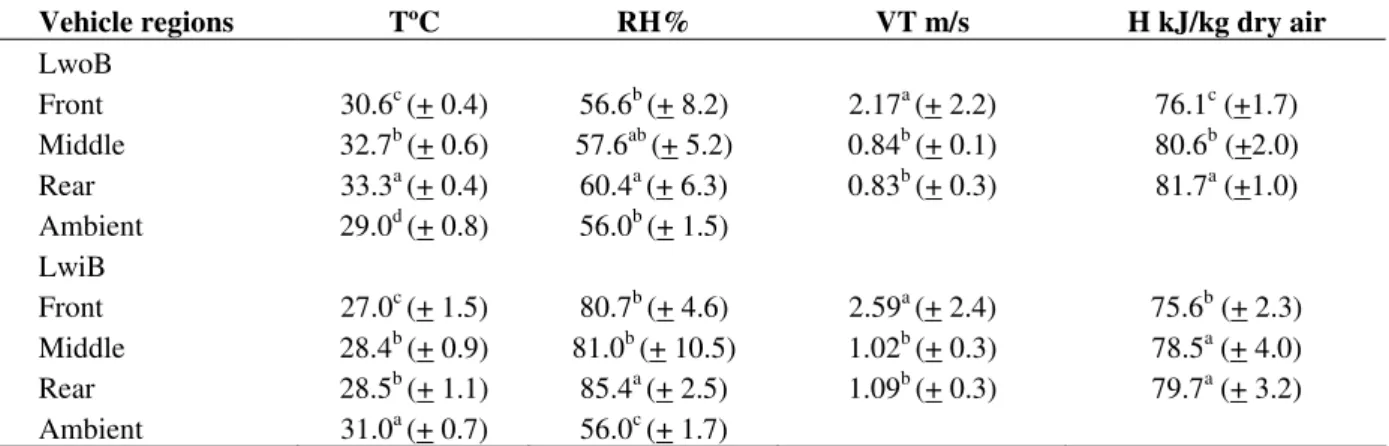
Table 2 shows the ambient and microclimate temperatures and relative humidity values from three truck regions and also the ventilation air speed and enthalpy of LwoB and LwiB transported 15 km. The monitored ambient temperatures were 29 and 31ºC throughout the experiment for LwoB and LwiB, respectively, on the same day but at
different loading times. The microclimate for LwoB presented temperatures that were higher than the ambient temperature by 1.6, 3.7, and 4.3ºC in the front, middle, and rear regions, respectively (Table 2). These results illustrated a better distribution of truck ventilation from the vehicle front to rear.
Table 2 – Average values of temperature (ºC) and relative humidity (%) of ambient and at vehicle microclimate at
the front, middle, and rear regions, Ventilation (VT) (m/s), and Enthalpy (H) (kJ/kg dry air) of the broiler lot without bath (LwoB)and with bath at the farm (LwiB)for the15 km/30 minslaughter processing plant.
Vehicle regions TºC RH% VT m/s H kJ/kg dry air
LwoB
Front 30.6c (+ 0.4) 56.6b (+ 8.2) 2.17a (+ 2.2) 76.1c (+1.7) Middle 32.7b (+ 0.6) 57.6ab (+ 5.2) 0.84b (+ 0.1) 80.6b (+2.0) Rear 33.3a (+ 0.4) 60.4a (+ 6.3) 0.83b (+ 0.3) 81.7a (+1.0) Ambient 29.0d (+ 0.8) 56.0b (+ 1.5)
LwiB
Front 27.0c (+ 1.5) 80.7b (+ 4.6) 2.59a (+ 2.4) 75.6b (+ 2.3) Middle 28.4b (+ 0.9) 81.0b (+ 10.5) 1.02b (+ 0.3) 78.5a (+ 4.0) Rear 28.5b (+ 1.1) 85.4a (+ 2.5) 1.09b (+ 0.3) 79.7a (+ 3.2) Ambient 31.0a (+ 0.7) 56.0c (+ 1.7)
a,b,c,dDifferent letters on the same column indicate statistical differences mensured by the Tukey test (p<0.05).
LwoB = Broiler lot without bath. LwiB = Broiler lot with bath.
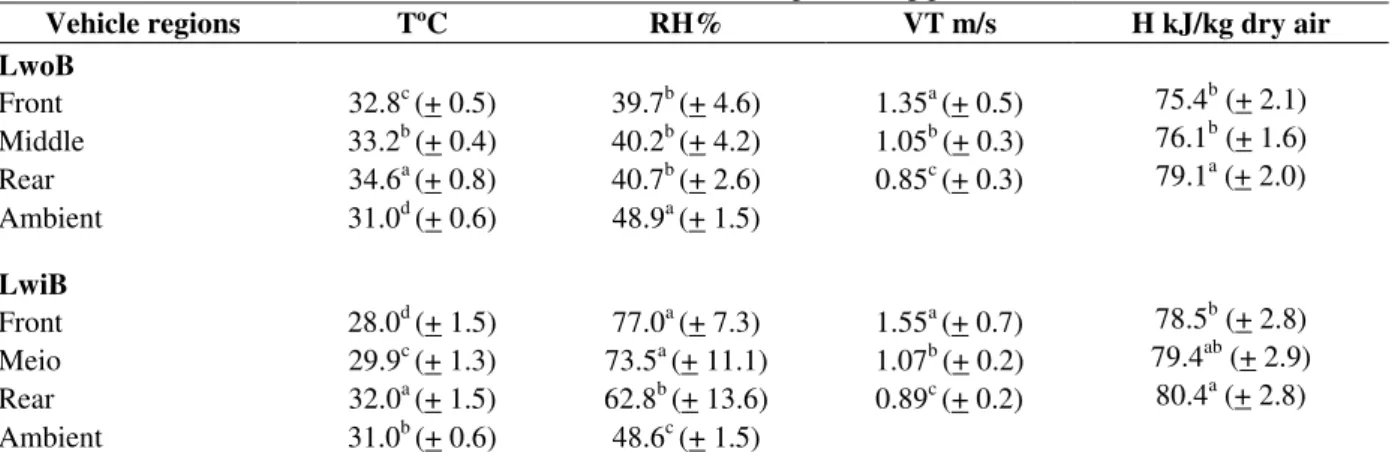
The microclimate for LwiB presented temperature that was lower in relation to the ambient temperature by 4.0, 2.6, and 2.5ºC in the front, middle, and rear regions, respectively (Table 2), indicating that the water bath decreased the truck’s thermal charge, as can be seen in the Figure 2. Table 3 presents the average values for the ambient and truck microclimate temperatures and RHs as well as the transit ventilation air speed and H of the microclimate for the LwoB and LwiB lots for the 55 km/90 min journey conditions. The average ambient temperature was 31.0ºC. The LwoB chicken lot had a truck microclimate temperature that was higher than the ambient temperature by 1.8, 2.2, and 3.6ºC in the front, middle, and rear of the truck, respectively (Table 3). Table 3 shows the microclimate temperature inside the vehicle with LwiB chickens, and the temperatures in the front and middle were lower compared to the ambient temperature, while the temperature in the rear region was the highest of all (p<0.05). The highest temperature observed in the rear region for both LwoB and LwiB (Table 3) occurred because of lower ventilation in this region and thus lower bird body heat dissipation as
the consequence of lower ventilation observed at the rear and middle of the truck.
microclimate regions were lower than the ambient RH (Table 4), while for LwiB, the RH for all microclimate regions was higher than the ambient
RH. However, the rear region presented an RH lower than the front and middle regions (p<0.05).
Figure 2 - Time versus temperature in the front, middle and rear regions of the vehicle for birds
without bath (LwoB) (A) and with bath (LwiB) (B) on the 15 km/30 min journey, while at the farm, and for a holding time of 60 min at the slaughterhouse.
Table 3 - Average values of the ambient temperature (T, ºC) and relative humidity (RH, %) and in the vehicle front,
middle, and rear regions, ventilation (VT, m/s), and enthalpy (H, kJ/kg dry air) of the broiler lot without bath (LwoB)and with bath (LwiB)for the farm55 km/90 min from the processing plant.
Vehicle regions TºC RH% VT m/s H kJ/kg dry air
LwoB
Front 32.8c (+ 0.5) 39.7b (+ 4.6) 1.35a (+ 0.5) 75.4b (+ 2.1) Middle 33.2b (+ 0.4) 40.2b (+ 4.2) 1.05b (+ 0.3) 76.1b (+ 1.6) Rear 34.6a (+ 0.8) 40.7b (+ 2.6) 0.85c (+ 0.3) 79.1a (+ 2.0) Ambient 31.0d (+ 0.6) 48.9a (+ 1.5)
LwiB
Front 28.0d (+ 1.5) 77.0a (+ 7.3) 1.55a (+ 0.7) 78.5b (+ 2.8) Meio 29.9c (+ 1.3) 73.5a (+ 11.1) 1.07b (+ 0.2) 79.4ab (+ 2.9) Rear 32.0a (+ 1.5) 62.8b (+ 13.6) 0.89c (+ 0.2) 80.4a (+ 2.8) Ambient 31.0b (+ 0.6) 48.6c (+ 1.5)
Ventilation
The results shown in Tables 2 and 3 demonstrate the importance of ventilation in order to decrease the thermal stress faced by the birds while in transit, irrespective of journey time or holding period. However, the ventilation values are not homogenous and depend on the location inside the vehicle. Ventilation decreases gradually from the front to rear as illustrated in Fig 4 and Fig. 5. Our results indicate that the water bath is an important treatment for keeping the temperature lower than the ambient temperature (Fig. 2 and 3). Similar results were obtained for both the 30 min and 90 min journeys in relation to the air movement. In the front vehicle region, the average air movement
was 4.6 m/s and reached a maximum value of 7.0 m/s in the first 15 min of the 30 min journey (Fig. 4). For the 55 km/90 min journey, the pattern was different: the ventilation reached a maximum of approximately 3 m/s after 35 min of transit (Fig 5). On this particular day of the experiment, the natural ventilation measured while the birds were at holding was 0.9 m/s on average. Obviously, this ventilation is not uniform and depends on several factors, including the vehicle velocity and the natural ventilation; however, it can be established from the results of this experiment that the lowest air movement within the vehicle is in its rear region.
Figure 3 - Time versus temperature in the front, middle, and rear regions of the vehicle for birds
without bath (LwoB) (A) and with bath (LwiB) (B) on the 55 km/90 min journey, while at the farm, and after the holding time of 50 min at the slaughterhouse.
Enthalpy
In relation to the CEI for both distances of 15 km and 55 km, Tables 2 and 3, respectively, show that
explained by the higher temperatures for both LwoB and LwiB (Tables 2 and 3), demonstrating a direct relationship between temperature and H. Enthalpy is defined as the energy from humid air per unit of dry mass; thus, the higher the enthalpy index is, the higher the energy within the environment (Barbosa Filho, 2008). By analyzing the microclimates of LwoB and LwiB transported both 15 km/30 min and 55 km/90 min, we found
that RH values above 80% are indicative of discomfort in the environment that would lead to a critical zone. Thus, the rear zone of the vehicle, during summer in Brazil, irrespective of the transit conditions for this experiment (Tables 2 and 3) should be characterized as a dangerous region and most likely is similar to the thermal core, as described previously by Mitchell and Kettlewell (1998).
Figure 4 - Time versus ventilation air speed in the front, middle, and rear vehicle regions
throughout the 15 km/30 min journey and 60 min holding time at the commercial slaughterhouse.
Figure 5 - Time versus ventilation air speed in the front, middle, and rear vehicle regions
Effects of transport conditions on the occurrence of broiler breast PSE meat
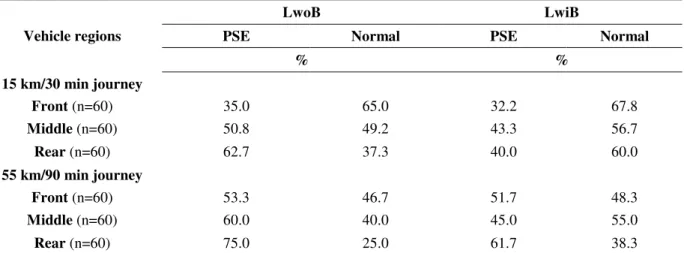
As can be observed in Table 4, the highest occurrence of PSE meat for the LwoB lot on the 15 km/30 min journey was from birds located in the rear of the vehicle, while for LwiB, the highest occurrences were observed in the middle and rear of the vehicle. These results are in accordance with the formation of the thermal core, which is located at the rear of the vehicle. For LwoB, the highest T value was in the rear, and the higher T value and lower VT resulted in a CEI value above 80.0 kJ/kg dry air (Table 2). For LwiB, the middle and rear zones of the vehicle were the locations where the highest T values were found. The RH was also high, but the VT values were lower, and CEI values were near 80.0 kJ/kg of dry air. Similar results were obtained for the 55 km/90 min journey for both LwoB and LwiB (Table 5). The
greatest occurrence of PSE meat was obtained from samples located at the rear of the vehicle. These results are the consequence of the location of birds within the vehicle, and those cages located in the rear were in the discomfort danger zones. Moreover, the ventilation in the front has been determined to influence the formation of PSE abnormalities. In each case, birds located in the front produced similar amounts of PSE and normal meat, whereas those located in the middle and rear regions produced higher quantities of PSE meat. These results can be explained by the value of T and RH per si or both associated. Higher T and RH values lead directly to a higher formation of PSE meat. Higher ventilation may decrease the temperature. Thus, ventilation was an important factor for controlling the temperature during transit.
Table 4 – Occurrence of PSE and normal meat after the 15 km/30 min and55 km/90 min journeys for birds located
in cages in the front, middle, and rear regions of the trucks both without (LwoB) and with (LwiB) a water bath at the farm.
LwoB LwiB
PSE Normal PSE Normal
Vehicle regions
% %
15 km/30 min journey
Front (n=60) 35.0 65.0 32.2 67.8
Middle (n=60) 50.8 49.2 43.3 56.7
Rear (n=60) 62.7 37.3 40.0 60.0
55 km/90 min journey
Front (n=60) 53.3 46.7 51.7 48.3
Middle (n=60) 60.0 40.0 45.0 55.0
Rear (n=60) 75.0 25.0 61.7 38.3
LwoB = Broiler lot without bath. LwiB = Broiler lot with bath.
Logistic regression analysis
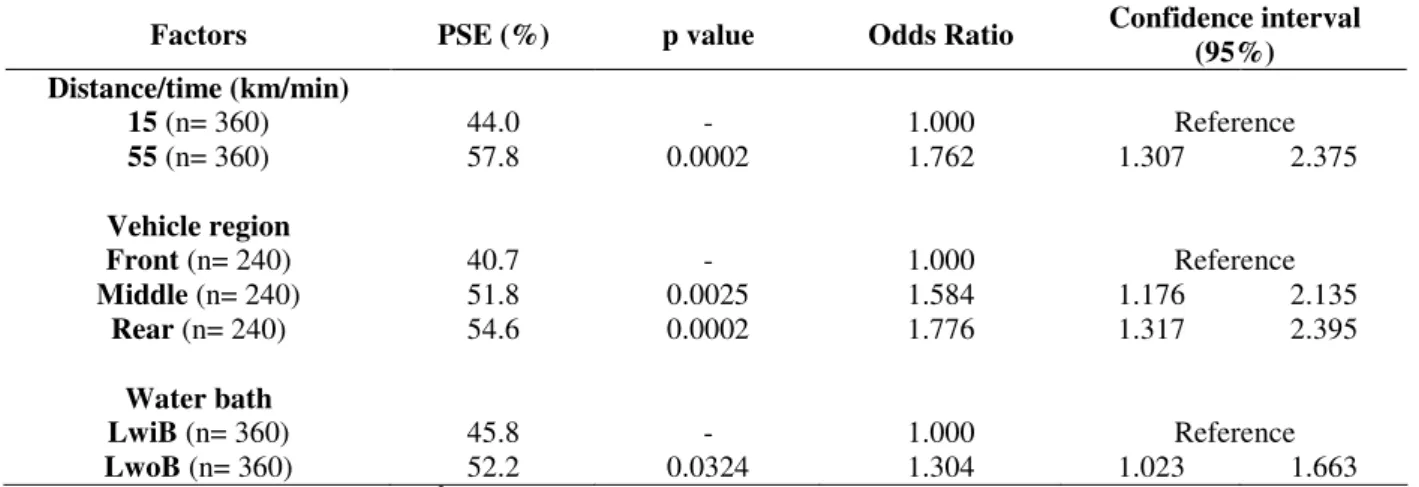
Logistic regression analysis was used in order to verify the occurrence of PSE meat in relation to the transport, application of the water bath while at the farm after broiler loading, and finally the location of the birds within the vehicle. Table 5 shows the logistic regression analysis and the odds ratio estimates for the occurrence of PSE meat during the summer season. It was verified that the distance/time of 55 km/90 min had a significant effect (p=0.0002) on the occurrence of PSE meat, with 57.8% (n=360) frequency of PSE meat and an odds ratio estimate of 1.762 [95% CI: 1.307 –
water bath, a significant effect on the occurrence of PSE meat was observed for the lot of birds that were not submitted to a water bath, with a 52.2% (n= 360) possibility and an odds ratio estimate of
1.304 [95% CI: 1.023 – 1.663], meaning that birds without the water bath had a 30.4% greater possibility of developing PSE meat.
Table 5 – Logistic regression analysis and hazard estimates for the occurrence of PSE meat, in the summer season
and for the distances of 15 km/30 min and 55 km/90 min.
Factors PSE (%) p value Odds Ratio Confidence interval
(95%) Distance/time (km/min)
15 (n= 360) 44.0 - 1.000 Reference
55 (n= 360) 57.8 0.0002 1.762 1.307 2.375
Vehicle region
Front (n= 240) 40.7 - 1.000 Reference
Middle (n= 240) 51.8 0.0025 1.584 1.176 2.135
Rear (n= 240) 54.6 0.0002 1.776 1.317 2.395
Water bath
LwiB (n= 360) 45.8 - 1.000 Reference
LwoB (n= 360) 52.2 0.0324 1.304 1.023 1.663
Hosmer-Lemerhow test for lack of fit: x2 = 6.0407.
CONCLUSIONS
For broiler chicken transportation during the summer season in Brazil, several factors influence the development of PSE meat. A water bath while at the farm reduced the occurrence of PSE meat, and long distances/higher transit times were deleterious to the birds’ welfare, producing more PSE meat. The thermal core is formed mainly at the rear of the vehicle, and birds located at this vehicle region produced higher amounts of PSE meat. Ventilation plays a significant role in the formation of PSE meat because birds located at the front of vehicle presented less meat color abnormalities. Thus, a better design is necessary in order to obtain adequate ventilation throughout the vehicle.
ACKNOWLEDGEMENTS
The financial resources for the conduction of this study were supported by the project BioAgroPar financed by FINEP, SETI/PR, and Fundação Araucária/PR; and by CNPq/Brazil. This work was
partially funded by CNPq, Fundação
Araucária/CNPq Pronex (Protocol 09.277). Thanks also go to CAPES Foundation for a
graduate scholarship to GSS. EII and MS are CNPq Research Fellows.
RESUMO
O microambiente térmico formado no caminhão de transporte de frangos da granja ao abatedouro pode ser a causa primária que compromete o bem estar das aves e a qualidade final da carne com o desenvolvimento de PSE (Pale, Soft, Exudative) em filés de peito de frango. O objetivo deste trabalho foi avaliar o efeito do microambiente formado durante o transporte por caminhão em uma linha comercial. Para classificação de filés de peito em PSE, o pH e a cor (L*, a* e b*) foram medidos nos filés de peito de frango 24 h
postmortem. Os resultados mostraram que em
jornadas longas, as aves transportadas nas regiões do meio e fundo do veículo apresentaram maior ocorrência de PSE devido às drámaticas condições
de temperatura e umidade relativa no
REFERENCES
Barbosa Filho, J. A. D. (2008), Quantiqualitative characterization of bioclimatic and productive conditions on poultry preslaughter operations. 2008. 174 p. Thesis (PhD in Phisics of Agricultural Environment) - Escola Superior de Agricultura “Luiz de Queiroz”, Universidade de São Paulo, Piracicaba. Barbosa Filho, J. A. D., Vieira, F. M. C., Fonseca, B. H.
F., Silva, I. J. O., Garcia, D. B., Hildebrand A. (2008), Poultry Transport Microclimate Analysis through Enthalpy Comfort Index (ECI): A Seasonal Assessment. Núcleo de Pesquisa em Ambiência, Escola Superior de Agricultura “Luiz de Queiroz, Universidade de São Paulo, Piracicaba. Disponível em:
http://www.nupea.esalq.usp.br/noticias/producao/101 3b_20080917.pdf
Belay, T.; Teeter, R. G. (1993), Broiler water balance and thermobalance during thermoneutral and high ambient temperature exposure. Poultry Science,
Ithaca, 72, 116-124.
Guarnieri, P. D.; Olivo, R.; Soares, A.; Ida, E. I.; Lara, J. A. F.; Shimokomaki, M. (2004), Bem estar animal e qualidade da carne das aves: uma exigência dos consumidores. São Paulo. Revista Nacional da Carne, 301, 36-44.
Hosmer, D. W.; Lemerhow, S. (1989), Applied logistic regression. New York: John Wiley and Sons.
Langer, R. O. S., Simões, G. S., Soares, A. L., Oba, A., Rossa, A., Shimokomaki, M., Ida, E. I. (2009),
Broiler Transportation Conditions in a Brazilian Commercial Line and the Occurrence of Breast PSE (Pale, Soft, Exudative) Meat and DFD-like (Dark, Firm, Dry) Meat. Brazilian Archives Biology and Technology (Submitted).
Mitchell, M.A. Kettlewell, P. J. (1998), Physiological stress and welfare of broiler chickens in transit: solutions not problems! Poultry Science, Ithaca, 77,
1803-1814.
Nicol, C. J.; Scott, G. B. (1990), Pre-slaughter handling and transport of broiler-chickens. Applied Animal Behaviour Science, 28, 1-2, 57-73.
Oliveira, R.; Donzele, J.; Abreu, M.; Ferreira, R.; Vaz, R.; Cellas. (2006), P. Efeitos da temperatura e da umidade relativa sobre o desempenho e o rendimento de cortes nobres de frangos de corte de 1 a 49 dias de idade. Viçosa, Revista Brasileira de Zootecnia, , 35
(3), 797-803,
Olivo, R.; Soares, A. L.; Ida, E. I.; Shimokomaki, M. (2001), Dietary Vitamin E inhibits poultry PSE and improves meat function properties. Journal of Food Biochemistry, Trumbull, 25 (4), 271-283.
Soares, A. L.; Lara, J. A. F.; Ida, E. I.; Guarnieri, P. D.; Olivo, R.; Shimokomaki, M. (2002), Variation in the colour of brazilian broiler breast fillet. Proceedings, Roma.. In: International Congress of Meat Science and Technology, 48 540-541,