The efficiency of electrocoagulation using aluminum electrodes
in treating wastewater from a dairy industry
Eficiência da eletrocoagulação no tratamento de efluente de uma indústria de laticínios usando eletrodos de alumínio
Gerson de Freitas Silva ValenteI Regina Célia Santos MendonçaII José Antônio Marques PereiraII
ISSN 0103-8478
ABSTRACT
This research deals with the investigation of electrocoagulation (EC) treatment of wastewater from a dairy plant using aluminum electrodes. Electrolysis time, pH, current density and distance between electrodes were considered to assess the removal efficiency of chemical oxygen demand (COD), total solids (TS) and their fractions and turbidity. Samples were collected from the effluent of a dairy plant using a sampling methodology proportional to the flow. The treatments were applied according to design factorial of half fraction with two levels of treatments and 3 repetitions at the central point. The optimization of parameters for treating dairy industry effluent by electrocoagulation using aluminum electrodes showed that electric current application for 21 minutes, an initial sample pH near 5.0 and a current density of 61.6A m-2 resulted in a significant reduction in COD by 57%;
removal of turbidity by 99%, removal of total suspended solids by 92% and volatile suspended solids by 97%; and a final treated effluent pH of approximately 10. Optimum operating condition was used for cost calculations show that operating cost is approximately 3.48R$ m-3.
Key words: electrolysis, dairy industry, electrocoagulation.
RESUMO
Eletrodos de alumínio foram usados para o
tratamento de efluente de uma indústria de laticínios por
eletrocoagulação. Tempo de eletrólise, pH, densidade de corrente elétrica e distância entre eletrodos foram os parâmetros
operacionais usados para avaliar a eficiência de remoção da demanda química de oxigênio (DQO), sólidos totais (ST) e
suas frações e turbidez. Amostras foram coletadas usando a metodologia de amostragem composta, proporcional à vazão. Os tratamentos foram aplicados segundo um delineamento fatorial de meia fração com dois níveis e 3 repetições no ponto
central. As melhores condições operacionais foram tempo de eletrólise de 21 minutos, pH inicial de aproximadamente 5,0 e densidade de corrente elétrica de 61,6A m-2, resultando em redução de 57% de DQO, remoção de turbidez de 99%, remoção
de sólidos suspensos totais de 92% e sólidos suspensos voláteis
de 97%. O pH do efluente tratado foi de aproximadamente
10. Para a condição otimizada, o custo operacional foi de aproximadamente 3, 48 R$ m-3.
Palavras-chave: eletrólise, indústria de laticínios,
eletrocoagulação.
INTRODUCTION
Water use in food processing generates large amounts of wastewater, which need to be treated before its release in receiving water bodies. Among the food industries, the contribution of dairy
pollution of water bodies is very significant, since
the processing of milk causes considerable pollution load, due to the presence of large amounts of organic matter in wastewater (MATOS et al., 2010).
Among chemical methods, electrochemical (EC) treatment is one of the advanced processes
which offer high removal efficiencies in compact
reactors with simple equipments for control and operation of the process (GUVEN et al., 2009). Electrocoagulation is the process of destabilizing
suspended, emulsified, or dissolved contaminants in
an aqueous medium by introducing an electric current into the medium (MOLLAH et al., 2004).
IInstituto Federal do Sudeste de Minas (IFSEMG), Campus Barbacena, Rua Monsenhor José Augusto, nº 204, Bairro São José,
36205-018, Barbacena, MG, Brasil. E-mail: [email protected]. Corresponding author.
IIDepartamento de Tecnologia de Alimentos, Universidade Federal de Viçosa (UFV), Viçosa, MG, Brasil.
This process involves applying an electric
current to sacrificial electrodes inside a reactor tank
where the current generates a coagulating agent and gas bubbles. In addition, electrocoagulation is a technique involving the electrolytic addition
of coagulating metal ions directly from sacrificial
electrodes. The metal ions form complexes with hydroxyl ions. The complexes formed depend on the pH of the medium. In the case of aluminum, there is a multitude of anionic and cationic complexes (EMAMJOMEH & SIVAKUMAR, 2009).These ions coagulate with pollutants in the water, similar to the addition of coagulating chemicals such as alum and ferric chloride, and allow easier removal
of the pollutants by sedimentation and flotation
(EMAMJOMEH & SIVAKUMAR, 2009).
Few studies have been carried out about the application of EC in wastewater treatment produced by real dairy wastewater. SENGIL & OZACAR
(2006) used iron electrode and reported significant
COD and oil-grease removal, while, TCHAMANGO et al. (2010) used aluminum electrodes for treatment
of artificial wastewater and reported COD, nitrogen and turbidity removal efficiencies of 61, 81 and
100%, respectively. KUSHWAHA et al. (2010) also
achieved using artificial effluent COD reduction of
approximately 70% in optimal conditions, current density of 270 A m-2, electrolysis time of 50min and
pH 7.0 and iron the material used for construction of the electrodes. BAZRAFSHAN et al. (2013) using aluminum electrodes and potassium chloride
as electrolytes shown that EC was efficient and able
to achieve 98.84% COD removal, 97.95% BOD5 removal and 97.75% TSS removal.
The aim of this study was to evaluate the
efficiency of the use of aluminum electrodes for the treatment of real dairy effluent by electrocoagulation.
The performance of this system was evaluated for its capacity to remove COD, turbidity, total solids and fractions; process parameters included current density, pH, electrolysis time and distance between the electrodes.
MATERIALS AND METHODS
Wastewater from a small milk-processing plant (15,000 liters of milk per day) with rinse waters from different sectors of the plant were pooled in a collection unit that was selected as site of sample collection.
Samples were collected using a sampling
methodology proportional to flow. Beginning at
8:00h and ending at 17:00h, corresponding to the
total processing time in the plant, samples were collected at 1h intervals. A total volume of 33L of wastewater was collected. The sub-samples were kept refrigerated until the required volume (33L) was collected and analysis began. The pH was measured in each sub-sample to assess changes over the period of operation of the plant. The parameters evaluated in this study were also used to characterize wastewaters. The experiment was performed in triplicate.
The analysis of chemical oxygen demand (COD) was carried out according to the American Public Health Association (APHA, 2005) colorimetric method 5200. Samples were digested in a MARCONI Dry Block MA 4004 heat block. Absorbance readings were performed using a GBC spectrophotometer model UV / VIS 911A at 600nm. The analysis of the levels of solids and their fractions were performed according to the APHA (APHA, 2005) gravimetric method 2540.
The pH measurements were performed following the potentiometric method, using a digital portable DIGIMED DMPH meter, model 2, according to the APHA (2005) method 4500 (H+). Turbidity was measured by the APHA (2005) method 2130; using a TECNOPON turbidimeter, model TB 1000.
The EC tests were performed in batches in a glass reactor (300 x 200 x135mm - l x w x h) with an aluminum electrode, as shown in VALENTE et al. (2012). The electrode was constructed from eight aluminum plates (130 x 200 x 1.5mm), maintaining a ratio between the area of
the electrode and the volume of effluent of 27m2
m-3 in each test. Teflon spacers allowed the distance
between the plates of the electrodes to be adjusted as the test was conducted. The connection was a parallel-type monopole and applied constant direct
current. The temperature of the effluent during the
electrocoagulation tests was 20±2oC.
After each test, the polarity of the electrodes was performed and reversed to avoid wearing it out and to prevent the formation of passive
films that reduce the efficiency of the system. The
sample pH was adjusted to the conditions stipulated in the experimental design, using NaOH (1mol L-1)
or H2SO4 (0.05mol L-1) as appropriate.
During the application of electric current, the liquid was agitated at 50rpm to ensure contact with the net mass of all of the electrodes. When the current application ceased, the agitation was stopped. After 20min, the time necessary for phase
depth of the reactor was collected for the analysis of
the effluent properties (Figure 1).
A statistical design of the type fractional factorial 2IV4-1 with triplicate at the central point
was used to evaluate the efficiency of wastewater
treatment by electrocoagulation. The process parameters were electrolysis time (5 and 25min), current density (37.0 and 61.6A m-2), pH (5.0 and
9.0) and distance between electrodes (0.6 and 1.4).
Statistical analysis of the removal efficiency of the effluent characteristics under study was performed
using the software MINITAB 17.0®.
Assay was realized to determinate operation cost in duplicate. The cost has been calculated for electrolysis time of 21 minutes, current density of 61.6A m-2, pH 5.0 and distance
of 0.6cm. The cost items included direct cost items such as electricity and material (electrodes and chemical reagents). The electrodes were washed thoroughly with water to remove any solid residues on the surfaces, washed with acetone to remove surface grease, and the impurities on the aluminum electrode surfaces which were removed by dipping for 5min in a HCl solution (35%), dried and weight. At the end of the run, the electrodes were washed again and reweighed to calculate sacrificial electrode consumptions (BAYRAMOGLU et al., 2006).
RESULTS AND DISCUSSION
Wastewater characterization
The decision to use composite sampling
proportional to the flow of wastewater was made
because of the wide variation in the composition
of effluent from the dairy industry. The variation
in the average values of physical and chemical
characteristics of the dairy effluent studied soon
after all of the samples were collected was: pH (1.0-5.4), turbity (267-1000NTU), COD (2060-5249mg L-1), total solids (TS) (1965-3723mg L-1), total volatile solids (TVS) (1560-3434mg L-1), total
fixed solids (TFS) (405-592mg L-1), total dissolved
solids (TDS) (1521-3083mg L-1), volatile dissolved
solids (VDS) (1198-2843mg L-1), fixed dissolved
solids (FDS) (240-492mg L-1), total suspended solids (TSS) (444-758mg L-1), volatile suspended
solids (VSS) (397-658mg L-1), fixed suspended
solids (FSS) (47-100mg L-1) and settleable solids (SS) (0.4-0.5mL L-1). These results are corroborated by previously published data (MATOS et al., 2010). High concentration of organic matter in
the dairy effluent, predominantly in dissolved form
was found as expected. This concentration may be higher in plants that have cheese production lines and do not use whey. The unit evaluated did use cheese whey, so this was not discarded with the
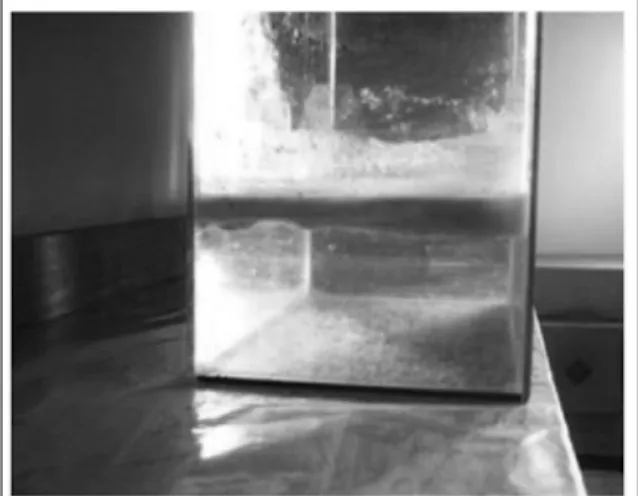
effluent. It was observed predominantly floating
material and some sedimented material after the
effluent has been treated by electrocoagulation; immediately after flotation of material, the treated
effluent was colorless; figure 2 shows an example.
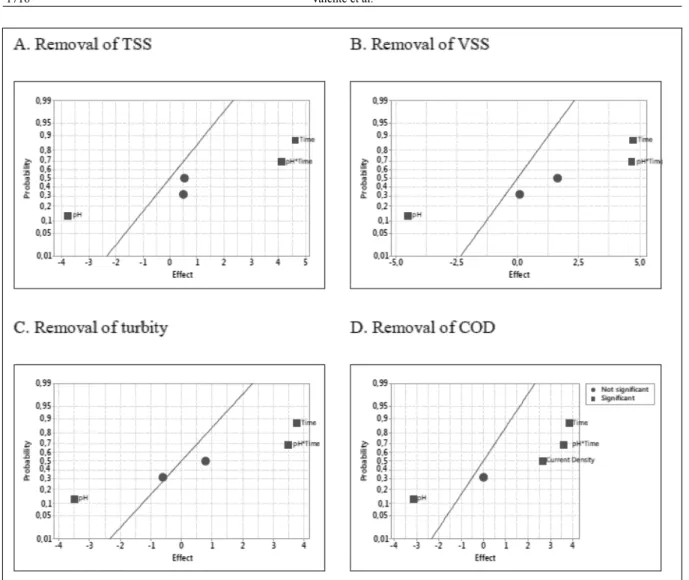
The estimates of the effects represented in the normal probability plot of zero mean and variance
to assess which effects were significant (α=0.05) for all treatments are shown in figure 2.
The application time of the electric current
and pH adjusted was significant for some fractions
of solids, TSS (Figure 2A) and VSS (Figure 2B) and turbidity removal (Figure 2C). The current density
applied was significant in the removal of COD
(Figure 2D). For the other parameters evaluated,
none of the variables were significant. The distance
between electrodes is important for cost, but is also important because of hydrogen bubble distribuition
in the electroflotation process.
Based on these results, it can express the removal of COD as a function of electrolysis time, pH adjusted and current density. The model adjusted
for the removal efficiency of COD is presented in
equation 1:
Z = 76.8 - 10.6 pH - 2.17 t + 0.533 j + 0.447 pH t (1)
Where, Z is the percentage of COD removed, t is time of electric current application, pH is pH adjusted and j is current density. For current density of 61.6A m-2 occurred higher removal of COD.
It is well-known that current not only determines the coagulant dosage rate but also the bubble production
rate and size and the flocs growth. The removal of COD,
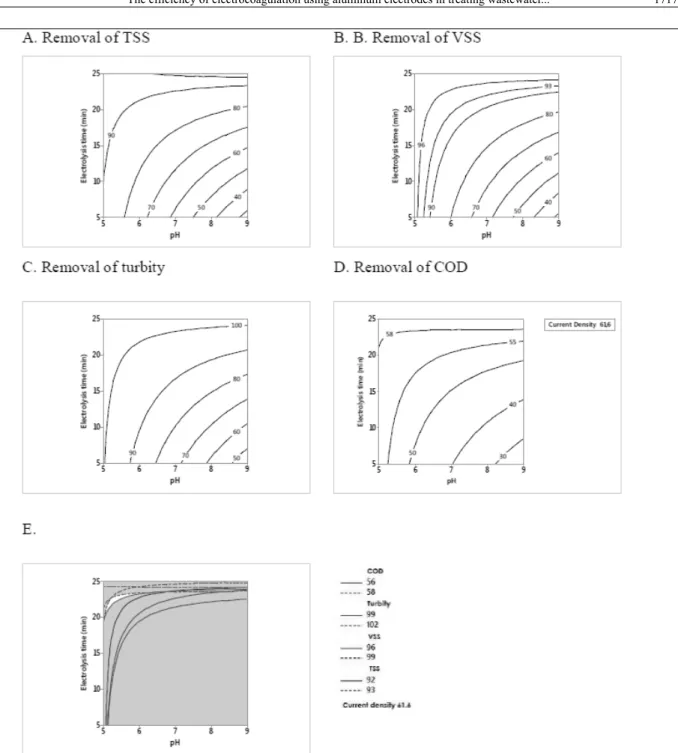
turbidity, TSS and VSS as a function of time and pH adjusted (Figure 3). All controlled parameters showed the same trend (Figures 3A, 3B, 3C and 3D), the treatment
efficiency was higher for pH~5.0 and electrolysis time
of 25 minutes. EC can be considered as an accelerated corrosion process. The rate of reaction will depend on the removal of [H+] via H2 evolution. This reaction will occur fast for low pH values (MORENO-CASILLAS et al., 2007). In addition it was demonstrated that too high pH will increase Al(OH)3 solubility and lead to the formation of soluble AlO2 (ADHOUM & MONSER, 2004). Figure 4 shows contours of removal (%) of TSS, VSS, turbidity, and COD as a function of time (min) and adjusted pH.
An analysis of this response on figure 3E and experiments data made possible to determinate the location of the region optimized.
For pH near 5.0 and electrolysis time upper 21 minutes made possible to remove approximately 57% of COD, 99% of turbity, 97% of VSS and 92.5% of TSS.
The models adjusted for the removal
efficiency of turbidity, TSS and SSV as a function
of time and pH adjusted are presented below in equations 2, 3 and 4:
W = 18.6.1 - 19.61 pH - 3.85 t + 0.811 pH t (2) Y = 205.6 - 21.68 pH - 4.38 t + 0.881 pH t (3) U = 187.9 - 17.56 pH - 3.41 t + 0.703 pH t (4)
Where, W is the percentage of TSS removed, Y is the percentage of VSS removed, U is the percentage of turbity removed, t is time of electric current application and pH is pH adjusted.
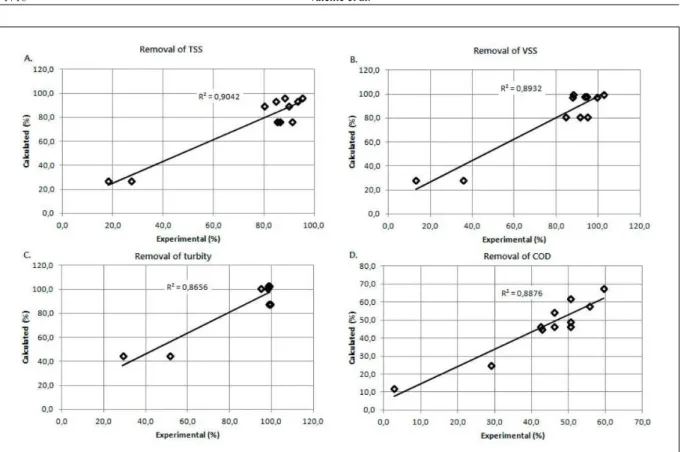
In figure 4, shows a comparison
between the experimental and calculated values using the equations 1, 2, 3 and 4. The data show
that, compared to the experimental results, the equations accurately predicted the treatment efficiency.
The effect on the final pH of the treated effluent as a function of time of electric current application and the adjusted pH of the sample. A final
pH of approximately 10 results from an electrolysis time upper 21min and a sample with an initial pH near 5.0
(Equation 5). Model adjusted for final pH of effluent as
a function of time and initial pH is shown below.
V = -2.02 + 1.42 pH + 0.473 t - 0.051 pH t (5)
Where V is the final pH, pH is the adjusted
pH and t is the electrolysis time.
The rise in the pH of the effluent was also
observed by MORENO-CASILLAS et al. (2007).
The distance between electrodes was not a significant
factor for organic matter removal under the tested conditions. Electrode distance is an important parameter in the operational cost of the treatment plant because reducing the distance between the electrodes reduces the energy required to run the EC reactor and therefore lowers the cost of operation.
The dissolved solids fraction was the most negatively affected fraction using the electrocoagulation process. It is observed reduction of 23.6% in the concentration of TDS, 27.10% and 7.71% in the concentration of SDV and FDS,
respectively. The EC showed low removal efficiency
of TS, VTS, FTS and FSS, on average 35.1; 39.3; 14.5 and 47.6% respectively.
COD reduction was found to be significantly
lower than previously reported by Tchamango et al. (2010) and KUSHWAHA et al. (2010) that used
artificial wastewater l. It was obtained a removal efficiency of 57% of COD in this study, in contrast
to the high value, 98%, obtained by SENGIL & OZACAR (2006) where the suspended solid content
in effluent was high. In the study presented here, the effluent had a high concentration of dissolved
solids, representing 80% of total solids. The removal
efficiency is related to the predominant type of
solid fraction as cited by MORENO-CASILLAS et
al. (2007) and VALENTE et al. (2014). In the case presented here, the predominant fraction of dissolved
solids in the effluent of the dairy plant (approximately 80% of total solids) was not efficiently removed,
while the TSS removal was favored.
Values of the operating cost are calculated based on economic data, electricity (0.33R$ kW-1 h-1), aluminum electrode (5.40R$
kg-1), H
2SO4 (23.00R$ kg
-1) and NaOH (R$ kg-1
30.00). Optimum operating conditions were used for cost calculations show that operating cost is approximately 3.48R$ m-3. The electricity cost and
electrode consumptions corresponding to 69 and 30% of operating cost, respectively.
CONCLUSIONS
According to the obtained results, the following can be concluded: The optimization of parameters for the treatment of dairy industry
effluents, using aluminum electrodes in the process
of electrocoagulation, showed that an electric current applied for 21 minutes, with a sample with an initial pH close to 5.0 and a current density of
61.6A m-2 showed a significant reduction in COD
by 57%; removal of turbidity, total suspended solids
and volatile suspended solids by 99, 92.5, 97%,
respectively. The final pH of treated effluent was
approximately 10. Optimum operating conditions were used for cost calculations that show operating cost of approximately 3.48R$ m-3. Dairy wastewaters are generally treated usually using biological methods such as activated sludge process, aerated lagoons, aerobic bioreactor. Aerobic biological processes are high energy intensive, whereas anaerobic treatment
of dairy wastewater reflects very poor nutrient removal, and effluents treated by anaerobic biological
processes need additional treatment. This study shows that electrocoagulation treatment would be used with biological process. Electrocoagulation treatment for removal of TSS and biological treatment for removal TDS.
ACKNOWLEDGEMENTS
This work was supported by Coordenação de Aperfeiçoamento de Pessoal de Nível Superior (CAPES).
REFERENCES
APHA (AMERICAN PUBLIC HEALTH ASSOCIATION). Standard methods for the examination of water and wastewater. 21.ed. Washington, DC, 2005. 1200p.
BAYRAMOGLU, M. et al. Technical and economic analysis of electrocoagulation for the treatment of poultry slaughterhouse wastewater. Separation and Purification Technology, Philadelphia, v.51, p.404-408, 2006. Available from: <http://www.sciencedirect. com/science/article/pii/S1383586606000724>. Accessed: mar. 11, 2013. doi: 10.1016/j.seppur.2006.03.003.
BAZRAFSHAN, E. et al. Application of electrocoagulation process for dairy wastewater treatment. Journal of Chemistry, New York, v.2013, p.1-8, 2013. Available from: <http://www.hindawi.com/ journals/jchem/2013/640139/>. Accessed: mar. 11, 2013. doi: 10.1155/2013/640139.
MORENO-CASILLAS, H.A. et al. Electrocoagulation mechanism for COD removal. Separation and Purification Technology, Philadelphia, v.56, p.204-211, 2007. Available from: <http:// www.sciencedirect.com/science/article/pii/S1383586607000846>. Accessed: mar. 11, 2013. doi: 10.1016/j.seppur.2007.01.031.
CRESPILHO, F.N. et al. Tratamento de efluente de indústria de processamento de coco utilizando eletroflotação. Química Nova, São Paulo, v.27, n.3, p.387-392, 2004. Available from: <http://www. scielo.br/scielo.php?pid=S0100-40422004000300005&script=sci_ abstract&tlng=pt>. Accessed: mar. 11, 2013. doi: 10.1590/S0100-40422004000300005.
EMAMJOMEH, M.M.; SIVAKUMAR, M. Review of pollutants removed by electrocoagulation and electrocoagulation/flotation
processes. Journal of Environmental Management, Philadelphia, v.90, p.1663-1679, 2009. Available from: <http://www.sciencedirect. com/science/article/pii/S0301479708003617>. Accessed: mar. 11, 2013. doi: 10.1016/j.jenvman.2008.12.011.
GUVEN, G. et al. Electrochemical treatment of simulated beet sugar factory wastewater. Chemical Engineering Journal, Amsterdam, v.151, p.149-159, 2009. Available from: <http://www.sciencedirect. com/science/article/pii/S1385894709001119>. Accessed: mar. 11, 2013. doi: 10.1016/j.cej.2009.02.008.
KUSHWAHA, J.P. Organics removal from dairy wastewater by eletrochemical treatment and residual disposal. Separation and Purification Technology, Philadelphia, v.76, p.198-205, 2010. Available from: <http://www.sciencedirect.com/science/article/pii/ S1383586610003990>. Accessed: mar. 11, 2013. doi: 10.1016/j. seppur.2010.10.008.
MATOS, A.T. et al. Capacidade extratora de plantas em sistemas alagados utilizados no tratamento de águas residuárias de laticínios. Revista Brasileira de Engenharia Agrícola Ambiental, Campina Grande, v.14, p.1311-1317, 2010. Available from: <http://www.scielo.br/scielo.php?script=sci_arttext&pid=S1415-43662010001200009&lng=pt&nrm=iso>. Accessed: mar. 11, 2013. doi: 10.1590/S1415-43662010001200009.
MOLLAH, M.Y.A. et al. Fundamentals, present and future perspectives of electrocoagulation. Journal of Hazardous Materials, Philadelphia, v.114, p.199-210, 2004. Available from: <http://www.sciencedirect.com/science/article/pii/ S0304389404004170>. Accessed: mar. 11, 2013. doi: 10.1016/j. jhazmat.2004.08.009.
SENGIL, I.A.; OZACAR, M. Treatment of dairy wastewaters by electrocoagulation using mild steel electrodes. Journal Hazardous Materials, Philadelphia, v.137, p.1197-1205, 2006. Available from: <http://www.sciencedirect.com/science/article/pii/ S0304389406003463>. Accessed: mar. 11, 2013. doi: 10.1016/j. jhazmat.2006.04.009.
TCHAMANGO, S. et al. Treatment of dairy effluents by electrocoagulation using aluminum electrodes. Science of the Total Environmental, Philadelphia, v.408, p.947-952, 2010. Available from: <http://www.sciencedirect.com/science/article/pii/ S0048969709009693>. Accessed: mar. 11, 2013. doi: 10.1016/j. scitotenv.2009.10.026.
VALENTE, G.F.S. et al. The efficiency of electrocoagulation in treating wastewater from a dairy industry, Part I: iron electrodes. Journal of Environmental Science and Health - Part B: Pesticides, Food Contaminants & Agricultural Wastes, Philadelphia, v.47, p.355-361, 2012. Available from: <http://www. ncbi.nlm.nih.gov/pubmed/22428897>. Accessed: mar. 11, 2013. doi 10.1080/03601234.2012.646174.